Commitment in navigating constraints and enablers in integrating the writing centre as an institutional structure
Abstract
Writing centres in higher education were historically established as remedial support structures for students perceived to have writing deficiencies. Positioned within academic development units or language departments, they were often regarded as add-on services rather than integrated institutional structures. Recent scholarship, however, highlights a shift towards viewing writing centres as collaborative partners in disciplinary writing instruction. Guided by Social Realist Theory, this study explores the enabling and constraining mechanisms affecting the integration of writing centres within universities. A qualitative design using focus group discussions with students, lecturers, and management was employed to gain an in-depth understanding of the research problem. The findings reveal that despite structural changes, underfunding, staff shortages, inadequate resources, and limited infrastructure continue to hinder the institutional integration of writing centres. The study recommends stronger structural and cultural support, alongside increased collaboration with academic departments, to enable stakeholder agency and facilitate the sustainable integration of writing centres within universities.
Constraints; enablers; integrated; structure; writing centre
Introduction
The need for equality in the Higher Education context led to the adoption of the three principles, which include Access and Success, Relevance and Responsiveness, and Transformation and Social Justice by the National Commission on Higher Education (NCHE) of 1996. This structural change was followed by a transformation agenda where institutions of higher learning witnessed the progress from an elite system to a mass system (Msiza, et al., 2020). Consequently, institutions of higher learning had to change their admission requirements to accommodate more students from racial, socio-economic and gender diverse backgrounds (Bazana & Mogotsi, 2017). As a result of this massification of higher education, more access was granted to students who 'previously could not access such privileges' (Adetiba, 2019). Some scholars (Clarence& Dison, 2017; Dison & Moore, 2019) argue that the less stringent access to higher education for historically disadvantaged communities also came with unique reading and writing challenges. This is because most students entering higher education were not exposed to adequate teaching of reading and writing in schools.
The study by Pineteh (2014: 20) confirms that the poor academic writing abilities of students at universities of technology are the result of students' diverse linguistic and overall literacy backgrounds, and their 'attitudes towards academic writing and South African universities'. This raises significant questions about how writing centres have become responsible for addressing the access-success gap, and to what extent this role is institutionally acknowledged and motivated by larger teaching and learning directives. The tension between widening access and ensuring success, therefore, highlights the need to position writing centres as integrated into the teaching and learning project, instead of marginal support structures. To address this problem, writing centres at universities have been established to bridge the articulation gap between the writing abilities of students who have just started their tertiary education and the type of writing expected at the university level. Writing centres emerged through institutional teaching and learning directives aimed at supporting academic literacy and student success, positioning them as integrated rather than peripheral structures within the university.
Previous studies on writing centres focus more on the efficacy, mentoring spaces, success, transformation, and collaboration models, and the misinterpretations of the writing centre services (Collett & Dison, 2019; Sefalane-Nkohla & Mtonjeni, 2019; Yeats, et al., 2010; Zuma, et al., 2016) with little attention given to the integration of writing centres and the factors contributing to their sustainability in universities. The current study focuses specifically on the sustainability of writing centres by examining the enablers and constraints. A more recent shift in the conceptualisation of the role of writing centres requires them to play a more active role in collaborating with lecturers in departments, which will enable the incorporation of academic literacies into disciplinary curricula (Clarence & Dison, 2017; Nichols, 2017). The main research question that this study aims to address is: What is the significance of the responses of institutional systems at CUT framed by structure, culture and agency that enable or constrain the integration of the writing centre?
Research problem
Twenty years after the restructuring of higher education, the challenges faced by writing centres remain mainly because of their peripheral status in assisting students outside of the main curriculum. The status of writing centres as independent and additional to the main teaching and assessment curricula at universities has resulted in their marginalised status at a structural level in the institution. However, the writing centre's effectiveness and validity have been contested since its inception. This is evidenced by their limited resources and inadequate venues, funding, and lack of permanent academic staff. Moore (2023) noted that the recent COVID-19 pandemic was a critical time for the Law Writing Centre at the University of the Witwatersrand which made visible the challenges and risks in higher education. Although much research has been conducted on the services, financial instability, job insecurity and the limited institutional support of writing centres, very little is known about the conditioning mechanisms that either constrain or enable the integration of the writing centre in universities.
The ideal is for writing centres to be adopted by faculties, departments, and schools through the integration of writing support into the core curriculum to ensure collaboration between writing and discipline specialists in the institution (Wingate, 2018). This absorption into faculties will ensure solid collaborations on disciplinary writing conventions, which is an enabler for the writing centre to become an integrated structure, thus ensuring its continuation within the institution.
Context analysis
Boughey and McKenna (2016) believe that the language of academia is a very specialised discourse, and if adequate support is not given, it places all students at a disadvantage, regardless of whether they are first or second language speakers of English. Consequently, students need to be prepared to meet the correct standards of academic writing conventions to succeed at university. To address this language problem at CUT, the Writing Centre was established in 2015. The services rendered are voluntary, and most students will only visit the centre on instruction from a lecturer; accordingly, many students do not take advantage of the support available. It is here that I locate my contribution to the study as the former Writing Centre Coordinator who was appointed in a contract position to establish the Writing Centre to assist students in mastering academic writing skills.
The Writing Centre at CUT is a recipient of government funding from the University Capacity Development Grant (UCDG), which funds different initiatives on a project basis. The need to establish a writing centre has forced CUT management to apply for government funding by submitting a proposal, and after approval, UCDG funding was set aside for the establishment of the writing centre for the duration of the project.
UCDG is an enabling structure, offering an opportunity for universities to develop more systematic strategic methods for the expansion of both teaching and research projects (Moyo, et al., 2021). The UCDG, therefore, acts as an agent of change, enabling universities to start experimental projects and if these projects demonstrate success, they should be integrated into the institution's core budget. Yeats, et al. (2010: 2) and others have urged writing centres to become self-sustaining by operating as financially independent entities with stable funding and resources and being long-term integrated into university programmes and teaching and learning support services with permanent staff. Becoming sustainable is important because disciplines have different values, expectations and ways of thinking and speaking to align writing support with the distinctive literacy practices of each discipline. Sustained writing support, therefore, aligns with specific disciplinary writing practices, assisting students to participate more successfully in their academic communities.
Writing centres function within wider structural and cultural settings that influence their integration within higher education institutions. The structural conditions, such as the different funding models, physical space, resources, staffing, and institutional positioning, shape how writing centres are integrated and continued. The literature analysed in this section, therefore, reflects the structural conditions of the writing centre.
Becoming an integrated structure within universities
Generally, structure refers to the hierarchical order of society, involving social positions, roles, and relationships and the allocation of material goods and resources, which frequently leads to inequalities within society (Francis, 2020). In a writing centre context, structure offers the material resources through which action can take place, thus enabling stakeholders to exercise power by allowing the resource to be applied in a specific way. For Archer (2010), the integration of writing centres into the university means incorporation into the mainstream curriculum and direct engagement with students in the training of academic literacies. Similarly, Manjeya (2021) views the integration at the Durban University of Technology (DUT) as the extent to which the writing centre is integrated into the curricular and academic literacy objectives. Khumalo, et al. (2024) view integration as the collaboration between writing centre staff and academic departments to develop academic research writing for students in a supportive and collaborative learning context. I explain the meaning of an integrated structure from the perspectives of Nichols (2017), who regards it as collaborations mainly achieved between writing centre staff and content lecturers on the incorporation of academic literacies into the discipline's curriculum. For this study, I consider aspects such as permanent staff, university funding, compulsory writing courses, and solid collaboration between writing centre staff and lecturers on disciplinary writing as important elements for the integration of the writing centre as an institutional structure. Nichols (2017) offers detailed descriptions of collaborative strategies between writing centres and disciplinary lecturers (on writing-intensive courses). This study aims to build on this by considering the construct of 'commitment'. The following sections will discuss the aspects that enable or constrain the integration of writing centres.
The impact of funding on the writing centre integration
The demand for universities to be receptive to societal needs means that globally, higher education has developed, shifting from offering education to an elite group to teaching larger numbers of students (Boughey, 2024). Mullin, et al. (2006) noted the challenge of securing a budget as something faced by writing centre directors across university settings, illustrating the financial strains within higher education institutions. This struggle for funding highlights the broader trend of massification in higher education, where universities are tasked with accommodating larger numbers of students. Even a writing centre funded by an English department must 'constantly cobble together a budget' with 'any other money it can beg, borrow, or steal' (Schreiber & Đurić, 2017: 228). Similarly, South African universities are also affected by this shift from an elite education system to massification, offering tuition to the masses and changing the purpose of higher education within a neo-liberal system. The South African higher education policy, directed by the national government, has provided institutions with independence, but it has also established a funding model that determines the source of funding from government and student enrolment income (White Paper, 1997).
The Teaching Development Grant (TDG) from the South African Department of Higher Education and Training (DHET) is considered the most suitable funding avenue (Muna, et al., 2019). This is primarily because its main objective is to systematically enhance the skills of university teaching staff and improve the quality and effectiveness of teaching to improve student learning and success (DHET, 2017). However, the funding allocated by the Department of Higher Education and Training (DHET) via the University Capacity Development Grant (UCDG) to enhance academic writing skills within the institution comes with several funding conditions. When funding is approved, the UCDG funding puts clear monitoring and evaluation conditions in place. These funding bodies often prefer statistical evidence, such as the number of students who visited the writing centre and who attended writing workshops, to ensure the centre's continuation of funding. However, providing quantifiable data is not always possible due to unforeseen occurrences such as ongoing student protests and the recent COVID-19 pandemic. The findings by Lerner (2003) concluded that qualitative evidence is also important because it can offer a rich and nuanced perspective, but he has also called for additional research methods, including quantitative or statistical ones.
The impact of building constraints on the continuation of the writing centre
Globally, the increase in access to universities has put pressure on institutional resources to accommodate the large number of students who have entered universities. The research by Reichelt, et al. (2013) argues that the funding constraints of writing centres are linked to a low prioritisation of literacy education in universities. This explains the precarious existence that threatens their continuation, often characterised by inadequate funding, contracted staff members, a shortage of spaces and venues, and marginalised positions (Dison, et al., 2023) within the institution because their services are not being prioritised. In South Africa, the shortfall of physical structures to host writing centres as an add-on service is also a common phenomenon in universities, as the centres must compete for venues with more important initiatives and mainstream programmes. Research by Boughey (2012) highlights the benefits and challenges in finding dedicated spaces as suitable venues, particularly for smaller departmental writing centres. Given the resource constraints, most writing centres, which are already integrated in the discipline, function out of library study rooms, tutoring rooms, or communal spaces (Arbee & Samuels, 2015; Boughey, 2012).
Muna, et al. (2019) share similar challenges in finding venues for the Writing Lab in 2015 at the University of Cape Town (UCT), as it was temporarily situated in a small office, compelling many 'corridor' and 'stairwell' consultations. The lack of well-resourced writing centres creates the perception that writing centre work is a non-essential service, which explains stakeholders' low level of commitment, as it is portrayed as a temporary, insignificant service.
The impact of limited resources on the sustainability of the writing centre
Although researchers have noted an increase in writing centres in various international English as a Foreign Language (EFL) establishments, these new centres are confronted with the same issues faced by South African writing centres, such as a lack of resources, funding, space, and the need to adjust teaching to local contexts (Broekhoff, 2014; Reichelt, et al., 2013). Simpson, et al. (1994) emphasise the importance of writing centres rethinking their strategies to justify their need for resource allocation within institutions, particularly because they are often in competition with much-needed services, which can contribute to their marginalised position.
Twenty years after the restructuring of higher education, the challenges faced by writing centres remain mainly because of their peripheral status in assisting students outside of the main curriculum. This view is supported by different scholars (Dison & Collett, 2019; Zuma, et al., 2016) who note that writing centres are often marginalised at a structural level in the institution. This is evidenced by their limited resources and inadequate venues, funding, and lack of permanent academic staff. Zuma, et al. (2016) highlight that the general allocation of resources to writing centres is a challenge because it requires justification based on their relevance and ability to achieve objectives.
Nanima (2019) confirms that this is the reason why an online writing centre has not yet been established, and no infrastructure or training exists for it. Although an online writing centre might be beneficial because resources are readily available to students regardless of their location, it might not be ideal due to the challenges in accessing online resources, such as limited internet connectivity.
The impact of the writing centre staff vs student ratio on its sustainability
Early writing centres in North America were often operated by students rather than lecturers, functioning as student-centred literacy communities, which aimed at fostering intellectual growth through literary activities and discussions (Waller, 2002). Contemporary writing instruction might be offered by writing experts who hold lecturing positions like the instructors they collaborate with in courses. Where peer tutors might be employed in a writing centre, they could be mentored and overseen by a writing expert (Bean, 2011). Even though the appointment of students might assist with the disparity between the number of students and staff, if peer tutors are temporarily employed and often waiting to secure permanent positions, the writing centre might be viewed as a non-essential service. This might make it difficult to demonstrate its value.
The transition to a democracy in South Africa led to a 15% increase in staff numbers but did not match the significant increase in student numbers, which jumped from 495 356 in 2014 to 938 201 in 2020 (De Wit, et al., 2015). The significant increase in student participation in HE led to a new demographic profile of academics, with more representation of African academic staff (DHET, 2017). However, a significant number of academic staff from all ethnic groups are in temporary positions, at 65% compared to 35% for permanent positions (CHE, 2018: 47). The diverse student body that entered universities needed more academic assistance to ensure they succeeded at university. Hence, more staff members were employed in contract positions. Despite the supplement of temporary staff in HE, universities struggle to keep up with the significant increase in student numbers, which has led to strained resources and an increasing imbalance in the staff versus student ratio.
Theoretical underpinnings
This study used Archer's theories on Social Realism (SR) (1995, 2003) to contextualise the structural and underlying mechanisms that impact the integration of the writing centre. Social Realist theory provides a more pragmatic view on how to distinguish between what takes place in society that can bring about social change (morphogenesis) and what stays in place to sustain the status quo (morphostasis). Social realism agrees that all different perspectives of reality are valid because people could view the same event in different ways due to their unique backgrounds. These different views on reality are relevant to this study because the writing centre is a social practice that involves students, lecturers, and management who bring their own realities with them, each of which has been constructed over time by different events and experiences. The data will be analysed in relation to three cycles, which commence at T1, which defines the early structural and cultural conditions; T2-T3 highlight what happens over time during the interplay between structure, culture, and agency, and T4 indicates whether changes have taken place or if things have remained the same cycle. In respect of SR, this study uses the concepts of Structure, Culture, and Agency (SCA) to understand the social world. Even though social realism views agency and structure as connected, this study will examine them separately as a tool for analysis for the continuation of the writing centre (Archer, 2003). Given this approach, this study remains cognisant of Archer's (1995, 1996) claims that while each of these concepts can be separately analysed, it is the interplay between culture, agency, and structure that can lead to a significant analysis of social organisation in a structural domain.
When discussing structures from a social realist perspective, it is important to keep in mind the constraints or enablements that can be caused by structures themselves. Although the structural changes have been mainly in the policy framework arena, interpretation and execution of such policies have been slow, difficult, and vague, resulting in strong debates, as 'impressive gains sit alongside old patterns, reproducing themselves both within the higher education sector and in the relations between this sector and society' (Reddy, 2006: 2). The examination of culture from a social realist perspective is concerned with how people include new items into their cultural understanding and shift from how they understood things before. In HE, 'ideas' and 'beliefs' manifest through discourses adopted to view the role and function of the writing centres and those remediation effects that focus on improving 'poor' writers and correcting superficial errors in the belief that such centres aim to produce better writers (Penti, 2007). In social realism, all agents can be changed by their context, depending on whether they possess the power to bring about change in their contexts. The 'agent' refers to a human being, while 'agency' indicates the human's power to function voluntarily and connect psychologically and personally to the duties they fulfil in society (Boughey, 2012). Archer (2000) differentiates between primary agents as individuals who fulfil roles in society that they either did not select such as social class or race (involuntary), or chose (voluntary), such as choosing a specific career and corporate agents who act collectively by engaging with other agents because they have an obligation to contribute towards a common goal by applying corporate power in decision-making (Archer, 2000). This study will analyse how students, lecturers and management respond to the changes or challenges in the university structures and how they exercise their agential powers individually or as a group to ensure the integration of the centre in the institution.
Methodology
Research design
The study employed a qualitative design because qualitative methods are flexible, responsive and offer depth and rich detail, which enables open-ended questions allowing participants to respond as freely and naturally as possible (Fraenkel & Wallen, 2006). This rich contextual data aims to understand the research problem from the perspectives of writing centre stakeholders at the institution by acknowledging their experiences, insights, beliefs, values, and social contexts through powerful verbatim descriptions. This is an explanatory case study research design (Swaraj, 2019) and is a suitable choice for this qualitative study because the research speaks to explanatory questions, which include the 'how' and 'why' of the specific phenomena being studied (Moser & Korstjens, 2018).
Study site
This case study is located in the Central University of Technology, Free State, in central South Africa, mainly serving multilingual and first-generation students from under-resourced schools. Given this background, the institution functions within a context of offering widening access along ongoing historical and structural disparities through targeted academic writing support, making this context suitable for examining how literacy practices are acquired.
Sampling method and sample size
This study employed purposive sampling and consequently ended up with a total of 74 participants who were made up of twenty lecturers, six staff members from management, and forty-eight students. As recommended by McCombes (2023), I have selected the participants because they would be able to grant me access to their roles in facilitating and attaining writing skills. Lecturers and students were chosen because they have accessed the services and/or referred students and collaborated with the writing centre on assessment task design. Members of management were chosen because they form part of forums such as committees or meetings where the existence or integration of the writing centre is discussed. In this study, 'management' refers to institutional leadership structures within the Teaching and Learning Directorate. This includes the Senior Director of the Centre for Innovation in Learning and Teaching (CILT), the Deputy Director for Student Academic Development and Support (SADS), and four Assistant Deans for Teaching and Learning (one per faculty).
Data collection
Data were collected from lecturers by conducting five focus group interviews (four lecturers per group) and eight focus group discussions with students (six students per group). A total of six individual interviews were conducted with management staff online due to their busy schedules. This is a sufficient sample as supported by Mpofu (2020), who argues that a sample should enable the researcher to generate abundant and relevant data to draw relevant and credible conclusions from.
Data analysis
The study utilised thematic analysis as the primary method of analysis because it offers an open and theoretically flexible approach to examining qualitative data (Braun & Clarke, 2006). Drawing on the analysis from a social realist perspective allowed me to move beyond the surface-level explanations of participants' accounts to explore the hidden structural, cultural, and agential mechanisms that shape the integration of the writing centre. While initial coding of the data enabled the identification of main patterns, the analysis moved beyond a descriptive level. The researcher utilised a guidebook for coding and automatic coding through ATLAS.ti 23 software for data analysis by reflecting on all the raw notes that were recorded during the data collection process. Patterns began to surface for themes and were highlighted in the field notes (Smith, et al., 2010), and the audio-recorded data were subsequently transcribed into a written document. After the researcher transcribed and reviewed the interviews from respondents, the data were then carefully analysed through a fully inductive and descriptive process (Shaw, 2010). The evaluation prevents answers from 'being taken out of context or being misinterpreted due to confusion on the researcher's part' (Dias, 2017:53).
Ethical considerations
Before conducting the research, ethical clearance was obtained from the University Ethical Clearance Committee with number H21/09/12 to carry out research with students, lecturers and management. It is important to not only acknowledge institutional approval but also to adhere to those ethical aspects necessary for conducting research responsibly. Although the researcher was previously part of the writing centre, during the study, she had limited contact with the writing centre regarding funding, visits, space, and collaborations because she was no longer employed in that role. This assisted her in reducing the influence of prior relations and the data collection process by minimising the identity struggle between being an insider researcher and an academic. The researcher provided participants with clear information about the study's aim, along with their right to withdraw at any time if they did not feel comfortable with participation (Dias, 2017). Data were recorded without participant identification, such as names and specific job titles; a numbering system was used instead to protect anonymity, and verbatim quotes were used during analysis and reporting.
Findings and discussions
Structural conditioning: findings, analysis and discussions
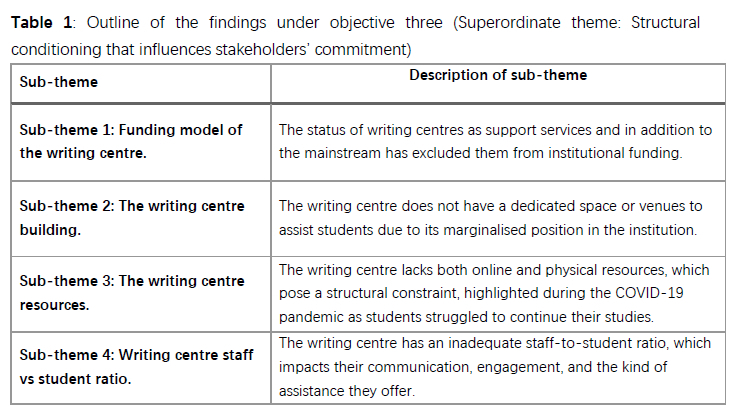
In a writing centre context, structures offer the material resources through which action can take place, enabling stakeholders to exercise power in a way that these resources can be applied. To reiterate, this study aims to assess the commitment of writing centre stakeholders in a university to ensure the centre's integration as an institutional structure. To achieve this aim, this section explains the mechanisms that condition the context for students, lecturers and management. This includes the funding model of the writing centre, a lack of writing centre space and venues resulting in a centralised writing centre building, accessibility of writing centre resources and writing centre staff vs. student ratios (See Table 1 below for themes).
After establishing the challenges linked to external funding for writing centre appointments from the literature, I will now turn to the data to analyse what participants have said regarding the insecurity of external funding.
Sub-theme 1: Funding model of the writing centre
Most staff from management voiced their opinion that the 'soft' and 'temporary' nature of funding was a constraint for the integration of the writing centre as a structure in the institution. From the data analysis, management reveals the need to secure supplementary funding within the institution annually to compensate for the instability and deficit in funds from the UCDG, which is evident in their responses below.
You know there have been some Mancom resolutions that have ensured that we have funding for our writing centre projects and also the opportunity to apply through the Strategic Fund. (Top Management 2)
I think going forward, what we will also do is to start to motivate in terms of operational funds to increase the appointment of writing centre staff. (Top Management 4)
In terms of budgeting at an operational level, this means that writing centre advisors will be funded to keep ensuring that the centre does not completely collapse should we lose DHET funding. (Top Management 4)
For me, that is a positive because it is not coming from our budget; secondly, for me, it is seen as a third-stream income for the university. The only disadvantage is that it poses a risk if they cancel it, but all depends on the functionality and the usefulness of your writing centre and the marketing and yet again the business plan. (Top Management 1)
Only two staff members from management feel that the external funding model is an enabler for the integration of the writing centre. Management 2 confirms the management committee's decision that the writing centre qualifies to apply for the Strategic Fund, a special source of money put aside to strengthen significant projects that assist the university in achieving or improving its long-term objectives. The absence of a sustainable funding model and appointment of staff on contracts reflects the institutional culture at CUT, characterised by the marginalisation of the Writing Centre through the short-term culture. Consequently, the lack of adequate funding does not guarantee job security and accordingly, staff might not be committed to their role because they are always on the lookout for more permanent job opportunities. This leads to potential tension between the need to be significant in the very same university that supports their livelihoods, and the need to prove value-added services to secure ongoing funding (Clarence, 2019).
Three staff members from management interviewed made similar observations on the impact of external funding on writing centre job security.
Because it's externally funded, it literally means that. If DHET were to say we can't fund you anymore, we can't give staff a contract. This means that all of that work, you know, falls through the cracks. It is certainly a threat that we don't have the funds to permanently employ staff, and we actually need more funding. (Top Management 4)
There are budget cuts every year, even next year, there are going to be budget cuts, so people are really looking for other jobs, especially the young people. They want stability. So, if a contract comes to an end next year, then it becomes a problem. (Top Management 3)
I think it's a challenge for every university to see where we can get the funding to sustain writing centre activities, even though it is important. (Top Management 2)
In the case of CUT, all the positions in the writing centre, such as managers, coordinators, administrators and consultants, are temporary and externally funded. This creates the perception that writing centre positions are stepping stones before landing the job they studied for or prefer (Janse van Rensburg, 2023). A full-time employee has the advantage of devoted time for teaching and learning, assessment and other duties bestowed upon them in an academic position. In contrast, when a person is employed on a contract, such a person can only achieve what is possible during the time they have available (Brendan, 2020). Ultimately, the agents' position influences their choice in deciding which things are important to them, what they are responsible for, and the measures they decide to take (Archer, 1995:203).
Although universities must produce other means of income from avenues such as partnerships and research funding, they also need to support students by offering them employment. This gap in funding suggests that management might be less committed to investing in writing centres, particularly because such centres are often perceived as additional to the mainstream academic project and because they do not generate income nor do they directly contribute towards student success. This view was supported by Hlatshwayo (2022), who argues that universities focus more on measurable outcomes based on performance measures such as graduation numbers, research output, and employment placement rates.
The temporary and unstable source of funding of the writing centre reflects the pre-existing structural conditioning (T1), where the writing centre is dependent on external funding to operate and needs to apply for strategic funds to budget for the salaries of writing centre advisors. This gap in funding suggests that management did not exercise their properties and powers to motivate for more funding because such centres are often perceived as additional to the mainstream academic project and because they do not generate income (T2-T3). To continue receiving funding, writing centres need to comply and be in good standing with the external funding bodies to ensure their continuation in the institution. This relates to Archer's (1996) notion of morphostasis, which requires a complementary relationship between the stakeholders (T4). The next section will focus on venues as a constraining aspect for the integration of the writing centre.
Sub-theme 2: The writing centre building
Five participants (three students and two lecturers) identified the writing centre building as a structural constraint. They highlighted the difficulties in locating the writing centre, the shortage of consultation space, and the building's distance from classes and faculty, which demonstrate the inaccessibility of the building. This view was supported by researchers (Allert, 2015; Okuma, 2013) who argued that the location of the writing centre should be easily accessible to students, as it affects the extent to which students use it. The shortfall of suitable venues and the impact of alternative or temporary venues on the writing centre's integration were recurring themes in the responses of five participants.
The writing centre should be more central; like if there is a writing centre in the BHP building, you won't miss it because everyone must pass there. (Student 8)
They call it a centre, but the writing centre staff are in their offices, not attending to you. (Student 20)
If they have rooms in all the buildings dedicated to writing, then you know after class your advisor will be available in the room because it is just next door. (Student 15)
There is no dedicated or adequate space for the writing centre and postgraduate cubicles are being utilised for consultations. Many times, the coordinator must use his office to consult with students or make it available to the consultants to consult with students. This is not ideal at all. (Lecturer 12)
A writing centre is extremely important at a university; it is needed, but it is not positioned correctly, it only has an office to make bookings, and postgraduate cubicles are utilised for consultations. When I think of a centre, I think of a big place. (Lecturer 16)
Students 8 and 15 highlighted that the location of the writing centre is a constraint in the institution and that it should rather be centralised in faculties to be more accessible for students between classes. The centralising of the writing centre space in the building will address the concern raised:
I know about the existence of the writing centre but not the physical location of the building, so I don't know where to send the students to. (Lecturer 8)
We don't even know where they are located. (Lecturer 10)
Student 20 and Lecturers 12 and 16 highlighted the inadequate space occupied by the writing centre, such as utilising cubicles and offices to consult with students and calling it a centre, which can be misleading.
Two staff members from management commented on the need to acquire a dedicated and accessible space to ensure that the writing centre becomes an integrated structure offering specialised educational knowledge in disciplines. Their sentiments (below) align with Muna, et al.'s (2019) perspective on the significance of identifying a dedicated venue for their Writing Lab, which offers a significant training platform for the disciplinary expertise of the curricula.
I think we are now pushing for a physical location. So that it's not a virtual idea, but it's an existing physical structure, and I believe we can only grow from there. (Top Management 4)
For the writing centre, we have now identified a dedicated space through the strategic budget on both campuses. It will be designed in such a way that when students come to the Student Academic Support Centre on the ground floor, they will already see from the branding that this is the writing centre with consulting hours, so they can literally walk in and come and ask for assistance. (Top Management 4)
Yeah, we now have a building where students can come physically for assistance, and that room is big enough to have workshops. We can have workshops and one-on-one consultations. (Top Management 3)
We are going to launch it, so the building is ready, the space is already done on the outside, but we're still working internally, so that's why we haven't really shared. (Top Management 4)
The inability to identify and occupy dedicated and centralised venues reflects the pre-existing structural conditioning, where it is a challenge to obtain permanent fixtures for the writing centre in the institution to provide essential services to students (T1). The two staff members from management (see above) have demonstrated their commitment by ensuring that the writing centre has a dedicated space. Management 4 highlights the point that with the new writing centre space, students do not need to make appointments in advance but can just walk in at any time and request assistance (T2-T3). While this new space might improve accessibility, it also poses a challenge for feasibility. Given the shortfall of writing centre consultants, they might be pressurised to offer quality support without previously accessing students' drafts, possibly limiting detailed feedback. The above suggestion reflects the interplay between structural constraints (staffing, appointments) and agency (the consultant's ability to respond), which work together to enable instant student support while putting strain on writing centre operations.
Their commitment to allocate a permanent dedicated space for the writing centre aligns with Archer's (1995) morphogenetic concept, particularly the idea of agential reflexivity (T4). Archer (1995) believes that management agents can exercise reflexivity by responding to structural conditions that can dynamically impact the social outcomes. In this study, the decision by management reflects that it acknowledges the significant role writing centres play in enhancing students' academic writing and academic literacy capabilities. The response by management contradicts the more common pattern of marginalisation as highlighted in international literature (Reichelt, et al., 2013; Schreiber & Đurić, 2017; Simpson, et al., 1994) and national literature (Dison, et al., 2023; Dison & Collett, 2019; Zuma, et al., 2016) where writing centres are characterised by a shortage of space or venues due to their marginalised position in the institution. Despite the shortfall of venues, both old and recent literature emphasise that writing centres do not need a physical space to operate, which became evident during COVID-19 when many centres were fully operating online (Peacock & Cowan, 2019). Recent studies noted that students prefer the flexibility of online sessions, because it addresses many challenges of access and venues; students can attend writing sessions via Zoom instead of coming to campus, as many students are employed and face challenges with commuting, disabilities, and social anxiety (Worm, 2020; Peacock & Cowan, 2019).
The identification of dedicated venues for the writing centre highlights the agency of management towards achieving institutional integration. This is because their managerial position holds power and influence in the institution, which allows them to make decisions aimed at ensuring the writing centre becomes an integrated structure in the institution. The next section will focus on how stakeholders have exercised their agency by ensuring that the writing centre has the resources to ensure its integration in the institution.
Sub-theme 3: The writing centre resources.
When reflecting on the lack of resources available at the writing centre, four lecturers expressed how the shortfall poses a constraint for mastering academic writing. These lecturers recall similar challenges with accessing online writing centre resources during COVID-19 when students were learning online.
The writing centre does not have enough resources online, such as Grammarly. (Lecturer 6)
There is a lack of resources for students to go through on their own time, like what is referencing again and how do I again reference a PowerPoint presentation or an unpublished thesis. (Lecturer 14)
I was hoping that the writing centre would plan or budget for Grammarly because even though it corrects, you also learn from it. It should be software that they use while at home. (Lecturer 16)
I don't know if it would be part of the department's cost or whose cost, but if they were to provide, like just short basic writing guidelines that could be provided to students to help them improve their academic writing. (Lecturer 15)
They need online training material that is not so heavily dependent on manpower, where there might be a link available where they can access information and not just a once-off. Even a blackboard link or platform. (Lecturer 16)
Lecturer 6 highlights a particular constraint on writing centre resources and identifies Grammarly as a required resource. Highlighting the need to obtain Grammarly also emphasised Lecturer 6's view that the writing centre only focuses on superficial errors, such as fixing grammatical errors in students' writing. Some researchers (Archer & Parker, 2016; Drennan, 2017) have resisted this view of the writing centre as a grammar "fix shop" that students can use to obtain better marks (Archer & Parker, 2016), especially since writing centres do far more than that. The above responses from lecturers contradict the institution's vision for 2030, to be a leading university in technology through innovation. At the same time, these responses also expose a constraint as there are insufficient electronic resources available for students to access supportive, innovative, technology-boosted, student-centred teaching and learning materials.
The response by lecturer 15 reflects the uncertainty regarding institutional responsibility for funding and providing writing support resources, while simultaneously highlighting the perceived value of collaborative academic writing guidelines in supporting student development. Researchers such as Muna, et al. (2019) shared their experiences of developing and presenting a set of academic literacy resources for the Writing Lab at UCT by developing assignment guidelines in collaboration with lecturers to explain the metalanguage and rules of disciplines within the Health Sciences. The design of assignment guidelines supports the response by lecturer 5, who suggested that there is a need to design basic writing guidelines for students to improve their academic writing skills. This collaboration is also supported by Nichols (2017), who argues that lecturers within departments should collaborate with writing centres to develop guidelines for incorporating academic literacies into mainstream curricula.
Two staff members from management at CUT shared their achievements and prospects in developing writing centre resources to ensure that students and lecturers have access to these.
I think what we have done is to shift the load for the academics. We have procured software that the students can use to book their appointments with the writing centre advisors. (Top Management 4)
I think with resources, we can do more. Like I was saying, if we can have somebody dedicated in the faculty focusing on developing disciplinary literacy resources, that could also help us with the work. (Top Management 3)
The writing centre also obtained rights to have access to Turnitin. (Top Management 3)
We are procuring desktops so that we have resources to be able to run students' assignments through Turnitin before they submit them to their lecturers and can give them a similarity report. (Top Management 3)
The above statements reflect the two stakeholders' commitment towards developing resources for the writing centre. However, the belief by management that it is the responsibility of the writing centre to handle Turnitin issues shows that they view the writing centre as a place that checks students' plagiarism instead of a place that assists students in developing their academic writing skills. This shifts the view of writing centres from focusing on learning and development to a place that is responsible for controlling and monitoring. It also poses a cultural constraint where lecturers believe that supporting staff are responsible for teaching students how to avoid plagiarism. This is evident as plagiarism detection programmes are in support units such as the writing centre and the library, alienating students from disciplinary learning, social context, and knowledge production processes (Boughey & McKenna, 2016).
Although online learning offers benefits such as accessibility and flexibility for some students, many CUT students come from disadvantaged communities and may therefore experience it as a structural constraint due to limited access to Wi-Fi connectivity and devices when studying from home. Despite these challenges, the findings indicate that management engages collectively with staff and support units such as the writing centre in addressing student support needs, suggesting emerging collaborative efforts that could strengthen the writing centre's role within broader Teaching and Learning structures. By acting as a group, management demonstrates that it does not make individual decisions but rather works together with staff and support units such as the writing centre, sharing responsibilities and active participation. The above reflects the pre-existing structural conditions (T1), where electronic resources are not developed and are inaccessible to students, making it difficult for students to access online resources or work remotely when they are off campus. Managements 3 and 4 demonstrate their corporate agency by acquiring resources for this writing centre, which includes software to make bookings, desktops and computers, access and plagiarism detection software (T3−T4). This is what Archer (1995) describes as systematic actors who have decision-making power. They exercise their powers through the allocation of resources, restructuring structures, and developing technical infrastructure, which leans towards the morphogenesis of the writing centre (T4).
Sub-theme 4: Writing centre staff vs student ratio.
Six stakeholders, reflecting on their writing centre experience, highlighted the staff-to-student ratio as a constraint when students are trying to obtain the necessary writing assistance. This is evident in the following responses:
Hahaha ...Not enabling at all. ± 20 000 students with only 5 writing centre employees are not logical. (Lecturer 20)
At this moment, it looks like they are totally understaffed, and it feels like it is an effort for students to go to them. (Lecturer 5)
I mean, if 400 students are using the writing centre, obviously, the advisor ratio will not be sufficient. (Top Management 5)
I think we don't have sufficient writing centre advisors for the support that will be needed before the assignment deadline, although students will be assisted, it won't be efficient. (Top Management 4)
For me, it looks like there are only a few staff members, and students don't form a personal relationship with the writing centre staff. (Lecturer 10)
It looks like the number of students who access their services, I would presume that there are not enough staff. (Lecturer 18)
All six stakeholders (four lecturers and two staff from management) confirmed that understaffing in the writing centre causes a constraint against its integration. Lecturer 10 points out that due to the inadequate staff employed, it becomes a constraint for students to establish a relationship with the writing centre staff to assist them during their scholarly journey. Management 4 highlights that although students will get assistance with their writing tasks, the assistance will not be effective, and this might impact the quality of the task. The lack of sufficient writing centre positions is a huge structural constraint that impacts the integration of the writing centre.
Two staff members from management shared similar ideas on addressing the shortage of writing centre staff:
Ideally, support should be offered to smaller groups, but that does not happen. I think you will also recall that when students are about to submit, all of them require assistance. (Top Management 4)
The staff ratio is not enough. I know they do their best what they can with what they have, but if you think of the vastness of this task, they need to change the model and say you know what, we are going to do group sessions and get a couple of students together. (Top Management 2)
The above two staff members from management both proposed smaller group sessions, which do not require as much manpower as individual consultations. In this case, both staff members made suggestions that developed their emergent agential powers by suggesting the restructuring of human resources to transform the situation (Archer, 2000). Their personal emergent powers of adjustment and suggestions were evident in their recommendations, as they are in a position of power to make decisions (T2−T3).
The inadequate number of staff members and the large number of students seeking assistance reflect the pre-existing structural conditioning (T1), where the availability of consultants, communication, engagement, and the kind of assistance offered is at risk. The lack of sufficient writing centre positions is a huge structural constraint that impacts the continuation of the writing centre. However, one staff member from management identified a more positive way of looking at the shortfall of staff at the writing centre:
What helps is that students don't always come, so it looks as if it's quiet; they only come when it's submission time and then you start to feel the pressure. (Management 4)
Four stakeholders suggested that the writing centre should employ more people and allocate them to specific departments to address the constraint in the writing centre. One management highlighted the importance of making the positions of writing centre coordinators permanent.
The writing centre needs more people or staff to be more actively engaged. Perhaps appoint one person to serve three or four different departments and that person is responsible for those departments. (Lecturer 10)
There is definitely a need for increased visibility, more manpower so they can actively serve them, especially services for postgraduate students like the Advanced Diploma who are busy with research modules. (Lecturer 15)
Until the two coordinators, one for Welkom, one for Bloemfontein is not permanent, we cannot guarantee the sustainability of the writing centre. (Lecturer 4)
The lecturers and students' suggestions to employ more staff demonstrate how they can 'act back' on conditioning factors. By making suggestions as a group, both students and lecturers reflect their collective agency, which is based on their shared experience and frustrations of visiting the writing centre when staff are not available to assist. By suggesting the employment of more staff for the writing centre, the students and lecturers, as primary agents, assert themselves as active participants in the process (T2−T3). This aligns with Archer's (2000) idea of an active agent. Management 4 responded that if the two writing centre coordinators' positions are not made permanent, the integration of the writing centre cannot be guaranteed.
Collectively, these findings suggest that the integration of the writing centre is shaped by an ongoing interplay between structural constraints and the agency exercised by institutional stakeholders. Although challenges such as unstable funding, inadequate staffing, inaccessible venues, and limited resources continue to marginalise the writing centre within the institution, the actions of management, lecturers, and students demonstrate growing recognition of its role in supporting academic literacy development. In line with Archer's morphogenetic framework, these interactions illustrate how institutional transformation occurs gradually through the relationship between structure and agency, creating possibilities for the fuller integration of the writing centre within the university's Teaching and Learning project.
Conclusion and recommendations
In conclusion, this study highlighted the structural enablers and constraints that shape the integration of the writing centre within the institution and the different levels of stakeholder commitment towards this process. The findings revealed that issues such as inaccessible physical space, dependence on external funding, high student-to-staff ratios, and limited writing resources continue to constrain the writing centre's ability to function as a fully integrated institutional structure. At the same time, the study demonstrated that the agency exercised by certain members of management in allocating resources, securing funding, and providing operational support reflects an emerging institutional recognition of the writing centre's role in advancing student academic literacy development.
The study therefore recommends that universities in both national and international contexts should prioritise the institutional integration of writing centres through sustainable funding models, permanent staffing structures, accessible physical and virtual spaces, and improved writing support resources. Dedicated writing centre spaces located within faculties and easily accessible to students should be established to improve visibility and participation. Permanent appointments for writing centre coordinators and staff may also help to address high student-to-staff ratios and promote long-term writing development initiatives.
Furthermore, writing centres should expand access to writing support resources by subscribing to electronic tools such as Grammarly and Turnitin, while recognising that the role of the writing centre is not to merely correct grammar or police plagiarism, but to offer developmental support. Writing centres should also collaborate with disciplinary lecturers to develop accessible discipline-specific writing guides, referencing support materials, and academic literacy resources that students can access both on campus and remotely through institutional online learning platforms such as eThuto. More broadly, the findings of this study suggest that universities need to move beyond viewing writing centres as peripheral support units and instead recognise them as strategic partners within the broader Teaching and Learning project of higher education institutions. The fuller integration of writing centres has the potential to contribute not only to student success and academic literacy development but also to institutional transformation, inclusivity, and equitable access to academic participation.
Declaration of generative AI and AI-assisted technologies in the writing process
Grammarly was used for language editing and proofreading to improve clarity and grammar. All the data and interpretations thereof remain the author's own, and the author takes full responsibility for the final submission.
References
Acknowledgements
This article forms part of a larger PhD study titled Assessing the Commitment of Writing Centre Stakeholders at Macro, Meso and Micro Levels: A Social Realist Sustainable Approach, submitted to the Faculty of Humanities, School of Education, University of the Witwatersrand, in 2025. The thesis was supervised by Professors Laura Dison and Ilse Fouché. The author confirms that the content has not been previously published or disseminated and complies with ethical standards for original publication.
Literature review
- Allert, K. 2015. Considering context: The importance of specific institutional and learner contexts when researching the set up of a self-access centre. Studies in Self-Access Learning Journal, 6(2): 231-244.
- Arbee, A. & Samuel, M. A. 2015. The writing centre: A site for discursive dialogue in management studies. South African Journal of Higher Education, 29(5): 48-69.
- Archer, M.S. 1995. Realist Social Theory: The Morphogenetic Approach. Cambridge: Cambridge University Press.
- Archer, M.S. 1996. Culture and agency: The Place of Culture in Social Theory. 2nd ed. Cambridge University Press.
- Archer, M.S. 2000. Being Human: The Problem of Agency. Cambridge: Cambridge University Press.
- Archer, M. S. 2003. Structure, agency and the internal conversation. Cambridge University Press.
- Archer, A. 2010. Challenges and potentials for writing centres in South African tertiary institutions. South African Journal of Higher Education, 24(4): 495-510.
- Archer, A. 2017. Using multimodal pedagogies in writing centres to improve student writing. Stellenbosch Papers in Linguistics Plus, 53: 1-12.
- Adetiba, T.C. 2019. Massification of higher education in South Africa, the good, the bad and the ugly. Proceedings of International Academic Conferences, 9410873. International Institute of Social and Economic Sciences.
- Bazana, S. & Mogotsi, O.P. 2017. Social identities and racial integration in historically White universities: A literature review of the experiences of black students. Transformation in Higher Education, 2: a25.
- Bean, J. 2011. Engaging ideas: The professor's guide to integrating writing, critical thinking, and active learning in the classroom. Jossey-Bass.
- Boughey, C. 2012. The significance of structure, culture and agency in supporting and developing student learning at South African Universities. In Dhunpath, R. & Vithal, R. (Eds.). Alternative Access to Higher Education: Underprepared Students or Underprepared Institutions. London: Pearson, 61-78.
- Boughey C. 2024. What have we been thinking about? Higher education as a knowledge field in the SAJS. South African Journal of Science 120 (Special issue: Celebrating 120 years), Art: 20085.
- Brendan, O.M. 2020. 'Dehumanising' impact of casualisation of HE staff exposed. University World News. Available at: https://www.universityworldnews.com/post.php?story=20200121072332456 (Accessed: 21 January 2020.
- Broekhoff, M. 2014. A tale of two writing centers in Namibia: Lessons for us all. Journal of Academic Writing, 4(1): 66-78.
- Clarence, S. & Dison, L. 2017. Writing Centres in Higher Education. Stellenbosch: African Sun Media.
- Clarence, S. 2019. Exploring the gap between what we say and what we do: Writing centres, 'safety' and 'risk' in higher education. Stellenbosch Papers in Linguistics Plus, 57: 117-131.
- Council on Higher Education CHE. 2016. South African Higher Education Reviewed: Two Decades of Democracy. Council on Higher Education.
- Collett, K.Z. & Dison, A. 2019. Decentering and recentering the writing centre using online feedback: Towards a collaborative model of integrating academic literacies development. Stellenbosch Papers in Linguistics, 57: 79-98.
- Department of Higher Education and Training. 1997. Education White Paper 3: A Programme for the Transformation of Higher Education.
- Department of Higher Education and Training. 2017. Ministerial Statement on the Implementation of the University Capacity Development Programme.
- De Wit, H., Hunter, F., Howard, L. & Egron-Polak, E. 2015. Internationalisation of higher education study. European Parliament's Committee on Culture and Education.
- Dias, P. R. (2017). The experience of low-income college students at a selective University: An interpretative phenomenological analysis [Doctoral dissertation, Northeastern University].
- Dison, L. & Moore, J. 2019. Creating conditions for working collaboratively in discipline-based writing centres at a South African university. Per Linguam: A Journal of Language Learning = Per Linguam: Tydskrif vir Taalaanleer, 35(1): 1-14.
- Dison, A., Oware, P.M. & Maropola, M.K. 2023. This work has paid off in bountiful ways'. development of writing tutors as emerging academics at a South African university writing centre. In Drennan, L. & Rambiritch, A. (Eds.). Reimagining Writing Centre Practices: A South African Perspective. University of Pretoria: ESI Press, 271-297.
- Francis, M. 2020. Global structures of inequality and unequal distribution of wealth. In In: Leal Filho, W., Azul, A., Brandli, L., Özuyar, P., Wall, T. (Eds.). Decent Work and Economic Growth. University of Chester, 1-19.
- Fraenkel, J.R. & Wallen, N.E. 2006. How to Design and Evaluate Research in Education. 6th ed. London: McGraw-Hill.
- Hlatshwayo, A.T. 2022. The role of local economic development in empowering women in rural areas in the city of Mbombela municipality in South Africa. Unpublished Master's dissertation, University of Limpopo.
- Janse van Rensburg, Z. 2023. Writing centre apologetics: A case for writing centre efficacy studies in South African higher education. In Rambiritch, A. & Drennan, L. (Eds.). Reimagining Writing Centre Practices: A South African perspective. University of Pretoria: ESI Press, 101-119.
- Kandenge, E., Dison, D., Kimani, W. & Namakula, H. 2019. Negotiating new ways of developing writing in disciplinary spaces: The changing role of writing consultants at the Wits School of Education Writing Centre. Stellenbosch Papers in Linguistics Plus, 57: 169-182.
- Lerner, N. 2003. Writing centre assessment: Searching for the "Proof" of Our Effectiveness. In Pemberton, M.A. & Kinkead, J. (Eds.). Center Will Hold, Utah: Unversity Press of Colorado 58-73.
- Manjeya, N.C. 2021. The role of a writing centre in a South African University of Technology (UoT). The Independent Journal of Teaching and Learning, 16(2): 148-162.
- McCombes, S. 2023. Sampling Methods: Types, techniques & examples. Scribbr. Available at: https://www.scribbr.com/methodology/sampling-methods/ (Accessed: 22 June 2023).
- Moore, J. 2023. Reflections on risk and resilience: A law school writing centre's learning from the Covid-19 storm. In Drennan, L. & Rambiritch, A. (Eds.). Reimagining Writing Centre Practices: A South African Perspective, 161-194. Pretoria: ESI Press, 161-194.
- Moyo, T. & McKenna S. 2021. Constraints on improving higher education teaching and learning through funding. South African Journal of Science, 117(1/2): 7807.
- Mpofu, S. 2020. Saturation controversy in qualitative research: Complexities and underlying assumptions. A literature review. Cogent Social Sciences, 6: 1838706.
- Mtonjeni, T. Sefalane-Nkohla, P., George, F., & Duke, L. 2023. Being and becoming: Decolonising the Fundani Writing Centre Cosmos. In Drennan, L. & Rambiritch, A. (Eds.). Reimagining Writing Centre Practices: A South African Perspective. University of Pretoria: ESI Press: 23-60.
- Mullin, J., Carino, P., Nelson, J. & Evertz, K. 2006. Administrative (chaos) theory: The politics and practices of writing center location. In Murphy, C. & Stay, B. (Eds.). The Writing Center Director's Resource Book. Lawrence Erlbaum, 225-236.
- Muna, N., Van Pletzen, E. & Hoosen, T.G. 2019. Establishing a health Sciences writing centre in the changing landscape of South African Higher Education. Critical Studies in Teaching and Learning, 7(1): 19-41
- Nanima, R. 2019. From physical to online spaces in the age of the #FeesMustFall protests: A Critical Interpretative Synthesis of writing centres in emergency situations. Stellenbosch Papers in Linguistics Plus, 57: 99-116.
- Nichols, P. 2017. Writing democracy: From writing centres to writing fellows to writing intensive courses in a university-wide writing programme. In Clarence, S. & Dison, L. (Eds.). Writing Centres in Higher Education: Working in and across the Disciplines. Stellenbosch: Sun Press, 35-47.
- Okuma, T. 2013. Understanding student perceptions of the writing center - A conversation between a student, a writing center instructor, and a director/professor. Available from http://writing.wisc.edu/blog/?p=3489 (Accessed: 13 February 2017).
- Peacock, S. & J. Cowan. 2019. Promoting a sense of belonging in online learning communities of inquiry in accredited courses. Online Learning Journal, 23: 67-81.
- Penti, M. (2007). Baylor School Writing Tutor Manual. Available at: http://mail.baylorschool.org/~cowens/writingcenter/Baylor%20School%20Writing%20Tutor%20Manual.pdf (Accessed: 22 June 2023).
- Rambiritch, A. 2018. A social justice approach to providing academic writing support. Educational Research for Social Change, 7(1): 46-60.
- Reddy, T. 2006. Higher education and social transformation in South Africa since the fall of apartheid. Cahiers de la recherche sur l'éducation et les savoirs, 5, 121-145.
- Simpson, J., Braye, S. & Boquet, B. 1994. War, peace, and writing center administration. Composition Studies, 22(1): 65 -95.
- Smith, J. A., Flowers, P. & Larkin, M. 2009. Interpretative phenomenological analysis: Theory, method and research. London: SAGE Publishing.
- Swaraj, A. 2019. Exploratory research: Purpose and process. Parisheelan, XV(2): 666-670.
- Waller, S. C. 2002. The development of writing centers: Variety and diversity. Available at: http://www.newfoundations.com/History/WritingCtr.html (Accessed: 22 June 2023).
- Williams, J.D. & Takaku, S. 2011. Help seeking, self-efficacy, and writing performance among college students. Journal of Writing Research, 3(1): 1-18.
- Wingate, U. 2018. Academic literacy across the curriculum: Towards a collaborative instructional approach. Language Teaching, 51(3): 349-364.
- Worm, A. 2020. Believing in the online writing center. The Writing Center Journal, 38: 231-260.

Accepted: 19 May 2026