
 Marine atmospheric chemistry research on the South African ice-breaker, the R/V SA Agulhas II
Katye AltieriI, II; Shantelle SmithI
IDepartment of Oceanography, University of Cape Town, Private Bag X3, Rondebosch, 7700, South Africa
IIEnergy Research Centre, University of Cape Town, Private Bag X3, Rondebosch, 7700, South Africa,
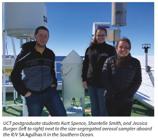
South Africa has a unique geographic advantage that affords regular access to the Southern Ocean, as well as a technical advantage in the Department of Environmental Affairs-owned state-of-the-art ice-breaker, the R/V SAAgulhas II, as an integrated research and training platform. Atmospheric chemistry research in South Africa has the potential to leverage these advantages and make significant contributions to the rapidly integrating Earth systems science (terrestrial-atmospheric-oceanic-ice) and climate change research space.
Recently, a group of University of Cape Town (UCT) postgraduate students studying Oceanography and Atmospheric Sciences had the opportunity to participate in the 58th South African National Antarctic Expedition (SANAE 58) and the international 2019 Weddell Sea Expedition (WSE) (https://weddellseaexpedition.org). The R/V SA Agulhas II left Cape Town on December 6, 2018, voyaged 11 000 km, and returned on March 15, 2019. M.Sc. students Kurt Spence and Shantelle Smith and Ph.D. student Jessica Burger, members of Dr. Katye Altieri's marine atmosphere biogeochemistry research group at UCT, led the atmospheric chemistry research campaign on the ship. Size-segregated aerosol samples were collected daily using a cascade impactor, while an Ambient Ion Monitor-Ion Chromatograph (AIM-IC) system measured hourly gas-phase (ammonia, nitric acid, sulfuric acid) and aerosol-phase (sodium, chloride, nitrate, sulfate, ammonium) concentrations. The students returned with ~220 aerosol filters to extract and analyze, and 600 hours of AIM-IC data to process.
This campaign was just the first of many atmospheric chemistry research opportunities afforded by the R/V SA Agulhas II and the NRF's South African National Antarctic Programme (SANAP). The Southern Ocean Seasonal Experiment (SCALE; www.scale.org.za), funded by the Department of Science and Technology, will take place in 2019 with dedicated science cruises planned for winter and spring, and SANAE 59 is scheduled for the summer of 2019/2020. In addition to Dr. Altieri's research group from UCT, these cruises will include international partners from Plymouth Marine Laboratory and GEOMAR measuring volatile organic compounds, dimethylsulfide, isoprene, and other trace gases. There are opportunities to join the exciting atmospheric chemistry research happening on the R/V SA Agulhas II through SCALE or future research cruises.
Contact Dr. Katye Altieri at UCT (www.solas-int.org) and CATCH (the cryosphere and atmospheric chemistry; www.igacproject.org/activities/CATCH ) for information on summer schools, workshops, and more.
