New records of Lamiaceae (subfamily Nepetoideae) from Central Africa with the description of five new species
Abstract
BACKGROUND: Subfamily Nepetoideae is the last subfamily of Lamiaceae not yet dealt with by the Flore d'Afrique centrale, and many specimens are still unidentified in the collections OBJECTIVES: To prepare the treatment of subfamily Nepetoideae (Coleus excluded) by analysing herbarium specimens METHODS: Herbarium material from BR, BRLU, K and POZG was studied RESULTS: Five species and one variety new to science are described (Equilabium mabwense, Fuerstia upembensis, Ocimum gnidioides, O. hirsutissimum var. para-doxum, Orthosiphon collinus, Plectranthus villosicaulis). Four new synonyms are proposed. A lectotype is designated for Ocimum fimbriatum. Fifteen taxa are reported as new to the Democratic Republic of Congo, two to Rwanda and one to Burundi. New records of rare taxa are also included CONCLUSION: Of the 26 taxa discussed in this note, 20 are found in Haut-Katanga, highlighting the region's significant contribution to the diversity of Lamiaceae subfamily Nepetoideae in Central Africa
Democratic Republic of Congo; distribution; endemism; flora; Haut-Katanga; Labiatae
Introduction
The completion of Lamiaceae for the Flore d'Afrique centrale (the Democratic Republic of Congo (D.R. Congo), Rwanda, Burundi) is on its way, with five subfamilies published so far, namely Premnoideae and Viticoideae (Paton & Meerts 2020), Scutellarioideae and Lamioideae (Meerts 2022) and Ajugoideae (Meerts 2023). Regional treatments of the Lamiaceae have been published for limited parts of that territory i.e., Rwanda (Troupin & Ayobangira 1985), and the Virunga National Park (Robyns 1947), but these are badly outdated. The whole family is now covered by standard floras in neighbouring regions, notably Flora of Tropical East Africa (Paton et al. 2009), Flora Zambesiaca (Paton et al. 2013) and the Flore du Gabon (Paton et al. 2022). The preparation of the treatment of the subfamily Nepetoideae is in progress. Coleus, by far the largest genus of the subfamily (89 species in Central Africa), has been recently revised, including 15 species new to science (Meerts & Paton 2024). In this paper, we deal with the remaining genera. During the revision of the herbarium specimens, a number of taxa new to science have come to our attention, which we publish here. New country records are also reported here, as well as new records for poorly known taxa with restricted distributions.
Materials and methods
The study was conducted in BR, BRLU, K and POZG and is based upon the examination of specimens either collected after the most recent revision of the relevant genus, or more ancient specimens that had remained unidentified so far. Herbarium acronyms are according to Thiers (2021). Other specimens have been retrieved from GBIF (https://www.gbif.org/fr/occurrence/). The nomenclature of accepted species names follows the World Flora Online (https://www.worldfloraonline.org/). The specimens cited are grouped according to the phytogeographic regions following Robyns (1948).
Results
New records for D.R. Congo, Rwanda and Burundi are documented below. These comprise five species and one variety new to science. Fifteen, two and one species are added to the flora of D.R. Congo, Rwanda and Burundi, respectively. Four new synonyms are proposed and one lectotype is designated. Genera are dealt with in alphabetic order.
Endostemon
N.E.Br.Endostemon obtusifolius
(E.Mey.) N.E.Br. in Fl. Cap. [Harvey] 5(1): 296 (1910).TYPES: SOUTH AFRICA, Transkei, Drège s.n. (BM, lecto.!, designated here; K, iso.!).
Plectranthus intrusus Briq. in Bulletin de l'Herbier Boissier, sér. 2, 1: 834 (1901), syn. nov.
Equilabium intrusum (Briq.) Mwany. & A.J.Paton in Phytokeys 129: 117 (2019), syn. nov.
Distribution
Angola, D.R. Congo (new country record), Malawi, Mozambique, Tanzania, South Africa, Zambia, Zimbabwe.
Habitat
Fallow fields, degraded savanna.
Specimens examined
D.R. CONGO, Bas-Congo: Kititi, 1909, Allard 14; Yié, zone Maluku, recru postcultural, 6 Apr. 1976, Breyne 2949 (BR); Yié, zone Maluku, ruderale, 30 Dec. 1976, Breyne 3173 (BR); M'Vuazi, dans un champ, 23 Sept. 1957, Delhaye 247 (BR); Environs de Ndembo, 1898, Gillet s.n. (2 sheets) (BR); Kisantu, 1899, Gillet 194 (BR); Kisantu, 1900, Gillet 662 (BR); Mboso, près de Ngeba (Territ. Madimba), savane, 15 Dec. 1980, Nkunga in Pauwels 6429 (BR); Kimpako, Feb. 1909, Vanderyst s.n.; Makanga, 15 May 1908, Vanderyst s.n. (BR); May-idi, 11 Jan. 1907, Yokolo, Apr. 1933, Vanderyst 39847 (MO, WAG, BR).
Discussion
Plectranthus intrusus Briq. has long been an enigmatic species, supposedly endemic to SW D.R. Congo. It was interpreted by Paton et al. (2019) as belonging in Equilabium. Re-examination of the type material and other collections in BR shows that it is identical to Endostemon obtusifolius. The latter is new to D.R. Congo, but the Congolese localities in Bas-Congo are a short distance from previously known localities in N Angola. All previous records of E. membranaceus (Benth.) Ayob. ex A.J.Paton & Harley in D.R. Congo (except Bequaert 7746) were also incorrect identifications of E. obtusifolius.
Bibliography
Paton et al. (1994, 2013).
Equilabium
Mwany. & A.J.PatonEquilabium candelabriforme
(Launert) Mwany. & A.J.PatonDistribution
D.R. Congo, Namibia, Tanzania, Zambia, Zimbabwe.
Habitat
Savanna.
Specimens examined
D.R. CONGO, Haut-Katanga: Env. de Sakabinda, savane à Acacia, près de la source de la Lufunfu, 9 Apr. 1971, Lisowski 23542 & 23542a (POZG).
Discussion
New country record for D.R. Congo. The new locality is situated a short distance from the nearest localities in Zambia.
Bibliography
Paton et al. (2009, 2013).
Equilabium janthinothryx
(Lebrun & L.Touss.) Mwany. & A.J.PatonDistribution
D.R. Congo, Rwanda (new country record), Uganda.
Habitat
Savanna, scrub, often on shallow rocky soil, termite mounds, fallow fields, at 1 000-2 100 m a.s.l.
Specimens examined (new identifications only)
RWANDA, Lacs Edouard et Kivu: Kisenyi, Mont Kama, 1 580 m a.s.l., fissure de rocher, 10 Aug. 1948, Mullen-ders 2685 (BR). D.R. CONGO, Lacs Edouard et Kivu: Parc National Albert [Virunga], Chana (?) termitière en savane, 11 May 1959, Keremera 396 (BR); Lulinga après de Mabenga (PNA) [Virunga], 1 000 m a.s.l., sa-vane boisée, 12 Mar. 1957, De Witte 14284 (BR); Parc National Albert [Virunga], vallée de la Rwindi (affl. Lac Edouard), rive gauche en aval du pont, 1 020 m a.s.l., galerie à Euphorbia nyakae, 3 Sept. 1956, De Witte 13380 (BR).
Discussion
New country record for Rwanda. E. janthinothryx is very closely related to the east African E. longipes, from which it differs in the slightly longer calyx and pedicel and indumentum of rachis consisting only of very short glandular hairs (< 0.2 mm). E. janthinothryx has a narrow distribution range in eastern D.R. Congo, western Rwanda and southern Uganda, i.e. at the western limit of E. longipes' distribution range.
Bibliography
Robyns (1947), Paton et al. (2009), as Plectranthus janthinothryx.
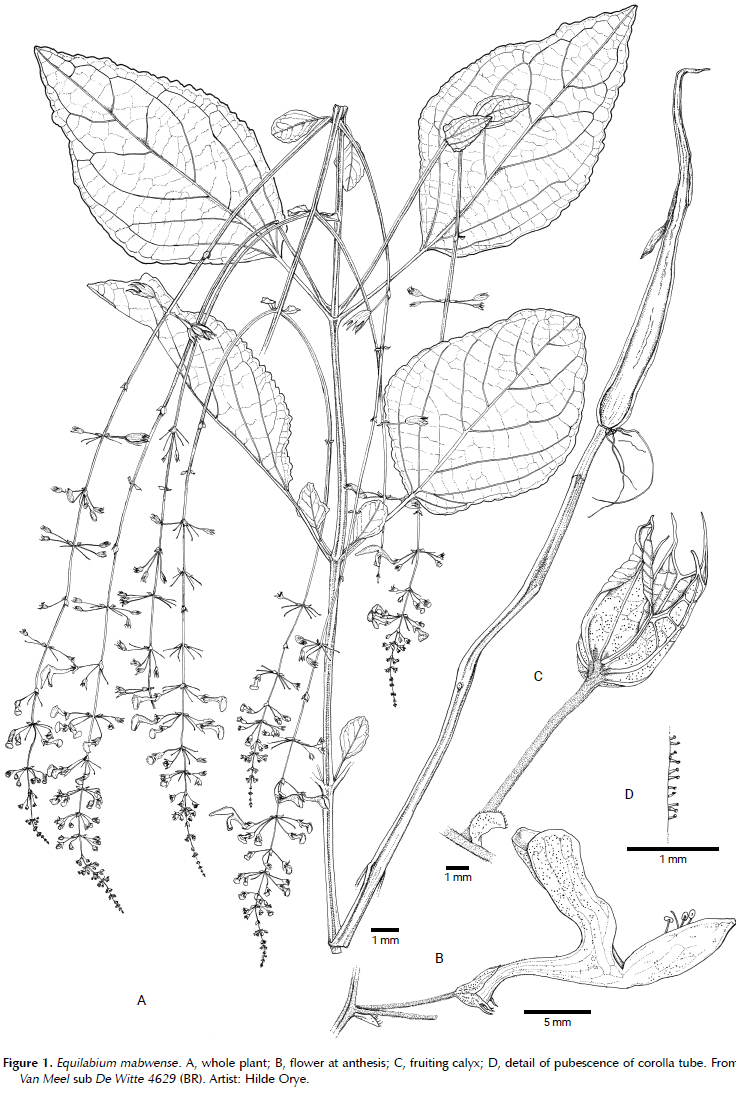
Equilabium mabwense
Meerts & A.J.Paton, sp. nov.TYPES: D.R. CONGO, Haut-Katanga/Bas-Katanga: Upemba National Park, près de Mabwe, sous-bois de forêt katangaise, 18 Nov. 1948, Van Meel sub De Witte 4629 (BR0000017708074, holo!; K, iso.). urn:lsid:ipni.org:names:77351580-1
Relationships
Close to E. viphyense (Brummitt & Seyani) Mwany., Culham & A.J.Paton on account of the vertical tuberous rootstock with annual shoots, the red sessile glands on calyx and corolla, differing in the indumentum of the stem lacking long hairs, the longer petiole, the asymmetric, ovate-elliptic obtusely cuneate (not cordiform) leaf blade, the longer pedicels, the longer corolla; E. stenophyllum (Baker) Mwany. & A.J.Paton has similar vertical, carrot-like tubers but leaves are very different in shape.
Description
Perennial herb ± 80 cm high, with a thickened, vertical, more or less fleshy rootstock; stem erect, fleshy, ± 6 mm in diam. in lower part (in dry material),
shortly pubescent, with retrorse eglandular somewhat curly hairs and orange sessile glands, in the inflorescence only with papilliform (0.1-0.2 mm) glandular hairs, branching in the upper part. Leaves opposite, often with smaller leaves in the axils, the lowermost ones often broader than long, petiole 1.5-7.0 cm, striate, with curly eglandular hairs; lamina ovate-elliptic, elliptic to broadly ovate, very variable in shape on the same shoot, 5.5-14.0 x3.0-7.0 cm, remarkably asymmetric, with the two halves of the same blade of different shapes, base obtusely cuneate, to almost rounded or almost auriculate, apex acute to subobtuse, with 5-6 pairs of secondary veins and many subsidiaries, margin irregularly crenate-serrate, upper surface shortly pubescent and with many red sessile glands (± 15/mm2), lower surface shortly pubescent on venation (retrorse hairs), and with dense red sessile glands (± 30/mm2). Inflorescence broadly paniculate, very lax, of opposite thyrses in the 2-5 upper nodes of the stem, in the axils of foliaceous bracts upwardly decreasing in size, the others in the axils of foliaceous bracts; each thyrse ± 25-35 cm long, very lax, of ± 15 verticils spaced 10-15 mm apart at anthesis, up to 25 mm in fruit; bracts broadly ovate to obovate, ± 1-3 mm long, ciliate, those subtending thyrses up to 7 X 5 mm; rachis with short papilliform mostly glandular hairs (0.1-0.2 mm), and sessile orange glands; cymes subsessile, 2- or 3-flowered; pedicel patent, 6-8 mm at anthesis, up to 9 mm in fruit, papillate and with tiny glandular hairs. Calyx campanulate, ± 3-4 mm long at anthesis, with red sessile glands and papillae, up to 8.5 mm long in fruit, tube slightly curving, upper lobe recurved, decurrent, ovate-elliptic, 3-4 mm long, acute at apex, lateral lobes of lower lip narrowly triangular, subulate, ± 2 mm long, middle lobes of lower lip subulate, ± 3 mm long. Corolla ± 15-20 mm long, colour not observed (collecting note in De Witte 4629: 'violacée très pâle' [very pale purplish]), in herbarium flushed mauve on lower lip, with red sessile glands, tube sigmoid ± 10 mm long, narrowest in the middle, expanding to throat, very shortly papillate-puberulent, upper lip erect, 2-lobed, ± 6-7 mm long, lower lip carinate, ± 6-12 mm long, 2.5 mm deep, hairy within. Fruit not observed. Figure 1, Figure S1.
Etymology
The specific epithet refers to Mabwe, a locality near Lake Upemba, where the species was collected.
Diagnostic characters
A geophyte with a fleshy, carrot-like vertical rhizome, annual shoots, more or less fleshy, asymmetric leaves generally not cordate at base, red sessile glands on calyx and corolla.
Distribution and habitat
E. mabwense is endemic to the northern part of Haut-Katanga near the limit with lower Katanga. It grows in dry tropical woodland (miombo). It has been collected in flower in the rainy season, from November to March.
Conservation status
Conservation status is Data Deficient (DD). It is unclear if the species was collected within the core area of Upemba National Park, which is protected, or in the 'zone annexe' in which human activities are allowed.
Additional specimens examined
D.R. CONGO, Haut-Katanga: Parc national de l'Upemba, près de Mabwe, forêt katangaise, 29 Feb. 1948, Van Meel sub De Witte 4738 (BR); Mabwe, sous-bois de forêt katangaise, terrain sablonneux, 8 Mar. 1949, Van Meel sub De Witte 5824 (BR).
Equilabium masukense
(Baker) Mwany. & A.J.Paton var. masukenseDistribution
Burundi, D.R. Congo (new country record), Kenya, Malawi, Tanzania, Zambia.
Habitat
Rocky outcrops or open areas in dry woodlands (miombo) and grasslands, disturbed ground; at 1 3001 800 m a.s.l.
Specimens examined
D.R. CONGO, Haut-Katanga: Kundelungu, lieu-dit 'La Dalle', 1 450 m a.s.l., lisière de forêt galerie, 18 Feb. 1969, Lisowski, Malaisse & Symoens 2558 (BR). BURUNDI, Kiharo: Mosso, dans une forêt claire à dominance de Berlinia sp., 28 Mar. 1952, Michel & Reed 1504 (BR); Kioffi, Mosso, Forêt de Brachystegia sp., 27 Mar. 1952, Michel & Reed 1581 (BR); Kininya, Mosso, Forêt de Brachystegia, 8 May 1952, Michel & Reed 1872 (BR); Rusengo, Buyogom, 1 700 m a.s.l., ruderale, 17 Apr. 1952, Michel 4002 (BR).
Discussion
New country record for D.R. Congo. Paton et al. (2013) recorded this species in D.R. Congo but the source of this information could not be traced. In Burundi the species was known hitherto from a single collection.
Bibliography
Paton et al. (2009, 2013).
Equilabium parvum
(Oliv.) Mwany. & A.J.PatonDistribution
Burundi, D.R. Congo, Kenya, Malawi, Rwanda (new country record), Tanzania, Uganda, Zambia.
Habitat
Swamp savannas, fallow fields, tree plantations, degraded woodland and forest; at 1 200-2 900 m a.s.l.
Specimen examined (Rwanda only)
RWANDA, Lacs Edouard et Kivu: Route Cyangugu-Butare, à 6 km de Cyangugu, 1 700 m a.s.l., bord de route dans une zone habitée, 19 Jan. 1971, Bouxin 9 (BR).
Discussion
New country record for Rwanda. The new record in Rwanda represents one of the westernmost localities of E. parvum, an east African species.
Bibliography
Paton et al. (2009).
Equilabium pulcherrimum
(A.J.Paton) Mwany. & A.J.PatonDistribution
S D.R. Congo (new country record), N Zambia.
Habitat
Savanna.
Specimens examined
D.R. CONGO, Haut-Katanga: Env. Kolwezi, près du village Muilu, pente rocheuse, 8 Apr. 1971, Lisowski
23313 (POZG); Plateau de la Manika, poste sud Musokatanda, 40 km SW de Kolwezi, 10°53'S, 25°05'E, forêt claire pâturée, 1 400 m a.s.l., 17 Feb. 1982, Malaisse & Robbrecht 2356 (BR); 47 km WSW de Kolwezi, 1 340 m a.s.l., rudéral, bord de piste en zone de forêt claire, 14 Mar. 1983, Schaijes 1889 (BR).
Discussion
New country record for D.R. Congo. The last two specimens were hitherto misidentified as Coleus schizophyllus (Meerts & Paton 2024). All Congolese collections are situated in the region of Kolwezi, ± 100-150 km NE of the type locality (Kalene hill, Zambia). The region is subject to rapidly increasing human settlement and disturbance of natural vegetation.
Bibliography
Paton et al. (2013).
Equilabium stolzii
(Gilli) Mwany. & A.J.PatonDistribution
D.R. Congo (new country record), Malawi, Tanzania.
Habitat
Wet savanna, marshland, springs.
Specimens examined
D.R. CONGO, Haut-Katanga: Marungu, Kasiki, 20-27 Jun. 1931, De Witte 493bis [BR0000016835351] (BR); Marungu, Kipiri, bosquet bordant une rivière dans un vallon encaissé, Jun. 1957, Duvigneaud 3714C1 (BRLU); Marungu, Kasiki, tête de source de la Bwasoa, formation marécageuse à Kotschya, 27 Jun. 1957, Du-vigneaud 3733C (BRLU); Marungu, rivière Mobolozi, 27 Jun. 1957, Duvigneaud 3734 (BRLU); Marungu, tête de source de la Kapangala, cirque boisé à Lobelia, 27 Jun. 1957, Duvigneaud 3740C (BRLU); Marungu, 1940, Jurion 267 (BR).
Discussion
New country record for D.R. Congo. All collections are situated in the Marungu massif, a region with Afromontane vegetation and with phytogeographic affinity with eastern Africa. The species distribution range is relatively restricted stretching from Lake Malawi to Marungu. The gathering De Witte 493 consists of two sheets i.e., [BR0000016835344] which is Coleus marunguensis Meerts & A.J.Paton (Meerts & Paton 2024), and [BR0000016835351] which is Equilabium stolzii; the latter was renumbered by us as 'De Witte 493bis'.
Bibliography
Paton et al. (2009, 2013).
Fuerstia
T.C.E.Fr.Fuerstia angustifolia
G.TaylorDistribution
Angola, D.R. Congo (new country record), Malawi, Tanzania, Zambia.
Habitat
Steppic savanna, dry woodlands, dambos, often on sandy soil; at 1 000-1 400 m a.s.l.
Specimens examined
D.R. CONGO, Haut-Katanga: 2 km S of Mofya, Ferme Servranckx, Duvigneaud 3470 (BRLU); Biano-hôtel, savane arborée de pente sur sable profond, 8 Dec. 1959, Duvigneaud 4455 (BRLU); Biano-hôtel, Duvigneaud 4459 (BRLU); 33 km S of Kolwezi, forêt claire de pente, 16 Dec. 1959, Duvigneaud 4605 (BRLU); Entre Pande et Kakonge, forêt sur macigno, à Brachystegia bussei, Duvigneaud 4775 (BRLU); Forêt claire riche en Monotes, 27 Dec. 1959, Duvigneaud 4788 (BRLU); Fungurume, savane steppique cuprifère, Malaisse, Kisimba & Saad 1013 (BRLU); Fungurume, colline XII, sur la route vers Kwatebala, 16 Dec. 2007, Senterre, Handjila & Semereab 4879 (BR).
Discussion
New country record for D.R. Congo.
Bibliography
Paton et al. (2013).
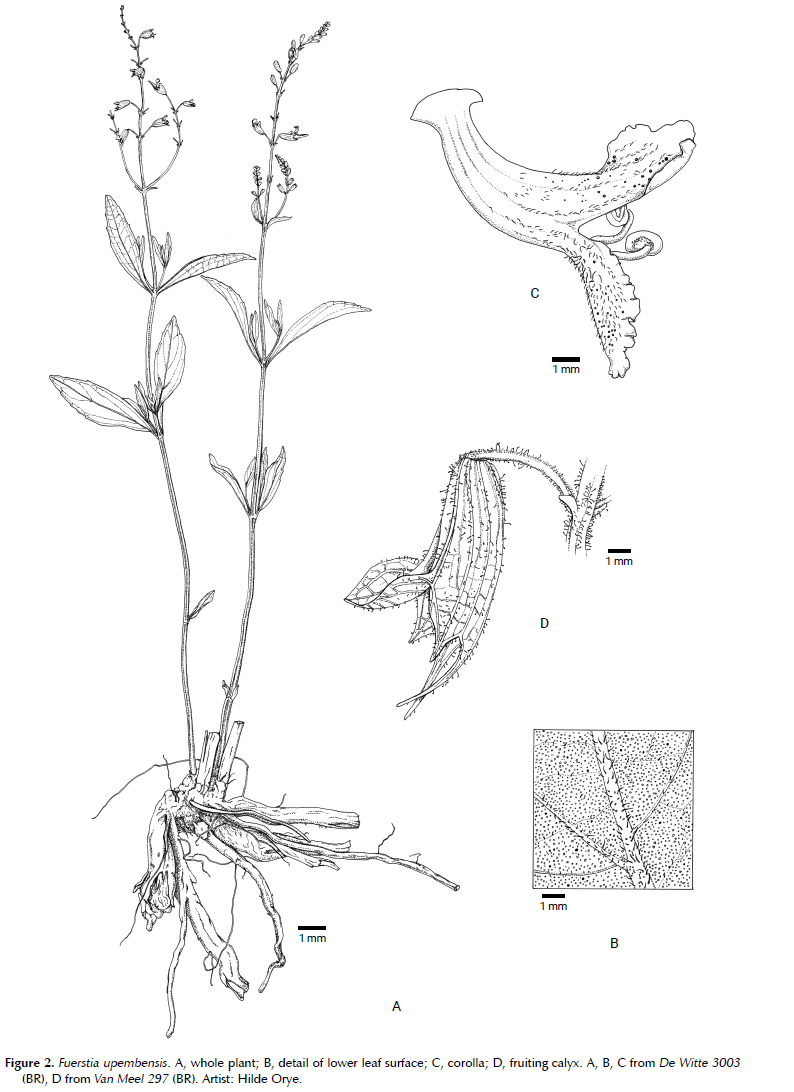
Fuerstia upembensis
Meerts & A.J.Paton, sp. nov.TYPES: D.R. CONGO, Haut-Katanga, Upemba National Park, Kaswabilenga, rive droite de la Lufira, [08°81'S, 26°43'E], 700 m a.s.l., forêt claire, 23 Oct. 1947, De Witte 3003 (BR0000017708005, holo!; K iso.). urn:lsid:ipni.org:names:77351581-1
Relationships
Similar to three Angolan species with opposite leaves and 2-flowered verticils i.e., F. adpressa A.J.Paton, F. rara G.Taylor and F. rigida (Benth.) A.J.Paton, the last two also having thickened rhizomes, differing from all of these in having greenish white corolla (vs purplish), from F. adpressa in having ascending-patent leaves (vs erect, appressed on stem), from F. rigida in having fewer leaves without glandular hairs, and from F. rara in having conspicuous glands on leaves.
Description
Geophytic perennial herb, with tufted shoots, often with remains of burnt stems at base, ± 30-60 cm high; rootstock of 1 to several woody ± horizontal rhizomes ± 5-10 mm thick. Stem erect, unbranched, with 3-5 nodes under the inflorescence, quadrangular, striate, shortly pubescent, with patent to slightly recurved mostly eglandular hairs of different lengths, and pale sessile glands, in the inflorescence glandular hairs abruptly more abundant. Leaves opposite, more rarely ternate, ascending to patent, often outwardly falcate, often with young shoots in the axils, 3-6 pairs to a stem, the lowermost pair much reduced; petiole 0-1 mm; blade flat to folded along midrib, narrowly elliptic to narrowly ovate- to obovate-elliptic, 15-75 X 4-22 mm, base cuneate to attenuate, apex acute, margin entire to somewhat crenate-serrulate distally, very narrowly recurved, shortly ciliate, dull and with sparse erect ± 0.3 mm long eglandular hairs on upper surface, very shortly hispidulous with antrorse hairs on lower surface of veins, glabrescent, glandular punctate on both surfaces, with 4 or 5 secondary veins on either side, diverging at an acute angle, reticulum becoming more or less prominent on ageing. Inflorescence unbranched or, more often, with a pair of ascending basal branches, 6-12 cm long, lax, with 10 to 15 verticils spaced 1-13 mm apart; bracts subtending pedicels narrowly ovate-elliptic, acute, 1.0-2.5 mm long, up to 10 mm long under the lowermost branched node; cymes 1-flowered, pedicel ascending, 2-3 mm at anthesis, elongating to 5 mm, with dense glandular and eglandular hairs and sessile glands. Calyx pale green, patent at anthesis, then downwardly pointing, tubular, ± 5-6 mm long at anthesis, with dense eglandular and glandular hairs and pale sessile glands, upper lobe ovate-triangular, ± 1 mm long, recurving, lateral lobes triangular, acuminate, ± 0.8 mm long, lower lobes filiform, ± 0.8 mm long; fruiting calyx ± 12 mm long. Corolla greenish white, 8-11 mm long, tube 4-5 mm long, upper lip 3-6 mm long, recurving, lower lip ± 3-6 mm long, horizontal. Two fertile stamens, 2 staminodes. Fruit not observed. Figure 2, Figure S2.
Etymology
The specific epithet refers to Upemba National Park, where the species was collected.
Diagnostic characters
A perennial herb with annual shoots, thick woody rhizomes, 3-5 pairs of opposite leaves, leaf blade ascending to patent, with sessile glands and without glandular hairs, 2-flowered verticils, and greenish white corolla.
Distribution and habitat
Endemic of D.R. Congo, Haut-Katanga; dry woodlands (miombo) and savanna, often in frequently burnt places.
Conservation status
Probably Least Concern (LC); even though the species is known from only five localities, two of these are situated within a protected area.
Additional specimens examined
D.R. CONGO, Haut-Katanga: Domaine de Muhila (Kansimba), forêt claire, près de la grand route, après la traversée de la rivière Konko, 28 Sept. 1970, Bulaimu 173 (POZG-V-0072867); Plateau de Muhila, près du village Baton, savane, 1 350 m a.s.l., 6 Nov. 1970, Lisowski 23700 (POZG-V-0072107); Parc national de l'Upemba, entre Kabenga et Kasiba, 1 250 m a.s.l., lambeau de forêt katangaise récemment incendié, 18 May 1949, Van Meel sub De Witte 6379 (BR); Tembwe (baie) [near Moba], colline rocheuse, 19 Dec. 1946, Van Meel 297 (BR).
Note
The specimen Lukuesa 538 (BR, BRLU) (Mitwaba, Plateau des Kibara, Steppe, à l'W. de la route Jadot-ville-Manono, près de la source de la Musundu, 19 Oct. 1958) most likely belongs here, differing in the shorter leaves, with yellow sessile glands on both sides.
Bibliography
Taylor (1932), Paton (1994).
Isodon
(Benth.) Schrad. ex SpachIsodon schimperi
(Vatke) J.K.MortonDistribution
Burundi, D.R. Congo (new country record), Ethiopia, Rwanda, South Sudan, Uganda.
Habitat
Montane forest edges, bushland, grassland, by rivers and swamps; at 1 050-2 850 m a.s.l.
Specimens examined (new identifications only)
D.R. CONGO, Lac Albert: Mont Dra, Blukwa, sous bois, 13 Oct. 1937, Gilbert 553 (BR). Lacs Edouard et Kivu: Entre Butembo et Lubero par Katwa, 23 km, jachère, 11 Oct. 1974, Baudet 630 (BR); Bwito, Kihondo, 1 650 m a.s.l., 25 Mar. 1954, Deru 116 (BR); Kirorirwe [Kirorerwa], forêt à Acanthus, 9 Mar. 1934, De Witte 1447 (BR); Bisoke, riv. Susa, 2 400-2 600 m a.s.l., forêt de amboo, 2 Feb. 1935, De Witte 2211 (BR); Env. De Kiandolili, le long de la piste Mutwanga-Kalonge, 1 800 m a.s.l., forêt ombrophile, 11 Oct. 1952, Frédéricq sub de Witte 8257 (BR, WAG); Parc national Albert [Virunga], Rumangabo, 1958, Donis 3970, 4084 (BR); Territ. Masisi, Bukombo, entre cultures et savanes à Pennisetum, 1 420 m a.s.l., 29 Apr. 1957, Gutzwiller 826 (BR); Territ. Walikale, Ibusha, Mutongo, 1 050 m a.s.l., 12 May 1958, Gutzwiller 2886 (BR); Bukombo (zone Masisi), 1 300 m a.s.l., savane à Pennisetum, 8 Mar. 1958, Gutzwiller3522 (WAG); Ouest du lac Kivu, 2 000 m a.s.l., 1929, Humbert 7803 (BR); Volcan Ninagongo [Nyiragongo], 2 000-2 200 m a.s.l., 1929, Humbert 7940 (BR); Mushumangabo, 2 075 m a.s.l., forêt, Aug. 1937, Lebrun 7136 (BR, K); Versant sud du Mikeno, 2 400-2 600 m a.s.l., étage des bambous et de la forêt mixte, Aug. 1937, Lebrun 7297 (BR, K); Parc national des Virunga, Ruwenzori, entre Mutwanga et le gite de Kalonge, 1 400-1 700 m a.s.l., jachère à Pennisetum purpureum, 28 Dec. 1977, Lejoly 2272 (BR); Parc national Albert [Virunga], flanc NW du volcan Karisimbi, 2 400-2 800 m a.s.l., étage des bambous et forêt mixte, 17 Aug. 1937, Louis 5255 (BR, K); Territ. Rutshuru, Parc National des Virunga, Kibumba, forêt secondaire, Jun. 2009, Mangambu 2068 (BR); West Ridge of Lamia, 2 300 ft [700 m a.s.l.], 5 Aug. 1952, Osmaston 1951 (BR); Territ. Kabare, Kahuzi, forêt de montagne, 20 Jul. 1976, Pauwels 5642 (BR); Ruamoli valley, 8 600 ft [2 620 m a.s.l.], gulley, bamboo forest, 5 Aug. 1952, Ross 843 (BR); Tshibinda, Kivu, 1929, Scaetta 1228 (BR); Tshifunzi, 1928, Scaetta 695 (BR); Entre Karoba et Mofumo, 1 900-2 100 m a.s.l., 1928, Scaetta 848 (BR); Nord Kivu, Virunga, Kibati, 1 900 m a.s.l., südliches Lavavorland der Westgruppe, im Busch, 30 Sept. 1954, Stauffer 547 (BR, K); Katana, 1932, Vanden Hout 425 (BR).
Discussion
New country record for D.R. Congo. I. schimperi occurs in the mountains of NE Africa from Ethiopia southwards to Burundi. It had not been formally reported from D.R. Congo so far. It is closely related to the widespread I. ramosissimus (Hook.f.) Codd with which it has often been confused, e.g. by Troupin and Ayobangira (1985) in the Flore du Rwanda [see Polhill (2009) for a discussion of the distinction of the two species]. The examination of material of Isodon from D.R. Congo has shown that I. schimperi is widespread in the mountains of N Kivu.
Bibliography
Robyns (1947), Troupin & Ayobangira (1985), Polhill (2009).
Ocimum
L.Ocimum amicorum
A.J.PatonDistribution
D.R. Congo (new country record), Tanzania.
Habitat
Clearings in miombo woodland and savanna, often on moist soil.
Specimens examined
D.R. CONGO, Haut-Katanga: Dikulushi, 1 000 m a.s.l., clairière de forêt claire, 25 Oct. 1980, Malaisse 11145 (BR); Upemba, près de la tête de source de la Ziveba (?), 1 680 m a.s.l., terrain marécageux en pente de 30°, 24 Aug. 1949, Van Meel sub De Witte 7510 (BR).
Discussion
New country record for D.R. Congo. O. amicorum was known hitherto from a relatively narrow range in SW Tanzania (Ufipa District). Newly identified materials from D.R. Congo extend the species' range ± 750 km to the west.
Bibliography
Paton et al. (2009).
Ocimum angustifolium
Benth.Distribution
Angola, Botswana, D.R. Congo (new country record), Kenya, Malawi, Mozambique, South Africa, Tanzania, Zambia, Zimbabwe.
Habitat
Steppic savanna, sometimes on moist soil, at 1 2001 700 m a.s.l.
Specimens examined
D.R. CONGO, Haut-Katanga: Marungu, section de Mulongoshi, 1 700 m a.s.l., Nov. 1945, Quarré 7213 (BR); Territ. Jadotville [Likasi], Busumba, 90 km NE de E'ville [Lubumbashi], 1 278 m a.s.l., 28 Sept. 1957, De Caters 131 (BR); Haut-Shaba [Haut-Katanga], Domaine de Muhia [Muhila], Mont Kiseye, 1 700 m a.s.l., 7 Nov. 1970, Lisowski 23323 (POZG, 7 sheets).
Discussion
New country record for D.R. Congo. Ocimum angustifolium is an east African species, broadly distributed from Kenya southwards to South Africa (northern provinces). Three specimens from D.R. Congo (Haut-Katanga) have been recently identified. Other specimens filed as O. angustifolium in POZG are errors for narrow-leaved forms of O. obovatum E.Mey. ex Benth. [e.g. Lisowski 23267 (POZG)].
Bibliography
Sebald (1989), Paton (1995), Paton et al. (2009).
Ocimum dambicola
A.J.PatonDistribution
Burundi (new country record), D.R. Congo (new country record), Malawi, Tanzania, Zambia.
Habitat
Savanna.
Specimens examined
D.R. CONGO, Ubangi-Uele: Tukpwo, savane, 22 Oct. 1954, Gérard 1602 (BR). BURUNDI, Kininya Mosso, savane à Loudetia arundinacea, 12 Jun. 1952, Michel 2786 (BR): Mosso, Ruyigi, savane légèrement boisée, 11 Oct. 1951, Michel & Reed 534 (BR).
Discussion
New country record for Burundi and D.R. Congo. The new localities in Burundi are situated at short distance from the previously known localities in N Tanzania; the new locality in NE D.R. Congo is disjunct.
Bibliography
Paton (1995, as Becium obovatum subsp. punctatum), Paton et al. (2009, 2013).
Ocimum fimbriatum
Briq. var. fimbriatumTYPES: ANGOLA, Mechow 165 (B, holo., destroyed; BR0000006249465, lectotype designated here).
Clerodendrum sessilifolium Moldenke in Phytologia 4: 289 (1953), syn. nov.
Ocimum glabrifolium var. sapinii De Wild. in Annales de la Société scientifique de Bruxelles 41: 20 (1921), syn. nov.
Distribution
Angola, Burundi, D.R. Congo, Malawi, Mozambique, Tanzania, Zambia, Zimbabwe.
Habitat
Dry deciduous woodland, savanna, at 9002 100 m a.s.l.
Specimens examined
D.R. CONGO, Haut-Katanga: Nikondama [Bikondama?], Oct. 1911, Hocks.n. (BR [BR0000008978585]); Bukama, 5 Jun. 1911, Bequaert ΊΊΊ (BR); Sankisia, 24 Sept. 1911, Bequaert 212 (BR); Nasondoye, forêt mulu [muhulu] sur Kalahari, 11 Dec. 1959, Duvigneaud 4514Be (BRLU); Dilolo, Jun. 1908, Sapin s.n. (BR [BR0000005570942] & [BR0000005570959]); Pare national de l'Upemba, entre Kabenga et Kaziba, lambeau de forêt katangaise récemment incendiée, 1 250 m a.s.l., 18 May 1949, Van Meel sub De Witte 6382 (BR); Environs de Lubudi, 1937, Cabu 112 (BR); Fungurume, colline 5, petite zone d'affleurement cuprifère entourée d'une savane arborée basse, 6 Dec. 2007, Senterre, Handjila & Semereab 4779 (BR).
Discussion
Clerodendrum sessilifolium has long been an enigmatic species, known only from the type specimen. During our revision of Clerodendrum for Central Africa (Meerts 2022), we have re-examined that material. The specimen has very few flowers, but bowl-shaped sessile glands are conspicuous in the inflorescence, thus pointing to Ocimum. Calyx shape, with fimbriate lateral teeth, separated from lower teeth by a sinus, points to O. fimbriatum. This is a most polymorphic species for leaf shape and size, and several varieties have been described. Hock s.n. (type specimen of C. sessilifolium) and Sapin s.n. (type specimen of O. glabrifolium var. sapinii) are remarkable in having larger leaves, with blade more ovate than usual for O. fimbriatum subsp. fimbriatum; however, variation is continuous and we consider these names as synonyms of O. fimbriatum var. fimbriatum. O. fimbriatum var. bequaertii (De Wild.) A.J.Paton also has broad leaves, but they are distinctly petiolate. Such broad-leaved morphs appear to be more frequent in W Katanga compared to the rest of the distribution range.
Bibliography
Sebald (1988), Paton (1995), Paton et al. (2009, 2013).
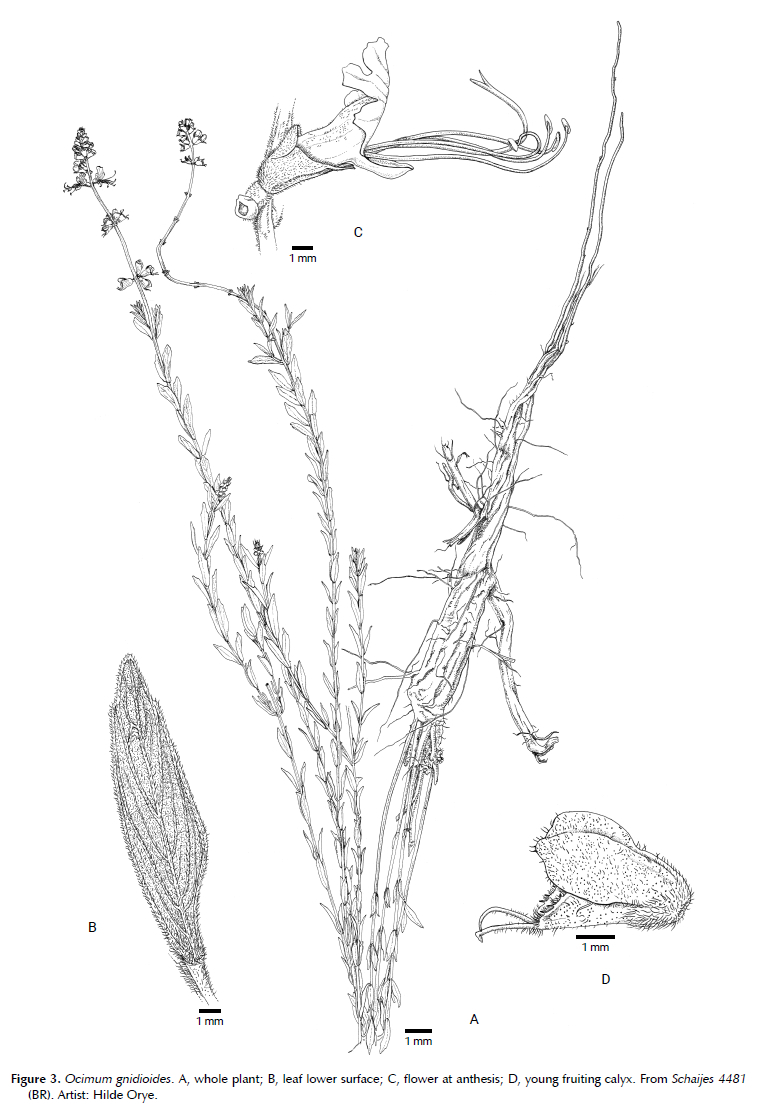
Ocimum gnidioides
Meerts & A.J.Paton, sp. nov.TYPE: D.R. CONGO, Haut-Katanga, entre les 2ème et 3ème rivières sur la piste du détournement de la piste Kolwezi-Musokantanda, 10°48'12"S, 25°19'28"E, 1 454 m a.s.l., 21 Oct. 1989, forêt claire à petits arbres, Schaijes 4481 (BR0000017713641, holo!). urn:lsid:ipni.org:names:77351582-1
Relationships
Superficially similar to O. ericoides (P.A.Duvign. & Plancke) A.J.Paton on account of the small leaves, differing in lack of fascicles of leaves in the axils, the leaves tightly appressed onto the stem (O. ericoides: becoming patent to reflexed), the leaf blade pubescent on both surfaces (O. ericoides: subglabrous), the margin often with a tooth on either side (O. ericoides: margin entire), the reticulum slightly prominent on both surfaces, thickened leaf margin, and the pale mauve corolla with darker stripes (O. ericoides: cream-coloured without stripes).
Description
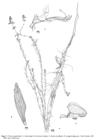
Perennial geophyte, up to 50 cm high, with tufted annual shoots on a thickened, vertical woody rhizome. Stem erect, more or less virgate, quadrangular, ± 1.5 mm thick in lower part, pubescent, with patent eglandular hairs 0.25-0.50 mm, and sessile glands, unbranched or sparingly branched, internodes ± 10 mm. Leaves up to 35 pairs to a stem, opposite, sessile, erect, without fascicles of young leaves in the axils; lamina more or less coriaceous, narrowly elliptic, obovateelliptic or ovate-elliptic, 8-15 x 2-4 mm, base cuneate to almost rounded, apex acute to obtuse, flat or more often gutter-shaped, margin thickened by a submarginal vein, entire or often distally with 1 or 2 teeth on either side, 3-5 secondary veins on either side, diverging at a narrow angle, venation slightly prominent on both surfaces (in herbarium), pubescent on both surfaces like the stem, gland-dotted. Inflorescence terminal, 1 cm long at anthesis, elongating to 9 cm, with ± 10 verticils spaced 2 mm apart at anthesis, up to 20 mm in fruit, bracts narrowly ovate, 3-4 mm long, early caducous or more or less persistent and forming a coma; pedicel 1 mm, ascending to patent. Calyx ± 5 mm long at anthesis, accrescent to at least 8 mm (fully mature calyx not seen), tube shortly pubescent and with pale sessile glands, upper lip obovate, ± 2 mm long, margin of lateral lobes denticulate to slightly fimbriate, with a fringe of white hairs, middle lobes of lower lip subulate, purplish, 3 mm. Corolla pale mauvish with darker stripes, ± 10 mm long, tube ± 6 mm long, lobes conspicuously fimbriate, stamens exserted 10-15 mm. Fruit not seen. Figure 3, Figure S3.
Etymology
The specific epithet gnidioides refers to the resemblance of the plant to some species of Gnidia, which also have many small erect leaves.
Diagnostic characters
A suffrutex with short internodes, small, erect leaves with lamina pubescent on both surfaces and slightly prominent reticulum.
Distribution and habitat
Endemic of D.R. Congo (Haut-Katanga, region of Kolwezi); steppic savanna, at ± 1 500 m a.s.l.
Conservation status
Probably Endangered (EN); known only from the type specimen, and one picture of a living plant in nature, both in the region of Kolwezi, subject to rapid increase in human settlement and disturbance of the natural flora.
Additional specimens examined
D.R. CONGO, Haut-Katanga: Plateau sablonneux de la Manika, au sud de Kolwezi, Aug. 1950, Schmitz 4122 (BR); Mutshatsha, 16 Oct. 2016, W.McCleland (photo iNaturalist).
Note
Another specimen possibly belongs here (Schmitz 5588 (BR)); it departs from the type in having less numerous, broader, obovate leaves, but it has the diagnostic traits of lamina pubescent on both surfaces, prominent veins and a thickened leaf margin.
Ocimum gratissimum subsp. iringense Ayob. ex A.J.Paton
Distribution
D.R. Congo (new country record), Tanzania.
Habitat
Shrub savanna, cultivated land, pastures, rocky scree, at 800 m a.s.l. in D.R. Congo, 700-1 200 m a.s.l. elsewhere.
Specimen examined
D.R. CONGO, Haut-Katanga: Kasanga [near Kalemie], éboulis rocheux, 30 Mar. 1947, Van Meel 1420 (BR).
Discussion
New country record for D.R. Congo. The new locality represents the western limit of the distribution range.
Bibliography
Ayobangira (1990), Paton et al. (2009).
Ocimum hirsutissimum
(P.A.Duvign.) A.J.Paton var. hirsutissimumDistribution
Endemic of D.R. Congo (Haut-Katanga, Kibara massif).
Habitat
Steppic savanna, at ± 1 600 m a.s.l.
Specimens examined (new identifications only)
D.R. CONGO, Haut-Katanga: Mitwaba, savane herbeuse, 1 600 m a.s.l., Feb. 1953, Desenfans 2363 (BRLU); au sud du Makomo, relevé 143, savane herbeuse, 16 Aug. 1953, Desenfans 3904 (BRLU); au sud de Makomo, relevé 179, 1 650 m a.s.l., savane herbeuse, 19 Mar. 1954, Desenfans 5353 (BRLU); au sud du point Kisonsa, relevé 182, 24 Mar. 1954, Desenfans 5440 (BRLU); Mitwaba, plateau des Kibara, steppe de pente rocheuse ou latéritique, 9 Sept. 1956, Duvigneaud & Timperman 2698B (BRLU); 14 km au nord de Mitwaba, steppe sur plateau latéritique, 16 Jan. 1960, Duvigneaud 5070L1 (BRLU); N de Mitwaba, pâturage brúlé, 30 Jun. 1988, Pauwels 7132 (BR); Mitwaba, Oct. 1956, Vanden Brande M252 (BRLU).
Discussion
O. hirsutissimum is related to O. centraliafricanum in having more or less patent leaves folded along the midrib, with secondary veins parallel to the margin. It is most distinct in having the upper lip of the calyx ovate-elliptic, acute, upright, particularly large, much exceeding calyx throat, and the lateral lobes of the calyx lacking the characteristic white floccose indumentum of O. centraliafricanum; it usually has ternate leaves (rarely opposite); the bracts are foliaceous, forming a conspicuous persistent coma. The type specimen is remarkable by the hispid to villose indumentum on all vegetative parts consisting of patent hairs 1-2 mm long. It is an endemic of the Kibara massif, in the region of Mitwaba.
Bibliography
Plancke (1959), Ayobangira (1987, 1990), Paton (1993).
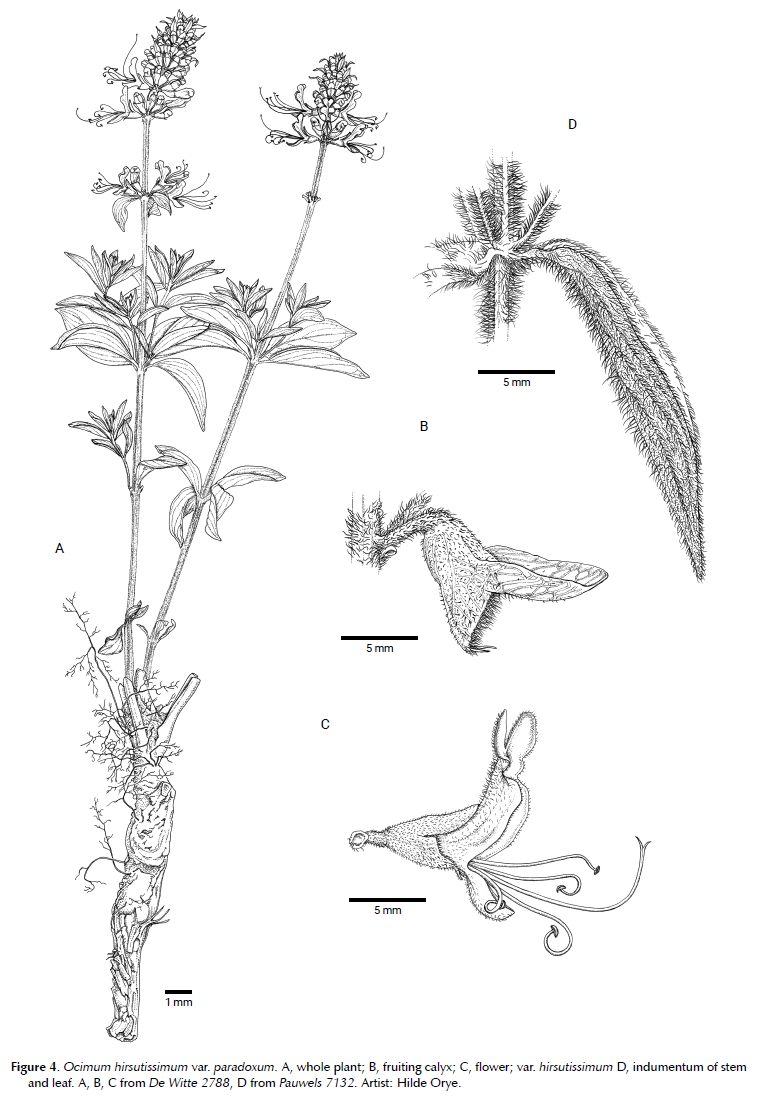
Ocimum hirsutissimum
(P.A.Duvign.) A.J.Paton var. paradoxum Meerts & A.J.Paton, var. nov.TYPES: D.R. CONGO, Haut-Katanga, Parc National de l'Upemba, Mukana, savane brúlée, 1 810 m a.s.l., 26 Aug. 1947, De Witte 2788 (BR [BR0000016581036], holo!; UPS, iso.). urn:lsid:ipni.org:names:77351583-1
Diagnostic features
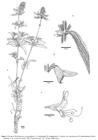
Differing from the typical variety in the much less developed indumentum, with the stem pubescent to tomentose, with antrorse hairs, not hispid-villose with patent hairs, and leaves subglabrous or pubescent only on veins, not wholly villose. Figure 4, Figure S4.
Etymology
The varietal epithet paradoxum refers to the paradoxical occurrence of specimens with much reduced pubescence in a species that is otherwise wholly hispid.
Distribution and habitat
Endemic of D.R. Congo (Haut-Katanga, Kibara massif); steppic savanna at high altitude (1 700-1 850 m), on rocky soil.
Conservation status
Probably Least Concern (LC); even though the variety is known from only four locations, they are all situated within the Upemba National Park.
Additional specimens studied
D.R. CONGO, Haut-Katanga: Mitwaba, 26 km au sud du poste, steppe de plateau sur micaschiste à Tristachya tholonii et Parinari pumila, 11 Sept. 1956, Duvigneaud & Timperman 2733Be (BRLU); Parc national de l'Upemba, entre Kabwe-Kanono et Mukana, savane herbeuse d'altitude, 30 Sept. 1948, Van Meel sub De Witte 4357 (BR, P, WAG); Parc national de l'Upemba, entre Lusinga et Mukana, savane herbeuse d'altitude, 1 815 m a.s.l., 28 Mar. 1949, Van Meel sub De Witte 5919 (BR); Parc national de l'Upemba, pente rocheuse de 45° près de la tête de source de la rivière Kadidiki, 1 775 m a.s.l., 25 Aug. 1949, Vvan Meel sub De Witte 7576 Mitwaba, 26 km au sud du poste, steppe de plateau sur micaschistes à Tristachya thollonii et Parinari pumila, 11 Sept. 1956, Duvigneaud & Timperman 2733Be (BRLU).
Discussion
Newly identified materials of O. hirsutissimum, collected in the same region as the type, show that the indumentum is not always villose. We propose to recognise at varietal rank a group of specimens with much shorter indumentum on stem and with leaves almost glabrous. O. hirsutissimum var. paradoxum is superficially similar to O. pyramidatum, on account of the ternate, spreading leaves, differing by the calyx traits (O. hirsutissimum: upper calyx lip elliptic, exceeding calyx throat by > 3 mm; O. pyramidatum: upper calyx lip obovate, exceeding calyx throat by ± 1 mm). The specimen Duvigneaud & Timperman 2733Be (BRLU) belongs here except for the villose indumentum on the lower surface of midvein and opposite (not ternate) leaves.
Bibliography
Plancke (1959), Ayobangira (1987, 1990), Paton (1993).
Ocimum mearnsii
(Ayob. ex Sebald) A.J.PatonDistribution
D.R. Congo (new country record), Kenya, Tanzania, Uganda.
Habitat
Steppic savanna (in D.R. Congo), seasonally flooded and/ or overgrazed placed elsewhere, at ± 1 500 m a.s.l. in D.R. Congo, 1 500-2 100 m a.s.l. elsewhere.
Specimen examined
D.R. CONGO, Haut-Katanga: Parc national de l'Up-
emba, savane d'altitude entre Mukana et Kabwe Kanono, 18 Oct. 1948, Van Meel sub De Witte 4533 (BR).
Discussion
New country record for D.R. Congo. The new locality in Upemba National Park is remarkably disjunct, > 1 000 km from the nearest localities in N Tanzania.
Bibliography
Sebald (1989), Paton (1995), Paton et al. (2009).
Ocimum mitwabense
(Ayob.) A.J.Paton DistributionEndemic of D.R. Congo (Haut-Katanga, Kibara massif).
Habitat
Steppic savanna, at ± 1 500 m a.s.l.
Specimens examined (new identifications only)
D.R. CONGO, Haut-Katanga: Mitwaba, champ d'avi-ation, relevé 180, savane herbeuse; 20 Mar. 1954, Desenfans 5393 (BRLU); Mitwaba, en face de l'hotel, grande steppe de plateau passant au verger à Monotes, 9 Sept. 1956, Duvigneaud & Timperman 2692Be (BRLU); massif des Kibara, hotel Mitwaba, Sept. 1945, Mortelmans 57 (BR).
Discussion
O. mitwabense is a somewhat enigmatic taxon known from only a few collections. It is related to O. centraliafricanum R.E.Fr. on account of the arching veins parallel to lamina margin, differing in coriaceous leaves, and the calyx lacking the white floccose indumentum on lateral lobes.
Bibliography
Ayobangira (1987, 1990), Paton (1993).
Ocimum pyramidatum
(A.J.Paton) A.J.PatonDistribution
D.R. Congo (new country record), Tanzania.
Habitat
Open dry woodland and grassland, at ± 1 100 m a.s.l. in D.R. Congo, 1 050-1 600 m a.s.l. elsewhere.
Specimen examined
D.R. CONGO, Bas-Katanga: Kamina, 1 100 m a.s.l., prairie marécageuse, 19 Sept. 1947, Mullenders 1400 (BR).
Discussion
New country record for D.R. Congo. O. pyramidatum was hitherto reported only from a narrow range in SW Tanzania. The new collection extends the range ± 800 km to the west. This specimen had been wrongly identified as O. obovatum by Sebald (1989). It differs from Tanzanian material [Richards 7127, 7277, 11595 (K)] in having a shorter calyx at anthesis (4 mm vs 5-7 mm long).
Bibliography
Paton et al. (2009).
Orthosiphon
Benth.Orthosiphon collinus
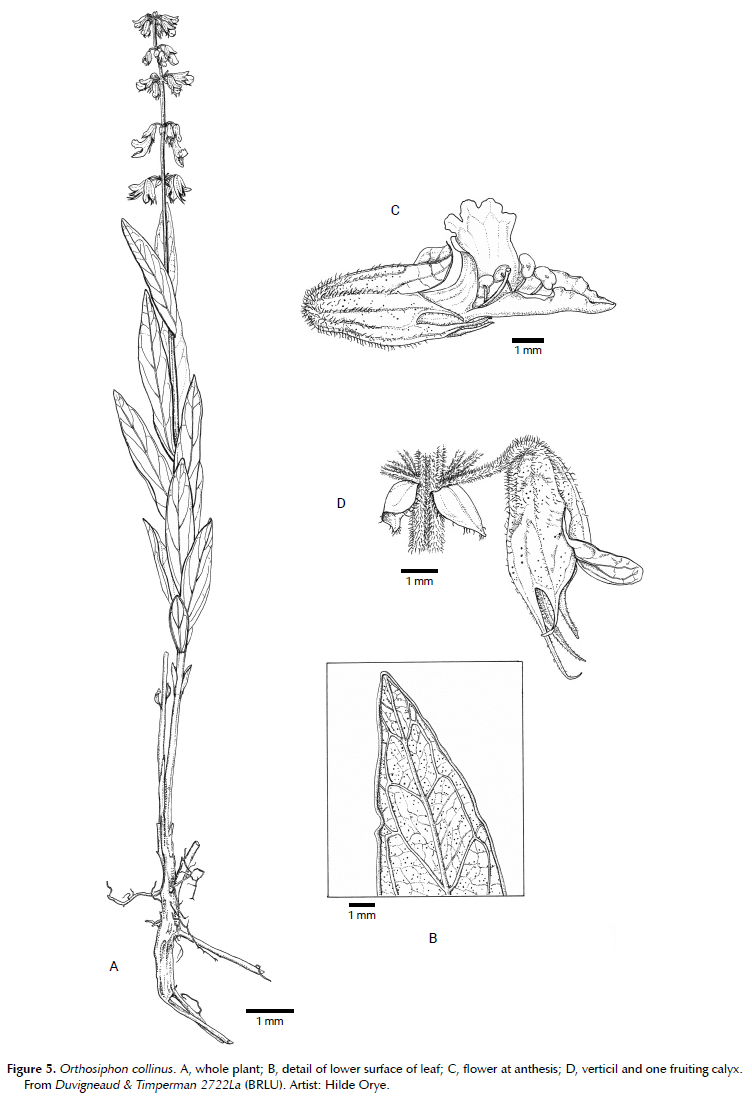
Ayob. ex Meerts & A.J.Paton sp. nov.TYPES: D.R. Congo, Haut-Katanga, 67 km E de Mitwaba, dembo dans un vallon en auge, steppe humide, après incendie, 10 Sept. 1956 ['1957' on label in error], Duvigneaud & Timperman 2722La (BRLU0043430, holo!; K, iso). urn:lsid:ipni.org:names:77351584-1
Relationships
Related to O. rufinervis G.Taylor, differing in the subsessile, erect (vs petiolate, patent) leaves with narrower leaf blade (5-10 mm vs 10-25 mm wide), with yellow glands (vs red), smaller bracts (1.5-3.5 mm vs 4-5 mm long), much shorter corolla (± 7 mm vs 11-14 mm long).
Description
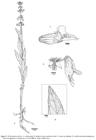
Perennial herb or suffrutex 15-20 cm high; rootstock a woody rhizome, tubers not observed; stem erect, unbranched, quadrangular, sulcate in upper half, papillate to puberulous in lower half (retrorse hairs), subglabrous upwards, becoming abruptly pubescent in the inflorescence with short patent to retrorse eglandular hairs. Leaves opposite-decussate, ± 8 pairs to a stem, lowermost 2 pairs much reduced, ascending to erect, subsessile, blade coriaceous, pale green, narrowly ovate elliptic to narrowly elliptic, 20-42 x 5-10 mm, much longer than the internodes, base cuneate, apex acute, margin recurved or thickened, subentire to slightly serrate distally with ± 5 teeth on either side, 3-5 pairs of veins diverging at a narrow angle, reticulum prominent on both surfaces, subglabrous, yellow gland-dotted on both surfaces, lower surface paler. Inflorescence terminal, a thyrse 4-5 cm long, with ± 6 verticils, spaced 5-12 mm apart, cymes 3-flowered, bract ovate ± 1.5-3.0 x 1.0-1.5 mm, acuminate, reflexed, ciliate; pedicel patent to ascending, curving at tip, ± 2 mm, puberulent. Calyx ± 4 mm long at anthesis, accrescent to 6 mm in fruit, more or less flushed purple, patent to reflexed, tube campanulate, shortly pubescent (eglandular hairs), with sessile glands, upper lobe ovate to obovate, ± 2 mm long, subacute at tip, upwardly recurving, decurrent, lateral lobes ovate-triangular, subulate, ± 2 mm, median lobes of lower lip subulate, attenuate into a filiform point 3-4 mm, ciliolate. Corolla ± 7 mm long, pale-coloured in herbarium, puberulent (curly hairs), lower lip ± 2 mm long. Fertile stamens 4, anther ± 0.8 mm long, thecae divergent. Fruit not observed. Figure 5, Figure S5.
Etymology
The specific epithet 'collinus' was proposed by Ayobangira (1990) referring to the hilly landscape in which the species was collected.
Diagnostic characters
A suffrutex with ascending to erect, subentire, coriaceous leaves, and 3-flowered cymes.
Distribution and habitat
Endemic of D.R. Congo (Haut-Katanga); steppic savanna in dambo, on seasonally flooded soil.
Conservation status
Data Deficient (DD); the species is known only from the type collection.
Additional specimens examined
None.
Discussion
This species was proposed by Ayobangira (1990) but was never effectively published. It is superficially similar to Fuerstia rigida (Benth.) A.J.Paton on account of habit, small coriaceous erect leaves with prominent veins, differing in the eglandular indumentum, the 3-flowered cymes (Fuerstia rigida: 1-flowered), and the androecium with 4 stamens.
Bibliography
Ayobangira (1990).
Orthosiphon rufinervis
G.TaylorDistribution
Angola, Central African Republic, D.R. Congo (new country record), Zambia.
Habitat
Steppic savanna, often on seasonally waterlogged soil.
Specimens examined
D.R. CONGO, Haut-Katanga: Dilolo, dilungu de la Mangoa, steppe frais à Eragrostis capensis, 20 Aug. 1956, Duvigneaud & Timperman 2404 (BRLU); Region de Kis-enge, tête de source de la rivière Kamalengu, dilungu, 25 Sept. 1958, Plancke 155/2087 & 2088 (BRLU); env. de Kabiasha, près du village Kimangu, dembo, 18 May 1970, Lisowski 23533 (POZG, 3 sheets).
Discussion
New country record for D.R. Congo. O. rufinervis is a relatively rare species throughout its range.
Bibliography
Paton et al. (2013).
Plectranthus
L'Hér.Plectranthus asymmetricus
A.J.PatonDistribution
S D.R. Congo (Haut-Katanga) (new country record), N Zambia.
Habitat
Evergreen forest, boulders, especially near watercourses; at 1 200-1 350 m a.s.l.
Specimens examined
D.R. CONGO, Haut-Katanga: Route Mitwaba-Manono, 45 km, riv. Kalumengongo (zone Mitwaba), 08°19'S, 27°16'E, 1 140 m a.s.l., rochers humides en bordure de rivière, 3 Feb. 1986, Bamps & Malaisse 8620 (BR); Route Lubumbashi-Likasi, 50 km, riv. Kamianga (zone Kambove), 11°18'S, 27°17'E, 1 335 m a.s.l., thalweg de ravin boisé, 15 Jan. 1986, Bamps & Malaisse 8027 (BR); Route Lubumbashi-Likasi, 70 km, ravin de la Luafi (zone Kambove), 11°12'S, 27°08'E, 1 200 m a.s.l., talus humifère de fond de ravin boisé, 14 Jan. 1986, Bamps & Malaisse 8017 (BR); 5 km NW de Shilatembo, ruisseau temporaire de la Kamianga, 1 340 m a.s.l., forêt dense (ravin encaissé) très humide (aspect guinéen), 5 Feb. 1982, Malaisse & Robbrecht 1733 (BR); 5 km N de Shilatembo, forêt dense de ravin du ruisseau temporaire Kamianga, 13 Jan. 1984, Malaisse 12947 (BR).
Discussion
New country record for D.R. Congo. The species was previously known from the type specimen only, in N Zambia. The four new localities extend the range ± 400 km to the north.
Bibliography
Paton et al. (2013).
Plectranthus villosicaulis
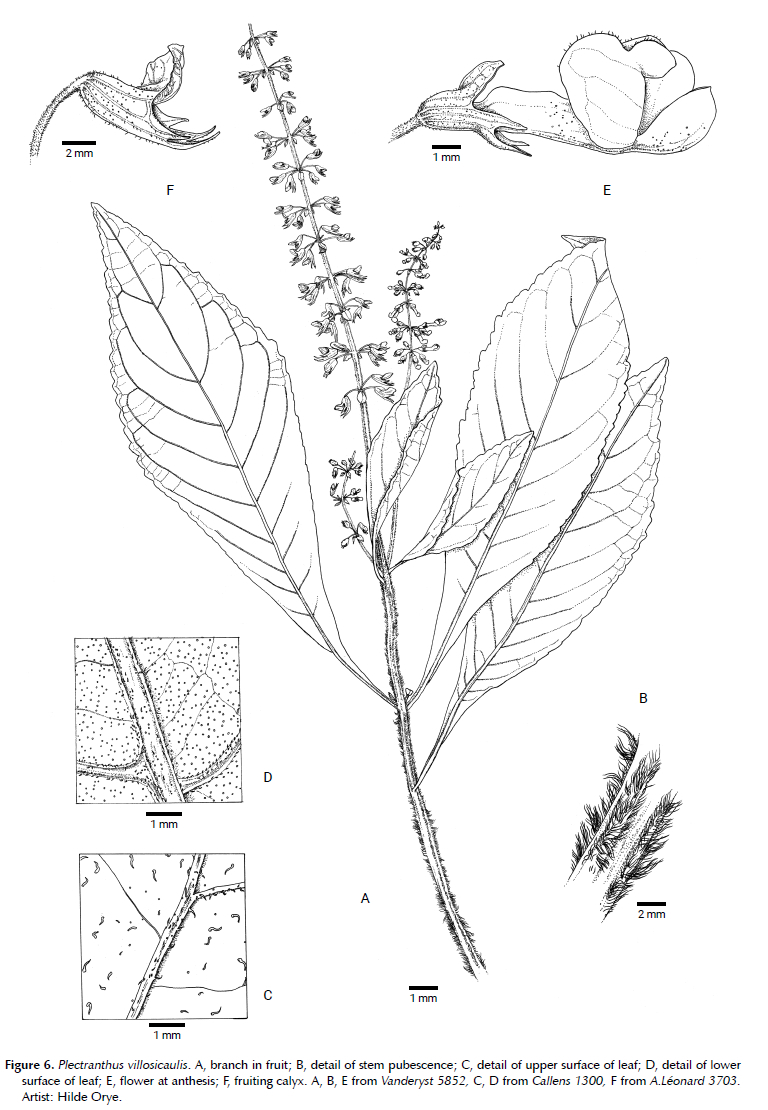
Meerts & A.J.Paton, sp. nov.TYPES: D.R. CONGO, Kivu, Ndolere, territ. Kabare, at 1 800 m a.s.l., forêt de montagne, 6 Apr. 1959, A.Léonard3703 (BR0000017710756, holo!; K, iso.). urn:lsid:ipni.org:names:77351585-1
Differing from all previously known species in the genus by the dark brown villose indumentum on stem angles; superficially similar to Coleus decurrens Gürke on account of the leaf lamina long attenuated at base, differing in the shorter corolla (6-9 mm vs 15-20 mm long), purplish to pinkish (vs yellow), and the villose indumentum on stem angles.
Description
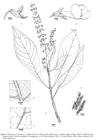
Perennial herb or shrub up to 2 m high. Stem erect, quadrangular, with dense brown villous indumentum on angles, sparingly branched. Leaves opposite, ascending, petiole 0.2-1.0 cm, not clearly distinct from lamina; lamina elliptic, 6-19 x 1.5-6.6 cm, base very progressively attenuate into the petiole, apex acuminate, margin serrate, upper surface sparsely rusty pubescent, lower surface appressed pubescent on veins and densely gland dotted (± 20 glands/mm2), with 5-11 pairs of secondary veins. Inflorescence lax, simple or with 1 or 2 short basal branches, ± 6-10 cm long at anthesis, elongating to 16-22 cm in fruit, with 8-15 (-22) verticils, spaced 7-15 mm apart in fruit, cymes subsessile, 3-flowered, bracts ovate ± 4 x 2.5 mm, reflexed, ciliate, persistent; pedicel 1-3 mm at anthesis, 5-6 mm at fruiting, patent, rusty pubescent, inserted slightly eccentrically on calyx. Calyx 3-5 mm long at anthesis, 7.5-10.0 mm long at fruiting, with red sessile glands and shortly stipitate pale minute glands, patent or downwardly pointing, tubulose to campanulate, with short stipitate pale glands, throat oblique, upper lobe ovate-elliptic, ± 5 mm long, subacute to subobtuse, curving upwards, slightly decurrent, lateral lobes of lower lip narrowly triangular, ± 2.5 mm, middle lobes of lower lip 3-4 mm long, long attenuate, somewhat curving upwards. Corolla pinkish, with red sessile glands, ± 6-9 mm long, tube almost straight, saccate at base, ± 4 mm long, upper lip ± 1.5 mm long, erect, 4-lobed, lower lip cucullate ± 4 mm. Stamens free, adnate to corolla tube, not exserted from corolla throat. Fruit: nutlets ovoid, slightly angled, ± 1.2 mm, dull brown, smooth. Figure 6, Figure S6.
Etymology
The specific epithet 'villosicaulis' refers to the villose indumentum on the angles of the stem.
Diagnostic characters
A shrub with sessile leaves long attenuate at base, and villose brown indumentum on stem angles.
Distribution and habitat
Endemic to D.R. Congo (Kivu and Kwango). Forests, at 800-1 800 m a.s.l.
Conservation status
This species is known from two localities (one in Kwango and one in Kivu), none of which is protected. It has not been collected after 1959. It is possibly endangered (EN).
Additional specimens examined
D.R. CONGO, Kasaï: Panzi, forêt, 10 Feb. 1950, Callens 2300 (BR); Panzi, 1925, Vanderyst 15801 (BR); Panzi, 1925, Vanderyst 15852 (BR); Panzi, Manzengele, 1925, Vanderyst 17308 (BR).
Discussion
Plectranthus villosicaulis is superficially similar to Coleus decurrens on account of leaf traits (lamina long attenuate at base into a pseudopetiole), and the 3-flowered cymes, differing in the remarkable stem indumentum, the much smaller, rose corolla with saccate tube, and calyx structure. The geographic distribution is intriguing, with two disjunct groups of populations more than 1 000 km apart, one in Kwango, and the other one in Kivu, suggesting that the species might be present elsewhere in the Congo Basin. Targeted field work is needed to collect more material of this interesting taxon.
Conclusion
Five species and one variety new to science are described in this note. In addition, fifteen, two and one species are new country records for D.R. Congo, Rwanda and Burundi, respectively. Of the 26 taxa discussed in this note, 20 are present in Haut-Katanga, in the Zambezian region of the Democratic Republic of Congo. Five of the six new taxa are located there. This highlights the importance of this region for the diversity and conservation of Lamiaceae subfamily Nepetoideae in Central Africa.
Competing interests
The authors declare that they have no financial or personal relationship(s) that may have inappropriately influenced them in writing this article.
Authors' contributions
P.M. contributed to the conceptualisation, methodology, investigation, data curation, writing - original draft, writing - review and editing.
A.J.F; contributed to validation, investigation, writing -review and editing, supervision.
Ethical considerations
This article followed all ethical standards for research without direct contact with human or animal subjects.
Acknowledgements
We would like to thank Hilde Orye, botanical artist, for preparing the illustrations.
References
- Ayobangira, F.-X., 1987, 'Contribution à l'étude des Ocimoideae africaines: nouveaux taxa, et nouvelles combinaisons du genre Becium Lindley', Etudes Rwandaises 1(3), 265-289.
- Ayobangira, F.-X., 1990, 'Contribution à l'étude des Lamiaceae africaines: systématique et phytogéographie des genres Ocimum L., Becium Lindl., Orthosiphon Benth. et Endostemon N.E.Br.', PhD thesis, Université de Lille II (France).
- Briquet, J., 1901, 'Plectranthus intrusus', in E. de Wildeman & T. Durand (eds.), Plantae Gilletianae congolenses, Bulletin de l'Herbier Boissier, sér. II, 1, 834.
- Brown, N.E., Cook, T., Skan, S.A., 1910, 'Labiatae', in W.T. Thiselton-Dyer (ed.), Flora Capensis 5(1), 226-387, Lovell Reeve & Co., London.
- De Wildeman, E., 1921, 'Notes sur la Flore du Katanga', VII. Annales de la Société scientifique de Bruxelles 41(2), 14-88
- Meerts, P.J., 2022, 'Labiatae - sous-familles IV. Scutellarioideae et V. Lamioideae', Flore d'Afrique Centrale, nouvelle série, Jardin botanique, Meise.
- Meerts, P.J., 2023, 'Labiatae - sous-famille III. Ajugoideae', Flore d'Afrique Centrale, nouvelle série, Jardin botanique, Meise.
-
Meerts, P.J. & Paton A.J., 2024, 'The genus Coleus (Lamiaceae) in Central Africa (Democratic Republic of the Congo, Rwanda, Burundi), with the description of 15 new species', Phytokeys 246, 71-178, https://doi.org/10.3897/phytokeys.246.129476.
» https://doi.org/10.3897/phytokeys.246.129476 - Moldenke, H.N., 1953, 'Notes on new and noteworthy plants'. XVI. Phytologia 4(4), 285-294.
-
Paton, A., 1993, 'Notes on Fuerstia (Labiatae) in Tropical Africa', Kew Bulletin 48, 129-137, https://doi.org/10.2307/4115757.
» https://doi.org/10.2307/4115757 -
Paton, A., 1995, 'The Genus Becium (Labiatae) in East Africa', Kew Bulletin 50, 199-242, https://doi.org/10.2307/4110628.
» https://doi.org/10.2307/4110628 - Paton, A.J., Bramley, G., Ryding, O., Polhill, R.M., Harvey, Y.B., Iwarsson, M., Willis, F., Phillipson, PB., Balkwill, K., Lukhoba, C.W., Otieno, D.F. & Harley, R.M., 2009, 'Lamiaceae (Labiatae)', in H.J. Beentje, S.A. Ghazanfar & R.M. Polhill (eds.), Flora of Tropical East Africa: 1-430, Royal Botanic Gardens, Kew.
- Paton, A.J., Bramley, G., Ryding, O., Polhill, R.M., Harvey, Y.B., Iwarsson, M., Willis, F., Phillipson P.B., Balkwill K., Lukhoba C.W., Otieno D.F. & Harley R.M., 2013, 'Lamiaceae', in J.R. Timberlake & E.S. Martins (eds.), Flora Zambesiaca 8(8), 1-346, Royal Botanic Gardens, Kew.
-
Paton, A., Harley, M.M., Harley, R.M. & Weeks, S., 1994, 'A revision of Endostemon (Labiatae)', Kew Bulletin 49, 673716, https://doi.org/10.2307/4118065.
» https://doi.org/10.2307/4118065 - Paton, A. & Meerts, P., 2020, 'Labiatae - Introduction + subfam. Viticoideae & Premnoideae', Flore d'Afrique Centrale, nouvelle série, Jardin botanique, Meise.
-
Paton, A.J., Mwanyambo M., Govaerts, R.H., Smith, A.K., Suddee, S., Phillipson, P.B., Wilson, T.C., Forster, P.I. & Culham, A., 2019, 'Nomenclatural changes in Coleus and Plectranthus (Lamiaceae): a tale of more than two genera', PhytoKeys 129, 1-158, https://doi.org/10.3897/phyto-keys.129.34988.
» https://doi.org/10.3897/phyto-keys.129.34988 - Paton, A., Pollard, B.J. & Meerts, P., 2022, 'Labiatae', in M.S.M. Sosef, J. Florence, H.P. Bourobou Bourobou, & P. Bissiengou (eds.), Flore du Gabon 58, 1-111, Margraf Publishers, Weikersheim.
- Plancke, J., 1959, 'Le genre Becium et sa distribution au Katanga', Mémoire de Licence, Université Libre de Bruxelles.
- Polhill, R.M., 2009, 'Isodon', in H.J. Beentje, S.A. Ghazanfar & R.M. Polhill (eds.), Flora of Tropical East Africa, Lamiaceae, 1-430, Royal Botanic Gardens, Kew.
- Robyns, W., 1947, Flore des Spermatophytes du Parc national Albert. II. Sympétales, Institut des Parcs Nationaux du Congo belge, Bruxelles.
- Robyns, W., 1948, Les territoires phytogéographiques du Congo belge et du Ruanda-Urundi, Atlas Général du Congo belge, Institut Royal Colonial Belge, Bruxelles.
- Sebald, O., 1988, 'Die Gattung Becium Lindley (Lamiaceae) in Afrika und auf Arabischen Halbinsel, Teil 1', Stuttgarter Beiträge zur Naturkunde Serie A, Biologie 419, 1-74.
- Sebald, O., 1989, 'Die Gattung Becium Lindley (Lamiaceae) in Afrika und auf Arabischen Halbinsel, Teil 2', Stuttgarter Beiträge zur Naturkunde Serie A, Biologie, 437, 1-63.
- Taylor, G., 1932, 'Notes on the Labiatae. I', Journal of Botany 70, 269-274.
-
Thiers, B., 2021, 'Index Herbariorum: A global directory of public herbaria and associated staff: New York Botanical Garden's Virtual Herbarium', Available online: http://sweetgum.nybg.org/ih/, [accessed 1 Dec. 2021].
» http://sweetgum.nybg.org/ih/ - Troupin, G. & Ayobangira F.-X., 1985, 'Lamiaceae', in G. Troupin, (ed.), Flore du Rwanda, Spermatophytes, vol. 3, 294-356, Musée royal de l'Afrique centrale, Annales, Sér. in-8°, Sciences économiques 15.

Accepted: 6 May 2025
Published: 7 November 2025