First records of Thesium ovatifolium (Santalaceae) from eSwatini, Africa
Abstract
Through ongoing research of Thesium (Santalaceae), new distribution records of the little-known species T. ovatifolium were uncovered. After careful morphological evaluation, their identities were confirmed as T. ovatifolium, which was formally described in 2019. The new records were found in eSwatini, which is outside of the known distribution range of the species in KwaZulu-Natal, South Africa. Along with this range extension and first record of T. ovatifolium from eSwatini, we present an adjusted morphological description reflecting new observed variation and an updated conservation assessment.
alpha taxonomy; conservation assessment; endemism; range extension
Introduction
The systematics of Thesium L. (Santalaceae), a globally distributed genus of about 330-350 hemi-parasitic species, is the subject of ongoing research (Moore et al. 2010; Mashego & Le Roux 2018; Visser et al. 2018; Lombard et al. 2019, 2021, 2022, in review; Zhigila et al. 2019, 2020, 2023, 2025; Lombard & Le Roux 2023; García et al. 2024). With awareness of this research, the South African botanical community remains watchful for Thesium specimens in the field. Consequently, observations are regularly posted on iNaturalist (https://www.inaturalist.org), and specimens deposited in PRE (herbarium codes according to Thiers 2025).
Thesium ovatifolium N.Lombard & M.M.le Roux (Lombard et al. 2019) was described from specimens collected around Hlabisa and Hlobane in KwaZulu-Natal, South Africa. It is a distinctive species with large ovate leaves that forms part of the T. goetzeanum species complex as revised by Visser et al. (2018). Limited information is available on T. ovatifolium, and it has been considered Endangered (Lombard et al. 2019).
With ongoing collection of Thesium, new morphological variation and new populations of species are uncovered. Here we report on the updated geographical distribution and conservation status of T. ovatifolium.
Material and methods
Observations recorded on iNaturalist and collections in PRE were evaluated. Searches in AMD, BR, K, MO and US herbaria and the Global Biodiversity Information Facility (https://www.gbif.org) did not uncover additional collections. Vegetative and reproductive morphology was studied to identify the plants and compared to descriptions to determine the extent of morphological variation in each species. Descriptive morphological terminology used here follows Lombard et al. (2019, 2021).
A map of the updated geographical distribution of T. ovatifolium was prepared in QGIS version 3.22.11 (Free Software Foundation 1989, 1991), and the Red List threat assessments were reviewed (IUCN Standards and Petitions Subcommittee 2024). Area of occupancy (AOO) and extent of occurrence (EOO) were calculated with GeoCAT software (https://spbachman.shinyapps.io/geocat_staging, viewed on 20 October 2025).
Results
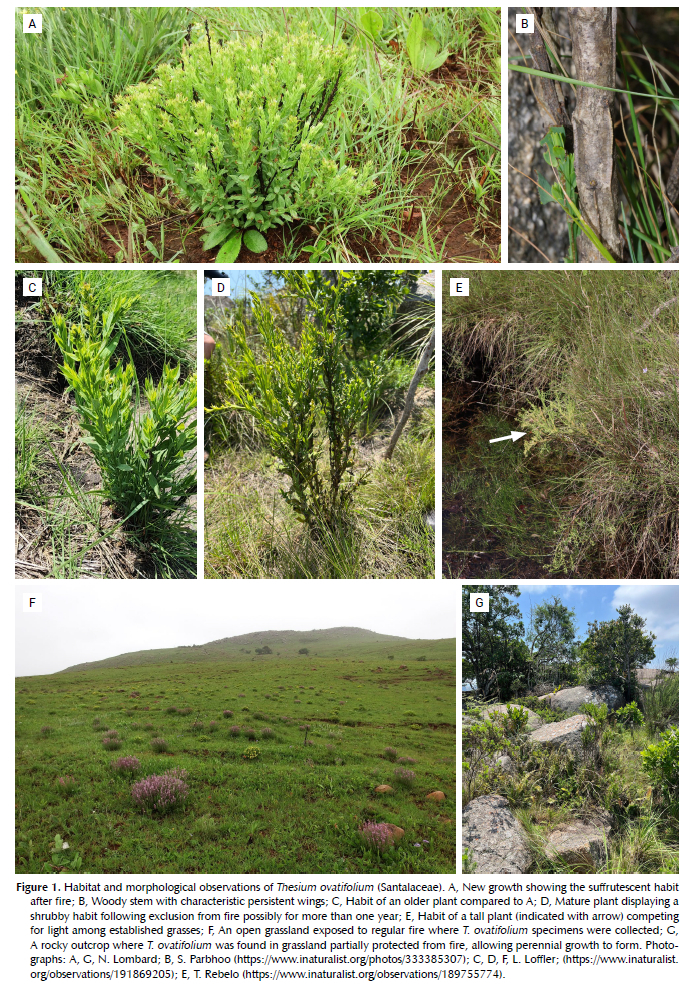
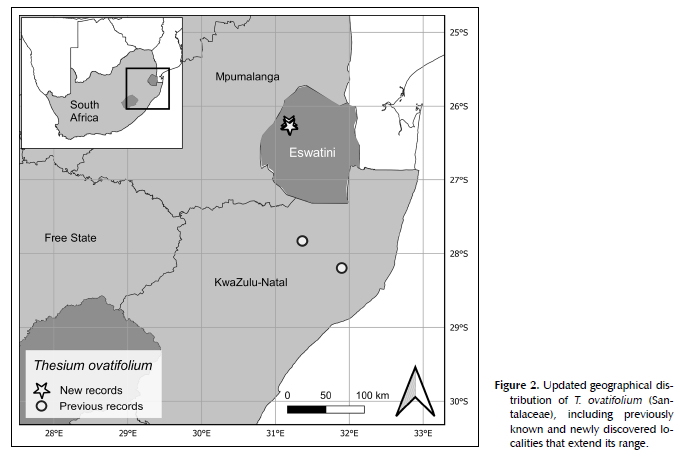
After careful evaluation of morphological characters, 12 iNaturalist observations and 1 recently collected gathering was identified as T. ovatifolium (Figure 1). It was determined that these new records are extensions of the currently recorded distribution range of the species (Figure 2).
Morphological investigation showed that the observations and gatherings from eSwatini match the diagnostic characters of T. ovatifolium, but that a slight adjustment to the species concept is required to accommodate the new morphological variation observed (Figure 1).
Discussion
Recent renewed interest in Thesium has been driving exciting discoveries through ongoing fieldwork and revisionary efforts. While limited material in herbarium collections might suggest a narrow distribution range for some taxa, this often stems from undercollection.
Thesium ovatifolium was described from six collections made in northern KwaZulu-Natal, South Africa (Lombard et al. 2019). Collections and observations made in eSwatini during 2023 and 2024 matched the diagnostic characters of T. ovatifolium but revealed new morphological variation (see updated description) and a distribution range extension. It was previously recognised as a suffrutex up to 0.3 m tall. Older plants from eSwatini have a shrubby habit to about 1 m tall. The development of woodiness possibly relates to the fire regime. Specimens collected in open grassland are more frequently exposed to fire (Figure 1F) while those occurring in rocky outcrops are excluded from regular exposure (Figure 1G). Exclusion from fire allows plants to become older, growing into shrubs. New plant growth can thus be deceptive, leading to the erroneous assumption that the species is a suffrutex only. This phenomenon is common in Thesium (e.g., T. procerum N.E.Br., T celatum N.E.Br.).
Taxonomic treatment and new distribution records
Thesium ovatifolium
N.Lombard & M.M.le Roux in Phytotaxa 405(5): 266 (2019). TYPE: SOUTH AFRICA, KwaZulu-Natal, Ngome area, about 60 km east of Vryheid on the R618, 1 105 m, 14 October 2018, Visser & Lombard 348 (PRE, holo!; NH!, NBG!, iso.). DescriptionRhizomatous suffrutex or shrub, 0.2-1.0 m tall, vegetative scales present on rhizome and lower parts of aerial stems; stems 5 to 50, arising from rhizome, erect or suberect, virgate, branched in upper half, green, glabrous, persistently alate due to decurrent bases of leaves and bracts, also on old growth. Leaves more or less spreading, (3-)9-38(-43) x 2-14 mm, narrowly elliptic, lanceolate to ovate, sessile, margins entire, apex acute or pungent, midrib prominent on both surfaces, secondary veins faintly reticulate, glabrous. Flowers usually solitary in bract axils, sometimes with 2- or 3-flowered cymes, arranged in 5- to 16-flowered determinate racemose inflorescences, terminating in 3-or 4-flowered cymes; pedicels 0-3(-5) mm long. Bracts 6.4-16.2(-23.0) × 1.6-5.7(-9.0) mm, lanceolate to ovate, sessile, margins entire, apex usually acuminate, fused to full length of pedicel, or unfused; bracteoles 4.0-9.7(-15.6) × 0.8-2.3(-3.2) mm, leaf-like, sessile, margins entire, apex usually acuminate. Perianth 3.0-5.6 × 1.5-2.7(-3.0) mm long, campanulate, elongate receptacle often present, 'glands' often visible on outside; corolla lobes 1.0-2.1 × 0.4-0.6(-0.9) mm, narrowly triangular, margins densely bearded, apex slightly cucullate. Stamens inserted at base of corolla lobes; filaments 0.3-0.6 mm long; anthers 0.4-1.0 mm long, attached to perianth with post-staminal hairs. Style 0.7-2.3 mm long, stigma ± opposite anthers or reaching to top of anthers. Placental column straight; ovules 3. Fruit 5.0-7.6 x 2.5-3.5 mm including persistent perianth (3-6 mm long excluding perianth), elliptic, shortly stipitate (stipe ± 0.5-1.1 mm long), 10-ribbed or occasionally 5-ribbed, smooth or with faint reticulate venation (adjusted description from Lombard et al. 2019).
Diagnosis and relationships
Thesium ovatifolium, T. alatum Hilliard & B.L.Burtt and T. angulosum A.DC. have winged (not only ribbed) stems but T. ovatifolium differs in having (narrowly elliptic) lanceolate to ovate leaves, 5 to 16 flowers, bracts longer than the flowers, and a stylate stigma. Thesium alatum, like T. ovatifolium, has a dense beard on the perianth lobe apices but has linear leaves, 1 to 7 flowers, bracts shorter than the flowers, and a sessile stigma. Thesium angulosum has fimbriate hairs on the perianth lobes, scale-like leaves, (8)12 to 53 flowers, bracts shorter than the flowers, and a stylate stigma. Thesium ovatifolium is also superficially similar to the Central Asian species T. minkwitzianum B.Fedtsch. in its leafy stems and lanceolate to ovate leaves, but these two species differ in several floral characters (Lombard et al. in review). Thesium ovatifolium was previously compared to T. goetzeanum Engl. and T. racemosum Bernh., but these species do not have alate stems (Visser et al. 2018; Lombard et al. 2019).
Distribution and habitat
Thesium ovatifolium occurs in the northern parts of eSwatini and southwards to Hlabisa in KwaZulu-Natal, South Africa. It grows in open grasslands and wooded areas within grasslands at elevations between 365 and 1 500 m. It is found in Northern Zululand Mistbelt Grassland (Gs1), Northern Zululand Sourveld (SVl22) and KaNgwane Montane Grassland (Gm16) (Mucina & Rutherford 2006, SANBI 2024).
Conservation status
Thesium ovatifolium was previously assessed as Endangered (EN) B1ab(iii) + 2ab(iii) (Lombard et al. 2019). The discovery of additional sites in eSwatini extends the range considerably northward (about 180 km) and increases the EOO (± 4 400 km2), AOO (24 km2) and locations (5-9). More than 100 individuals were observed at the Ngome type locality in 2018 and 200300 individuals in the Sibebe Hills [Bester, Braun, Loffler & Parbhoo 20072, 20087 (PRE)] in 2023.
All known sites in South Africa are subject to current or historical habitat degradation (Lombard et al. 2019). In eSwatini, plants occur on communal land threatened by overgrazing, rural sprawl, informal settlements and small-scale agriculture (P. Bester pers. comm.), leading to a continuing decline in habitat quality and extent. Much of the potentially suitable habitat between known sites has been transformed, but additional sites may exist. We suggest downgrading the global status to Vulnerable (VU) B1ab(iii) + 2ab(iii).
New collection records
ESWATINI: Sibebe Hills, 26°16'12"S, 31°10'51.6"E, 28 October 2023, Bester, Braun, Loffler, Parbhoo 20072 (PRE), 26°16'44.4"S, 31°11'42"E, 28 October 2023, Bester, Braun, Loffler, Parbhoo 20087 (PRE).
New observation records
ESWATINI: Hhohho Region, 26°16'55.2"S, 31°11'34.8"E, 28 October 2023, lindaloffler (https://www.inaturalist.org/observations/191869205), 26°16'48"S, 31 °11'6"E, 28 October 2023, noku_mhlongo (https://www.inaturalist.org/observations/189588981), 26°16'22.8"S, 31°11'2.4"E, 26 November 2024, lindaloffler (https://www.inaturalist.org/observations/253999819), 26°16'12"S, 31 °10'51.6"E, 31 August 2023, lindaloffler (https://www.inaturalist.org/observations/182928639), 26°16'12"S, 31°10'51.6"E, 28 October 2023, sp_bester (https://www.inaturalist.org/observations/193029752), 26°15'50.4"S, 31°11'27.6"E, 27 November 2023, lindaloffler (https://www.inaturalist.org/observations/192897896); Makhelwane east of Sibebe, 26°16'55.2"S, 31°11'34.8"E, 28 October 2023, tonyrebelo (https://www.inaturalist.org/observations/189755799), 26°16'55.2"S, 31 °11'34.8"E, 28 October 2023, tonyrebelo (https://www.inaturalist.org/observations/189755774), 26°16'44.4"S, 31°11'42"E, 28 x 2023, tonyrebelo (https://www.inaturalist.org/observations/189702391), 26°16'12"S, 31°10'48"E, 28 October 2023, katebraunsd (https://www.inaturalist.org/observations/189711397); Hhukwini, SZ-HH, SZ, 26°16'26.4"S, 31°10'48"E, 28 October 2023, suvarna (https://www.inaturalist.org/observations/190215160), 26°16'22.8"S, 31°10'48"E, 28 October 2023, suvarna (https://www.inaturalist.org/observations/190214457).
Additional specimens examined
SOUTH AFRICA, KwaZulu-Natal, Hlabisa, ca. 4.5 miles [7.2 km] south of Hlabisa, 28°11'39.16"S, 31°53'55.57"E, 13 October 1946, Acocks 13068 (PRE [2 sheets]); Ngome area, about 60 km east of Vryheid on the R618, 27°49'47.42"S, 31°21'58.14"E, 14 October 2018, Visser & Lombard 346 (PRE), 27°49'47.42"S, 31°21'58.14"E, 14 October 2018, Visser & Lombard 349 (PRE); 27°49'41.05"S, 31°22'2.86"E, 14 October 2018, Visser & Lombard 347 (PRE); Ngotshe District, 57 km east of Vryheid on the R618 between Vaalbank and Nongoma, Farm: Zaagkuil 14333, 27°49'43.21"S, 31°21'54.61"E, 15 October 2013, Bester 11666 (PRE).
Competing interests
The authors declare that they have no financial or personal relationship(s) that may have inappropriately influenced them in writing this article.
Author contributions
M.L.R. (South African National Biodiversity Institute and University of Johannesburg) and N.L. (South African National Biodiversity Institute and University of Johannesburg) contributed equally to all aspects of this study.
Acknowledgements
We thank all those who have contributed observations and collections of Thesium to iNaturalist and the National Herbarium (PRE), in particular Pieter Bester, Kate Braun, Linda Loffler, Suvarna Parbhoo and Tony Rebelo (photos and locality details). We also thank Hlengi-we Mtshali for her assistance with the IUCN threat assessments.
References
-
García, M.A., Mucina, L. & Nickrent, D.L., 2024, 'A tough nutlet to crack: resolving the phylogeny of Thesium (Thesiaceae), the largest genus in Santalales', Taxon 73, 109-236, https://doi.org/10.1002/tax.13123.
» https://doi.org/10.1002/tax.13123 -
IUCN Standards and Petitions Committee, 2024, Guidelines for using the IUCN Red List categories and criteria, version 16', prepared by the Standards and Petitions Committee, viewed on 22 October 2025, https://www.iucnredlist.org/documents/RedListGuidelines.pdf.
» https://www.iucnredlist.org/documents/RedListGuidelines.pdf -
Lombard, N. & Le Roux, M.M., 2023, 'Thesium hispidifructum (Santalaceae), a new hispidulous species from Limpopo, South Africa and notes on enigmatic T. celatum', Taxonomy 3, 95-108, https://doi.org/10.3390/taxonomy3010009.
» https://doi.org/10.3390/taxonomy3010009 -
Lombard, N., Le Roux, M.M. & Van Wyk, B-E., 2019, 'The-sium ovatifolium (Santalaceae), a new species with ovate leaves from KwaZulu-Natal, South Africa', Phytotaxa 405, 263-268, https://doi.org/10.11646/phytotaxa.405.5.5.
» https://doi.org/10.11646/phytotaxa.405.5.5 -
Lombard, N., Le Roux, M.M. & Van Wyk, B-E., 2021, 'A taxonomic revision of the Thesium scirpioides species complex (subgenus Frisea, Santalaceae) near endemic to South Africa', South African Journal of Botany 138, 193-208, https://doi.org/10.1016/j.sajb.2020.12.005.
» https://doi.org/10.1016/j.sajb.2020.12.005 - Lombard, N., Le Roux, M.M. & Van Wyk, B-E., 'A synopsis of Thesium (Santalaceae, Santalales)', Systematic Botany Monographs, in review.
-
Lombard, N., Stander, M.A., Redelinghuys, H., Le Roux, M.M. & Van Wyk, B-E., 2022, 'A study of phenolic compounds and their chemophenetic value in the genus Thesium (Santalaceae)', Diversity 14, 590, https://doi.org/10.3390/d14080590.
» https://doi.org/10.3390/d14080590 -
Mashego, K.S. & Le Roux, M.M., 2018, A taxonomic evaluation of the Thesium confine species complex (Santalaceae), Bothalia 48, a2346, https://journals.abcjournal.aosis.co.za/index.php/abc/article/view/2346/2447.
» https://journals.abcjournal.aosis.co.za/index.php/abc/article/view/2346/2447 -
Moore, T.E., Verboom, G.A. & Forest, F., 2010, 'Phylogenetics and biogeography of the parasitic genus Thesium L. (Santalaceae), with an emphasis on the Cape of South Africa', Botanical Journal of the Linnean Society 162, 435-452, https://doi.org/10.1111/j.1095-8339.2010.01032.x.
» https://doi.org/10.1111/j.1095-8339.2010.01032.x -
Mucina, L. & Rutherford, M., 2006, The vegetation of South Africa, Lesotho and Swaziland, Strelitzia 19, South African National Biodiversity Institute, Pretoria, 807 pp., https://www.sanbi.org/wp-content/uploads/2024/05/2006_Strelitzia19.pdf.
» https://www.sanbi.org/wp-content/uploads/2024/05/2006_Strelitzia19.pdf -
SANBI (South African National Biodiversity Institute), 2024, National Vegetation Map Final 2024, Biodiversity GIS, viewed on 21 October 2025, https://bgis.sanbi.org/SpatialDataset/Detail/7739.
» https://bgis.sanbi.org/SpatialDataset/Detail/7739 -
Thiers, B., 2025, Index Herbariorum, a global directory of public herbaria and associated staff, New York Botanical Garden's Virtual Herbarium, viewed on 21 October 2025, http://sweetgum.nybg.org/ih.
» http://sweetgum.nybg.org/ih -
Visser, N., Le Roux, M.M. & Van Wyk, B-E., 2018, 'A taxonomic revision of the Thesium goetzeanum species complex (Santalaceae) from Lesotho, South Africa and Swaziland', South African Journal of Botany 119, 45-62, https://doi.org/10.1016/j.sajb.2018.08.005.
» https://doi.org/10.1016/j.sajb.2018.08.005 -
Zhigila, D.A., Lombard, N. & Muasya, A.M., 2025, 'A taxonomic revision and conservation assessments of Thesium section Frisea (subgenus Frisea, Santalaceae)', South African Journal of Botany 178, 280-306, https://doi.org/10.1016/j.sajb.2025.01.036.
» https://doi.org/10.1016/j.sajb.2025.01.036 -
Zhigila, D.A., Schmiedel, U. & Muasya, A.M., 2023, 'Thesium schmiedeliae (Santalaceae), a new species from Knersvlakte quartz fields, South Africa', Kew Bulletin 78, 509-518, https://doi.org/10.1007/s12225-023-10114-y.
» https://doi.org/10.1007/s12225-023-10114-y -
Zhigila, D.A., Verboom, G.A. & Muasya, A.M., 2020, 'An infrageneric classification of Thesium (Santalaceae) based on molecular phylogenetic data', Taxon 69, 100-123, https://doi.org/10.1002/tax.12202.
» https://doi.org/10.1002/tax.12202 -
Zhigila, D.A., Verboom, G.A., Stirton, C.H. & Muasya, A.M., 2019, 'A taxonomic revision of Thesium section Hagnothesium (Santalaceae) and description of a new species, T. quartzicolum', South African Journal of Botany 124, 280-303, https://doi.org/10.1016/j.sajb.2019.05.016.
» https://doi.org/10.1016/j.sajb.2019.05.016

Accepted: 27 May 2026
Published: 31 August 2026