Photographic storytelling to achieve diversity and representation in conservation
Abstract
Storytelling is a powerful tool for communicating science and sharing information with public and policymaker audiences. However, certain stories have historically been privileged above others, effectively silencing certain perspectives. In conservation, there are calls to decolonise conservation science and promote diversity in knowledge production. Storytelling may offer more effective means to advocate for protecting biodiversity. Seven professional conservation photographers and seven aspiring young photographers were interviewed to explore photographic storytelling as an advocacy tool for conservation. Using thematic analysis, several themes were drawn from interviews across both photographer groups. The professional photographers raised themes on the legacy of exclusion, starting conversations using photographs, the 21st century's environmental focus and the importance of evidence-based stories. The aspiring photographers discussed themes of access and inequality, using photography for self-expression, creating connections with nature and capacity building. The findings provide insights into improving representation and diversity in conservation and highlight the value of photography for advocacy and empowerment.
Storytelling; conservation photography; conservation; environmental education; diversity
Introduction
Storytelling encompasses oral, visual and performative methods, and was integral to human evolution before our ability to write (Bayer & Hettinger 2019). Our natural inclination to share and receive stories makes storytelling a powerful tool to communicate science and share information. However, certain stories have historically been privileged above others (Sonn et al. 2013), leading to dominant perspectives effectively silencing others.
If stories create connections and enhance credibility (Bayer & Hettinger 2019), promoting underrepresented perspectives may decolonise science and diversify knowledge. Social scientists increasingly promote diversity and incorporate local and indigenous knowledge into conservation practices (Bartlett et al. 2012; Domínguez & Luoma 2020; Yanou et al. 2023). Storytelling can effectively advocate for greater environmental protection (Pileggi & Morgan 2017) at a time when biodiversity protection urgently requires more effective actions (Gavin et al. 2018). Iqani and Judge (2025) write about 'affective encounters' and the power of situated knowledge through storying, which will be exemplified in this study through the medium of photographic storytelling.
The efficacy of teaching photography to young people for advocacy has yielded limited results. More specifically, there is a dearth of research addressing the potential for teaching photography as a storytelling and advocacy tool for historically marginalised youth. Here, photographic storytelling was explored as a tool for environmental advocacy. Regardless of genre, stories are a powerful means of conveying information and experiences. The study explored the question: how do established conservation photography professionals and aspiring photographers from historically marginalised communities use photographic storytelling for advocacy purposes?
Advocacy-driven storytelling and photography
Storytelling improves mental wellbeing (Pennebaker & Seagal 1999) and, when combined with photography, may promote health through self-reflection and the discovery of one's purpose (Koithan 1994). Forming stories allows deeper self-understanding by consolidating thoughts and feelings (Pennebaker & Seagal 1999). However, the literature focuses on individuals rather than those using storytelling to connect with wider audiences for advocacy.
Indigenous storytelling promotes inclusion and diverse values for protecting biodiversity (Fernández-Llamazares & Cabeza 2017; Schellnack-Kelly 2018). McCal-lum (2005) asserts it strengthens connections to nature. Wood and Meyer (2022) argue narratives disrupt and promote justice to 'challenge, transgress and change' (p. 29) social and climate-related injustices, while Fernández-Llamazares and Cabeza (2017) argue storytelling can decolonise conservation knowledge.
Storytelling serves as a social critique among youth (Enciso 2011) and is closely tied to issues of justice (Iqani & Judge 2025). This study highlights the conservation experiences of black youth living near protected areas, positing photographic storytelling as a reparative practice (Malatjie 2024; Iqani & Judge 2025). I assert that photographic storytelling provides an engaging way to enhance critical literacy and promote social and environmental justice; 'to explain and expand on the images, emotions and meaning of their lives, they may be recognised in new ways as people with complex social histories and insights about equity and justice' (Enciso 2011, p. 21).
Photography is increasingly used to promote conservation through education and to communicate environmental messages to the public (Mittermeier 2005; Ward 2008; Farnsworth 2011). Mittermeier (2005) emphasises that photographs are 'a necessary and constant element of conservation communications. Be it to document, illustrate, compare, or inspire, images are an indispensable element of the conservation toolbox' (p. 8). Conservation photography is mission-focused, seeking to protect the environment (Mittermeier 2005; Farnsworth 2011) by merging art with science and education to create compelling narratives that drive change (Farnsworth 2011).
Photographs are useful in educational settings to meaningfully connect students to natural places (Farnsworth 2011). Farnsworth (2011) argues that youth with strong connections to their communities are more likely to engage in restorative and sustaining supportive practices. He proposes that photographs be created by students themselves in their communities.
While storytelling for conservation is growing amongst photographers, journalists and environmental advocates, it is essential to ensure that narratives are diverse and representative of the people impacted by conservation areas (Fernández-Llamazares & Cabeza 2017; Gould et al. 201 7). Stories provide a voice for silenced perspectives (Porter 2015) and a platform for ignored knowledge (Moezzi et al. 2017), enhancing conservation efficacy. These diverse voices include the indigenous and First Nation groups (Price et al. 2021), who are often forcefully excluded by fortress conservation models (DeCaro & Stokes 2008); young people, who increasingly call for recognition in environmental spaces and decision making (Schusler et al. 2009; Jagadeesh 2024); and women, particularly in rural areas, who are impacted by resource scarcity and diminished decision-making power (Mago & Gunwal 2019).
Conservation photographers integrate storytelling into their photographs to create compelling narratives in favour of protecting the natural world, aiming to invoke emotional responses to garner support for the protection of natural environments (Mittermeier 2005). Despite support for conservation photography, its effectiveness in engaging the public in environmental matters remains underexplored. Few studies have investigated photography's role in conservation, despite anecdotal evidence (Mittermeier 2005; Ward 2008; Hanisch et al. 2019; Farnsworth 2023). Additionally, teaching photography skills in a conservation context has yielded few results. While photography is accessible, it is often pursued by those with access to expensive technology. This consideration was vital for this research conducted in a historically marginalised rural community in South Africa.
Context
Many young black South Africans in the Greater Kruger region have never visited the Kruger National Park or the surrounding reserves (Anthony 2007). These rural communities also face high unemployment rates (Kanjere & Choenyane 2021). In response, a local resident created an outreach programme, Wild Shots Outreach, in November 2015, focused on capacity building.
The goals of the outreach programmes include teaching young people about photography and providing opportunities to take participants into game reserves for opportunities to connect with wildlife and natural spaces, and expose young people to careers in conservation, wildlife tourism and wildlife media. Photography was chosen to inspire storytelling among participants. These stories were examined to understand how black youth living in communities surrounding a national park have experienced life bordering protected land and this capacity-building initiative.
Conducting social research in conservation raises ethical considerations beyond those associated with natural sciences research (Brittain et al. 2020). Conservation research often occurs in communities where cultural and social differences exist between participants and researchers, particularly. Additionally, research may be conducted in countries with colonial histories where conservation strategies may have fostered existing social divisions and power dynamics (Brittain et al. 2020). This highlights the unique and serious consequences of conducting conservation research with people without careful consideration given to ethics throughout the process of initiating, conducting and concluding research.
Given South Africa's history of racial segregation, understanding its impact on the Kruger National Park and surrounding communities is essential before initiating research in these areas. Forced removals commenced in the park's earliest days (1898 - 1899) and continued during apartheid (Carruthers 1995; Dlamini 2020). Thus, it is crucial to ensure power dynamics, exclusion and racism are not perpetuated. Rather, it is necessary to examine the social impact of exclusion and how the outreach and its participants aim to positively change the legacy of racial segregation. The representation of black youth in conservation and photography requires a conscious effort to address and challenge the lack of representation of black conservationists and photographers. A participatory approach was initiated to make the research process one of collaboration, sharing and learning to ensure power dynamics were not perpetuated.
Methodology
This study explored the experiences of professional and aspiring photographers working in wildlife and/or conservation. Interviews were conducted to gain insights into their personal and collective experiences. Using the case study method (Woodside 2010), the research examined the participants' complex experiences of capacity building, photography and conservation to describe the lived experiences of the outreach graduates and conservation photographers, through the following:
• Seven qualitative interviews with established professional conservation/wildlife photographers detailing their professional intentions.
• Four interviews with seven aspiring professional photographers detailing experiences of historical marginalisation and learning photography.
• Three qualitative interviews with male outreach graduates working as photographers and filmmakers for the outreach media team and interns at a South African conservation NGO during 2020/2021.
• One qualitative group interview with four female outreach graduates working as photographers for the outreach media team and/or training in photography or conservation.
Ethical approval was secured from the Humanities Academic Ethics Committee at the University of Johannesburg (Ethical clearance number: REC-02-170-2019).
Sample
Seven professional photographers responded to interview requests sent through the National Geographic Explorers and The New Big 5 websites. They were identified as wildlife and/or conservation photographers, primarily based in African countries or working on African wildlife issues. The sample included two conservation photographers, one environmental journalist, two photographic guides and a photographer/filmmaker pair working in the conservation and tourism industry. All but one were based in southern Africa, with six in two southern African countries, and one in Europe. Two of the seven photographers were white and over 40 years old.
The established professionals were included to understand what conservation and wildlife photography entails, including their goals and processes. This also provided insights into the career trajectory of aspiring professionals and the current status and representation of African photographers in wildlife and/or conservation.
Through critical case sampling (Tracy 2020), the second part of the sample comprised aspiring professionals from the photography outreach in the Greater Kruger. These were young adults who had completed the outreach programme, including photographic workshops and game drives. Initially, the three aspiring professionals were all black males, aged 21 to 23. Further interviews were conducted with young black female photographers aged 19, 23, 29 and 33 to represent emerging female photographers from the same community.
Procedure
The interviews covered themes regarding environmental issues, human well-being, visual storytelling, apartheid-era environmental injustices and capacity building through photography to address historical marginalisation. They also explored photography as a means of voice and expression along with its potential for employment and inclusion in conservation/wildlife sectors.
The interview schedules differed to capture the unique experiences and insights of established professional and aspiring professional photographers (Supplementary material 1 and 2). Depending on the availability and location of the photographers and the impact of changing COVID-19 restrictions on travel and contact, interviews were conducted in written form, via video calls, or in person. Interviews conducted via video call and in person were voice recorded and transcribed using a combination of Otter AI software and a professional transcriber to check for accuracy. Transcribed interviews were anonymised. Once all interview data was collated as text, data analysis was conducted.
Data analysis
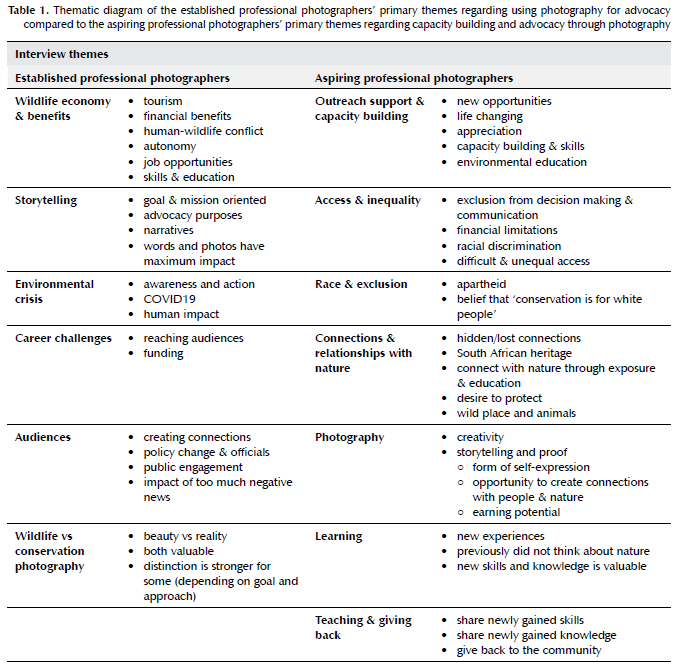
Thematic analysis (Braun & Clarke 2006) was used to analyse the themes that emerged in the interviews. I followed a process of identifying semantic themes (explicit ideas stated at the surface level of the data) before proceeding to interpreting and analysing the latent themes (underlying ideas that require deeper interpretation) (Marks & Yardley 2004; Braun & Clarke 2006). Given the complexity and variety of ideas in the data, thematic analysis is advantageous in its theoretical flexibility and foundational methodology (Braun & Clarke 2006). Thematic analysis is systematic by nature, allowing analysis of the data within a given context while preserving the complexity typical of qualitative data (Marks & Yardley 2004). Table 1 visualises the thematic outcomes of the two interview groups by combining thematically related ideas shared by the photographers.
The transformative paradigm (Mertens 2007) is an important framework that promotes direct and purposeful engagement with diverse groups, especially those who have experienced marginalisation or exclusion, with a focus on social justice. The research strived to achieve several goals outlined by Mertens (2007), including raising awareness of inequality, the need to prioritise redress, giving voice to marginalised groups, and promoting inclusion and empowerment to improve the representation of those who have experienced the least advantage in society. The transformative paradigm allows for a deeply personal, rich and layered exploration of the professional and aspiring photographers' experiences in such a way that justice is foregrounded as a vital component.
Results
The professional photographers' insights presented ways of conceptualising photography as a conservation tool to address their concerns of biodiversity conservation as a crisis. The aspiring professionals' insights provided an in-depth examination of their experiences of environmental injustices and how capacity building and photography may contribute to addressing the historical marginalisation that is still perpetuated today.
Experiencing nature through photography
For the aspiring professional photographers, creating connections with the natural environment involved taking a more encompassing attitude towards nature and wildlife, in which its protection was linked to forming close bonds with it, mostly through exposure or education. They suggested that relationships with nature are largely absent until one is either exposed to it and/or provided with knowledge about the natural environment and its importance.
One aspiring professional compared his perspectives about protecting nature before and after learning about it: Ί can say before, I heard nothing about it. I didn't have any feelings... I came to understand, ok, nature. If I can take care of nature, nature will take care of me.'
Experiential learning opportunities may expand knowledge and change perspectives to alter behaviour and may bridge the gap from exclusion to inclusion for young black South Africans, enabling them to experience spaces they were previously prohibited from. The photographers' experiences addressed the simultaneous importance of environmental protection and human well-being by repairing unjust divisions through opportunities to pursue new skills, careers, experiences and connections with people. The experiential opportunities should be more critically understood as inclusion and access as opposed to short-term and once-off opportunities to enter protected areas, which would not achieve lasting, just outcomes for community members.
Nature conservation is not only considered important for nature's sake, but also for the wellbeing of people. This is reiterated in 'we as people, we benefit from nature; and by doing so, nature will be benefitting from us', additionally, the national economy is considered in 'the country will be making money from that also'. Reciprocity between nature and people is the motivation to protect natural spaces and resources for current and future generations. To ensure reciprocity is embedded in environmentally just outcomes, the promotion of environmental protection also needs to protect the rights and well-being of communities fairly and equitably. It is necessary to examine what may be underlying the idea that many people in these communities do not have a connection or relationship with nature. One aspiring professional discussed his belief that such a relationship is 'hidden' or 'lost', suggesting something that once existed but is no longer prominent. This could potentially be tied to the notion of heritage and the ways in which apartheid severed ties to natural and cultural heritage:
It's not like people living in my community don't have a relationship with nature.They do have a relationship with nature but the relationship, I can say, is hidden. So, it needs someone who can come and just bring it out... There was a relationship because we hear about these things. Everything that they see comes from nature... So, I can say the relationship was there, but it's hidden. It needs someone to revive. I think it's because people are saying they are distanced from nature or from maybe going to a game reserve, to learn more. So, that is why I am saying the relationship is there because they are able to plant from home. So, that's nature. But they don't have the real nature, like maybe, of conserving wildlife, animals, for the wildlife that we need to make money for our country to be safe... I believe that if we really want to save nature; people need nature and nature needs people. If we can connect the local communities and the national reserves and the government. You know, all of them, just connect them together.
Another aspiring photographer stated that people are 'distanced from nature or from maybe going to game reserves, to learn more,' echoing the issues of exclusion that are responsible for this severed connection. Growing plants from home suggest that a relationship with nature exists but this is countered against the lack of a connection to 'real nature', which consists of 'conserving the wildlife, animals'. This suggests the operation of a bias, in which local community members are not currently participating in 'big' environmental actions but only small-scale actions within their homes. This is more indicative of the impact of exclusion and blame placed on local communities for not being sufficiently educated or knowledgeable about conservation.
Heritage is used to argue in favour of creating connections, especially on an emotional level that appeals to people's desires to protect what is considered inherent to being a South African, e.g., 'this is your animal'. The aspiring photographer also asked several rhetorical questions, indicating the dialogic approach he takes when engaging with others on conservation matters. 'Because without the community' served as a reminder that working with communities is more likely to achieve positive 'connections'. His own goals to be a documentary filmmaker highlight the use of photography and filmmaking as platforms that create connections and foster a sense of voice, where he tells a story through the eyes of a young black South African targeted at audiences living near protected land.
The legacy of apartheid's exclusive and divisive environmental regulations is still felt today by South Africa's youth, who are not excluded by law, but rather by the lasting impact of prejudice. Restoring access to wild places for younger generations is seen as a partial solution to conservation problems. However, there is an inextricable link between environmental injustice and human rights. Experiences of discrimination and prejudice (whether historical and/or current) underlie the need to ask for access to a space that ought to be accessible to South Africans as a whole. Connections cannot be fostered in spaces where exclusion is perceived.
Overcoming career challenges - the legacy of exclusion
Only two established professional photographers addressed issues of access and inequality in their photographic careers, noting that equipment costs and access to protected areas were prohibitive and hindered their establishment as professionals. One cited 'a lack of photography equipment' as his 'main challenge' in breaking into wildlife photography. 'Being a black photographer' was also cited as a challenge in an industry with a reputation for being 'white male-dominated'. Inequality and the challenge of gaining access to expensive resources and areas were apparent in this group but were uncommon among the white photographers. These 'uneven socio-economic influences' may also account for my difficulties in securing a diverse sample of conservation photographers. Aspiring young photographers from historically marginalised communities may face similar challenges, and therefore, capacity building and mentorship may provide valuable support.
Photography equipment is very expensive, and it was a limiting factor to start being under-resourced. Accessing prime wildlife areas is also inaccessible due to the cost implications. The industry is white male dominated so socio-economic influences play out unevenly.
Another professional photographer reflected on his perception of historical exclusion in South Africa and the impact of apartheid on 'impoverished communities' bordering protected land. Impoverishment, lack of resources and limited access to land have perpetuated exclusion and perceptions of not belonging. His use of 'legacy' highlights the enduring effects of this exclusion, which has been inadequately addressed and requires significant attention to remedy.
Exclusion has as always created the impression that wildlife is a rich or white man's prerogative, particularly in impoverished communities where survival in terms of food and water resources is important. So, it has had a negative impact in terms of land being put aside, which could have also been used theoretically for agriculture or farming or development purposes... [exclusion] definitely has a massive impact and a long-term legacy that needs to be addressed.
For the aspiring professionals, access and inequality concerning natural spaces, including national and private parks, was a common source of frustration due to its persistence today. Ongoing financial restraints, such as park fees, transport and food costs, often become exorbitant for individuals on salaries that must provide for necessities and family support. Access to protected areas is therefore unfeasible for South Africans whose resources cannot be stretched to cover the multiple expenses required to enter. One photographer noted a sense of resentment in the community, where some view the park as a waste of 'money and time'. He emphasised how 'it takes us back to apartheid', highlighting that black South Africans were only allowed into the park as workers and would likely face racism or 'even chase you at any time'. The legacy of racial exclusion was apparent in the experiences of the photographers and their communities.
We feel like we're not included... There are so many communities next to the Kruger, but only, I can say, only a fraction, maybe only two, three per cent of them get to access the wild places. So, that's why there's no connection. I think if we care for people in a way that's equal to the way that we care for nature... If we find a balance between taking care of wildlife and taking care of people, I think it will be better for both parties.
[Game reserves and parks] tend to push us away and give access to other people who are not from here. And I'm not saying that is wrong; it is very right for our economy and our wildlife, but we should have an equal chance. Telling people to stop poaching and they're telling people who don't really know the importance of protecting the wild places. They don't really know the importance of protecting the wild.
The aspiring photographers referred to the broader issues of inequality associated with feeling excluded in favour of tourists, with only a small minority perceived to be gaining access. They expressed frustration that foreign visitors are prioritised over locals who do not have the means to gain access to wild spaces, whilst their presence as 'poachers' is then criminalised. One photographer argued that the legacy of exclusion has generated a misunderstanding of the importance of wild spaces beyond their tourism value. Yet, he suggested that caring for both nature and people would provide the most beneficial overall outcome. His views highlighted the negative consequences for local communities and conservation because local people have 'no connection' with these wild places. The sentiment of being 'push[ed] away' to do what is 'right for our economy and our wildlife' suggests an unfair prioritisation of economic and conservation goals over the needs of local communities.
Fences surrounding protected areas symbolise both metaphorical and structural barriers, preventing inclusion. However, fences are also paradoxical: they were perceived as a necessary safety precaution, but their existence presents a point of separation in that community members are unaware of and excluded from what happens beyond the fence in protected land. Issues of knowledge and education regarding nature 'to conserve' were also raised, which may be argued were related to historically denied access and current issues of accessibility rather than deficient knowledge about nature or conservation. If the fence was presented only as a safety precaution it was welcomed by those bordering protected areas, but its dual purpose to prevent unauthorised access has created a sense of exclusion that prohibits accessibility beyond apartheid.
A lot of young people or a lot of people in our area are not well-educated about wildlife. They just think it's just a fence [between us], like they're blank about what's happening there... it's not just a fence [between us], but there's nature there, there's life there we have to conserve.
I think [the fence is] good, because when I grew up, I remember being from toddlers to teenagers, we would be instructed to go play in the street. I think it's good because it protects us from predators. Obviously, people can't live amongst animals in the same area. It's not really a bad thing that there is a fence; it's separating us and the animals or the wildlife on that side.
Racism is compounded by further prejudice against black women in conservation and photography. The perception that conservation is primarily the domain of white men was raised when discussing how unusual it is to find young black women in wildlife roles. They highlighted experiences of opposition and scepticism from peers. While this has not inhibited their career goals or motivation, opposition and scepticism is nevertheless a challenge they navigate. For some, this challenge is taken on to prove they are equally capable and skilled. These female photographers have encountered doubts about their strengths and abilities, and whilst they appear ready to face it ('it doesn't really restrict me from doing anything' and 'I just laugh it off'), it is apparent they are aware the prejudice exists as a dual challenge of being both black and a woman, requiring them to work harder to prove their ability in a white, male-dominated field of work.
At this point I do get a lot of that [prejudice]. Maybe we are busy with rhino dehorning or elephants, or lions. I'll get a lot of questions, like are you not scared? You think you're a white person? You think you're not going to be eaten by a lion, only white people do that. You're not supposed to do that, and a man should be doing that. So, I get a lot of that. I'm used to it;___It's not as bad as you think. If you can get involved here, you can see it's not really a white people thing or a male thing. Sometimes I just laugh it off.
I want to inspire young people, like not only male photographers. We can do it as females. Ok, I took a picture of a lion. I show it to my colleagues, and they say, 'were you not scared?' Like really wow. A little girl like you can take a picture like this. I said yes; they said, 'no, I don't think that you took this picture.' So, I want to inspire them.
The enduring notion that black South Africans have no place in natural spaces is a 'narrative' perpetuated to the extent that white people are conveyed as protectors, while black people are conveyed as being motivated by money or work alone. Through specific and frequent reference to this existing 'narrative' the aspiring photographers suggested an entrenched idea that black South Africans do not have a space in nature outside of employment purposes created by the enduring exclusion experienced by black South Africans in conservation. 'So, conversations you hear them have, like you'd hear someone say a ranger is trained to protect the [wildlife], but they only did it for the job. It's the lack of love for animals. Most black people think conservation and wildlife is a white people thing. I believe we can change the narrative.'
Photographic storytelling: advocacy and learning new skills
Initiating dialogue allows stakeholders to raise issues of personal relevance, share ideas and negotiate ways forward. Photographers are, therefore, well-positioned to contribute to effective communication about biodiversity conservation. Although the photographers here referred to conservation and wildlife, similar approaches can apply to environmental and social injustices for young aspiring photographers looking to use photography for advocacy.
I believe photographs bring nature to those detached from it. A picture could ignite one's interest in nature. Great photographs reach the inner consciousness, triggering varying emotions. For example, a local villager may remember what a problem the animal shown is and for the other how beautiful an animal is. I think by showing pictures, especially of locally threatened species coupled with education and community beneficiation, photographs can help start conversations around conservation.
Photographs rarely speak for themselves but rather offer a vehicle through which information is conveyed. For photographers who identify their work as mission-focused, photographic storytelling is used for advocacy as opposed to art. Captions on photographs, therefore, fulfil two roles: to deliver an emotive, engaging story that captures the audience's attention and to combine the art of storytelling with scientific evidence.
One thing that I learned and taught [to my students] is that the caption to a picture makes the picture worth 1 000 words... Never tell [the audience] what the picture is in the caption; tell them what the picture isn't. The second was always to tell the story that I was there to write: how does this picture tell the story? And how do I wrap the story around this particular picture because I didn't know I was going to get that picture. But now that I've got that picture, it's changing my story. So, the dynamic between the story and the picture becomes important. It is a constantly evolving process because the images would start telling the story.
What is going to stop [the audience] in their tracks from all this fraud and noise is a very well composed, well thought out, powerful image. I think that image is not the end of it, it's actually the beginning. If you have a powerful image, it will stop the person and encourage them to read the title of that image. The text that accompanies that image is powerful. It will make a person need to read the greatest story.
Photographers whose work is rooted in effecting change may positively contribute to bringing issues of injustice to light for public audiences and those in positions of authority. Furthermore, empowering local members of marginalised communities to tell stories of injustice may provide a powerful means of effecting change from a grassroots level.
Where scientific information is regarded as inaccessible to the public, photographers are well-positioned to translate it into engaging content that is easier to understand for various audiences. In this way, knowledge about the environment, conservation, and the negative impacts affecting it, may be shared with the non-academic public. However, it is still necessary to share and create this material inclusively, which aligns with the research aims in terms of photography being used as a means of voice and expression.
For me, it is a very clear combination of using powerful imagery with the right scientific supporting evidence to affect positive change.
While some educational efforts may be criticised for taking a top-down approach to teaching, some of the professional photographers emphasised targeting various groups with sensitive, carefully considered campaigns. The professional photographers were sensitive about whom their educational and awareness campaigns reached. The complexities of the environment and potential risks to it need to be elucidated in ways that are easily accessible and understandable to the general public and policymakers. Such information should be shared in ways that do not perpetuate exclusionary or top-down approaches in which knowledge deficits are assumed based on socioeconomic class, race or gender.
So, educating everybody about those values, and wanting to protect [the environment] is ultimate... So of course, this is where we as educators need to come into play, whether it is taking school kids in, whether it is creating other facilities that can create training.
We need to conduct educational talks throughout our villages and schools to educate our people about the fauna and flora. We can host talks abroad to recruit more wildlife or conservation photographers and share our work through every platform to reach [global audiences] ... If we accommodate good numbers [of local residents] in our camps we can manage to help everyone, therefore they will conserve [the environment] knowing that everything is available for them.
The aspiring professionals discussed several appealing characteristics of photography, including storytelling, self-expression, creating connections and earning potential. They viewed photography primarily as a means of storytelling and self-expression and enjoyed creatively engaging with a subject. There was a strong sense of pride in creating an artistic piece requiring skill, experience and creativity. They reflected on self-expression and storytelling in ways imbued with freedom and creativity. One appealing impact of sharing stories visually was that the photographers believed it created a stronger emotional connection, despite it being a silent medium.
One aspiring photographer emphasised that his work had 'greater impact as opposed to another person from a different place telling those stories,' highlighting the importance of local voices telling local stories. His voice as a young black South African adds authenticity to his photographic storytelling. Therefore, photography offers young South Africans a platform to showcase their experiences. This in itself may serve to empower them and challenge the perpetuation of marginalisation: 'I think when the youth see me telling stories about the wild places, I think it will make a much greater impact as opposed to another person from a different place telling those stories.'
One aspiring photographer asserted his photography could serve as evidence for conservation, helping viewers who are unfamiliar with the daily realities of nature conservation or those not closely connected to land or wildlife understand and appreciate conservation. He therefore saw value in using photography to lead an audience towards understanding, appreciating and supporting efforts that outreach participants have become aware of. 'Without pictures' conservationists would experience more difficulty in proving the validity and necessity of their work, according to the photographer. Photography, therefore, provides a platform to share, communicate and connect.
The aspiring photographers expressed similar feelings regarding the impact of learning photography through the outreach programme, highlighting the family-like bond amongst participants. They valued the new skills, experiences and opportunities; the ability to network with other aspiring and established professionals; and empowerment. They also had a desire to share their skills and knowledge, and an appreciation for the long-term commitment of the outreach towards its participants.
I attended the Wild Shot Outreach course; I picked up the camera, and I never want to put it down ever again. Besides wanting to raise awareness, I want people to see nature through my eyes.
[Photography] is fun, this is enjoyable, and it's something that you can use to create a relationship with different people. Different people around the world. Different people, anywhere. Obviously, when you get [to a shoot], you need to communicate with those people. How do you want your picture [taken]? And after shooting the event, you need to communicate with people, like when they see you, they ask some questions: how do you become a photographer? How are you doing this? So, you get to reach out and make contact with those people that are asking questions and also everyone that is there. And also, after the event you need to get feedback from them: how was my work? How were my pictures? Did you enjoy the pictures? Are the pictures ok? It lets you interact with them, with every person that is your customer. Or maybe you just create something... It's all about interaction.
Two aspiring photographers used the phrase 'one day', highlighting their initial perceptions of the outreach and what they had gained from it. Both saw potential for themselves and the community, and believed future opportunities would arise from the initial workshop. One participant exceeded his goal of becoming an assistant and now runs workshops himself, demonstrating second-order capacity building (Salafsky et al. 2002).
Learning about photography through the outreach opened doors for the participants, inspiring them to seek opportunities in previously unexplored areas, including career guidance, photojournalism and other possibilities, particularly those that involved fellow community members. This was another indication of the empowering advantages of second-order capacity building, in which participants used their skills to further uplift others. This positive influence was apparent not only in the content taught during the workshops but also in its sustained engagement, supportive environment, and focus on creating connections and networking. Thus, the outreach's objectives expanded from capacity building and environmental connection towards long-term goals that empower young people to utilise their skills in various ways.
The statement 'I did learn quite a lot from the outreach, not only like photography wise, but life in general' suggests that the outreach has conducted capacity building that meets the needs of young participants. Although the initial focus was on photographic skills, it broadened towards skills that can be useful in everyday life, particularly for youth seeking knowledge and opportunities in the working world. Photography-related careers have a special appeal for many young participants, and inclusion in the workshops created opportunities for them to use the connections and skills gained from the outreach to pursue careers. This affirms that capacity building can foster skills that can be used independently and will likely be used in ways that benefit more people as a result of sharing skills.
Another common theme was a desire by aspiring photographers to give back to their communities following their own capacity-building experiences, an aspect of capacity building that is largely absent in the literature. It is possible that capacity building may be extended beyond second-order capacity building (Salafsky et al. 2002) to the more personal desire to uplift others within one's community. The photographers spoke selflessly about sharing their newly acquired skills and knowledge with other youths. This has been achieved in various ways, including teaching workshops, creating collaborative opportunities with other young photographers and running charitable collections. Their language illustrated an inclusive approach, as seen in 'maybe this is one more person that could get involved in wildlife conservation'; 'more youth doing the course and more youth getting the opportunity to learn more about the wild places' and 'get more people from the local community into the reserve and get a chance to also experience wild places'. These extracts focus not only on passing on knowledge or teaching but also show their motivation to include young South Africans in the opportunities they have experienced. There was a strong sense of community rather than only individual upliftment, with photographers demonstrating the ripple effect of empowerment and the empowering nature of second-order capacity building.
I went online and checked Wild Shots Outreach, for me it was not about doing photography alone but to participate in a programme that helped the young in our community to visit the Kruger National Park...for me getting into Wild Shots, I knew if I kept on pushing [the WSO director], pushing and pushing, one day I would get to work with him and that would be a huge benefit for our community, meaning there would be more youth doing the Wild Shots course and more youth getting the opportunity to learn more about the wild places.
... in me transferring my skills with them and also having some of them working with me in some of my shoots. And I help my friends and other people who are interested in photography and video. The long-term plan is to get more people from the local community into the reserve and experience and get a chance to also experience wild places.
And with all that has been done for me, I feel there's a lot I need to give back. Even, though it doesn't have to be for Wild Shots, it can be for children, orphanages or somewhere. I believe it, there is something for me to give back to people.
Discussion
The professional photographers emphasised that conservation photography is rooted in purpose, advocacy and science. Similarly, Ward (2008) considers conservation photography to be 'a vehicle for science' (p. 46), in which images and information are shared in the public sphere and amongst policymakers, which aligns with its roots in documentary photography (Ward 2008; Farnsworth 2011). This mission focus (Mittermeier 2005) may be likened to Soulé (1986)'s definition of conservation biology as a crisis discipline, responding to an urgent need to address environmental concerns. Conservation photography is a means of responding to environmental crises by encouraging action and awareness, making it an important tool to communicate and advocate for environmental issues.
The professional photographers' views supported the existing literature regarding photography and storytelling. They emphasised the importance of collaborating and sharing images across platforms to raise awareness and educate targeted audiences (Seelig 2015). Both professional and aspiring photographers discussed storytelling as a means to engage with and move viewers emotionally (Seelig 2015) in a social manner (Hanisch et al. 2019). Some aspiring photographers mentioned the relational and connective nature of photography in connecting with viewers and photographic subjects. They noted that learning the craft fosters social opportunities and connections with both viewers and subjects.
Farnsworth (2011) demonstrated that conservation photographers are well positioned as environmental educators and advocates based on their array of skills and experiences, which include their ecological and environmental knowledge, their ability to effectively communicate and collaborate, and the opportunity to represent communities affected by environmental challenges. Like the professional photographers here, Farnsworth (2011) found conservation photographers demonstrated an in-depth and accurate understanding of the ecology, biodiversity and socio-political knowledge of their photographic subjects. Through their need to communicate accurate information, the photographers prioritised evidence-based information alongside their photographs. As such, they have been recognised as experts through several accolades, confirming that they are well positioned as environmental educators.
Representing affected communities is particularly noteworthy in this context. The aspiring professionals all resided in a community impacted by historical marginalisation and its legacy. Likewise, they have experienced the burdens of environmental injustices and by providing empowerment and a platform to share local voices, photography may help aspiring youth represent their communities and raise awareness of important issues, environmental or otherwise. Their stories of exclusion echoed Iqani and Judge's (2025) that environmental issues have always been closely connected to social and political structures. The aspiring photographers were able to 'challenge, transgress and change' (Wood & Meyer 2022, p. 29) the lack of inclusivity in conservation and photography through their visual storytelling and contribute to decolonised ways of understanding the impact of fortress conservation (Fernández-Llamazares & Cabeza 2017), such as those associated with the creation of the Kruger National Park.
The aspiring photographers' visual stories elicited conversations about environmental and social injustices so 'they may be recognised in new ways as people with complex social histories and insights about equity and justice', thereby confirming that storytelling is a valuable tool in critical literacy (Enciso 2011, p. 21) and conveying 'affective encounters' (Iqani & Judge 2025) through the medium of photography. By merging photographs and stories, the participants expressed issues of personal importance, in which storytelling elicited something personal and meaningful. Their keen interest in photographic storytelling created a platform 'to name what matters to them, to speculate about what is possible in their lives, to unravel contradictions, to make sense of what is senseless, to claim or question a point of view, to wonder and to act'. Using photographic stories generated unique opportunities to raise issues of injustice among peers, community members and the wider public, such as Ngobeni (2024)'s call for greater representation of young black photographers.
The research expands upon Iqani and Judge (2025)'s notion of affective encounters by utilising the medium of photography for storying the impact of environmental injustices on young people, but also upon how photography can be transformative as a notion of reparative practice to reconnect and 'reignite healthy ... and mutually beneficial relationships' to nature (Malatjie 2024) in light of the environmental injustices committed under apartheid's legacy. The stories showcased here contribute to calls to decolonise knowledge and promote diversity and inclusivity (Fernández-Llamazares & Cabeza 2017; Schellnack-Kelly 2018), but also as a demonstration that conservation stories by young black South Africans can 'reconfigure global scholarly conversations' (Iqani & Judge 2025). Environmental activists from the global south, like Vanessa Nakarte, have been undermined (Barnes 2021), but the stories presented here aim to contribute their voices to conservation literature.
The research is limited by a small sample size for both established professional photographers and the aspiring photographers. However, qualitative research methods, such as the case study, rely on achieving greater depth and richness in data collection rather than breadth (Yin 2018). Data triangulation in this study, achieved through qualitative group and individual interviews, photographs and written captions, allowed for the collection of rich data that explored the issues under study in greater depth (Denzin 2015). Furthermore, Fusch et al. (2018) promote data triangulation as a valuable means of enhancing data saturation, reducing bias and improving social change through research. However, future research may benefit from conducting similar exploratory studies in more South African communities bordering protected areas to develop a knowledge base and collection of stories of the context-specific experiences of diverse groups across geographical, cultural and historical backgrounds.
Conclusion
The study explored how established conservation photography professionals and aspiring photographers from historically marginalised communities use photographic storytelling for advocacy purposes. In so doing, the youth participants addressed the importance of first improving the representation of black South African youth in photography and conservation spaces and how to empower aspiring photographers to enter these professional spaces by developing social networks, communication skills, technical photographic skills and engaging stories. Bringing attention to aspiring youth through photographic storytelling is considered a platform and potential for momentum to share their stories and photographs, thus improving the diversity of conservation knowledge and encouraging critical discourse regarding exclusion and representation. Without such a platform, aspiring photographers face challenges of access and representation, which limit their ability to advocate for the environment as the professionals do. South Africa is a naturally and culturally diverse country and promoting the stories and experiences of communities across the country can improve representation in conservation spaces and highlight voices historically silenced or unheard in biodiversity protection. Storytelling offers an impactful means of inclusion and reparation. The communities within Bush-buckridge still bear the brunt of historical marginalisation, but promoting their stories and experiences of conservation can make the first steps towards reparation and a more inclusive path forward to conserve biodiversity in the Lowveld region of South Africa.
Ethical clearance
Ethical approval was secured from the Humanities Academic Ethics Committee at the University of Johannesburg (Ethical clearance number: REC-02-170-2019)
Competing interests
None.
Funding statement
This research received no specific grant from any funding agency in the public, private, or not-for-profit sectors.
Acknowledgements
I would like to thank my supervisor, Brendon Barnes, for his invaluable feedback on the initial drafts of this manuscript.
References
-
Ali, M.I., 2013, 'Stories/storytelling for women's empowerment/empowering stories', Women S Studies International Forum 45, 98-104, https://doi.org/10.1016/j.wsif.2013.10.005.
» https://doi.org/10.1016/j.wsif.2013.10.005 -
Anthony, B., 2007, 'The dual nature of parks: attitudes of neighbouring communities towards Kruger National Park, South Africa', Environmental Conservation 34(3), 236-245, https://doi.org/10.1017/s0376892907004018.
» https://doi.org/10.1017/s0376892907004018 -
Barnes, B.R., 2021, 'Reimagining African women youth climate activism: the case of Vanessa Nakate', Sustainability 13(23), 13214, https://doi.org/10.3390/su132313214.
» https://doi.org/10.3390/su132313214 -
Bartlett, C., Marshall, M. & Marshall, A., 2012, 'Two-eyed seeing and other lessons learned within a co-learning journey of bringing together indigenous and mainstream knowledges and ways of knowing', Journal of Environmental Studies and Sciences 2(4), 331-340, https://doi.org/10.1007/s13412-012-0086-8.
» https://doi.org/10.1007/s13412-012-0086-8 -
Bayer, S. & Hettinger, A., 2019, 'Storytelling: a natural tool to weave the threads of science and community together', Bulletin of the Ecological Society of America 100(2), https://doi.org/10.1002/bes2.1542.
» https://doi.org/10.1002/bes2.1542 -
Bowles, L.R., 2017, 'Doing the snap: storytelling and participatory photography with women porters in Ghana', Visual Anthropology Review 33(2), 107-118, https://doi.org/10.1111/var.12129.
» https://doi.org/10.1111/var.12129 -
Braun, V. & Clarke, V., 2006, 'Using thematic analysis in psychology', Qualitative Research in Psychology 3(2), 77-101, https://doi.org/10.1191/1478088706qp063oa.
» https://doi.org/10.1191/1478088706qp063oa -
Brittain, S., Ibbett, H., De Lange, E., Dorward, L., Hoyte, S., Marino, A., Milner-Gulland, E.J., Newth, J., Rakotonarivo, S., Veríssimo, D. & Lewis, J., 2020, 'Ethical considerations when conservation research involves people', Conservation Biology 34, 925-933, https://doi.org/10.1111/cobi.13464.
» https://doi.org/10.1111/cobi.13464 - Carruthers, J., 1995, The Kruger National Park: a social and political history, University of Natal Press, Pietermaritzburg.
-
DeCaro, D. & Stokes, M., 2008', 'Social-psychological principles of community-based conservation and conservancy motivation: attaining goals within an autonomy-supportive environment', Conservation Biology 22(6), 1443-1451, https://doi.org/10.1111/j.1523-1739.2008.00996.x.
» https://doi.org/10.1111/j.1523-1739.2008.00996.x -
Denzin, N.K., 2015, 'Triangulation', The Blackwell Encyclopedia of Sociology [Preprint], https://doi.org/10.1002/9781405165518.wbeost050.pub2.
» https://doi.org/10.1002/9781405165518.wbeost050.pub2 -
Dlamini, J.S.T., 2020, Safari nation: a social history of the Kruger National Park, https://openlibrary.org/books/OL2947-6454M/Safari_Nation.
» https://openlibrary.org/books/OL2947-6454M/Safari_Nation -
Domínguez, L. & Luoma, C., 2020, 'Decolonising conservation policy: how colonial land and conservation ideologies persist and perpetuate Indigenous injustices at the expense of the environment', Land 9(3), 65, https://doi.org/10.3390/land9030065.
» https://doi.org/10.3390/land9030065 - Enciso, P., 2011, Storytelling in critical literacy pedagogy: removing the walls between immigrant and non-immigrant youth', English Teaching: Practice and Critique, 10(1), 21-40.
-
Farnsworth, B.E., 2011, 'Conservation photography as environmental education: focus on the pedagogues', Environmental Education Research 17(6), 769-787, https://doi.org/10.1080/13504622.2011.618627.
» https://doi.org/10.1080/13504622.2011.618627 -
Fernández-Llamazares, Á. & Cabeza, M., 2017, 'Rediscovering the potential of Indigenous storytelling for conservation practice', Conservation Letters 11(3), https://doi.org/10.1111/conl.12398.
» https://doi.org/10.1111/conl.12398 -
Fusch, P., Fusch, G.E. & Ness, L.R., 2018, 'Denzin's paradigm shift: revisiting triangulation in qualitative research', Journal of Social Change 10(1), https://doi.org/10.5590/josc.2018.10.1.02.
» https://doi.org/10.5590/josc.2018.10.1.02 -
Gavin, M.C., McCarter, J., Berkes, F., Mead, A.T.P., Sterling, E.J., Tang, R. & Turner, N.J., 2018, 'Effective biodiversity conservation requires dynamic, pluralistic, partnership-based approaches', Sustainability 10(6), 1846, https://doi.org/10.3390/su10061846.
» https://doi.org/10.3390/su10061846 -
Gould, R.K., Phukan, I., Mendoza, M.E., Ardoin, N.M. & Panikkar, B., 2017, 'Seizing opportunities to diversify conservation', Conservation Letters 11(4), e12431, https://doi.org/10.1111/conl.12431.
» https://doi.org/10.1111/conl.12431 -
Hanisch, E., Johnston, R. & Longnecker, N., 2019, 'Cameras for conservation: wildlife photography and emotional engagement with biodiversity and nature', Human Dimensions of Wildlife, 24(3), 267-284, https://doi.org/10.1080/10871209.2019.1600206.
» https://doi.org/10.1080/10871209.2019.1600206 -
Iqani, M. & Judge, M., 2025, 'Affective encounters: storying in South African environmental communication', Environmental Communication 19(1), 1-11, https://doi.org/10.1080/17524032.2024.2427296.
» https://doi.org/10.1080/17524032.2024.2427296 -
Jagadeesh, S.N., 2024, 'Changing natures: a perspective on youth and conservation futures', Frontiers in Human Dynamics 6, https://doi.org/10.3389/fhumd.2024.1290856.
» https://doi.org/10.3389/fhumd.2024.1290856 -
Kanjere, M.K. & Choenyane, L.C., 2021, 'The effect of socio-economic challenges of youth unemployment in Limpopo on the economy of South Africa', Commonwealth Youth and Development 19(1), 1-23, https://doi.org/10.25159/2663-6549/9727.
» https://doi.org/10.25159/2663-6549/9727 - Koithan, M., 1994, 'The seeing self: photography and storytelling as a health promotion methodology', in P.L. Chinn & J. Watson (eds), Art and Aesthetics in Nursing, (pp. 247-261), National League for Nursing.
-
Mago, P. & Gunwal, I., 2019, 'Role of women in environment conservation', SSRN Electronic Journal [Preprint], https://doi.org/10.2139/ssrn.3368066.
» https://doi.org/10.2139/ssrn.3368066 -
Malatjie, P., 2024, Quiet ground, https://www.investeccapetownartfair.co.za/story/6620f01a353b7b00123dae56 (viewed: 11 June 2025).
» https://www.investeccapetownartfair.co.za/story/6620f01a353b7b00123dae56 -
Marks, D.F. & Yardley, L., 2004, 'Content and thematic analysis', in D.F. Marks & L Yardley (eds), Research methods for clinical and health psychology, (pp. 56-68), https://doi.org/10.4135/9781849209793.n4.
» https://doi.org/10.4135/9781849209793.n4 -
McCallum, I., 2005, Ecological intelligence: rediscovering ourselves in nature, https://openlibrary.org/books/OL22541839M/Ecological_intelligence.
» https://openlibrary.org/books/OL22541839M/Ecological_intelligence -
Mertens, D.M., 2007, 'Transformative considerations: inclusion and social justice', American Journal of Evaluation, 28(1), 86-90, https://doi.org/10.1177/1098214006298058.
» https://doi.org/10.1177/1098214006298058 -
Mittermeier, C., 2005, 'Conservation photography: art, ethics, and action', International Journal of Wilderness 11(3), 8-13, https://www.umt.edu/media/wilderness/NWPS/documents/IJWApr05_mittermeier.pdf.
» https://www.umt.edu/media/wilderness/NWPS/documents/IJWApr05_mittermeier.pdf -
Moezzi, M., Janda, K.B. & Rotmann, S., 2017, 'Using stories, narratives, and storytelling in energy and climate change research', Energy Research & Social Science 31, 1-10, https://doi.org/10.1016/j.erss.2017.06.034.
» https://doi.org/10.1016/j.erss.2017.06.034 -
Ngobeni, W., 2024, 'Why are there so few Black African photographers?', https://www.getaway.co.za/photography/why-are-there-so-few-black-wildlife-photographers (viewed: 11 June 2025).
» https://www.getaway.co.za/photography/why-are-there-so-few-black-wildlife-photographers -
Pennebaker, J.W. & Seagal, J.D., 1999, 'Forming a story: the health benefits of narrative', Journal of Clinical Psychology 55(10), 1243-1254, https://pubmed.ncbi.nlm.nih.gov/11045774/.
» https://pubmed.ncbi.nlm.nih.gov/11045774/ -
Pileggi, M. & Morgan, E., 2017, 'Storytelling as action: exploring transformation', in T. Milstein, M. Pileggi & E. Morgan (eds), Environmental communication pedagogy and practice, (pp. 159-166), Routledge Imprint, https://doi.org/10.4324/9781315562148.
» https://doi.org/10.4324/9781315562148 -
Porter, E., 2015, 'Gendered narratives: stories and silences in transitional justice', Human Rights Review 17(1), 35-50, https://doi.org/10.1007/s12142-015-0389-8.
» https://doi.org/10.1007/s12142-015-0389-8 -
Price, M., Winter, K.B. & Jackson, A., 2021, 'Towards resilience in the Anthropocene: transforming conservation biology through Indigenous perspectives', Pacific Conservation Biology 27(4), 309-319, https://doi.org/10.1071/pcv27n4_fo.
» https://doi.org/10.1071/pcv27n4_fo -
Salafsky, N., Margoluis, R., Redford, K.H. & Robinson, J.G., 2002, 'Improving the practice of conservation: a conceptual framework and research agenda for conservation science', Conservation Biology 16(6), 1469-1479, https://doi.org/10.1046/j.1523-1739.2002.01232.x.
» https://doi.org/10.1046/j.1523-1739.2002.01232.x -
Schellnack-Kelly, I., 2018, 'The role of storytelling in preserving Africa's spirit by conserving the continent's fauna and flora', Mousaion South African Journal of Information Studies 35(2), 17-27, https://doi.org/10.25159/2520-5293/1544.
» https://doi.org/10.25159/2520-5293/1544 -
Schusler, T.M., Krasny, M.E., Peters, S.J. & Decker, D.J., 2009, 'Developing citizens and communities through youth environmental action', Environmental Education Research, 15(1), 111-127, https://doi.org/10.1080/13504620802710581.
» https://doi.org/10.1080/13504620802710581 -
Seelig, M.I., 2015, 'Advocating environmental issues beyond photography', Qualitative Research Reports in Communication, 16(1), 46-55, https://doi.org/10.1080/17459435.2015.1086420.
» https://doi.org/10.1080/17459435.2015.1086420 - Sonn, C.C., Stevens, G. & Duncan, N., 2013, 'Decolonisation, critical methodologies and why stories matter', in G. Stevens, N. Duncan & D. Hook (eds), Race, memory and the apartheid archive: Towards a transformative psychosocial praxis, (pp. 295-314), Palgrave Macmillan UK, London.
- Soulé, M.E., 1986, 'Conservation biology and the Real World', in M.E. Soulé (ed.), Conservation biology. The science of scarcity and diversity, (pp. 1-12), Sinauer Associates.
- Tracy, S.J., 2020, Qualitative research methods, ed. 2, John Wiley and Sons.
-
Ward, C., 2008, Conservation photography, Unpublished MSc thesis, University of Florida, https://ufdcimages.uflib.ufl.edu/UF/E0/02/18/60/00001/ward_r.pdf.
» https://ufdcimages.uflib.ufl.edu/UF/E0/02/18/60/00001/ward_r.pdf -
Wood, N. & Meyer, F., 2022, 'Just stories: the role of speculative fiction in challenging the growing climate apartheid', Psychology in Society (PINS) 63(1), 29-51, https://scielo.org.za/scielo.php?script=sci_arttext & pid=S1015-60462022000100003.
» https://scielo.org.za/scielo.php?script=sci_arttext & pid=S1015-60462022000100003 -
Woodside, A.G., 2010, Case study research: theory, methods, practice, https://ci.nii.ac.jp/ncid/BB03179476.
» https://ci.nii.ac.jp/ncid/BB03179476 -
Yanou, M.P, Ros-Tonen, M.A.F., Reed, J., Moombe, K. & Sunderland, T., 2023, 'Integrating local and scientific knowledge: The need for decolonising knowledge for conservation and natural resource management', Heliyon, 9(11), e21785, https://doi.org/10.1016/j.heliyon.2023.e21785.
» https://doi.org/10.1016/j.heliyon.2023.e21785 - Yin, R.K., 2018, Case study research and applications, ed. 6, Sage publications, Thousand Oaks, California.

Accepted: 13 February 2026
Published: 31 August 2026
Supplementary material
Available online: http://dx.doi.org/10.38201/abc.v56.1.a10
Supplementary material: 'Supplement 1: Photographer and conservationist questions' & 'Supplement 2: Aspiring photographers questions'
DISCLAIMER: Please note that supplementary materials are not edited, proofread or designed by SANBI Graphics and Editing and is the sole work and responsibility of the author(s).