African Biodiversity & Conservation: an open access, free to publish journal for research on African biodiversity and conservation
In this editorial we provide an overview of the journal African Biodiversity & Conservation (ABC, www.abcjournal.org/): 'A journal that publishes scientifically robust peer-reviewed studies on African biodiversity and conservation in a manner that is free, accessible and ethical, and that maintains high quality standards throughout'. ABC is one of only four ISI-listed platinum open access journals focussing on African biodiversity. The journal is financially supported by, but editorially independent from, the South African National Biodiversity Institute (SAN-BI). There is no requirement on readers to pay for access nor on authors to pay to publish, although if a research grant provides funds for author page charges, we are keen to establish the principle that SANBI should not subsidise such publications. Unlike many other journals, the production team of ABC is in-house, allowing us to ensure that production standards are high. The scope of the journal is self-explanatory: 1, the research must be directly on African issues; 2, it must be focussed on biodiversity; 3, there should be a link through to conservation management and policy in a broad sense; and finally, 4, the research must be well conducted and noteworthy. We provide various examples of what ABC regards as noteworthy and what sorts of submissions are not considered. Parochial articles will be considered if they link to broader lessons or a broader audience, otherwise a local or more discipline-specific journal would be more suited. The aim is to be inclusive; ABC will not chase impact factors. We also evaluate how ABC currently addresses the various developing international standards in biodiversity data management and publishing ethics. The journal is indexed in the Directory of Open Access Journals (DOAJ), is listed on the Institute for Scientific Information (ISI) Web of Science, and aims to support FAIR data standards and to meet the principles of Plan S. ABC follows a largely traditional model with a growing board of Associate Editors relying on reviewers from Africa and elsewhere to ensure a robust and scientifically rigorous peer-review process. Please get in touch if you are keen to be involved in the journal in whatever capacity. We welcome input, advice, criticism, but most of all noteworthy submissions on African biodiversity and conservation.
Bothalia; journal; Africa; biodiversity; conservation; free to publish; open access
African Biodiversity & Conservation: an open access, free to publish journal for research on African biodiversity and conservation
Anthony R. MageeI, II, *; John R. WilsonIII, IV
ISouth African National Biodiversity Institute, Compton Herbarium, Claremont 7735, Cape Town, South Africa
IIDepartment of Botany & Plant Biotechnology, University of Johannesburg, Auckland Park, Johannesburg, South Africa
IIISouth African National Biodiversity Institute, Kirstenbosch Research Centre, Claremont 7735, Cape Town, South Africa
IVCentre for Invasion Biology, Department of Botany and Zoology, Stellenbosch University, Stellenbosch, South Africa
In this editorial we provide an overview of the journal African Biodiversity & Conservation (ABC, www.abcjournal.org/): 'A journal that publishes scientifically robust peer-reviewed studies on African biodiversity and conservation in a manner that is free, accessible and ethical, and that maintains high quality standards throughout'. ABC is one of only four ISI-listed platinum open access journals focussing on African biodiversity. The journal is financially supported by, but editorially independent from, the South African National Biodiversity Institute (SAN-BI). There is no requirement on readers to pay for access nor on authors to pay to publish, although if a research grant provides funds for author page charges, we are keen to establish the principle that SANBI should not subsidise such publications. Unlike many other journals, the production team of ABC is in-house, allowing us to ensure that production standards are high.
The scope of the journal is self-explanatory: 1, the research must be directly on African issues; 2, it must be focussed on biodiversity; 3, there should be a link through to conservation management and policy in a broad sense; and finally, 4, the research must be well conducted and noteworthy. We provide various examples of what ABC regards as noteworthy and what sorts of submissions are not considered. Parochial articles will be considered if they link to broader lessons or a broader audience, otherwise a local or more discipline-specific journal would be more suited. The aim is to be inclusive; ABC will not chase impact factors. We also evaluate how ABC currently addresses the various developing international standards in biodiversity data management and publishing ethics. The journal is indexed in the Directory of Open Access Journals (DOAJ), is listed on the Institute for Scientific Information (ISI) Web of Science, and aims to support FAIR data standards and to meet the principles of Plan S. ABC follows a largely traditional model with a growing board of Associate Editors relying on reviewers from Africa and elsewhere to ensure a robust and scientifically rigorous peer-review process. Please get in touch if you are keen to be involved in the journal in whatever capacity. We welcome input, advice, criticism, but most of all noteworthy submissions on African biodiversity and conservation.
Keywords: Bothalia, journal, Africa, biodiversity, conservation, free to publish, open access.
The need for a journal on African biodiversity and conservation
Africa is endowed with remarkable natural wealth and an enviably diverse assemblage of ecosystems and habitats. More than a quarter of the world's biodiversity hotspots (9 of the 35 currently recognised) are located in this, the poorest and second most populous continent (IPBES 2018). Cataloguing this tremendous biodiversity is far from complete, especially as biodiversity hotspots likely contain the majority of undescribed species, most of which are likely to be threatened with extinction (Joppa et al. 2011). Sustained maintenance of this rich biodiversity, and the services rendered (at local, regional and global levels) by its varied ecosystems, increasingly need to align with the urgent priorities for economic development and improved human wellbeing (Chapman et al. 2022). It is anticipated that the human population on the continent will quadruple in the next 80 years (United Nations Department of Economic and Social Affairs Population Division 2015) with massive urbanisation (Cartwright 2015), precipitating rapidly expanded pressures on land, aquatic systems and biodiversity. Higher consumption levels will necessitate agricultural development and likely lead to increased hunting pressures (Lambin & Meyfroidt 2011); increased pressure on forests for fuelwood and building material (Fisher 2010); increased pressures on fisheries (Allison et al. 2009); and, with almost 30% of the world's minerals, the pressure for development through mining will be intense. The associated direct and indirect impacts of these pressures on biodiversity will be significant. Complicating these already considerable pressures, Africa is likely to be the continent hardest hit by climate change (IPCC 2014).
Scientific research is an important driver of economic growth and development, and essential if Africa's environmental challenges are to be addressed equitably at appropriate scales. Rapid publication and access to this research is important for African policymakers to make informed science-based decisions that support the region. African scientific production is the fastest growing of any continent (an increase in scientific papers produced of 38.6% between 2012 and 2016), with the number of authors also increasing by 43% over the same period (Duermeijer et al. 2018).
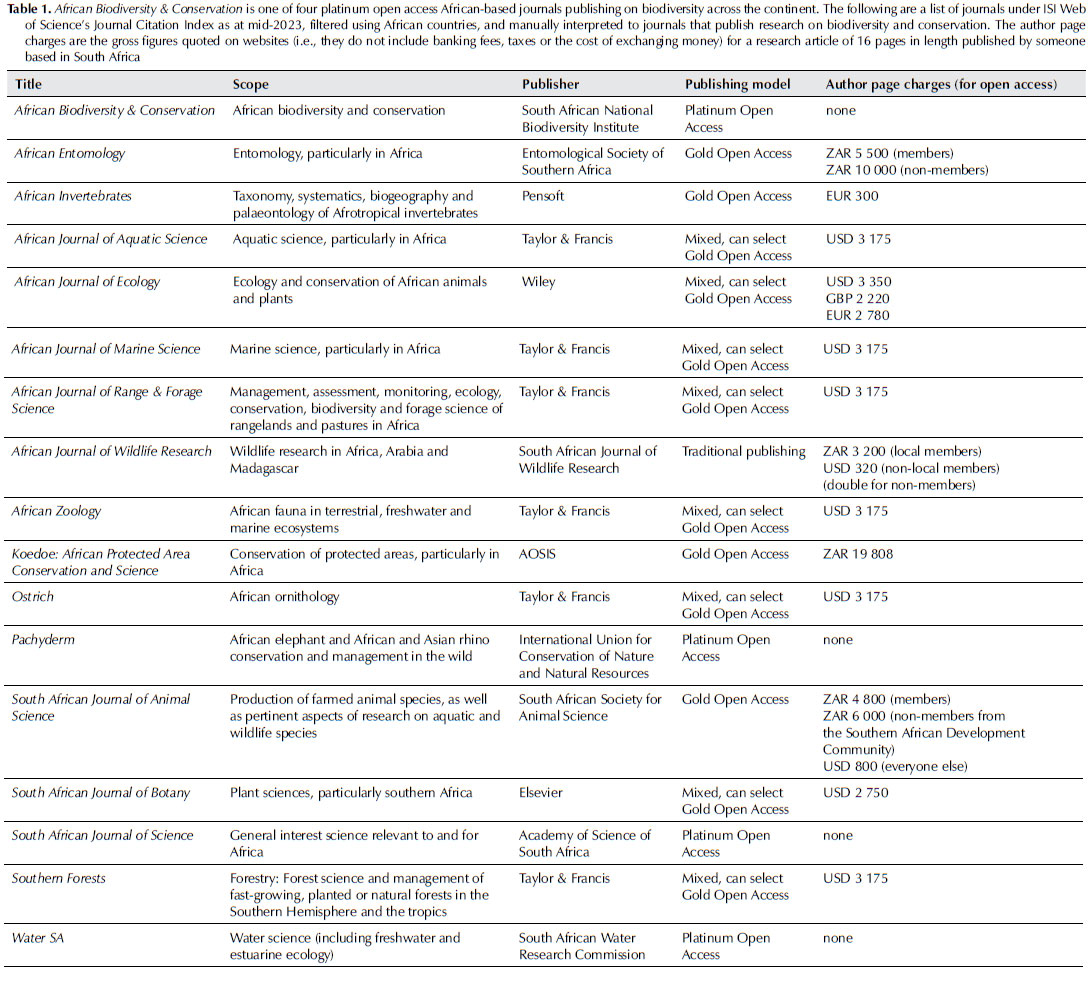
One of the stumbling blocks is ensuring access to information. The global drive for open access scientific publishing, while making scientific literature more accessible, has the potential to limit the publication of research by the Global South due to the cost of open access publishing fees (Table 1; Smith et al. 2021; Kwon 2022) and increase geopolitical knowledge inequality by drowning out the visibility of developing nation research (Demeter & Istratii 2020). The publishing models of scientific journals is generally either pay to access or pay to publish - if research is to be subsidised, it likely only happens when such research aligns with the agendas of journals based outside of Africa, reviewed by institutions outside of Africa, and that will contribute to the reputation of the journal (e.g., through the impact factor). Well-conducted relevant local research is not routinely regarded as important to the wider international scientific community, but such context-specific research should be the foundation of decisions that need to be made on the continent.
Facilitating intra-African collaborations is also vital. Species distributions and how they are impacted by global change cut across national boundaries. Biological invasions in Africa can be due to introductions to any part of the continent, and so biosecurity is a pan-African issue (Faulkner et al. 2017, 2020). Management decisions therefore can have international consequences. A classical biological control agent released in one country can disperse to other countries, providing significant benefits by reducing plant invasions (Langa et al. 2020)
but also potential conflicts (Paterson & Witt 2022). These point to the need for African-wide perspectives rather than solutions from abroad. There are, however, relatively few African-based open access journals that publish biodiversity research (Table 1) and of these only four appear to be both listed on ISI-Web of Science and free to publish and access, i.e., platinum open access. Of these four only African Biodiversity & Conservation publishes across the broad scope of biodiversity.
Since the first issue of African Biodiversity & Conservation was published in 1922, the scope and title of the journal has expanded. The journal was first published under the name Bothalia, as an institutional journal of the then Botanical Research Institute (BRI). The BRI merged with other institutions and eventually in 2004 became part of the newly established South African National Biodiversity Institute (SANBI). Bothalia continued to be published by SANBI until 2013 (volume 43). The following year, publication was shifted to the Cape Town based publisher AOSIS under the title Bothalia, African Biodiversity & Conservation. In 2020 the journal moved back to being published in-house by SANBI under the title Bothalia, African Biodiversity & Conservation. In 2025, the prefix was dropped, and the title updated to African Biodiversity & Conservation (ABC for short). ABC is now an ISI-listed platinum open access journal with dedicated support for journal production from SANBI. We are enormously grateful to Prof. Michelle Hamer, the previous Editor-in-Chief of ABC, for pioneering this publishing model. We came on as co-Editors-in-Chief in July 2022, and have since focussed on building on her foundation and codifying how the journal is run.
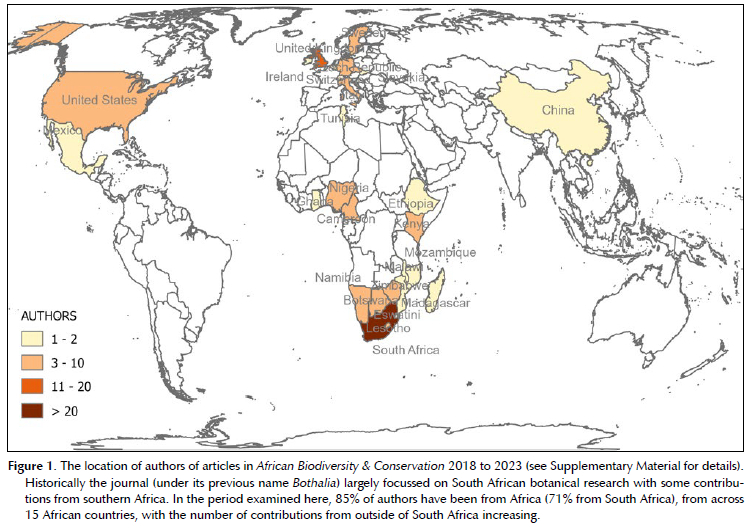
Until 2014, almost all papers published in the journal were botanical, and the majority included an author based at SANBI. In the years since, and as reflected by the change in title, the scope has broadened to biodiversity, and over the last few years the majority of authors are from outside of SANBI, and increasingly from around the continent (Figure 1).
Based on this we developed a vision for the journal ABC:
'A journal that publishes scientifically robust peer-reviewed studies on African biodiversity and conservation in a manner that is free, accessible and ethical, and that maintains high quality standards throughout.'
The scope of ABC
We recognise there is a rich variety of knowledge systems and types of papers; ABC will try to be flexible and accommodating, but we take a literal approach to the scope.
1. The research must be directly on African issues
We are keen for submissions from Santo Antao in Cabo Verde in the west to Ile Rodrigues in the Indian Ocean to the east, and from Cani Islands in Tunisia to Cape Agulhas in South Africa. This is a rich and varied bio-geography. ABC does not, however, consider South Africa's sub-Antarctic islands (i.e., the Prince Edward Islands) to be part of Africa, nor any of the Mediterranean islands, except those that form part of African countries (e.g., Tunisia's Galite Islands). As such, we aim to follow the United Nations geoscheme for Africa.
Authors can be based anywhere but the research must be directly on African issues. We welcome papers from those based at African institutions, from the African diaspora and from non-Africans based at non-African institutions (Figure 1).
2. The research must be relevant to biodiversity
We are keen to publish work from genes to ecosystems and across all realms in line with the UN Convention of Biological Diversity (CBD), 1992, Article 2's definition of biological diversity: 'the variability among living organisms from all sources including, inter alia, terrestrial, marine and other aquatic ecosystems and the ecological complexes of which they are part; this includes diversity within species, between species and of ecosystems.' We do not believe there is a neat separation between natural, rural and urban, just as people and nature should not be viewed as separate. We have found that the term 'in the wild' can mislead, and ABC welcomes studies on urban ecology particularly as Africa rapidly urbanises. However, research on agricultural or production systems would be considered only in the context of how such land-uses or production affect or interact with African biodiversity.
3. Facilitate uptake into conservation policy and management
ABC publishes applied and foundational studies, but we encourage all authors to think about the likely readers and end users of their work. Who would use the results and how? Who might cite it? In describing a new species, identifying a taxon at risk of extinction or reporting a new invasion, it is, we feel, important to consider the implications. Who is affected and how can the information presented feed through to managers and policy-makers? ABC does not, at present, specifically have a section on practice and management insights, though we are keen to publish such studies. We are excited by the Kunming-Montreal Global Biodiversity Framework of the CBD, and encourage authors to be explicit as to how their research can help towards the four long-term goals and 23 targets (https://www.cbd.int/article/cop15-final-text-kunming-montreal-gbf-221222). We appreciate much work is still needed to develop robust biodiversity indicators to track progress towards such targets (Leadley et al. 2022), and research into making the targets and indicators relevant to the African context is crucial. Often, with a few small tweaks to a manuscript, it is possible to ensure that research is more digestible or more readily incorporated into such processes (see data standards below).
4. The research must be well conducted and noteworthy
ABC publishes research that is scientifically robust and that is clearly and accessibly presented. Our editorial and production teams aim to help, though authors are ultimately responsible for their manuscripts. By noteworthy we mean that research should be of interest to other researchers or conservation practitioners in Africa and not just of local interest to those working in the same field. This is the aspect that is by far the hardest to pin down, and so we have provided specific examples in the last section of this editorial. If the topic of a manuscript is in this scope, ABC will try to be flexible in terms of how and what is published.
The ethos of the journal
Open access, free to publish, but still with high-production value
Far too often Africa's natural wealth has been lost to the continent. African taxpayers' money and research grants are still, in some cases, literally going into Swiss bank accounts. None of a recent list of the hundred largest scientific publishing houses in the world are based in Africa (Nishikawa-Pacher 2022), and the top publishers have few if any offices on the continent (See Supplementary Appendix 1).
ABC is different. ABC is produced in-house by the South African National Biodiversity Institute (SANBI), Pretoria, South Africa; and offers high-quality scientific editing and production once a paper has been accepted following peer review. As a platinum open access journal, neither authors nor readers pay to publish or access the journal. The journal is indexed in the Directory of Open Access Journals (DOAJ) and aims to meet the principles of Plan S (https://www.coalition-s.org/plan_s_principles/). We are, of course, conscious of cost and sustainability, and want to create a flexible model. ABC is not set up to subsidise large international research funders and so, if research funders allocate money to pay for author page charges, then the costs of ABC should be covered. We have not worked out the precise model, though the working principle is that no-one needs to pay, but if there is budget for it, then they should.
Trying to meet international data standards
Given the massive increase in our ability to capture data and the urgent need to synthesise such data into information useful for policy-makers and managers, biodiversity informatics is emerging as a distinct discipline [for an overview see Gadelha Jr et al. (2021) and for a perspective from South Africa see MacFadyen et al. (2022) and Parker-Allie et al. (2023)]. We are at the heart of a paradigm shift in scientific practice and impact metrics, where datasets are described and published as data papers, providing recognition for the efforts of data gathering and cleaning. This creates new challenges but also new types of manuscripts. In particular we are looking to have a new category of 'Data Descriptor' publications. Costello et al. (2013) presented a proposed 14-step procedure for such publications, and we will be keen to explore the degree to which ABC can adopt this model. We are similarly interested to ensure publications include data workflows where appropriate, so that analyses are truly repeatable and transferrable. We encourage prospective authors to look at proposed best practice for publishing data [e.g., Costello & Wieczorek (2014)]; and at ABC we will try to follow FAIR data principles both by encouraging the publication of data underlying papers and also in the way we run the journal (Wilkinson et al. 2016). We aspire for manuscripts to be:
•Findable - all articles receive a digital object identifier (doi), and we strongly encourage appropriate metadata to be provided.
•Accessible - all papers are published online once accepted and laid out, and papers will be free to access.
•Interoperable - we encourage the use of biodiversity data standards (e.g., Darwin Core terms).
•Reusable - manuscripts are, by default, published under the Creative Commons Attribution 4.0 International License, meaning that, with appropriate attribution of sources, people are welcome to use and distribute the published work.
We are also keen for authors to follow international best-practices in other areas. For example, for literature reviews and meta-analysis, we would encourage authors to follow the Preferred Reporting Items for Systematic reviews and Meta-Analyses (PRISMA) guidelines, for example see O'Dea et al. (2021) for recommendations in ecology and evolutionary biology.
An ethical framework
Accessibility and diversity are core values for the journal. We aim to ensure that the composition of the editorial board is diverse (in terms of gender, ethnicity, career stage and geographical representation) and where possible encourage a similar consideration of diversity in the peer review of manuscripts. In so doing we hope to reduce some of the additional burdens experienced by African scientists as identified by Marincola and Kariuki (2020). To ensure that we maintain the highest standards of publication ethics within the journal, publication policies and core practices will be revised or developed and made available on the journal's webpage as per the guidelines of the Committee on Publication Ethics (COPE). This commitment, in our opinion, will strengthen the scientific rigour of the peer-review process, noting decisions to publish articles will be based solely on the scholarly merit of the research and not the ability to pay.
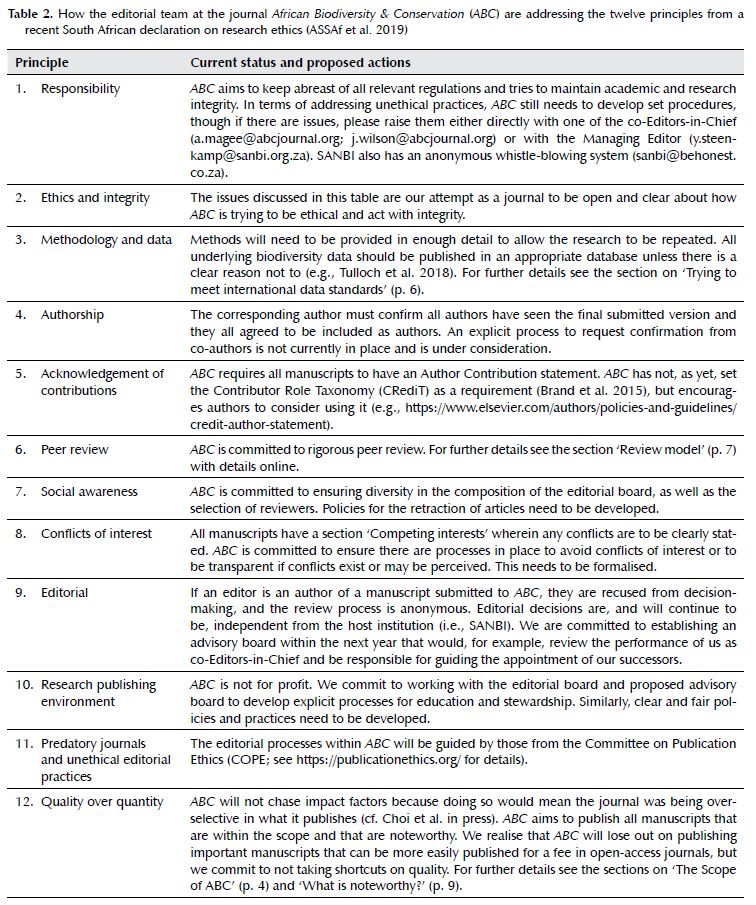
It is similarly crucial that studies increasingly evaluate issues from various perspectives. Local knowledge systems and indigenous peoples and local communities must be respected and acknowledged. For examples of specific recommendations, see the Cape Town Statement on fostering research integrity through fairness and equity (Horn et al. 2023). We encourage all authors to read and engage with codes of ethical practice for researchers, and we will try and set processes in place to facilitate this. For example, a recent South African statement on ethical research and scholarly publishing practices sets out 12 principles (ASSAf et al. 2019), we believe that ABC meets many of these principles in full already, but we recognise that much more can be done (Table 2).
ASSAf and SciELO also recently produced guidelines regarding the ethical use of artificial intelligence (AI) in writing, reviewing and editing scientific publications (ASSAf and SciELO 2024). To summarise, only humans can be considered authors, and if such large language models (LLMs) are used in a substantive way, their use must be declared and cited in either the methods or acknowledgements as appropriate.
So how does ABC work?
Full details of how ABC works are available on the journal's website (www.abcjournal.org) in particular in the 'Information For Authors' section. We highlight a few key aspects below.
Review model
There are lots of exciting emerging publishing models, but ABC is committed in the medium term to a traditional model. Each submitted manuscript will be briefly evaluated by the journal team and one of the co-Editor-in-Chiefs to check if it is: within scope, the contribution is original research, not published elsewhere, research techniques are of appropriate standard, written in English, meets ethical considerations and is noteworthy. Submissions need to be of a quality such that potential reviewers will be able to concentrate on the content and not on the presentation. Manuscripts are returned to authors prior to peer review if there are substantive issues that would detract from the peer-review process or rejected if the manuscript is not within the journal's scope. Similarly, it is important that the underlying data are accessible, e.g., they should aim to be tidy where possible (Wickham 2014) (i.e., the physical layout links with its meaning by using a specific structure: a column for each variable, a row for each observation and a table for each type of observational unit). Manuscripts that meet these criteria are then allocated to an Associate Editor who has expertise relevant to the manuscript. The Associate Editor performs a similar but much more detailed evaluation and either rejects, requests pre-review revisions or sends the manuscript out for external peer review.
Peer review at ABC involves at least two, ideally three, external reviewers assessing each paper and providing detailed comments and insights. The default model is for single-blind reviews (i.e., authors names are available to reviewers, but reviewers names are not available to authors). If authors specifically request for their names to be withheld from the review process we can try to accommodate, but our experience (at least from South Africa) is that there are only a few people who work on any one topic - it is often readily apparent who the authorship team is, and so double-blind reviewing is illusory. We leave the decision up to reviewers to choose whether to sign a review, but if they do not, then it is assumed that they wish to be anonymous. We have not, as yet, a process whereby manuscript drafts and reviews can be published alongside accepted manuscripts, though this is something we may consider in future.
On receipt of reviews, the Associate Editor then provides feedback to the authors via the journal system. The authors, as appropriate, revise their manuscript, and the process repeats until a final decision is made. A decision can be appealed with the appropriate co-Editor-in-Chief on the basis of procedural or scientific grounds.
Submission system
The journal is managed, from submission, peer review and production, using the Open Journal Systems https://pkp.sfu.ca/ojs/. Supplementary material can be stored online; however, we are very happy if supplementary information, data sets and code are stored on open-access repositories (e.g., Zenodo for data and code on GitHub).
Production
ABC has an in-house production team that provides scientific and copy-editing services and ensures the final documents are appropriately laid out. Articles are published on-line the moment production is complete, with each article assigned a digital object identifier (doi) and page numbers as part of a virtual volume. At the end of each year a physical copy is still produced (divided into issues as necessary). These can be purchased from the SANBI bookshop
Authors retain copyright of the published work under the Creative Commons Attribution 4.0 International License. Under this licence the work is effectively released into the public domain under the restriction that users provide proper attribution to the original publication, as set out in the official citation of the article as published in the journal. All articles published in ABC are archived on SciELO SA and in Sabinet African Journals and digitally preserved through Portico.
Indexing
The journal is indexed in SciELO SA, SCOPUS, Thomson Reuters Web of Science Core Collection, Science Citation Index Expanded, Directory of Open Access Journals (DOAJ), EBSCO Host and Google Scholar.
Types of papers
The bulk of papers published by ABC are 'Research articles and Reviews'. We do not currently separate these papers into different thematic sections (either in the physical volumes or online), though this could be considered if the number of accepted manuscripts increases markedly and such divisions are considered to be useful by the readers and contributors. ABC has four other types of research papers ('Data descriptors', 'No-menclatural changes', 'New distribution records' and 'Short communications'). It is increasingly important that data are curated and presented in and of themselves. As such ABC will start to explicitly publish 'Data descriptors' papers that describe relevant data that are foundational to broader analyses and indicators needed for conservation planning. ABC has for many years served as the repository for taxonomic nomenclatural papers in botany in South Africa and will continue to publish 'Nomenclatural changes'. Similarly, the journal will continue to publish 'New distribution records'. Finally we have a 'Short communications' category for papers that don't fit neatly into the other boxes. Sharp and Burrett (2021) provide fascinating insights into the nineteenth century naturalist Emil Holub's work on fungi, including some of his sketches. Such historical notes can serve as important reference points for current research in fascinating ways, and ABC will aim to strongly support Sagarin and Pauchard's (2010) call for rigorous observational approaches to ecology.
There are a few other specific categories. 'Editorials', as the name suggests, are opinion pieces by members of the editorial team on issues either directly related to ABC (as in this current paper) or on topical issues. Similarly, ABC has and will continue to publish 'Commentaries' on topical issues by any contributors. For example, Klopper et al. (2018) provided a report on the outcomes of the Nomenclature Section of the XIXth International Botanical Congress of relevance to South African botanists and mycologists (a report on the 2024 congress is under consideration). Finally, ABC will annually publish a list of reviewers under 'Reviewer Acknowledgement'.
ABC has historically published other types of articles, including book reviews. For example, Siebert (2021) reviewed William Bond's (2019) book 'Open Ecosystems: ecology and evolution beyond the forest edge', a fascinating exposition of global grasslands, savannas and shrublands. However, with the move from Bothalia to ABC, the journal is less about one particular institution or one community of practice and rather about the broader discipline of biodiversity and conservation. ABC is not a society-run journal, and as such we found it difficult to justify what to review in terms of books and who to include in the case of obituaries. This is a decision that we will revisit once an advisory board is established.
The current restriction on article length is 8 000 words. We can be flexible on this limit, although, as with all scientific articles, it is desirable that ideas are presented as concisely as necessary. Moreover, as physical copies are still produced, online supplementary material will be preferred for large data sets or discussion on issues not essential for the central narrative of the manuscript.
What is noteworthy?
A potential manuscript will need to carefully demonstrate that the contributions are noteworthy. Given that we do not want to be overly dogmatic, we felt it best to try and define noteworthy through recent ABC articles.
Taxonomie papers
We encourage authors to publish new species within a taxonomic revision of a genus or other appropriate infrageneric group. If the taxonomy of the study group is adequate, single species descriptions will be considered, providing the new taxon is placed within the framework of the current taxonomy. Sochorová et al. (2022) described a new fungus - Pseudoplectania africana - using morphological, anatomical and phylogenetic data to place the species. This is possibly the first record of the genus in Africa.
Nomenelatural changes
The journal is an outlet for notes to correct, validate and formalise taxonomic nomenclature. These formalised publications are crucial for the rapid updating and correction of taxonomic backbones as nomenclatural issues come to the fore. Manning and Govaerts (2022) demonstrated that the currently recognised name for the African daisy genus Polydora Fenzl. ex H. Rob. was superfluous and so illegitimate, as such new combinations for the species needed to be made with in the earlier published (and so correct) generic name, Crystallopollen Steetz. In order to ensure rapid processing, these manuscripts are reviewed by a dedicated nomenclatural review board. Such a board is in place for botanical nomenclatural papers and additional boards will be instigated to handle other groups.
Distribution records
ABC publishes first records of alien taxa and new distributional records (e.g., range shifts in response to habitat modification or climate change). However, for them to be noteworthy, there needs to be biogeographic novelty. If an alien taxon is already found in neighbouring countries or provinces or states within a country, it is important information, but a local journal is likely preferable; by comparison a first record outside of a species' continent of origin is noteworthy. Such cases should also discuss the potential management or policy implications. Iamonico and El Mokni (2023) record a small population of Amaranthus crassipes subsp. warnockii (I.M.Johnst.) N.Bayón naturalised within ruderal vegetation in Tunisia, possibly the first such record outside of the plant's native range in North America, noting that the populations might need to be considered for extirpation. Detailed studies and analyses of continent-wide spread would also be noteworthy, especially if linked to mechanistic hypotheses and pathways. Single species distribution models are not noteworthy in and of themselves.
Atlassing and checklists
ABC is keen to ensure that the collection and curation of primary biodiversity data gains the scientific recognition and visibility that it deserves. Fryday (2015) reviewed and updated information on the presence of lichen in South Africa and provided a checklist of 1 750 taxa; and Dayaram et al. (2019) provided details of an update to the vegetation maps of South Africa, Lesotho and eSwatini, adding 47 vegetation types and removing 35 in total affecting around 5% of the whole map. These papers were not specifically flagged as data descriptors / data papers but will likely be categorised as such in future.
Case studies
We agree with Simberloff (2004) that responding to many conservation challenges will require local observational and experimental studies. For such case studies to be noteworthy there should be some explicit consideration of what the context is and why it is important (Catford et al. 2022), and ideally general lessons applicable to other sites or other taxa should be highlighted. For example, Kashe et al. (2022) used the opportunity provided by an international airport in Botswana to provide insight into the ecological consequences of fencing off an area. Case studies that document an eradication or an extinction are noteworthy in and of themselves. For a case study that documents progress towards either to be noteworthy, it would have to provide some general insights relevant to policy and management beyond the individual example (i.e., direct and detailed recommendation of how practices need to change).
People and nature
Conservation is inherently about people and nature, and ABC is keen to publish articles about how people interact with nature and why, recognising and respecting the knowledge held by indigenous peoples and local communities. Bello et al. (2019) interviewed traditional medical practitioners and others in the Sudanian savanna of northern Nigeria and developed a list of 169 plant species utilised, of which 43 are used for ethnomedicinal practices. They then conducted local conservation assessments of these taxa to provide recommendations for policy and management. Engaging communities in conservation science takes many forms, including crucially by ensuring there are more eyes on the ground. Deschodt et al. (2021) documented the rediscovery of a taxon thought to be extinct. They found several images of an unusual dung beetle from Madagascar on a citizen science platform (iNaturalist). As the photographs included diagnostic features, they were able to identify the beetles as Scarabaeus sevoistra, the only confirmed records of the species for 80 years.
Communities of practice
Understanding relationships between people and institutions is essential if global change challenges are to be effectively met. Jubase et al. (2021) surveyed community groups that are clearing invasive plants in the Western Cape of South Africa, documenting their important contribution to efforts to combat invasions. Davies et al. (2020) reviewed the activities of the CAPE Invasive Alien Animals Working Group, highlighting how the group bridges the science-policy gap and providing important suggestions for how such groups can be made more effective. ABC will similarly consider workshop and meeting reports providing there is critical analysis or interpretation of the effectiveness and outcomes of the events held.
Ecosystem processes
Understanding the drivers and mechanisms of global change will be vital if policy makers and managers are to respond effectively. However, understanding such processes often requires rigorous measurements of abiotic and biotic factors, particularly if mechanisms are to be unequivocally ascribed to the observed changes. ABC will publish studies that seek to document ecosystem processes, recognising the need to be explicit about potential consequences. Tsheboeng et al. (2020) explored the influence of flooding regimes on plant communities of the Okavango Delta in Botswana. They showed how soil nutrients varied over time and with floods, identifying potential links between flooding, soils and specific plant taxa. They note that water abstraction from the Okavango River Basin needs to carefully consider the quantity and timing of water needed to sustain seasonal floodplain plant communities.
Conservation assessments, monitoring and planning
We support the publication of conservation assessments, in particular to improve the flow of information to decision-makers and managers. However, to be noteworthy, there needs to be more than simply repeating a Red List assessment. Mostert and Mostert (2021) investigated the saprophytic coastal forest floor orchid Didymoplexis verrucosa in Zululand, South Africa. After almost a thousand person-hours of searching they found a plant and subsequently a couple of other sightings were noted. Recognising that, 'Traditional search techniques are inadequate for population monitoring programmes of rare and cryptic species.', they carefully circumscribed the habitat characteristics of the orchid and used this to develop recommendations for focussed future searches and conservation efforts. Escobar et al. (2021) looked at the species richness and abundance of dung beetles in the Maputo Special Reserve of Mozambique and highlighted the importance of the reserve to conservation in the broader region, particularly given the large patches of sand and dune forest within a natural grassland matrix. ABC also welcomes broader taxonomic or regional assessments that look at emerging trends across groups. Van Rooy et al. (2019) produced the first list of lost or threatened bryophytes for Africa, and proposed taxa that should be prioritised for IUCN Red List assessments.
Policy
ABC publishes papers of relevance to regulation and policy, including critiques. Blackmore (2022) reviewed an on-going legal dispute over whether to grant a permit to mine in an area that was, until recently, part of the Mabola Protected Environment in South Africa. Building on this case, Blackmore (2022) argued for an amendment to legislation under which protected areas can be downgraded, downsized and degazetted. ABC is keen, as in this case, to ensure that published recommendations are practical, and so encourage authors to consider how a policy would be monitored and effectiveness determined.
Methods
New methods and techniques will be considered if they are clearly and specifically relevant to the African context. Makwela et al. (2016) outlined the potential to use a remotely operated vehicle as a non-destructive measure to investigate the fish fauna of deep reefs off the southern coast of Africa (the central Agulhas Bank). They recorded 35 fish species as compared to 30 species reported by the commercial line fishery over the previous decade. Bertschinger and Lueders (2018), as part of a special issue, reviewed the use of hormone injections to reduce aggressive behaviour in free-roaming 'problem [male elephant] bulls'; again the method is both relevant to Africa and, we believe, noteworthy.
Special issues
ABC publishes special issues with coherent and relevant themes. If you have a proposal, please get in touch. Selier et al. (2018) outlined a special issue on 'Conservation and management of elephant populations on small and medium-sized fenced reserves: Current practices, constraints and recommendations'. Wilson et al. (2017) highlighted a special issue on 'Contributions to the National Status Report on Biological Invasions in South Africa' that fed directly into a national level report published the following year (Van Wilgen & Wilson 2018). Finally the special issue described by Rouget et al. (2016) looked at 'eThekwini Ecosystems' and the Durban Research Action Partnership, exploring how the conservation of threatened ecosystems in an urban biodiversity hotspot in South Africa was being addressed and could be improved. Each of these special issues thus helped establish the state of a particular issue or topic and provided advice as to how things could move forward. By contrast, some publishers send round speculative spam e-mails tempting scientists to edit a special issue on a topic identified by the journal as the most likely to generate income and citations for the journal. Such practices result in papers being published that, to quote a colleague on a list server about science publishing, are 'either banal or venal or, worse yet, both of these'. ABC will only focus on special issues where there is a clear reason for why papers are grouped together.
How can I get involved?
We recognise the pressures on everyone's time, but if you get a review request please either accept or reject promptly, and if you do accept, please try to provide a constructive review in good time. For editors of other journals, we welcome collaboration and will endeavour to look to cross-refer out-of-scope articles as appropriate. For authors, please consider ABC for your research. We can help with production, and we are committed to sustainably growing the journal. In particular, we are very keen to increase the number of submissions from across the continent (cf. Figure 1). We do not have funds for translation but would be very open to partnerships to address the issue of accessibility and would be keen to publish translated material in languages other than English. If you want to know if a publication might be suitable, please contact us. And if you have comments or criticisms of the journal's vision and proposed approach, please get in touch (the e-mail
Funding
JRW thanks the South African Department of Forestry, Fisheries, and the Environment (DFFE) for funding, noting that this publication does not necessarily represent the views or opinions of the DFFE or its employees.
Acknowledgements
We wish to thank the current production team, Yolande Steenkamp and Nicole Meyer, all past editors (especially the last few Editors-in-Chief: Michelle Hamer, Colleen Seymour and John Manning) and all authors and reviewers for making ABC what it is. Yvette Ehlers-Smith, Theressa Frantz, Michelle Hamer, Fatima Parker-Allie, Nicole Meyer, Dave Richardson, Jessica da Silva and Yolande Steenkamp provided valuable comments on an earlier draft. Figure 1 was produced by the Centre for Geographical Analysis at Stellenbosch University.
References
-
Allison, E.H., Perry, A.L., Badjeck, M.C., Adger, W.N., Brown, K., Conway, D., Halls, A.S., Pilling, G.M., Reynolds, J.D., Andrew, N.L. & Dulvy, N.K., 2009, 'Vulnerability of national economies to the impacts of climate change on fisheries', Fish and Fisheries 10, 173-196, https://doi.org/10.1111/j.1467-2979.2008.00310.x.
» https://doi.org/10.1111/j.1467-2979.2008.00310.x -
ASSAf, CHE, DHET, DST, NRF & USAf, 2019, 'Statement on ethical research and scholarly publishing practices', South African Journal of Science 115, #a0316, https://doi.org/10.17159/sajs.2019/a0316.
» https://doi.org/10.17159/sajs.2019/a0316 -
ASSAf & SciELO 2024, 'ASSAf and SciELO Guidelines for the Use of Artificial Intelligence (AI) Tools and Resources in Research Communication', https://www.assaf.org.za/wp-content/uploads/2024/09/Final-ASSAf-and-SciELO-Guidelines-for-the-Use-of-Artificial-Intelligence-AI-Tools-and-Resources-in-Research-Communication_17-Sept-2024-.pdf.
» https://www.assaf.org.za/wp-content/uploads/2024/09/Final-ASSAf-and-SciELO-Guidelines-for-the-Use-of-Artificial-Intelligence-AI-Tools-and-Resources-in-Research-Communication_17-Sept-2024-.pdf -
Bello, A., Jamaladdeen, S., Elder, M., Yaradua, S., Kankara, S.S., Wagini, N., Stirton, C. & Muasya, M., 2019, 'Threatened medicinal and economic plants of the Sudan Savanna in Katsina State, northwestern Nigeria', Bothalia, African Biodiversity & Conservation 49, a2325, https://doi.org/10.4102/abc.v49i1.2325.
» https://doi.org/10.4102/abc.v49i1.2325 -
Bertschinger, H.J. & Lueders, I., 2018, 'Use of anti-gonadotropin-releasing hormone vaccines in African elephants Loxodonta africana: A review', Bothalia, African Biodiversity & Conservation 48, a2320, https://doi.org/10.4102/abc.v48i2.2320.
» https://doi.org/10.4102/abc.v48i2.2320 -
Blackmore, A., 2022, 'To be or not to be a protected area: A perverse political threat', Bothalia, African Biodiversity & Conservation 52, a4, https://doi.org/10.38201/btha.abc.v52.i1.4.
» https://doi.org/10.38201/btha.abc.v52.i1.4 -
Bond, W.J., 2019, Open ecosystems: ecology and evolution beyond the forest edge, Oxford University Press, Oxford, UK, https://doi.org/10.1093/oso/9780198812456.001.0001.
» https://doi.org/10.1093/oso/9780198812456.001.0001 -
Brand, A., Allen, L., Altman, M., Hlava, M. & Scott, J., 2015, 'Beyond authorship: attribution, contribution, collaboration, and credit', Learned Publishing 28, 151-155, https://doi.org/10.1087/20150211.
» https://doi.org/10.1087/20150211 - Cartwright, A, 2015, Better growth, better cities: rethinking and redirecting urbanisation in Africa, The New Climate Economy Working Paper, New Climate Economy, Washington, USA.
-
Catford, J.A., Wilson, J.R.U., Pysek. P., Hulme, P.E. & Duncan, R.P., 2022, 'Addressing context dependence in ecology', Trends in Ecology and Evolution 37, 158-170, https://doi.org/10.1016/j.tree.2021.09.007.
» https://doi.org/10.1016/j.tree.2021.09.007 -
Chapman, C.A., Abernathy, K., Chapman, L.J., Downs, C., Effiom, E.O., Gogarten, J.F., Golooba, M., Kalbitzer, U., Lawes, M.J., Mekonnen, A., Omeja, P., Razafindratsima, O., Sheil, D., Tabor, G.M., Tumwesigye, C. & Sarkar, D., 2022, 'The future of sub-Saharan Africa's biodiversity in the face of climate and societal change', Frontiers in Ecology and Evolution 10, 790522, https://doi.org/10.3389/fevo.2022.790552.
» https://doi.org/10.3389/fevo.2022.790552 -
Choi, J.J., Gaskins, L.C., Morton, J.P., Bingham, J.A., Blawas, A.M., Hayes, C., Hoyt, C.. , Halpin, P.N. & Silliman, B., in press, 'Role of low-impact-factor journals in conservation implementation', Conservation Biology e14391, https://doi.org/10.1111/cobi.14391.
» https://doi.org/10.1111/cobi.14391 -
Costello, M.J., Michener, W.K., Gahegan, M., Zhang, Z.Q. & Bourne, PIE., 2013, 'Biodiversity data should be published, cited, and peer reviewed', Trends in Ecology and Evolution 28, 454-461, https://doi.org/10.1016/j.tree.2013.05.002.
» https://doi.org/10.1016/j.tree.2013.05.002 -
Costello, M.J. & Wieczorek, J., 2014, 'Best practice for biodiversity data management and publication', Biological Conservation 173, 68-73, https://doi.org/10.1016/j.bio-con.2013.10.018.
» https://doi.org/10.1016/j.bio-con.2013.10.018 -
Davies, S.J., Bell, J.A., Impson, D., Mabin, C., Meyer, M., Rhoda, C., Stafford, L., Stephens, K., Tafeni, M., Turner, A.A., Van Wilgen, N.J., Wilson, J.R.U., Wood, J. & Measey, J., 2020, 'Coordinating invasive alien species management in a biodiversity hotspot: The CAPE Invasive Alien Animals Working Group', Bothalia, African Biodiversity & Conservation 50, a10, https://doi.org/10.38201/btha.abc.v50.i1.10.
» https://doi.org/10.38201/btha.abc.v50.i1.10 -
Dayaram, A., Harris, L., Grobler, B., Van der Merwe, S., Rebelo, A., Powrie, L., Vlok, J., Desmet, P., Desmet, P., Qabaqaba, M., Hlahane, K. & Skowno, A., 2019, 'Vegetation map of South Africa, Lesotho and Swaziland 2018: A description of changes since 2006', Bothalia, African Biodiversity & Conservation 49, a2452, https://doi.org/10.4102/abc.v49i1.2452.
» https://doi.org/10.4102/abc.v49i1.2452 -
Demeter, M. & Istratii, R., 2020, 'Scrutinising what open access journals mean for global inequalities', Publishing Research Quarterly 36, 505-522, https://doi.org/10.1007/s12109-020-09771-9.
» https://doi.org/10.1007/s12109-020-09771-9 -
Deschodt, C., Harrison, J. & Sole, C., 2021, 'Rediscovery of Scarabaeus sevoistra Alluaud, 1902 (Coleoptera: Scarabaeinae): biological notes and IUCN Red Listing', Bothalia, African Biodiversity & Conservation 51, a14, https://doi.org/10.38201/btha.abc.v51.i2.14.
» https://doi.org/10.38201/btha.abc.v51.i2.14 -
Duermeijer, C., Amir, M. & Schoombee, L., 2018, 'Africa generates less than 1% of the world's research; data analytics can change that', https://www.elsevier.com/connect/africa-generates-less-than-1-of-the-worlds-research-data-analytics-can-change-that, Elsevier Connect, accessed 19 April 2023.
» https://www.elsevier.com/connect/africa-generates-less-than-1-of-the-worlds-research-data-analytics-can-change-that -
Escobar, F., Davis, A., Deschodt, C.M. & Scholtz, C.H., 2021, 'Dung beetle conservation in a heterogeneous landscape of the Maputaland Centre of Endemism', Bothalia, African Biodiversity & Conservation, 51, a15, https://doi.org/10.38201/btha.abc.v51.i2.15.
» https://doi.org/10.38201/btha.abc.v51.i2.15 -
Faulkner, K.T., Hurley, B.P., Robertson, M.P., Rouget, M. & Wilson, J.R.U., 2017, 'The balance of trade in alien species between South Africa and the rest of Africa', Bothalia, African Biodiversity & Conservation 47, a2157, https://doi.org/10.4102/abc.v47i2.2157.
» https://doi.org/10.4102/abc.v47i2.2157 -
Faulkner, K.T., Robertson, M.P. & Wilson, J.R.U., 2020, 'Stronger regional biosecurity is essential to prevent hundreds of harmful biological invasions', Global Change Biology 26, 2449-2462, https://doi.org/10.1111/gcb.15006.
» https://doi.org/10.1111/gcb.15006 -
Fisher, B., 2010, 'African exception to drivers of deforestation', Nature Geoscience 3, 375-376, https://doi.org/10.1038/ngeo873.
» https://doi.org/10.1038/ngeo873 -
Fryday, A.M., 2015, 'A new checklist of lichenised, lichenicolous and allied fungi reported from South Africa', Bothalia, African Biodiversity & Conservation 45, a148, https://doi.org/10.4102/abc.v45i1.148.
» https://doi.org/10.4102/abc.v45i1.148 -
Gadelha Jr, L.M.R., De Siracusa, P.C., Dalcin, E.C., Da Silva, L.A.E., Augusto, D.A., Krempser, E., Affe, H.M., Costa, R.L., Mondelli, M.L., Meirelles, PM., Thompson. F., Chame, M., Ziviani, A. & De Siqueira, M.F., 2021, 'A survey of biodiversity informatics: concepts, practices, and challenges', WIREs Data Mining and Knowledge Discovery 11: e1394, https://doi.org/10.1002/widm.1394.
» https://doi.org/10.1002/widm.1394 -
Horn, L., Alba, S., Gopalakrishna, G., Kleinert, S., Kombe, F., Lavery, J.V. & Visagie, R.G., 2023, 'The Cape Town Statement on fairness, equity and diversity in research', Nature 615, 790-793, https://doi.org/10.1038/d41586-023-00855-y.
» https://doi.org/10.1038/d41586-023-00855-y -
lamonico, D. & El Mokni, R., 2023, 'First record of Amaranthus crassipes subsp. warnockii (I.M.Johnst.) N.Bayón (Am-aranthaceae) outside of the Americas, with nomenclatural notes', Bothalia, African Biodiversity & Conservation 53, a2, https://doi.org/10.38201/btha.abc.v53.i1.2.
» https://doi.org/10.38201/btha.abc.v53.i1.2 -
IPBES, 2018, Summary for policymakers of the regional assessment report on biodiversity and ecosystem services for Africa of the Intergovernmental Science-Policy Platform on Biodiversity and Ecosystem Services, E. Archer, L.E. Dziba, K.J. Mulongoy, M.A. Maoela, M. Walters, R. Biggs, M.-C. Cormier-Salem, F. DeClerck, M.C. Diaw, A.E. Dunham, P. Failler, C. Gordon, K.A. Harhash, R. Kasisi, F. Kizito, W.D. Nyingi, N. Oguge, B. Osman-Elasha, L.C. Stringer, L.T. de Morais, A. Assogbadjo, B.N. Egoh, M.W. Halmy, K. Heubach, A. Mensah, L. Pereira & N. Sitas (eds), IPBES secretariat, Bonn, Germany, 42 pp.
» https://doi.org/10.1038/s41559-018-0608-1 -
lPCC, 2014, 'Africa', in lntergovernmental fanel on Climate C (ed.), Climate Change 2014 - Impacts, Adaptation and Vulnerability: Part B: Regional Aspects, Working Group II Contribution to the lfCC Fifth Assessment Report, Volume 2, Regional Aspects, Cambridge University fress, Cambridge, pp. 1199-1266, https://doi.org/10.1017/CBO9781107415386.002.
» https://doi.org/10.1017/CBO9781107415386.002 -
Joppa, L.N., Roberts, D.L., Myers, N. & Pimm, S.L., 2011, 'Biodiversity hotspots house most undiscovered plant species', Proceedings of the National Academy of Sciences of the United States of America 108, 13171-13176, https://doi.org/10.1073/pnas.1109389108.
» https://doi.org/10.1073/pnas.1109389108 -
Jubase, N., Shackleton, R.T. & Measey, J., 2021, 'Motivations and contributions of volunteer groups in the management of invasive alien plants in South Africa's Western Cape province', Bothalia, African Biodiversity & Conservation 51, a3, https://doi.org/10.38201/btha.abc.v51.i2.3.
» https://doi.org/10.38201/btha.abc.v51.i2.3 -
Kashe, K., Teketay, D., Mmusi, M. & Galelebalwe, M.K., 2022, 'Restoration of diversity and regeneration of woody species through area exclosure: the case of Maun International Airport in northern Botswana', Bothalia, African Biodiversity & Conservation 53, a1, https://doi.org/10.38201/btha.abc.v53.i1.1.
» https://doi.org/10.38201/btha.abc.v53.i1.1 -
Klopper, R.R., De Beer, Z.W. & Smith, G.F., 2018, 'Some outcomes of the Nomenclature Section of the XlXth International Botanical Congress', Bothalia, African Biodiversity & Conservation, 48, a2329, https://doi.org/10.4102/abc.v48i1.2329.
» https://doi.org/10.4102/abc.v48i1.2329 -
Kwon, D., 2022, 'Open-access publishing fees deter researchers in the global south', Nature 16 Feb 2022, https://doi.org/10.1038/d41586-022-00342-w.
» https://doi.org/10.1038/d41586-022-00342-w -
Lambin, E.F. & Meyfroidt, P, 2011, 'Global land use change, economic globalization, and the looming land scarcity', Proceedings of the National Academy of Sciences of the United States of America 108, 3465-3472, https://doi.org/10.1073/pnas.1100480108.
» https://doi.org/10.1073/pnas.1100480108 -
Langa, S.D.F., Hill, M.P. & Compton, S.G., 2020, 'Agents sans frontiers: cross-border aquatic weed biological control in the rivers of southern Mozambique', African Journal of Aquatic Science 45, 329-335, https://doi.org/10.2989/16085914.2020.1749551.
» https://doi.org/10.2989/16085914.2020.1749551 -
Leadley, P., Gonzalez, A., Obura, D., Krug, C.B., Londoño-Murcia, M.C., Millette, K.L., Radulovici, A., Rankovic, A., Shannon, L.J., Archer, E., Armah, F.A., Bax, N., Chaudhari, K., Costello, M.J., Dávalos, L.M., Roque, Fd.O., DeClerck, F., Dee, L.E., Essl, F., Ferrier, S., Genovesi, P., Guariguata, M.R., Hashimoto, S., Ifejika Speranza, C., Isbell, F., Kok, M., Lavery, S.D., Leclère, D., Loyola, R., Lwasa, S., McGeoch, M., Mori, A.S., Nicholson, E., Ochoa, J.M., Öllerer, K., Polasky, S., Rondinini, C., Schroer, S., Selomane, O., Shen, X., Strassburg, B., Su-maila, U.R., Tittensor, D.P., Turak, E., Urbina, L., Vallejos, M., Vázquez-Domínguez, E., Verburg, P.H., Visconti, P., Woodley, S. & Xu, J., 2022, 'Achieving global biodiversity goals by 2050 requires urgent and integrated actions', One Earth 5, 597-603, https://doi.org/10.1016/j.onee-ar.2022.05.009.
» https://doi.org/10.1016/j.onee-ar.2022.05.009 -
MacFadyen, S., Allsopp, N., Altwegg, R., Archibald, S., Botha, J., Bradshaw, K., Carruthers, J., De Klerk, H., De Vos, A., Distiller, G., Foord, S., Freitag-Ronaldson, S., Gibbs, R., Hamer, M, Landi, P, MacFadyen, D, Manuel, J, Midgley, G, Moncrieff, G, Munch, Z, Mutanga, O., Sershen Nenguda, R., Ngwenya, M., Parker, D., Peel, M., Fower, J., Pretorius, J., Ramdhani, S., Robertson, M., Rushworth, I., Skowno, A., Slingsby, J., Turner, A., Visser, V., Van Wageningen, G. & Hui, C., 2022, 'Drowning in data, thirsty for information and starved for understanding: A biodiversity information hub for cooperative environmental monitoring in South Africa', Biological Conservation 274, 109736, https://doi.org/10.1016/j.biocon.2022.109736.
» https://doi.org/10.1016/j.biocon.2022.109736 -
Makwela, M.S., Kerwath, S.E., Götz, A., Sink, K., Samaai, T. & Wilke, C.G., 2016, 'Notes on a remotely operated vehicle survey to describe reef ichthyofauna and habitats -Agulhas Bank, South Africa', Bothalia, African Biodiversity & Conservation 46, a2108, https://doi.org/10.4102/abc.v46i1.2108.
» https://doi.org/10.4102/abc.v46i1.2108 -
Manning, J. & Govaerts, R., 2022, 'New combinations in Crystallopollen Steetz (Asteraceae: Vernonieae), the correct name for the illegitimate Polydora Fenzl ex H.Rob.' Bothalia, African Biodiversity & Conservation 52, a8, https://doi.org/10.38201/btha.abc.v52.i1.8.
» https://doi.org/10.38201/btha.abc.v52.i1.8 -
Marincola, E. & Kariuki, T., 2020, 'Quality Research in Africa and why it is important', American Chemical Society Omega 5, 24155-24157, https://doi.org/10.1021/acsome-ga.0c04327.
» https://doi.org/10.1021/acsome-ga.0c04327 -
Mostert, T.H.C. & Mostert, R.E., 2021, 'Habitat description of the rare orchid Didymoplexis verrucosa for more effective conservation', Bothalia, African Biodiversity & Conservation 51, a2, https://doi.org/10.38201/btha.abc.v51.i2.2.
» https://doi.org/10.38201/btha.abc.v51.i2.2 -
Nishikawa-Pacher, A., 2022, 'Who are the 100 largest scientific publishers by journal count? A webscraping approach', Journal of Documentation 78, 450-463, https://doi.org/10.1108/JD-04-2022-0083.
» https://doi.org/10.1108/JD-04-2022-0083 -
O'Dea, R.E., Lagisz, M., Jennions, M.D., Koricheva, J., Noble, D.W.A., Parker, T.H., Gurevitch, J., Page, M.J., Stewart, G., Moher, D. & Nakagawa, S., 2021, 'Preferred reporting items for systematic reviews and meta-analyses in ecology and evolutionary biology: a PRISMA extension', Biological Reviews 96, 1695-1722, https://doi.org/10.1111/brv.12721.
» https://doi.org/10.1111/brv.12721 -
Parker-Allie, F., Gibbons, M.J. & Harebottle, D.M., 2023. 'A conceptual approach to developing biodiversity informatics as a field of science in South Africa', Frontiers in Ecology and Evolution 11, 1107212, https://doi.org/10.3389/fevo.2023.1107212.
» https://doi.org/10.3389/fevo.2023.1107212 - Paterson, I. & Witt, A., 2022, 'Biological control of pest cactus and cactus pests in Africa', in J.C.B. Dubeux Jr., M.V. Ferreira dos Santos, A. Pereira de Andrade (eds.), ISHS Acta Horticulturae: X International Congress on Cactus Pear and Cochineal: Cactus - the New Green Revolution in Drylands International Society for Horticultural Science (ISHS), Leuven, Belgium, João Pessoa, Paraíba, Brazil.
-
Rouget, M., Donoghue, S., Taylor, C., Roberts, D. & Slotow, R., 2016, 'Improving the management of threatened ecosystems in an urban biodiversity hotspot through the Durban Research Action Partnership', Bothalia, African Biodiversity & Conservation 46, a2199, https://doi.org/10.4102/abc.v46i2.2199.
» https://doi.org/10.4102/abc.v46i2.2199 -
Sagarin, R. & Pauchard, A., 2010, 'Observational approaches in ecology open new ground in a changing world', Frontiers in Ecology and the Environment 8, 379-386, https://doi.org/10.1890/090001.
» https://doi.org/10.1890/090001 -
Selier, S.A.J., Slotow, R. & Balfour, D., 2018, 'Management of African elephant populations in small fenced areas: Current practices, constraints and recommendations', Bothalia, African Biodiversity & Conservation 48, a2414, https://doi.org/10.4102/abc.v48i2.2414.
» https://doi.org/10.4102/abc.v48i2.2414 -
Sharp, C. & Burrett R.S., 2021, 'Mushroom art in South Africa and Zimbabwe - Emil Holub: 1847-1902', Bothalia, African Biodiversity & Conservation 51, https://doi.org/10.38201/btha.abc.v51.i2.13.
» https://doi.org/10.38201/btha.abc.v51.i2.13 -
Siebert, F., 2021, 'Open Ecosystems: Ecology and Evolution Beyond the Forest Edge', Bothalia, African Biodiversity & Conservation 51, a12, https://doi.org/10.38201/btha.abc.v51.i1.12.
» https://doi.org/10.38201/btha.abc.v51.i1.12 -
Simberloff, D., 2004, 'Community ecology: Is it time to move on?', American Naturalist 163, 787-799, https://doi.org/10.1086/420777.
» https://doi.org/10.1086/420777 -
Smith, A.C., Merz, L., Borden, J.B., Gulick, C.K., Kshirsagar, A.R. & Bruna, E.M., 2021, 'Assessing the effect of article processing charges on the geographic diversity of authors using Elsevier's "Mirror Journal" system', Quantitative Science Studies 2, 1123-1143, https://doi.org/10.1162/qss_a_00157.
» https://doi.org/10.1162/qss_a_00157 -
Sochorová, Z., Carbone, M., Sedlářová, M., Polhorsky, A. & Sochor, M., 2022, 'Pseudoplectania africana (Sarcosomataceae, Pezizales), a new species from South Africa', Bothalia, African Biodiversity & Conservation 52, a1, https://doi.org/10.38201/btha.abc.v52.i1.1.
» https://doi.org/10.38201/btha.abc.v52.i1.1 -
Tsheboeng, G., Bonyongo, M. & Murray-Hudson, M., 2020, 'Environmental factors that influence species diversity of floodplain plant communities in different flooding phases in the Okavango Delta, Botswana', Bothalia, African Biodiversity & Conservation 50, a3, https://doi.org/10.38201/btha.abc.v50.i1.3.
» https://doi.org/10.38201/btha.abc.v50.i1.3 - United Nations Department of Economic and Social Affairs Population Division, 2015, World Population Prospects: The 2015 Revision, Key Findings and Advance Tables, Working Paper No. ESa/p/WF:241, United Nations, New York, 59 pp.
-
Van Rooy, J., Bergamini, A. & Bisang, I., 2019, 'Fifty shades of red: Lost or threatened bryophytes in Africa', Bothalia, African Biodiversity & Conservation 49: a2341, https://doi.org/10.4102/abc.v49i1.2341.
» https://doi.org/10.4102/abc.v49i1.2341 - Van Wilgen, B.W. & Wilson, J.R. (eds.), 2018, The status of biological invasions and their management in South Africa in 2017, South African National Biodiversity Institute, Kirstenbosch and DST-NRF Centre of Excellence for Invasion Biology, Stellenbosch, 398 pp.
-
Wickham, H., 2014, 'Tidy data', Journal of Statistical Software 59, 1-23, https://doi.org/10.18637/jss.v059.i10.
» https://doi.org/10.18637/jss.v059.i10 -
Wilkinson, M.D., Dumontier, M., Aalbersberg, I.J., Appleton, G., Axton, M., Baak, A., Blomberg, N., Boiten, J.W., Santos, L.B.D., Bourne, P.E., Bouwman, J., Brookes, A.J., Clark, T., Crosas, M., Dillo, I., Dumon, O., Edmunds, S., Evelo, C.T., Finkers, R., Gonzalez-Beltran, A., Gray, A.J.G., Groth, P., Goble, C., Grethe, J.S., Heringa, J., Hoen, P.A.C., Hooft, R., Kuhn, T., Kok, R., Kok, J., Lusher, S.J., Martone, M.E., Mons, A., Packer, A.L., Persson, B., Rocca-Serra, P., Roos, M., Van Schaik, R., Sansone, S.A., Schultes, E., Sengstag, T., Slater, T., Strawn, G., Swertz, M.A., Thompson, M., Van der Lei, J., Van Mulligen, E., Velterop, J., Waagmeester, A., Wittenburg, P., Wolstencroft, K., Zhao, J. & Mons, B., 2016, 'Comment: The FAIR Guiding Principles for scientific data management and stewardship', Scientific Data 3, 9, https://doi.org/10.1038/sdata.2016.18.
» https://doi.org/10.1038/sdata.2016.18 -
Wilson, J.R.U., Gaertner, M., Richardson, D.M. & Van Wilgen, B.W., 2017, 'Contributions to the National Status Report on Biological Invasions in South Africa', Bothalia, African Biodiversity and Conservation 47, a2207, https://doi.org/10.4102/abc.v47i2.2207.
» https://doi.org/10.4102/abc.v47i2.2207

e-mail: