The invasion status of Syagrus romanzoffiana (Cham.) Glassman in KwaZulu-Natal, South Africa
Abstract
BACKGROUND: Syagrus romanzoffiana is a palm species native to South America and is very popular as an ornamental palm in South Africa. This species was first recorded in cultivation in the Durban Botanic Gardens (DBG) in 1897. The earliest record of this species outside of cultivation is from 2016 near the DBG. OBJECTIVES: This study reports field data from a survey of two study areas where this species is currently in cultivation: the DBG as well as University of KwaZulu-Natal (UKZN), Westville Campus, approximately 8 km apart (both sites in the eThekwini Municipality). The objective was to assess the invasion status of S. romanzoffiana within eThekwini Municipality. METHODS: Both study areas were covered on foot and the number of plants outside of cultivation was recorded and the tallest plant measured among the natural regeneration. A GPS point was logged for each plant inside and outside of cultivation and distances between plants calculated in ArcGIS. Three South African herbaria were searched for specimens and three databases consulted to determine the distribution in South Africa. RESULTS: A total of 58 and 85 plants were found outside of cultivation at the DBG and UKZN Westville campus, respectively. Seedlings were concentrated near the parent trees at both sites; 12.1% occurred over 150 m from the nearest putative parent plant at DBG and 9.4% more than 50 m from the nearest putative parent plant at UKZN Westville campus. The tallest plant outside of cultivation was 4.8 m, however, none of the plants found had reached reproductive age. CONCLUSION: Evidence from the field data suggests that S. romanzoffiana is at the casual stage of establishment with self-sown individuals surviving outside of cultivation but reproduction has not been recorded. A risk analysis on S. romanzoffiana is recommended but legal listing is unwarranted at this stage.
ornamental plants; naturalisation; palms; invasion status
Introduction
The Arecaceae is a relatively large botanical family of approximately 2 780 species, grouped into 200 genera (Zomlefer 1994), found mostly in the tropics and sub-tropics (Dransfield & Uhl 1998). While some species are endangered (Couvreur et al. 2024), a number of palm species have become naturalised or invasive in regions where they are cultivated (Meyer et al. 2008). South Africa has six native palm species from five genera (Germishuizen et al. 2006) and Glen (2004) reports 279 taxa from 107 genera in cultivation (Supplementary material, Table S1). The first description of a palm species outside of cultivation in South Africa was of Livistona chinensis (Jacq.) R.Br. ex Mart. that had escaped into a swamp forest in northern KwaZulu-Natal (Siebert 2009). Recent field work by the second author throughout the eThekwini Municipality indicated that another palm, Syagrus romanzoffiana (Cham.) Glassman is also occurring outside of cultivation in KwaZulu-Natal.
Syagrus romanzoffiana is a palm species native to the Atlantic and semi-deciduous forests of the Paraná basin in South America (Noblick 2017). Wood (1897) reported that Cocos plumosa Lodd., which is a synonym of the name Syagrus romanzoffiana, was in cultivation at the Durban Botanic Gardens (DBG) in 1897 (Glassman 1987; Zona 2020). Carter (1919) also recommended S. romanzoffiana (under the name Cocos plumosa) as an ornamental palm for South Africa. Syagrus romanzoffiana is still popular as a street tree along the east coast of KwaZulu-Natal and as an ornamental garden palm in South Africa (Glen & Van Wyk 2016). Syagrus romanzoffiana has been recorded as naturalised in southern Queensland, Australia (Dowe & Jones 2011), New Zealand (Cameron et al. 2002) and does occur outside of cultivation in Florida, U.S.A. (Zona 2020). No information could be found on the naturalisation status of S. romanzoffiana in South Africa and this paper aims to assess the degree of establishment of S. romanzoffiana in South Africa. The dispersal of this species was studied at two sites in the eThekwini (Durban) Municipality considering that this palm has been in cultivation in this municipality for a long time and is a popular horticultural specimen along the KwaZulu-Natal coast.
Materials and methods
To add to the distribution data acquired through field work, three herbarium collections (NH, PRE, NBG) were consulted, as well as the 2020 South African Plant Invader Atlas (SAPIA) (Henderson 1999). The iNaturalist database (www.inaturalist.org) was also checked for records of S. romanzoffiana in South Africa with the filters 'Research Grade' and 'Wild' selected. Records of S. romanzoffiana on the Global Biodiversity Information Facility (GBIF.org; GBIF 2025) were checked for South Africa. To assess the invasion status of S. romanzoffiana within eThekwini Municipality, the interpretation of Groom et al. (2019) was followed.
The two study sites, the DBG (29°50'48"S, 31°00'24"E) and the University of KwaZulu-Natal (UKZN), Westville Campus (29°49'08"S, 30°56'42"E), were visited in autumn and spring 2023. Both sites were covered on foot, and co-ordinates were logged for S. romanzoffiana seedlings and cultivated plants using a Garmin eTrex 10 GPS. Cultivated plants and seedlings growing spontaneously were differentiated based on their size and position. At the DBG, S. romanzoffiana is cultivated towards the north of the garden along the Palm Walk and along Edith Benson Road, outside the garden fence. The Palm Walk was laid out in 1889 (Lambert 1994) and the palms along Edith Benson Road in 1935 (McCracken 1996) and all are about 20 m tall. Specimens were considered not cultivated when they were growing away from the palm walk and many of these still had fronds that were entire, only becoming differentiated into once-pinnate leaves with age. At UZKN Westville Campus, cultivated S. romanzoffiana trees were also about 20 m tall and cultivated as feature plants along roads within the campus and those outside of cultivation were seedlings with leaves that were still entire or juvenile palms growing in non-landscaped sections of the campus.
Herbarium specimens were collected from each study site, following standard botanical collection practices and submitted to the KwaZulu-Natal Herbarium (NH). The tallest plant found outside of cultivation was measured at each site. The presence of flowers or fruit was recorded to assess the number of plants that had reached reproductive maturity and also if animals were eating the fruit to assess herbivory and potential dispersal.
To investigate the distances between seedlings and their putative parent plants (the nearest cultivated palm), the GPS points were entered into ArcGIS Pro (ESRI 2011) and the Near Analysis function used to calculate the distances among the cultivated and non-cultivated plants. Kernel density estimations were drawn in R 4.3.3 (R Core Team 2017) of the distances between seedlings and the nearest cultivated plants at both sites.
Results
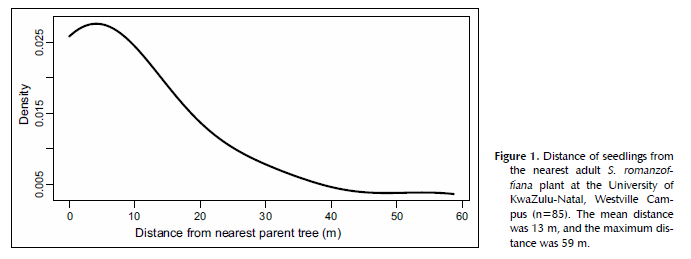
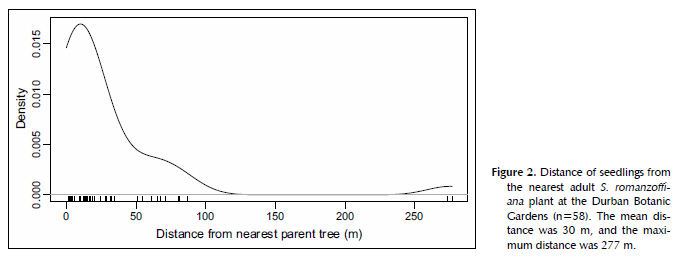
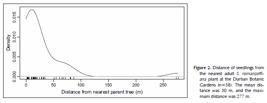
Eighty-five (85) and 58 S. romanzoffiana plants were found outside of cultivation at UKZN Westville Campus and the DBG, respectively. The tallest non-cultivated individuals were 1.6 m and 4.8 m at the DBG and UKZN Westville Campus, respectively. The average height of the specimens was 0.9 m (n = 2) and 2.3 m (n = 3) at the DBG and UKZN Westville Campus, respectively. None of the plants from outside of cultivation had reached reproductive maturity, although many of the adult, cultivated plants were in fruit. The majority of the seedlings were found in close proximity to cultivated palms with 90.6% being within 40 m of cultivated palms at the UKZN West-ville Campus (Figure 1) and 77.5% within 40 m at the DBG (Figure 2). The mean distance of seedlings to the nearest cultivated palm was 13 m and 30 m at UZKN Westville Campus and the DBG, respectively. At the DBG, 7 seedlings (12%) were found over 150 m from the nearest putative parent plant (Figure 2). Syagrus romanzoffiana is still in cultivation at both study sites with 25 plants present at the DBG and 45 at UKZN Westville Campus. Observed frugivory was limited to vervet monkeys (Chlorocebus pygerythrus F. Cuvier) and birds.
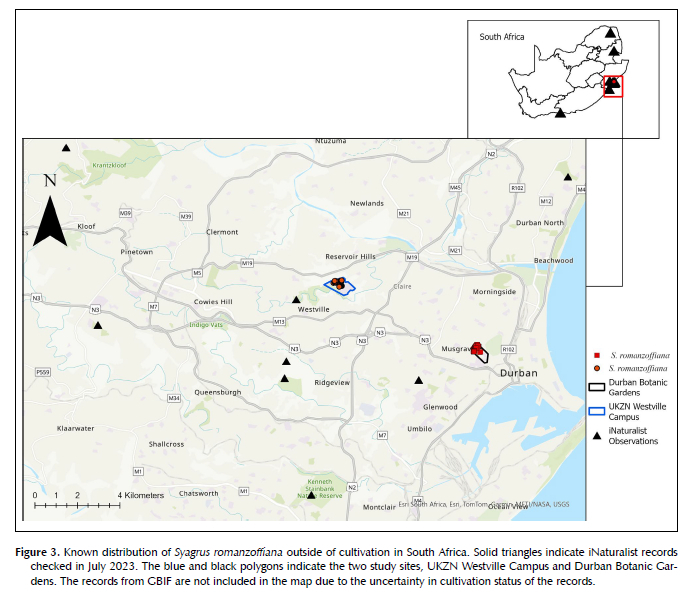
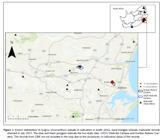
The oldest herbarium specimen from South Africa was of a cultivated plant collected in 1946 near the Union Buildings, Pretoria (Erens 59065, PRE). The only collection from outside of cultivation in South Africa was from the KwaZulu-Natal Herbarium grounds, collected in 2016 (Gxekwa 7, NH). Apart from specimens collected at the DBG (Cheek 3191, NH) and UKZN Westville Campus (Cheek3174, NH), S. romanzoffiana was also found outside of cultivation in Paradise Valley Nature Reserve (Cheek 3180, NH), Hillcrest suburb (Cheek 3195, NH) and as far inland as Pietermaritzburg. No records for S. romanzoffiana were found on the SAPIA database and 18 records were found in iNaturalist, of which 11 indicated that they were not cultivated (Supplementary material, Table S2). The iNaturalist records were not verified in the field. Six of the 11 records were from eThekwini Municipality and 5 were from locations across South Africa: the Garden Route (Western Cape), Oribi Gorge Nature Reserve (KwaZulu-Natal south coast), Pietermaritzburg (KwaZulu-Natal), Nelspruit (Mpumalanga) and Thohoyandou Botanic Garden (Limpopo). Two (2) of these records indicated that they were of mature individuals growing outside of cultivation (observers: Troos 2019; Nature-club 2022). In total, 162 plants were found outside of cultivation during this study: at the two study sites, from iNaturalist and through further fieldwork throughout the eThekwini and Msunduzi municipalities (Figure 3; Supplementary material, Table S2). A total of 274 records of S. romanzoffiana were obtained for South Africa from GBIF.org (GBIF 2025), which included cultivated and non-cultivated records.
Discussion
Distances to nearby plants of the same species or different species, are important in plant ecology in inferring dispersal and competition (Proches et al. 2015). Dispersal distances from the putative parent plants were mostly short, resulting in a clumped distribution of natural regeneration close to the parent plant, which is consistent with dispersal by gravity. Lambert (1999) found that redtail monkeys and chimpanzees spit the fruit within 5 m of where the fruit was found, suggesting that, while vervet monkeys do eat the fruit, birds may be responsible for the small number of S. romanzoffiana seedlings found beyond 100 m from the nearest cultivated plant. Fruit bats are also known to spread S. romanzoffiana in Australia (Dowe & Jones 2011) and may also contribute to the dispersal of S. romanzoffiana in South Africa.
Syagrus romanzoffiana hybridises with some members of the Syagrus genus (Noblick 2017), as well as with Butia capitata (Mart.) Becc., producing a mostly sterile hybrid x Butyagrus nabonnandii (Prosch.) Vorster (Zona 2020); however, no record of hybridisation with South African plant species is known. None of the 162 plants outside of cultivation were producing fruit and therefore S. romanzoffiana is classed at the casual escape stage (Groom et al. 2019) within KwaZulu-Natal. The 274 records found on GBIF.org (GBIF 2025) for South Africa include cultivated and non-cultivated records. This suggests that S. romanzoffiana could be more widespread outside of cultivation than observed in this study.
We recommend that S. romanzoffiana be left unlisted from South Africa's regulatory lists for invasive species until self-sustaining populations are recorded from natural vegetation, i.e. there is evidence of the species becoming established in natural areas. In the subtropical climate of the Indian Ocean Belt biome, S. romanzoffiana produces fruit throughout the year, as it does in its native range where the seeds take three to six months to germinate (Noblick 2017). While this species seems to take a relatively long time to reach reproductive age, once it does so it produces large numbers of seeds. This could represent a useful phase during which plants outside of cultivation could be controlled. Ideally a risk analysis (Kumschick et al. 2020) should be done for S. romanzoffiana, and it would be prudent to monitor the two iNaturalist records of mature plants [by observers Troos (2019) and Nature-club (2019)] for signs of producing flowers or fruit, as this could change the current classification.
Specimens examined
SOUTH AFRICA, Gauteng.-2528 (Pretoria): Old Union Buildings Nursery, near chemical services, 14 Jan. 1946, Erens 59064 (PRE). KwaZulu-Natal.- 2930 (Pietermaritzburg): Durban, Paradise Valley Nature Reserve, Spillway trail, 14 Apr. 2023, Cheek 3180 (NH); Durban, UKZN Westville campus, 24 Mar. 2023, Cheek 3174 (NH); 2931 (Stanger): KwaZulu-Natal Herbarium garden, behind lecture room, 6 Jul. 2016, Gxekwa 7 (NH); Durban Botanic Gardens, indigenous section, 6 June 2024, Cheek 3191, (NH).
Authors' contributions
ON, ŞP and MDC were involved in the research, data analysis and manuscript drafting. ON and MC were responsible for collecting the field data.
Competing interests
The authors declare that they have no financial or personal relationships that may have influenced them in writing this article.
Acknowledgements
We thank the South African Department of Forestry, Fisheries, and the Environment (DFFE) for funding, noting that this publication does not necessarily represent the views or opinions of DFFE or its employees. We are grateful to M. Clement for permission to use the DBG as a study site. We thank T. Krishlal for an extract on S. romanzoffiana from BODATSA and M. Mkhize for scans of specimens from PRE. We are also grateful to J.R.U. Wilson, K. Faulkner and M. Nxumalo for comment on an earlier version of the manuscript and to two anonymous reviewers for constructive criticism.
References
- Cameron, E.K., Sullivan, J.J. & Whaley, K., 2002, 'A new palm naturalizes in Auckland', Auckland Botanical Society Journal, 57, 123-124.
- Carter, G., 1919, About trees, shrubs and climbing plants for South Africa, Burnley, Pietermaritzburg.
-
Couvreur, T.L.P, Jijon, N., Montúfar, R., Morales-Morales, PA., Sanín, M.J., Copete, J.C., Lozinguez, A., Pérez, A.J. & Beech, E., 2024, 'Diversity and conservation of palms (Arecaceae) in two hotspots of biodiversity in Colombia and Ecuador', Plants People Planet 6, 885-901, https://doi.org/10.1002/ppp3.10506.
» https://doi.org/10.1002/ppp3.10506 - Dowe, J.L. & Jones, D.L., 2011, 'Arecaceae', Flora of Australia, 39, 145-210.
- Dransfield, J. & Uhl, N.W., 1998, 'Palmae', in K. Kubitzki (ed.), The families and genera of vascular plants Vol IV, pp. 306-388, Spinger-Verlag, Berlin.
-
GBIF 2025, GBIF occurrence download, gbif.org (31 January 2025), https://doi.org/10.15468/dl.5xvhxw.
» https://doi.org/10.15468/dl.5xvhxw - Germishuizen, G., Meyer, N.L., Steenkamp, Y. & Keith, M. (eds), 2006, A checklist of South African plants, Southern African Botanical Diversity Network Report No. 41, SABONET, Pretoria.
-
Glassman, S.F., 1987, 'Revisions of the palm genus Syagrus Mart. and other selected genera in the Cocos alliance', Illinois Biological Monographs 56, University of Illinois Press, Chicago, https://archive.org/details/revisionsofpalmg56glas_0/page/n7/mode/2up.
» https://archive.org/details/revisionsofpalmg56glas_0/page/n7/mode/2up - Glen, H.F., 2004, Cultivated plants of southern Africa: names, common names, literature, Jacana, Johannesburg.
- Glen, H. & Van Wyk, B., 2016, Guide to trees introduced into southern Africa, Struik Nature, Cape Town.
-
Groom, Q., Desmet, P, Reyserhove, L., Adriaens, T., Oldoni, D., Vanderhoeven, S., Baskauf, S.J., Chapman, A., McGeoch, M., Walls, R., Wieczorek, J., Wilson, J.R.U., Zermoglio, P.F.F. & Simpson, A., 2019, 'Improving Darwin Core for research and management of alien species', Biodiversity Information Science and Standards 3, e38084, https://doi.org/10.3897/biss.3.38084.
» https://doi.org/10.3897/biss.3.38084 - Henderson, L., 1999, 'The Southern African Plant Invader Atlas (SAPIA) and its contribution to biological control', African Entomology Memoir 1, 159-163.
-
Kumschick S., Wilson J.R. & Foxcroft L.C., 2020, 'A framework to support alien species regulation: the Risk Analysis for Alien Taxa (RAAT)', NeoBiota 62, 213-239, https://doi.org/10.3897/neobiota.62.51031.
» https://doi.org/10.3897/neobiota.62.51031 - Lambert, A., 1994, The palm collection of the Durban Botanic Gardens, Durban Botanic Gardens, Parks Department, City of Durban.
- Lambert, J.E., 1999, 'Seed handling in chimpanzees (Pan troglodytes) and redtail monkeys (Cecropithecus ascanius): implications for understanding hominid and cercopithecine fruit processing strategies and seed dispersal', American Journal of Physical Anthropology 109, 365-386.
- McCracken, D.P, 1996, A new history of the Durban Botanic Gardens, Durban Parks Department, City of Durban.
- Meyer, J.-Y., Lavergne, C. & Hodel, D.R., 2008, 'Time bombs in gardens: invasive ornamental palms in tropical islands, with emphasis on French Polynesia (Pacific Ocean) and the Mascarenes (Indian Ocean)', Palms 52, 23-35.
-
Nature-club, 2022, Queen palm, https://www.inaturalist.org/observations/135085941, viewed July 2023.
» https://www.inaturalist.org/observations/135085941 - Noblick, L.R., 2017, 'A revision of the genus Syagrus (Arecaceae)', Phytotaxa 294, 1-262.
-
Procheş, Ş., Forest, F., Jose, S., De Dominicis, M., Ramdhani, S. & Wiggill, T., 2015, 'How do alien plants fit in the space-phylogeny matrix?', PloS One 10,4, e0123238, https://doi.org/10.1371/journal.pone.0123238.
» https://doi.org/10.1371/journal.pone.0123238 -
R Core Team, 2017, 'R: a language and environment for statistical computing', R Foundation for Statistical Computing, Vienna, http://www.R-project.org.
» http://www.R-project.org - Siebert, S.J, 2009, 'Livistona chinensis, a semi-naturalised palm of swamp forest in subtropical South Africa', Palms, 53, 193-196.
-
Troos, 2019, Queen palm, https://www.inaturalist.org/observations/26754178, viewed July 2023.
» https://www.inaturalist.org/observations/26754178 - Wood, J.M., 1897, A guide to the Natal Botanic Gardens, Ellinger, Durban.
- Zomlefer, W.B., 1994, Guide to flowering plant families, University of North Carolina Press, Chapel Hill.
-
Zona, S., 2020, 'Syagrus romanzoffiana', Flora of North America 22, 121, viewed 20 August 2024, http://floranorthamerica.org/Syagrus_romanzoffiana.
» http://floranorthamerica.org/Syagrus_romanzoffiana

Accepted: 3 December 2025
Published: 30 July 2026
Supplementary material
Available online: http://dx.doi.org/10.38201/abc.v56.1.a8
Supplement 1 : Table S1 - List of palm taxa recorded as 'in cultivation' in South Africa by Glen (2004).
Supplement 2: Table S2 - Records of Syagrus romanzoffiana recorded as 'outside of cultivation' in this study as well as those on iNaturalist.
DISCLAIMER: Please note that supplementary materials are not edited, proofread or designed by SANBI Graphics and Editing and is the sole work and responsibility of the author(s).