Introduction of Sesamum radiatum in green spaces: preliminary genetic study using HAT-RAPD
BACKGROUND AND AIM: The promotion of indigenous floral diversity would have a positive impact on ecosystem services and provide a source of additional income for local residents. Sesamum radiatum (Pedaliaceae) has great potential because it can provide a wide range of ornamental, ethnobotanical and nutritional services. Genetic studies are advocated before the increased introduction of a species into green spaces. Therefore, we aimed to study genetic diversity and differentiation among both disjunct and geographically close populations of S. radiatum in Gabon and Cameroon, to better manage indigenous genetic resources. METHODS: Thirteen autochthonous populations of S. radiatum from two disjunct savanna areas of southeastern Gabon and northern Cameroon, separated by rain forest, were analysed using a highly reproducible high annealing temperature-random amplified polymorphic (HAT-RAPD) protocol. Genetic differentiation was assessed using distance-based and Bayesian approaches. RESULTS AND CONCLUSION: The observed values of genetic differentiation between populations varied considerably (FST 0.041 to 0.706), with the majority found in the very high genetic differentiation range. Only two major genetic clusters were identified, mostly coinciding with geographic sampling areas. One of the populations from Cameroon showed signs of admixture possibly due to more intense agricultural activities in the area. The genetic differentiation among geographically close populations in Gabon is weak and most likely due to indigenous anthropogenic activities in connection with the traditional use of S. radiatum. Thus, the production and dissemination of planting material used, for instance, for green space development should take place within the main clusters in order not to distort the existing genetic structure, while benefiting from sufficient genetic diversity within the regions themselves.
green spaces; indigenous species; genetic diversity; Sesamum radiatum
Introduction of Sesamum radiatum in green spaces: preliminary genetic study using HAT-RAPD
Julie DumortierI; Samson Medza-MveI; Oumar DoungousII; Klaus EimertIII
IMasuku University of Science and Technology, BP 941 Franceville, Gabon
IIInstitute of Agricultural Research for Development, Ekona Regional Research Centre, PMB 25 Buea, Cameroon
IIIInstitute of Molecular Plant Sciences, Hochschule Geisenheim University, Von-Lade-Strasse 1, D-65366 Geisenheim, Germany
BACKGROUND AND AIM: The promotion of indigenous floral diversity would have a positive impact on ecosystem services and provide a source of additional income for local residents. Sesamum radiatum (Pedaliaceae) has great potential because it can provide a wide range of ornamental, ethnobotanical and nutritional services. Genetic studies are advocated before the increased introduction of a species into green spaces. Therefore, we aimed to study genetic diversity and differentiation among both disjunct and geographically close populations of S. radiatum in Gabon and Cameroon, to better manage indigenous genetic resources.
METHODS: Thirteen autochthonous populations of S. radiatum from two disjunct savanna areas of southeastern Gabon and northern Cameroon, separated by rain forest, were analysed using a highly reproducible high annealing temperature-random amplified polymorphic (HAT-RAPD) protocol. Genetic differentiation was assessed using distance-based and Bayesian approaches.
RESULTS AND CONCLUSION: The observed values of genetic differentiation between populations varied considerably (FST 0.041 to 0.706), with the majority found in the very high genetic differentiation range. Only two major genetic clusters were identified, mostly coinciding with geographic sampling areas. One of the populations from Cameroon showed signs of admixture possibly due to more intense agricultural activities in the area. The genetic differentiation among geographically close populations in Gabon is weak and most likely due to indigenous anthropogenic activities in connection with the traditional use of S. radiatum. Thus, the production and dissemination of planting material used, for instance, for green space development should take place within the main clusters in order not to distort the existing genetic structure, while benefiting from sufficient genetic diversity within the regions themselves.
Keywords: green spaces, indigenous species, genetic diversity, Sesamum radiatum
Introduction
In a situation of ever increasing urbanisation, confronted with the challenges of sustainable development, vegetation is the best means of structuring habitats in developing countries (Ali Khodja 2011). In this context, the development of public green spaces is a key element (Wolch et al. 2014). The urbanisation process in Africa remains marked by the lack of planning that has prevailed since the 1950s (Vermeiren et al. 2012), which contributes to the deterioration of the urban environment quality through the removal of the original vegetation cover (Kabanyegeye et al. 2022). However, the development and management of green spaces in sub-Saharan Africa cannot keep up with the spatial expansion of cities. This growth is rapid and poorly controlled, which causes a series of adverse socio-economic and environmental impacts, including a loss of biodiversity and the degradation of ecosystem services (Kaleghana & Mweru 2018). Moreover, green spaces development plans in Central Africa are implemented with the massive use of exotic, non-native plants to the detriment of local plants. This approach prevents the utilisation of indigenous species and deprives autochthonous plant populations of their potential ecosystem services (Ka-banyegeye et al. 2022). The promotion of indigenous floral diversity would have a significant positive impact on the functional quality of the landscape, allowing for the enhancement of their ecosystem services and providing a source of additional income for local residents. Gabon alone has a very rich botanical diversity, with a total flora estimated between 6 100 and 7 000 species of plants (Sosef et al. 2006). In this reservoir with undeniable potential, which remains entirely underex-ploited from an ornamental point of view, we highlight Sesamum radiatum Thonn. ex Hornem., a plant of the family Pedaliaceae.
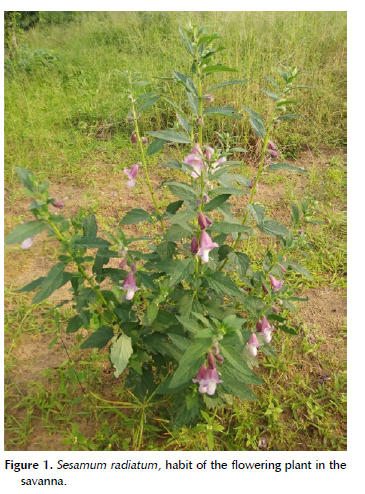
Sesamum radiatum (Figure 1) or black benniseed is native to West and Central Africa. The leaves of S. radiatum are consumed as a vegetable in the countries of this region, particularly in Nigeria, Ghana, Benin and north Cameroon (Adebisi & Oni 2023), where it can amount to 50-100% of the incomes of rural households (Mbaye & Moustier 2000). The plant is used in traditional pharmacopoeia, an avenue for enriching research for new chemical entities that could lead to production of medicines for use in different therapeutic areas (Lavaee et al. 2019). It is found on nutrient-poor sites, growing in sandy, rocky or gravelly places, and it tolerates heat and drought well and continues to grow and bloom during the dry season (Bedigian 2003). As such, it is capable of occupying open places where few other herbaceous plants grow. Sesamum radiatum is also a hermaphroditic plant, optionally allogamous with a pollen/egg ratio equivalent to 66.1 and a development cycle that spans about 75 days (Zhang et al. 2019).
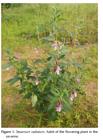
Additionally, S. radiatum has a high potential to contribute to ecosystem services. Ecosystem services can be defined as the services rendered to human populations by the natural functioning of ecosystems (Maréchal et al. 2016). Sesamum radiatum in urban green spaces generates a wide range of ecosystem services, including provisioning services such as food and medicine, regulating services like environmental stewardship and erosion control, supporting services by being melliferous, serving as green manure, providing habitat and conserving genetic diversity, and finally cultural services, which encompass aesthetic appreciation, recreation and spirituality. All of these characteristics, including its aesthetic value, illustrate the species' great potential as an autochthonous plant utilised in green spaces. Beyond green spaces, S. radiatum also has relevance in agriculture. Several characteristics of S. radiatum make it easy to multiply and use as a rapidly growing crop. Sesamum radiatum is among the wild relatives of sesame (Sesamum indicum) that are proposed as a potential source of pest and microbe resistance alleles (Kawase 2000). Thus, inclusion of S. radiatum into sesame breeding programmes will be an effective strategy to improve biotic stress tolerance characters and broaden the breeding potential of sesame.
Despite all its varied potentials, S. radiatum remains a genetically understudied species. A comprehensive understanding of the genetics of S. radiatum may provide a scientific foundation for its sustainable use, conservation and improvement, whether in agriculture, green spaces or traditional practices. This knowledge facilitates informed decision-making for the cultivation, utilisation and conservation of this versatile plant species. To the best of our knowledge, there is no germplasm collection for S. radiatum, and little is known about its genetics. Research to define the genetic diversity of S. radiatum, for example in Benin, has depended mainly on the use of quantitative morphological traits (Adéoti et al. 2012). However, the use of morphological and agronomic characteristics is associated with a strong influence from environmental factors. First efforts made using amplified fragment length polymorphism (AFLP) markers revealed low diversity or differentiation within the accessions analysed (Adéoti et al. 2011). The absence of detailed molecular data across multiple sesame accessions and related species also hampers further investigations into the origin and domestication of sesame. Uncu et al. (2015) emphasised the need for more characterisation of wild germplasm including African species, interspecific crosses and molecular studies to efficiently harness potentialities of wild sesame species. In this context, S. radiatum may contribute genes that could be beneficial to S. indicum.
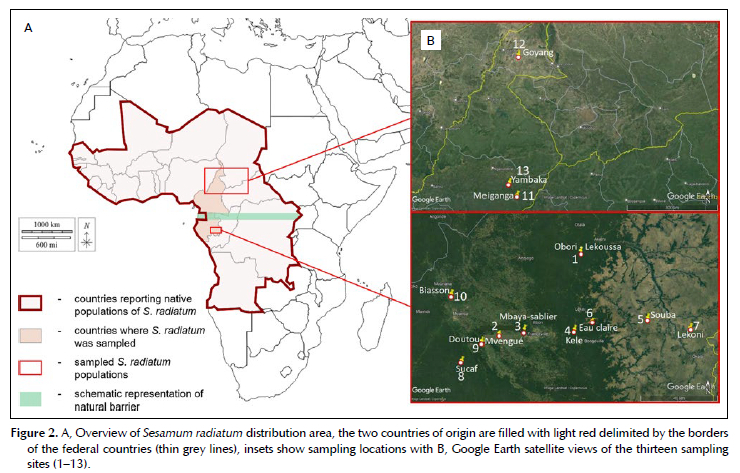
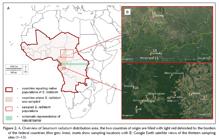
HAT-RAPD may represent a simpler and more efficient marker system for extensive S. radiatum biodiversity conservation and utilisation strategies. The advantage of HAT-RAPD is its simplicity and cost-effectiveness. It is not necessary to have prior information about the DNA sequence as is required for microsatellites or single nucleotide polymorphisms (SNPs), and this technique avoids the specialised electrophoretic equipment needed for AFLPs. A good knowledge of the genetic diversity and differentiation of S. radiatum will also make it possible to appreciate its ability to respond to environmental changes and adaptability in new environments (Miller & Cramer 2005) and will facilitate the knowledge-based preservation of natural genetic structures of the autochthonous S. radiatum populations. We started our study from the postulate that the distribution of S. radiatum is partitioned by deep equatorial tropical forest. Indeed, S. radiatum occurs in savannas and is not known from the tropical rainforest spanning Equatorial Guinea and eastward, and appears to represent a natural barrier (Figure 2). The objective of this work is to analyse the genetic diversity and potential differentiation of S. radiatum accessions on both side of this natural barrier, from the southeastern border of Gabon to the north of Cameroon. It is interesting to evaluate plants with ornamental, nutritional and cultural values from natural formations to ultimately establish a global strategy for their introduction and integration into local markets, ensuring that the process is systematic, quality controlled and adapted to needs and on-site conditions. The objective is to make them gradually available and accessible to the local populations. In the end, our goal is to promote the use of native plants for more sustainable green spaces development. Knowledge of the biology and genetic situation of autochthonous species with nutritional and decorative potential constitutes a prerequisite for valorisation through domestication. This study could be a first step to identify genes or genetic variants associated with these local adaptations. It would facilitate the identification of genetically distinct populations in different regions with implications for the conservation of genetic diversity to promote the preservation of unique populations for the species' maintenance.
Materials and methods
Sampling area
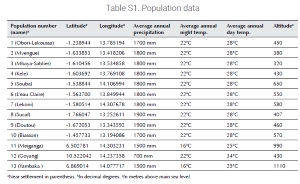
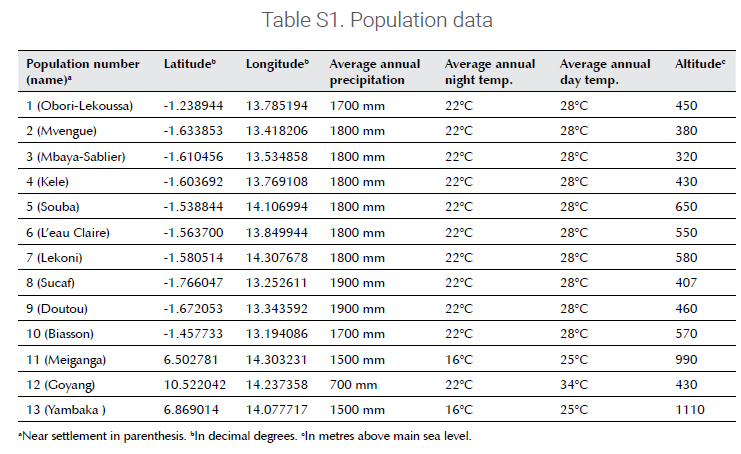
The native distribution area of Sesamum radiatum includes West and Central African countries (Figure 2A). Our sampling areas were located in two savannas separated by the tropical equatorial rainforest, where the species has not been observed, thus, creating a natural barrier in-between. This natural barrier is close to the species' centre of distribution. The two sampling areas were located respectively about seven hundred kilometres southeast and northeast of S. radiatum distribution area centre (which correspond approximately to Malabo city). By choosing sampling areas on both sides of this natural barrier, we increased the probability of capturing a greater part of the species genetic diversity, subject to different selective pressures, which could induce distinct genetic characteristics. Its populations could have developed local adaptations to cope with the specific environmental conditions in the two geographically distant regions. While both sampling areas were ecologically classified as savanna, they were not meteorologically identical. The average maximum temperatures are 34°C for the northern Cameroon region and 28°C for southeastern Gabon. In terms of annual rainfall, the northern Cameroon region receives only 700 mm of precipitation compared to a maximum of 1 900 mm in southeastern Gabon (for detailed information see Supplementary Table S1).
 Supplementary
Plant material
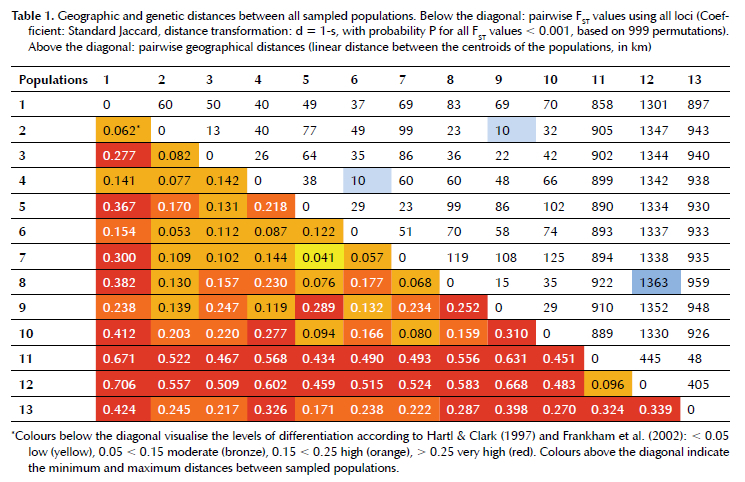
Whole young leaves were collected from the apical part of 123 S. radiatum plants in 13 populations - i.e., those populations occupying savanna habitats of southeastern Gabon and northern Cameroon (Figure 2B). Leaves were harvested from six to ten plants per population, with individual plants in a given population separated by 100-150 m, and populations separated by 10-786 km (Figure 2, Table 1, Supplementary Table S1).
DNA extraction and HAT-RAPD analysis
DNA extraction was performed following the protocol of Eimert et al. (2016) with slight modifications. Specifically, the amount of plant material to be extracted had to be limited to 10 mg of dry leaves per 900 μ! buffer because of the very high viscosity of the crude extracts, due to the richness in polysaccharides within the leaves. Polysaccharides were largely removed using polyvinyl-polypyrrolidone (PVPP 10 mg per sample) in UEB (urea extraction buffer composed of 7 M urea, 0.3125 M NaCl, 50 mM Tris-Cl pH 8, 20 mM EDTA pH 8 and 1% Sarkosine in a volume of water). For additional purification we used RNase treatment. DNA purification also included the use of phenol-chloroform-isoamyl alcohol (25:24:1). Finally, TE buffer was used to dissolve the plant DNA that is relatively free of major contaminants. The quantity and quality of DNA were estimated using a Nanodrop spectrophotometer (Thermo Scientific NanoDrop TM8000). Mean DNA concentration was 101.3 ng/μl (range 30.1-433.7 ng/μl). DNA purity was for 260/280 ratios 2.08 (range 1.64-2.61) and for 260/230 ratios 1.20 (range 0.43-1.98). DNA samples are available from the authors upon request. Prior to use, all DNA solutions were diluted with sterile deionised water to 5 ng/μl to ensure that all targets are amplified uniformly, reducing amplification biases and improving the reliability and comparability of the results. Amplifications were achieved using DNA extracts with a minimum OD260/280 ratio of 1.40.
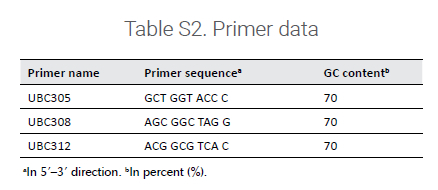
The primers selected for the study (UBC 305, UBC 308 and UBC 312, Table S2) were part of the RAPD set of the University of British Columbia (UBC, Vancouver, Canada), chosen for their high GC content to facilitate the HAT-RAPD specific approach. The high GC content allows for the higher annealing temperatures of HAT-RAPD polymerase chain reactions (PCRs) avoiding the unspecific priming inherent to low-temperature RAPD PCRs (Chundet et al. 2007, Ruangsuttapha et al. 2007). HAT-RAPD reactions were performed in reaction volumes of 20 μl containing 5 ng/μl DNA, 1.5 uM primer, 5 mM four deoxynucleotide triphosphates (dATP dCTP dGTP dTTP), 0.1 U/μl DreamTaq DNA polymerase (Fermentas, Thermo Scientific) and 1 x PCR Green Buffer, using a Primus Advanced thermocycler (PeqLab, VWR International GmbH). The amplification was initiated by a denaturation step at 95°C for 5 minutes, followed by 38 cycles of 1 minute at 95°C, 1 minute at 45°C and 2 minutes at 72°C. Ramp speeds were set to 2°C/sec for heating and 1°C for cooling. The resulting DNA fragments were separated by horizontal gel electrophoresis (1.3% agarose in Tris-borate-EDTA Buffer). Gels were stained with 7.5 μl ROTI®GelStain (Carl Roth GmbH, Karlsruhe, Germany) and scanned using a MF-ChemiBIS 3.2 gel documentation system (DNR Bio-Imaging Systems, Neve Yamin, Israel).
Data analysis
Amplified polymorphic HAT-RAPD markers were scored as present (1) or absent (0) for each sample. Ambiguous bands that could not be easily distinguished were not scored (Williams et al. 1990). Thus, for the three primers and the 123 samples from 13 populations, 56 polymorphic loci were analysed. Allel-ic frequencies of loci were calculated using fingerprint analysis with missing data (FAMD, Schlueter & Harris 2006) using Lynch and Milligan's (1994) estimation recommended for RAPD markers. Pairwise FST values (Fixation index; Wright 1969; Holsinger & Weir 2009) were also calculated using FAMD based on the Jaccard similarity coefficient (Jaccard 1912), average coefficient calculated from 100 draws (d = 1-s). Here, also the unbiased expected heterozygosity was calculated as (2N / [2N-1])*He, where N is the number of different alleles in a population, and He equals 1-Epi 2, where pi is the frequency of the ith allele in the population. STRUCTURE 2.3 software (Pritchard et al. 2000; Falush et al. 2007; Hubisz et al. 2009) was used to detect genetic structures within the sample populations. Here, the first 100 000 steps in the Marcov chain were used as burn-in to reach equilibrium distribution, minimising the effect of the starting configuration. This was followed by 50 000 additional Markov chain steps for each K-value and the calculation was iterated 20 times to ensure consistency and reliability of the results. Settings were assuming an admixture model and correlated allele frequencies without locpriors in order to minimise skewed clusterings due to prior assumptions. The most likely number of clusters (K, tested for 1 through 13) was calculated according to Evanno et al. (2005) using the Structure Harvester program (Earl & VonHoldt 2012), where the best K was calculated based on the second order rate of change of the likelihood (∆K, with higher numerical values indicating higher likelihoods). Based on the FST data found, distance-based cluster analysis (NJ - neighbourhood joining; Saitou & Nei 1987) for populations was calculated in FAMD and a dendrogram was constructed from 1 000 repetitions. A Principal Coordinate Analysis (PCoA; Gower 1966) for populations was conducted in GenAlEx plug-in version 6.5 (Peakall & Smouse 2006, 2012), which was also used for analysis of molecular variance (AMOVA analysis) (set to 999 permutations; Excoffier et al. 1992) to assess the hierarchical compartmentalisation of genetic variations within and among populations and between the two previously detected regions (K=2). The correlation of genetic, geographic and environmental patterns was analysed using Mantel tests (Mantel 1967; Sokal 1979) through the zt-win software (Bonnet & Van de Peer 2002) with 10 000 simulations per parameter. This analysis can reveal correlating patterns such as isolation by distance, where geographically distant populations are more genetically distinct, or adaptation to altitude, where populations at similar altitudes might be more genetically similar regardless of geographic distance. The altitude and geographic (linear) distances between the centroids of the sampled populations were determined with Google EarthTM using the 'ruler' tool. Climate data on precipitation and temperature (Supplementary Table S1) were collected based on data from the IRD (The Research Institute for Development) ground stations observation using inverse distance weighted with monthly time step and half a square degree for spatial scale. Data correspond to the average monthly values cumulated over 20 years (1991-2021).
Results
The genetic fingerprint profiles of S. radiatum samples show a varying degree of heterogeneity within and among populations. Pairwise FST values vary from 0.041 (between population 5 and 7) to 0.706 (between population 1 and 12) (Table 1). The overall average of interpopulation FST of all samples is 0.284. The genetic diversity within the populations is described by the heterozygosity. The unbiased expected heterozygosity over all populations is 0.256.
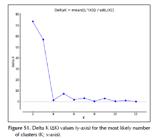
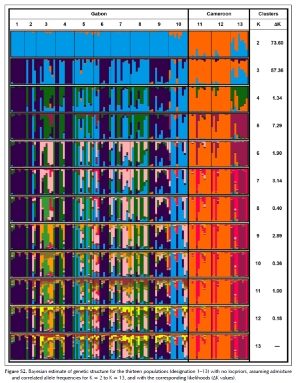
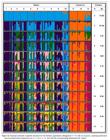
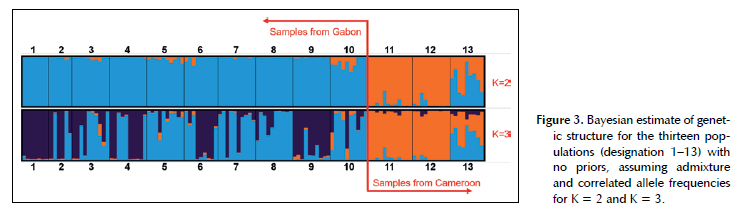
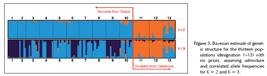
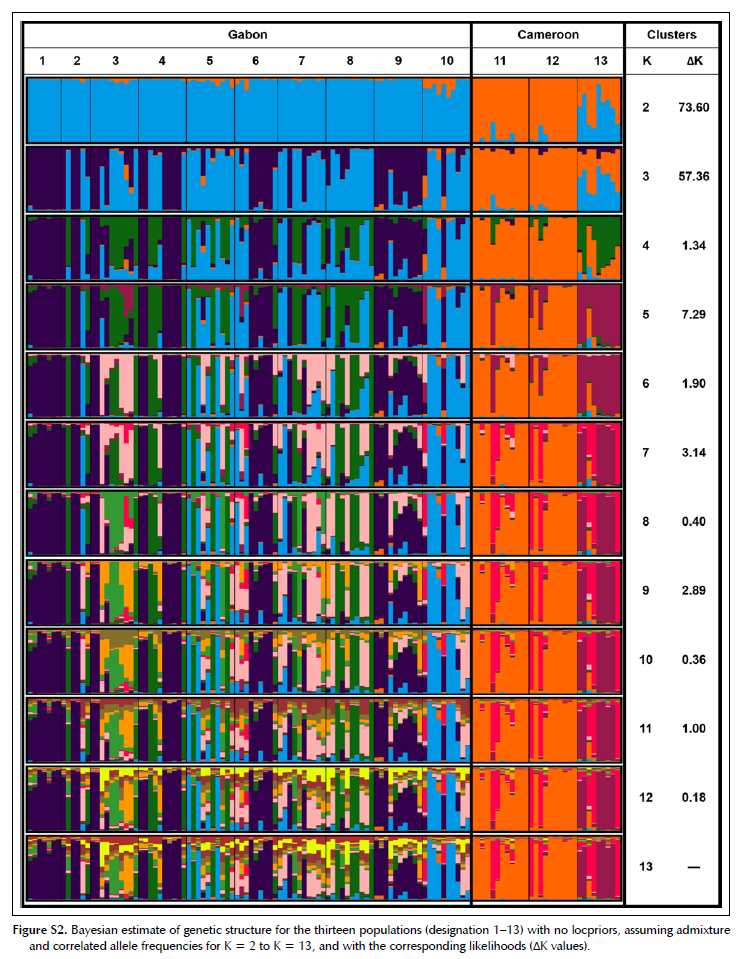
We used structure analysis to determine the most likely number of genetic groups (K) potentially situated in the observed populations, ranging from a minimum of 1 to a maximum of 13. In these calculations a higher ∆K indicates a greater probability of the hypothesis of the corresponding K value. Here, the most likely K value was observed for K = 2 (∆K = 73, Supplementary Figure S1) for all models tested from the STRUCTURE analysis using all loci. Thus, we observed two main clusters with populations 1 through 10 belonging to the first cluster and populations 11 through 13 to the second cluster (Figure 3). These clusters largely correspond to the two geographical extremes, southeastern Gabon and northern Cameroon, with population 13 appearing to be an admixed population of the two main clusters. A lower likelihood (∆K = 58) was calculated for a potential K = 3 (Supplementary Figure S1) with two possible subclusters within the Gabonese region, differentiating populations 1, 2, 3, 4, 6, and 9 (subcluster A, Figure 3, lower panel, dark blue) from populations 5, 7, 8, and 10 (subcluster B, Figure 3, lower panel, light blue). Almost all Gabonese populations show a certain amount of admixture between the subclusters, with population 3 exhibiting an almost equal allocation of both subclusters, with subcluster A (Figure 3, dark blue) slightly prevailing. No significant probability was observed for higher K values (see Supplementary Figures S1 and S2).
 S2
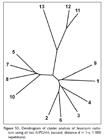
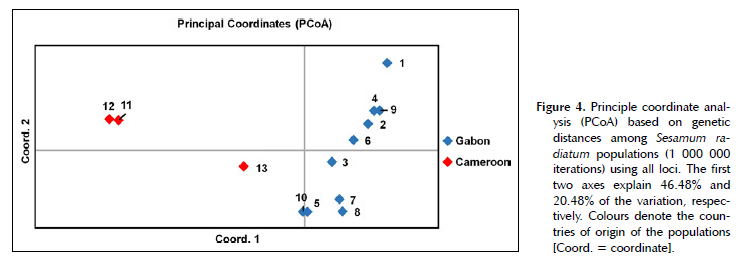
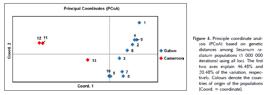
The PCoA (Figure 4), carried out on all the samples, supports the relative genetic distance of the populations from each other, with 46.48% and 20.48% of the genetic differentiation explained by the first two axes, respectively. Here, one group consists of populations 1 through 10 and the second group of populations 11 through 13, with the population 13 occupying an intermediate position, suggesting admixture between the two main clusters. A cluster analysis revealed a similar configuration, but with the mentioned population 13 being placed nearer to populations 11 and 12 from Cameroon, than to the populations from Gabon (Supplementary Figure S3).
The AMOVA analysis of all the data applied to all samples shows that 32% of the total genetic differentiation can be detected among the populations and 68% variability within populations. Mantel tests, applied to all populations, show that there is a strong and highly significant correlation between genetic and geographical distances with R (correlation coefficient) = 0.784 (P = 0.003). Significant correlations with genetic distances were also observed for temperature (R = 0.664, P = 0.004) and precipitation (R = 0.691, P = 0.001).
Discussion
Sesamum radiatum, a traditional leafy vegetable, has strong potential to contribute to the ecosystem services provided by green spaces essential to human well-being. The genetic analysis of S. radiatum populations aims to give a basis for the valorisation of local nutritional plants with decorative potential and its popularisation through domestication. Sesamum radiatum has many advantages because it is easy to cultivate and can adapt to a wide variety of conditions. It provides ecosystem processes, such as nutrient cycling, erosion control and pest regulation, thereby helping to maintain the balance of ecosystems. By assessing the genetic diversity and potential differentiation of S. radiatum populations from different regions, the study lays the foundation for searching for genes or genetic variants associated with local adaptations. This information is valuable for the conservation of genetic diversity and the development of green spaces using native plants with ornamental and functional potential. The study results could facilitate the identification of genetically distinct populations, with implications for the preservation of unique populations and maintenance of the species.
HAT-RAPD markers were used in this study to assess the genetic diversity of S. radiatum accessions from two regions of Central Africa. This DNA profiling technique was utilised because of the lack of knowledge about genetic sequence information from S. radiatum and the cost efficiency of HAT-RAPD. A similar RAPD technique was earlier used to genetically characterise accessions of another member of the Pedaliaceae family, Sesamum indicum (Salazar et al. 2006).
Genetic diversity within S. radiatum populations remains very high with an overall mean equivalent to 0.284, which is above the unbiased expected heterozygosity for the overall populations (0.256). This high genetic diversity is likely due to the reproductive biology of S. radiatum as a hermaphrodite plant with preferential allogamy and anemophilous pollination (Ahohuendo et al. 2012). It is possible that S. radiatum has an estimated cross-pollination rate of up to 60% (Awoleye & Illoh 2017). As observed by Yermamos (1980), S. indicum, a plant of the same family and with agromorphological similarities, has approximately 10 to 20% of its diversity genetics of its populations linked to this cross-pollination. This could also explain the high level of genetic diversity observed in our study. According to Bhat et al. (1999), a high local diversity of S. indicum is also associated with cross-pollination, depending on the presence of pollinating insects at the time of flowering.
Distance-based analysis of the electrophoretic profiles identified two main clusters, mostly consistent with their geographic origin: southeastern Gabon and northern Cameroon, except for population 13 where we see evidence for admixture. Such general pattern is typical for large populations in the absence of disruptive selection (Hartl & Clark 1997) with genetic drift as the main driver of population genetic differentiation.
In this study, Mantel tests support the role of geographical distance and climatic factors to have jointly affected the genetic differentiation of S. radiatum. The correlation between the spatial structure of clusters and the genetic structure might be related to genetic drift through founding effects. The distance between the two savannas has very likely contributed to an inhibited gene flow. The significant correlation between genetic distance and climatic factors suggest that differences of temperature and precipitation between the two savannas may have driven local adaptation or divergent selection in the areas. The climatic conditions of the two clusters are not at all identical. Therefore, one might speculate that the populations of each cluster may have acquired morphological or physiological characteristics adapted in response to specific ecological conditions (Sauvion & Darnis 2022). Thus, populations in the two areas may represent different ecotypes. Concerning population 13 in Cameroon, there were many agricultural activities in the locality compared to other sites. This could be one of the reasons why we observed significant admixture of the two main genetic clusters only in this Cameroonian population. However, our current dataset may not be sufficient to achieve this level of discrimination. This can be done with additional sampling from West African and other Central African countries.
Further Bayesian analysis of the Gabonese cluster allows for the possible existence of two subgroups within the cluster. However, cluster analysis cannot find any evidence for further isolation by distance or for selective adaptation within this cluster. Also, AMOVA shows no strong differentiation between the populations of this cluster. Hence, we argue that this weak differentiation is most likely due to anthropogenic activities (seed exchange etc.). Indeed, the first subcluster (populations 1, 2, 3, 4, 6, 9) is characterised by semi-urban environments with a proximity to main roads suggesting high anthropogenic pressures. The second subcluster (populations 5, 7, 8, 10) is characterised by more isolated areas with less anthropogenic pressure. The populations 5 and 7, which are the genetically closest populations, belong exactly to the same type of habitat, the Guineo-Congolia savanna formation, which stretches to the Congo. The area from which population 8 was sampled is located in a large private area belonging to the SUCAF Gabon Company (Sucrerie Africaine du Gabon), a sugar cane producer. In the 4 400 ha area, access to the public to this population is limited. Finally, population 10 is also geographically isolated, but less so than other populations. Population 10 was far from inhabited areas and without agricultural activities in the vicinity. All these elements suggest that the subclusters diversity could strongly depend on human factors and that the anthropogenic activities, affecting the plants directly, as well as their environs, can be considered a strong driver of genetic differentiation.
Conclusions
The HAT-RAPD method allowed for the genetic delimitation based on the actual biological situation. The two detected clusters may be shaped by geographic isolation (isolation by distance and genetic drift) or by adaptive differentiation (adaptation to different environmental factors) or anthropogenic factors (agricultural expansion or seed distribution by humans). However, we cannot, at this point, definitely differentiate between the driving factors of the differentiation of the observed populations. On the other hand, for the populations in Gabon that are geographically proximate, diversity tends to be explained by indigenous anthropogenic activities and the traditional use of S. radiatum. Indeed, S. radiatum is used in the culinary habits and customs of the inhabitants. An archaeological dig in the Lastoursville region, located 200 km from the sampling sites, has uncovered seeds of S. radiatum or a related species in clay pots thousands of years old. The populations of the Stone Age harvested and therefore already consumed sesame seeds (White & Abernetty 1997). Thus, if we want to promote a more rational and intensive use of this plant in green space development programs, the source of seeds is a key element. The production and dissemination of planting material should take place within the clusters in order not to modify the existing genetic structure, while benefiting from sufficient genetic diversity within the regions themselves. Such an approach of detailed genetic studies of S. radiatum populations, allows the precise determination of regions specific to the origin and the establishment of appropriate management.
Competing interests
The authors declare that they have no financial or personal relationship(s) that may have inappropriately influenced them in writing this article.
Authors' contributions
Conceptualisation by S.M., O.D. and K.E.; methodology, investigation and analysis by J.D. and K.E.; writing of original draft by J.D.; review and editing by J.D., S.M., O.D. and K.E.. All authors have read and agreed to the published version of the manuscript.
Ethical considerations
Gabon and Cameroon are both members of the CEMAC (Economic and Monetary Community of Central Africa). Within this network, no permission was necessary for the collection of the leaf samples. There should be no negative impact on the sampled S. radiatum populations as no plants were removed from their environment. Only a few leaves per plant were collected. The necessary phytosanitary and export permits to the EU were obtained from the Gabonese Agency for Food Safety (AGASA).
Funding
This research received no external funding.
Data availability statement
DNA samples and the complete character table (RAPD, raw data) are available upon request.
Acknowledgements
We would like to thank U. Hüwe of the Hochschule Geisenheim University for support.
References
- Adebisi, I.A. & Oni, O., 2023, 'Utilization of underutilized leafy vegetables in Nigeria: A case study of Sesamum radiatum', Journal of Ethnobiology and Ethnomedicine 19(1), 12-21.
-
Adéoti, K., Dansi, A., Ahoton, L., Vodouhe, R.S., Ahohuendo, B.C., Rival, A. & Sanni, A., 2012, 'Agromorphological characterization of Sesamum radiatum (Schum. and Thonn.), a neglected and underutilized species of traditional leafy vegetable of great importance in Benin', African Journal of Agricultural Research 7(24), 3569-3578, http://dx.doi.org/10.5897/AJAR11.1845.
» http://dx.doi.org/10.5897/AJAR11.1845 -
Adéoti, K., Rival, A., Dansi, A., Santoni, S., Brown, S., Beule, T., Nato, A., Henry, Y., Vodouhe, R. & Loko, L., 2011, 'Genetic characterization of two traditional leafy vegetables (Sesamum radiatum Thonn. ex Hornem. and Ceratotheca sesamoides Endl.) of Benin, using flow cytometry and amplified fragment length polymorphism (AFLP) Markers', African Journal of Biotechnology 10(65), 14264-14275, https://doi.org/10.5897/AJB11.1176.
» https://doi.org/10.5897/AJB11.1176 -
Ahohuendo, B.C., Sinébou, V.C.O., Ahoton, L.E., Etèka, A.C., Dansi, A., Ahanchédé, A., Hounhouigan, J.D., Sanni, A. & De Foucault, B., 2012, 'Phénologie et biologie florale de Sesamum radiatum Schumach. & Thon., un légume feuille traditionnel en voie de domestication au Bénin [Study of the phenology and floral biology of Sesamum radiatum Schumach. & Thon., a traditional leafy vegetable in domestication in Benin]', Acta Botanica Gallica 159, 335-344, https://doi.org/10.1080/12538078.2012.737146.
» https://doi.org/10.1080/12538078.2012.737146 -
Ali Khodja, A., 2011, 'Espace vert public urbain de l'histori-cisme a la normativite (cas de Constantine)', PhD thesis, Universite Mentouri de Constantine, Constantine, Tunisia, http://archives.umc.edu.dz/handle/123456789/7489.
» http://archives.umc.edu.dz/handle/123456789/7489 - Awoleye, F. & Illoh, H.C., 2017, 'Genetic diversity and cross-pollination rates in Sesamum radiatum populations', Genetic Resources and Crop Evolution 64(3), 579-587.
-
Bedigian, D., 2003, 'Evolution of sesame revisited: domestication, diversity and prospects', Genetic Resources and Crop Evolution 50, 779-787, https://doi.org/10.1023/A:1025029903549.
» https://doi.org/10.1023/A:1025029903549 -
Bhat, K.V., Babrekar, PP & Lakhanpaul, S., 1999, 'Study of genetic diversity in Indian and exotic sesame (Sesamum indicum L.) germplasm using random amplified polymorphic DNA (RAPD) markers', Euphytica 110, 21-34, https://doi.org/10.1023/A:1003724732323.
» https://doi.org/10.1023/A:1003724732323 -
Bonnet, E. & Van de Peer, Y., 2002, 'Zt: a sofware tool for simple and partial Mantel tests', Journal of Statistical Software 7, 1-12, https://doi.org/10.18637/jss.v007.i10.
» https://doi.org/10.18637/jss.v007.i10 - Chundet, R, Cutler, R.W., Tasanon, M, & Anuntalabhochai, S., 2007, 'Hybrid detection in lychee (Litchee chinensis Sonn.) cultivars using HAT-RAPD markers', ScienceAsia 33, 307-311.
-
Earl, D.A. & VonHoldt, B.M., 2012, 'STRUCTURE HARVESTER: a website and program for visualizing STRUCTURE output and implementing the Evanno method', Conservation Genetics Resources 4, 359-361, https://doi.org/10.1007/s12686-011-9548-7.
» https://doi.org/10.1007/s12686-011-9548-7 -
Eimert, K., Hüwe, U. & Rückert, F.-E., 2016, 'Evaluation of genetic differentiation of autochthonous sloe (Prunus spi-nosa, Rosaceae) populations across Germany using molecular markers', Plant Ecology and Evolution 149, 280-290, https://doi.org/10.5091/plecevo.2016.1182.
» https://doi.org/10.5091/plecevo.2016.1182 -
Evanno, G., Regnaut, S. & Goudet, J., 2005, 'Detecting the number of clusters of individuals using the software STRUCTURE: a simulation study', Molecular Ecology 14, 2611-2620, https://doi.org/10.1111/j.1365-294X.2005.02553.x.
» https://doi.org/10.1111/j.1365-294X.2005.02553.x -
Excoffier, L., Smouse, FIE. & Quattro, J.M., 1992, 'Analysis of molecular variance inferred from metric distances among DNA haplotypes: application to human mitochondrial DNA restriction data', Genetics 131(1), 479-491, https://doi.org/10.1093/genetics/131.2.479.
» https://doi.org/10.1093/genetics/131.2.479 -
Falush, D., Stephens, M. & Pritchard, J.K., 2007, 'Inference of population structure using multilocus genotype data: dominant markers and null alleles', Molecular Ecology Notes 7, 574-578, https://doi.org/10.1111/j.1471-8286.2007.01758.x.
» https://doi.org/10.1111/j.1471-8286.2007.01758.x - Frankham, R., Ballou, S.E.J.D., Briscoe, D.A. & Ballou, J.D., 2002, Introduction to Conservation Genetics, Cambridge University Press, New York, USA.
-
Gower, J.C., 1966, 'A Q-Technique for the calculation of canonical variates', Biometrika 53(3-4), 588-590, https://doi.org/10.1093/BIOMET/53.3-4.588.
» https://doi.org/10.1093/BIOMET/53.3-4.588 - Hartl, D.L. & Clark, A.G., 1997, Principles of population genetics, 3rd edition, Sinauer Associates Inc., Sunderland, USA.
-
Holsinger, K.E. & Weir, B.S., 2009, 'Genetics in geographically structured populations: defining, estimating and interpreting FST', Nature Reviews Genetics 10, 639-650, http://dx.doi.org/10.1038/nrg2611.
» http://dx.doi.org/10.1038/nrg2611 -
Hubisz, M.J., Falush, D., Stephens, M. & Pritchard, J.K., 2009, 'Inferring weak population structure with the assistance of sample group information' Molecular Ecology Resources 9, 1322-1332, https://doi.org/10.1111/j.1755-0998.2009.02591.x.
» https://doi.org/10.1111/j.1755-0998.2009.02591.x -
Jaccard, P., 1912, 'The distribution of the flora in the Alpine zone', New Phytologist 11, 37-50, https://doi.org/10.1111/j.1469-8137.1912.tb05611.x.
» https://doi.org/10.1111/j.1469-8137.1912.tb05611.x -
Kaleghana, K.K. & Mweru, J.-P., 2018, 'Environmental governance undertaken by urban public services in Butembo (North Kivu, Democratic Republic of Congo)', Tropicultura 36(3), 578-592, http://www.tropicultura.org/text/v36n3/578.pdf.
» http://www.tropicultura.org/text/v36n3/578.pdf -
Kabanyegeye, H., Ndayishimiye, J., Hakizimana, P., Masharabu, T., Malaise, F. & Bogaert, J., 2022, 'Diversité floristique et statut de conservation des espaces verts de la ville de Bujumbura (Burundi)', Geo-Eco-Trop 46, 15-28, https://hdl.handle.net/2268/295460.
» https://hdl.handle.net/2268/295460 -
Kawase, M., 2000, 'Genetic relationships of the ruderal weed type and the associated weed type of Sesamum mulaya-num Nair distributed in the Indian Subcontinent to cultivated sesame, S. indicum L.', Japanese Journal of Tropical Agriculture 44, 115-122, https://doi.org/10.11248/jsta1957.44.115.
» https://doi.org/10.11248/jsta1957.44.115 -
Lavaee, F., Moshaverinia, M., MalekHosseini, S.A., Jamshidzade, A., Zarei, M., Jafarian, H., Haddadi, P. & Badiee, P., 2019, 'Antifungal effect of sesame medicinal herb on Candida species: original study and mini-review', Brazilian Journal of Pharmaceutical Sciences 55:e17479, https://dx.doi.org/10.1590/s2175-97902019000117479.
» https://dx.doi.org/10.1590/s2175-97902019000117479 -
Lynch, M. & Milligan, B.G., 1994, 'Analysis of population genetic structure with RAPD markers', Molecular Ecology 3, 91-99, http://dx.doi.org/10.1111/j.1365-294X.1994.tb00109.x.
» http://dx.doi.org/10.1111/j.1365-294X.1994.tb00109.x - Mantel, N., 1967, 'The detection of disease clustering and a generalized regression approach', Cancer Research 27, 209-220.
- Maréchal, J., Sikuzani, Y.U., Bogaert, J., Kankumbi, F.M., & Mahy, G., 2016, 'La perception par des experts locaux des espaces verts et de leurs services écosystémiques dans une ville tropicale en expansion: le cas de Lubumbashi', in J. Bogaert, G. Colinet & G. Mahy (eds.), Anthropisation des paysages katangais, Les Presses Universitaires de Liège, Liège, Belgique, 59-69.
- Mbaye, A. & Moustier, P., 2000, 'Market-Oriented Urban Agricultural Production in Dakar', in N. Bakker, M. Dubbeling, S. Gündel, U. Sabel-Koschella & H. de Zeeuw (eds.), Growing cities, growing food. urban agriculture on the policy agenda - A reader on urban agriculture, pp. 235-256, Deutsche Stiftung für Internationale Entwicklung (DSE), Feldafing, Germany.
-
Miller, A.J. & Cramer, M.D., 2005, 'Root nitrogen acquisition and assimilation', Plant and Soil 274, 1-36, https://doi.org/10.1007/s11104-004-0965-1.
» https://doi.org/10.1007/s11104-004-0965-1 -
Peakall, R. & Smouse, P.E., 2006, 'GENALEX 6: genetic analysis in Excel. Population genetic software for teaching and research', Molecular Ecology Notes 6, 288-295, https://doi.org/10.1111/j.1471-8286.2005.01155.x.
» https://doi.org/10.1111/j.1471-8286.2005.01155.x -
Peakall, R. & Smouse, P.E., 2012, 'GenAlEx 6.5: genetic analysis in Excel. Population genetic software for reaching and research - an update', Bioinformatics 28, 2537-2539, https://doi.org/10.1093/bioinformatics/bts460.
» https://doi.org/10.1093/bioinformatics/bts460 - Pritchard, J.K., Stephens, M. & Donnelly, P., 2000, 'Inference of population structure using multilocus genotype data', Genetics 155(2), 945-959.
-
Ruangsuttapha, S., Eimert, K., Schröder, M.B., Silayoi, B., Denduangboripant, J. & Kanchanapoom, K., 2007, 'Molecular phylogeny of banana cultivars from Thailand on HAT-RAPD markers', Genetic Resources and Crop Evolution 54, 1565-1572, https://doi.org/10.1007/s10722-006-9169-2.
» https://doi.org/10.1007/s10722-006-9169-2 -
Saitou, N. & Nei, M., 1987, 'The neighbor-joining method: a new method for reconstructing phylogenetic trees', Molecular Biology and Evolution 4, 406-425, https://doi.org/10.1093/oxfordjournals.molbev.a040454.
» https://doi.org/10.1093/oxfordjournals.molbev.a040454 -
Salazar, B., Laurentín, H., Dávila, M. & Castillo, M.A., 2006, 'Reliability of the rapd technique for germplasm analysis of sesame (Sesamum indicum L) from Venezuela', Inter-ciencia 31(6), 456-460, http://www.redalyc.org/articulo.oa?id=33911712.
» http://www.redalyc.org/articulo.oa?id=33911712 -
Sauvion, N. & Darnis, M., 2022, 'Reconstruction des scénarios évolutifs d'introduction et d'expansion en Europe des psylles du complexe Cacopsylla prunï, MSc thesis, Université de Montpellier, Montpellier, France, https://hal.inrae.fr/hal-03772001.
» https://hal.inrae.fr/hal-03772001 -
Schlueter, RM. & Harris, S.A., 2006, Analysis of multilocus fingerprinting data sets containing missing data', Molecular Ecology Notes 6, 569-572, https://doi.org/10.1111/j.1471-8286.2006.01225.x.
» https://doi.org/10.1111/j.1471-8286.2006.01225.x -
Sokal, R.R., 1979, 'Testing statistical significance of geographic variation patterns', Systematic Biology 28, 227-232, https://doi.org/10.1093/sysbio/28.2.227a.
» https://doi.org/10.1093/sysbio/28.2.227a - Sosef, M.S.M., Wieringa, J.J., Jongkind, C.C.H., Achoundong, G., Issembé, Y.A., Bedigian, D., Van den Berg, R.G., Breteler, F.J., Cheek, M. & Degreef, J., 2006, 'Check-list des plantes vasculaires du Gabon [Checklist of Gabonese Vascular Rlants]', Scripta Botanica Belgica 35, 1-438, Le Jardin Botanique de Belgique, Belgium.
-
Uncu, A.Ö., Gultekin, V., Allmer, J., Frary, A. & Doganlar, S., 2015, 'Genomic simple sequence repeat markers reveal patterns of genetic relatedness and diversity in sesame', Plant Genome 8(2), https://doi.org/10.3835/plantgenome2014.11.0087.
» https://doi.org/10.3835/plantgenome2014.11.0087 -
Vermeiren, K., Van Rompaey, A., Loopmans, M., Serwajja, E. & Mukwaya, R, 2012, 'Urban growth of Kampala, Uganda: Rattern analysis and scenario development', Landscape and Urban Planning 106(2), 199-206, http://dx.doi.org/10.1016/j.landurbplan.2012.03.006.
» http://dx.doi.org/10.1016/j.landurbplan.2012.03.006 - White, L. & Abernetty, K., 1997, Guide de la végétation de la Réserve de la Lopé [A guide to the vegetation of the Lopé Reserve, Gabon], 2nd edition, ECOFAC, Libreville, Gabon.
-
Williams, J.G.K., Kubelik, A.R., Livak, K.J., Rafalski, J.A. & Tingey, S.V., 1990, 'DNA polymorphisms amplified by arbitrary primers are useful as genetic markers', Nucleic Acids Research 18, 6531-6535, https://doi.org/10.1093/nar/18.22.6531.
» https://doi.org/10.1093/nar/18.22.6531 -
Wolch, J.R., Byrne, J. & Newell, J.R., 2014, 'Urban green space, public health, and environmental justice: The challenge of making cities 'just green enough', Landscape and Urban Planning 125, 234-244, https://doi.org/10.1016/j.landurbplan.2014.01.017.
» https://doi.org/10.1016/j.landurbplan.2014.01.017 - Wright, S., 1969, Evolution and the genetics of populations: Vol. 2. The theory of gene frequencies, The University of Chicago Rress, Chicago, USA.
- Yermamos, D.M., 1980, 'Sesame', in W.R. Fehr & H.H. Hadley (eds.), Hybridization of crop plants, pp. 549-563, American Society of Agronomy, CSSA, Madison, USA, 1980.
-
Zhang, H.Y., Miao, H.M., Ju, M., 2019, 'Potential for adaptation to climate change through genomic breeding in sesame', in C. Kole, (ed), Genomic designing of climate-smart oilseed crops, pp. 371-440, Springer, Switzerland, https://doi.org/10.1007/978-3-319-93536-2_7.
» https://doi.org/10.1007/978-3-319-93536-2_7

Accepted: 3 December 2024
Published: 30 April 2025