Checklist of Basidiomycete macrofungi diversity in the Djebel El Ouahch Forest in the Constantine region, northeastern Algeria
Abstract
This study offers the first systematic checklist of the mycoflora diversity in the Djebel El Ouahch Forest, located in the Constantine region of northeastern Algeria and covering an area of approximately 577 km2. Investigations were conducted to document the presence of macrofungal species. Macrofungal species were surveyed based on their macroscopic and ecological characteristics and identified through morphological analysis and comparison with standard taxonomic keys and specialised databases. The results reveal several interesting and uncommon species. A total of 90 fungal species, belonging to 52 genera, 30 families and 8 orders were identified. Saprophytic and mycorrhizal species were more abundant than parasitic fungi. Several rare and ecologically significant species were recorded, including Agaricus litoralis, Tricholoma pseudonictitans, Gloeophyllum abietinum, Coriolopsis gallica, C. trogii, and Trametes pubescens. These findings highlight the contribution of the Djebel El Ouahch Forest's macrofungal community to the overall fungal biodiversity of the Constantine region. The Constantine region is an important area due to its high macrofungal biodiversity and its significance from a mycological perspective. Given the importance of fungi in terrestrial ecosystems and their potential interactions with plants, further studies should be conducted to expand knowledge of the fungal species present in this region.
Basidiomycetes; checklist; Algeria; biodiversity; macrofungi
Introduction
Macrofungi play diverse and essential roles in ecosystems, serving not only as crucial nutritional sources but also finding widespread applications in biotechnology, medicine and ecology (Badalyan & Zambonelli 2019; Zatout et al. 2021a). In biotechnology, they are used in the production of enzymes, antibiotics and other bioactive compounds (De Silva et al. 2013; Zatout et al. 2024; Zatout et al. 2026a). In medicine, certain species of macrofungi, such as Ganoderma lucidum (Curtis) P. Karst. (reishi mushroom), have been studied for their potential health benefits, including immune-boosting and anti-cancer properties (Chugh et al. 2022).
In the field of ecology, macrofungi contribute to soil formation and carbon cycling, making them key players in environmental sustainability (Tripathi et al. 2017; Liu et al. 2021).
Most of these macrofungi belong to the basidiomycete group. These basidiomycetes are particularly notable for their production of large, visible fruiting bodies, commonly known as mushrooms, which are the reproductive structures of the fungi. The visibility of these fruiting bodies to the naked eye makes Basidiomycetes easily recognisable and important in ecological studies and fungal biodiversity surveys (Kirk et al. 2008; Zatout & Chaouche 2023a).
Macrofungi are heterotrophic organisms in terms of their carbon needs, meaning they rely on preformed organic matter for energy and the building blocks necessary for their growth, much like animals (Durrieu 1993; Karaman et al. 2012). These fungi can be categorised based on their ecological relationships: saprophytes feed on dead or decomposed organic matter; parasites derive their carbon from living organisms, exploiting them to the organism's detriment; and symbiotic species form mutually beneficial relationships with primary producers, such as plants, providing them with the organic substances they require through their roots (Dighton 2019; Sridhar 2019; Yu et al. 2023; Sridhar & Deshmukh 2024; Zatout et al. 2025).
Algeria is characterised by remarkable biodiversity due to its extensive range of bioclimatic zones, which span from humid Mediterranean coastal areas in the north to hyperarid Saharan landscapes in the south (Yahi et al. 2012). This ecological variety has given rise to a wide array of habitats and species, making Algeria one of the most ecologically diverse countries in North Africa (Zatout et al. 2021a). Among the many biological groups supported by these ecosystems, macrofungi represent an important yet understudied component of Algeria's biodiversity. Macrofungi, which include both basidiomycetes and ascomycetes visible to the naked eye, play crucial ecological roles in nutrient cycling, symbiotic interactions - particularly mycorrhizal relationships - and forest health (Kirk et al. 2008; Zatout & Chaouche 2023a).
In Algeria's northeastern regions, which are rich in forested landscapes and receive relatively high rainfall, several macrofungal species have been documented. For instance, forests dominated by Quercus suber L. (cork oak) and Pinus halepensis Mill. (Aleppo pine) have yielded fruiting bodies of ecologically significant species such as Boletus edulis Bull., Amanita caesarea (Scop.) Pers., Cantharellus cibarius Fr., and Macrolepiota procera (Scop.) Singer (Mesfek et al. 2021; Youcef Khodja 2023). These fungi are often found in the Kabylie region, the El Kala National Park and other humid or subhumid forest zones. Despite these promising findings, research on macrofungi in Algeria is still in its early stages. Only a limited number of systematic surveys have been conducted, and these are often restricted in scope, focusing on individual regions or short time periods (Djelloul & Samraoui 2011; Youcef Khodja et al. 2020).
Furthermore, some researchers in Tunisia have documented a variety of ectomycorrhizal and saprotrophic fungi associated with oak and pine forests in regions such as the Kroumirie and Mogod (Malençon 1952; Boussaidi et al. 2020). Some of these macrofungi are also expected to occur in Algerian ecosystems due to biogeographical continuity and ecological similarities with northeastern Algerian habitats (Ouali et al. 2021).
These findings suggest that North African Mediterranean forests, though underexplored, are potentially rich reservoirs of fungal biodiversity. Collectively, these regional patterns highlight an urgent need to enhance fungal research in Algeria and across North Africa. The Djebel El Ouahch Forest, located in the Constantine region of northeastern Algeria, stands out as an ecologically diverse area, yet no prior studies have documented its macrofungal communities. This forest offers a particularly suitable microclimate for macrofungal growth due to its elevation, forest structure and Mediterranean climatic conditions. Nevertheless, its macrofungal diversity has remained undocumented.
To our knowledge, no data currently exist on the macrofungal diversity of the Constantine region. This knowledge gap motivated us to conduct the first systematic survey of macrofungi in the Djebel El Ouahch Forest, northeastern Algeria. Our study aims to contribute to the regional fungal biodiversity inventory and fill critical gaps in taxonomy and distribution.
Materials and methods
Study area
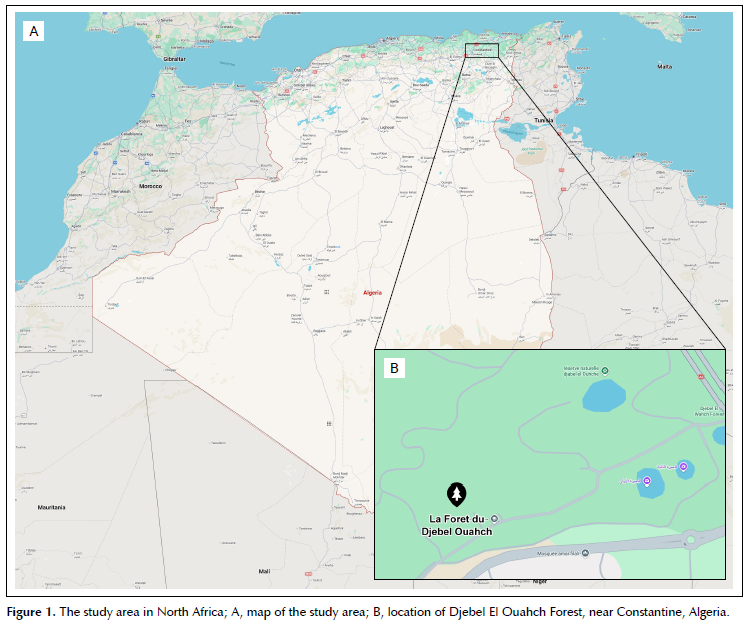
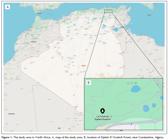
The Djebel El Ouahch Forest is located in the Constantine region of northeastern Algeria and covers an area of approximately 577 km2. It lies within the Tell Atlas range, between the Mediterranean coastline and the northern fringe of the Sahara Desert (Figure 1). This strategic location offers favourable topographical and ecological conditions that enhance the region's biodiversity.
The forest is characterised by a Mediterranean climate with pronounced temperature variations. Winters can be particularly cold, with temperatures dropping to -6°C, while summers are extremely hot, reaching up to 47°C. Annual precipitation ranges between 500 and 700 mm (Bouchahm 1987), supporting a diverse range of plant and fungal life.
Dominant tree species in the area include blue gum (Eucalyptus globulus Labill.), cork oak (Quercus suber), Aleppo pine (Pinus halepensis), and Mediterranean cypress (Cupressus sempervirens L.). These species are representative of typical Mediterranean forest ecosystems and play a crucial role in supporting local biodiversity (Soualah et al. 2024).
Collection and identification of macrofungi
Surveys were conducted periodically after rainfall in the Djebel El Ouahch Forest between 2017 and 2018, with field visits taking place four to six times annually, typically between October and May. During each visit, macroscopic and ecological characteristics of the macrofungal specimens were recorded and photographed in their natural habitats. These characteristics included the shape, size, colour, cap, stipe (stalk), texture, growth habit and the type of substrate (such as soil, decaying wood or leaf litter) on which the fungi were found (Courtecuisse & Duhem 2013; Zatout et al. 2023b). Specimens were carefully collected and brought to the laboratory for further analysis and identification. In the laboratory, identification of the fungi focused on macroscopic features.
The collected specimens were processed using standard mycological techniques for specimen preservation, including drying, mounting and storing. Preliminary identification was carried out in the field by comparing observed characteristics with relevant literature sources, such as Bon (1987), which provided valuable keys to species identification. For further confirmation, more comprehensive resources like MycoKeys (www.mushroomexpert.com) and Species Fungorum (www.speciesfungorum.org) were consulted, ensuring a higher degree of accuracy in the identification process.
Results and discussion
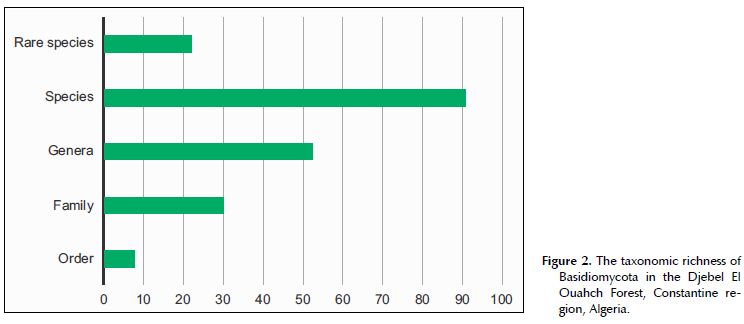
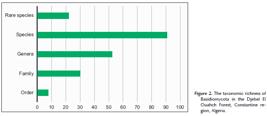
A total of 90 macrofungal species were recorded from Djebel El Ouahch Forest in the Constantine region of northeastern Algeria. These species belong to 8 orders, 30 families and 52 genera, indicating considerable fungal diversity within the study area (Figure 2).
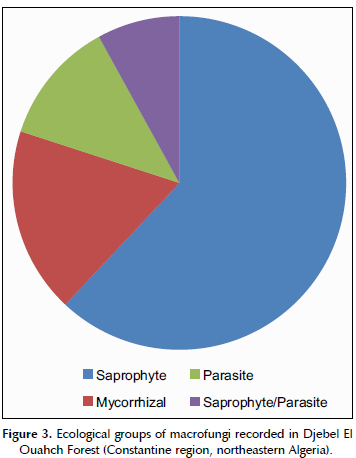
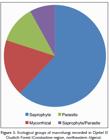
The macrofungi identified were categorised based on their ecological functional roles into three major trophic strategies: saprotrophic, mycorrhizal and parasitic. Saprotrophs represented 62% of the identified species, reflecting the humid conditions and abundance of decomposing organic material in the forest, which create favourable environments for these fungi. The majority of saprotrophs belonged to the order Agaricales, while others from Polyporales and Gloeophyllales were also found on dead wood and forest litter. Other orders such as Hymenochaetales, Phallales and Russulales were also recorded.
Mycorrhizal fungi constituted 18% of the species, including members of the genera Amanita and Tricholoma, which are often found in association with Quercus species (Ortega et al. 2010; Guo et al. 2024). Other ectomycorrhizal species were also recorded, including Astraeus hygrometricus (Pers.) Morgan, Clitocybe fragrans (With.) P.Kumm., Laccaria laccata (Scop.) Cooke, Lactarius deliciosus (L.) Gray and Suillus collinitus (Fr.) Kuntze. These associations are consistent with ectomycorrhizal relationships commonly found in temperate and Mediterranean forest systems (Comandini et al. 2006).
Parasitic fungi made up 12% of the identified species, including Ganoderma applanatum (Pers.) Pat., G. orbiforme (Fr.) Ryvarden and Porodaedalea pini (Brot.) Murrill, while an additional 8% exhibited a dual life strategy - initially parasitic and later saprophytic (Figure 3). Armillaria mellea (Vahl) P.Kumm., is one such example, known to infect a range of host trees before continuing its life cycle as a saprobe (Spaulding 1961; Souto et al. 2024).
Some rare fungi were recorded in the study area, highlighting the unique biodiversity of Djebel El Ouahch Forest (Zatout et al. 2026b). These include Agaricus litoralis Wakef. & A.Pearson, a coastal or forest-dwelling species with a restricted distribution (Zatout et al. 2023b), Tricholoma pseudonictitans Bon, an ectomycorrhizal species associated with conifers, distinguishable by microscopic features (Garnier-Delcourt et al. 2012) and Gloeophyllum abietinum (Bull.) P.Karst., a brown-rot fungus commonly found on coniferous wood, playing a role in decomposition (Zatout et al. 2023a). Also recorded were Coriolopsis gallica (Fr.) Ryvarden, a saprotroph on hardwood with potential biotechnological value (Dajoz 1996; Bujakiewicz 2002; Zatout et al. 2026c), C. trogii (Berk.) Domański, known for its thermotolerant enzymes and lignin-degrading ability (Niemelä et al. 1992; Zhai et al. 2024), and Trametes pubescens (Schumach.) Pilát, a white-rot fungus important for lignin breakdown and studied for its environmental and medicinal applications (Vlasenko et al. 2020). These uncommon species may have specialised ecological roles or specific habitat requirements. Their presence underscores the importance of conserving this forest ecosystem to protect its full fungal diversity.
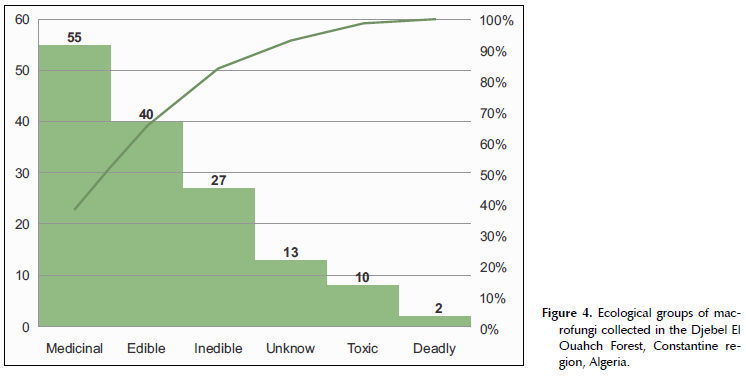
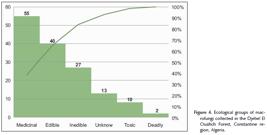
An analysis of the edibility and potential uses of the recorded species revealed that 40 species are considered edible, encompassing a variety of fungi that hold significant cultural and economic value. These species are not only consumed locally but also play a vital role in regional diets and traditional practices. Among these, notable examples such as Agaricus bisporus (J.E.Lange) Imbach (common button mushroom) and Pleurotus ostreatus (Jacq.) P.Kumm. (oyster mushroom) stand out due to their widespread cultivation and global consumption. Both species are well-documented for their nutritional benefits, including high protein content, essential vitamins and bioactive compounds with medicinal properties (Deepalakshmi & Sankaran 2014; Atila et al. 2017; Ramos et al. 2019).
Beyond their dietary importance, these fungi contribute economically by supporting local livelihoods through small-scale and commercial mushroom farming, providing sustainable income opportunities for rural communities. Additionally, some species have traditional cultural uses, such as being integral parts of local cuisine, rituals or folk medicine, reflecting their integration in the socio-cultural fabric of the region.
These findings underscore the forest's untapped potential as a valuable resource for both nutrition and economic development. The diversity of edible fungi highlights opportunities for promoting sustainable harvesting and cultivation practices that can enhance food security and rural economies while preserving biodiversity. Furthermore, integrating these species into local agricultural and economic strategies could foster greater appreciation and conservation of forest ecosystems.
In contrast, 27 species were identified as inedible, although some possess recognised medicinal properties. Genera such as Ganoderma and Trametes are well documented for their therapeutic applications, including antioxidant and antimicrobial activities (Cui & Zhang 2019; Habtemariam 2020; Angulo-Sanchez et al. 2022). Fomes fasciatus (Sw.) Cooke and F. fomentarius (L.) Fr. are medicinal fungi traditionally used for their anti-inflammatory, antimicrobial and antioxidant properties. F. fomentarius contains bioactive compounds such as polysaccharides and triterpenoids and shows potential as an immunomodulator. Extracts of F. fasciatus also demonstrate antimicrobial and antioxidant effects (McCormick et al. 2013; Gáper et al. 2016; Campi et al. 2024).
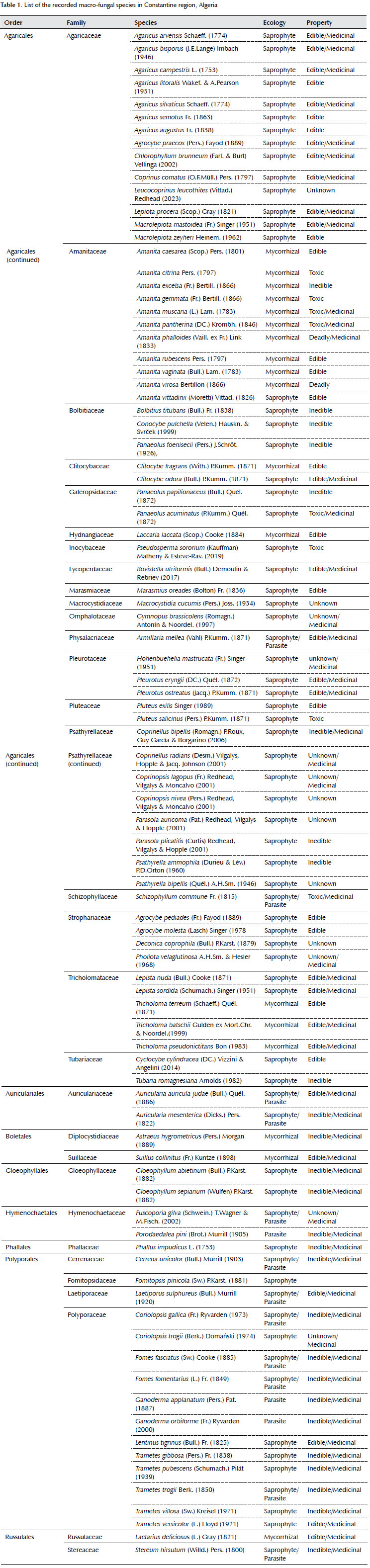
The study also identified ten toxic or potentially deadly species (Table 1, Figure 4), among which Amanita phalloides (Vaill. ex Fr.) Link and A. virosa Bertillon (1866) were confirmed to be lethal. These fungi contain potent toxins, such as amatoxins and virotoxins, emphasising the critical importance of accurate species identification for public health and safety (Garcia et al. 2015; Tavassoli et al. 2019).
Conclusion
The present study establishes the first documented checklist of macrofungi in the Djebel El Ouahch Forest, northeastern Algeria, providing an essential baseline for future mycological investigations in the region. The recorded diversity demonstrates that this forest represents an important reservoir of macrofungal biodiversity within Mediterranean ecosystems. The occurrence of edible, medicinal and toxic species highlights the ecological and practical relevance of these fungi for biodiversity conservation, public awareness and sustainable resource use. This checklist contributes to improving the current knowledge of fungal distribution in Algeria and supports the need for continued surveys in underexplored habitats. Future studies incorporating seasonal monitoring and complementary identification approaches are recommended to refine species inventories and strengthen regional fungal conservation strategies.
Acknowledgements
This work was supported by the Université des Frères Mentouri, Constantine 1 (UFMC1-Constantine, Algeria). The authors also thank Dr Pierre-Arthur Moreau, Faculty of Pharmacy, Université de Lille, France, for helping to identify some macrofungi.
References
-
Angulo-Sanchez, L.T., López-Peña, D., Torres-Moreno, H., Gutiérrez, A., Gaitán-Hernández, R. & Esqueda, M., 2022, 'Biosynthesis, gene expression, and pharmacological properties of triterpenoids of Ganoderma species (Agaricomycetes): a review', International Journal of Medicinal Mushrooms 24,6, 1-17, https://doi.org/10.1615/IntJMedMushrooms.2022044016.
» https://doi.org/10.1615/IntJMedMushrooms.2022044016 -
Atila, F., Owaid, M.N. & Shariati, M.A., 2017, 'The nutritional and medical benefits of Agaricus bisporus: a review', Journal of Microbiology, Biotechnology and Food Sciences 7,3, 281-286, https://doi.org/10.15414/jmbfs.2017/18.7.281-286.
» https://doi.org/10.15414/jmbfs.2017/18.7.281-286 - Badalyan, S.M. & Zambonelli, A., 2019, 'Biotechnological exploitation of macrofungi for the production of food, pharmaceuticals and cosmeceuticals', Advances in Macrofungi (pp. 199-229), CRC Press.
- Bon, M., 1987, Guía de Campo de los hongos de Europa, Omega, Barcelona, Spain.
- Bouchahm, G., 1987, Passive energy design for schools in the Constantine region of Algeria, Master of Architecture thesis, University of Glasgow, United Kingdom.
- Boussaidi, N., Mechergui, T., Noisri, W. & Hamrouni, S., 2020, 'Effets des peuplements forestiers et du sol sur la production et la diversité des champignons sylvestres en Kroumirie (Tabarka et Ain Draham_Tunisie', Agrobiologia 10,1, 1904-1917.
-
Bujakiewicz, A., 2002, 'New, rare and endangered fungi in the Białowieza Primeval Forest (E Poland)', Polish Botanical Journal 47,2, 113-124, https://api.semanticscholar.org/CorpusID:84715128.
» https://api.semanticscholar.org/CorpusID:84715128 - Campi, M.G., Mancuello, C.R., Maubet, Y.E., Cristaldo, E.L., Veloso, B.A. & Robledo, G.L., 2024, 'Fomes: A comprehensive review of traditional and modern biotechnological applications in medicine, food, and materials', Lilloa, 397-413.
-
Chugh, R.M., Mittal, P., Mp, N., Arora, T., Bhattacharya, T., Chopra, H., Cavalu, S. & Gautam, R.K. 2022, 'Fungal mushrooms: a natural compound with therapeutic applications', Frontiers in Pharmacology 13, 925387, https://doi.org/10.3389/fphar.2022.925387.
» https://doi.org/10.3389/fphar.2022.925387 -
Comandini, O., Contu, M. & Rinaldi, A.C., 2006, 'An overview of Cistus ectomycorrhizal fungi', Mycorrhiza 16,6, 381-395, https://doi.org/10.1007/s00572-006-0047-8.
» https://doi.org/10.1007/s00572-006-0047-8 - Courtecuisse, R. & Duhem, B., 2013, Champignons de France et d'Europe, Delachaux et Niestlé, France.
-
Cui, X. & Zhang, Y., 2019, 'Neuropharmacological effect and clinical applications of Ganoderma (Lingzhi)', Ganoderma and Health: Pharmacology and Clinical Application, 143-157, https://doi.org/10.1007/978-981-32-9421-9_5.
» https://doi.org/10.1007/978-981-32-9421-9_5 - Dajoz, R., 1996, 'Inventory and biology of the beetles of the fungus Basidiomycete Polyporaceae Coriolopsis gallica in Arizona', Bulletin de la Société entomologique de France 101,3, 241-250.
- Deepalakshmi, K. & Sankaran, M., 2014, 'Pleurotus ostreatus: an oyster mushroom with nutritional and medicinal properties', Journal of Biochemical Technology 5,2, 718-726.
-
De Silva, D.D., Rapior, S., Sudarman, E. & Stadler, M. & Hyde, K.D., 2013, 'Bioactive metabolites from macrofungi: ethnopharmacology, biological activities and chemistry', Fungal Diversity 62, 1-40, https://doi.org/10.1007/s13225-013-0265-2.
» https://doi.org/10.1007/s13225-013-0265-2 - Djelloul, R. & Samraoui, B., 2011, 'Distribution and ecology of the superior mushrooms of the Aulnaie of Ain Khiar (El Kala National Park, northeastern Algeria)', African Journal of Environmental Science and Technology 5,6, 448-456.
- Dighton, J., 2019, 'The roles of macro fungi (Basidomycotina) in terrestrial ecosystems', in Advances in Macrofungi (pp. 70-104), CRC Press.
- Durrieu, G., 1993, Écologie des Champignons, Masson, Paris.
-
Gáper, J., Gáperová, S., Pristas, P. & Naplavova, K., 2016, 'Medicinal value and taxonomy of the tinder polypore, Fomes fomentarius (Agaricomycetes): a review', International Journal of Medicinal Mushrooms 18, 10, https://doi.org/10.1615/IntJMedMushrooms.v18.i10.10.
» https://doi.org/10.1615/IntJMedMushrooms.v18.i10.10 -
Garcia, J., Costa, V.M., Carvalho, A. & Baptista, P. & Carvalho, F., 2015, 'Amanita phalloides poisoning: mechanisms of toxicity and treatment', Food And Chemical Toxicology 86, 41-55, https://doi.org/10.1016/j.fct.2015.09.008.
» https://doi.org/10.1016/j.fct.2015.09.008 - Garnier-Delcourt, M., Reckinger, C., Schultheis, B., Tholl, M.T. & Thorn, J., 2012, 'Notes mycologiques luxembourgeoises. VI', Bulletin de la Société des naturalistes luxembourgeois 113, 117-135.
-
Guo, H., Liu, W., Xie, Y. & Wang, Z. & Sibirina, L.A., 2024, 'Soil microbiome of shiro reveals the symbiotic relationship between Tricholoma bakamatsutake and Quercus mongolica', Frontiers in Microbiology 15, 1361117, https://doi.org/10.3389/fmicb.2024.1361117.
» https://doi.org/10.3389/fmicb.2024.1361117 -
Habtemariam, S., 2020, 'Trametes versicolor (Synn. Coriolus versicolor) polysaccharides in cancer therapy: Targets and efficacy', Biomedicines 8,5, 135, https://doi.org/10.3390/biomedicines8050135.
» https://doi.org/10.3390/biomedicines8050135 - Karaman, M., Novakovic, M. & Matavuly, M., 2012, Fundamental fungal strategies in restoration of natural environment. Fungi: Types, environmental impact and role in disease, Nova Science Publishers Inc., New York.
- Kirk, P.M., Cannon, P.F., Minter, D.W. & Stalpers, J.A., 2008, Ainsworth and Bisby's dictionary of the fungi, CABI, Wallingford.
-
Liu, D., Wang, Y., Zhang, P. & Yu, F. & Perez-Moreno, J., 2021, 'Macrofungi cultivation in shady forest areas significantly increases microbiome diversity, abundance and functional capacity in soil furrows', Journal of Fungi 7,9, 775, https://doi.org/10.3390/jof7090775.
» https://doi.org/10.3390/jof7090775 -
Malençon, G., 1952, 'Contribution à l'étude des champignons de la Kroumirie', Bulletin de la Société Botanique de France 99,10, 33-52, https://doi.org/10.1080/00378941.1952.10836510.
» https://doi.org/10.1080/00378941.1952.10836510 -
McCormick, M.A., Grand, L.F. Post, J.B. & Cubeta, M.A., 2013, 'Phylogenetic and phenotypic characterization of Fomes fasciatus and Fomes fomentarius in the United States', Mycologia 105,6, 1524-1534, https://doi.org/10.3852/12-336.
» https://doi.org/10.3852/12-336 -
Mesfek, F., Fortas, Z. & Dib, S., 2021, 'Inventory and ecology of macrofungi and plants in a Northwestern Algerian forest', Journal of Biodiversity Conservation and Bioresource Management 7,2, 33-46, https://doi.org/10.3329/jbcbm.v7i2.60148.
» https://doi.org/10.3329/jbcbm.v7i2.60148 - Niemelä, T., Kotiranta, H. & Penttilä, R., 1992, 'New records of rare and threatened polypores in Finland', Karstenia 32, 81-94.
- Ortega, A., Lorite, J. & Valle, F., 2010, 'Mycorrhizal macrofungi diversity (Agaricomycetes) from Mediterranean Quercus forests; a compilation for the Iberian Peninsula (Spain and Portugal)', Nova Hedwigia 91,1, 1.
-
Ouali, Z., Boudagga, S., Sbissi, I., Calvo, R., Venturella, G., Jaouani, A. & Gargano, M.L., 2021, 'Updated checklist of macromycetes of Tunisia', Plant Biosystems 155,4, 691-699, https://doi.org/10.1080/11263504.2020.1779838.
» https://doi.org/10.1080/11263504.2020.1779838 -
Ramos, M., Burgos, N., Barnard, A., Evans, G., Preece, J., … Jiménez, A, 2019, 'Agaricus bisporus and its by-products as a source of valuable extracts and bioactive compounds', Food Chemistry 292, 176-187, https://doi.org/10.1016/j.foodchem.2019.04.035.
» https://doi.org/10.1016/j.foodchem.2019.04.035 -
Soualah, L., Bouzekri, A. & Chenchouni, H., 2024, 'Hoping the best, expecting the worst: Forecasting forest fire risk in Algeria using fuzzy logic and GIS', Trees, Forests and People 17, 100614, https://doi.org/10.1016/j.tfp.2024.100614.
» https://doi.org/10.1016/j.tfp.2024.100614 -
Souto, M., Raposeiro, P.M., Balibrea, A. & Gonçalves, V., 2024, 'Checklist of Basidiomycota and new records from the Azores archipelago', Diversity 16,3, 170, https://doi.org/10.3390/d16030170.
» https://doi.org/10.3390/d16030170 - Spaulding, P., 1961, 'Foreign diseases of forest trees of the world: an annotated list', no. 197, US Government Printing Office, USA.
- Sridhar, K.R., 2019, 'Expedition with micro-and macro-fungi: New perspectives to bridge the gaps', KAVAKA-Tr Mycological Society of India 2, 1-19.
- Sridhar, K.R. & Deshmukh, S.K., 2024, 'Ecology of Macrofungi', in Ecology of Macrofungi (pp. 1-14), CRC Press.
-
Tavassoli, M., Afshari, A., Arsene, A.L. & Mégarbane, B., ... Rezaee, R., 2019, 'Toxicological profile of Amanita virosa. A narrative review', Toxicology Reports 6, 143-150, https://doi.org/10.1016/j.toxrep.2019.01.002.
» https://doi.org/10.1016/j.toxrep.2019.01.002 - Tripathi, N.N., Singh, P. & Vishwakarma, P., 2017, 'Biodiversity of macrofungi with special reference to edible forms: a review', Journal of Indian Botanical Society 96,3-4, 144-187.
-
Vlasenko, V.A., 2020, 'Substrate specialization and distribution of fungi of the genus Trametes in the southeast of Western Siberia', Samara Journal of Science 9,4, 39-42, https://doi.org/10.17816/snv202094105.
» https://doi.org/10.17816/snv202094105 - Yahi, N., Vela, E., Benhouhou, S., De Belair, G. & Gharzouli, R., 2012, 'Identifying important plants areas (key biodiversity areas for plants) in northern Algeria', Journal of Threatened Taxa 4,8, 2753-2765.
- Youcef Khodja, L., Rahmania, F., Courtecuisse, R. & Moreau, P.A., 2020, 'First check-list with the occurrence of new records of Agaricomycetes (Fungi, Basidiomycota) in Babors Kabylia (Northern Algeria)', Ecologia mediterranea 46,2, 5-25.
-
Youcef Khodja, L., 2023, 'Review of ecology and nomenclature of fungi (Basidiomycota) reported under the Algerian cedar forests (Cedrus atlantica Mentti Carries) with the occurrence of new orthographical variants for fungal repositories', Ecologia Mediterranea 49,2, 5-24, https://doi.org/10.3406/ecmed.2023.2200.
» https://doi.org/10.3406/ecmed.2023.2200 -
Yu, Y., Liang, Y., Cheng, Y. & Shen, R. & Lu, D., 2023, 'Investigation on Macrofungi in Zhanjiang City', Environment, Resource and Ecology Journal 7,5, 26-39, http://dx.doi.org/10.23977/erej.2023.070504.
» http://dx.doi.org/10.23977/erej.2023.070504 -
Zatout, R., Benarbia, R. & Yalla, I., 2024, 'Phytochemical profiles and antimicrobial activities of Phellinus mushroom: Implications for agricultural health and crop production', Agricultural Research Journal 61, 3, http://dx.doi.org/10.5958/2395-146X.2024.00044.7.
» http://dx.doi.org/10.5958/2395-146X.2024.00044.7 -
Zatout, R., Benslama, O., Chaouche, N.K., Lu, W., Karunarathna, S.C. & Garzoli, S., 2026b, 'Integrated morphological, molecular, and chemical characterization of the macrofungus Pholiota gallica with phylogenetic analysis and in silico antioxidant and anti-inflammatory evaluation', Chemistry & Biodiversity 23,3, e71091, https://doi.org/10.1002/cbdv.71091.
» https://doi.org/10.1002/cbdv.71091 -
Zatout, R., Benslama, O., Lu, W., Zatout, C. & Garzoli, S., 2026a, 'Molecular and volatile profile of Stereum hirsutum: An integrated network pharmacology and in silico docking study predicting potential targets related to cutaneous inflammation', Biochemical Systematics and Ecology 127, 105268, https://doi.org/10.1016/j.bse.2026.105268.
» https://doi.org/10.1016/j.bse.2026.105268 -
Zatout, R., Benslama, O., Zatout, C. & Garzoli, S., 2026c, 'Chemical profiling and biological activities of the medicinal macrofungus Coriolopsis gallica: volatile, non-volatile, and fatty acid composition with antioxidant and in silico-supported anti-inflammatory properties', DARU Journal of Pharmaceutical Sciences 34,1, 21, https://doi.org/10.1007/s40199-026-00600-6.
» https://doi.org/10.1007/s40199-026-00600-6 - Zatout, R. & Chaouche, N.K., 2023a, 'Antibacterial activity screening of an edible mushroom Agaricus litoralis', International Journal of Botany Studies 8, 49-52.
- Zatout, R., Christopher, B., Cherfia, R., Chaoua, S. & Chaouche, N. K., 2023b, 'A new record of Agaricus litoralis, a rare edible macro-fungus from Eastern Algeria', Mycopath 20, 2.
- Zatout, R., Cimmino, A., Cherfia, R. & Chaouche, N.K., 2021a, 'Isolation of tyrosol the main phytotoxic metabolite produced by the edible fungus Agaricus litoralis', Egyptian Journal of Chemistry 64,10, 5741-5745.
-
Zatout, R., Garzoli, S., Khodja, L.Y., Abdelaziz, O., Salvatore, M.M., Andolfi, A. & Cimmino, A., 2025, 'Extracts of the Algerian Fungus Phlegmacium herculeum: chemical analysis, antioxidant, antibacterial, and cytotoxicity evaluation', Journal of Fungi 11,12, 894, https://doi.org/10.3390/jof11120894.
» https://doi.org/10.3390/jof11120894 -
Zhai, X.M., Wang, L.L., Li, N. & Ren, F.C., 2024, 'A new split-ring protoilludane-type sesquiterpenoid and prenylated aromatic compounds from Coriolopsis trogii', Phytochemistry Letters 63, 8-13. https://doi.org/10.1016/j.phytol.2024.07.008.
» https://doi.org/10.1016/j.phytol.2024.07.008

Accepted: 12 January 2026
Published: 19 May 2026