Identification of Botryosphaeriaceae species in the South African National Collection of Fungi, including a novel species of Oblongocollomyces
Abstract
The Botryosphaeriaceae is a diverse group of fungi that includes several important plant pathogens. This study aimed to identify the 201 Botryosphaeriaceae isolates deposited at the South African National Collection of Fungi (NCF). The isolates were revived and phylogenetic analyses, based on multiple loci (ITS, tefl-α, rpb2, tub2), revealed several distinct clades, leading to the identification of 15 known species from Botryosphaeria, Lasiodiplodia, Neofusicoccum and a new species of Oblongocollomyces. This study expands the known diversity and host ranges of the Botryosphaeriaceae in South Africa and China, significantly contributing to our understanding of this family. The results highlight the importance of national collections as valuable resources for fungal biodiversity research. Further research is needed to explore the pathogenicity and distribution of these species in local agricultural ecosystems.
Botryosphaeriales; latent pathogen; South Africa; China
Introduction
The Botryosphaeriaceae Theiss. & Syd. was originally established to include three genera: Botryosphaeria Ces. & De Not., Phaeobotryon Theiss. & Syd. and Dibotryon Theiss. & Syd. (Theissen & Sydow 1918). Early classifications relied heavily on morphological characteristics, such as the production of large, ovoid to oblong, typically hyaline, aseptate ascospores that darken and become septate with age, contained within bitunicate asci in either unilocular or multilocular ascomata (Sivanesan 1984; Phillips et al. 2013). The asexual forms of the Botryosphaeriaceae exhibit a diverse range of conidial morphologies that are significant for taxonomic classification (Phillips et al. 2013). However, the taxonomy of the Botryosphaeriaceae has undergone substantial changes since the first molecular taxonomic study by Crous et al. in 2006. That study revealed ten lineages within the family, which were subsequently recognised as individual genera based on their sexual morphs. Over the years, this classification has been refined multiple times (Liu et al. 2012; Phillips et al. 2013; Yang et al. 2017; Zhang et al. 2021; Rathnayaka et al. 2023) and the family currently includes 23 genera and approximately 230 species. Notable genera within this family include Neofusicoccum Crous, Slippers & A.J.L. Phillips (45 species), Dothiorella Sacc. (44 species), Lasiodiplodia Ellis & Everh. (35 species) and Diplodia Fr. (30 species) (Bhunjun et al. 2024; Pem et al. 2024).
Botryosphaeriaceae species are cosmopolitan in distribution, existing as sap-robes, endophytes or pathogens on a wide array of plant hosts in both human-altered (agricultural and urban) and natural ecosystems (Slippers & Wingfield 2007). Among the known species, three are the most common including Lasiodiplodia theobromae (Pat.) Griffon & Maubl. reported from 97 countries (666 hosts), Botryosphaeria dothidea (Moug.) Ces. & De Not. reported from 66 countries (403 hosts) and Neofusicoccum parvum (Pennycook & Samuels) Crous, Slippers & A.J.L. Phillips reported from 50 countries (223 hosts). Eleven countries exhibit the highest described diversity of Botryosphaeriaceae species, with China hosting the most species (72) and South Africa ranking second (62) (Batista et al. 2021). However, numerous new species have recently been described in China (Rathnayaka et al. 2022; Sun et al. 2022; Wu et al. 2024) and South Africa (Zhang et al. 2021), leading to an increased number of documented hosts and species from both these countries.
The South African National Collection of Fungi (NCF) is located in Pretoria at the Agricultural Research Council (ARC). This collection houses over 60 000 fungal specimens (Rong & Baxter 2006), representing a diverse array of plant pathogenic groups. Although the collection is extensive, many isolates have only been identified to the genus level based on morphological features. In recent years, however, increased funding has enabled the use of molecular methods to improve the identification of these isolates. This study focuses specifically on isolates deposited under the Botryosphaeriaceae, with the aim of advancing their taxonomic resolution through molecular techniques.
Materials and methods
Isolates
The isolates of this study were obtained from the National Collection of Fungi at the Agricultural Research Council, Plant Health and Protection, South Africa. The 201 isolates were collected from 42 different host species, including 69 isolates from South Africa, 130 isolates from China and 2 isolates from Benin (Supplementary material, Table S1). All isolates were revived on potato dextrose agar (PDA) and incubated at 25°C in the dark for seven days.
DNA sequence analyses
DNA was extracted using a Zymo Quick-DNA Fungal/ Bacterial Miniprep (Zymo Research) kit from mycelium taken from four-day-old pure cultures. DNA sequences were generated for the internal transcribed spacer (ITS) region of the ribosomal RNA (rRNA) operon amplified with primers ITS-1 (Gardes & Bruns 1993) and ITS-4 (White et al. 1990), the translation elongation factor 1-α (tef1-α) gene amplified with primers EF1-728F and EF1-986R (Carbone & Kohn 1999), the β-tubulin (tub2) gene amplified with primers BT2a and BT2b (Glass & Donaldson 1995), and the RNA polymerase II second largest subunit (rpb2) using primers RPB2-6F and RPB2-7cR (Liu et al. 2012). Polymerase Chain Reaction (PCR) amplifications were performed on a MyCycler thermal cycler (Bio-Rad Laboratories, Inc). The PCR mixtures consisted of 1 μl genomic DNA, 10 μl OneTaq® 2X MasterMix (New England, Biolabs) with Standard Buffer (Catalogue No. M0482S), 1 μl of each 10 nM primer and 7 μl nuclease free water in a total volume of 20 μΙ To amplify the ITS region the following PCR protocol was used: initial denaturation (94°C, 5 min), 35 amplification cycles (94°C, 30 s; 50°C, 30 s; 68°C, 1 min), and a final extension (68°C, 10 min). The same PCR protocol was used for tef1-α and rpb2 with the exception of the annealing temperature, which was increased to 53°C.
Sequencing reactions were performed using an ABI 3500XL Genetic Analyzer at Inqaba Biotec (Pretoria, South Africa). Sequences were edited using the CLC-Bio Workbench V9.0 (Qiagen, Hilden, Germany). DNA sequences for relevant Botryosphaeriaceae species previously published were retrieved from GenBank (https://www.ncbi.nlm.nih.gov). The resulting data matrices were aligned online using MAFFT (https://mafft.cbrc.jp/alignment/server) version 6 (Katoh et al. 2019) and checked manually for alignment errors. Phyloge-netic analyses for all datasets were performed using Maximum Likelihood (ML) using PhyML 3.0 online (http://www.atgc-montpellier.fr/phyml; Guindon et al. 2010). The confidence levels for ML were determined with 1 000 bootstrap replications.
Morphology
Cultures of a possible novel species were incubated on half-strength PDA to induce spore production for morphological characterisation. The fungal structures were mounted in water on microscope slides and characteristic morphological structures were observed using a Zeiss compound microscope (Zeiss, Germany). Images were captured with a Zeiss Axiocam mounted on the microscope and measurements were made using the imaging software Zeiss Zen 3.9. Up to 20 measurements were made for spores and other morphologically characteristic structures, where these were found.
Results
Molecular identification
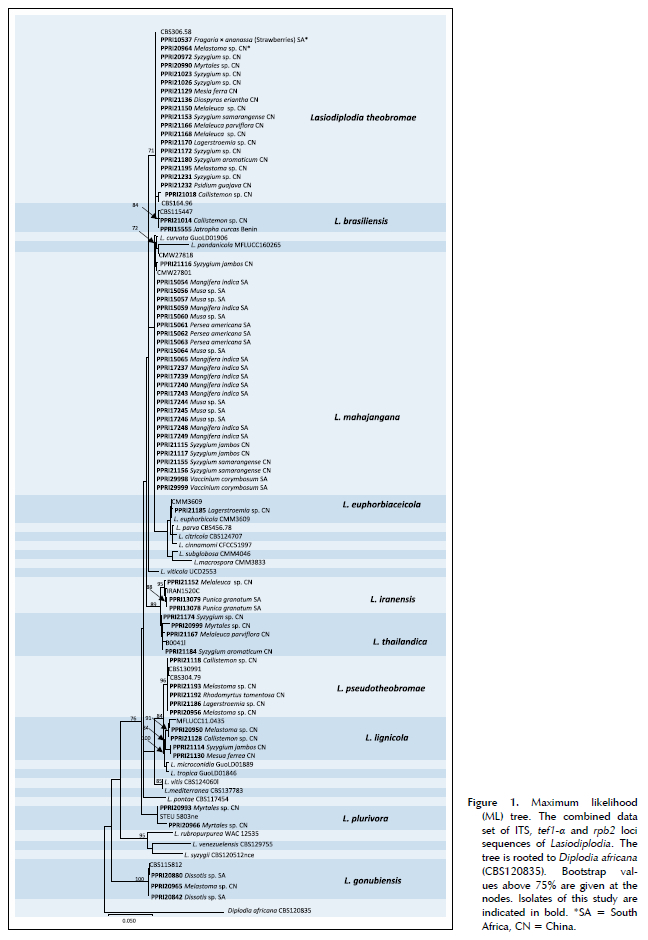
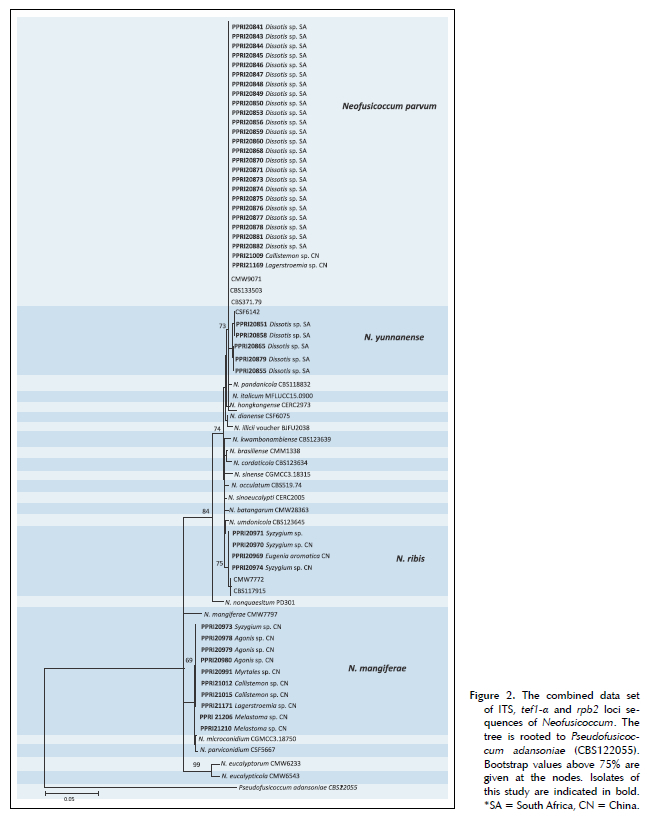
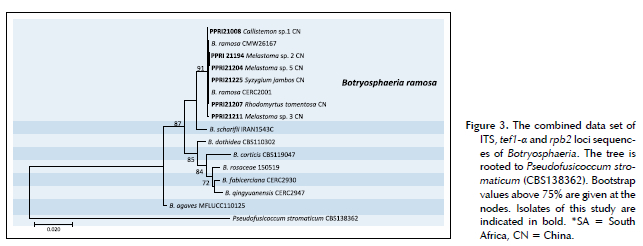
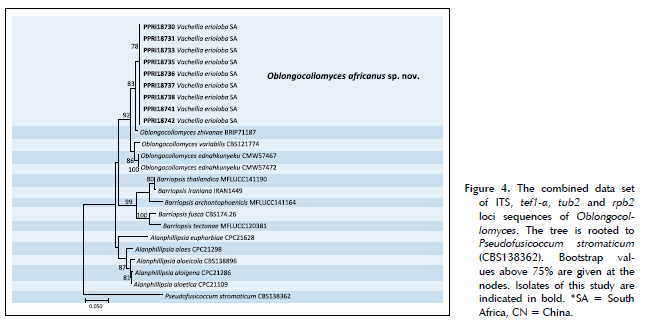
Blast N searches in GenBank revealed the presence of four genera of Botryosphaeriaceae among the 201 isolates sequenced in this study. Four sets of phylogenetic trees were generated from the derived DNA sequence data individually for Lasiodiplodia species (Figure 1), Neofusicoccum species (Figure 2), Botryosphaeria species (Figure 3) and Oblongocollomyces Tao Yang & Crous species (Figure 4). The topologies of the trees emerging from the ML analyses were congruent in individual gene regions, as well as in the combined dataset for the clades representing the species isolated in this study.
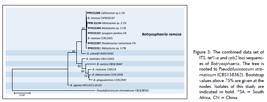
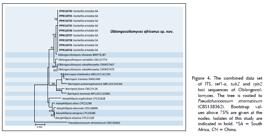
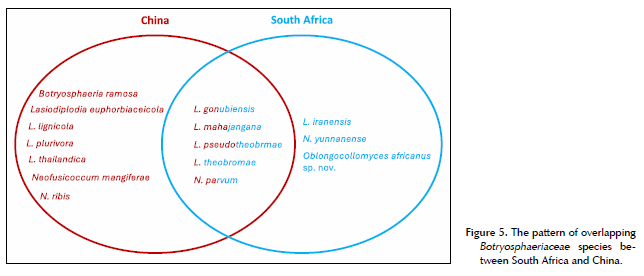
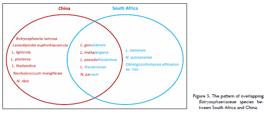
The sequence dataset for Lasiodiplodia contained 531 characters for ITS, 357 characters for tef-1a and 623 characters for the rpb2 dataset, and the combined dataset consisted of 1 511 characters. Ten clades were identified from analyses, and these resolved as Lasiodi-plodia brasiliensis M.S.B. Netto, M.W. Marques & A.J.L. Phillips, L. euphorbiaceicola A.R. Machado & O.L. Pereira, L. gonubiensis Pavlic, Slippers & M.J. Wingf., L. iraniensis Abdollahz., Zare & A.J.L. Phillips, L. ¡ignicola (H.A. Ariy., Jian K. Liu & K.D. Hyde) A.J.L. Phillips, A. Alves & Abdollahz., L. mahajangana Begoude, Jol. Roux & Slippers, L. plurivora Damm & Crous, L. pseudo-theobromae A.J.L. Phillips, A. Alves & Crous, L. thai-landica Trakun., L. Lombard & Crous and L. theobro-mae (Pat.) Griffon & Maubl. The sequence dataset for Neofusicoccum contained 477 characters for ITS, 369 characters for tef-Ία and 639 characters for the rpb2 dataset, and the combined dataset consisted of 1 485 characters. Four clades were identified from the analyses, and these resolved as Neofusicoccum mangiferae (Syd. & P Syd.) Crous, Slippers & A.J.L. Phillips, N. par-vum (Pennycook & Samuels) Crous, Slippers & A.J.L. Phillips, N. ribis (Slippers, Crous & M.J. Wingf.) Crous, Slippers & A.J.L. Phillips and N. yunnanense G.Q. Li & S.F. Chen. The sequence dataset for Botryosphaeria contained 525 characters for ITS, 329 characters for tef-Ία and 684 characters for the rpb2 dataset, and the combined dataset consisted of 1 538 characters. One clade was identified from analyses, and this resolved as Botryosphaeria ramosa (Pavlic, T.I. Burgess & M.J. Wing-field) A.J.L. Phillips & A. Alves. The sequence dataset for Oblongocollomyces contained 535 characters for ITS, 394 characters for tef-Ία, 592 characters for the rpb2 dataset, and 452 characters for tub2, and the combined dataset consisted of 1 973 characters. One new clade was identified from the analyses, and it was described as a new species. Among all these species, five species overlapped between China and South Africa (Figure 5).
Taxonomy
An undescribed species of Oblongocollomyces emerged from the phylogenetic analyses and it is described as follows:
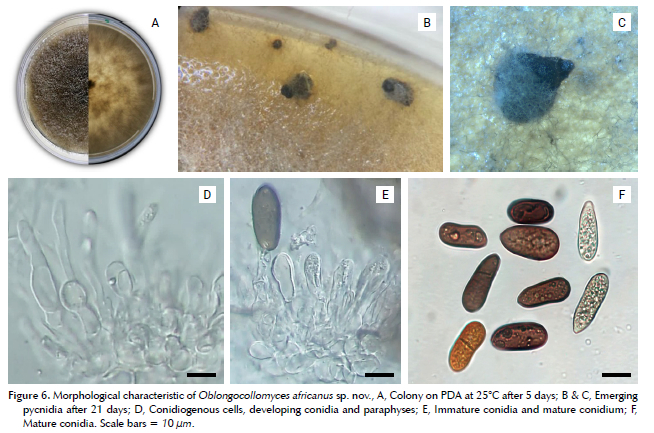
Oblongocollomyces africanus Jami, Roux & Pavlic sp. nov. Figure 6. MycoBank: MB857578.
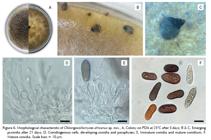
Conidiomata stromatic, formed on half strength PDA in vicinity of edges of plates after 21 days, often covered with aerial hyphae, producing black spore masses in single or multiple locules. Conidiophores reduced to conidioge-nous cells. Conidiogenous cells borne on the inner most layer of compressed hyaline cells, cylindrical to lageni-form, enteroblastic, 5-11 (avg. 6.5-9.5 μπι) x 2-8 μπι (avg. 3.5-6.5 μαι). Conidia hyaline, becoming brown when mature, 0-1 septate, septation occurring mostly when pigmented, fusiform to ellipsoidal, bases truncated, apex round, slightly tapering towards base, 14-24 (avg. 15.5-21.5 μm x 5-9 μm (avg. 6.5-8.5 μm).
Etymology
The species name refers to Africa, the continent from which this species was collected.
Specimens examined
SOUTH AFRICA, Limpopo: twigs of Vachellia erioloba (E.Mey.) PJ.H.Hurter., Nov. 2018, J. Roux and C. Ncedana, holotype, cultures ex-holotype PPRI18730, PPRI18731, PPRI18733, PPRI18735, PPRI18736, PPRI18737, PPRI18738, PPRI18741, PPRI18742.
Note
Oblongocollomyces africanus differs from its closest known phylogenetic neighbour, O. zhivanae (BRIP71187) by 3 bp in the ITS region and 4 bp in the tub2 locus.
Discussion
The results of this study enhance our understanding of the taxonomic diversity and host ranges within the Botryosphaeriaceae family, with a particular focus on isolates preserved in the NCF. Using multilocus phylogenetic analyses (ITS, tef1-α, rpb2, tub2), 15 known species were identified, including Botryosphaeria ramosa, L. brasiliensis, L. euphorbiaceicola, L. gonubiensis, L. iraniensis, L. lignicola, L. mahajangana, L. plurivora, L. pseudotheobromae, L. thailandica, and L. theobromae, N. mangiferae, N. parvum, N. ribis and N. yunnanense, as well as a novel species within the genus Oblongocollomyces. This new species, along with two other species were found exclusively in South Africa. Five species were shared between South Africa and China, while seven species were found exclusively in China. These results contribute to the broader understanding of Botryosphaeriaceae diversity in both South Africa and China.
In this study L. theobromae was the most prevalent species, isolated from 26 different hosts. This dominance is not surprising, as L. theobromae is the most widespread species in the genus, having been reported from over 600 hosts worldwide (Batista et al. 2021). Lasiodiplodia pseudotheobromae was the second most prevalent species, isolated from 16 hosts. This species has been reported from 124 hosts across 44 countries (Batista et al. 2021). This study expands the hosts range of these two species, including the first reports of L. theobromae from Dissotis sp., Diospyros eriantha Champ. ex Benth, Rhodomyrtus tomentosa (Aiton) Hassk and L. pseudotheobromae from Syzygi-um jambos (L.) Alston.
Lasiodiplodia mahajangana was the third most prevalent species, identified on seven hosts. This species was originally described from Terminalia catappa L. in Madagascar (Begoude et al. 2010). In 2021, Zhang et al. synonymised seven Lasiodiplodia species, including L. americana S.F. Chen, G.Q. Li & Michailides (Chen et al. 2015), L. caatinguensis I.B.L. Cout., F.C. Freire, C.S. Lima & J.E. Cardoso (Coutinho et al. 2017), L. curvata Y. Zhang ter & S. Lin (Wang et al. 2019), L. exigua Linald., Deidda & A.J.L. Phillips (Linaldeddu et al. 2015), L. irregularis Y. Zhang ter & S. Lin (Wang et al. 2019), L. macroconidia Y. Zhang ter & S. Lin (Wang et al. 2019) and L. pandanicola Tibpromma & K.D. Hyde (Tibpromma et al. 2018) under L. mahajangana. To date, this species has been reported from 33 different hosts across 19 countries (https://fungi.ars.usda.gov).
Lasiodiplodia gonubiensis was identified from Dissotis sp. in South Africa and Melastoma sp. in China. Previously, this species was reported from Syzygium cordatum, Pinus sp. (Pavlic et al. 2004), Sclerocarya birrea subsp. afra (Sond.) Kokwaro (Jami et al. 2017) and Ceriops tagal (Perr.) C.B.Rob. (Osorio et al. 2017) in South Africa. It has also been reported from Acmena smithii (Poir.) Merr. & L.M.Perry, Camellia sinensis (L.) Kuntze and Lenwebbia lasioclada (F.Muell.) N.Snow & Guymer in Australia (Burgess et al. 2019; Tan et al. 2019), and Phyllanthus emblica L. in Thailand (Trakunyingcharoen et al. 2015). Lasiodiplodia iraniensis, has been reported from 27 hosts across 18 countries (https://fungi.ars.usda.gov), including Adansonia digitata L. and Sclerocarya birrea subsp. afra in South Africa (Cruywagen et al. 2017; Jami et al. 2017), Bougainvillea spectabilis Willd. and Caryota mitis Lour. in China (Li et al. 2015; Zhu et al. 2015). In this study L. iraniensiswas identified on Melaleuca sp. in China and Punica granatum L. in South Africa.
Lasiodiplodia thailandica and L. lignicola were identified from six different hosts in China. Lasiodiplodia thailandica was found on a Myrtales species, Melaleuca parviflora and Syzygium aromaticum, while L. lignicola was identified from Callistemon sp., Melastoma sp., Mesua ferrea L. and Syzygium jambos. Lasiodiplodia thailandica was previously reported from Acacia confusa Merr., Albizia chinensis (Osbeck) Merr. and Podocarpus macrophyllus (Thunb.) Sweet. in China (Dou 2017; Li et al. 2018), as well as from Mangifera indica L., Pandanus sp. and Phyllanthus acidus (L.) Skeels in Thailand (Hyde et al. 2018). Lasiodiplodia lignicola has been reported from Aquilaria crassna Pierre. ex Lecom-te in Laos (Wang et al. 2019), Sterculia oblonga Mast. in Germany (Yang et al. 2017) and Canarium parvum Leenh., Hevea brasiliensis (Willd. ex A.Juss.) Müll.Arg, Rhodomyrtus tomentosa, Sterculia lychnophora Hance and Vaccinium uliginosum L. in China (Dou 2017; Dou et al. 2017).
Some Lasiodiplodia species were identified exclusively from a single host in China. For instance, L. euphorbiaceicola and L. plurivora were identified on Lagerstroemia sp. and a Myrtales species, respectively, both of which are new hosts for these species. Lasiodiplodia euphorbiaceicola was initially described from Jatropha curcas L. (Machado et al. 2014) in Brazil and has since been reported from various hosts, including Anacardium sp. (Netto et al. 2017), Cocos nucifera L. (Coutinho et al. 2017), Carica papaya L. (Netto et al. 2014), Vitis vinifera L. (Correia et al. 2016) and Nopalea cochenil-lifera (L.) Salm-Dyck (Conforto et al. 2019) in Brazil. It has also been reported from Adansonia digitata in Botswana, Cameroon, Madagascar, Senegal and Zimbabwe (Cruywagen et al. 2017). Lasiodiplodia plurivora was previously reported from Prunus salicina Lindl. and Vitis sp. in Australia and South Africa (Jami et al. 2017; Burgess et al. 2019). These findings significantly broaden the known host ranges of Lasiodiplodia species and emphasise the ongoing need to monitor their spread across diverse regions and plant species.
Neofusicoccum is among the 100 most cited fungal genera (Bhunjun et al. 2024). In this study, four species were identified including N. mangiferae, N. parvum, N. ribis and N. yunnanense. Neofusicoccum parvum was the most common species isolated from three different hosts in China and South Africa. Neofusicoccum mangiferae was identified exclusively in China, across six different hosts. This species has been reported from 13 countries from 25 hosts (https://fungi.ars.usda.gov) including China (Dissanayake et al. 2015; Lin et al. 2019; Wan et al. 2020) and South Africa (Pavlic et al. 2007; Jami et al. 2017). However, all six hosts, Syzygi-um sp., Agonis sp., a Myrtales species, Callistemon sp., Lagerstroemia sp., Melastoma sp., represent new host records. Neofusicoccum yunnanense was identified on Dissotis sp. in South Africa and was previously known only from Eucalyptus species in China (Li et al. 2020) and apples in Serbia (Vuckovic et al. 2022).
Neofusicoccum parvum and N. ribis are phylogenetically closely related and had been considered a species complex. The taxonomy of the N. parvum/N. ribis complex has been re-evaluated multiple times over the past two decades, leading to the introduction of six species, including N. batangarum Begoude, Jol. Roux & Slippers, N. cordaticola Pavlic, Slippers & M.J. Wingf., N. kwambonambiense Pavlic, Slippers & M.J. Wingf., N. occulatum Sakalidis & T.I. Burgess, N. umdonicola Pavlic, Slippers & M.J. Wingf. and Neofusicoccum sp. (Slippers et al. 2004; Pavlic et al. 2009; Sakalidis, et al. 2011a). However, a recent taxonomic revision by Zhang et al. (2021) synonymised N. batangarum and N. umdonicola under N. ribis. To date, N. ribis has been reported from 285 hosts across 47 countries (https://fungi.ars.usda.gov), including various hosts in South Africa (Pavlic et al. 2007) and China (Chen et al. 2011).
Botryosphaeria ramosa is a relatively uncommon species, first described as Fusicoccum ramosum Pavlic, T.I. Burgess & M.J. Wingf. from asymptomatic branches of Eucalyptus camaldulensis Dehnh. in Australia (Pavlic et al. 2008). Later, Phillips et al. (2013) reclassified it under the correct name Botryosphaeria ramosa. This species was subsequently reported from Acacia sp., Corymbia citriodora (Hook.) K.D.Hill & L.A.S.Johnson and a Myrtaceae species in China (Zhou et al. 2017). Botryosphaeria pseudoramosa G.Q. Li & S.F. Chen was initially reported from Eucalyptus sp. and Melastoma in China (Li et al. 2018), but Zhang et al. (2021) later syn-onymised it under B. ramosa. In this study, B. ramosa was identified from Callistemon sp., Syzygium jambos, Rhodomyrtus tomentosa, and three Melastoma species, all of which represent new host records for this species. Interestingly, all known hosts of B. ramosa to date are in the same order, the Myrtales.
Oblongocollomyces is a rare genus within the Botryosphaeriaceae family, previously reported only from southern Africa and Australia. Described by Yang et al. (2017), its type species, Oblongocollomyces variabilis (F.J.J. Van der Walt, Slippers & G.J. Marais) Tao Yang & Crous, was originally identified as Sphaeropsis variabilis F.J.J. Van der Walt, Slippers & G.J. Marais and found on Vachellia hebeclada (DC.) Kyal. & Boatwr., V. karroo Hayne) Banfi & Galasso, and Senegalia mellifera (Vahl) Seigler & Ebinger in Namibia and South Africa (Slippers et al. 2014). Subsequently, O. ednahkunjekuae Slippers, Ramabulana & Coetzee was discovered on Sclerocarya birrea in South Africa (Slippers et al. 2024), and O. zhivanae on Vachellia farnesiana in Australia (Limbongan et al. 2023). In this study, we describe a novel species, Oblongocollomyces africanus isolated from Vachellia erioloba in South Africa. These findings highlight the expanding diversity and host range of Oblongocollomyces, suggesting that additional un-described species may exist in unexplored regions and host plants.
The diverse isolate origins in this study have revealed distinct distributions of Botryosphaeriaceae species, including several first-time reports for each area, including N. yunnanense and Botryosphaeria ramosa for South Africa, L. mahajangana, L. gonubiensis, L. euphorbiaceicola and L. plurivora for China and L. brasiliensis for Benin. Additionally, multiple species were found on new hosts in both countries including L. gonubiensis, L. iraniensis, L. mahajangana, L. pseudotheobromae, L. theobromae and N. parvum. These findings significantly enhance our understanding of the geographical distribution of Botryosphaeriaceae species across China and South Africa. The identification of these fungi on various hosts in diverse regions underscores their extensive presence and ecological importance in both countries.
Botryosphaeriaceae species are known as latent pathogens that can cause disease when their hosts are under stress (Slippers & Wingfield 2007). Some of the identified species of this study are well-known pathogens associated with canker and branch dieback, including L. pseudotheobromae, L. theobromae, N. mangiferae and N. parvum (Sakalidis et al. 2011b; Mehl et al. 2013; Mehl et al. 2017). Lasiodiplodia mahajangana has been reported in association with dieback and canker on various hosts (Burgess et al. 2019) and shoot blight on pistachio (Chen et al. 2015). In this study, L. mahajangana was identified from black spots on mango, banana and avocado fruits, indicating its potential as a postharvest pathogen. Neofusicoccum yunnanense is another example that has been previously reported causing dieback and cankers on Eucalyptus (Li et al. 2020) and as postharvest pathogen of apples in Serbia (Vučković et al. 2022). In this study, N. yunnanense was found on Dissotis sp., as an endophyte suggesting a broader host range than previously documented. Further studies are needed to assess its pathogenicity and potential impact on newly identified hosts.
Conclusion
This study highlights the critical role of fungal collections, such as the NCF, in addressing global gaps in fungal biodiversity. The identification of novel species and the overlap of species between South Africa and China highlights the importance of continued research and global collaboration to better understand the ecological roles and potential impacts of these fungi as pathogens across different regions. These findings emphasise the importance of continued exploration of fungal collections and ecosystems in underexplored regions. Such efforts will enhance fungal taxonomy, also inform plant health management strategies, and contribute to broaden the biodiversity conservation initiative.
Authors' contributions
FJ conducted laboratory experiments, analysed fungal species, conceived and supervised the study, coordinated manuscript writing and editing. MT and DP contributed to the sample collection and isolations. SC and JR contributed to the sample collection.
Acknowledgements
We would like to acknowledge the South African National Research Foundation (NRF) for funding project FBIP210323590750, and the Agricultural Research Council for financial support. We also thank Ms Grace Kwinda and Ms Thando Bhiya for their assistance with reviving the cultures.
References
-
Batista, E., Lopes, A. & Alves, A., 2021, 'What do we know about Botryosphaeriaceae? An overview of a worldwide cured dataset', Forests 12,3, 313, https://doi.org/10.3390/f12030313.
» https://doi.org/10.3390/f12030313 -
Begoude, B.A.D., Slippers, B., Wingfield, M.J. & Roux, J., 2010, 'Botryosphaeriaceae associated with Terminalia catappa in Cameroon, South Africa and Madagascar', Mycological Progress 9, 101-123, https://doi.org/10.1007/s11557-009-0622-4.
» https://doi.org/10.1007/s11557-009-0622-4 -
Bhunjun, C., Chen, Y., Phukhamsakda, C., Boekhout, T., ... Crous, P.W., 2024, 'What are the 100 most cited fungal genera?', Studies in Mycology 108,1, 1-412, https://doi.org/10.3114/sim.2024.108.01.
» https://doi.org/10.3114/sim.2024.108.01 -
Burgess, T.I., Tan, Y.P, Garnas, J., Edwards, J., Scarlett, K.A., Shuttleworth, L.A., Daniel, R., Dann, E.K., Parkinson, L.E., Dinh, Q., Shivas, R.G. & Jami, F., 2019, 'Current status of the Botryosphaeriaceae in Australia', Australasian Plant Pathology 48,1, 35-44, https://doi.org/10.1007/s13313-018-0577-5.
» https://doi.org/10.1007/s13313-018-0577-5 -
Carbone, I. & Kohn, L.M., 1999, 'A method for designing primer sets for speciation studies in filamentous ascomycetes', Mycologia 91,3, 553-556, https://doi.org/10.1080/00275514.1999.12061051.
» https://doi.org/10.1080/00275514.1999.12061051 -
Chen, S., Li, G., Liu, F. & Michailides, T.J., 2015, 'Novel species of Botryosphaeriaceae associated with shoot blight of pistachio', Mycologia 107,4, 780-792, https://doi.org/10.3852/14-242.
» https://doi.org/10.3852/14-242 -
Chen, S., Pavlic, D., Roux, J., Slippers, B., Xie, Y., Wingfield, M.J. & Zhou, X., 2011, 'Characterization of Botryosphaeriaceae from plantation-grown Eucalyptus species in South China', Plant pathology 60,4, 739-751, https://doi.org/10.1111/j.1365-3059.2011.02431.x.
» https://doi.org/10.1111/j.1365-3059.2011.02431.x -
Conforto, C., Lima, N.B., Silva, F.J.A., Câmara, M.PS., Maharachchikumbura, S. & Michereff, S.J., 2019, 'Characterization of fungal species associated with cladode brown spot on Nopalea cochenillifera in Brazil', European Journal of Plant Pathology 155, 1179-1194, https://doi.org/10.1007/s10658-019-01847-3.
» https://doi.org/10.1007/s10658-019-01847-3 -
Correia, K.C., Silva, M.A., De Morais Jr, M.A., Armengol, J., Phillips, A.J., Cômara, M. & Michereff, S.J., 2016, 'Phylog-eny, distribution and pathogenicity of Lasiodiplodia species associated with dieback of table grape in the main Brazilian exporting region', Plant Pathology 65,1, 92-103, https://doi.org/10.1111/ppa.12388.
» https://doi.org/10.1111/ppa.12388 -
Coutinho, I., Freire, F., Lima, C., Lima, J., Gonçalves, F., Machado, A., Silva, A. & Cardoso, J., 2017, 'Diversity of genus Lasiodiplodia associated with perennial tropical fruit plants in northeastern Brazil', Plant Pathology 66,1, 90-104, https://doi.org/10.1111/ppa.12565.
» https://doi.org/10.1111/ppa.12565 -
Crous, P.W., Slippers, B., Wingfield, M.J., Rheeder, J., Mara-sas, W.F., Philips, A.J., Alves, A., Burgess, T., Barber, P. & Groenewald, J.Z., 2006, 'Phylogenetic lineages in the Botryosphaeriaceae', Studies in mycology 55,1, 235-253, https://doi.org/10.3114/sim.55.1.235.
» https://doi.org/10.3114/sim.55.1.235 -
Cruywagen, E.M., Slippers, B., Roux, J. & Wingfield, M.J., 2017, 'Phylogenetic species recognition and hybridisation in Lasiodiplodia: a case study on species from baobabs', Fungal Biology 121,4, 420-436, https://doi.org/10.1016/j.funbio.2016.07.014.
» https://doi.org/10.1016/j.funbio.2016.07.014 -
Dissanayake, A.J., Zhang, W., Li, X., Zhou, Y., Chethana, T., Chukeatirote, E., Hyde, K.D., Yan, J., Zhang, G. & Zhao, W., 2015, 'First report of Neofusicoccum mangiferae associated with grapevine dieback in China', Phytopathologia Mediterranea 2015, 414-419, https://doi.org/10.14601/Phytopathol_Mediterr-15159.
» https://doi.org/10.14601/Phytopathol_Mediterr-15159 -
Dou, Z., 2017, 'Does morphology matter in taxonomy of Lasiodiplodia? An answer from Lasiodiplodia hyalina sp. nov.', Mycosphere 8, 2, 1014-1027, https://doi.org/10.5943/mycosphere/8/2/3.
» https://doi.org/10.5943/mycosphere/8/2/3 -
Dou, Z., He, W. & Zhang, Y., 2017, 'Lasiodiplodia chinensis, a new holomorphic species from China', Mycosphere 8, 521-532, https://doi.org/10.5943/mycosphere/8/2/3.
» https://doi.org/10.5943/mycosphere/8/2/3 -
Gardes, M. & Bruns, T., 1993, 'ITS primers with enhanced specificity for basidiomycetes-application to the identification of mycorrhizae and rusts', Molecular Ecology 2,2, 113-118, https://doi.org/10.1111/j.1365-294X.1993.tb00005.x.
» https://doi.org/10.1111/j.1365-294X.1993.tb00005.x -
Glass, N.L. & Donaldson, G.C., 1995, 'Development of primer sets designed for use with the PCR to amplify conserved genes from filamentous ascomycetes', Applied and Environmental Microbiology 61,4, 1323-1330, https://doi.org/10.1128/aem.61.4.1323-1330.1995.
» https://doi.org/10.1128/aem.61.4.1323-1330.1995 -
Guindon, S., Dufayard, J.F., Lefort, V., Anisimova, M., Hordijk, W. & Gascuel, O., 2010, 'New algorithms and methods to estimate maximum-likelihood phylogenies: assessing the performance of PhyML 3.0', Systematic Biology 59,3, 307-321, https://doi.org/10.1093/sysbio/syq010.
» https://doi.org/10.1093/sysbio/syq010 -
Hyde, K.D., Norphanphoun, C., Chen, J., ... Stadler, M., 2018, 'Thailand's amazing diversity: up to 96% of fungi in northern Thailand may be novel', Fungal Diversity 93, 215-239, https://doi.org/10.1007/s13225-018-0415-7.
» https://doi.org/10.1007/s13225-018-0415-7 -
Jami, F., Wingfield, M.J., Gryzenhout, M. & Slippers, B., 2017, 'Diversity of tree-infecting Botryosphaeriales on native and non-native trees in South Africa and Namibia', Australasian Plant Pathology 46,6, 529-545, https://doi.org/10.1007/s13313-017-0516-x.
» https://doi.org/10.1007/s13313-017-0516-x -
Katoh, K., Rozewicki, J. & Yamada, K.D., 2019, 'MAFFT online service: multiple sequence alignment, interactive sequence choice and visualization', Briefings in Bioinformatics 20,4, 1160-1166, https://doi.org/10.1093/bib/bbx108.
» https://doi.org/10.1093/bib/bbx108 -
Li, G., Arnold, R.J., Liu, F., Li, J. & Chen, S., 2015, 'Identification and pathogenicity of Lasiodiplodia species from Eucalyptus urophyllax grandis, Polyscias balfouriana and Bougainvillea spectabilis in southern China', Journal of Phytopathology 163,11-12, 956-967, https://doi.org/10.1111/jph.12398.
» https://doi.org/10.1111/jph.12398 -
Li, G., Liu, F., Li, J., Liu, Q. & Chen, S., 2018, 'Botryosphae-riaceae from Eucalyptus plantations and adjacent plants in China', Persoonia - Molecular Phylogeny and Evolution of Fungi 40, 63-95, https://doi.org/10.3767/per-soonia.2018.40.03.
» https://doi.org/10.3767/per-soonia.2018.40.03 -
Li, G., Slippers, B., Wingfield, M.J. & Chen, S., 2020, 'Variation in Botryosphaeriaceae from Eucalyptus plantations in YunNan Province in southwestern China across a climatic gradient', IMA Fungus 11,1, 1-49, https://doi.org/10.1186/s43008-020-00043-x.
» https://doi.org/10.1186/s43008-020-00043-x -
Limbongan, A., Young A.J., Campbell, S., Galea, V.J. & Tan, Y., 2023, 'Index of Australian Fungi no. 23', Zenodo, https://doi.org/10.5281/zenodo.10146049.
» https://doi.org/10.5281/zenodo.10146049 -
Lin, Q., He, H. & Xie, S., 2019, 'First Report of Leaf Spot Caused by Neofusicoccum mangiferae on Kandelia obova-ta in China', Plant disease 103,9, 2479-2479, https://doi.org/10.1094/PDIS-12-18-2216-PDN.
» https://doi.org/10.1094/PDIS-12-18-2216-PDN -
Linaldeddu, B.T., Deidda, A., Scanu, B., Franceschini, A., Serra, S., Berraf-Tebbal, A., Zouaoui Boutiti, M., Ben Jamâa, M. & Phillips, A.J., 2015, 'Diversity of Botryosphaeriaceae species associated with grapevine and other woody hosts in Italy, Algeria and Tunisia, with descriptions of Lasiodiplo-dia exigua and Lasiodiplodia mediterranea sp. nov.', Fungal Diversity 71, 201-214, https://doi.org/10.1007/s13225-014-0301-x.
» https://doi.org/10.1007/s13225-014-0301-x -
Liu, J.-K., Phookamsak, R., Doilom, M., ... Hyde, K., 2012, 'Towards a natural classification of Botryosphaeriales', Fungal Diversity 57,1, 149-210, https://doi.org/10.1007/s13225-012-0207-4.
» https://doi.org/10.1007/s13225-012-0207-4 -
Machado, A.R., Pinho, D.B. & Pereira, O.L., 2014, 'Phylogeny, identification and pathogenicity of the Botryosphaeriaceae associated with collar and root rot of the biofuel plant Jatropha curcas in Brazil, with a description of new species of Lasiodiplodia', Fungal Diversity 67, 231-247, https://doi.org/10.1007/s13225-013-0274-1.
» https://doi.org/10.1007/s13225-013-0274-1 -
Mehl, J., Slippers, B., Roux, J. & Wingfield, M.J., 2013, 'Cankers and other diseases caused by the Botryosphae-riaceae', Infectious forest diseases 298-317, https://doi.org/10.1079/9781780640402.0298.
» https://doi.org/10.1079/9781780640402.0298 -
Mehl, J., Wingfield, M.J., Roux, J. & Slippers, B., 2017, 'Invasive everywhere? Phylogeographic analysis of the globally distributed tree pathogen Lasiodiplodia theobromae', Forests 8,5, 145, https://doi.org/10.3390/f8050145.
» https://doi.org/10.3390/f8050145 -
Netto, M.S., Assunção, I.P, Lima, G.S., Marques, M.W., Lima, W.G., Monteiro, J.H., de Queiroz Balbino, V., Michereff, S.J., Phillips, A.J. & Câmara, M.P, 2014, 'Species of La-siodiplodia associated with papaya stem-end rot in Brazil', Fungal Diversity 67, 127-141, https://doi.org/10.1007/s13225-014-0279-4.
» https://doi.org/10.1007/s13225-014-0279-4 -
Netto, M.S.B., Lima, W.G., Correia, K.C., Da Silva, C.F.B., Thon, M., Martins, R.B., Miller, R.N.G., Michereff, S.J. & Câmara, M.PS., 2017, 'Analysis of phylogeny, distribution, and pathogenicity of Botryosphaeriaceae species associated with gummosis of Anacardium in Brazil, with a new species of Lasiodiplodia', Fungal biology 121,4, 437-451, https://doi.org/10.1016/j.funbio.2016.07.006.
» https://doi.org/10.1016/j.funbio.2016.07.006 -
Osorio, J.A., Crous, C.J., De Beer, Z.W., Wingfield, M.J. & Roux, J., 2017, 'Endophytic Botryosphaeriaceae, including five new species, associated with mangrove trees in South Africa', Fungal Biology 121,4, 361-393, https://doi.org/10.1016/j.funbio.2016.09.004.
» https://doi.org/10.1016/j.funbio.2016.09.004 - Pavlic, D., Slippers, B., Coutinho, T.A., Gryzenhout, M. & Wingfield, M.J., 2004, 'Lasiodiplodia gonubiensis sp. nov., a new Botryosphaeria anamorph from native Syzygium cordatum in South Africa', Studies in Mycology 50,2, 313-322.
-
Pavlic, D., Slippers, B., Coutinho, T.A. & Wingfield, M.J., 2007, 'Botryosphaeriaceae occurring on native Syzygium cordatum in South Africa and their potential threat to Eucalyptus', Plant Pathology 56,4, 624-636, https://doi.org/10.1111/j.1365-3059.2007.01608.x.
» https://doi.org/10.1111/j.1365-3059.2007.01608.x -
Pavlic, D., Slippers, B., Coutinho, T. A. & Wingfield, M.J., 2009, 'Molecular and phenotypic characterization of three phylogenetic species discovered within the Neo-fusicoccum parvum/N. ribis complex', Mycologia 101, 5, 636-647, https://doi.org/10.3852/08-193.
» https://doi.org/10.3852/08-193 -
Pavlic, D., Wingfield, M.J., Barber, P., Slippers, B., Hardy, G.E.S.J. & Burgess, T.I., 2008, 'Seven new species of the Botryosphaeriaceae from baobab and other native trees in Western Australia', Mycologia 100,6, 851-866, https://doi.org/10.3852/08-020.
» https://doi.org/10.3852/08-020 -
Pem, D., Hyde, K.D., McKenzie, E.H.C., Hongsanan, S., Wanasinghe, D.N., Boonmee, S., Darmostuk, V., Bhat, J.D., Tian, Q., Htet, Z.H., Senanayake, I.C., Niran-jan, M., Sarma, V.V., Doilom, M. & Dong, W., 2024, 'A comprehensive overview of genera in Dothideomycetes', Mycosphere 15,1, 2175-4568, https://doi.org/10.5943/mycosphere/15/1/18.
» https://doi.org/10.5943/mycosphere/15/1/18 -
Phillips, A., Alves, A., Abdollahzadeh, J., Slippers, B., Wing-field, M.J., Groenewald, J. & Crous, P.W., 2013, 'The Bo-tryosphaeriaceae: genera and species known from culture'. Studies In Mycology 76, 51-167, https://doi.org/10.3114/sim0021.
» https://doi.org/10.3114/sim0021 -
Rathnayaka, A.R., Chethana, K.T., Phillips, A.J. & Jones, E.G., 2022, 'Two new species of Botryosphaeriaceae (Botryos-phaeriales) and new host/geographical records', Phytotaxa 564,1, 8-38, https://doi.org/10.11646/phytotaxa.564.1.2.
» https://doi.org/10.11646/phytotaxa.564.1.2 -
Rathnayaka, A.R., Chethana, K., Phillips, A.J., Liu, J.-K., Sa-marakoon, M.C., Jones, E., Karunarathna, S.C. & Zhao, C.-L., 2023, 'Re-evaluating Botryosphaeriales: Ancestral state reconstructions of selected characters and evolution of nutritional modes', Journal of Fungi 9,2, 184, https://doi.org/10.3390/jof9020184.
» https://doi.org/10.3390/jof9020184 -
Rong, I.H. & Baxter, A.P., 2006, 'The South African National Collection of Fungi: celebrating a centenary 1905-2005', Studies in Mycology 55,1, 1-12, https://doi.org/10.3114/sim.55.1.1.
» https://doi.org/10.3114/sim.55.1.1 -
Sakalidis, M.L., Hardy, G.E.S.J. & Burgess, T.I., 2011a, 'Use of the Genealogical Sorting Index (GSI) to delineate species boundaries in the Neofusicoccum parvum-Neofusi-coccum ribis species complex', Molecular Phylogenetics and Evolution 60,3, 333-344, https://doi.org/10.1016/j.ympev.2011.04.026.
» https://doi.org/10.1016/j.ympev.2011.04.026 -
Sakalidis, M.L., Ray, J.D., Lanoiselet, V., Hardy, G.E.S.J. & Burgess, T.I., 2011b, 'Pathogenic Botryosphaeriaceae associated with Mangifera indica in the Kimberley region of Western Australia', European Journal of Plant Pathology 130, 379-391, https://doi.org/10.1007/s10658-011-9760-z.
» https://doi.org/10.1007/s10658-011-9760-z - Sivanesan, A., 1984, The bitunicate ascomycetes and their anamorphs, J. Cramer, Vaduz, Liechtenstein.
-
Slippers, B., Crous, P.W., Denman, S., Coutinho, T.A., Wingfield, B.D. & Wingfield, M.J., 2004, 'Combined multiple gene genealogies and phenotypic characters differentiate several species previously identified as Botryosphaeria dothidea', Mycologia 96,1, 83-101, https://doi.org/10.1080/15572536.2005.11833000.
» https://doi.org/10.1080/15572536.2005.11833000 -
Slippers, B., Ramabulana, E. & Coetzee, M.P.A., 2024, 'Botryosphaeriaceae partially overlap on asymptomatic and symptomatic tissues of Anacardiaceae in agroecosystems and conservation areas in northern South Africa', Fungal Systematics and Evolution 13, 131-142, https://doi.org/10.3114/fuse.2024.13.07.
» https://doi.org/10.3114/fuse.2024.13.07 -
Slippers, B., Roux, J., Wingfield, M.J., Van der Walt, F.J.J., Jami, F., Mehl, J.W.M. & Marais, G., 2014, 'Confronting the constraints of morphological taxonomy in the Botryosphaeriales', Persoonia-Molecular Phylogeny and Evolution of Fungi 33,1, 155-168, https://doi.org/10.3767/003158514X684780.
» https://doi.org/10.3767/003158514X684780 -
Slippers, B. & Wingfield, M.J., 2007, 'Botryosphaeriaceae as endophytes and latent pathogens of woody plants: diversity, ecology and impact', Fungal Biology Reviews 21,2-3, 90-106, https://doi.org/10.1016/j.fbr.2007.06.002.
» https://doi.org/10.1016/j.fbr.2007.06.002 -
Sun, J.-E., Meng, C.-R., Phillips, A.J. & Wang, Y., 2022, 'Two new Botryosphaeria (Botryosphaeriales, Botryosphaeria-ceae) species in China', MycoKeys 94, 1-16, https://doi.org/10.3897/mycokeys.94.90264.
» https://doi.org/10.3897/mycokeys.94.90264 -
Tan, Y.P., Shivas, R.G., Marney, T.S., Edwards, J., Dearnaley, J., Jami, F. & Burgess, T.I., 2019, 'Australian cultures of Botryosphaeriaceae held in Queensland and Victoria plant pathology herbaria revisited', Australasian Plant Pathology 48,1, 25-34, https://doi.org/10.1007/s13313-018-0559-7.
» https://doi.org/10.1007/s13313-018-0559-7 - Theissen, F. & Sydow, H., 1918, 'Vorentwürfe zu den Pseudosphaeriales', Annales Mycologici 16, 1-34.
-
Tibpromma, S., Hyde, K.D., McKenzie, E.H., Bhat, D.J., Phillips, A.J., Wanasinghe, D.N., Samarakoon, M.C., Jayawar-dena, R.S., Dissanayake, A.J. & Tennakoon, D.S., 2018, 'Fungal diversity notes 840-928: micro-fungi associated with Pandanaceae', Fungal Diversity 93, 1-160, https://doi.org/10.1007/s13225-018-0408-6.
» https://doi.org/10.1007/s13225-018-0408-6 -
Trakunyingcharoen, T., Lombard, L., Groenewald, J.Z., Chee-wangkoon, R., To-Anun, C. & Crous, P.W., 2015, 'Caulicolous Botryosphaeriales from Thailand', Persoonia - Molecular Phylogeny and Evolution of Fungi 34,1, 87-99, https://doi.org/10.3767/003158515X685841.
» https://doi.org/10.3767/003158515X685841 -
Vučković, N., Vico, I., Duduk, B. & Duduk, N., 2022, 'Diversity of Botryosphaeriaceae and Diaporthe species associated with postharvest apple fruit decay in Serbia', Phytopathology 112,4, 929-943, https://doi.org/10.1094/PHYTO-07-21-0304-R.
» https://doi.org/10.1094/PHYTO-07-21-0304-R -
Wan, Y., Wang, X.-Y., He, L.-X., Xu, W. & Zhu, L.-H., 2020, 'First report of Neofusicoccum mangiferae causing shoot blight of Sassafras tzumu in China', Plant disease 104,7, 2028, https://doi.org/10.1094/PDIS-11-19-2521-PDN.
» https://doi.org/10.1094/PDIS-11-19-2521-PDN -
Wang, Y., Lin, S., Zhao, L., Sun, X., He, W., Zhang, Y. & Dai, Y.-C., 2019, 'Lasiodiplodia spp. associated with Aquilaria crassna in Laos', Mycological Progress 18, 683-701, https://doi.org/10.1007/s11557-019-01481-7.
» https://doi.org/10.1007/s11557-019-01481-7 -
White, T.J., Bruns, T., Lee, S. & Taylor, J., 1990, 'Amplification and direct sequencing of fungal ribosomal RNA genes for phylogenetics', PCR protocols: A guide to methods and applications 18,1, 315-322, https://doi.org/10.1016/B978-0-12-372180-8.50042-1.
» https://doi.org/10.1016/B978-0-12-372180-8.50042-1 -
Wu, Y., Peng, C., Yuan, R., Zhang, M., Hu, Y. & Tian, C., 2024, 'New species and records of Botryosphaeriales (Dothideomycetes) associated with tree dieback in Beijing, China', MycoKeys 106, 225, https://doi.org/10.3897/my-cokeys.106.122890.
» https://doi.org/10.3897/my-cokeys.106.122890 -
Yang, T., Groenewald, J.Z., Cheewangkoon, R., Jami, F., Abdollahzadeh, J., Lombard, L. & Crous, P.W., 2017, 'Families, genera, and species of Botryosphaeriales', Fungal biology 121,4, 322-346, http://dx.doi.org/10.1016/j.fun-bio.2016.11.001.
» http://dx.doi.org/10.1016/j.fun-bio.2016.11.001 -
Zhang, W., Groenewald, J.Z., Lombard, L., Schumacher, R.K, Phillips, A.J.L. & Crous, P.W, 2021, 'Evaluating species in Botryosphaeriales', Persoonia - Molecular Phylogeny and Evolution of Fungi 46, 63-1115, https://doi.org/10.3767/persoonia.2021.46.03.
» https://doi.org/10.3767/persoonia.2021.46.03 -
Zhou, Y., Zhang, M., Dou, Z. & Zhang, Y., 2017, 'Botryosphaeria rosaceae sp. nov. and B. ramosa, new botryosphaeriaceous taxa from China', Mycosphere 8,2, 162-171, https://doi.org/10.5943/mycosphere/8/2/2.
» https://doi.org/10.5943/mycosphere/8/2/2 -
Zhu, H., Qin, W.-Q., Liu, L. & Yan, W., 2015, 'First report of leaf spot of clustering fishtail palm (Caryota mitis) caused by Lasiodiplodia jatrophicola in China', Plant disease 99,7, 1038-1038, https://doi.org/10.1094/PDIS-10-14-1065-PDN.
» https://doi.org/10.1094/PDIS-10-14-1065-PDN

Accepted: 12 January 2026
Published: 6 July 2026