Characterisation of carabid functional traits in different farm systems
Abstract
Agricultural intensification has a major impact on arthropod diversity and related functional traits. However, research has primarily focused on how farm systems influence biodiversity metrics, often overlooking trait-mediated responses. This study examined the response of carabid beetle abundance, composition and functional traits to farming systems and vegetation cover in South African agricultural systems. Carabid beetles were collected from grain crop farms (conservation grazing, conservation tillage and conventional tillage) and semi-natural grasslands using pitfall traps and active search method. The abundance and community trait composition of the six genera were quantified using Generalised Linear Models (GLMs - Poisson and negative binomial distributions) and multivariate ordination. The relationship between traits and vegetation cover was evaluated using Generalised Additive Models (GAMs). Conservation grazing supported the highest carabid abundance, with conventional tillage and semi-natural grasslands exhibiting a significant abundance decline. Large-bodied genera, Calosoma and Scarites, showed 95% abundance decline outside conservation grazing. Community ordination indicates distinct segregation by farm type, primarily attributed to wing morphology and predatory behaviour. Functional trait responses were significantly affected by the interaction between vegetation cover and farm system, with brachypterous species responding uniformly (optimal at 25-35% cover), whereas macropterous carnivores exhibited different patterns. Conversely, semi-natural grasslands had the lowest abundance and trait results despite permanent vegetation. Overall, conservation grazing with a moderate vegetation structure provide an intact habitat for functionally important predatory carabids. These results suggest that species-specific functional traits should be identified when implementing sustainable management practices.
carabid beetles; conservation agriculture; body size; dispersal ability; functional trait; vegetation cover
Introduction
Research on biodiversity has predominantly focused on assessing species richness, composition and abundance to quantify the effects of agricultural practices (Holland & Luff 2000; Tscharntke et al. 2005; Boinot et al. 2020). Consequently, there is a significant knowledge gap in understanding how agricultural management practices influence arthropods and their functional characteristics, which are critical for ecosystem services (Pedley & Dolman 2014). Functional traits are morphological, physiological and behavioural characteristics that mediate species environment interactions and establish ecological roles within ecosystems (Schirmel et al. 2016; Djoudi et al. 2018). A trait-based approach is crucial for understanding and managing arthropod biodiversity in agricultural landscapes (Birkhofer et al. 2018). Beyond traditional taxonomic assessment (Cole et al. 2012), it is critical to examine how farm systems shape functional traits (Rouabah et al. 2015).
Carabid beetles (Coleóptera: Carabidae) are ideally well-suited for trait-based assessments especially because their functional characteristics are closely related to ecosystem processes. Among these, body size and wing shape represent ecologically relevant characteristics that strongly modulate dispersal potential, resource utilisation and predatory efficiency (Marrec et al. 2021). Large-bodied species typically exhibit higher per-capita consumption rates and stronger numerical responses to pest outbreaks, making them particularly valuable for biological pest control (Veres et al. 2013; Rusch et al. 2014). But these species are often more sensitive to agricultural intensification. Stable and structurally complex agroecosystems typically favour large-bodied and brachypterous carabids while the intensively managed ones favour smaller, macropterous species with higher dispersal capacity (Deppe & Fischer 2023). Limited dispersal ability constrains the persistence of brachypter-ous species in highly disturbed environments (Martins da Silva et al. 2017), and longer larval developmental periods exacerbate their susceptibility to soil disturbance, driven by the soil tillage and crop management activities (Boinot et al. 2020). However, larger-bodied species will persist in diverse heterogeneous systems in which alternative resources including crop diversity, grass margins and beetle banks afford them a refuge and continuous resources (Philpott et al. 2019). Dispersal ability is a crucial functional trait that influences carabid survival (Ng et al. 2018). High dispersal capacity allows species to track spatial and temporal variability in resources and enables them to move between habitats in response to disturbance and/or degradation (Nolte et al. 2019). Macropterous carabid species are an example of this adaptive approach, able to rapidly establish and recolonise newly modified habitats and respond to new environmental perturbations allowing them to coexist in rapidly changing, disturbed and highly varied agroecosystems (Hanson et al. 2017).
Although detailed research has been conducted on carabid responses to agricultural farming practices, the relationship between specific management practices, particularly conservation grazing versus tillage-based systems, is poorly understood in terms of functional trait composition. Also, semi-natural grasslands, which are generally described as relatively natural landscapes, may be affected by land degradation in conjunction with abandonment and nutrient enrichment (Lyons et al. 2017). The importance of biodiversity in such habitats compared to actively managed conservation systems has not been extensively investigated; however, understanding this comparison is crucial for informing habitat restoration priorities. For example, research has demonstrated that carabid beetles are highly responsive to habitat structure, vegetation composition, soil disturbance regimes and resource availability, all of which are influenced by farm management (Birkhofer et al. 2015; Homburg et al. 2019). Management practices such as crop rotations and retaining crop residues can benefit granivorous and omnivorous carabid species that consume weed seeds (Gaines & Gratton 2010). Thus, vegetation structure plays a crucial role in shaping these communities by providing shelter and overwintering sites and influencing prey availability (Tscharntke et al. 2005; Bianchi et al 2006). However, most studies have compared only two or three management types, and few have simultaneously examined community-level patterns, species-specific responses and functional trait associations across a broad range of management intensities (Holland & Luff 2000; Rouabah et al. 2015).
This study addresses these gaps by assessing carabid beetles across contrasting grain crop farm systems: conservation grazing (ConsG), conventional tillage (ConvT), conservation tillage (ConsT) and semi-natural grasslands (SemiNG). We focused on carabid beetles because they are diverse and sensitive to environmental changes (Ribera et al. 2001). In agroecosystems, carabids serve as natural enemies of pests (e.g., aphids, lepidopteran larvae, slugs and weed seeds) that are linked to their functional traits (Lövei & Sunderland 1996; Kromp 1999).
Our objectives were to: (1) quantify carabid abundance and trait composition at the genus level across farm systems; and (2) assess how vegetation cover relates to functional traits. We hypothesised that conservation grazing would result in the highest carabid abundance and functional traits because of structural heterogeneity and low disturbance. We further expected that brachypterous carabid genera would decline in response to intensive tillage systems because of their limited dispersal ability compared to macropterous carabids. Semi-natural grasslands would support intermediate abundance levels, composition and functional traits between conservation and conventional tillage farm systems owing to permanent vegetation cover.
Materials and methods
Study area
This study was conducted in Thabo Mofutsanyane District, located in the eastern Free State, South Africa (Supplementary material, Figure S1). Our study focused on grain crop farms in two areas, Bethlehem (28°09'S; 28°18'E) and Reitz (27°52'S; 28°32'E), which generally experience temperate weather conditions. We selected 36 study sites representing four contrasting farm types, each at least 500 m apart and generally 2-5 km between farms, with three replications: (1) intensive monoculture under conventional tillage (ConvT) with high agrochemical inputs, repeated deep tillage, mechanical weeding and burning after harvest; (2) low-intensity cropland under conservation tillage (ConsT), characterised by reduced tillage, stubble retention, herbicide application, cover crops and simplified crop rotations; (3) conservation grazing (ConsG) with low-intensity livestock grazing systems managed explicitly for biodiversity conservation, with controlled stocking densities, rotational and continuous grazing and no ag-rochemical inputs; and (4) semi-natural grassland (Sem-iNG), selected for biodiversity conservation, which has been undergoing passive recovery since intensive cattle grazing ceased three years before sampling began. Prior to grazing cessation, these sites had been subjected to continuous year-round grazing for approximately 15 years, resulting in severe vegetation degradation, including extensive bare ground, soil compaction and reduced plant diversity. At the time of sampling, these recovering grasslands exhibited a patchy vegetation structure with highly variable cover dominated by Smuts finger grasses (Digitaria eriantha), interspersed with bare ground patches and scattered forb species (Supplementary material, Table S1). This recovery process provided an opportunity to examine carabid responses to intermediate levels of vegetation cover and habitat complexity.
Carabid beetle sampling
Carabid beetles were sampled during two separate growing seasons: September-December 2020 and July-August 2021, using standardised pitfall trapping and hand search methods. Although sampling times varied slightly between 2021 and 2022, both seasons corresponded with the primary crop growing season and followed early summer rainfall events, prompting peak activity of ground-dwelling beetles. This variation was attributed to variability in rainfall and field access at the time of the year, but sampling of carabids took place at the ideal biological time. Eight pitfall traps were placed in a linear transect at each site at 10 m from the field boundary to minimize edge influences. Traps were 30 m apart in the transect (Supplementary material, Figure S2). Each pitfall trap consisted of a plastic cup (diameter: 9 cm, depth: 11 cm) inserted flush with the ground surface and filled with a 70% propylene glycol preservative solution (Haysom et al. 2004). To prevent flooding and minimise vertebrate disturbance, the traps were covered with elevated plastic lids positioned approximately 5 cm above the trap opening. Traps were left operational for seven consecutive days during each sampling round to avoid digging-in effects that can bias early capture (Schirmel et al. 2010). All captured specimens were collected, preserved in 70% ethanol and transported to the laboratory for processing.
To supplement pitfall trapping, we conducted standardised hand searches within a 10 m radius of each pitfall trap location. Two trained observers spent 10 minutes per trap location actively searching for surface-active carabids, focusing on potential refugia including under stones, logs, leaf litter, vegetation tussocks and within soil cracks. Hand-search data were pooled with pitfall trap data to generate total abundance estimates per site and per sampling round. The identifications were verified by Dr Colin Schoeman (University of Venda), an expert in southern African Carabidae. The dataset comprised abundance records for six ecologically diverse genera: Bembidion (small, generalist predators), Harpalus (medium-sized, omnivorous generalists), Amara (seed-feeding specialists), Pterostichus (large, generalist predators), Calosoma (large, specialist predators) and Scarites (large, specialist predators). Specimens were assigned to morphospecies within each genus based on consistent morphological differences, with dominant genera being Bembidion, Harpalus, Amara, Pterostichus, Calosoma and Scarites (Supplementary material, Table S2). For subsequent analyses, morphospecies were aggregated to the genus level to ensure adequate sample sizes for statistical analysis, as species-level identifications are often unreliable for southern African carabids because of incomplete taxonomic knowledge and high cryptic diversity.
Functional traits assessment
Functional traits were assigned based on a comprehensive literature review and trait databases, focusing on body size, dispersal ability and feeding preference (Ribera et al. 2001; Homburg et al. 2013; Homburg et al. 2014; Schirmel et al. 2016). Carabid genera were categorised into body size classes, specifically small to medium-bodied (3-9 mm; Bembidion and Amara) and medium-large-bodied (9-22 mm; Harpalus, Pterostichus, Calosoma and Scarites) (Cole et al. 2002). Dispersal ability was evaluated based on wing morphology, distinguishing between brachypterous species with hind wings shorter than elytra or completely absent and macropterous species with fully developed hind wings longer than elytra, according to data from Homburg et al. (2019) and Schirmel et al. (2012). Feeding preferences were identified as carnivorous/predators, granivorous or omnivorous based on insights from several studies (Larochelle & Larivière 2003; Purtauf et al. 2005; Liu et al. 2015).
Vegetation assessment
Vegetation structure was evaluated simultaneously with each carabid sampling round to ensure temporal correspondence between the habitat structure and beetle community data. On each site, eight 5 x 5 m quadrats were placed 2 m perpendicular to the transect line in the vicinity of each pitfall trap. Vegetation type cover percentages were estimated for each quadrat: (1) grain crops in cropland fields; (2) herbaceous weeds and forbs; and (3) perennial grasses. The estimates were based on the standard ecological field protocol (Mueller-Dombois & Ellenberg 1974), recording the proportion of the ground surface obscured when viewed directly from above. Vertically overlapping vegetation layers (e.g., tall crops overtopping a grass understory) were estimated separately, allowing the total cover to exceed 100%. For further analyses, total vegetation cover (summed across all categories) was used as the primary predictor variable, representing overall habitat structure, shading and ground surface complexity relevant to carabids. To improve and standardise visual estimation, field assessments were combined with digital image analysis using the Canopeo mobile application (Oklahoma State University; http://www.canopeoapp.com), which provides objective and repeatable measurements of green canopy cover (Govindasamy et al. 2022). Two ground-level images were taken per quadrat from opposing corners at 60 cm above the canopy, with the camera lens oriented perpendicular to the ground surface. Canopeo utilizes a color-coding technique to convert green cover into white pixels and bare land into black pixels, resulting in the percentage of white pixels in the image (Govindasamy et al. 2022). For each quadrat, we calculated the mean Canopeo-derived cover value from two replicate images.
Statistical analysis
All statistical analyses were performed using R version 4.3.1 (R Core Team 2021) with several packages: lme4 (Warton et al. 2016) for Generalised Linear Mixed Models (GLMMs), MASS for negative binomial modelling, and mgc (Venables & Ripley 2003) for Generalized Additive Mixed Models (GAMMs). Additionally, the package Vegan (Oksanen et al. 2020) was used for multivariate analyses, while model diagnostics were carried out with DHARMa.
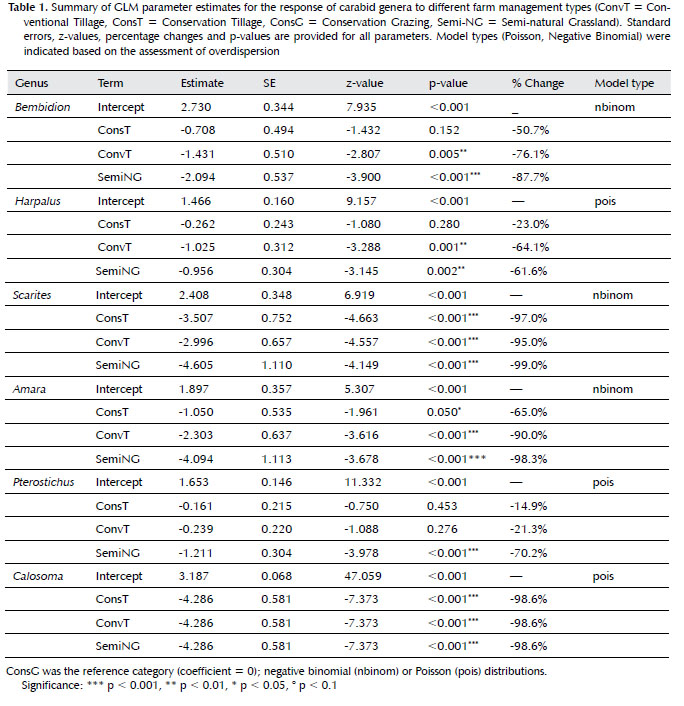
For each site, the total genus-specific abundance was calculated. To evaluate how different farm systems influence individual genera, Generalized Linear Models (GLMs) were used to investigate the response of individual carabid genera across four farm types: conventional tillage (ConvT), conservation tillage (ConsT), conservation grazing (ConsG), and semi-natural grassland (SemiNG). Overdispersion diagnostics revealed that Negative Binomial models were appropriate for Bembidion, Amara and Scarites, whereas Poisson models provided adequate fits for Harpalus, Pterostichus and Calosoma. The model coefficients (Estimates, β) represent the log-transformed effect of each farm system, relative to the baseline reference. Positive values indicated an increase in abundance, whereas negative coefficients represented reductions relative to the reference system. Standard errors (SE) represent estimations, whereas z-values indicate the strength of the relationship. We also applied GAMMs to explore the relationship between vegetation cover and carabid functional traits, where farm type was treated as a categorical explanatory factor and vegetation cover was used as a smoothing factor with a thin plate regression spline. It is important to note that body size was not treated as an independent predictor within the GAMs because of the strong link with wing morphology observed in our data-set, specifically indicating that all macropterous species displayed small body size, in contrast to medium-large body sizes among brachypterous species.
Results
Genus level abundance
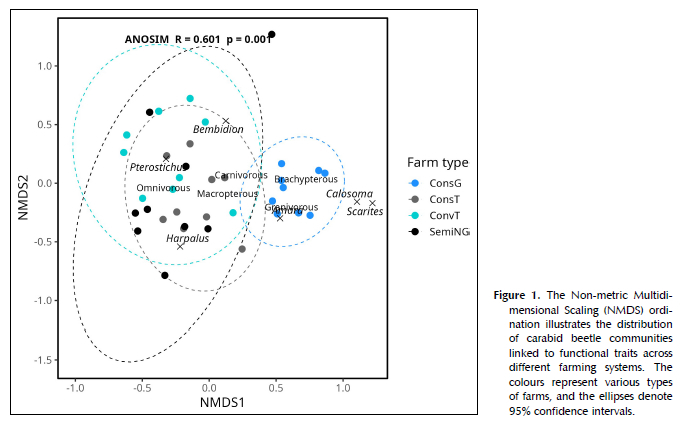
In total, 916 individual carabids were collected across the sampling sites, representing six genera ranging from 88 to 256 individuals per genus. Carabid abundance varied significantly among farm types, with conservation grazing supporting the highest abundance across all genera (GLM reference level; Table 1; Figure 1). The genus Bembidion, characterised as small-bodied, macropterous carnivores, declined moderately under ConsT (-51%, p = 0.152), but this decrease was more pronounced under ConvT (-76%, p = 0.005) and SemiNG (-88%, p < 0.001). Harpalus (medium-bodied, macropterous, granivorous) showed tolerance to ConsT (-23%, p = 0.280) but declined significantly under ConvT (-64%, p = 0.001) and SemiNG (-62%, p = 0.002). The generalist macropterous carnivore (Pteros-tichus) showed remarkable resilience effects, declining slightly under ConsT (-15%, p = 0.453) and ConvT (-21%, p = 0.276), although these changes were not significant. However, there was a substantial decline in abundance under SemiNG (-70%, p < 0.001). Amara (medium-bodied, macropterous, granivorous) showed a clear gradient of increasing impact severity declining under ConsT (-65%, p = 0.050), followed by drastic decline under ConvT (-90%, p < 0.001), and SemiNG (-98%, p < 0.001). In contrast, Calosoma, a large-bodied specialist carnivore, exhibited high sensitivity across all treatments, with effect sizes of -4.286 for ConsT, ConvT, and SemiNG (all p < 0.001), representing a 98.6% reduction. Scarites (large-bodied, brachypterous and burrow-dwelling) showed similar trends (Table 1; Supplementary material Table S1).
Community ordination and functional trait associations
Functional trait composition varied significantly among the farm systems (Figure 1). The Non-metric Multidimensional Scaling (NMDS) ordination showed distinct clustering of carabid assemblages by management type (ANOSIM R = 0.601, p = 0.001; Figure 1). Conservation grazing sites were grouped separately and were dominated by Calosoma and Scarites, together with carnivorous, granivorous and brachypterous trait groups. In contrast, communities associated with both conservation and conventional tillage occupied the centre of the ordination, aligning with macropterous, mobile carnivorous traits dominated by Bembidion and Pterostichus. Additionally, semi-natural grassland showed association aligned with omnivorous and granivorous vectors (Figure 1)
Functional traits and vegetation cover relationships
Generalised Additive Mixed Models (GAMs) identified significant non-linear associations between vegetation cover and carabid functional traits, revealing distinct response patterns influenced by varying farm management practices. In conservation grazing (ConsG) systems, brachypterous morphology exhibited a pronounced response to vegetation cover, peaking sharply at approximately 25-35% vegetation cover (Figure 2a). Conversely, macropterous morphology demonstrated opposing patterns, gradually increasing at low vegetation cover (<15%) under conventional and conservation tillage (Figure 2a). Carnivorous beetles showed response patterns that closely mirrored those of brachypterous morphology, which then declined slightly beyond >40% in the conservation grazing system (Figure 2b). Granivorous and omnivorous taxa remained relatively stable or slightly increased beyond 30% cover but never surpassed predator abundance (Figure 2b).
Discussion
Abundance and community functional traits
The present study highlights the importance of functional traits, specifically body size, dispersal ability and trophic specialisation, in carabid beetle responses to different farm systems, conservation grazing (ConsG), conventional tillage (ConvT), conservation tillage (ConsT) and semi-natural grassland (SemiNG). Large-bodied specialist predators were particularly sensitive to management regime, and nearly all systems except ConsG showed near-complete population declines (95-99%). These results support the growing consensus that conservation agricultural practices positively influence beneficial arthropod populations (Trichard et al. 2014; Triquet et al. 2023). Importantly, we found that the influence of vegetation cover on beetle abundance was trait-specific, with farming practices overriding the advantages of the vegetation. Consistent with our initial hypothesis, ConsG significantly supported all six genera, including both brachypterous and macropterous carabid genera, with Calosoma and Scarites being particularly prevalent. Both genera possess similar characteristics; they are large-bodied with limited dispersal ability. It is evident that the brachypterous crop field specialist is significantly supported in ConsG (reference category) because of the optimal habitat quality of this system (Martins da Silva et al. 2017). Similarly, Lyons et al. (2017) investigated the impact of long-established (>10 years) conservation grazing management on biodiversity in upland calcareous grasslands in Northern England using carabid beetles as models. They found that a light grazing regime was associated with a greater abundance of the genus Carabus, which has a brachypterous nature and limited dispersal ability (Sander et al. 2006). Larger carabid species contend not only with dispersal abilities but also face heightened susceptibility due to prolonged larval development phases, increasing their vulnerability to soil disturbance common in agricultural environments (Boinot et al. 2020). For instance, despite reduced tillage large-bodied Scarites (97% reduction) and Calosoma (99% reduction) still declined, because essential conditions, such as stable deep burrows for Scarites or abundant caterpillar prey for Calosoma, are unattainable amid even minimum soil disturbance or simplified cropping systems (Lövei & Sunderland 1996; Kotze et al. 2011; Gayer et al. 2019). These outcomes can be attributed to several interacting stressors, such as direct mortality during the tillage process, which eliminates overwintering sites and breeding habitats as well as detrimental effects on soil structure, thereby reducing burrowing opportunities while exposing organisms excessively prone to microclimates due to bare soil (Cole et al. 2002; Boetzl et al. 2014). For instance, Thiele (1977) documented that deep mouldboard ploughing can kill 30-50% of surface-active carabids directly, with additional mortality from predation exposure. Our findings corroborate recent meta-analyses demonstrating the overall net negative effects of intensive tillage on carabid communities (Müller et al. 2022).
Conversely, the Pterostichus genus showed a lower decline in ConsT and ConvT, with these communities positioned centrally in the ordination. This observation corresponds to their mobile carnivorous characteristics, suggesting adaptation to moderate soil disturbance along-side spatial variability. Their dispersal abilities allow them to navigate different habitats, even under unstable conditions, enabling their survival (Allema et al. 2019). Conventional and conservation tillage systems seem suitable for species measuring around 15 mm, possessing high dispersal ability and moderate disturbance tolerance, but are insufficient for large specialist species (Deppe & Fischer 2023). These patterns imply that while disturbances from tillage and herbicides are tolerable for certain beetle populations, substantial degradation of semi-natural grassland represents a critical threshold where severe declines occur, ranging from 62% to 99% across all six genera compared to those in ConsT and ConvT, contrary to our hypothesis. This negative response suggests that grassland recovery alone may be insufficient to restore functional beetle communities in the area. A similar study conducted by Schirmel et al. (2012) on coastal heath-lands revealed that beetle communities' recovery could take decades following the cessation of disturbances. Delays may stem from challenges associated with prey community recovery, soil structure restoration, or limitations in recolonisation among flightless species (Ribera et al. 2001). It is noteworthy that our findings contrast sharply with those Torma et al. (2019), which highlighted the positive effects of intensive grazing on carabid diversity in Hungarian salt grasslands. This discrepancy likely reflects the different ecological contexts, as salt grasslands are naturally adapted to high-disturbance regimes, whereas our semi-natural grasslands are recovering from degradation and are more sensitive to grazing intensity.
Vegetation cover and carabid genera trait relationships
Vegetation cover interacts with farm systems to shape distribution of functional traits such as wing morphology and feeding guilds (Meiss et al. 2010; Yanahan & Taylor 2014). This study indicates that moderate vegetation cover (25-35%), particularly under conservation grazing, supports higher proportions of brachypterous carabids (Cole et al. 2012; Waite et al. 2022). This finding aligns with the intermediate disturbance hypothesis, which suggests that moderate habitat complexity optimises resource availability and niche diversity (De Pedro et al. 2020). The abundance of Calosoma and Scarites under ConsG is consistent with their preference for medium-dense vegetation cover, which provides stable microclimates and abundant prey (Ball et al. 2015; Deppe & Fischer 2023). These genera are poor dispersers and cannot rapidly recolonise disturbed agroecosystems. For example, Scarites prefers bare soil or sparsely vegetated soil (<10% cover) because of its burrow-dwelling nature, constructing vertical burrows up to 50 cm deep (Thiele 1977). Dense vegetation impedes burrow formation, accounting for a significant decline in Scarites from all farm systems except ConsG, where grazing maintains presumably bare patches. Conversely, when considering a broader carabid community, it becomes evident that vegetation cover below 20% generally indicates excessive soil exposure and moisture loss, reducing habitat suitability for predators. While species from the genus Scarites can thrive under very low vegetation cover, other brachypterous species tend to thrive best at intermediate vegetational densities, since excessively dense foliage limits mobility and prey capture (Ng et al. 2018).
In contrast to brachypterous species, which peak amidst moderate vegetation cover, small- to medium-bodied macropterous species exhibited nonlinear responses to vegetation cover. In conventional tillage (ConvT), low vegetation cover arises primarily because of post-harvest burning, monocropping and prolonged periods of bare soil. These conditions benefit resilient genera, such as Harpalus and Bembidion, which exploit open warmer surfaces that enhance prey visibility and movement. The decline observed through GAM across increasing vegetation cover in ConvT confirms how closed canopies hinder foraging efficiency (Boetzl et al. 2014). The GLM results reflect this pattern, showing significant declines in dense vegetation cover and greater persistence in more open fields. Because vegetation cover in ConvT is temporary and frequently disturbed, macropterous species with dispersal ability and broad dietary tolerance can rapidly colonise disturbed patches and abandon them as vegetation structure changes (Boetzl et al. 2019; Triquet et al. 2023). This dynamic contrasts with brachypterous species, which require stable vegetation structure and cannot track shifting resources across disturbed agroecosystems. Although permanent vegetation is often assumed to favour arthropod diversity, excessively dense vegetation may hinder predator movement and limit prey detection efficiency, whereas insufficient cover limits thermal variability and microhabitats needed to sustain diverse prey population (Blubaugh et al. 2016; Riggi et al. 2024). The differences in response between brachypterous and macropterous species reflect body-size-mediated dispersal constraints. Large species with weak dispersal abilities rely on intact vegetative habitats, whereas small, mobile species may track resources across variable agroecosystems (Deppe & Fischer 2023).
Carnivorous beetles demonstrated an increase in abundance with high vegetation cover in ConsG and ConsT farms, suggesting favourable conditions for hunting and prey availability (Muneret et al. 2023). However, when vegetation cover exceeds (>40%), the structural complexity may hinder predators' mobility, resulting in the decline of large bodied carnivorous responses at the highest cover levels (Kotze & O'Hara 2003; Riggi et al. 2024). This accounts for the greater presence of brachypterous carnivores in ConsG, where the vegetation is neither excessively dense nor too sparse. Additionally, the positive response observed among carnivorous genera (Caloso-ma, Scarites and Pterostichus), which feed on aphids, slugs and lepidopteran larvae (Lövei & Sunderland 1996; Gardarin et al. 2023), suggest that ConsG supports robust prey webs capable of supporting higher trophic consumers. Large body size enhances predation efficiency since large carabids tend to consume more prey than small species (Ball et al. 2015; Rusch et al. 2015). Recent studies have demonstrated increased prey consumption among larger Pterostichus individuals (Neame & Galpern 2025), indicating body size as a crucial functional trait vital for biological pest control (Chungu 2017). Predators with large body size significantly offer high per-capita suppression rates of pest population (Kulkarni 2015; Gardarin et al. 2023).
Granivorous species slightly increased beyond 30% cover but remained less abundant than carnivorous predators, likely due to differing resource requirements or competitive avoidance of dominant carnivorous species at higher vegetation densities (Gámez-Virués et al. 2015). The granivorous genera Harpalus and Amara exhibited significant decline in SemiNG (-64% to -98%) despite the presence of vegetation. This decline is ecologically expected because perennial grasslands produce fewer arable weed seeds while dense litter limit seed accessibility (Meiss et al. 2010). Granivores depend on weed seed banks sustained through annual tillage, cover crops and crop rotation, processes absent in long-term grassland systems (Blubaugh et al. 2016; Marrec et al. 2021). In contrast, the lower decline of Harpalus granivorous species in ConsT, reflect this genus preference for open, seed-rich habitats rather than dense grassland vegetation. Studies have shown that this genus favours moderately disturbed environments that maintain soil turnover and annual seed bank (Shearin et al. 2008).
Omnivorous carabids displayed weaker yet variable responses to vegetation cover across farm types, likely reflecting their flexible diets and ability to exploit both detrital and invertebrate resources (De Heij et al. 2022). However, this flexibility also means that omnivores may not track vegetation structure as strongly as specialist carnivores or granivores, which may explain the absence of significant correlations in the GAM analyses. Despite these differences, conservation grazing (ConsG) consistently supported relatively higher abundances of both granivorous, and omnivorous taxa compared to ConvT and SemiNG. Moderate vegetation structure in ConsG provides a balance of microhabitat heterogeneity, prey availability, and seed resources (Blubaugh et al. 2016). Moreover, it should be acknowledged that granivorous species contribute an important ecosystem service that is often overlooked (Bohan et al. 2011; Labruyere et al. 2016). They reduce weed seed banks and suppress early-season weed pressure, (Power 2010; Diehl et al. 2012; Lami et al. 2020). Thus, while carnivores remain the most responsive functional group, the trait-specific roles of granivores and omnivores highlight the importance of maintaining structurally balanced habitats that promote multiple ecosystem services within agroecosystems.
Management implication for biodiversity conservation
The strong community differentiation and functional trait responses observed in this study have important implications for preserving biodiversity on agricultural lands.
This study highlights the value of conservation grazing as a biodiversity-friendly agricultural method. Maintaining moderate level of vegetation cover, specifically between 25% and 35%, provides an optimal habitat for both predatory and large-bodied carabids (Calosoma, Scarites), which are crucial for biological pest control. At these cover levels, structural heterogeneity and prey availability are maximised without causing excessive shading, which can limit ground-active beetles. In contrast, lower vegetation cover (<20%) reduces microhabitat stability, whereas dense cover (>40%) restricts movement and prey capture. Management practices that maintain intermediate vegetation through rotational grazing, minimal tillage and restricted pesticide use can enhance carabid functional traits and their associated ecosystem services. Therefore, integrating grazing-based practices that maintain vegetation heterogeneity can strengthen ecological resilience and sustain biodiversity-driven ecosystem function (Triquet et al. 2023). These findings support the prevailing consensus that large brachypterous and carnivorous carabid beetles are sensitive to intensive management practices in agricultural landscapes (Cole et al. 2006; Zara et al. 2021). These insights reinforce the role of carabid beetles as bioindicators for monitoring sustainable agricultural transitions and provide a scientific basis for guiding conservation agriculture policies in southern Africa.
Conclusion and future recommendations
Our results prompt several key questions that warrant further investigations. The temporal consistency concerning vegetation cover trait relationships requires assessment over multiple years and seasons to determine whether optimal management thresholds remain stable under varying environmental conditions. Additionally, direct quantification is needed to elucidate mechanistic links between vegetation structure and prey availability to validate the proposed foraging behaviour influencing trait responses. Although functional traits may serve as useful proxies for indicating potential ecosystem service potential provided by different carabid assemblages, measuring actual pest suppression effects would strengthen the applicability concerning trait-based management recommendations (Birkhofer et al. 2018). The strong responses of large predatory genera, such as Calosoma and Scarites, to conservation grazing suggest a significant potential for biological pest control in these systems. We recommend maintaining >30% ground cover to support both mobile predators and brachypterous specialists in South African cropping systems. However, realising this potential requires careful management of vegetation structure and grazing intensity to maintain optimal foraging conditions for ground-dwelling predators. These findings contribute to our understanding of how agricultural intensification affects farmland biodiversity and provide practical guidance for implementing management practices that support conservation and production goals. As agricultural systems face increasing pressure to balance productivity with environmental sustainability, the maintenance of functional diversity in beneficial arthropod communities will become increasingly important for long-term system resilience.
Competing interests
The authors declare that they have no competing interests.
Authors' contributions
MMM did the conceptualisation, data curation, formal analysis, methodology, writing original draft, review and editing. TCM performed the conceptualisation, data curation, methodology, statistical validation, supervision and editing of the original draft. RS conceptualised, statistically validated, supervised, reviewed and edited the original draft.
Acknowledgements
The author thanks the National Research Foundation (NRF), in association with DAAD-In-Country Doctoral Scholarships (MND190627451172/123279) and the Sustainable and Healthy Food Systems (SHEFs) initiative funded through the Wellcome Trust's 'Our Planet, Health' Programme (205200/Z/16/Z). The University of KwaZulu-Natal's Centre for Functional Biodiversity is hereby recognised for its financial support of this research project. The farmers who granted us the necessary permissions to conduct our research activities on their agricultural properties are duly recognised. Additionally, appreciation is extended to the Agricultural Research Council (ARC) small-grain campus for the provision of essential facilities. Our sincere appreciation goes to the postgraduate students at the Ant Lab, University of KwaZulu-Natal, for their significant contributions to data collection.
References
- Allema, B., Hemerik, L., Rossing, W.A.H., Groot, J.C.J., Van Lenteren, J.C. & Van der Werf, W., 2019, 'Dispersal of a carabid beetle in farmland is driven by habitat-specific motility and preference at habitat interfaces', Entomología Experimentalis et Applicata, 167(8), 741-754.
- Ball, S.L., Woodcock, B.A., Potts, S.G. & Heard, M.S., 2015, 'Size matters: Body size determines functional responses of ground beetle interactions', Basic and Applied Ecology, 16(7), 621-628.
- Bianchi, F.J.J.A., Booij, C.J.H. & Tscharntke, T., 2006, 'Sustainable pest regulation in agricultural landscapes: A review on landscape composition, biodiversity and natural pest control', Proceedings of the Royal Society B: Biological Sciences, 273(1595), 1715-1727.
- Birkhofer, K., Diekötter, T., Meub, C., Stötzel, K. & Wolters, V., 2015, 'Optimizing arthropod predator conservation in permanent grasslands by considering diversity components beyond species richness', Agriculture, Ecosystems and Environment, 211, 65-72.
- Birkhofer, K., Rusch, A., Andersson, G.K.S., Bommarco, R., Dänhardt, J., Ekbom, B., Jönsson, A., Lindborg, R., Olsson, O., Rader, R., Stjernman, M., Williams, A., Hedlund, K. & Smith, H.G., 2018, 'A framework to identify indicator species for ecosystem services in agricultural landscapes', Ecological Indicators, 91, 278-286.
- Blubaugh, C.K., Hagler, J.R., Machtley, S.A. & Kaplan, I., 2016, 'Cover crops increase foraging activity of omnivorous predators in seed patches and facilitate weed biological control', Agriculture, Ecosystems and Environment, 231, 264-270.
- Boetzl, F.A., Krimmer, E., Krauss, J. & Steffan-Dewenter, I., 2019, 'Agri-environmental schemes promote ground-dwelling predators in adjacent oilseed rape fields: Diversity, species traits and distance-decay functions', Journal of Applied Ecology, 56(1), 10-20.
-
Boetzl, F.A., Sponsler, D., Albrecht, M., Batáry, P, Birkhofer, K., Knapp, M., Krauss, J., Maas, B., Martin, E.A., Sirami, C.,... & Schirmel, J., 2014, 'Distance functions of carabids in crop fields depend on functional traits, crop type and adjacent habitat: a synthesis', Proceedings of the Royal Society B: Biological Sciences, 291, 20232383, https://doi.org/10.1098/rspb.2023.2383.
» https://doi.org/10.1098/rspb.2023.2383 - Bohan, D.A., Boursault, A., Brooks, D.R. & Petit, S., 2011, 'National-scale regulation of the weed seedbank by carabid predators', Journal of Applied Ecology, 48(4), 888-898.
-
Boinot, S., Mézière, D., Poulmarc'h, J., Saintilan, A., Lauri, P.E. & Sarthou, J.P., 2020, 'Promoting generalist predators of crop pests in alley cropping agroforestry fields: Farming system matters', Ecological Engineering, 158, 106041, https://doi.org/10.1016/j.ecoleng.2020.106041.
» https://doi.org/10.1016/j.ecoleng.2020.106041 -
Chungu, D., 2017, 'Converting forests to agriculture decreases body size of Carabid assemblages in Zambia', African Journal of Ecology, 56(2), 216-224, https://doi.org/10.1111/aje.12437.
» https://doi.org/10.1111/aje.12437 - Cole, L.J., Brocklehurst, S., Elston, D.A. & McCracken, D.I., 2012, 'Riparian field margins: Can they enhance the functional structure of ground beetle (Coleoptera: Carabidae) assemblages in intensively managed grassland landscapes?', Journal of Applied Ecology, 49(6), 1384-1395.
- Cole, L.J., Mccracken, D.I., Dennis, P, Downie, I.S., Griffin, A.L., Foster, G.N., Murphy, K.J. & Waterhouse, T., 2002, Relationships between agricultural management and ecological groups of ground beetles (Coleoptera: Carabidae) on Scottish farmland. Agriculture, Ecosystems and Environment, 93(1-3), 323-336.
- Cole, L.J., Pollock, M.L., Robertson, D., Holland, J.P & Mc-Cracken, D.I., 2006, 'Carabid (Coleoptera) assemblages in the Scottish uplands: The influence of sheep grazing on ecological structure', Entomológica Fennica, 17(3), 229-240.
-
De Heij, S.E., Benaragama, D. & Willenborg, C.J., 2022, 'Carabid activity-density and community composition, and their impact on seed predation in pulse crops', Agriculture, Ecosystems & Environment, 326, 107807, https://doi.org/10.1016/j.agee.2021.107807.
» https://doi.org/10.1016/j.agee.2021.107807 -
De Pedro, L., Perera-Fernández, L.G., López-Gallego, E., Pérez-Marcos, M. & Sanchez, J.A., 2020, 'The effect of cover crops on the biodiversity and abundance of ground-dwelling arthropods in a Mediterranean pear orchard', Agronomy, 10(4), https://doi.org/10.3390/agronomy10040580.
» https://doi.org/10.3390/agronomy10040580 -
Deppe, F. & Fischer, K., 2023, 'Landscape type affects the functional diversity of carabid beetles in agricultural landscapes', Insect Conservation and Diversity, 16(4), 441-450, https://doi.org/10.1111/icad.12634.
» https://doi.org/10.1111/icad.12634 - Diehl, E., Wolters, V. & Birkhofer, K., 2012, 'Arable weeds in organically managed wheat fields foster carabid beetles by resource- and structure-mediated effects', Arthropod-Plant Interactions, 6(1), 75-82.
- Djoudi, E.A., Marie, A., Mangenot, A., Puech, C., Aviron, S., Plantegenest, M. & Pétillon, J., 2018, 'Farming system and landscape characteristics differentially affect two dominant taxa of predatory arthropods', Agriculture, Ecosystems and Environment, 259, 98-110.
- Gaines, H.R. & Gratton, C., 2010, 'Seed predation increases with ground beetle diversity in a Wisconsin (USA) potato agroecosystem', Agriculture, Ecosystems and Environment, 137(3-4), 329-336.
-
Gámez-Virués, S., Perovic, D.J., Gossner, M.M., Börschig, C., Blüthgen, N., Jong, H. De, Simons, N.K., Klein, A.M., Krauss, J., Maier, G., Scherber, C., Steckel, J., Rothen-wöhrer, C., Steffan-Dewenter, I., Weiner, C.N., Weisser, W., Werner, M., Tscharntke, T. & Westphal, C., 2015, 'Landscape simplification filters species traits and drives biotic homogenization', Nature Communications, 6, https://doi.org/10.1038/ncomms9568.
» https://doi.org/10.1038/ncomms9568 - Gardarin, A., Capowiez, Y., Teulé, J.M., Wetzel, G. & Hedde, M., 2023, 'Assessing ground predation by invertebrates in crops: Camera observations clarify the relevance of aphid cards and coleopteran sentinel prey', Basic and Applied Ecology, 71, 111-118.
-
Gayer, C., Lövei, G.L., Magura, T., Dieterich, M. & Batáry, P., 2019, 'Carabid functional diversity is enhanced by conventional flowering fields, organic winter cereals and edge habitats', Agriculture, Ecosystems and Environment, 284, 106579, https://doi.org/10.1016/j.agee.2019.106579.
» https://doi.org/10.1016/j.agee.2019.106579 -
Govindasamy, P, Mahawer, S.K., Sarangi, D., Halli, H.M., Das, T.K., Raj, R., Pooniya, V., Muralikrishnan, L., Kumar, S. & Chandra, A., 2022, 'The comparison of Canopeo and samplepoint for measurement of green canopy cover for forage crops in India', MethodsX, 9, 101916, https://doi.org/10.1016/j.mex.2022.101916.
» https://doi.org/10.1016/j.mex.2022.101916 - Hanson, H.I., Birkhofer, K., Smith, H.G., Palmu, E. & Hedlund, K., 2017, 'Agricultural land use affects abundance and dispersal tendency of predatory arthropods', Basic and Applied Ecology, 18, 40-49.
-
Haysom, K.A., McCracken, D.I., Foster, G.N. & Sotherton, N.W., 2004, 'Developing grassland conservation headlands: Response of carabid assemblage to different cutting regimes in a silage field edge', Agriculture, Ecosystems and Environment, 102(3), 263-277, https://doi.org/10.1016/j.agee.2003.09.014.
» https://doi.org/10.1016/j.agee.2003.09.014 - Holland, J.M. & Luff, M.L., 2000, 'The effects of agricultural practices on Carabidae in temperate agroecosystems', Integrated Pest Management Reviews, 5(2), 109-129.
- Homburg, K., Drees, C., Boutaud, E., Nolte, D., Schuett, W., Zumstein, P, Von Ruschkowski, E. & Assmann, T., 2019, 'Where have all the beetles gone? Long-term study reveals carabid species decline in a nature reserve in Northern Germany', Insect Conservation and Diversity, 12(4), 268-277.
- Homburg, K., Homburg, N., Schäfer, F., Schuldt, A. & Assmann, T., 2014, 'Carabids.org - a dynamic online database of ground beetle species traits (Coleoptera, Carabidae)', Insect Conservation and Diversity, 7(3), 195-205.
- Homburg, K., Schuldt, A., Drees, C. & Assmann, T., 2013, 'Broad-scale geographic patterns in body size and hind wing development of western Palaearctic carabid beetles (Coleoptera: Carabidae)', Ecography, 36(2), 166-177.
- Kotze, D.J., Brandmayr, P., Casale, A., Dauffy-Richard, E., Dekoninck, W., Koivula, M.J., Lövei, G.L., Mossakowski, D., Noordijk, J., Paarmann, W., Pizzolotto, R., Saska, P., Schwerk, A., Serrano, J., Szyszko, J., Taboada, A., Turin, H., Venn, S., Vermeulen, R. & Zetto, T., 2011, 'Forty years of carabid beetle research in Europe - from taxonomy, biology, ecology and population studies to bioindication, habitat assessment and conservation', ZooKeys, 100, 55-148.
-
Kotze, D.J. & O'Hara, R.B., 2003, 'Species decline - but why? Explanations of carabid beetle (Coleoptera, Carabidae) declines in Europe', Oecologia, 135(1), 138-148, https://doi.org/10.1007/s00442-002-1174-3.
» https://doi.org/10.1007/s00442-002-1174-3 - Kromp, B., 1999, 'Carabid beetles in sustainable agriculture: A review on pest control efficacy, cultivation impacts and enhancement', Agriculture, Ecosystems and Environment, 74(1-3), 187-228.
- Kulkarni, S.S., Dosdall, L.M. & Willenborg, C.J., 2015, 'The role of ground beetles (Coleoptera: Carabidae) in weed seed consumption: a review', Weed Science, 63(2), 355-376.
- Labruyere, S., Bohan, D.A., Biju-Duval, L., Ricci, B. & Petit, S., 2016, 'Local, neighbor and landscape effects on the abundance of weed seed-eating carabids in arable fields: A nationwide analysis', Basic and Applied Ecology, 17(3), 230-239.
-
Lami, F., Boscutti, F., Masin, R., Sigura, M. & Marini, L., 2020, 'Seed predation intensity and stability in agro-ecosystems: Role of predator diversity and soil disturbance', Agriculture, Ecosystems and Environment, 288, 106720, https://doi.org/10.1016/j.agee.2019.106720.
» https://doi.org/10.1016/j.agee.2019.106720 - Larochelle, A. & Larivière, M.C., 2003, A natural history of the ground-beetles (Coleoptera : Carabidae) of America North of Mexico, Pensoft Publisher, Bulgaria and Belgium.
- Liu, Y., Duan, M., Zhang, X. & Zhang, X.I.N., 2015, 'Effects of plant diversity, habitat and agricultural landscape structure on the functional diversity of carabid assemblages in the North China Plain', Insect Conservation and Diversity, 8, 163-176.
- Lövei, G.L. & Sunderland, K.D., 1996, 'Ecology and behavior of ground beetles (Coleoptera: Carabidae)', Annual Review of Entomology, 41(1), 231-256.
- Lyons, A., Ashton, P.A., Powell, I. & Oxbrough, A., 2017, 'Impacts of contrasting conservation grazing management on plants and carabid beetles in upland calcareous grasslands', Agriculture, Ecosystems & Environment, 244, 22-31.
-
Marrec, R., Gross, N., Badenhausser, I., Dupeyron, A., Caro, G., Bretagnolle, V., Roncoroni, M. & Gauffre, B., 2021, 'Functional traits of carabid beetles reveal seasonal variation in community assembly in annual crops', bioRxiv pre-print https://www.doi.org/10.1101/2021.02.04.429696.
» https://www.doi.org/10.1101/2021.02.04.429696 - Martins da Silva, P, Oliveira, J., Ferreira, A., Fonseca, F., Pereira, J.A., Aguiar, C.A.S., Serrano, A.R.M., Sousa, J.P & Santos, S.A.P, 2017, 'Habitat structure and neighbor linear features influence more carabid functional diversity in olive groves than the farming system', Ecological Indicators, 79, 128-138.
- Meiss, H., Lagadec, L. Le, Munier-Jolain, N., Waldhardt, R. & Petit, S., 2010, 'Weed seed predation increases with vegetation cover in perennial forage crops', Agriculture, Ecosystems and Environment, 138(1-2), 10-16.
- Mueller-Dombois, D. & Ellenberg, H., 1974, Aims and methods of vegetation ecology, John Wiley & Sons, New York, Chichester, Brisbane, Toronto.
- Müller, P., Neuhoff, D., Nabel, M., Schiffers, K. & Döring, T.F., 2022, Tillage effects on ground beetles in temperate climates: a review, Agronomy for Sustainable Development, 42(4) ,65.
- Muneret, L., Ricci, B., Vialatte, A., Aviron, S., Ducourtieux, C., Biju-Duval, L. & Petit, S., 2023, 'Carabid beetles have hump-shaped responses to disturbance and resource gradients within agricultural landscapes', Journal of Applied Ecology, 60(4), 581-591.
-
Neame, T. & Galpern, P., 2025, 'Body size mediates ground beetle dispersal from non-crop vegetation: Implications for conservation biocontrol', Agriculture, Ecosystems & Environment, 377, 109270, https://doi.org/10.1016/j.agee.2024.109270.
» https://doi.org/10.1016/j.agee.2024.109270 - Ng, K., Barton, P.S., Blanchard, W., Evans, M.J., Lindenmayer, D.B., Macfadyen, S., McIntyre, S. & Driscoll, D.A., 2018, 'Disentangling the effects of farmland use, habitat edges, and vegetation structure on ground beetle morphological traits', Oecologia, 188(3), 645-657.
- Nolte, D., Boutaud, E., Kotze, D.J., Schuldt, A. & Assmann, T., 2019, 'Habitat specialization, distribution range size and body size drive extinction risk in carabid beetles', Biodiversity and Conservation, 28(5), 1267-1283.
- Oksanen, J., Blanchet, F.G., Friendly, M., Kindt, R., Legendre, P., McGlinn, D., Minchin, P.R., O'Hara, R.B., Simpson, G.L., Solymos, P., Henry, M., Stevens, H., Szoecs, E. & Maintainer, H.W., 2020, Package 'Vegan' Title Community Ecology Package Version 2.5-7.
-
Pedley, S.M. & Dolman, P.M., 2014, 'Multi-taxa trait and functional responses to physical disturbance', Journal of Animal Ecology, 83(6), 1542-1552, https://doi.org/10.1111/1365-2656.12249.
» https://doi.org/10.1111/1365-2656.12249 -
Philpott, S.M., Albuquerque, S., Bichier, P, Cohen, H., Egerer, M.H., Kirk, C. & Will, K.W., 2019, 'Local and landscape drivers of carabid activity, species richness, and traits in urban gardens in coastal California', Insects, 10(4), https://doi.org/10.3390/insects10040112.
» https://doi.org/10.3390/insects10040112 - Power, A.G., 2010, 'Ecosystem services and agriculture: Trade-offs and synergies', Philosophical Transactions of the Royal Society B: Biological Sciences, 365(1554), 2959-2971.
- Purtauf, T., Dauber, J. & Wolters, V., 2005, 'The response of carabids to landscape simplification differs between trophic groups', Oecologia, 142(3), 458-464.
-
R Core Team, 2021 (+2017 and 2018), R: A language and environment for statistical computing. R Foundation for Statistical Computing, Vienna, Austria, ISBN 3-900051-07-0, http://www.R-project.org.
» http://www.R-project.org - Ribera, I., Dolé Dec, S., Downie, I.S. & Foster, G.N., 2001, Effect of land disturbance and stress on species traits of ground beetle assemblages, Ecology, 82(4), 1112-1129.
-
Riggi, L.G.A., Aguilera, G. & Chopin, P., 2024, 'Expert-based model of the potential for natural pest control with landscape and field scale drivers in intensively managed cereal-dominated agricultural landscapes', Ecological Indicators, 159, 111684, https://doi.org/10.1016/j.ecolind.2024.111684.
» https://doi.org/10.1016/j.ecolind.2024.111684 - Rouabah, A., Villerd, J., Amiaud, B., Plantureux, S. & Lasserre-Joulin, F., 2015, 'Response of carabid beetles' diversity and size distribution to the vegetation structure within differently managed field margins', Agriculture, Ecosystems and Environment, 200, 21-32.
- Rusch, A., Birkhofer, K., Bommarco, R., Smith, H.G. & Ekbom, B., 2014, 'Management intensity at field and landscape levels affects the structure of generalist predator communities', Oecologia, 175(3), 971-983.
- Rusch, A., Birkhofer, K., Bommarco, R., Smith, H.G. & Ekbom, B., 2015, 'Predator body sizes and habitat preferences predict predation rates in an agroecosystem', Basic and Applied Ecology, 16(3), 250-259.
- Sander, A.C., Purtauf, T., Wolters, V. & Dauber, J., 2006, 'Landscape genetics of the widespread ground-beetle Carabus auratus in an agricultural region', Basic and Applied Ecology, 7(6), 555-564.
- Schirmel, J., Blindow, I. & Buchholz, S., 2012, 'Life-history trait and functional diversity patterns of ground beetles and spiders along a coastal heathland successional gradient', Basic and Applied Ecology, 13(7), 606-614.
-
Schirmel, J., Lenze, S., Katzmann, D. & Buchholz, S., 2010, 'Capture efficiency of pitfall traps is highly affected by sampling interval', Entomología Experimentalis et Applicata, 136(2), https://doi.org/10.1111/j.1570-7458.2010.01020.x.
» https://doi.org/10.1111/j.1570-7458.2010.01020.x -
Schirmel, J., Thiele, J., Entling, M.H. & Buchholz, S., 2016, 'Trait composition and functional diversity of spiders and carabids in linear landscape elements', Agriculture, Ecosystems and Environment, 235, 318-328 https://doi.org/10.1016/j.agee.2016.10.028.
» https://doi.org/10.1016/j.agee.2016.10.028 - Shearin, A.F., Reberg-Horton, S.C. & Gallandt, E.R., 2008, ' Cover crop effects on the activity-density of the weed seed predator Harpalus rufipes (Coleoptera: Carabidae) ', Weed Science, 56(3), 442-450.
- Thiele, H.U., 1977, Carabid beetles in their environments. A study on habitat selection by adaptations in physiology and behaviour, Springer-Verlag, Berlin, Germany.
- Torma, A., Császár, P, Bozsó, M., Deák, B., Valkó, O., Kiss, O. & Gallé, R., 2019, 'Species and functional diversity of arthropod assemblages (Araneae, Carabidae, Heteroptera and Orthoptera) in grazed and mown salt grasslands', Agriculture, Ecosystems and Environment, 273, 70-79
- Trichard, A., Ricci, B., Ducourtieux, C. & Petit, S., 2014, 'The spatio-temporal distribution of weed seed predation differs between conservation agriculture and conventional tillage', Agriculture, Ecosystems and Environment, 188, 40-47.
- Triquet, C., Roume, A., Wezel, A., Tolon, V. & Ferrer, A., 2023, 'In-field cover crop strips support carabid communities and shape the ecological trait repartition in maize fields', Agricultural and Forest Entomology, 25(1), 152-163.
- Tscharntke, T., Klein, A.M., Kruess, A., Steffan-Dewenter, I. & Thies, C., 2005, 'Landscape perspectives on agricultural intensification and biodiversity - Ecosystem service management', Ecology Letters, 8(8), 857-874.
- Venables, W.N. & Ripley, B.D., 2003, Modern applied statistics with S, Springer, Berlin, Germany.
- Veres, A., Petit, S., Conord, C. & Lavigne, C., 2013, 'Does landscape composition affect pest abundance and their control by natural enemies? A review', Agriculture, Ecosystems and Environment, 166. 110-117
-
Waite, E.S., Houseman, G.R., Jensen, W.E., Reichenborn, M.M. & Jameson, M.L., 2022, 'Ground beetle (Coleop-tera: Carabidae) responses to cattle grazing, grassland restoration, and habitat across a precipitation gradient', Insects, 13(8), https://doi.org/10.3390/insects13080696.
» https://doi.org/10.3390/insects13080696 - Warton, D.I., Lyons, M., Stoklosa, J. & Ives, A.R., 2016, 'Three points to consider when choosing a LM or GLM test for count data', Methods in Ecology and Evolution, 7(8), 882-890.
- Yanahan, A.D. & Taylor, S.J., 2014, 'Vegetative communities as indicators of ground beetle (Coleoptera: Carabidae) diversity', Biodiversity and Conservation, 23(6), 1591-1609.
-
Zara, L., Tordoni, E., Castro-Delgado, S., Colla, A., Maccher-ini, S., Marignani, M., Panepinto, F., Trittoni, M. & Bacaro, G., 2021, 'Cross-taxon relationships in Mediterranean urban ecosystem: A case study from the city of Trieste', Ecological Indicators, 125, 107538, https://doi.org/10.1016/j.ecolind.2021.107538.
» https://doi.org/10.1016/j.ecolind.2021.107538

Accepted: 27 March 2026
Published: 30 July 2026
Supplementary material
Available online: http://dx.doi.org/10.38201/abc.v56.1.a7
Supplement 1: Supplementary tables and figures mentioned in this paper.
DISCLAIMER: Please note that supplementary materials are not edited, proofread or designed by SANBI Graphics and Editing and is the sole work and responsibility of the author(s).