A baseline assessment of the photosynthetic potential of Welwitschia mirabilis using the JIP-test for monitoring and conservation purposes
Abstract
BACKGROUND: Welwitschia mirabilis is highly specialised to survive the harsh climate of the Namib Desert. Changes in land use, such as the expansion of mining activities, may endanger their survival. OBJECTIVES: The purpose of this study was to understand the photosynthetic potential of W. mirabilis plants to provide a baseline for future long-term monitoring, and for future comparison to determine plant health status after the onset of mining operations METHODS: The study was conducted in a population of W. mirabilis on the Welwits-chia Plains. Chlorophyll a fluorescence data were used to measure plant photochemical potential and analysed using the JIP-test. RESULTS: Significant differences in the photosynthetic potential was observed for W. mirabilis plants located in different catchments. The partial parameters of the PIABS values were also significantly lower, which indicated that all aspects of photosynthesis were influenced CONCLUSION: PIABS values can serve as a baseline for future long-term monitoring studies to detect any changes in the health status of W. mirabilis that might result from land use change.
chlorophyll a fluorescence; JIP-test; photosynthesis; PIABS; Welwitschia mirabilis; Welwitschia Plains
Introduction
Welwitschia mirabilis Hook.f. (Welwitschiaceae) is undoubtedly a desert oddity and, unlike most desert plants, has relatively large leaves. Its sheer size in comparison with other desert xerophytes emphasises its uniqueness (Veste 2008), together with its anatomy, cytology and habitat in which it is found (Schulze et al. 1976). W. mirabilis also has an unusual metabolic pathway; even though it displays a C3 photosynthetic pathway, it also exhibits CAM characteristics (Cooper-Driver 1994; Henschel & Seely 2000; von Willert et al. 2005).
Though more than one population of W. mirabilis exists within the Namib Desert, the Welwitschia Plains have the most plants and these are also the best-studied specimens (World Heritage Convention 2002). This area lies within the Namib-Naukluft Park and is the most accessible location for tourists to see these remnants from the Jurassic period (Cooper-Driver 1994). W. mirabilis plants form the dominant perennial vegetation in the area and provide shelter for numerous desert creatures such as arachnids, lizards and birds, and sustenance for oryx and zebra.
Mining in Namibia contributes substantially to its economy (Humavindu 2013), and uranium is currently being mined close to the Welwitschia Plains. This change in land use may pose a threat to the health and integrity of the surrounding desert ecosystem and, therefore, to the protection of W. mirabilis plants. The development of a management and monitoring plan to ensure the future of these iconic plants would be imperative, since W mirabilis is a protected species under the Namibian Forest Act, No. 12 of 2001 and is also listed in Appendix II of the Convention on International Trade in Endangered Species (CITES).
Considering the species' protection status, a nondestructive and cost-effective method is required for monitoring. Chlorophyll a fluorescence-based techniques to assess plant health status, such as the JIP-test, is non-intrusive and widely employed to monitor stress (Busotti et al. 2010). Plants emit a fluorescence signal at a wavelength higher than 690 nm after exposure to actinic light. The JIP-test is then used to analyse the polyphasic rise of the chlorophyll fluorescence signal to gather valuable information about the plant's photosynthetic system (Strasser et al. 2004). Changes in the chemical and physical environment will lead to changes in the shape of the fluorescence transient and, therefore, it can be used to investigate the photosyn-thetic potential of plants. This study's objective was to understand the photosynthetic potential of W. mirabilis plants on the Welwitschia Plains to provide a baseline for future long-term monitoring of the plant health status for conservation purposes after the onset of mining operations.
Materials and method
The Welwitschia Plains are located approximately 60 km east of Swakopmund in the central Namib Desert, enclaved between the Swakop and Khan rivers (World Heritage Convention 2002). This area is characterised by rocky outcrops, inselbergs, rocky valleys, drainage networks and plains.
Rainfall patterns in the central Namib Desert are sporadic with an increase from the coast (~10 mm) eastwards (~60 mm at 100 km inland) (Shanyengana et al. 2002). Fog and dew are the primary water sources for many plants in the central Namib (Henschel & Seely 2000). Unlike rainfall, fog events and amount decrease with the distance from the coast, with 60-200 days of fog events recorded at Gobabeb (Henschel & Seely 2000; Shanyengana et al. 2002).
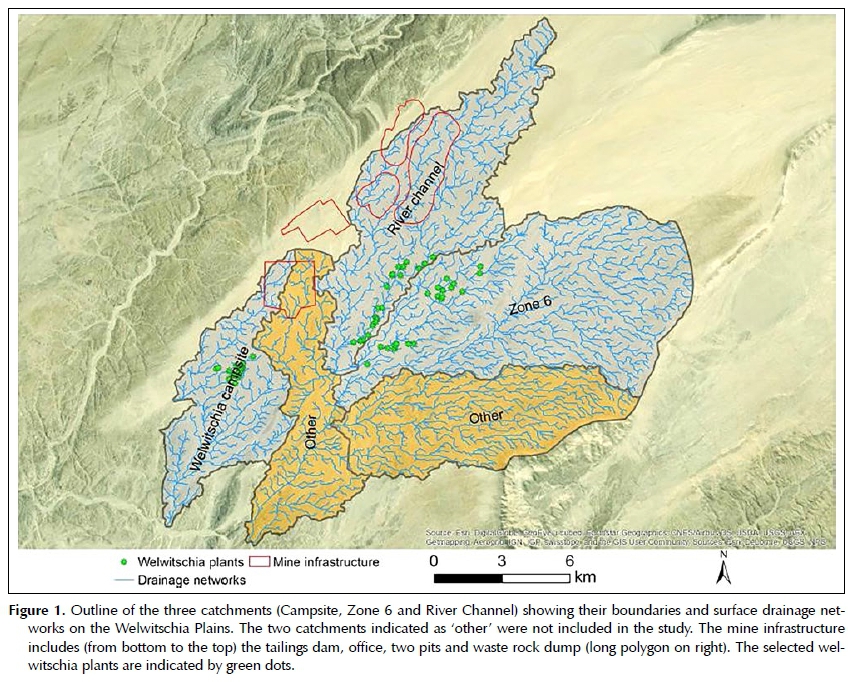
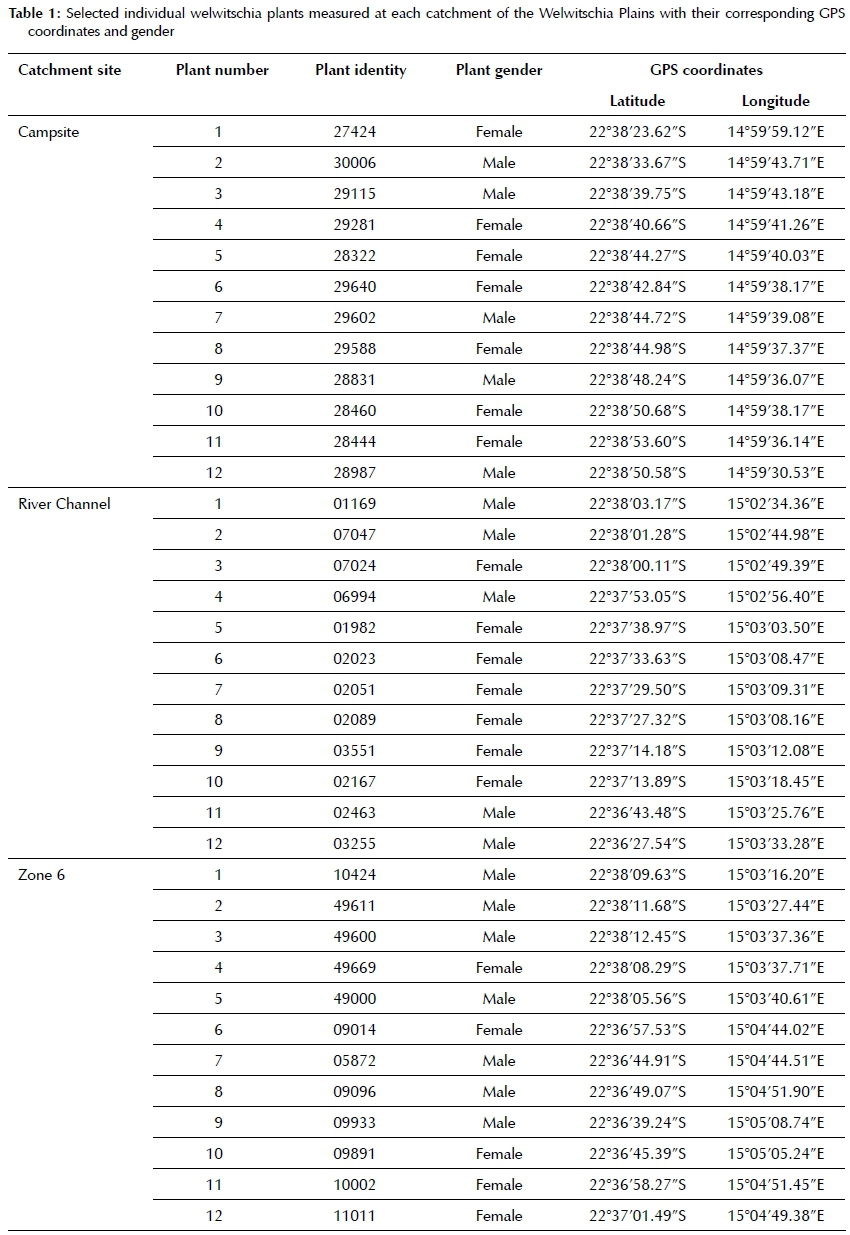
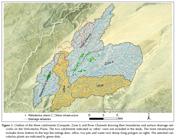
The study area was subdivided into three catchments areas due to observed differences in geological formations and topography, namely Campsite, River Channel and Zone 6 (Figure 1). Within each of these catchments, 12 individual plants were randomly selected for monitoring using ArcGIS 10.2 software (Supplementary Table 1) and were located in the field with their respective GPS coordinates.
Chlorophyll a fluorescence measurements of W. mirabi-lis plants were taken during winter (July) with a Handy Pea (Plant Efficiency Analyzer) fluorometer during the night. Measurements were taken one hour after sunset and continued to approximately midnight. Such dark adaption was done to ensure that all reaction centres were open. Ten fluorescence measurements were taken at different spots on each plant within the first 10 cm from the leaf base. During the time of the measurements, the night temperature was around 18°C. The Handy Pea was calibrated to produce pulses of light with an intensity of 3 445 ^mol mol-1 and a gain of 1. These light pulses each had a duration of 1 second at a wavelength of 650 nm.
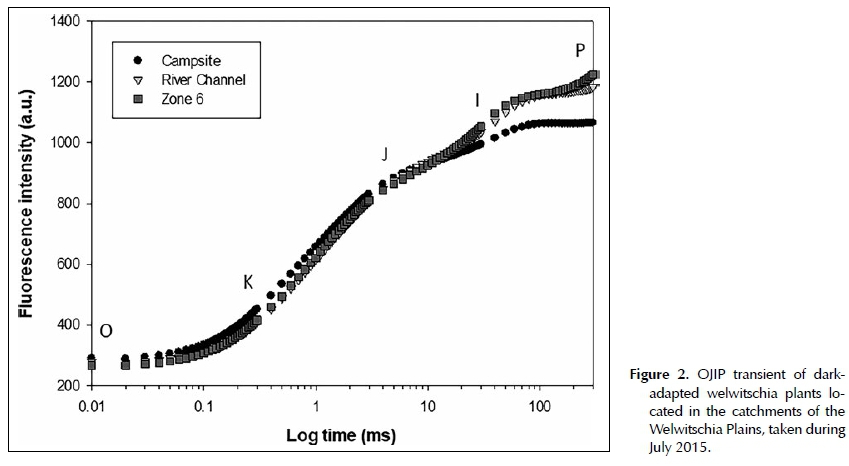
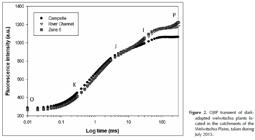
The chlorophyll fluorescence induction curve has specific inflection points named O, K, J, I and P plotted on a logarithmic time scale (OJIP transient). Typically, stress will influence the shape of the OJIP transients by causing a shift in the induction curve. Assessing shifts in the induction curve provides information regarding the photosynthetic potential of the plant and, ultimately, plant health. The OJIP transient section between steps J and P is known as the thermal phase (or the multiple turn-over phase). This phase represents the reduction of the electron transport chain. The step between J and I is associated with the reduction of the PQ-pool and the I to P step with electron flow through photosystem I (Stirbet & Govindjee 2011).
The performance index (PIABS) is a widely used JIP-test parameter that provides quantitative information about the physiological state of plants and vitality. PIABS provides information about the potential for energy conservation from light absorption to the reduction of intersystem electron acceptors (Strasser et al. 2004). It is a function of its three partial parameters: the density of active reaction centres per chlorophyll (yRC/(1-yRC)), the efficiency of electron movement by trapped excitation into electron transport chain ((ppO/(1-(ppO)) and the probability that the reaction centres will trap an absorbed photon (i|/Eo/(1-i|/Eo)) (Strasser et al. 2000). If a stress condition influences any of these partial parameters, the stress will influence the PIABS values and reflect the current state of photosyn-thetic performance (Strasser et al. 2004).
The fluorescence data captured with the Handy Pea was analysed with PEA Plus 1.140 software. The River Channel was selected as the reference site as the plants represented at this site were visually larger and appeared healthier compared to the other two sites. The translation of the fluorescence data to biophysical parameters was done according to Strasser et al. (2004). Data were subjected to the Shapiro-Wilk test and if data conformed to the assumptions of normality, a one-way ANOVA was run for each parameter in Statistica v13, Dell Inc. (2016).
Results
Typical chlorophyll a fluorescence induction curves of dark-adapted leaves of W. mirabilis plants were plotted for the Campsite, River Channel and Zone 6 catchments (Figure 2). The time frame between steps O and J (also referred to as the single turn-over phase or the photochemical phase) provides information about the antenna size and the connectivity between photosystem II reaction centres (Strasser et al. 2004). When the induction curves from the different catchments were compared to one another during this time frame, there were no apparent shifts in the induction curve from any of the catchments (Figure 2). A shift in the shape of the Campsite induction curve was observed between steps I and P. The rise in the fluorescence transient, especially after the I-step, was the lowest at Campsite. This would imply that the electron flow between photosystem II and photosystem I was less efficient (Figure 2).
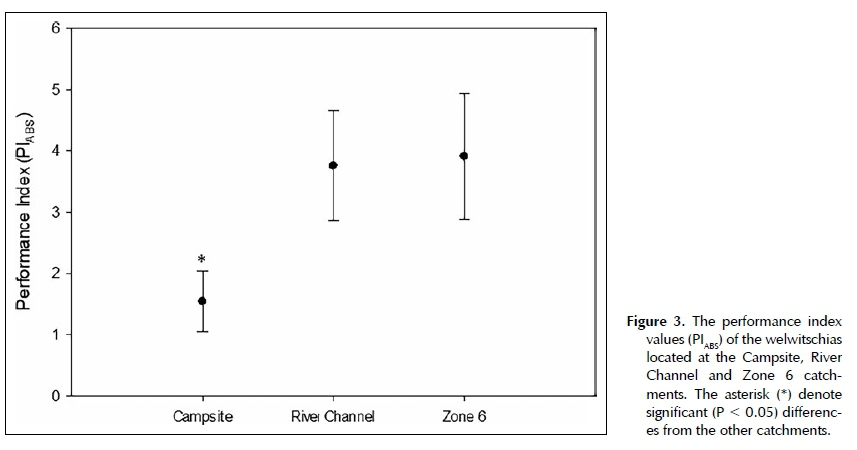
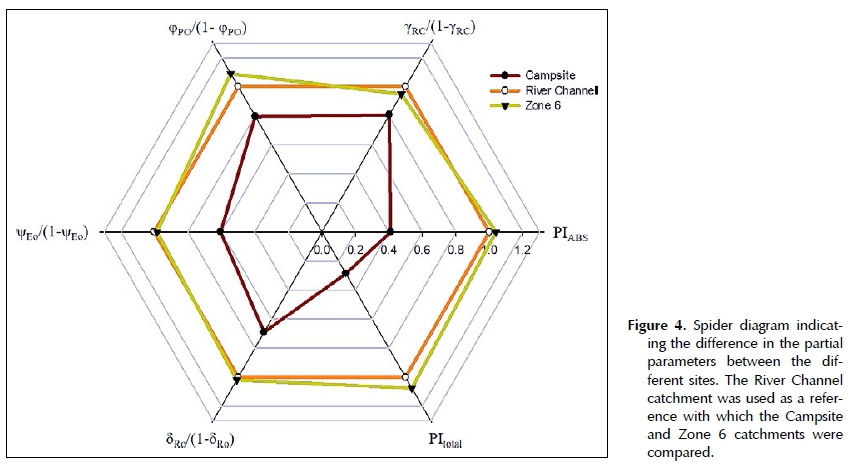
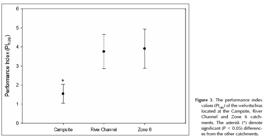
W. mirabilis plants located at Campsite had significantly lower PIABS (P < 0.05) values when compared to the other catchments (Figure 3). The lower PIABS values of Campsite suggests that these W. mirabilis plants are in a less optimal condition. By normalising the JIP parameters of Campsite and Zone 6 to River Channel (references site), differences among the catchments were emphasised. From the spider plot it was clear that all of the parameters that comprise the PIABS values for Campsite were all lower than those of River Channel and Zone 6 (Figure 4). The density of active reaction centres (yRC/(1- YRC)), the potential to create a charge separation (φρ(_/(1- φ )) and the potential to transport electrons between pSiI and PSI (v|/Eo/(1-v|/Eo)) were all lower at Campsite (Figure 4).
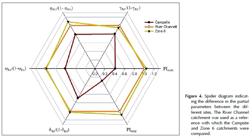
The total performance index, PItotal, is the product of the PIABS and the probability that an electron can move from a reduced intersystem electron acceptor to the PSI end-electron acceptors (Tsimilli-Michael & Strasser 2008). The PI index is, therefore, very closely related to the plants' overall growth and health. The PI values of the welwitschia plants growing at Campsite were also significantly lower (P < 0.05). The only difference between the PItotal and the PIabs is that for calculating the PItotal index, the reduction of the end electron acceptors (5Ro/(1-5Ro)) is included. Overall the spider plot (Figure 4) clearly shows that the photosynthetic potential of the W. mirabilis plants at Campsite was less efficient compared to the other two catchments.
Discussion
Monitoring the health status of W. mirabilis plants is critical for early detection of the impact of land-use change. Chlorophyll a fluorescence measurements, which were taken before the onset of mining activi-tiesm, can now serve as a baseline for future monitoring
(Kalaji et al. 2016). The vitality statuses of plants before mining activities is indicated by differences in the photosynthetic potential between W. mirabilis plants located within different catchment areas in the same locality. The maximum photosynthetic quantum yield of W. mirabilis plants located at Campsite was lower than River Channel and Zone 6, indicating a less optimal health condition when compared to the latter two.
The Campsite catchment has a higher elevation than the other catchments resulting in lower water accumulation, as water accumulates along the flow paths, which is influenced by the topography (Fan et al. 2020). This lower water accumulation at Campsite will lower the photosynthetic potential of the W. mirabilis plants. Topographic features such as elevation and slope may also change vegetation exposure to wind and solar radiation, contributing to a decrease in the photosynthetic potential (Mikita & Klimánek 2010). Because this study was conducted during winter, episodic rainfall did not influence the measurements. Incoming fog from the Atlantic Ocean might influence the photosynthetic potential of plants and has to be acknowledged, but the selected welwitschia plants for this study were chosen from outside the reach of the incoming fog.
For all practical reasons, the PItotal performance index or any partial parameters could have been used (Kalaji et al. 2016). To optimise the value of the JIP-test, annual readings should be taken on the same plants and any changes in the JIP parameters should be noted. It is recommended that several measurements be taken throughout the year. The data from this study represent the environmental conditions during the winter and if this same investigation was carried out during the summer, different PIABS values would be obtained, but the trend should remain the same (Janssen & Hasselt 1994).
Considering the planned change in anthropogenic activities, together with natural stressors on the fringes of the Welwitschia Plains, it is imperative to detect changes in the health status before the onset of visible stress symptoms. This early detection of plant stress will prompt for management actions to prevent populations from being adversely affected (Chaerle & Van Der Straeten 2000). Therefore, the chlorophyll fluorescence parameters analysis can be a very informative tool in ecological surveys (Kalaji et al. 2016) by providing explanations on the physiological behaviour of W. mirabilis plants in response to its changing environment. We suggest that long-term monitoring studies integrating potential drivers and responses be conducted to understand the plant health of W. mirabilis across the landscape. This study has established a baseline that can be used to develop a protocol to monitor the plant physiological status and the possible management strategies for mines and other developments that may have adverse impacts on the W. mirabilis population. Besides that, the findings may also aid restoration and rehabilitation measures such as transplantation and re-introduction of this species by understanding its current functional health status across the landscape over time.
Conclusion
Chlorophyll a fluorescence measuring techniques have high potential to investigate plant health in situ in longterm monitoring. Our study was a preliminary one, conducted over only a short period. Considering the longevity of welwitschia plants and the urgent need to develop a thorough understanding of how the species reacts to different stressors created by land-use change, longer-term studies should be conducted to understand the in situ spatial and temporal patterns of the species' health. With increasing mining activities on the fringes of the Welwitschia Plains and the potential threat that these anthropogenic activities pose to the welwitschia population, continued monitoring is vital.
Authors' contributions
JMB planned and coordinated the study, collected field data, conducted data analyses and wrote the manuscript. HC collected field data, conducted data analyses and contributed to the writing of the manuscript. TS collected field data and contributed to the analysis & interpretation of the data.
Disclaimer
The views expressed in the submitted article are our own and not an official position of the institution or funder.
Acknowledgments
The authors of this paper would like to thank the National Research Foundation (NRF) in South Africa and the National Commission on Research, Science and Technology (NCRST) of Namibia for funding this project. Also, our appreciation to the Gobabeb Research and Training Centre, Namibia, for organising the permits to conduct research within the Welwitsch-ia Plains and to the Gobabeb volunteers who assisted with the collection of data.
References
-
Busotti, F., Desotgiu, R., Pollastrini, M. & Cascio, C., 2010, 'The JIP test: a tool to screen the capacity of plant adaptation to climate change', Scandanavian Journal of Forest Research, 25(8), 43-50, https://doi.org/10.1080/02827581.2010.485777.
» https://doi.org/10.1080/02827581.2010.485777 -
Chaerle, L. & Van Der Straeten, D., 2000, 'Imaging techniques and the early detection of plant stress', Trends in Plant Science, 5(11), 495-501, https://doi.org/10.1016/S1360-1385(00)01781-7.
» https://doi.org/10.1016/S1360-1385(00)01781-7 - Cooper-Driver, G., 1994, 'Welwitschia mirabilis - a dream come true', Arnoldia, 54(2), 2-10.
-
Henschel, J. & Seely, M.K., 2000, 'Long-term growth patterns of Welwitschia mirabilis, as long-lived plant of the Namib Desert', Plant Ecology, 150(1-2), 7-26, https://doi.org/10.1023/A:1026512608982.
» https://doi.org/10.1023/A:1026512608982 - Fan, J., Xu, Y., Ge, H. & Yang, W., 2020, 'Vegetation growth variation in relation to topography in Horqin Sandy Land', Ecological Indicators, 113, 106-215.
-
Humavindu, M. & Stage, J., 2013, 'Key sectors of the Namib-ian economy', Journal of Economic Structures, 2(1), 1-15, https://doi.org/10.1186/2193-2409-2-1.
» https://doi.org/10.1186/2193-2409-2-1 - Janssen, L.H. & Hasselt, PR., 1994, 'Temperature effects on chlorophyll fluorescence induction in tomato', Journal of Plant Physiology, 144(2), 129-135.
-
Kalaji, H.M., Jajoo, A., Oukarroum, A., Brestic, M., Zivcak, M., Samborska, I.A. & Ladle, R.J., 2016, 'Chlorophyll a fluorescence as a tool to monitor physiological status of plants under abiotic stress conditions', Acta Physiologiae Plantarum, 38(4), 102, https://doi.org/10.1007/s11738-016-2113-y.
» https://doi.org/10.1007/s11738-016-2113-y - Mikita, T. & Klimánek, M., 2010, 'Topographic exposure and its practical applications', Jounal of Landscape Ecology, 3(1), 42-51.
- Schulze, E.D., Ziegler, H. & Stichler, W., 1976, 'Environmental control of Crassulacean Acid Metabolism in Welwitsch-ia mirabilis Hook. Fil. in in its range of natural distribution in the Namib desert', Oecologia, 24, 323-334.
-
Shanyengana, E.S., Henschel, J.R., Seely, M.K. & Sanderson, R.D., 2002, 'Exploring fog as a supplementary water source in Namibia', Atmospheric Research, 64(1), 251-259, DOI: 10.1016/S0169-8095(02)00096-0.
» https://doi.org/10.1016/S0169-8095(02)00096-0 -
Stirbet, A., 2011, 'On the relation between the Kautsky effect (chlorophyll a fluorescence induction) and photosystem II: Basic applications of the OJIP fluorescent transient', Journal of Photochemistry & Photobiology B: Biology, 104, 236-257, DOI: 10.1016/j.jphotobiol.2010.12.010.
» https://doi.org/10.1016/j.jphotobiol.2010.12.010 - Strasser, R.J., Srivastava, A. & Tsimilli-Michael, M., 2000, 'The fluorescence transient as a tool to characterize and screen photosynthetic samples', in M. Yunus, U. Pathre & P. Mohanty (eds), Probing photosynthesis: Mechanisms, regulation and adaptation, London: Taylor & Francis, pp. 445-483.
- Strasser, R.J., Tsimilli-Michael, M. & Srivastava, A., 2004, 'Analysis of the chlorophyll a Fluorescence Transient', in G.C. Papageorgiou & Govindjee (eds), Chlorophyll a fluorescence. A signature of photosynthesis. Advances in Photosynthesis and Respiration, vol 19. Dordrecht: Springer, p. 818.
- Tsimilli-Michael, M. & Strasser, R.J., 2008, 'In vivo assessment of stress impact on plant's vitality: applications in detecting and evaluating the beneficial role of mycorrhization on host plants', in A. Varma (ed.), Mycorrhiza. Berlin: Springer.
- Veste, M. & Herppich, W.B., 2008, 'Welwitschia mirabilis -Eine ökophysiologische Betrachtung', Naturwissenschaftliche Rundschau, 61, 620-624.
-
von Willert, D.J., Armbrüster, N., Drees, T. & Zaborowski, M., 2005, 'Welwitschia mirabilis: CAM or not CAM - what is the answer?', Functional Plant Biology, 32(5), 389-395, DOI: 10.1071/FP01241.
» https://doi.org/10.1071/FP01241 -
World Heritage Convention, 2002. Welwitschia plains. Available at: http://whc.unesco.org/en/tentativelists/1747/ (Accessed: 9 September 2015).
» http://whc.unesco.org/en/tentativelists/1747/

Accepted: 15 October 2020
Published: 24 February 2021