Risk factors of digital eye strain among computer users at Al-Baha University
Abstract
BACKGROUND: Digital eye strain (DES) affects an estimated 60 million people worldwide, with a higher prevalence among populations that are occupationally reliant on digital display devices. AIM: This study investigated risk factors of DES and ergonomic practices among computer users at Al-Baha University. SETTING: The study was conducted among computer users at Al-Baha University. METHODS: This study used a descriptive cross-sectional design and data were gathered using self-administered questionnaires. RESULTS: A total of 360 computer users participated (mean age: 36.33 years, standard deviation [s.d.]: 7.08). The lifetime and daily computer usage were 8.38 (s.d.: = 1.04) years and 4.37 (s.d.: = 2.07) hours, respectively, with 30% of respondents having used computers for more than 10 years. The baseline total eye complaints score was either mild or moderate for 64.7% and severe for 35% of the sample. The total workstation design score was poor for 47.1% and fair for 35.5% of the sample. The regression analysis of potential DES risk factors found statistically significant coefficients for the duration of daily computer use, use of contact lenses, poor ergonomic practices, poor workstation design and use of non-prescription spectacles. CONCLUSION: This study emphasises the need for learning institutions and public health policy makers to not only raise awareness about digital eye strain but also impose time restrictions and breaks on digital-based activities and generally improve workstation design and ergonomic conditions. CONTRIBUTION: This study offers a basis for targeted interventions to prevent and manage DES, particularly within learning settings.
digital eye strain (DES); ergonomic practices; computer users; occupation; computer vision syndrome
Introduction
The use of visual display terminals has become a necessity in 21st century work, education, and private lives, after barely three decades of the personal computer and computing devices revolution. While office work involves a range of disparate and adequately varied mental, physical, and social activities (e.g., writing, typing, in-person meetings, and filing), computers combine many activities. This enhances efficiency, productivity, and quality.123,4
Digital eye strain or computer vision syndrome (CVS) refers to many eye and vision-related problems, as well as external and internal symptoms, resulting from prolonged usage of computers, tablets, e-readers, smartphones, and other high-resolution digital displays.1,52,4,6,72,8,9
Past research has targeted occupations that involve extensive use of computers and high-resolution digital or video display terminals, including radiation levels and prevalence among different population groups.8,10,112,128,13,145,13210158,10
Predictably, public health concerns of DES are increasingly becoming a problem for researchers and policy makers. Digital eye strain is one of the commonest occupational hazards, with an estimated 60 million people globally, suffering from it.4,516717
Multiple studies have since tried to identify risk factors among specific occupational groups (e.g. radiologists, students, and teleworkers) using diverse methodologies,5,17,185,1811
Mowatt et al.7
Methods
Research design and sampling
This study used an observation analytical study design involving cross-sectional sampling. The study population comprised students and employees at Al-Baha University, Saudi Arabia. Established in 2006 in the southern region of the kingdom, Al-Baha University has an estimated student population of 21 000 (Al-Baha University, 2022). The study was undertaken at both the male and female wings of the university's administrative buildings. All individuals who were willing to participate and met the inclusion criteria, that is, continual computer use for at least 2 years, and absence of severe pre-existing eye disorders, were included in the study. The sample size was estimated by way of Cochran's formula (using the EPI Info 7 software) and respondents were selected by simple random sampling. Using the Taro Yomane formula, assuming a 50% predictive prevalence and a 5% margin of error, the minimum adequate sample size was estimated at 374, p < 0.05.
Tools for data collection
This study relied on two tools: Computer User's Structured Questionnaire Sheet (CUSQS) and the Ergonomic Practices and Workstation Design Observational Checklist (EPWDOC). The CUSQS tool was custom-developed by researchers from the recent literature. It comprised two parts. The first part sought demographic and computer usage data. The demographic data included age, gender, and educational level. The tool similarly gathered medical history data, including comorbidities, eye problem history and history of eye surgery as well as any history of past ophthalmological consultation for eye problems and related medication use. The computer use data included the lifetime duration of computer use (years), daily computer use (hours), and use of spectacles or lenses during computer use.
The second part of the CUSQS tool was an Assessment of Self-Reported Eye Complaints adapted from Arif and Alam.19
The EPWDOC tool was adapted from the American Optometric Association's recommended guidelines for the prevention of DES. It comprised two parts. The first part comprised 17 constructs that sought to capture data on the computer users' preventive ergonomic practices. The 17 items are categorised into eight dimensions: location of the computer screen (2), display settings (3), reference materials (2), lighting (3), anti-glare screen (1), seating position (3), rest breaks (2), and blinking (1). The total observational score was rated on a three-point Likert scale: (2) accurately done, (1) inaccurately done, and (0) not done. The resulting total score scale was a 34-point ordinal scale, which was further graded on a three-point ordinal scale: poor practice (0 < 17), fair practice (18 < 26), and good practice (> 26).10
The second part of the EPWDOC tool assessed elements of workstation design. The scale comprised 14 items, that are categorised into six dimensions as follows: computer screen (4), anti-glare screen (1), lighting (3), document holder (3), desk (1) and chair (2). Each item was scored using a three-point categorical scale: (2) if present, (1) if absent, and (0) if not applicable. The total observational score was calculated, ranging between 0 and 28. It was subsequently graded using a three-point ordinal scale: poor workstation (0 < 14), fair workstation (14 < 21), and good workstation (≥ 21).19,20
Procedures
The data collection tools were developed by the researchers after a thorough review of relevant recent literature, before being piloted using a jury of three experts in the field of ophthalmology to ascertain the construct validity. To ascertain the clarity, applicability, and feasibility of the tools, as well as to detect potential obstacles that might impede the data collection process, the tools were piloted using 20 computer users that were subsequently excluded from the sampling frame. The Cronbach's alpha coefficient showed that the scales were highly reliable (66 items: α = 0.81). The data were collected from August 2021 to October 2021. The descriptive and inferential statistics were obtained by using Microsoft Excel and IBM® SPSS® 21 software packages.
Ethical considerations
Ethical approval was obtained from the Institutional Review Board of Al Baha University (No. 1443-21-43110072).
Results and discussion
Demographic attributes
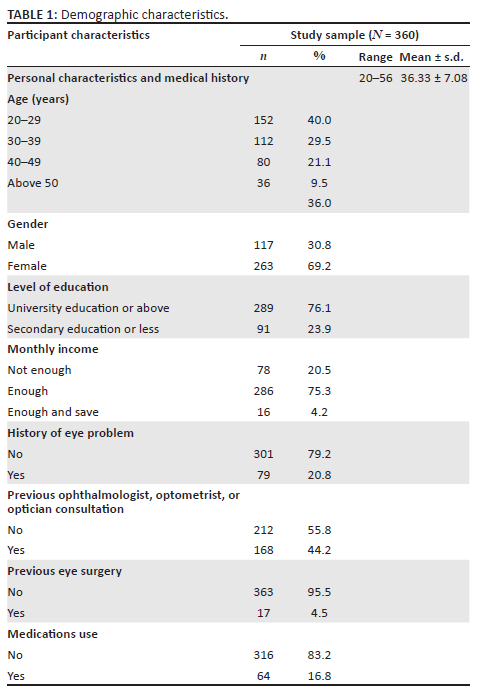
A total of 380 computer users (69.2% female) completed the survey. The mean age of the respondents was 36.33 (standard deviation [s.d.]: 7.08) years and at least 76% were university graduates, while 23% had a high school qualification. Three-quarters (75.3%) of the respondents believed that their monthly income was enough. Concerning DES symptoms, 79.2% of respondents believed they did not have any problems before using digital devices, while 20.8% self-reported suffering from eye problems before using digital devices. Up to 55.8% of the respondents had never consulted an ophthalmologist, optometrist or optician and only 4.5% had undergone surgery. At least 16% took medications for eye conditions. Table 1 shows the demographic characteristics of the participants.
Computer use characteristics
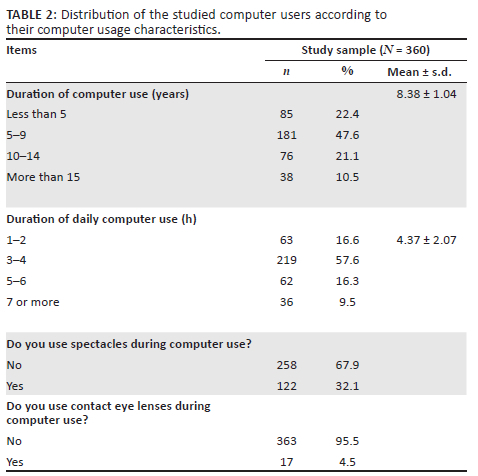
On an average, the respondents reported active usage of digital computing devices 8.38 (s.d.: 1.04) years during their lifetimes and 4.37 (s.d.: 2.07) hours daily. At least 30% of the sample had used computers for more than 10 years, 25% of whom used computers for more than 5 h per day. Only 32.1% and 4.5% reported using spectacles and contact lenses, respectively, when using computers. Table 2 shows the computer usage characteristics of the participants.
The average of 4.37 h of daily screen time is consistent with the generally high screen time among students and younger people during the COVID-19 pandemic.6,21106,21,2223242526142
Workstation design and ergonomics
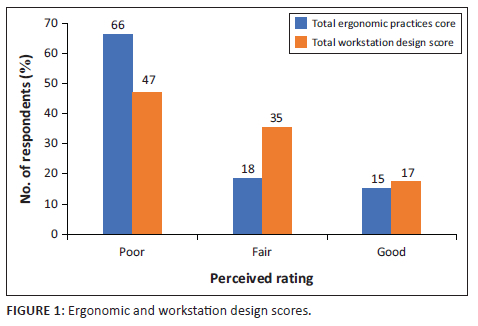
The majority of the sampled population's baseline total eye complaints score was either mild or moderate (64.7%). At least 35% had a severe total eye complaint score. The self-reported baseline preventive ergonomic practices score was poor among 66.3% of the sampled computer users, with only 15.3% a good baseline score. Similarly, the total workstation design score was found to be poor for 47.1% and fair for 35.5% of the sample (Figure 1).
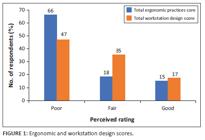
The finding of moderate or mild baseline complaint score could explain the equally poor instrumental preventive behaviours among 66.3% of the sample as many people would not see the need to mitigate a condition that is not severe.23,26
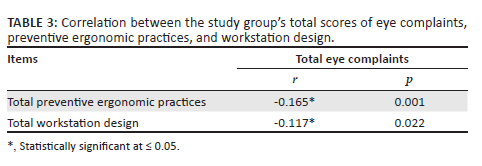
The Pearson rank correlation analysis results show that the coefficient of total eye complaints scores of the studied computer users, with both the total preventive ergonomic practices and total workstation design, is negative and statistically significant, p < 0.05 (Table 3).
The large gap between the proportion of respondents who felt they did not have pre-existing DES symptoms and the 20.8% who self-reported pre-existing conditions points to one possible conclusion. It is possible that DES prevalence is low in either the sample or the Al-Baha University population, but given the high prevalence rate of DES in the general population and students,5,7,16
Digital eye strain risk factors and their effects on digital eye strain
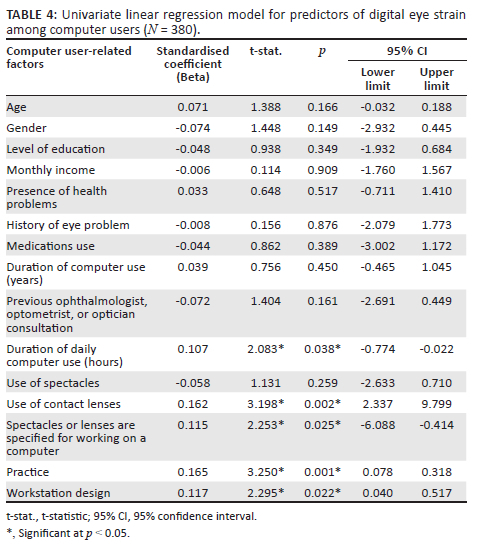
The univariate linear regression model for predictors of DES among computer users showed that the coefficients of the duration of daily computer use, use of contact lenses while working on a digital device, and using properly indicated spectacles or lenses to working on a computer, were statistically significant at 5%. In addition, preventive ergonomic practices and workstation design showed a significant relation to the DES among studied computer users (Table 4).
This study shows the existence of potentially positive causal relationships between the duration of daily computer use (hours), use of contact lenses, poor ergonomic practices, use of spectacles or lenses not specified for working on a computer, and poor workstation design. The findings concerning the duration of computer use are consistent with past studies on the increased screen time among at-risk populations such as students, radiologists, and office workers.4,8,13,212772124828
On their part, Abudawood, Ashi, and Almarzouki233,5,7,12,13,282421122
Demographic characteristics, including age, gender, income, education level, health problems, history of eye problems, and use of medications are not statistically significant determinants of DES. These findings are inconsistent with the previous studies that linked DES to heightened digital device utilisation among certain demographic groups. These include findings of an inverse relationship between DES and age (mediated by screen time),6,215,17,23,296,7,8,12,17
Contrary to this study's findings, the past research also links DES to pre-existent eye conditions, use of spectacles, and use of medications.21,23,301052,10,315,10
Conclusion and recommendations
This study sought to identify the risk factors of DES (including workstation ergonomics) and estimated the effect of the identified risk factors on DES symptoms among computer users at Al-Baha University. The findings reveal that more than 83% of the respondents use digital computing devices for more than 3 h with less than 36.6% of the respondents using spectacles or lenses. Even so, only a minority have optimal workstation design and preventive ergonomic practices. Proper visual ergonomics have been shown to be effective in preventing the development of DES and mitigating the severity of DES.5,9
This study similarly bears out the importance of healthy computer use behaviours.5,95,272,32
The use of spectacles; previous consultations with ophthalmologists, optometrists and opticians; duration of computer use (years); medications use; history of comorbid ocular complaints; general comorbid health conditions; monthly income; level of education, age, and gender do not have a statistically significant effect on the development of DES. While more research is needed to confirm these findings, the evidence from this study helps to achieve more targeted interventions in preventing and managing DES, particularly among learning settings.
Competing interests
The authors declare that they have no financial or personal relationships that may have inappropriately influenced them in writing this article.
Author's contributions
S.K.A.-A. testifies that she conceived, designed and conducted the research, collected and analysed the data, drafted and critically reviewed and approved the final draft of the manuscript. She is responsible for all aspects of the work.
Funding information
This research did not receive any specific grant from funding agencies in the public, commercial, or not-for-profit sectors.
Data availability
Data supporting the findings of this study are available from the corresponding author, S.K.A.-A., upon request.
Disclaimer
The views and opinions expressed in this article are those of the author and do not necessarily reflect the official policy or position of any affiliated agency of the author.
Acknowledgements
References
-
1.Blehm C, Vishnu S, Khattak A, Mitra S, Yee RW. Computer vision syndrome: A review. Surv Ophthalmol. 2005;50(3):253-262. https://doi.org/10.1016/j.survophthal.2005.02.008
» https://doi.org/10.1016/j.survophthal.2005.02.008 -
2.Tesfaye AH, Alemayehu M, Abere G, Mekonnen TH. Prevalence and associated factors of computer vision syndrome among academic staff in the University of Gondar, Northwest Ethiopia: An institution-based cross-sectional study. Environ Health Insights. 2022;16:117863022211118. https://doi.org/10.1177/11786302221111865
» https://doi.org/10.1177/11786302221111865 - 3.Sen A, Richardson S. A study of computer-related upper limb discomfort and computer vision syndrome. J Hum Ergol (Tokyo). 2007;36(2):45-50.
-
4.Ranasinghe P, Wathurapatha WS, Perera YS, et al. Computer vision syndrome among computer office workers in a developing country: An evaluation of prevalence and risk factors. BMC Res Notes. 2016;9(1):150. https://doi.org/10.1186/s13104-016-1962-1
» https://doi.org/10.1186/s13104-016-1962-1 -
5.Zalat MM, Amer SM, Wassif GA, El Tarhouny SA, Mansour TM. Computer vision syndrome, visual ergonomics and amelioration among staff members in a Saudi medical college. Int J Occup Saf Ergon. 2022;28(2):1033-1041. https://doi.org/10.1080/10803548.2021.1877928
» https://doi.org/10.1080/10803548.2021.1877928 -
6.Li R, Ying B, Qian Y, Chen D, Li X, Zhu H, et al. Prevalence of self-reported symptoms of computer vision syndrome and associated risk factors among school students in China during the COVID-19 pandemic. Ophthalmic Epidemiol. 2021;29(4):1-11. https://doi.org/10.1080/09286586.2021.1963786
» https://doi.org/10.1080/09286586.2021.1963786 -
7.Mowatt L, Gordon C, Santosh ABR, Jones T. Computer vision syndrome and ergonomic practices among undergraduate university students. Int J Clin Pract. 2018;72(1):e13035. https://doi.org/10.1111/ijcp.13035
» https://doi.org/10.1111/ijcp.13035 -
8.Portello JK, Rosenfield M, Bababekova Y, Estrada JM, Leon A. Computer-related visual symptoms in office workers. Ophthalmic Physiol Opt. 2012;32(5):375-382. https://doi.org/10.1111/j.1475-1313.2012.00925.x
» https://doi.org/10.1111/j.1475-1313.2012.00925.x -
9.Lurati AR. Computer vision syndrome: Implications for the occupational health nurse. Workplace Health Saf. 2018;66(2):56-60. https://doi.org/10.1177/2165079917731790
» https://doi.org/10.1177/2165079917731790 -
10.Assefa NL, Weldemichael DZ, Alemu HW, Anbesse DH. Prevalence and associated factors of computer vision syndrome among bank workers in Gondar City, northwest Ethiopia, 2015. Clin Optom (Auckl). 2017;2017:67-76. https://doi.org/10.2147/OPTO.S126366
» https://doi.org/10.2147/OPTO.S126366 -
11.Adane F, Alamneh YM, Desta M. Computer vision syndrome and predictors among computer users in Ethiopia: A systematic review and meta-analysis. Trop Med Health. 2022;50(1):26. https://doi.org/10.1186/s41182-022-00418-3
» https://doi.org/10.1186/s41182-022-00418-3 -
12.Boadi-Kusi SB, Adueming POW, Hammond FA, Antiri EO. Computer vision syndrome and its associated ergonomic factors among bank workers. Int J Occup Saf Ergon. 2022;28(2):1219-1226. https://doi.org/10.1080/10803548.2021.1897260
» https://doi.org/10.1080/10803548.2021.1897260 -
13.Ardahan M, Simsek H. Analyzing musculoskeletal system discomforts and risk factors in computer-using office workers. Pak J Med Sci. 2016;32(6):1425-1429. https://doi.org/10.12669/pjms.326.11436
» https://doi.org/10.12669/pjms.326.11436 -
14.Wróbel-Dudzińska D, Osial N, Stępień PW, Gorecka A, Żarnowski T. Prevalence of dry eye symptoms and associated risk factors among university students in Poland. Int J Environ Res Public Health. 2023;20(2):1313. https://doi.org/10.3390/ijerph20021313
» https://doi.org/10.3390/ijerph20021313 -
15.Tafese A, Nega A, Getasew D, Erku G. Assessment of knowledge and practice of computer ergonomics among secretaries and data processing workers in University of Gondar, Northwest Ethiopia, 2016. J Community Med Health Educ. 2018;8(1):583. https://doi.org/10.4172/2161-0711.1000583
» https://doi.org/10.4172/2161-0711.1000583 -
16.Turkistani A, Al-Romaih A, Alrayes M, Al Ojan A, Al-Issawi W. Computer vision syndrome among Saudi population: An evaluation of prevalence and risk factors. J Family Med Prim Care. 2021;10(6):2313. https://doi.org/10.4103/jfmpc.jfmpc_2466_20
» https://doi.org/10.4103/jfmpc.jfmpc_2466_20 -
17.Alhasan AS, Aalam WA. Magnitude and determinants of computer vision syndrome among radiologists in Saudi Arabia: A National Survey. Acad Radiol. 2021;29(9):197-204. https://doi.org/10.1016/j.acra.2021.10.023
» https://doi.org/10.1016/j.acra.2021.10.023 -
18.Kawthalkar AS, Sequeira RA, Arya S, Baheti AD. Non-radiation occupational hazards and health issues faced by radiologists - A cross-sectional study of Indian radiologists. Indian J Radiol Imaging. 2019;29(01):61-66. https://doi.org/10.4103/ijri.IJRI_403_18
» https://doi.org/10.4103/ijri.IJRI_403_18 -
19.Arif KM, Alam MJ. Computer vision syndrome. Faridpur Med Coll J. 2016;10(1):33-35. https://doi.org/10.3329/fmcj.v10i1.27923
» https://doi.org/10.3329/fmcj.v10i1.27923 -
20.American Optometric Association. Computer vision syndrome/Digital Eye Strain [homepage on the Internet]. 2017 [cited 2022 Jul 24]. p. 1-2. Available from: https://www.aoa.org/
» https://www.aoa.org/ -
21.Ganne P, Najeeb S, Chaitanya G, Sharma A, Krishnappa NC. Digital eye strain epidemic amid COVID-19 pandemic - A cross-sectional survey. Ophthalmic Epidemiol. 2021;28(4):285-292. https://doi.org/10.1080/09286586.2020.1862243
» https://doi.org/10.1080/09286586.2020.1862243 -
22.Almarzouki N, Faisal K, Nassief A, et al. Digital eye strain during COVID-19 lockdown in Jeddah, Saudi Arabia. J Contemp Med Sci. 2021;7(1):40-45. https://doi.org/10.22317/jcms.v7i1.937
» https://doi.org/10.22317/jcms.v7i1.937 -
23.Abudawood GA, Ashi HM, Almarzouki NK. Computer vision syndrome among undergraduate medical students in King Abdulaziz University, Jeddah, Saudi Arabia. J Ophthalmol. 2020;2020:278937. https://doi.org/10.1155/2020/2789376
» https://doi.org/10.1155/2020/2789376 -
24.Sheppard AL, Wolffsohn JS. Digital eye strain: Prevalence, measurement and amelioration. BMJ Open Ophthalmol. 2018;3(1):e000146. https://doi.org/10.1136/bmjophth-2018-000146
» https://doi.org/10.1136/bmjophth-2018-000146 -
25.Yammouni R, Evans BJ. An investigation of low power convex lenses (adds) for eyestrain in the digital age (CLEDA). J Optom. 2020;13(3):198-209. https://doi.org/10.1016/j.optom.2019.12.006
» https://doi.org/10.1016/j.optom.2019.12.006 -
26.Markoulli M, Kolanu S. Contact lens wear and dry eyes: Challenges and solutions. Clin Optom (Auckl). 2017;9:41-48. https://doi.org/10.2147/OPTO.S111130
» https://doi.org/10.2147/OPTO.S111130 -
27.Basnet A, Basnet P, Karki P, Shrestha S. Computer vision syndrome prevalence and associated factors among the medical student in Kist Medical College. Nepal Med J. 2018;1(1):29-31. https://doi.org/10.3126/nmj.v1i1.20396
» https://doi.org/10.3126/nmj.v1i1.20396 -
28.Salinas-Toro D, Cartes C, Segovia C, et al. High frequency of digital eye strain and dry eye disease in teleworkers during the coronavirus disease (2019) pandemic. Int J Occup Saf Ergon. 2022;28(3):1787-1792. https://doi.org/10.1080/10803548.2021.1936912
» https://doi.org/10.1080/10803548.2021.1936912 -
29.Al Dandan O, Hassan A, Al Shammari M, Al Jawad M, Alsaif HS, Alarfaj K. Digital eye strain among radiologists: A survey-based cross-sectional study. Acad Radiol. 2021;28(8):1142-1148. https://doi.org/10.1016/j.acra.2020.05.006
» https://doi.org/10.1016/j.acra.2020.05.006 -
30.Zayed HAM, Saied SM, Younis EA, Atlam SA. Digital eye strain: Prevalence and associated factors among information technology professionals, Egypt. Environ Sci Pollut Res. 2021;28(20):25187-25195. https://doi.org/10.1007/s11356-021-12454-3
» https://doi.org/10.1007/s11356-021-12454-3 -
31.Umar A, Kashif M, Zahid N, et al. The prevalence of musculoskeletal disorders and work-station evaluation in bank employees. Phys Med Rehabil Kurortmed. 2019;29(02):99-103. https://doi.org/10.1055/a-0756-9782
» https://doi.org/10.1055/a-0756-9782 -
32.al Baha University. Al Baha University [homepage on the Internet]. 2022 [cited 2022 Jul 23]. p. 1-1. Available from: https://bu.edu.sa/about
» https://bu.edu.sa/about

Accepted: 14 June 2023
Published: 27 July 2023