Essential visual skills required for boxing: A review
Abstract
BACKGROUND: Boxing requires athletes to possess specific visual skills to effectively evaluate situations and react in a timely manner. Understanding these skills is crucial for the training and development of athletes AIM: This review aimed to summarise and analyse the essential visual skills required for boxing, highlighting their importance beyond basic visual acuity METHOD: Studies were obtained from various databases, including Science Direct, Google Scholar, CISTI Source, SPORTDiscus and PubMed. A comprehensive keyword search was conducted, searching Medical Subject Headings (MeSH) 'visual skills', 'hand-eye coordination', 'peripheral vision', 'eye movements', 'boxing', 'boxing rules', 'reaction time', 'speed of recognition', 'accommodation facility', 'visual memory', 'combat sport', 'depth perception', 'motor learning', and 'cognitive function' RESULTS: A total of 35 full-text English-language articles were included in the review after the removal of duplicates and the full-text review process. The review found that the essential visual skills required for boxing are depth perception, accommodation facility, saccadic eye movements, hand-eye coordination, peripheral awareness, speed and span of recognition, reaction time, visual memory and anticipation CONCLUSION: The findings suggest that training programmes for boxers should incorporate exercises to enhance these visual skills. Further research is needed to develop specific training protocols and evaluate their effectiveness CONTRIBUTION: This review provides a comprehensive overview of visual skills in boxing, offering insights into their role in athletic performance. The study contributes to the development of more effective training strategies and highlights the need for further research in sports vision
vision; reaction time; boxing; depth perception; visual skills
Introduction
While 'sight' refers to the clarity of the image formed on the retina, 'vision' involves a broader concept, including the cognitive process of interpreting and understanding what is observed.12345511,3,4
Athletes' visual skills can be divided into two categories: hardware and software skills.6,76,76,7
Boxing is a sport where athletes are in close quarters, requiring the ability to quickly evaluate the situation and predict the opponent's next move.8877777
Previous research has primarily concentrated on the physical and physiological profiles, biomechanical characteristics, and injuries of amateur boxers.9,10,1112,13,14,15
Ethical considerations
Ethical clearance to conduct this study was obtained from the University of Zululand Research Ethics Committee (No. UZREC 171110-030 PGD 2022/31).
Methods
Search strategy
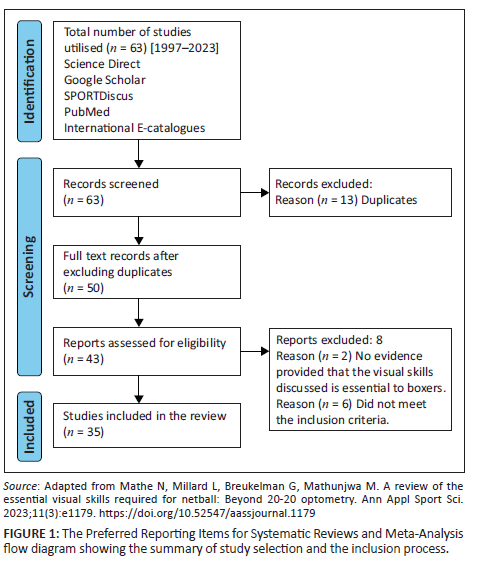
The literature review on the visual skills required for boxing involved electronic searches across various databases, including Science Direct, Google Scholar, CISTI Source (1997-February 2023), SPORTDiscus (1997-February 2023), PubMed (1997-February 2023), and international e-catalogues. A keyword search included MeSH headings such as 'sport vision', 'boxing vision', 'vision in sport', 'depth perception', 'eye-coordination', 'accommodation facility', 'fixation skill', 'saccadic eye movements', 'visual skills', 'reaction time', 'peripheral awareness', 'visual memory', 'concentration', and 'visual perception'. Only peer-reviewed articles in English were considered, and the search results were categorised for discussion, as illustrated in Figure 1.
Inclusion and exclusion criteria
The inclusion criteria were the following: (1) studies that utilised MeSH headings such as 'visual skills', 'hand-eye coordination', 'peripheral vision', 'eye movements', 'boxing', 'boxing rules', 'reaction time', 'speed of recognition', 'accommodation facility', 'visual memory', 'combat sport', 'depth perception', 'motor learning', and 'cognitive function' during keyword searches, (2) studies published between 1997 and 2023, as detailed in the data sources section, and (3) studies exploring a diverse range of visual skills essential for boxers. The exclusion criteria were the following: (1) studies not published in the English language, (2) articles not directly relevant to boxing, and (3) studies lacking evidence demonstrating the essential nature of the mentioned visual skills for boxing.
Data extraction
Studies that did not meet the inclusion criteria were excluded from the analysis. After collecting and analysing substantial data on crucial visual skills in boxing, the primary author evaluated each study for eligibility during the full-text review. A systematic approach was used for data analysis, which included the extraction of relevant findings related to visual skills, followed by a qualitative synthesis to identify and summarise the key visual skills essential for boxing performance. Final selections were approved by one of the co-authors to ensure clarity and consistency.
All included articles were categorised as either 'vision in boxing' or 'essential visual skills in boxing' based on their respective journal or conference publications and associated keywords. Data extraction involved gathering information on analysis methodologies, sample selection criteria, and spatial aggregation features to evaluate each study's contributions to essential visual skills. In addition, information regarding the connection between match performance, research objectives or study aims, and the inclusion of theoretical explanations for strategic behaviours was extracted to assess research interpretability. The findings were systematically categorised and organised within a comprehensive framework, as illustrated in Figure 1, which will guide the discussion of outcomes. The Preferred Reporting Items for Systematic Reviews and Meta-Analysis (PRISMA) statement was selected for its effectiveness in transparently depicting the study selection process, ensuring clarity in reporting systematic reviews and meta-analyses.16
Review findings
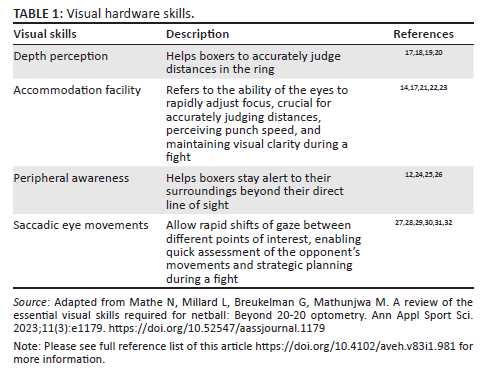
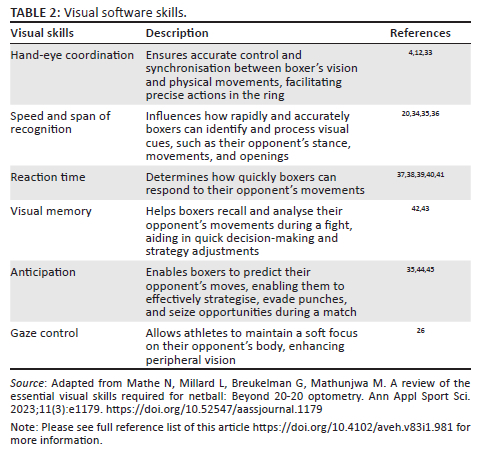
This research utilised 63 full-text English-language articles obtained from 63 citations identified through electronic searches. After eliminating duplicates and reviewing full-text versions, 35 articles were retained for analysis. The study identified various visual skills essential for boxing, recognising that some are more critical for performance than others. However, all these skills are deemed relevant and contribute to enhanced performance in boxing. Refer to Table 1 for a comprehensive list of essential visual hardware skills and Table 2 for a comprehensive list of essential visual software skills.
It is widely believed that the visual system offers the most comprehensive and abundant source of information about our surrounding environment.34,46443737373838
Optimal vision, which requires exceptional visual skills, contributes to roughly 80% of how athletes gather information about their sports environment. The visual skills identified in this review are as follows. Visual Hardware includes depth perception, accommodation facility, peripheral awareness, and saccadic eye movements. Visual Software includes eye-hand coordination, speed and span of recognition, visual reaction time, visual memory and anticipation.
Visual hardware
Dodging punches in boxing is like a high-stakes game of timing and precision. Boxers must swiftly calculate the distance and direction of each incoming blow, almost like anticipating the next move in a fast-paced dance.1718191920
For athletes to be able to focus quickly on stable and clear vision, especially when trying to fixate from far to near or vice versa, accommodation facility is essential.212223231417
In sports, it is crucial for an athlete to gaze in the right place to take advantage of his or her sharp foveal vision, but it's also crucial to use one's peripheral vision to pay attention to nearby objects without looking directly at them.25242626262612
Combat sports and ball activities prioritise precise object tracking and quick reactions more than many other sports.27,282930,3132
Visual software
As in any full-contact combat sport, the main objective is to be efficient in attacks and counterattacks, hitting the opponent correctly and accurately, and avoiding getting hit, which all require a strong hand-eye coordination.1243333
In the intense realm of boxing, the speed of recognition stands as a critical determinant of a fighter's success in the ring. Speed of recognition is the amount of time required to correctly judge a visual stimulus.353536202034
Boxing is a competitive combat discipline where two contenders fight for success.37373738394040414141
As discussed, in boxing, quick reactions are essential. A key factor in achieving this is effective gaze control, which helps optimise peripheral vision while minimising the drawbacks of rapid eye movements or saccades.26262626
Visual memory involves the mental skill of remembering and bringing back to mind visual images or information that was seen or noticed before.424343424242
In sports and other fast-paced situations, it's important to be able to guess what others are going to do.4445454544
Although this review focuses on visual skills specific to boxing, many of the identified skills, such as hand-eye coordination, depth perception, and reaction time, are integral to performance in a wide range of sports. For instance, hand-eye coordination is critical in tennis for hitting the ball accurately and reaction time is crucial for performance in martial.25,47,48
The study's limitations lie in the scarcity of prior research focusing on the visual skills necessary for boxing, as well as their specific significance in the context of boxing. Additionally, despite conducting a thorough examination of the critical visual skills required for boxing, there remains the possibility of overlooking certain visual skills. Therefore, this study serves merely as a foundational exploration, leaving room for future research to identify and incorporate essential visual skills relevant to boxing. Furthermore, the exclusion of visual acuity (static and dynamic) is a notable limitation. While visual acuity is an important foundational skill, the lack of available studies on its specific role in boxing led to its omission in this review. Future research could address this gap by exploring the impact of visual acuity on boxing performance and its interplay with other visual skills.
Recommendations
Future studies should prioritise the creation and validation of training protocols designed to enhance visual skills in boxers, utilising advanced technologies such as eye-tracking and motion capture for precise measurement. Longitudinal research is essential to track the development of visual skills over time, while comparative studies should explore these abilities across various levels of expertise and different combat sports. Moreover, incorporating visual skills assessments into regular health evaluations and promoting interdisciplinary collaboration among sports scientists, optometrists, neuroscientists, and coaches will be vital for developing comprehensive training programmes that address the diverse aspects of visual skills in boxing.
Conclusion
This review identifies several essential visual skills critical to boxing performance, including depth perception, accommodation facility, saccadic eye movements, hand-eye coordination, peripheral awareness, speed and span of recognition, reaction time, visual memory, and anticipation. The findings emphasise the need for targeted training regimens to develop these visual skills in boxers. While this review provides valuable insights, there are gaps in the literature regarding the role of specific visual skills in combat sports. Future research should focus on determining the trainability of these skills and assessing their direct impact on performance in both amateur and elite boxers. Additionally, investigations into the contributions of optometrists, ophthalmologists, and sports psychologists in developing training protocols could provide a more comprehensive understanding of how to optimise visual performance in athletes. Moving forward, further studies could explore the efficacy of visual skill training in other combat sports, the long-term benefits of such training, and the potential for visual testing to identify talent in young athletes. These topics represent key areas for future research that could significantly advance our understanding of the role of visual skills in athletic performance.
Competing interests
The authors declare that they have no financial or personal relationships that may have inappropriately influenced them in writing this article.
Authors' contributions
S.M., L.M., G.J.B., and M.L.M. contributed equally to the study's design, article analysis, content, and writing.
Funding information
This research received no specific grant from any funding agency in the public, commercial, or not-for-profit sectors.
Data availability
Data sharing is not applicable to this article as no new data were created or analysed in this study.
Disclaimer
The views and opinions expressed in this article are those of the authors and are the product of professional research. It does not necessarily reflect the official policy or position of any affiliated institution, funder, agency, or that of the publisher. The authors are responsible for this article's results, findings, and content.
Acknowledgements
References
-
1.Khanal S. Impact of visual skills training on sports performance: Current and future perspectives. Adv Ophthalmol Vis Syst. 2015;2:00032. https://doi.org/10.15406/AOVS.2015.02.00032
» https://doi.org/10.15406/AOVS.2015.02.00032 -
2.Wang C, Yan A, Deng W, Qi C. Effect of tennis expertise on motion-in-depth perception at different speeds: An event-related potential study. Brain Sci. 2022;12(9):1160. https://doi.org/10.3390/brainsci12091160
» https://doi.org/10.3390/brainsci12091160 -
3.Omar R, Kuan YM, Zuhairi NA, Manan FA, et al. Visual efficiency among teenaged athletes and non-athletes. Int J Ophthalmol. 2017;10(9):1460-1464. https://doi.org/10.18240/ijo.2017.09.20
» https://doi.org/10.18240/ijo.2017.09.20 -
4.Mahomed AF, Kleynhans M, Govender C, et al. The effect of sports vision exercises on the visual skills of university students. The effect of sports vision exercises on the visual skills of university students. Afr J Phys Health Educ Recreat Dance. 2011;17(3):429-440. https://doi.org/10.4102/SATNT.V32I1.842
» https://doi.org/10.4102/SATNT.V32I1.842 -
5.Knöllner A, Memmert D, Von Lehe M, et al. Specific relations of visual skills and executive functions in elite soccer players. Front Psychol. 2022;13:960092. https://doi.org/10.3389/fpsyg.2022.960092
» https://doi.org/10.3389/fpsyg.2022.960092 -
6.Pereira VBP, Pereira VBP, Pereira RA, et al. Comparison of retinal sensitivity between professional soccer players and non-athletes. Int J Sports Med. 2016;37(4):282-287. https://doi.org/10.1055/s-0035-1564103
» https://doi.org/10.1055/s-0035-1564103 -
7.Mathe N, Millard L, Breukelman GJ, Mathunjwa M. Differences in visio-spatial intelligence between non-athletes and netball players. Front Sports Act Living. 2023;5:1109967. https://doi.org/10.3389/fspor.2023.1109967
» https://doi.org/10.3389/fspor.2023.1109967 - 8.Yordanova Y, Pulev T, Kirilova K, et al. Sport experience and visual motor reaction time of boxers. J Phys Educ Sport. 2023;23(5):1176-1181.
-
9.Chaabène H, Tabben M, Mkaouer B, et al. Amateur boxing: Physical and physiological attributes. Sports Med. 2015;45(3):337-352. https://doi.org/10.1007/s40279-014-0274-7
» https://doi.org/10.1007/s40279-014-0274-7 -
10.Stojsih S, Boitano M, Wilhelm M, Bir C. A prospective study of punch biomechanics and cognitive function for amateur boxers. Br J Sports Med. 2010;44(10):725-730. https://doi.org/10.1136/bjsm.2008.052845
» https://doi.org/10.1136/bjsm.2008.052845 - 11.Busko K. Biomechanical characteristics of amateur boxers. Arch Budo. 2019;15:23-31.
-
12.Pinto FCL, Branquinho L, Marinho DA, et al. The efficiency and transversality of traditional boxing skills to several full-contact combat sports: A narrative review. Arch Budo Sci Martial Arts Extrem Sports [serial online]. 2022 [cited 2024 Apr 5]; 18:1-10. Available from: http://hdl.handle.net/10198/24803
» http://hdl.handle.net/10198/24803 -
13.Mathe N, Millard L, Breukelman G, Mathunjwa M. A review of the essential visual skills required for netball: Beyond 20-20 optometry. Ann Appl Sport Sci. 2023;11(3):e1179. https://doi.org/10.52547/aassjournal.1179
» https://doi.org/10.52547/aassjournal.1179 -
14.Hukkanen E, Häkkinen K. Effects of sparring load on reaction speed and punch force during the precompetition and competition periods in boxing. J Strength Cond Res. 2017;31(6):1563-1568. https://doi.org/10.1519/JSC.0000000000001885
» https://doi.org/10.1519/JSC.0000000000001885 -
15.Piatysotska S, Podrigalo L, Romanenko V, et al. Study of short-term visual memory of athletes in cyclic sports, martial arts and esports. Pedagogy Phys Cult Sports. 2023;27(6):503-514. https://doi.org/10.15561/26649837.2023.0609
» https://doi.org/10.15561/26649837.2023.0609 -
16.Page MJ, McKenzie JE, Bossuyt PM, et al. The PRISMA 2020 statement: An updated guideline for reporting systematic reviews. BMJ. 2021;372:n71 https://doi.org/10.1136/bmj.n71
» https://doi.org/10.1136/bmj.n71 -
17.Muiños M, Ballesteros S. Peripheral vision and perceptual asymmetries in young and older martial arts athletes and nonathletes. Atten Percept Psychophys. 2014;76(8):2465-2476. https://doi.org/10.3758/s13414-014-0719-y
» https://doi.org/10.3758/s13414-014-0719-y -
18.Presta V, Vitale C, Ambrosini L, Gobbi G. Stereopsis in sports: Visual skills and visuomotor integration models in professional and non-professional athletes. Int J Environ Res Public Health. 2021;18(21):11281. https://doi.org/10.3390/ijerph182111281
» https://doi.org/10.3390/ijerph182111281 -
19.Gupta R. Important visual skills in sports and introduction to sports vision. J Opto Ophth. 2021;1(1):1-5. https://doi.org/10.37191/Mapsci-JOO-1-005
» https://doi.org/10.37191/Mapsci-JOO-1-005 -
20.Khasanshin I. Application of an artificial neural network to automate the measurement of kinematic characteristics of punches in boxing. Appl Sci. 2021;11(3):1223. https://doi.org/10.3390/app11031223
» https://doi.org/10.3390/app11031223 -
21.Russo G, Ottoboni G. The perceptual - Cognitive skills of combat sports athletes: A systematic review. Psychol Sport Exerc. 2019;44:60-78. https://doi.org/10.1016/j.psychsport.2019.05.004
» https://doi.org/10.1016/j.psychsport.2019.05.004 -
22.Atchison D, Mon-williams M, Tresilian J, et al. The value of training accommodative facility for ball sports. Clin Exp Optom. 1997;80(4):127-132. https://doi.org/10.1111/j.1444-0938.1997.tb04867.x
» https://doi.org/10.1111/j.1444-0938.1997.tb04867.x -
23.Ottoboni G, Russo G, Tessari A. What boxing-related stimuli reveal about response behaviour. J Sports Sci. 2015;33(10):1019-1027. https://doi.org/10.1080/02640414.2014.977939
» https://doi.org/10.1080/02640414.2014.977939 -
24.Klostermann A, Vater C, Kredel R, Hossner EJ. Perception and action in sports. On the functionality of foveal and peripheral vision. Front Sports Act Living. 2020;1:66. https://doi.org/10.3389/fspor.2019.00066
» https://doi.org/10.3389/fspor.2019.00066 - 25.Paul M, Biswas SK, Sandhu JS. Role of sports vision and eye hand coordination training in performance of table tennis players. Braz J Biomotricity. 2011;5(2):106-116.
-
26.Hausegger T, Vater C, Hossner E. Peripheral vision in martial arts experts: The cost-dependent anchoring of gaze. J Sport Exerc Psychol. 2019;41(3):137-145. https://doi.org/10.1123/jsep.2018-0091
» https://doi.org/10.1123/jsep.2018-0091 -
27.Ju Y, Liu Y, Cheng C, et al. Effects of combat training on visuomotor performance in children aged 9 to 12 years - An eye-tracking study. BMC Pediatr. 2018;18(1):39. https://doi.org/10.1186/s12887-018-1038-6
» https://doi.org/10.1186/s12887-018-1038-6 -
28.Atan T, Akyol P. Reaction times of different branch athletes and correlation between reaction time parameters. Procedia Soc Behav Sci. 2014;116:2886-2889. https://doi.org/10.1016/j.sbspro.2014.01.674
» https://doi.org/10.1016/j.sbspro.2014.01.674 -
29.Rudin AMA, Sharipan MN. Improvement of the Saccadic Eye Movements with the sport training activity. In: Ismail S, Sulaiman N, Adnan R, editors. Proceedings of the 2nd International Colloquium on Sports Science, Exercise, Engineering and Technology 2015 (ICoSSEET 2015). Singapore: Springer, 2016; pp 261-268. https://doi.org/10.1007/978-981-287-691-1_28
» https://doi.org/10.1007/978-981-287-691-1_28 -
30.Imaoka Y, Flury A, De Bruin ED. Assessing saccadic eye movements with head-mounted display virtual reality technology. Front Psychiatry. 2020;11:572938. https://doi.org/10.3389/fpsyt.2020.572938
» https://doi.org/10.3389/fpsyt.2020.572938 -
31.Termsarasab P, Thammongkolchai T, Rucker JC, Frucht SJ. The diagnostic value of saccades in movement disorder patients: A practical guide and review. J Clin Mov Disord. 2015;2:14. https://doi.org/10.1186/s40734-015-0025-4
» https://doi.org/10.1186/s40734-015-0025-4 -
32.Zhang Z, Piras A, Chen C, et al. A comparison of perceptual anticipation in combat sports between experts and non-experts: A systematic review and meta-analysis. Front Psychol. 2022;13:961960. https://doi.org/10.3389/fpsyg.2022.961960
» https://doi.org/10.3389/fpsyg.2022.961960 -
33.Putra JP, Kusmaedi N, Mulyana M, Ma'mun A. Effect of limb power, arm power, hand eye coordination on the combination of punches and kicks of martial arts athletes. Jumora: J Moderasi Olahraga. 2023;3(1):11-25. https://doi.org/10.53863/mor.v3i1.606
» https://doi.org/10.53863/mor.v3i1.606 -
34.Mohammadi N, Rostami R, Alborzi M. Visual skills of the female athletes in team and individual sports. Ann Appl Sport Sci. 2016;4(4):69-77. https://doi.org/10.18869/acadpub.aassjournal.4.4.69
» https://doi.org/10.18869/acadpub.aassjournal.4.4.69 -
35.Owsley C. Visual processing speed. Vis Res. 2013;90:52-56. https://doi.org/10.1016/j.visres.2012.11.014
» https://doi.org/10.1016/j.visres.2012.11.014 -
36.Bovier ER, Hammond BR. A randomized placebo-controlled study on the effects of lutein and zeaxanthin on visual processing speed in young healthy subjects. Arch Biochem Biophys. 2015;572:54-57. https://doi.org/10.1016/j.abb.2014.11.012
» https://doi.org/10.1016/j.abb.2014.11.012 -
37.Asar S, Ezabadi RR, Baghini AS, Maleksabet N. The relationship between reaction time, eye-hand coordination with visual field in elite table tennis players. Asian J Sports Med. 2022;13(2):e115787. https://doi.org/10.5812/asjsm-115787
» https://doi.org/10.5812/asjsm-115787 -
38.El-Gazzar HAE. Punching boxer's eye and optic nerve damage. J Appl Sports Sci. 2022;12(2):1-6. https://doi.org/10.21608/jass.2022.271870
» https://doi.org/10.21608/jass.2022.271870 -
39.Krüger PE, Campher J, Smit CE. The role of visual skills and its impact on skill performance of cricket players. Afr J Phys Health Educ Recreat Dance. 2009;15(4):605-623. https://doi.org/10.4314/ajpherd.v15i4.49548
» https://doi.org/10.4314/ajpherd.v15i4.49548 -
40.Ramaja JR, Hansraj R. Vision and sports: An overview. Afr Vis Eye Health. 2023;82(1):a679. https://doi.org/10.4102/aveh.v82i1.679
» https://doi.org/10.4102/aveh.v82i1.679 -
41.Chaabène H, Hachana Y, Franchini E, et al. Physical and physiological profile of elite karate athletes. Sports Med. 2012;42(10):829-843. https://doi.org/10.1007/BF03262297
» https://doi.org/10.1007/BF03262297 - 42.Yoo H. Visual memory recovery by gender in young athletes with a sport-related concussion (SRC). Sport J. 2023;26(15).
-
43.Davis P, Wittekind A, Beneke R. Amateur boxing: Activity profile of winners and losers. Int J Sports Physiol Perform. 2013;8(1):84-91. https://doi.org/10.1123/ijspp.8.1.84
» https://doi.org/10.1123/ijspp.8.1.84 - 44.Skoghagen L, Andersson L. The integration of contextual priors and kinematic information during anticipation in skilled boxers: The role of video analysis. Halmstad: School of Health and Welfare, Halmstad University, 2022; pp. 1-27
-
45.De Quel ÓM, Bennett SJ. Perceptual-cognitive expertise in combat sports: A narrative review and a model of perception-action. Rev Int Cienc Deporte. 2019;15(58):323-338. https://doi.org/10.5232/ricyde2019.05802
» https://doi.org/10.5232/ricyde2019.05802 -
46.Du Toit PJ, Krüger PE, Fowler KF, et al. Influence of sports vision techniques on adult male rugby players. Afr J Phys Health Educ Recreat Dance. 2010;16(3):487-494. https://doi.org/10.4314/ajpherd.v16i3.60931
» https://doi.org/10.4314/ajpherd.v16i3.60931 -
47.Predoiu, R. Intersegmental and eye-hand coordination in elite junior tennis players. Procedia Soc Behav Sci. 2015;187:107-112. https://doi.org/10.1016/j.sbspro.2015.03.021
» https://doi.org/10.1016/j.sbspro.2015.03.021 -
48.Mülhim IT, Akcan F. Comparison of simple visual and auditory reaction times of martial arts athletes. Eur J Phys Educ Sport Sci. 2022;7(5):176-185. https://doi.org/10.46827/ejpe.v7i5.4097S
» https://doi.org/10.46827/ejpe.v7i5.4097S

Accepted: 21 Oct. 2024
Published: 18 Dec. 2024