Comparing visio-spatial intelligence in amateur rugby and netball players using hand-eye coordination tests
Abstract
BACKGROUND: Research investigating the differences in visio-spatial skills (VSS) between athletes and non-athletes, as well as variations across sports, presents conflicting findings. AIM: The objective of this study was to determine if there exist significant differences in visio-spatial intelligence (VSI) skills between rugby players and netball players, and whether such disparities are present when comparing both groups to non-athletes. SETTING: All participants, including the control group (non-athletes), rugby players and netball players, were recruited from the Zululand region of South Africa's KwaZulu-Natal province, specifically from all premier league rugby and netball teams in the area. METHODS: Participants underwent an optometric assessment, followed by an evaluation of VSS using six established tests: The Hart Near Far Rock, saccadic eye movement, evasion, accumulator, flash memory and ball wall toss tests. RESULTS: The results revealed that rugby players significantly outperformed netball players in speed of recognition, peripheral awareness and hand-eye coordination (P = 0.000). Moreover, both rugby players and netball players performed significantly better than non-athletes in five of the six tests (P = 0.000), with the exception being the visual memory test (P = 0.809). CONCLUSION: This discrepancy in performance suggests that certain VSS are superior in athletes compared to non-athletes, highlighting potential implications for theories of vision, test selection and the development of sport-specific VSS testing batteries. Furthermore, the use of a hand-eye coordination-specific VSS test battery effectively differentiated between different sports. CONTRIBUTION: The identified pattern was not consistent across all VSS tests, indicating that further research should explore the training methods employed by both sports, as these factors may contribute to the observed differences.
visio-spatial intelligence (VSI); Rugby vision; netball; vision; visual skills; sport
Introduction
One of the most sophisticated and essential sensory systems for receiving information from the environment is vision.1223,4 and high-level sports performance is achieved only when both visual information and cognitive abilities are adequate.5,6 Sports training programmes often emphasise visual and visual-motor skills because sports are perceptually demanding, and athletes, coaches and trainers constantly seek ways to enhance these skills.78,9 The notion that expert athletes possess superior visual-perceptual and visual-cognitive abilities is supported by empirical evidence across various sports disciplines.8,9
Rugby necessitates visual skills that enable players to perform tasks such as target identification, scanning the opponent's playing style, positioning, reacting to audio-visual signals, and most importantly, hand-eye and foot-eye coordination.10,11 For instance, during a line-out, players require excellent hand-eye coordination with the ball, precise timing for throwing and catching, and the use of both central and peripheral vision to successfully complete the catch, often using opponents' eye gazes as cues.1112
Netball is categorised as a non-static sport, requiring continuous processing of visual information for over an hour. This necessitates visual attention and dynamism from the player to consistently process game-related information.13,14 Coaches should recognise that optimal performance in competitive sports such as netball involves the entire body, including the visual system.15151617
Research on gender disparities in cognitive capacity is contradictory; however, it is generally acknowledged by social and psychological scientists that men and women have different spatial abilities.18,19 Studies have shown that males exhibit stronger spatial skills on average than females in various sports categories.202122
These findings indicate that the physical impact level and associated hormonal variations may explain the differences in capacities between male and female athletes.22
Aims and hypothesis
The aim of this study was to compare the VSI of amateur rugby and netball players using a hand-eye coordination specific visual test battery. Six visio-spatial skills (VSS) components were compared between amateur rugby players and netball players in this study: accommodation facility, saccadic eye movement, speed of recognition, peripheral awareness, hand-eye coordination and visual memory. The study hypothesises that rugby and netball players will exhibit superior VSS compared to non-athletes.
Research methods and design
Participants
The study sampled male amateur rugby players (n = 35), female netball players (n = 35), and a sedentary control group (n = 35), all participants were aged 18 to 34 years. All participants, including the control group (non-athletes), rugby players and netball players, were recruited from the Zululand region of South Africa's KwaZulu-Natal province, specifically from all premier league rugby and netball teams in the area. A non-probability sampling technique was employed. Rugby and netball players were required to have completed 30 h of training and played at least one competitive game per week in the Premier League in the previous three months. To ensure group equivalence, participants in each group were age-matched. The non-athletes participating were required to not participate in any form of sport for the past 6 months.
Optometric assessment
Each participant underwent a general optometric assessment using the Spectrum Eyecare program (Version 6.0.0, Digital Optometry, Republic of South Africa) to determine whether any visual impairments prevented them from taking part in the study. Every participant claimed to have normal or corrected-to-normal vision, characterised 20/20 or greater vision. All of them had previously undergone a VSS test.
Visio-spatial skill test battery
Testing was conducted on weekday mornings between 07:00 am and 12:00 pm in the post-absorptive state following a 9 to 12-h fast to minimise the influence of any meal or supplement influences. To minimise any physical and psychological effects, participants were assessed at least 48 h after partaking in any physical activity. Both groups received the same VSS test battery, which was administered in the following order to prevent the impact of earlier tests on later tests: accommodation facility, saccadic eye movements, speed of recognition, hand-eye coordination, peripheral awareness and visual memory. Five minutes of rest was taken between each session to ensure adequate recovery.
Accommodation facility
The ability of an eye to locate and recognise an object at a specific distance, as well as its position, orientation and refractive errors, was evaluated using a Hart Chart.23,24 The test is valid and reliable to use, with a reliability score of 0.724.25,26 The Hart Chart was placed at each participant's head height on a wall 3 m away. Each participant was required to hold a second chart at arm's length, the font size of the letters was standardised according to the set up used by previous authors. The participants were then requested to read aloud the first letter of the first line of the chart from 3 m, and they were then told to read aloud the first letter of the chart from an arm's length away.26,27 The participants were instructed to continue in this manner for 30 s, at the end of which the errors and their final score (i.e. the number of letters properly read) were recorded. The final score was calculated by deducting the participant's total number of errors from the overall score. Various charts were used to demonstrate that letters cannot be memorised.23,26 After a 5-min intersession break, the highest score from the two trials was recorded and used in the analysis.
Saccadic eye movements
The participant's eyes were monitored using a saccadic eye movement chart to determine how rapidly they moved to a new location in the visual field.17,28,29 The reliability of this test is 0.703.262626
Speed of recognition
The Batak Pro (Quotronics, Surrey, United Kingdom),302625
Peripheral awareness
The ability of participants to perceive objects and motion that are not directly in front of them was assessed using the Accumulator Program of the Batak Pro.302530
Hand-eye coordination
To assess hand-eye coordination, a tennis ball wall throw was used in this study.252626
Visual memory
The Batak Pro Flash Program, which entailed the illumination of six randomly selected targets for 0.5 s, was utilised to evaluate the memory where the stored information was collected by the visual system.262630
Ethical considerations
The study followed the tenets of the declaration of Helsinki and approval was obtained from the ethical board committee (UZREC 171110-030 PGD 2019/24 and UZREC 171110-030 PGM 2022/55) of the University of Zululand in the form of certificates. Informed consent was obtained from all subjects prior to participating in the study after indications and potential consequences of the study had been explained in detail. All data collected were kept safe in a password protected excel document that was saved on the laptop of the first author.
Results
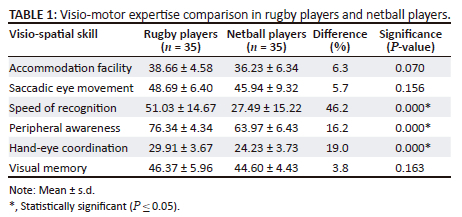
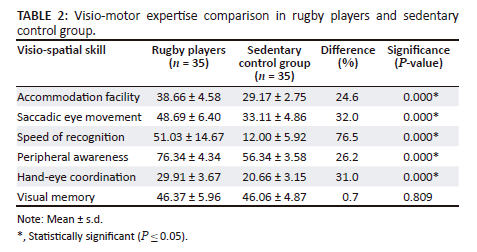
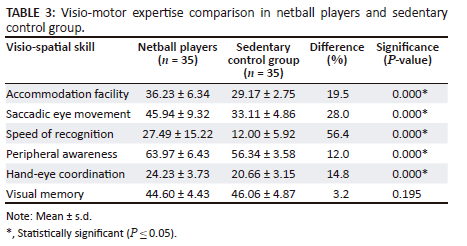
The findings showed that there was a significant difference (P ≤ 0.05) between rugby players and netball players in three of the six tests (Table 1). In terms of speed of recognition (P = 0.000), peripheral awareness (P = 0.000) and hand-eye coordination (P = 0.000), rugby players significantly outperformed netball players, but not in terms of accommodation facility (P = 0.070), saccadic eye movement (P = 0.156) and visual memory (P = 0.163). The findings showed that there was a significant difference (P ≤ 0.05) between rugby players and the sedentary control group in five of the six tests (Table 2). In terms of accommodation facility (P = 0.000), saccadic eye movement (P = 0.000), speed of recognition (P = 0.000), peripheral awareness (P = 0.000) and hand-eye coordination (P = 0.000), rugby players significantly outperformed the sedentary group, but not in terms of visual memory (P = 0.809). Furthermore, the findings showed that there was a significant difference (P ≤ 0.05) between netball players and the sedentary control group in five of the six tests (Table 3). In terms of accommodation facility (P = 0.000), saccadic eye movement (P = 0.000), speed of recognition (P = 0.000), peripheral awareness (P = 0.000) and hand-eye coordination (P = 0.000), netball players significantly outperformed the sedentary group, but not in terms of visual memory (P = 0.195).
According to a rank-ordered analysis, rugby players performed 46% faster at the speed of recognition than netball players, followed by 19% for hand-eye coordination and 16% for peripheral awareness (Table 1).
Rugby players performed 77% faster at the speed of recognition than the sedentary group, according to a rank-ordered analysis, followed by 32% for saccadic eye movement, 31% for hand-eye coordination, 26% for peripheral awareness and 25% for accommodation facilities (Table 2).
Netball players performed 56% faster at the speed of recognition than the sedentary group, according to a rank-ordered analysis, followed by 28% for saccadic eye movements, 20% for accommodation facilities, 15% for hand-eye coordination and 12% for peripheral awareness (Table 3).
Discussion
This study compared the VSI of male rugby players and female netball players using a battery of hand-eye coordination-specific visual tests. The six components of VSI assessed were accommodation facilities, saccadic eye movements, speed of recognition, peripheral awareness, hand-eye coordination and visual memory.
A statistical difference was found in accommodation facilities between rugby and netball players, with netball players demonstrating superior performance. This finding aligns with Agostini et al.,313233343536,37 Both rugby and netball players outperformed a sedentary control group in accommodation facilities, consistent with findings by Mathe et al.14253838
Rugby players also exhibited superior saccadic eye movements compared to netball players, this is controversial to the findings by Sargezeh et al.,394041,42 with high scores among females possibly because of effective instruction-following and extensive training.4344454647
Rugby players demonstrated a 46% faster speed of recognition than netball players, showing the greatest disparity. This finding supports McGivern et al.,484921505145526
Peripheral awareness also showed significant differences between rugby and netball players. This aligns with David et al.,53542155,56 Experienced soccer players also showed differences in peripheral vision compared to novices,575847
Rugby players demonstrated superior hand-eye coordination compared to netball players, aligning with Swathi et al.,59606119,62 Both rugby and netball players showed superior hand-eye coordination compared to the control group, supporting findings by Mathe et al.14 and contrasting with results for badminton players.6364
Finally, rugby players exhibited superior visual memory compared to netball players, which was controversial to other studies showing females have better visual memory post-concussion.65666768691470
Conclusion
The identified superiority of certain VSS within this study carries broad implications for theories of vision, test selection and the development of sport-specific VSS testing batteries. While confirming the hypothesis that athletes, particularly rugby and netball players, exhibit superior VSS compared to non-athletes, the study also revealed that this superiority does not extend to all aspects of VSS, such as visual memory. In addition, utilising a hand-eye coordination specific VSS test battery effectively differentiated between different sports, showing significant differences in three out of six VSS tests, with rugby players outperforming the netball players. However, this trend was not consistent across all VSS tests, suggesting that future research should explore the training methods employed by both sports, as these may account for the observed differences.
Competing interests
The authors declare that they have no financial or personal relationships that may have inappropriately influenced them in writing this article.
Authors' contributions
L.M., G.J.B. and N.M. contributed to the article equally and approved the submitted version.
Funding information
This research received no specific grant from any funding agency in the public, commercial or not-for-profit sectors.
Data availability
The authors confirm that the data supporting the findings of this study are available within the article.
Disclaimer
The views and opinions expressed in this article are those of the authors and are the product of professional research. The article does not necessarily reflect the official policy or position of any affiliated institution, funder, agency, or that of the publisher. The authors are responsible for this article's results, findings and content.
Acknowledgements
The authors would like to extend their gratitude to optometrist Graham Chrich, director of Nevada Cloud, for providing the Spectrum Eye Care Software to enable the optometric assessments.
References
- 1. Biswas SK, Paul M, Sandhu JS. Role of sports vision and eye hand coordination training in performance of table tennis players. Braz J Biom. 2011;5:106-116.
-
2. Du Toit PJ, Kruger PE, Mahomed AF, et al. The effect of sports vision exercises on the visual skills of university students science. Afr J Phys Health Educ Recreat Dance. 2011;17(3):429-440. https://doi.org/10.4314/ajpherd.v17i3.71094
» https://doi.org/10.4314/ajpherd.v17i3.71094 -
3. Nascimento H, Martinez-Perez C, Alvarez-Peregrina C, Sánchez-Tena MÁ. Citations network analysis of vision and sport. Int J Environ Res Public Health. 2020;17(20):7574. https://doi.org/10.3390/ijerph17207574
» https://doi.org/10.3390/ijerph17207574 -
4. Presta V, Vitale C, Ambrosini L, Gobbi G. Stereopsis in sports: Visual skills and visuomotor integration models in professional and non-professional athletes. Int J Environ Res Public Health. 2021;18:11281. https://doi.org/10.3390/ijerph182111281
» https://doi.org/10.3390/ijerph182111281 - 5. Erickson GB. Visual task analysis in sports. Sports vision: Vision care for the enhancement of sports performance. St. Louis, MO: Butterworth-Heinemann, 2007; p. 8-18.
-
6. Mathe N, Millard L, Breukelman G, Mathunjwa M. A review of the essential visual skills required for netball: Beyond 20-20 Optometry. Ann Appl Sport Sci. 2023;11:0-0. https://doi.org/10.21203/rs.3.rs-2175100/v1
» https://doi.org/10.21203/rs.3.rs-2175100/v1 - 7. Erickson GB. Sports vision: Vision care for the enhancement of sports performance. St. Louis, Missouri: Elsevier Health Sciences; 2020.
- 8. Starkes JL, Ericsson KA. Expert performance in sports: Advances in research on sport expertise. Florida: Human Kinetics; 2003.
- 9. Williams AM, Davids K, Williams JG. Visual perception and action in sport. New York: Taylor & Francis; 1999.
-
10. Alvarez GA, Franconeri SL. How many objects can you track?: Evidence for a resource-limited attentive tracking mechanism. J Vis. 2007;7(13):14. https://doi.org/10.1167/7.13.14
» https://doi.org/10.1167/7.13.14 -
11. Millard L, Breukelman GJ, Burger T, Nortje J, Schülz J. A review of the essential visual skills required for Rugby: Beyond 20-20 Optometry. 2022. https://doi.org/10.21203/rs.3.rs-2175100/v1
» https://doi.org/10.21203/rs.3.rs-2175100/v1 -
12. Du Toit PJ, Kruger PE, Joubert A, Lunsky J. Effects of exercise on the visual performance of female rugby players science. Afr J Phys Health Educ Recreat Dance. 2007;13(3):267-273. https://doi.org/10.4314/ajpherd.v13i3.24770
» https://doi.org/10.4314/ajpherd.v13i3.24770 - 13. Coker CA. Motor learning and control for practitioners. New York: Routledge; 2021.
-
14. Mathe N, Millard L, Breukelman GJ, Mathunjwa M. Differences in visio-spatial intelligence between non-athletes and netball players. Front Sports Act Living. 2023;023:5. https://doi.org/10.3389/fspor.2023.1109967
» https://doi.org/10.3389/fspor.2023.1109967 -
15. Applegate RA. Set shot shooting performance and visual acuity in basketball. Optom Vis Sci. 1992;69(10):765-768. https://doi.org/10.1097/00006324-199210000-00004
» https://doi.org/10.1097/00006324-199210000-00004 -
16. Millard L, Breukelman G, Nonkululeko M, Shaw I, Shaw B. A review of the essential visual skills required for soccer: Beyond 20-20 optometry. Front Sports Act Living. 2022;4:965195. https://doi.org/10.3389/fspor.2022.965195
» https://doi.org/10.3389/fspor.2022.965195 - 17. Wilson TA, Falkel J. Sportsvision: Training for better performance. Champaign, Illinois: Human Kinetics; 2004.
- 18. Halpern DF, Collaer ML. Sex differences in visuospatial abilities: More than meets the eye. New York: Cambridge University Press; 2005.
- 19. Kimura D. Sex and cognition. London: MIT Press; 2000.
-
20. Hromatko I, Butkovic A. Sensation seeking and spatial ability in athletes: An evolutionary account. J Hum Kinetics. 2009;21:5-13. https://doi.org/10.2478/v10078-09-0001-x
» https://doi.org/10.2478/v10078-09-0001-x -
21. Notanircola A, Maccagnano G, Pesce V, Tafuri S, Novielli G, Moretti B. Visual-spatial capacity: Gender and sport differences in young volleyball and tennis athletes and non-athletes. BMC Res Notes. 2014;7:57. https://doi.org/10.1186/1756-0500-7-57
» https://doi.org/10.1186/1756-0500-7-57 -
22. Lord TR, Garrison J. Comparing spatial abilities of collegiate athletes in different sports. Percept Mot Skills. 1998;86(3):1016-1018. https://doi.org/10.2466/pms.1998.86.3.1016
» https://doi.org/10.2466/pms.1998.86.3.1016 -
23. Vera J, Redondo B, Molina R, Koulieris GA, Jiménez R. Validation of an objective method for the qualitative and quantitative assessment of binocular accommodative facility. Curr Eye Res. 2020;45(5):636-644. https://doi.org/10.1080/02713683.2019.1688837
» https://doi.org/10.1080/02713683.2019.1688837 - 24. Radomski MV, Latham CA, editors. Occupational therapy for physical dysfunction. Baltimore: Lippincott Williams & Wilkins; 2008.
-
25. Millard L, Shaw I, Breukelman GJ, Shaw BS. Differences in visio-spatial expertise between 1st division rugby players and non-athletes. Heliyon. 2021;7:e06290. https://doi.org/10.1016/j.heliyon.2021.e06290
» https://doi.org/10.1016/j.heliyon.2021.e06290 - 26. Millard L. Impact of visual skills training on the visual ability of elite rugby players. Master's Thesis; 2016.
- 27. Dhote SA. Eye exercises-An eyesight rejuvenation therapy. World J Pharmaceutical Res SJIF Impact Factor. 2015;5:6.
-
28. Crawford TJ, Higham S, Renvoize T, et al. Inhibitory control of saccadic eye movements and cognitive impairment in Alzheimer's disease. Biol Psychiatry. 2005;57(9):1052-1060. https://doi.org/10.1016/j.biopsych.2005.01.017
» https://doi.org/10.1016/j.biopsych.2005.01.017 -
29. Crawford TJ, Smith ES, Berry DM. Eye gaze and aging: Selective and combined effects of working memory and inhibitory control. Front Hum Neurosci. 2017;11:563. https://doi.org/10.3389/fnhum.2017.00563
» https://doi.org/10.3389/fnhum.2017.00563 - 30. BATAK Pro Hardware operation. User's manual. Horley: Quotronics Limited; 2011.
-
31. Agostini V, Chiaramello E, Canavese L, Bredariol C, Knaflitz M. Postural sway in volleyball players. Hum Move Sci. 2013;32(3):445-456. https://doi.org/10.1016/j.humov.2013.01.002
» https://doi.org/10.1016/j.humov.2013.01.002 -
32. Muzaliha MN, Nurhamiza B, Hussein A, et al. Visual acuity and visual skills in Malaysian children with learning disabilities. Clin Ophthalmol. 2012:1527-1533. https://doi.org/10.2147/OPTH.S33270
» https://doi.org/10.2147/OPTH.S33270 -
33. Feng J, Spence I, Pratt J. Playing an action video game reduces gender differences in spatial cognition. Psychol Sci. 2007;18(10):850-855. https://doi.org/10.1111/j.1467-9280.2007.01990.x
» https://doi.org/10.1111/j.1467-9280.2007.01990.x -
34. Kempel P, Gohlke B, Klempau J, Zinsberger P, Reuter M, Hennig J. Second-to-fourth digit length, testosterone and spatial ability. Intelligence. 2005;33(3):215-230. https://doi.org/10.1016/j.intell.2004.11.004
» https://doi.org/10.1016/j.intell.2004.11.004 -
35. Luo Q, Sahakian BJ. Brain sex differences: The androgynous brain is advantageous for mental health and well-being. Neuropsychopharmacology. 2022;47:407-408. https://doi.org/10.1038/s41386-021-01141-z
» https://doi.org/10.1038/s41386-021-01141-z -
36. Roser ME, Fiser J, Aslin RN, Gazzaniga MS. Right hemisphere dominance in visual statistical learning. J Cogn Neurosci. 2011;23(5):1088-1099. https://doi.org/10.1162/jocn.2010.21508
» https://doi.org/10.1162/jocn.2010.21508 -
37. Bitan T, Lifshitz A, Breznitz Z, Booth JR. Bidirectional connectivity between hemispheres occurs at multiple levels in language processing but depends on sex. J Neurosci. 2010;30(35):11576-11585. https://doi.org/10.1523/JNEUROSCI.1245-10.2010
» https://doi.org/10.1523/JNEUROSCI.1245-10.2010 - 38. Omar R, Kuan YM, Zuhairi NA, Abd Manan F, Knight VF. Visual efficiency among teenaged athletes and non-athletes. Int J Ophthalmol. 2017;10:1460.
-
39. Sargezeh BA, Tavakoli N, Daliri MR. Gender-based eye movement differences in passive indoor picture viewing: An eye-tracking study. Physiol Behav. 2019;206:43-50. https://doi.org/10.1016/j.physbeh.2019.03.023
» https://doi.org/10.1016/j.physbeh.2019.03.023 -
40. Wilson SJ, Glue P, Ball D, Nutt DJ. Saccadic eye movement parameters in normal subjects. Electroencephalogr Clin Neurophysiol. 1993;86(1):69-74. https://doi.org/10.1016/0013-4694(93)90068-7
» https://doi.org/10.1016/0013-4694(93)90068-7 - 41. Halpern DF, Wai J, Saw A. A psychobiosocial model. Gender differences in mathematics. 2005; p. 48.
-
42. Tatara S, Toda H, Maeda F, Ito A, Handa T. Comparison of the Saccadic eye movement ability of female professional basketball players and non-athletes. Appl Sci. 2024;14:1108. https://doi.org/10.3390/app14031108.
» https://doi.org/10.3390/app14031108 -
43. Ackerman PL, Kanfer R, Goff M. Cognitive and noncognitive determinants and consequences of complex skill acquisition. J Exp Psychol. 1995;1:270. https://doi.org/10.1037/1076-898X.1.4.270
» https://doi.org/10.1037/1076-898X.1.4.270 -
44. Hussey KA, Hadyniak SE, Johnston Jr RJ. Patterning and development of photoreceptors in the human retina. Front Cell Dev Biol. 2022;10:878350. https://doi.org/10.3389/fcell.2022.878350
» https://doi.org/10.3389/fcell.2022.878350 -
45. Nakamoto H, Mori S. Sport-specific decision-making in a go/nogo reaction task: Difference among nonathletes and baseball and basketball players. Percept Motor Skills. 2008;106:163-170. https://doi.org/10.2466/pms.106.1.163-170
» https://doi.org/10.2466/pms.106.1.163-170 -
46. Nascimento H, Alvarez-Peregrina C, Martinez-Perez C, Sánchez-Tena MÁ. Differences in visuospatial expertise between skeet shooting athletes and non-athletes. Int J Environ Res Public Health. 2021;18:8147. https://doi.org/10.3390/ijerph18158147
» https://doi.org/10.3390/ijerph18158147 - 47. Maman P, Gaurang S, Sandhu JS. The effect of vision training on performance in tennis players. Serbian J Sports Sci. 2011;5:11-16.
-
48. McGivern RF, Adams B, Handa RJ, Pineda JA. Men and women exhibit a differential bias for processing movement versus objects. PLoS One. 2012;7:e32238. https://doi.org/10.1371/journal.pone.0032238
» https://doi.org/10.1371/journal.pone.0032238 -
49. Camarata S, Woodcock R. Sex differences in processing speed: Developmental effects in males and females. Intelligence. 2006;34:231-252. https://doi.org/10.1016/j.intell.2005.12.001
» https://doi.org/10.1016/j.intell.2005.12.001 -
50. Wrigley-Asante C, Ackah CG, Frimpong LK. Gender differences in academic performance of students studying Science Technology Engineering and Mathematics (STEM) subjects at the University of Ghana. SN Soc Sci. 2023;3:12. https://doi.org/10.1007/s43545-023-00608-8.
» https://doi.org/10.1007/s43545-023-00608-8 -
51. Yuan L, Kong F, Luo Y, Zeng S, Lan J, You X. Gender differences in large-scale and small-scale spatial ability: A systematic review based on behavioral and neuroimaging research. Front Behav Neurosci. 2019;13:128. https://doi.org/10.3389/fnbeh.2019.00128
» https://doi.org/10.3389/fnbeh.2019.00128 -
52. Mori S, Ohtani Y, Imanaka K. Reaction times and anticipatory skills of karate athletes. Hum Move Sci. 2002;21:213-230. https://doi.org/10.1016/S0167-9457(02)00103-3
» https://doi.org/10.1016/S0167-9457(02)00103-3 -
53. David SS, Foot HC, Chapman AJ. Children's sensitivity to traffic hazard in peripheral vision. Appl Cogn Psychol. 1990;4(6):471-484. https://doi.org/10.1002/acp.2350040606
» https://doi.org/10.1002/acp.2350040606 -
54. Adhilakshmi AP, Karthiga UK, John NA. Auditory and visual reaction time and peripheral field of vision in helmet users. J Bangladesh Soc Physiol. 2016;11(2):43-46. https://doi.org/10.3329/jbsp.v11i2.30648
» https://doi.org/10.3329/jbsp.v11i2.30648 - 55. Berenbaum SA, Martin CL, Ruble DN. Gender development. Child and adolescent development: An advanced course. Hoboken, NJ: John Wiley & Sons, Inc., 2008; p. 647-695.
-
56. McCormick CM, Teillon SM. Menstrual cycle variation in spatial ability: Relation to salivary cortisol levels. Hormones Behav. 2001;39(1):29-38. https://doi.org/10.1006/hbeh.2000.1636
» https://doi.org/10.1006/hbeh.2000.1636 -
57. Ando S, Kida N, Oda S. Central and peripheral visual reaction time of soccer players and nonathletes. Percept Motor Skills. 2001;92(3):786-794. https://doi.org/10.2466/pms.2001.92.3.786
» https://doi.org/10.2466/pms.2001.92.3.786 - 58. Ward P, Williams AM, Loran DF. The development of visual function in elite and sub-elite soccer players. Int J Sports Vis. 2000;6:1.
-
59. Swathi B, Srivastava S, Krishnaprasad KM. Gender difference in hand-eye coordination in young adults - A cross-sectional study. J Clin Diagnos Res. 2023;17:YC15-8. https://doi.org/10.7860/JCDR/2023/59208.17430
» https://doi.org/10.7860/JCDR/2023/59208.17430 -
60. Orhan İ, Aktop A, Pekaydın Y. An investigation of hand-eye coordination, attention, balance and motor skill in school children. Eur Proceed Soc Behav Sci. 2018. https://doi.org/10.15405/epsbs.2018.06.02.2
» https://doi.org/10.15405/epsbs.2018.06.02.2 - 61. Buss D. Evolutionary psychology: The new science of the mind. New York: Routledge; 2019.
-
62. Vlachos F, Andreou G, Andreou E. Biological and environmental influences in visuospatial abilities. Learn Individ Differ. 2003;13(4):339-347. https://doi.org/10.1016/S1041-6080(03)00014-1
» https://doi.org/10.1016/S1041-6080(03)00014-1 -
63. Wong TKK, Ma AWW, Liu KPY, et al. Balance control, agility, eye-hand coordination, and sport performance of amateur badminton players: A cross-sectional study. Medicine. 2019;98:e14134. https://doi.org/10.1097/MD.0000000000014134
» https://doi.org/10.1097/MD.0000000000014134 -
64. Akarsu S, Çalişkan E, Dane Ş. Athletes have faster eye-hand visual reaction times and higher scores on visuospatial intelligence than nonathletes. Turkish J Med Sci. 2009;39(6):871-874. https://doi.org/10.3906/sag-0809-44
» https://doi.org/10.3906/sag-0809-44 -
65. Sicard V, Moore RD, Ellemberg D. Long-term cognitive outcomes in male and female athletes following sport-related concussions. Int J Psychophysiol. 2018;132(Part A):3-8. https://doi.org/10.1016/j.ijpsycho.2018.03.011
» https://doi.org/10.1016/j.ijpsycho.2018.03.011 -
66. Brooks BL, Silverberg N, Maxwell B, et al. Investigating effects of sex differences and prior concussions on symptom reporting and cognition among adolescent soccer players. Am J Sports Med. 2018;46(4):961-968. https://doi.org/10.1177/0363546517749588
» https://doi.org/10.1177/0363546517749588 - 67. Barton KA. The effect of mental imagery on sport climbing performance of college students. University of West London Theses; 1996.
- 68. Peschke JG. A case study of teaching and learning mathematics online. Edmonton, Alberta: University of Alberta (Canada); 2014.
-
69. Tomczyk CP, Mormile M, Wittenberg MS, Langdon JL, Hunt TN. An examination of adolescent athletes and nonathletes on baseline neuropsychological test scores. J Athl Train. 2018;53(4):404-409. https://doi.org/10.4085/1062-6050-84-17
» https://doi.org/10.4085/1062-6050-84-17 - 70. Ceciliani A. Elementi di didattica degli giochi sportive: l'allievo e lo spazio-tempo. SdS/Rivista di Cultura Sportive. 2005;XXIII:61-68.

Accepted: 07 Oct. 2024
Published: 08 Nov. 2024