Spectacle lens and contact lens recycling in South Africa
Abstract
BACKGROUND: The increase in global plastic waste generation poses a threat to human, animal and plant life. As such, industries world-wide are encouraged to review waste management systems to prevent, minimise, recycle or recover plastic waste. There is a paucity of information on plastic waste generation by the local optical industry in South Africa, especially with respect to spectacle lens and contact lens recycling. AIM: The purpose of this review article was to provide a current outlook on spectacle lens and contact lens recycling in South Africa. METHODS: Literature review of scientific papers from online databases, websites and lens material patents. RESULTS: No studies regarding lens recycling in South Africa were found. However, data for this review were collated based on lens constituent materials. CONCLUSION: This review article provided an overview of lens recycling, identified the barriers and potential measures to advance plastic spectacle lens and contact lens recycling in South Africa, and suggested controlled energy recovery as an alternative pending implementation of lens recycling programmes. CONTRIBUTION: This paper contributes useful information on a previously unexplored aspect of recycling in South Africa. Ophthalmic lens recycling is currently not available in South Africa, and as such, this review focuses on the current outlook, barriers and considerations for implementation of such programmes.
spectacle lenses; contact lenses; recycling; waste management; plastic waste
Introduction
Spectacles and contact lenses are vision-corrective devices that are in common use. It is anticipated that an ageing population along with the predicted increase in myopia will result in a consequent increased demand for vision correction.1,2334
It is predicted that plastics could take centuries to decompose under natural environmental conditions.5678,9,10,113
Methods
A search was conducted on various online databases, such as EBSCOhost, Google Scholar, ScienceDirect and PubMed for scientific articles using the following keywords and phrases: 'disposal and recycling of spectacle lenses' and 'disposal and recycling of contact lenses'. Because of the paucity of scientific papers on this topic, an expanded search was conducted incorporating the lens material classification in terms of thermoset, thermoplastic and hydrogel. Sixty resources, including articles, websites and patent literature, were selected for use.
The findings of the literature search are presented with a brief description on the use, disposal and recycling of plastic waste followed by the chemistry of spectacle and contact lenses as pertaining to current recycling processes. The barriers to lens recycling and measures to promote lens recycling in SA conclude this review.
Plastic materials: Use and disposal
Plastic materials are used extensively because of their versatile properties that can be adapted for various applications. Some of their characteristics include being lightweight, durable, easily processed, can be mass produced, transparent and yet also easy to dye, corrosion-free with electrical and heat insulation properties.121213
Global waste generation is projected to increase by 69% between 2016 and 2050, mainly attributed to the growth in global population, urbanisation and affluence.1413156
Conventional plastics have poor degradation capacity and may take many centuries to decompose naturally.51661617
Recycling of plastic waste
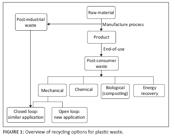
A waste management hierarchy has been advocated to restrict waste volumes.661812192016,21Figure 1.
Chemistry of plastic spectacle lenses and contact lenses
Spectacle lenses and contact lenses were traditionally manufactured from glass until the introduction of synthetic plastic materials in the form of poly(methyl methacrylate) (PMMA) in the 1930s.2222
Plastics are made of many repeating units known as monomers.12,1712,1721211212,17
Spectacle lenses and contact lenses have an array of chemical constituents which may be summarised as follows:
•Thermoset spectacle lenses comprise the low, mid- and high index lenses (1.49 to 1.60 index) which have a common constituent monomer in diethylene glycol bis(allyl carbonate).232412
•Thermoplastic spectacle lenses include impact resistant lenses such as polycarbonate (1.59 index) while Trivex (1.53 index) is considered quasi-thermoset, having properties of both thermoset and thermoplastic materials. Polycarbonate may be synthesised from dimethacrylates of BPA2526
•Contact lenses are classified as being either hard (water content less than 10% by weight) or soft (water content greater than 10% by weight).27282929
Additives may be incorporated as processing aids into the spectacle lens and contact lens matrix, such as thermal stabilisers and mould release agents.23,24,2523,24,25,26
Recycling of plastic spectacle lenses and contact lenses
The literature search did not provide scientific papers on the recycling of spectacle lenses or contact lenses; therefore, the recycling processes described in the next section were based on the recycling of thermoset, thermoplastic and hydrogel materials.
Thermoset materials
The low, mid- and high index lenses, dummy lenses used in unglazed spectacle frames, and lenses from ready-made reading spectacles have thermoset properties:
•Thermosets are considered non-recyclable because of their inherent rigid cross-linked polymer network; therefore, to reduce thermoset waste entering landfills, thermosets can be ground into fine powder and used as a filler in new polymers.1212303132
•Investigations have been conducted on methods to convert thermoset materials into 'vitrimers'.3333,3433,34
Thermoplastic materials
The impact resistant lenses and PMMA contact lenses have thermoplastic properties. The lack of a permanent cross-linked matrix allows thermoplastics to be reprocessed:12
•Polycarbonate lenses may be synthesised from BPA and phosgene along with methyl methacrylate (MMA) derivatives.2525,28353535
•Poly(methyl methacrylate) is an ideal lens material as it provides desired optical properties, such as transparency and good mechanical strength.28282812,36
Hydrogels
Hydrogels rose to prominence from seminal work on contact lens materials by scientists3738383944041
Current outlook on lens recycling
There is currently a lack of dedicated recycling programmes for spectacle lenses and contact lenses in SA. An international lens manufacturer based in SA has indicated that they have the technology to recycle polycarbonate material (Clark M, 2019, personal communication, July 2). An optical group in the US has initiated collection and recycling of lenses to make safety glasses, scuba masks and shields for motorcycle helmets.89,10,11
Barriers to lens recycling in South Africa
Several barriers have been identified that may hamper prospective lens collection and recycling efforts in SA. These include:
•The lack of awareness regarding whether spectacle lens materials can be recycled successfully which may result in disinterest in lens collection schemes. Anecdotal evidence from eye care practitioners suggests that they are uncertain about the recycling of lenses, and that unwanted lenses are typically discarded as waste. These lenses are then diverted to landfills. South Africa has a large informal waste collection community that depends on the income received from the sale of waste plastics.4243
•The heterogeneity of lenses poses a collection problem as the lenses could have thermoset or thermoplastic properties, which affect the recycling process, especially with thermosets being a challenge to recycle at present. Therefore, there is a need to sort and separate the various lenses to achieve the best material value from recycling processes.43
•The collected spectacle lenses would require manual sorting which is a labour-intensive process and incurs additional costs.12
•Without dedicated and sustained collection efforts, there will be small volumes of lenses available for recycling. This will not be economically viable to the materials reprocessing facility (MRF) especially when considering the volume of water and energy required for profitable recycling. In addition, a comparison of the cost of recycling lenses as opposed to landfilling will determine whether it would be feasible to collect lenses for recycling or dispose of them instead. At present, landfilling is the cheapest and, unfortunately, preferred option in SA.44
•There is a need for new technology and facilities to recycle the various types of lens materials. Some materials such as polycarbonate may have smaller market share and may require specific recycling processes and technology.4543
•A further consideration is the market demand for lens recyclates.12,451221
•A well-planned and dedicated system of lens collection is required, involving eye care practitioners, optical laboratories, and lens wearers in SA. Lens wearers may purchase lenses from any number of eye care practitioners who in turn may purchase frames and lenses from a range of lens suppliers and optical laboratories. It would not be practical or cost-efficient to return lenses that are unwanted or at end-of-use to the supplier or laboratory that originally provided the lens. A lens wearer who purchases spectacles on average every two years3
•Thermoplastic materials may be recovered through chemical recycling. These methods are still being investigated on a small-scale and are energy-intensive processes and require solvents that are expensive.201843
•Spectacle lenses have high calorific values, comparable to that of coal. Calorific value describes the amount of energy released upon combustion in oxygen.46471712,1812,32Carbon Tax Act (Act 15 of 2019) imposes additional taxes on MRF that generate or recover heat or energy from waste.48
Implications of and measures to promote lens recycling in South Africa
The above sections provided details on the challenges and barriers to lens recycling in SA, and considering that waste systems in SA reported to be at least two to three decades behind that of developed regions,42
• Concerned eye care practitioners and optical suppliers can engage with their local MRF or organisations such as Plastics SA regarding facilities in SA that may have the capacity to recycle lens materials. Trial runs may be conducted to assess if lens recycling is achievable with locally available technology as well as to assess the type of recyclate achieved, the market demand for such recyclate and the potential for long term success. A further consideration is whether market-leading international lens suppliers based in SA would be willing to import and share technical recycling knowledge and skills to develop such facilities in SA and invest in local research and development. Widespread use of technical advancements in recycling will eventually result in lower recycling costs and close the gap in price between recyclates and virgin materials thus creating a market demand for recyclates.21
• If lens recycling trial runs are successful, it will be essential to create and sustain awareness of lens recycling. Studies have shown that for recycling programmes to be effective, clear and concise information should be provided on how the programme works and what participants would need to do.4945,4945
• A central collection point for all lens waste may be more economically feasible. Eye care practitioners and laboratories could collect unwanted lenses and forward to this central facility for recycling. Additional costs, however, will be incurred through the transportation and storage of waste plastic. This cost could be met by the Extended Producer Responsibility (EPR) regulation that was recently gazetted in SA.5050
•Research should be conducted into the use of compatibilisers17,353551
• Creation of an end market for lens recyclates would encourage lens recycling.12,36,4512,36,454343,4543434343
• Considering that SA is a developing economy, funds may not be available to develop chemical recycling facilities. However, it is still essential to divert lens waste from landfills, and the next preferred option after recycling in the waste hierarchy is incineration with energy recovery. The high calorific values of lenses47525312,32
• Education and awareness campaigns regarding lens recycling would be vital to ensure sustained volumes of collected lenses. This requires buy-in from all interested parties in the recycling and eye care industries. In addition, the perception that recycled materials are of inferior quality needs to be addressed and the public needs to be assured of the safety of recyclates. This may help with wider acceptance of recycled material and improve plastic waste collection schemes.12
Industry perspective on lens recycling
Reports from the optical industry suggest that attaining a sustainable cost-effective recycling model may be challenging as mixed post-industrial ophthalmic lens waste is expensive to collect, transport and recycle.5454,55515657
Current trials and patent literature describe the synthesis of mid-index spectacle lenses, dummy lenses and hydrogels from plant-derived materials, namely, corn and soy proteins.58,59,6058
Summary
Waste management policies will only be effective if citizens and organisations modify disposal behaviours and embrace recycling ethos.45,49
Conclusion
This review article presented the current outlook of spectacle lens and contact lens recycling in SA. At present, ophthalmic lens recycling is not available, and the barriers to lens recycling were identified and potential measures towards developing a lens recycling ethos were described. Ophthalmic lens manufacturers, lens distributors, eye care providers and lens wearers should be encouraged to adopt measures to prevent and reduce ophthalmic lens waste. Potential solutions include redesign towards biodegradable lens materials, and energy-efficient manufacturing processes while upholding the circular economy model in each step of the lens lifecycle. The lack of lens recycling technology and facilities is a significant barrier in SA, and requires further research and investment. In the absence of recycling, unwanted ophthalmic lenses may be useful in controlled energy recovery processes thereby offering a two-fold advantage of reducing plastic waste to landfill and providing an alternative to coal as a fuel source. This review suggests that a collective effort by all interested parties is required to implement and sustain ophthalmic lens recycling initiatives in SA.
Competing interests
The authors declare that they have no financial or personal relationships that may have inappropriately influenced them in writing this article.
Authors' contributions
All authors were involved in the conceptualisation and methodology of the article. R.P. completed the literature search and drafted the research article. R.H. and N.R. were involved in review and editing of the article to the final version.
Ethical considerations
This study received ethical approval by the University of KwaZulu-Natal Humanities and Social Sciences Research Ethics Committee (HSS/1649/018D).
Funding information
This research received no specific grant from any funding agency in the public, commercial, or not-for-profit sectors.
Data availability
Data sharing is not applicable to this article, as no new data were created or analysed in this study.
Disclaimer
The views and opinions expressed in this article are those of the authors and do not necessarily reflect the official policy or position of any affiliated agency of the authors.
References
Acknowledgements
Literature review
-
1.Euromonitor International Passport. Eyewear: Ageing population and its impact on eyewear [homepage on the internet]. Euromonitor; 2020 [cited 2022 Apr 18]. Available from: https://www.euromonitor.com/ageing-population-and-its-impact-on-eyewear/report
» https://www.euromonitor.com/ageing-population-and-its-impact-on-eyewear/report -
2.Holden BA, Fricke TR, Wilson DA, et al. Global prevalence of myopia and high myopia and temporal trends from 2000 through 2050. Ophthalmology. 2016;123(5):1036-1042. https://doi.org/10.1016/j.ophtha.2016.01.006
» https://doi.org/10.1016/j.ophtha.2016.01.006 -
3.Hansraj R, Govender B, Joosab M, Magubane S, Rawat Z, Bissessur A. Spectacle frames: Disposal practices, biodegradability and biocompatibility - A pilot study. Afr Vision Eye Health. 2021;80(1):a621. https://doi.org/10.4102/aveh.v80i1.621
» https://doi.org/10.4102/aveh.v80i1.621 -
4.Rolsky C, Kelkar VP, Halden RU. Nationwide mass inventory and degradation assessment of plastic contact lenses in US wastewater. Environ Sci Technol. 2020;54:12102. https://doi.org/10.1021/acs.est.0c03121
» https://doi.org/10.1021/acs.est.0c03121 -
5.Barnes DKA, Galgani F, Thompson RC, Barlaz M. Accumulation and fragmentation of plastic debris in global environments. Phil Trans R Soc B. 2009;364(1526):1985-1998. https://doi.org/10.1098/rstb.2008.0205
» https://doi.org/10.1098/rstb.2008.0205 - 6.United Nations Environment Programme. Global waste management outlook. Nairobi: United Nations Environment Programme; 2015.
-
7.Smith SL, Orsborn GN, Sulley A, Chatterjee NB, Morgan PB. An investigation into disposal and recycling options for daily disposable and monthly replacement soft contact lens modalities. Cont Lens Anterior Eye. 2022;45(2):101435. https://doi.org/10.1016/j.clae.2021.03.002
» https://doi.org/10.1016/j.clae.2021.03.002 -
8.Eyecare Business. Plastic lens recycling program expands to labs [homepage on the Internet]. Eyecare Business; 2019 [cited 2022 Apr 18]. Available from: https://www.eyecarebusiness.com/news/2019/plastic-lens-recycling-program-expands-to-labs
» https://www.eyecarebusiness.com/news/2019/plastic-lens-recycling-program-expands-to-labs -
9.Terracycle. Bausch + Lomb ONE by ONE free recycling program [homepage on the Internet]. Terracycle; 2019 [cited 2022 Apr 18]. Available from: https://www.terracycle.com/en-US/brigades/bauschrecycles
» https://www.terracycle.com/en-US/brigades/bauschrecycles -
10.Terracycle. The ACUVUE® contact lens free recycling programme [homepage on the Internet]. Terracycle; 2019 [cited 2022 Apr 18]. Available from: https://www.terracycle.com/en-GB/brigades/acuvue#@54.39586446195522:-2.83447377734376zoom:6
» https://www.terracycle.com/en-GB/brigades/acuvue#@54.39586446195522:-2.83447377734376zoom:6 -
11.CooperVision. CooperVision launches soft contact lens recycling program for all brands in Sweden [homepage on the Internet]. CooperVision; 2019 [cited 2022 Apr 18]. Available from: https://coopervision.com/our-company/news-center/press-release/coopervision-launches-soft-contact-lens-recycling-program-all
» https://coopervision.com/our-company/news-center/press-release/coopervision-launches-soft-contact-lens-recycling-program-all - 12.Goodship V. Recycling issues in polymer matrix composites. In: Robinson P, Greenhalgh E, Pinho S, editors. Failure mechanisms in polymer matrix composites. Oxford: Woodhead Publishing; 2012: p. 337-367.
-
13.Geyer R, Jambeck JR, Law KL. Production, use, and fate of all plastics ever made. Sci Adv. 2017;3(7):e1700782. https://doi.org/10.1126/sciadv.1700782
» https://doi.org/10.1126/sciadv.1700782 - 14.Kaza S, Yao L, Bhada-Tata P, Van Woerden F. What a waste 2.0: A global snapshot of solid waste management to 2050. Urban Development Series. Washington, DC: World Bank; 2018.
- 15.Geyer R. A brief history of plastics. In: Streit-Bianchi M, Cimadevila M, Trettnak W, editors. Mare plasticum - The plastic sea. Combatting plastic pollution through science and art. Cham, Switzerland: Springer Nature; 2020: p. 31-47.
-
16.Hopewell J, Dvorak R, Kosior E. Plastics recycling: Challenges and opportunities. Phil Trans R Soc B. 2009;364(1526):2115-2126. https://doi.org/10.1098/rstb.2008.0311
» https://doi.org/10.1098/rstb.2008.0311 - 17.Andrady AL, editor. Plastics and the environment. Hoboken, New Jersey: John Wiley & Sons, 2003.
- 18.Worrell E, Reuter MA. Handbook of recycling: State-of-the-art for practitioners, analysts, and scientists. Oxford: Elsevier; 2014.
- 19.Francis R. Recycling of polymers: Methods, characterization and applications. Weinheim: Wiley-VCH Verlag; 2017.
- 20.Rudolph N, Kiesel R, Aumnate C. Understanding plastics recycling. Munich: Carl Hanser Verlag; 2020.
- 21.Kulkarni GS. Introduction to polymer and their recycling techniques. In: Thomas S, Rane AV, Kanny K, Abitha VK, Thomas MG, editors. Recycling of polyurethane foams. Oxford: Elsevier; 2018: p. 1-16.
-
22.Bruneni J. More than meets the eye. The story behind the development of plastic lenses [homepage on the Internet]. PPG Optical; 1997 [cited 2019 May 22]. Available from: http://www.ppgoptical.com/getmedia/47e39594-6472-48e7-8e2c-8f48015284c8/CR39_50years_booklet.pdf
» http://www.ppgoptical.com/getmedia/47e39594-6472-48e7-8e2c-8f48015284c8/CR39_50years_booklet.pdf - 23.Dyball CJ, inventor, Arkema Inc., assignee. Diethylene glycol bis(allyl carbonate) compositions containing crosslinkable copolymers. United States patent. US4217433A. 1980 Aug 12.
- 24.Yean L, Bochu C, inventors, EssilorLuxottica SA, assignee. Polymer compositions based on polythiourethanes for the manufacture of organic glasses. United States patent. US5310847A. 1994 May 10.
- 25.Kato N, Hirakawa M, Motoi T, Kitamura M, inventors, Mitsubishi Gas Chemical Company, Inc., assignee. Polycarbonate resin and optical lens. United States patent. US20170276837A1. 2017 Sep 28.
- 26.Kumar A, Foller PC, inventors, Transitions Optical Inc., PPG Industries Ohio Inc., assignees. Polarizing devices and methods of making the same. United States patent US7044599B2. 2006 May 16.
- 27.Gasson A, Morris J. The contact lens manual. 3rd ed. Edinburgh: Butterworth-Heinemann; 2003.
- 28.Ullmann F. Ullmann's encyclopedia of industrial chemistry. 7th ed. Weinheim, Germany: Wiley-VCH; 2011.
- 29.Efron N, editor. Contact lens practice. 3rd ed. Edinburgh: Elsevier; 2018.
- 30.Liangcheng X, Xinping X, Weibin G, Libo M, Shanshan L, Ziying W, inventors, Changzhou Xiaoguo Information Services Co., Ltd, assignee. Recycling method of thermosetting resin lens waste. Chinese Patent CN103483620A. 2016 Jan 20.
-
31.Polymer Properties Database. Allyl diglycol carbonate (ADC) [homepage on the Internet]. Polymer Properties Database; 2012 [cited 2022 Jan 19] Available from: http://www.polymerdatabase.com/Polymer%20Brands/ADC.html
» http://www.polymerdatabase.com/Polymer%20Brands/ADC.html -
32.World Economic Forum, Ellen MacArthur Foundation, McKinsey and Company. The new plastics economy - Rethinking the future of plastics [homepage on the Internet]. WEF, EMF; 2016 [cited 2019 May 22]. Available from: http://www.ellenmacarthurfoundation.org/publications
» http://www.ellenmacarthurfoundation.org/publications -
33.Yue L, Bonab VS, Yuan D, Patel A, Karimkhani V, Manas-Zloczower I. Vitrimerization: A novel concept to reprocess and recycle thermoset waste via dynamic chemistry. Glob Chall. 2019;3(7):1800076. https://doi.org/10.1002/gch2.201800076
» https://doi.org/10.1002/gch2.201800076 -
34.Zheng J, Png ZM, Ng SH, et al. Vitrimers: Current research trends and their emerging applications. Mater Today. 2021;51:586-625. https://doi.org/10.1016/j.mattod.2021.07.003
» https://doi.org/10.1016/j.mattod.2021.07.003 -
35.Bhogle CS, Pandit AB. Ultrasound assisted methanolysis of polycarbonate at room temperature. Ultrason Sonochem. 2019;58:104667. https://doi.org/10.1016/j.ultsonch.2019.104667
» https://doi.org/10.1016/j.ultsonch.2019.104667 -
36.Godiyaa CB, Gabriellia S, Materazzib S, Pianesic MS, Stefaninia N, Marcantonia E. Depolymerization of waste poly(methyl methacrylate) scraps and purification of depolymerized products. J Environ Manage. 2019;231:1012-1020. https://doi.org/10.1016/j.jenvman.2018.10.116
» https://doi.org/10.1016/j.jenvman.2018.10.116 -
37.Wichterle O, Lim D. Hydrophilic gels for biological use. Nature. 1960;185(4706):117-118. https://doi.org/10.1038/185117a0
» https://doi.org/10.1038/185117a0 -
38.Turioni C, Guerrini G, Squartini A, Morari F, Maggini M, Gross S. Biodegradable hydrogels: Evaluation of degradation as a function of synthesis parameters and environmental conditions. Soil Syst. 2021;5(3):47. https://doi.org/10.3390/soilsystems5030047
» https://doi.org/10.3390/soilsystems5030047 - 39.Nikolić LB, Zdravković AS, Nikolić VD, Ilić-Stojanović SS. Synthetic hydrogels and their impact on health and environment. In: Mondal IH, editor. Cellulose-based superabsorbent hydrogels. Cham, Switzerland: Springer Nature AG; 2019: p. 1-29.
-
40.Charlet A, Hirsch M, Schreiber S, Amstad E. Recycling of load-bearing 3D printable double network granular hydrogels. Small. 2022;18(12):2107128. https://doi.org/10.1002/smll.202107128
» https://doi.org/10.1002/smll.202107128 -
41.Li Y, Yang HY, Lee DS. Advances in biodegradable and injectable hydrogels for biomedical applications. J Control Release. 2021;330:151-160. https://doi.org/10.1016/j.jconrel.2020.12.008
» https://doi.org/10.1016/j.jconrel.2020.12.008 -
42.Godfrey L, Oelofse S. Historical review of waste management and recycling in South Africa. Resources. 2017;6(4):57. https://doi.org/10.3390/resources6040057
» https://doi.org/10.3390/resources6040057 - 43.OECD. Improving markets for recycled plastics: Trends, prospects and policy responses. Paris: OECD Publishing; 2018.
- 44.Nahman A. Incentives for municipalities to divert waste from landfill in South Africa. Waste research development and innovation roadmap research report. Pretoria: Council for Scientific and Industrial Research; 2021.
-
45.Ignatyev IA, Thielemans W, Vander Beke B. Recycling of polymers: A review. ChemSusChem. 2014;7(6):1579-1593. https://doi.org/10.1002/cssc.201300898
» https://doi.org/10.1002/cssc.201300898 - 46.Núñez Regueira L. Bomb calorimeter. In: Cleveland CJ, Morris C, editors. Dictionary of energy. 2nd ed. Oxford: Elsevier; 2015: p. 67.
-
47.Pillay R, Hansraj R, Rampersad N, Bissessur A. Environmental impact and end-of-life options of disposed polymeric spectacle and contact lenses. Afr Vision Eye Health. 2023;82(1), a775. https://doi.org/10.4102/aveh.v82i1.775
» https://doi.org/10.4102/aveh.v82i1.775 - 48.RSA. Carbon Tax Act 15 of 2019. Pretoria: Government Printer; 2019.
-
49.Conke LS. Barriers to waste recycling development: Evidence from Brazil. Resour Conserv Recycl. 2018;134(1):129-135. https://doi.org/10.1016/j.resconrec.2018.03.007
» https://doi.org/10.1016/j.resconrec.2018.03.007 - 50.DFFE. National Environmental Management: Waste Act, 2008 (Act No 59 of 2008) Amendment of the regulations and notices regarding extended producer responsibility. Pretoria: Department of Forestry, Fisheries and the Environment; 2021.
-
51.Pillay R, Rampersad N, Hansraj R. Freight-related greenhouse gas emissions in the supply of spectacles and contact lenses. Afr Vision Eye Health. 2021;80(1):a619. https://doi.org/10.4102/aveh.v80i1.619
» https://doi.org/10.4102/aveh.v80i1.619 -
52.Fountain Green Energy. New horizons waste to energy [homepage on the Internet]. FGE; 2017. Available from: http://www.fge.co.za/project/a-large-waste-to-energy-plant/
» http://www.fge.co.za/project/a-large-waste-to-energy-plant/ -
53.Smit S. More money won't end Eskom's load-shedding woes. Mail and Guardian [newspaper online]. 2022 Mar 11 [cited 2022 Apr 20]. Available from: https://mg.co.za/news/2022-03-11-more-money-wont-end-eskoms-load-shedding-woes/
» https://mg.co.za/news/2022-03-11-more-money-wont-end-eskoms-load-shedding-woes/ -
54.The Vision Council. Optical manufacturing solutions. Bazell Technologies Corporation. COLA Meeting 29 April 2016 [homepage on the Internet]. The Vision Council; 2016 [cited 2022 Apr 18]. Available from: https://www.thevisioncouncil.org/sites/default/files/Swarf%20Panel%20-%20Phil%20Bazell.pdf
» https://www.thevisioncouncil.org/sites/default/files/Swarf%20Panel%20-%20Phil%20Bazell.pdf - 55.Chiu H, Jallouli A, Shan H, inventors, Essilor International, assignee. Method for making optical lenses using 3D printed functional wafers. European patent. EP3760423A1. 2021 Jan 6.
- 56.Su L, Feng WM, Ruoyi W, et al, inventors, Yueyang Hospital of Integrated Traditional Chinese and Western Medicine Shanghai University of TCM, assignee. 3D contact lens printing method. Chinese patent. CN104827671A. 2015 Aug 12.
-
57.Mikula K, Skrzypczak D, Izydorczyk G, et al. 3D printing filament as a second life of waste plastics - A review. Environ Sci Pollut Res. 2021;28(10):12321-12333. https://doi.org/10.1007/s11356-020-10657-8
» https://doi.org/10.1007/s11356-020-10657-8 -
58.SBIR. Novol, Inc. Corn based chemistries for making renewable optical polymers [homepage on the Internet]. SBIR; 2019 [cited 2022 Apr 18]. Available from: https://www.sbir.gov/sbirsearch/detail/1548671
» https://www.sbir.gov/sbirsearch/detail/1548671 - 59.Yamanaka K, Kushida K, Ueda T, inventors, Arukee, Toray Ind Inc., assignees. Dummy lens for eyeglass. Japanese patent JP2010197761A. 2010 Sep 9.
-
60.Dorishetty P, Balu R, Sreekumar A, et al. Robust and tunable hybrid hydrogels from photo-cross-linked soy protein isolate and regenerated silk fibroin. ACS Sustainable Chem Eng. 2019;7(10):9257-9271. https://doi.org/10.1021/acssuschemeng.9b00147
» https://doi.org/10.1021/acssuschemeng.9b00147

Accepted: 30 Nov. 2022
Published: 21 June 2023