Keratoconus in the West Region of Cameroon: Stakeholder knowledge and management
Abstract
BACKGROUND: Adequate knowledge and skills by eyecare personnel and administrators are essential for the early diagnosis and prompt management of keratoconus (KC AIM: This study aimed to determine the knowledge and skills of key stakeholders on KC management in eyecare facilities of Bafoussam, West Region of Cameroon SETTING: Eyecare facilities in the West Region of Cameroon METHODS: A qualitative study, using a purposive (non-probability) sampling technique, was applied to collect data relevant to this study. In-depth interviews were used to collect data from eyecare personnel and administrators. Eyecare personnel in this study comprised optometrists, ophthalmic nurses and optometric technicians, who are trained to World Council of Optometry (WCO) competency level one or two. There were no ophthalmologists working at the study sites. Data obtained were captured, de-identified and stored in a password-protected electronic file. Data were coded and analysed applying a deductive thematic analysis approach RESULTS: There were 21 participants (five administrators and 16 eyecare professionals) from five facilities. Fourteen (66.6%) were males; 10 (47.6%) had 11-20 years of work experience. The majority of the participants had limited or no knowledge of KC. They reported an undersupply of KC diagnostic equipment and consumables at facilities, resulting in poor diagnosis and management of KC patients CONCLUSION: The study revealed inadequate knowledge, training and skills of eyecare practitioners and administrators on KC. Deficiencies in KC diagnosis and management could cause visual impairment with a potential negative impact on the quality of life (QoL) of KC patients CONTRIBUTION: This study illustrates the need to procure basic equipment, capacitate eyecare workers with knowledge of KC and establish standard clinical protocols for the diagnosis and management of KC, including referral pathways
keratoconus; keratoconic management; eye-health personnel; Cameroon; stakeholders knowledge
Introduction
Keratoconus (KC) is a chronic continuous, conjoined ocular, non-inflammatory abnormality of the front part of the eye called cornea, marked by unsymmetrical corneal degeneration, producing a conical shape.11,22,3
Worldwide, KC is a primary reason for transparent-eye-surface vision loss in youths, as the disease is mostly prevalent among young people, especially in nations with well-known high prevalence.1,24,54,566
The reported risk factors associated with KC include age, gender, eye rubbing, allergic experiences, uncorrected refractive error, genetics, consanguinity and parental education levels.2,7,8910
The management of KC differs according to its severity, with spectacle interventions being utilised in the early stages of the disease. Soft and rigid gas permeable (RGP) contact lenses (CLs) are essential in the management of the disease for mild to moderate stages, while surgical intervention is generally necessary for the severe stages of KC.1165
Methods
This qualitative, transverse, phenomenal research was undertaken in Bafoussam, the Western Region of Cameroon from June 2021 to October 2021. Bafoussam, with a population of about 465 000, lies at approximately 1500 m above sea level.12
The first part covered socio-demographic determinants, while the second part comprised questions on the participants' knowledge and experience of KC, available facilities and resources and protocols applied for the diagnosis and management of KC. Before data collection, a semi-structured, open-ended interview questionnaire with probe questions was tested and validated. An audio recorder was used to record the interviews. Recordings were transcribed, de-identified and stored electronically in password-protected files. Transcripts from the in-depth interviews were analysed utilising a deductive thematic review method. Data were coded, and themes were developed, forming the basis of the analysis. Common statements were collated and reported in narratives, and specific individual participant statements were presented as quotes to substantiate the views expressed.
Ethical approval
Ethical clearance was obtained from the Biomedical Research Ethics Committee (BREC) of UKZN, Durban-South Africa (BREC/00000906/2019), the CAMBIN-ERCC, Yaounde-Cameroon (CBI/456/ERCC/CAMBIN), and written permissions were obtained from overseeing authorities at the various research sites. The research interviewees were dealt with as per the tenets of the Helsinki Declaration involving human subjects. Written informed consent was sought from the participants, who were advised that they were free to withdraw from the study at any stage if they so wished. The identities of all participants were anonymised.
Results
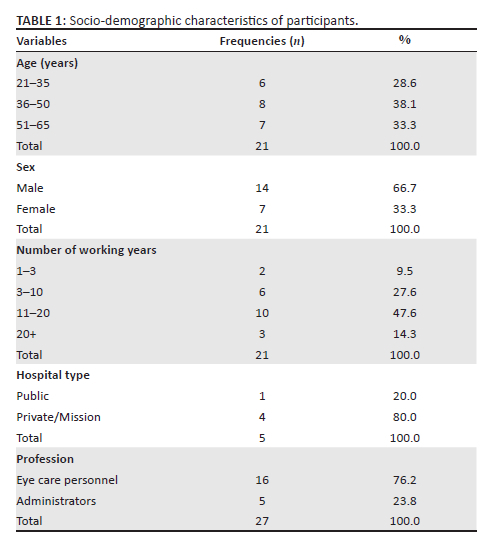
A total of 21 participants, including five administrators and 16 eyecare personnel (five optometrists, two ophthalmic nurses and nine ophthalmic technicians), participated in the study. The optometrists were trained to WCO competency level three and the ophthalmic nurses and optometric technicians to WCO competency levels one and two, respectively. There were no ophthalmologists at the study sites. Their ages ranged from 24 to 62 years (mean = 43.86 ± 2.6 years). Most participants (66.6%; n = 14) were males, with the majority (47.6%; n = 10) having between 11 and 20 years of work experience. Four (80.0%) out of five of the selected hospitals (from the divisional/district and regional levels) were private hospitals (Table 1), as the majority of eyecare facilities are mission or private facilities, which receive subventions from the government to operate.
There were 12 codes extracted from the data, which were further condensed into three codes using descriptive coding methods namely, KC awareness, KC clinical practice and KC interventions. Further in vivo analysis, resulted in the emergence of two major themes as described below:
Knowledge and experience
Most eye health personnel and eye health facility administrators reported poor self-knowledge on KC with only a few reporting some knowledge of the disease. Participants reported that their limited or lack of knowledge of the disease was because of inadequate training on KC:
'With my training in ophthalmic nursing, I have never heard about a disease called keratoconus.' (KS012: ophthalmic nurse, 4 years' experience, female).
An optometric technician added:
'I have been serving in this hospital for 10 years and I am now in charge of the register. I have never seen a disease called keratoconus.' (KS004: optometric technician, 10 years' experience, male)
Participants who reported having some knowledge of KC had attended workshops in the past, initiated by their personal motivation towards professional development and not through their undergraduate education studies, as highlighted by one participant:
'Unfortunately, in my curricula, I did not learn much of keratoconus. The reality here is that we don't have standardised global training on eye issues. I actually learned about it when I went in for an eye-care workshop and there was a complete module of keratoconus there. That is how I got to know it. If not, I would have never heard about it.' (KS017: optometrist, 12 years' experience, male)
Others reported having gained some knowledge of KC through the training programme that they had at university:
'I know of keratoconus. I did my studies in Ghana and I was taught about it.' (KS014: optometrist, 5 years' experience, female)
There was consensus among all participants that the limited or total lack of knowledge on KC was linked to a lack of undergraduate exposure to KC knowledge and skills as well as the absence of continuous professional development (CPD) opportunities on the disease:
'We have not engaged in staff development. That is why some of them do not have knowledge of keratoconus.' (KS002: Eye health administrator, 15 years of service, female)
Another health administrator added:
'We don't have clear clinical and administrative procedures and/or protocols to handle this disease. This makes our personnel not to pay much attention to the disease. Equally, when seminars or workshops are organised, they are directed towards other diseases such as glaucoma and cataracts. They do not talk of keratoconus. So those are possible reasons why the personnel in my hospital may not know of keratoconus.' (KS008: health administrator, 26 years of service, male)
Management of keratoconus
In addressing the management of KC, all participants reported that patients presenting at the facilities represented in the study are not assessed for KC and hence remain undiagnosed and managed. Participants acknowledged that their knowledge deficiencies may be resulting in many patients, who present at their respective facilities with the disease, remaining undiagnosed. Hence, it could hinder any further patient management:
'I have heard about this disease called keratoconus but my knowledge on it is very limited. This means that, maybe, when a patient comes to the hospital with the disease, it may go unnoticed.' (KS019: health administrator, 23 years of service, male)
This assertion was corroborated by other participants, two of whom stated:
'We don't usually come across keratoconus cases in our centre. This is not because the cases do not come to our centres, but it is because, the cases which come go unnoticed.' (KS005: optometrist, 30 years of service, male and KS013: optometrist, 10 years' service, male)
In addition to the lack of knowledge, it emerged that facilities do not have equipment required for KC diagnosis, as the participant further elaborated:
'We don't have machines to detect cases of keratoconus. Not only that, I am the only one in this centre who is knowledgeable about keratoconus. So, if I am not there, nobody can detect it.' (KS005: optometrist, 30 years of service, male)
'In the hospital I used to work at, in Mali, before coming to Cameroon, there were cases of keratoconus and they were easy to detect, but since I came here, I have not yet seen a machine which can detect keratoconus, so now I haven't yet come across a case of keratoconus since I arrived in Bafoussam.' (KS013: optometrist, 10 years' service, male)
Discussion
Most study participants were males (66.7%) and middle aged. The reason for more male eye health workers could be because of a common cultural practice in many sub-Saharan African countries, where a male child's education and professional training are preferred over the girl child, who is often prepared for marriage.131415,16,1718
Despite having many years of experience in eye health services, many eyecare practitioners and administrators had limited or poor knowledge of KC. The key reason raised was that little or no emphasis is made on the disease during the training of practitioners, with the focus having been on 'more common' eye diseases such as cataracts and glaucoma. This is of concern as evidence suggests that the prevalence of KC is on the increase in countries such as Cameroon.9
The self-reported inadequate knowledge and skill levels of eyecare workers could have a negative impact on the eye health care of the population and may contribute further to the high prevalence of uncorrected refractive errors, vision impairment and blindness in Africa.6,186
While studies conducted elsewhere report on KC management being conducted by designated groups of eyecare personnel (such as optometrists and ophthalmologists),19
To meaningfully manage KC, the country requires eye health teams working together to plan the entire management strategy from primary to tertiary levels of care. This should include the nurses and technicians involved in school screening and serving at primary care clinics, ophthalmic nurses who will help to detect KC, optometrists who will diagnose and manage the majority of cases with optical devices such as CLs, as well as the ophthalmic surgeons to perform corneal cross-linking and manage the severe cases requiring corneal transplants and INTACS. The researchers recommend that all stakeholders collaborate to address issues related to KC patient management that span education, clinical practice standards and administrative support.
Limitations of the study
There were challenges in recruiting eyecare practitioners and administrators because of the limited health facilities that have eyecare services. Most participants represented the private sector, as private operators receive subsidies from the government to operate eye clinics as opposed to having more government-run clinics. Additionally, some facilities showed no interest in participating in the study, which may limit the full understanding of current practices.
Conclusion
The inadequate knowledge, training and skills of eyecare practitioners and administrators on KC and the absence of clinical protocols and guidelines for the region lead to underservicing of the population. The lack of prompt KC diagnosis could negatively impact on the quality of life (QoL) of keratoconic patients as they are generally young and live with avoidable VI during their most productive years of life. To ameliorate the situation, there is a need to rebuild capacity of the eyecare workers in the diagnosis and management of KC, establish standard clinical guidelines on management, and procure equipment and consumables for KC management at all stages of the disease.
Competing interests
The authors declare that they have no financial or personal relationship(s) that may have inappropriately influenced them in writing this article.
Authors' contributions
Conceptualisation: E.N.A., V.R.M. and K.P.M.; data collection: E.N.A.; data analysis: E.N.A., V.R.M. and K.P.M.; methodology: E.N.A., V.R.M. and K.P.M.; supervision: V.R.M. and K.P.M.; writing - original draft: E.N.A.; writing - review and editing: V.R.M. and K.P.M. All authors have read and agreed to the published version of the manuscript.
Funding information
This research received no specific grant from any funding agency in the public, commercial or not-for-profit sectors.
Data availability
The data that support the findings of this study are not openly available due to containing information that could compromise the privacy of study participants and are available from the corresponding author, E.N.A., upon reasonable request.
Disclaimer
The views and opinions expressed in this article are those of the authors and are the product of professional research. It does not necessarily reflect the official policy or position of any affiliated institution, funder, agency, or that of the publisher. The authors are responsible for this article's results, findings, and content.
Acknowledgements
The authors wish to thank Enow Samuel, Tataw, George Moyo and Kepang Nanseu Evrad Melvin, for assistance with statistical analyses.
References
-
1.Omer K. Epidemiology of keratoconus worldwide. Open Ophthalmol J. 2018;12:289-299. https://doi.org/10.2174/1874364101812010289
» https://doi.org/10.2174/1874364101812010289 - 2.Barbara A. Text book on keratoconus new insights. New Delhi: Jaypee Highlights; 2012.
-
3.Africa KFS. What is keratoconus? [homepage on the Internet] [cited 2023 Nov 10]. Available from: http://www.keratoconusfoundationsa.org/page-19.html
» http://www.keratoconusfoundationsa.org/page-19.html -
4.Torres Netto EA, Al-Otaibi WM, Hafezi NL, et al. Prevalence of keratoconus in paediatric patients in Riyadh, Saudi Arabia. Br J Ophthalmol. 2018;102(10):1436-1441. https://doi.org/10.1136/bjophthalmol-2017-311391
» https://doi.org/10.1136/bjophthalmol-2017-311391 -
5.Masiwa L, Moodley V. A review of corneal imaging methods for the early diagnosis of pre-clinical Keratoconus. J Optom. 2020;13(4):269-275. https://doi.org/10.1016/j.optom.2019.11.001
» https://doi.org/10.1016/j.optom.2019.11.001 -
6.Akowuah PK, Kobia-Acquah E, Donkor R, et al. Keratoconus in Africa: A systematic review and meta-analysis. Ophthalmic Physiol Opt. 2021;41(4):736-747. https://doi.org/10.1111/opo.12825
» https://doi.org/10.1111/opo.12825 -
7.Wagner H, Barr JT, Zadnik K. Collaborative Longitudinal Evaluation of Keratoconus (CLEK) Study: Methods and findings to date. Cont Lens Anterior Eye. 2007;30(4):223-232. https://doi.org/10.1016/j.clae.2007.03.001
» https://doi.org/10.1016/j.clae.2007.03.001 -
8.Hassan H, Samira H, Elham H, et al. The prevalence and risk factors for keratoconus: A systematic review and meta-analysis. Cornea. 2020;39(2):263270. https://doi.org/10.1097/ICO.0000000000002150
» https://doi.org/10.1097/ICO.0000000000002150 -
9.Ayukotang EN, Moodley VR, Mashige KP. Risk profile of keratoconus among secondary school students in the West Region of Cameroon. Vision. 2023;7(1):2. https://doi.org/10.3390/vision7010002
» https://doi.org/10.3390/vision7010002 -
10.Mas Tur V, MacGregor C, Jayaswal R, O'Brart D, Maycock NA. Review of keratoconus: Diagnosis, pathophysiology, and genetics. Surv Ophthalmol. 2017;62(626):770-783. https://doi.org/10.1016/j.survophthal.2017.06.009
» https://doi.org/10.1016/j.survophthal.2017.06.009 - 11.Kanski JJ, Bowling B, Nischal KK, Pearson A. Clinical ophthalmology: A systematic approach. 8th ed. Amsterdam: Elsevier; 2016, p. 213.
-
12.Climate-Data.org. Bafoussam: Average temperature, altitude and monthly weather [homepage on the Internet]. 2022 [cited 2023 Nov 13]. Available from: https://en.climate-data.org/africa/cameroon/west/bafoussam-894680/
» https://en.climate-data.org/africa/cameroon/west/bafoussam-894680/ -
13.Tuwor T, Sossou MA. Gender discrimination and education in West Africa: Strategies for maintaining girls in school. Inter J Inclusion Educ. 2008;12(4):363-379. https://doi.org/10.1080/13603110601183115
» https://doi.org/10.1080/13603110601183115 -
14.Aghaji A, Burchett HED, Oguego N. Human resource and governance challenges in the delivery of primary eye care: A mixed methods feasibility study in Nigeria. BMC Health Serv Res. 2021;21:1321. https://doi.org/10.1186/s12913-021-07362-8
» https://doi.org/10.1186/s12913-021-07362-8 -
15.Burton MJ, Ramke J, Marques AP, et al. The Lancet global health commission on global eye health: Vision beyond 2020. Lancet Glob Health. 2020;9(4):489-551. https://doi.org/10.1016/S2214-109X(20)30488-5
» https://doi.org/10.1016/S2214-109X(20)30488-5 -
16.WHO. Ending the neglect to attain the sustainable development goals: A road map for neglected tropical diseases 2021-2030 [homepage on the Internet] [cited 2023 Nov 13]. Available from: https://www.who.int/publications-detail-redirect/9789240010352
» https://www.who.int/publications-detail-redirect/9789240010352 - 17.Sanders A, Emerson P, Courtright P, Hooper PJ. Women and trachoma: Why prioritising gender equity is essential to achieve vision for all. Community Eye Health. 2023;36(119):19.
-
18.Stevens GA, White RA, Flaxman SR, et al. Global prevalence of vision impairment and blindness: Magnitude and temporal trends, 1990-2010. Ophthalmology. 2013;120(12):2377-2384. https://doi.org/10.1016/j.ophtha.2013.05.025
» https://doi.org/10.1016/j.ophtha.2013.05.025 -
19.Gcabashe N, Moodley VR, Hansraj R. Keratoconus management at public sector facilities in KwaZulu-Natal, South Africa: Practitioner perspectives. Afr Vision Eye Health. 2022;81(1):a698. https://doi.org/10.4102/aveh.v81i1.698
» https://doi.org/10.4102/aveh.v81i1.698

Accepted: 29 Feb. 2024
Published: 21 May 2024