Optometry faculty perspectives on low vision care and rehabilitation education in sub-Saharan Africa
Abstract
BACKGROUND: Human resource challenges have been a factor in the low coverage of low vision care and rehabilitation (LVCR) services in sub-Saharan Africa (SSA). Faculty in optometry institutions play a critical role in training and building interest in LVCR among students AIM: This study examined the perspectives of optometry faculty regarding undergraduate LVCR education and training SETTING: The study was conducted across eight universities in five SSA countries: Ghana, Nigeria, Malawi, Kenya and South Africa METHODS: This study utilised a qualitative research design, employing in-depth interviews to explore the perspectives of 13 optometry faculty members with an average of 8 (±4.8) years of teaching experience RESULTS: There was significant variability in the structure and content of low vision modules, particularly in the duration and depth of clinical exposure. Most institutions lacked adequate equipment for functional vision assessment and low vision aids, with many relying on donated devices. Practical training was constrained by limited infrastructure, increasing student numbers and insufficient patient access. Some faculty responded to this challenge by manufacturing magnifiers locally and using digital low vision tools. South African schools demonstrated more structured clinical training because of regulatory requirements CONCLUSION: Low vision education in SSA would benefit from a harmonised curriculum, increased investment in training resources and regulatory support. These strategies will help improve training and increase interest in practising LVCR among optometry students CONTRIBUTION: The study describes the state of LVCR education in SSA and its impact on the interest of students to become LVCR practitioners
low vision; vision impairment; faculty; education; sub-Saharan Africa; optometry; students; undergraduate
Introduction
Visual impairment is an important cause of disability globally. Current estimates indicate that about 2.2 billion people live with some form of visual impairment.12,32,3,4,56,7
Low vision care and rehabilitation (LVCR) is the primary intervention provided for persons living with low vision (PLWLV) and is a component of optometry training programmes globally.89,1011
However, the provision of LVCR faces several challenges globally and especially in low- and middle-income countries where the burden of visual impairment is four times higher when compared with high-income countries.12,13,141516,17,18
One solution to the low human resource challenge is to increase the number of optometrists available by expanding the training programmes; with the hope that this would lead to an increased number of low vision practitioners. Sub-Saharan Africa has experienced an exponential increase in optometry education over the last two decades.19,2021212223222425
Research methods and design
Study design
The study employed a qualitative research design. An in-depth interview approach was used to explore the perspectives of faculty involved in training students in LVCR from eight institutions across five countries in SSA.
Sampling of countries and institutions
The SSA countries included in the study needed to have at least one bachelor's degree awarding optometry programme, show evidence of expansion and use English as a primary language. Evidence of expansion was determined based on the country having more than one optometry training institution.
The five countries that met the inclusion criteria were Ghana, Kenya, Malawi, Nigeria and South Africa.20
The faculty members responsible for low vision education and training in the selected institutions were contacted through email, phone calls and video conferencing platforms and interviewed. For this study, a low vision faculty member was defined as any individual employed at the institution, either part-time or full-time, who was actively involved in low vision education and training activities. Furthermore, this individual needed to be involved in the low vision module for at least 6 months before being recruited for the study. This time was considered adequate for the faculty member to be sufficiently familiar with the education and training currently taking place at the institution and to be able to contribute to the study.
Data collection
Participants were interviewed using a prepared interview guide containing open-ended questions from March 2023 to March 2024. The questions included in the interview guide were informed by previous studies that have documented known barriers to low vision education and training and the established low vision training competencies.24,26via Zoom, Google Meet and WhatsApp platforms, particularly in areas with unstable internet connectivity). All interviews were recorded with the consent of the participant.
Data analysis
All interviews were recorded, transcribed verbatim and analysed using thematic content analysis. This involved the researcher reading the transcripts several times to facilitate data immersion. This process allowed for researcher to have complete familiarisation with the data and informed the initial coding process. The coding was carried out using the QDA Miner 5.0 software from Provalis Research. Once the initial codes were identified, they were reviewed and synthesised into the emerging themes. Data related to participant and institution characteristics were anonymised and summarised using descriptive statistics and presented in tables.
Ethical considerations
Ethical approval for the study was granted by the Humanities and Social Sciences Research Ethics Committee of the University of KwaZulu-Natal (HSSREC/00004324/2022). Gatekeeper approvals from all institutions that participated in this study were obtained as a prerequisite to obtaining the final ethical approval. The study was conducted by following the ethical boundaries set by the tenets of the Declaration of Helsinki governing studies involving human participants. Each participant was provided with all details concerning the study and they provided and/or informed consent before the study was initiated. Before interviews were recorded, participants had to give assent to it.
Results
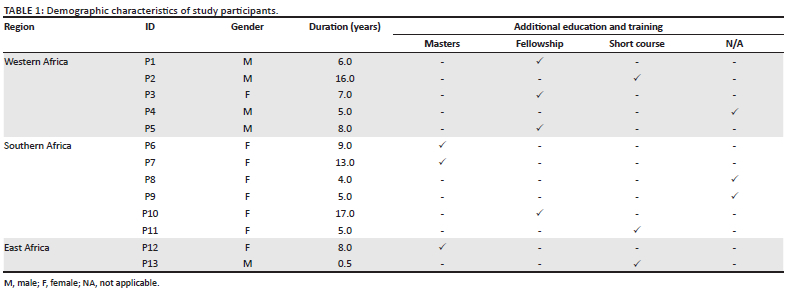
Thirteen faculty members involved in low vision education and training from eight universities were interviewed. Table 1 shows the demographic and education characteristics of the sample. The majority of the sample were female (n = 8.62%). The participants had an average of 8 (±4.8) years of teaching experience in the field of low vision (ranged from 0.5 to 17 years). Three participants had completed postgraduate masters degrees focused on low vision while four participants had attained low vision fellowships. Of the remaining participants, three had completed short courses in low vision while three did not have any additional formal training in low vision care.
Six major themes emerged from the interviews with the faculty members and these were:
• Motivation to practice LVCR
• Impact of training
• Structure of low vision module and scope of training
• Training infrastructure and equipment
• Assessment of low vision practical training
• Students perceived barriers towards low vision care.
Motivation to practice low vision care and rehabilitation
Low vision has traditionally been an underrepresented field of optometry with few optometrists venturing into this sub-specialty. A faculty member succinctly described the difficulty in getting optometrists interested in undertaking low vision as a sub-specialty even among members of the faculty. She said:
'Historically at our institution, its [low vision] been a very sort of grey area, a grey sub-speciality of optometry, something that at 'my institution' lots of people shy away from.' (P10, Female, Faculty member)
Faculty members gave narrations on the circumstances that motivated them to get involved in low vision education and training and these could be broadly classified as either extrinsic or intrinsic motivation. Extrinsic motivation often bordered on the level of unmet needs identified by the participants in their immediate environments. For example, participants realised that there were no low vision care practitioners in their communities and that they also lacked the skills needed to provide such care:
'At that time, the closest place I knew [they could get low vision care was] about six to seven hours [drive] to get there [to a low vision centre]. And most patients, you refer [will] not be able to get to that place. So, that sort of made me realise there was a great need for that [low vision care]. There were students [patients attending the clinic] who had low vision. And we were sort of handicapped. We didn't know what to do for them. We had learnt low vision …. But what were we going to do for these people? And we didn't know how to assess them, we didn't have the aids to give them. So we still had to refer them. … And that's how I got into low vision practice.' (P1, Male, Faculty member)
Some of the extrinsic motivating factors were institutionally driven as they were largely influenced by the human resource gaps in the institution that needed to be filled:
'I was approached by our academic leader at that time and I was advised that it would be nice to take part in a low vision training. I was not sure what I was getting myself into, but I said, yeah, let's try that then. Yeah. So that is how I ended up being part of the low vision training. To be honest, prior to the last four years, it's never been an interest of mine. It's something I've stayed very far away from because I had an interest in other aspects of optometry. But in the last few years, it's what role I have been serving as part of our department.' (P10, Female, Faculty member)
Other extrinsic factors included the influence of undergraduate education and the role mentorship played in shaping their career paths:
'My masters [degree] was in low vision, it was in oculocutaneous albinism and low vision … in my undergraduate study, was actually low vision orientated with no thought of a future in low vision and then when I got into academia, I was mentored by somebody in low vision and that's how the spark grew.' (P6, Female, Faculty member)
'So I did say that so I was working with now Dr A [name removed for anonymity and pseudonym used] and he was a project student to Professor B [name removed for anonymity and pseudonym used] and then he was working with the oculocutaneous albinism. And I was fortunate when I got to my final year, I was assigned to Professor B for my own undergraduate project work. So, I ended up working with people living with albinism … and so that was my transition to low vision.' (P5, Male, Faculty member)
In terms of the intrinsic factors reported, participants noted the desire and passion to improve the quality of life for persons with low vision:
'I actually have a passion for persons with disabilities. And if I were to specifically mention visual impairment, now these are people who are having mostly moderate to severe visual impairment. I felt like venturing into low vision and rehabilitative optometry would be a way of, you know, fulfilling my, what's my passion? Taking care of these people, trying to help them make the best of their lives, just out of the residual vision they have.' (P12, Female, Faculty member)
Furthermore, there were other diverse reasons for motivation and interest in low vision care wherein participants reported a sense of fulfilment from the work because of the impact of the services they provided:
'But one thing that I love about low vision that fulfils me is, as much as these people struggle or having just, or they're partially sighted, but they sort of, they get happy, you get a feedback. A little thing that you do, it makes a difference in their life.' (P7, Female, Faculty member)
'In trying to help the patient I was happy if my patient could see anything if it made a difference to their life then I was happy, if I could help the patient to function in their environment then I felt I have achieved something.' (P8, Female, Faculty member)
Impact of training
The faculty members were asked to provide the number of students they had trained in the past who were currently practising LVCR as a way of assessing the impact of their training. The majority of respondents could not identify any of their students who were currently practicing LVCR, even though some had made themselves available to mentor graduates who showed interest:
'So, you know, we've encouraged students to keep in contact and if they have any questions to let us know if they have any interesting cases to share. But honestly, I haven't received feedback from students regarding low vision cases. So, nobody has reached out with any interesting cases or asked for assistance. So no, I don't have any examples to share with you there.' (P9, Female, Faculty member)
The few who identified former students who were practising indicated that they were not doing it as a full-time low vision practice:
'There's one at a tertiary hospital and a private clinic. So, it's not like they have a low vision centre, but they are practising some aspects of low vision care.' (P1, Male, Faculty member)
Structure of the low vision module and scope of training
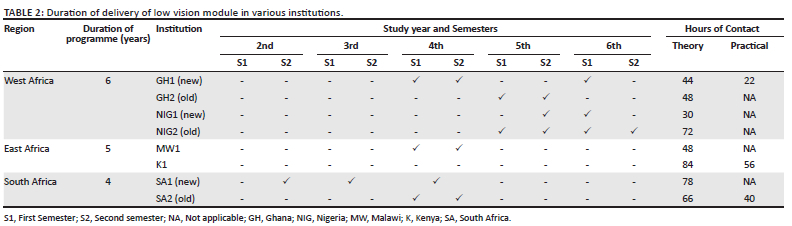
The reported duration of delivering the low vision modules varied among the different institutions even within the same country (Table 2). The theoretical training was covered in the fourth year of training at four institutions. Most institutions (n = 5) taught the module over two semesters. However, one institution reported that it took five semesters to complete the various parts of the module with an introduction in the second year and a build-up towards the final year. The contact hours for theoretical and practical teaching differed greatly among the various institutions. For the theory component, the contact hours ranged from 30 h to 84 h while for the practical component, it ranged from 22 h to 78 h (Table 2). Some institutions had extensive practical training while others were unable to implement practical training although it is required as part of the curriculum:
'In the second semester you'll spend a two-week block on campus so you either examine in the internal campus clinic or you go to hospitals surrounding that clinic. So, we've got local sites where you travel to, you do a four-hour session you will come back if you are allocated to an external decentralized clinical rotation block then you will go and stay at a particular hospital accommodation for two weeks and you will examine patients each day, Monday to Friday.' (P10, Female, Faculty member)
'Currently, it is not possible [to have clinical training]. Previously we attached students to some clinics or facilities with low vision patients for students to learn. We used to take them to places which have the facilities. It is not possible now because there are now large classes and we will not even be able to have enough low vision patients for all of them.' (P2, Male, Faculty member)
All participants reported that the content and time allocated in the low vision modules were adequate. Although one participant recommended an increase in the number of credit hours at each level:
'We've got eight [credits]. I think if we made it a 12-credit module in each level. That would include notional hours for the teaching of theory as well as practical experience for the students.' (P6, Female, Faculty member)
Another faculty member also expressed some reservations concerning the practical training component:
'In my opinion, the number of [hours for] training in the classroom is adequate, but for the clinic, I think they need more hours.' (P12, Female, Faculty member)
Training infrastructure and equipment
The available infrastructure and equipment were extensively evaluated. The responses from the respondents generated multiple sub-themes.
Infrastructure for training students
The primary infrastructure for providing low vision care is ideally a fully resourced low vision clinic. Four of the institutions did not have a low vision clinic in the main campus, but two of these had clinics or practical training centres outside the main campus. The clinical training infrastructure can be categorised into three:
• Internal training centres
• External training centres
• Hybrid training centres.
Internal training centres: This refers to low vision training centres that are primarily set up on the campuses and as such are operated solely by the hosting institution. This could be a permanently set-up clinic that is in operation for all days of the week or on specific days:
'Yeah, we are running a low vision clinic on campus, yes. Except for the fact that … we are able to see patients from outside campus, but we can't give them low vision assistive devices yet.' (P12, Female, Faculty member)
Because of limitations in training space, some of the regular student clinic spaces at some institutions were converted for use as low vision clinics on specific days to provide services to patients and an opportunity for the students to also learn:
'When I go to clinic, I have to clear a room and set it up for my low vision patients. And after that, I have to pack everything up so that the regular patients can be seen. So that is not the best.' (P1, Male, Faculty member)
However, this mode of providing practical training presented an additional challenge of securing an adequate number of patients for student training:
'In our African setting, they [patients] are unhappy about being exposed to students. You know, when I'm talking about one or two students, I'm talking about five students in a group. And so, the patient might not be too happy about others seeing his or her low vision condition, which some people still stigmatize. Having a lot of people crowding and, you know, explaining, it makes them feel like a specimen. So that reduces the number of patients that they can actually practice with.' (P5, Male, Faculty member)
'I run a low vision clinic, but even though it is meant for the students, it's meant to be a clinic for the patients as well, I don't have a lot of patients. Most of them don't get to actually see a low vision patient. So most of the time, the course schedule is mostly theoretical.' (P1, Male, Faculty member)
External training centres: This form of low vision training involved student clinical training outside of the campus at affiliated health institutions and/or schools for the blind, irrespective of the presence of a campus clinic for general eye care services and student training:
'When you say on-site, it's not where our theoretical modules are held. It's actually a distance. It's about a 10-minute drive. But it is affiliated to the university. But the actual site is not where the theory is being held. Okay. And that is for the patients. Our practical teaching sessions are held here at the university. No patient involvement.' (P6, Female, Faculty member)
Hybrid training centres: In some institutions, students were provided with opportunities to examine patients with low vision at on-campus and off-campus low vision clinical sites. Consequently, this allowed students to be exposed to a broad range of patient cases for the semester. Furthermore, the hybrid system also has the advantage of ensuring the students have a broad range of experiences that would help them to improve their confidence and competencies in low vision examination and management:
'At the university, actually, we have a decentralized training program. So what that means is that groups of students go to external sites, so different hospitals around the province, for two weeks at a time. Because they are more hospital-based, then they are seeing a lot more low vision patients there. Internally, at the university clinic itself, we have schools for visually impaired schools, schools for children with disabilities booked to come in….' (P9, Female, Faculty member)
Equipment for training students
Based on participant responses, the equipment needed for student training was categorised into functional vision testing equipment and low vision aids.
Functional vision testing equipment: Although the basic vision testing equipment needed to train students was available in almost all institutions, participants reported specific challenges because of inadequate functional vision assessment equipment. This was often reported by institutions that operated using external and hybrid practical training centres. Specifically, equipment needed for functional assessments related to contrast sensitivity and colour vision was found as the most deficient. The problem of inadequate equipment was sometimes compounded by the increasing number of students in the class:
'It becomes a problem because you've got certain equipment now based at the hospital, which [is outside campus] …. But we are required to teach at our university using that equipment. Or we've got equipment based at the university, which we actually need at the clinic for our patients. So, we have a lot of ups and downs. Transfer from one entity to another entity, which becomes a bit of a problem for the lecturer. And the class numbers. We've got enough equipment for student educational purposes. But when it comes to functional vision testing, that's a problem.' (P6, Female, Faculty member)
'When you look at it from the number of students, we have to teach and what we have on the ground, then it [equipment] becomes inadequate. It means we need more.' (P3, Female, Faculty member)
Low vision aids: They were three different kinds of low vision aids that were being used in the different institutions, including low vision aids in an assessment kit, practice low vision aids and low vision aids for dispensing.
The low vision aids in assessment kits were used for low vision assessment and students' practical training. In some institutions, these were the only low vision aids available and were often obtained through donations:
'We got some low vision aids from a European partner university [name removed for anonymity], about five years back and that has been very instrumental. And we're using it for teaching. So, students are able to see it, use it and all that.' (P1, Male, Faculty member)
'I believe they were largely donated to us. They were largely donated to us.' (P5, Male, Faculty member)
'Almost all the equipment that we have in the department are donated equipment from our donors. We have not bought anything.' (P13, Male, Faculty member)
The low vision aids were mostly inadequate:
'Then, of course, the availability of these low vision aids. You know, you want to be able to go through a lot of these aids. Yes, we do have a good number, but I think for proper experience and learning, we actually need a lot more than that.' (P5, Male, Faculty member)
In the quest to overcome the challenge of lack of availability of low vision aids for training some are adopting innovative approaches by building low vision aids locally and some are increasing the exposure of students to digital-based low vision applications:
'[W]e are also making our own magnifiers at the university here. We use locally available materials like bottles and pipes. We cut them. We put some fluids inside like that. So index magnifiers, we make them. And we usually, every student is asked to make their own magnifier or a telescope to provide to the student there. Though they are not very beautiful, but they are doing the right job.' (P13, Male, Faculty member)
'And one thing I've been doing for my students is trying to get them to be innovative. And so, in the department, we have 3D printed magnifiers, … yes both telescopes and magnifiers.' (P1, Male, Faculty member)
'[T]he digital may take over as the years go and it's not yet included fully in the curriculum because they still teaching them like magnification for telescope and all that but what happens is I do have to use it sometimes in the clinic because if a patient cannot buy an appliance am I going to send them away or do I teach them how to use it [phone]; I'm going to teach them how to use it on their phone if they have a phone, digital may take over I think as digital is growing quite fast.' (P8, Female, Faculty member)
The "practice" low vision aids were given to patients to use temporarily for training purposes and returned after the period of training ended:
'We have a set of practising devices whereby we practice we give you [the patient], we train you with this device. And then in the end, if you are happy with it, then we can order for you and we tell you how much it is.' (P11, Female, Faculty member)
'We are able to not only do consultation but also give them some devices. We lend them out to them for use, but they're not permanently theirs. For example, if we have a low vision patient who needs to sit exams and they need assistance, they could use the devices for the exams and they'd have to bring them back afterwards.' (P12, Female, Faculty member)
The availability of low vision aids for dispensing to patients was a major challenge for most institutions. In response to the availability of low vision aids, one participant responded:
'[G]etting the aids are really tough. We have not been able to network enough to even get some. Though we have been trying to see if we can partner with one or two agencies, but for now, it's still a big challenge.' (P3, Female, Faculty member)
Assessment of low vision practical training
The study used the number of low vision patients that students need to examine before passing the module as an index for assessment of practical training. However, the minimum number varied and in some instances was not completely enforced because of existing challenges:
'So, for the low vision clinic, it's not … we can't impose the number of patients, unfortunately, because, like I said, you might have a group coming and, on that day, you don't have a low vision patient coming in. So we do a demonstration and then, you know, role-playing for them to learn. You might have on that group, during their session, see patients all day, but at least they are expected before they graduate to encounter at least two low vision patients, one in five [fifth year] and one in six [sixth year], as part of their clinical postings.' (P5, Male, Faculty member)
All faculty members from South Africa specifically indicated that students needed a minimum of 10 low vision patient cases to meet the requirements for graduation. The consistency was because of the demand made by the regulator (Health Professions Council of South Africa [HPCSA]) in South Africa:
'Well, HPCSA has given them a minimum of 10 patients to be seen. So, they need to have at least 10 low vision patients to be seen. So that's only for low vision….' (P11, Female, Faculty member)
Even though the institutions in South Africa stipulated the minimum number of low vision patient cases, one participant thought this number was low:
'I actually think that's too little considering that they have a whole 15 to14 weeks to examine patients and when I log in patient numbers at the end of the year very few students actually get 10, I have students sitting with 20 to 30 [patient cases].' (P10, Female, Faculty member)
The outcome of the low vision module should be for students to start independently practising low vision care after graduation. The participants gave insights into whether their graduates were able to provide low vision care independently for patients. In this regard, the responses were mixed as some were sure of their students' capabilities:
'By the end of the year they were working quite well very independent and I think they could make decisions, they needed guidance here and there but they can work independently.' (P8, Female, Faculty member)
'I have seen our students in the situation where they're not able to use it to attend to real patients in a real world. … but I do think that you know with supervision and guidance they're able to apply their skills to the patient and they're able to examine that patient that comes in.' (P10, Female, Faculty member)
Some faculty had some reservations because of inadequate practical training and human resources and a time lag between when the low vision module was delivered and when practice would begin:
'Yes. I do believe it's enough except for one thing, … the practical part is what I can say I feel is still falling back a bit … if they could just be exposed a little more to practical seeing low vision patients and then immediately after their graduation they transition into doing the same in the field without like taking a break.' (P12, Female, Faculty member)
'I feel like if the university, there's quite a lot of students in our times. I think there were like 30-something students in final year. We currently have a lot of students, … we get like 50 or 60 final-year students, which make it very, very hard because there's limited supervisors. …, but we making it work. I don't want to lie. We're really making it work. You know how it is when you're working at university; you have to forget about the pay and just have passion for what you're doing.' (P11, Female, Faculty member)
'The problem would start if they take maybe 5 years, 6 years being in a practice where there are no low vision patients. And then now, boom! They have to go see a low vision patient with that knowledge would have been out. But coming straight from the university, they will be able to see low vision patients.' (P11, Female, Faculty member)
Some countries require students to undertake internships after graduation, but these have not been adequately structured to ensure that there are opportunities for practising low vision care. It was noted that some students are fortunate to find themselves in facilities with such sub-specialities that tend to benefit:
'[I]t depends on each facility anyway. Some facilities have these different structures and different units like low vision, contact lenses, orthoptics and, of course, pediatric optometry and others. But some practice, depending on the board assessment. They may not have all those different departments. But they can still accommodate optometrists for internships.' (P4, Male, Faculty member)
Students' perceived barriers towards low vision practice
Faculty members also stated some barriers that they believe emanate from students' perception of low vision practice that may keep them from potentially taking LVCR as a career. This ranged from mathematical contents of the low vision module, a lack of recognition, economic and emotional factors:
'[T]hey always have an issue calculating magnification. And there's always confusion between handheld magnifiers and stand magnifiers. And so there's that lot of, a bit of, actually, a bit of a challenge with that. And like I said, you find it's reflecting in their results. Most of them not being able to score so well when it comes to calculating magnification.' (P12, Female, Faculty member)
'[T]he interest is motivated by two things financial and the person's desire to do low vision. Without the finances, most people don't pursue it. It's not as if they cannot learn, with the basics I give them they can learn and learn extra. But they won't do it because it's not financially rewarding.' (P2, Male, Faculty member)
'[Y]ou know emotionally they get involved and many people because we once had um the fourth years doing research on this of how many people are interested in low vision and what are some of those reasons so people were complaining that you know it required you know you need to consider patients emotions and many people were saying they don't want to get involved in that regard….' (P7, Female, Faculty member)
Discussion
The study explored the perspectives of faculty members in eight universities from five countries within SSA on undergraduate low vision education and training.
Low vision has been documented as one of the least preferred sub-speciality to practice within the optometry profession.27,28
The findings of the study also revealed considerable diversity in the structure and delivery of low vision modules across the various institutions and sometimes even within the same countries. Harmonisation of the low vision education and training curriculum across the various countries in SSA can help mitigate these discrepancies and improve standards.2926
Deficiencies in the availability of equipment for functional vision assessment and low vision aids have been a long-standing challenge in low-resource countries such as those in SSA.18,3031
The various institutions tried to overcome the infrastructure and equipment challenges by adapting various ways of providing practical training. Internal training centres were present in only half of the institutions included in the study. This may be because of the high investment needed to properly resource a place for such purposes even though it may be convenient and provide immediate access. However, this may limit the variety of patients the students may examine and they may not benefit from the expertise of other low vision practitioners apart from the faculty members in their schools. The hybrid model, in contrast, maximises the advantages of both internal and external training settings, offering a balanced approach to clinical education. Institutions may need to consider combining these approaches to provide students with an optimal learning experience, enhancing their readiness to deliver effective low vision care.
Faculty members also mentioned various factors that they perceived as barriers to their students practising LVCR. One barrier was the mathematical content in the low vision module. The level of mathematical computational requirements may need to be reviewed and its relation to patient care better emphasised to convince students of its application in LVCR. The mathematical content is linked to the fundamental principles that underline the use of optical and non-optical low vision aids and can be made into a prerequisite course instead of being part of the general low vision course. Adio et al. showed that teaching low vision in a very simple manner greatly improves optometrists' interest in the sub-speciality.24
Limitations
The study employed strict criteria to select countries and this resulted in exclusion of non-English speaking African countries (francophone and lusophone countries) and even English-speaking countries such as Zimbabwe where Optometry programmes existed, but had not graduated first cohort of students at the time of study inception. The exclusion of optometry programmes in these countries may reduce the diversity of perspectives captured and limited the representativeness of the study findings. It is also possible that study participants may have also understated their challenges and overemphasised their successes to protect the image of their institutions.
Conclusion
The study provides faculty insights into the factors that shape the training competencies of undergraduate optometry students in LVCR. The findings have shown that optometry faculty in SSA are highly motivated to provide training in low vision care. The lack of infrastructure and equipment can be effectively resolved with targeted investment in resourcing optometry schools in SSA. The mode of assessment used for practical training is critical to improve students' experiences by implementing specific patient quotas supported by regulatory bodies and including well-supervised internships. This has the potential to increase the possibility of undergraduate students becoming low vision practitioners and provide the much-needed human resources to address the growing demand for LVCR by persons with visual impairment particularly in SSA.
Competing interests
The authors declare that they have no financial or personal relationships that may have inappropriately influenced them in writing this article.
Authors' contributions
D.v.S., N.R. and C.H.A. conceived the research idea, D.v.S. and N.R. were involved in planning and supervised the work and C.H.A. processed the data, performed the analysis and drafted the manuscript. D.v.S., N.R. and C.H.A. aided in interpreting the results and worked on the manuscript. C.H.A., D.v.S. and N.R. discussed the results and commented on the manuscript. All authors contributed to the article, discussed the results and approved the final version for submission and publication.
Funding information
The authors received no financial support for the research, authorship and/or publication of this article.
Data availability
The data that support the findings of this study are available on request from the corresponding author, C.H.A. The data are not publicly available because of the format of the data and the presence of information that could compromise the privacy of research participants.
Disclaimer
The views and opinions expressed in this article are those of the authors and are the product of professional research. They do not necessarily reflect the official policy or position of any affiliated institution, funder, agency or that of the publisher. The authors are responsible for this article's results, findings and content.
Acknowledgements
References
- 1. Burton MJ, Ramke J, Marques AP, et al. The Lancet Global Health Commission on global eye health: Vision beyond 2020. Lancet Glob Health. 2021;9(20):e489-e551.
-
2. Leat SJ, Legge GE, Bullimore MA. What is low vision? A re-evaluation of definitions. Optomet Vis Sci. 1999;76(4):198-211. https://doi.org/10.1097/00006324-199904000-00023
» https://doi.org/10.1097/00006324-199904000-00023 -
3. Rubin GS, Roche KB, Prasada-Rao P, Fried LP. Visual impairment and disability in older adults. Optomet Vis Sci. 1994;71(12):750-760. https://doi.org/10.1097/00006324-199412000-00005
» https://doi.org/10.1097/00006324-199412000-00005 -
4. Shah P, Schwartz SG, Gartner S, Scott IU, Flynn HW. Low vision services: A practical guide for the clinician. Ther Adv Ophthalmol. 2018;10:1-12. https://doi.org/10.1177/2515841418776264
» https://doi.org/10.1177/2515841418776264 - 5. World Health Organization. International Classification of Diseases Eleventh Revision (ICD-11). Geneva: World Health Orgnisation; 2022.
-
6. WHO. Management of low vision in children [homepage on the Internet]. 1992 [cited 2025 Mar 23]. Available from: http://whqlibdoc.who.int/hq/1993/WHO_PBL_93.27.pdf
» http://whqlibdoc.who.int/hq/1993/WHO_PBL_93.27.pdf - 7. WHO. WHO/PBL examination record for children with blindness and low vision. Geneva: World Health Organisation; 2005.
- 8. WCO. A global competency-based model of scope of practice in optometry. In Chappell R, Kiely PM, editors. 1st ed. St Louis: World Council of Optometry, 2015; p. 1-73.
-
9. Ryan B. Models of low vision care: Past, present and future. Clin Exp Optom. 2014;97(3):209-213. https://doi.org/10.1111/cxo.12157
» https://doi.org/10.1111/cxo.12157 -
10. Wallace S, Alao R, Kuper H, Jackson ML. Multidisciplinary visual rehabilitation in low- and middle-income countries: A systematic review. Disabil Rehabil. 2020;44(8):1164-1175. https://doi.org/10.1080/09638288.2020.1794063
» https://doi.org/10.1080/09638288.2020.1794063 -
11. De Boer MR, Twisk J, Moll AC, Völker-Dieben HJM, De Vet HCW, Van Rens GHMB. Outcomes of low-vision services using optometric and multidisciplinary approaches: A non-randomized comparison. Ophthalmic Physiol Opt. 2006;26(6):535-544. https://doi.org/10.1111/j.1475-1313.2006.00424.x
» https://doi.org/10.1111/j.1475-1313.2006.00424.x -
12. Freeman EE, Roy-Gagnon M-H, Samson E, et al. The global burden of visual difficulty in low, middle, and high income countries. PLoS One. 2013;8(5):e63315. https://doi.org/10.1371/journal.pone.0063315
» https://doi.org/10.1371/journal.pone.0063315 -
13. Bright T, Wallace S, Kuper H. A systematic review of access to rehabilitation for people with disabilities in low-and middle-income countries. Int J Environ Res Public Health. 2018;15(10):1-34. https://doi.org/10.3390/ijerph15102165
» https://doi.org/10.3390/ijerph15102165 -
14. Marmamula S, Yelagondula VK, Varada R, Khanna RC. Improving access to eye care in low and middle-income countries-challenges, opportunities, and the way forward. Expert Rev Ophthalmol. 2023;18(6):365-377. https://doi.org/10.1080/17469899.2023.2281448
» https://doi.org/10.1080/17469899.2023.2281448 -
15. Metreau E, Young KE, Eapen SG. World Bank country classifications by income level for 2024-2025 [homepage on the Internet]. 2024 [cited 2025 Mar 28]. Available from: https://blogs.worldbank.org/en/opendata/world-bank-country-classifications-by-income-level-for-2024-2025
» https://blogs.worldbank.org/en/opendata/world-bank-country-classifications-by-income-level-for-2024-2025 -
16. Minto H. Optometry in developing countries. Optom Vis Sci. 2008;85(2):E74-E77. https://doi.org/10.1097/OPX.0b013e318165e4a4
» https://doi.org/10.1097/OPX.0b013e318165e4a4 -
17. Chiang PP-C, O'Connor PM, Le Mesurier RT, Keeffe JE. A global survey of low vision service provision. Ophthalmic Epidemiol. 2011;18(3):109-121. https://doi.org/10.3109/09286586.2011.560745
» https://doi.org/10.3109/09286586.2011.560745 -
18. Abraham CH, Van Staden D, Rampersad N, Abraham CH. Barriers and enablers to low vision care and rehabilitation in sub-Saharan Africa within a global context within a global context. Clin Exp Optom. 2023;107(1):3-13. https://doi.org/10.1080/08164622.2023.2254766
» https://doi.org/10.1080/08164622.2023.2254766 -
19. Oduntan OA, Mashige KP, Kio FE, Boadi-Kusi SB. Optometric education in Africa. Optom Vis Sci. 2013;91(3):1. https://doi.org/10.1097/OPX.0000000000000153
» https://doi.org/10.1097/OPX.0000000000000153 -
20. Abu SL. The hisstory and current status of optometric education in Africa. Hindsight J Optomet Hist. 2020;51(4):84-92. https://doi.org/10.14434/hindsight.v51i4.31557
» https://doi.org/10.14434/hindsight.v51i4.31557 -
21. Osuagwu UL, Rasengane T, Ovenseri-Ogbomo GO, et al. Mapping the landscape of optometric education in sub-Saharan Africa. Clin Exp Optom. 2025;108(3):282-292. https://doi.org/10.1080/08164622.2024.2446473
» https://doi.org/10.1080/08164622.2024.2446473 -
22. Naidoo K, Morjaria P, Fai Chan V, Chee Yong A, Bilotto L. Global mapping of optometry workforce. Afr Vis Eye Health. 2023;82(1):1-13. https://doi.org/10.21203/rs.3.rs-1286073/v1
» https://doi.org/10.21203/rs.3.rs-1286073/v1 -
23. Palmer JJ, Chinanayi F, Gilbert A, et al. Mapping human resources for eye health in 21 countries of sub-Saharan Africa: Current progress towards VISION 2020. Hum Resour Health. 2014;12(1):44. https://doi.org/10.1186/1478-4491-12-44
» https://doi.org/10.1186/1478-4491-12-44 -
24. Adio A, Bekibele C, Lewerenz D, Lawrence L. Low vision evaluation training in Nigeria: Time to improve human resource in developing countries. Br J Vis Impair. 2021;39(2):147-160. https://doi.org/10.1177/0264619620915263
» https://doi.org/10.1177/0264619620915263 -
25. Akuffo KO, Osei Duah Junior I, Acquah EA, et al. Low vision practice and service provision among optometrists in Ghana: A nationwide survey. Ophthalmic Epidemiol [serial online]. 2025 [cited 2025 Mar 28]. Available from: https://www.tandfonline.com/doi/abs/10.1080/09286586.2024.2317816
» https://www.tandfonline.com/doi/abs/10.1080/09286586.2024.2317816 - 26. Kammer RL, Jamara RJ, Kollbaum E, Matchinski T, Flom R. The development of entry level low vision rehabilitation competencies in optometric education. Optom Educ. 2010;35(3):98-107.
-
27. Ovenseri-Ogbomo GO, Alghamdi W. Knowledge, attitudes, and practices of optometrists regarding low vision services in Saudi Arabia. Open Ophthalmol J. 2021;15(1):217-288. https://doi.org/10.2174/1874364102115010217
» https://doi.org/10.2174/1874364102115010217 -
28. Naicker N, Munsamy AJ. Optometrists' perspectives on speciality programme development in South Africa. Afr Vis Eye Health. 2024;83(1):1-9. https://doi.org/10.4102/aveh.v83i1.910
» https://doi.org/10.4102/aveh.v83i1.910 -
29. Beastall GH. Harmonisation of specialist training and continuing professional development in laboratory medicine: A long but necessary journey. Clin Chem Lab Med. 2015;53(1):1-3. https://doi.org/10.1515/cclm-2014-1005
» https://doi.org/10.1515/cclm-2014-1005 -
30. Okoye OI, Aghaji AE, Umeh RE, Nwagbo DFE, Chuku A. Barriers to the provision of clinical low-vision services among ophthalmologists in Nigeria. Vis Impair Res. 2007;9(1):11-17. https://doi.org/10.1080/13882350701198702
» https://doi.org/10.1080/13882350701198702 -
31. Silver J, Gilbert CE, Spoerer P, Foster A. Low vision in east African blind school students: Need for optical low vision services. Br J Ophthalmol. 1995;79(9):814-820. https://doi.org/10.1136/bjo.79.9.814
» https://doi.org/10.1136/bjo.79.9.814

Accepted: 01 Sept. 2025
Published: 10 Oct. 2025