Colour vision defects among South African male students and its impact on quality of life
Abstract
BACKGROUND: Colour vision defects are expected to have a negative impact on daily activities, education, misguided career choices, and mental and social well-being. Its prevalence among university students in South Africa remains unknown. AIM: This study aimed to investigate the prevalence of colour vision deficiency (CVD) among male university students and its adverse effects on education, emotions, social life and everyday tasks. SETTING: The study was conducted in all colleges of the selected university. METHODS: Purposive sampling was used to select 272 male students aged 18-30 years, at all colleges of University of KwaZulu-Natal (UKZN). The Hardy-Rand-Rittler colour vision test (HRRT) and Ishihara colour vision test were used for the assessment of colour vision. The CVD-AES questionnaire was used to assess the adverse effects on participants with CVD in four subscale areas, viz. education, social life, emotion, and everyday tasks. RESULTS: A total of 272 male students, with a mean age of 20.61 years (s.d. = 2.08), participated. The occurrence of CVD was noted in 19 (7%) participants, with the majority (74%) being unaware of this defect. The most common type of defect was deutan (6.5%). Participants' responses indicated adverse effects on education, emotions, social life and everyday tasks, with CVD having a greater impact on the latter two. CONCLUSION: The occurrence of CVD among male university students is significant, with many of them being unaware of it. Social life is most adversely affected, but adverse effects are noted in all subscales. CONTRIBUTION: This study provides further evidence to the prevalence of colour vision deficiency and its impact on quality of life.
colour vision; colour vision deficiency; colour vision defect; quality of life; male; prevalence; CVD-AES questionnaire; adverse effect; impact
Introduction
Colour vision (CV) is the ability to differentiate and thus perceive varying wavelengths of the light transmitted, emitted or reflected by objects.123,415
The basis of colour is differences in the peak sensitivities of the three classes of cones, with L-cones having a peak sensitivity of approximately 560 nm, M-cones approximately 530 nm and S-cones approximately 430 nm.1,51167,8,9
Overall, a prevalence of CVD between 1.7% and 6.3% has been recorded across a range of studies, which included both male and female participants, over the past few years, including: 6.3% among Iranian industry workers,10811121314915
As congenital CVD is X-linked recessive, it has been noted predominantly in male individuals, although it is transmitted by female individuals, with 8% of the female population being carriers.1617918
More recently, studies have also focused on congenital CVD among university students, considering its influence on learning and career choices.9,11,159,11,154
An earlier study by Barry et al.192021
While most studies on colour blindness have reported on the epidemiology of the condition, and many have alluded to its impact on quality of life (QoL), particularly in younger populations, only a few have documented this expected impact.4,8,9,10,11,13,14,15,19,202022
Currently, the prevalence of CVD among university students in South Africa has not been reported, and the findings of this study can add this information to the current body of knowledge. Furthermore, because the impact of CVD on quality of life relating to academic performance and career pursuits remains largely unknown, this study will raise awareness among students and teachers of the possible impact of CVD on academic performance, also highlighting the importance of screening for CVD in routine eye tests to the optometric fraternity.
Methods
Study design
A cross-sectional, quantitative, descriptive research design was used for this study. The study setting was all colleges of the University of KwaZulu-Natal (UKZN), with the study population being male students. Non-probability, purposive sampling, because of time constraints for data collection, was used to recruit 272 male students, aged 18-30 years and of all races, to participate in the study.
Data collection procedure
Data collection commenced once ethical clearance was obtained. Initial screening of the subjects involved distance visual acuity (VA) measurements using the Snellen chart, including only those with a distance VA of 6/24 or better in the study. Thereafter, each subject underwent a colour vision assessment using two colour vision tests, the Ishihara pseudoisochromatic 24-plate edition and the Hardy-Rand-Rittler colour vision test (HRRT), the order of which was randomised across subjects. These tests were chosen because of practical constraints and lack of access to a clinical setting for data collection. However, they are valid tests for the assessment of colour vision.23,242219

The impact score ranges from 0 to 1, with a higher score on the CVD-AES indicating a higher negative impact of CVD.
The subjects were encouraged to be truthful when answering the questionnaire. The CVD-AES questionnaire was also conducted on a subset of colour normals (n = 19) for comparison. All procedures and instructions used during the data collection were standardised among the researchers by reading from a printed sheet for the various tests. A pilot study (n = 5) was conducted prior to the main study, with minimal modification required to the procedures prior to implementation.
Data analysis
Data were entered into Microsoft Excel and analysed using the Statistical Package for the Social Science (SPSS), version 28. Descriptive and inferential statistics, such as frequencies and means, were calculated. The Fisher's exact test, analysis of variance (ANOVA) and multivariate regression analysis were used to test the association between colour vision status and impact scores versus socio-demographic variables. Anova and the Mann-Whitney U tests were used to compare the means for the impact scores. All the tests were two-sided, and all p-values reported were tested at the α = 0.05 level.
Ethical considerations
Ethical clearance was obtained from the Biomedical Research and Ethics Committee of the University of KwaZulu-Natal (BREC/00005581/2023) prior to data collection, and the tenets of the Declaration of Helsinki were adhered to where necessary. Informed consent was obtained in writing from all respondents. The identity of all respondents remained confidential, and the research data were only accessible to the researchers through a password-protected computer.
Results
Demographics and colour vision status
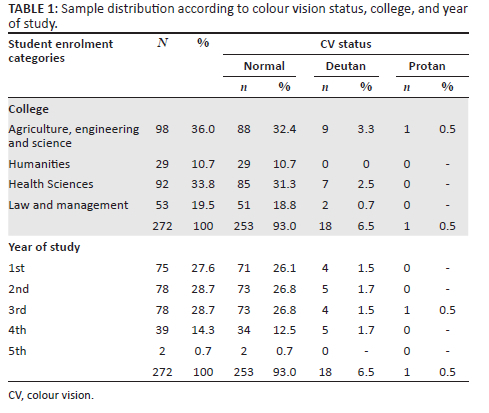
A total of 272 male students were enrolled in the study and included in the data analysis. The mean age of the sample was 20.61 years (s.d. = 2.08 years), with an age range between 18 years and 30 years. The sample included 86.8% (n = 236) black, 0.7% (n = 2) coloured, 11.4% (n = 31) Indian, and 1.1% (n = 3) Caucasians. The distribution of the participants according to their colour vision status, the college they were currently enrolled in, and their year of study is detailed in Table 1.
Of the total participants enrolled, 19 were found to have a colour vision defect; hence, a prevalence of 7% of CVD was found in the population under study (Table 1). Of the 19 participants, only one displayed a possible protan defect, while the remainder (n = 18; 94.7%) were found to be deutans. The Fisher's exact test revealed no associations between CVD and the college of enrolment (p = 0.409), nor with the year of study (p = 0.566). Furthermore, only 11.8% (n = 32) of all the participants screened reported having their CV assessed previously, with only five (26.32%) of those affected being aware of their CVD. The results from the Ishihara and the HRR test were significantly correlated (p = 0.000), with no differences in the diagnoses of the colour vision statuses of all participants noted between the two tests.
Adverse effects of colour vision deficiency
The participants (n = 19) diagnosed with CVD were required to complete the CVD-AES questionnaire to investigate the adverse effects, if any, of their CVD on four subscales of QoL, namely, education, social life, emotions and everyday tasks. The frequencies reported in this section are calculated based on only the total number of colour-deficient participants, that is, 19 and not the total sample for the study.
Subscale 1: Education
Subscale 1 focused on the adverse effects of CVD on the participants' education. Figure 1 depicts the participants' responses regarding difficulties experienced in various subjects, specifically because of their perception of colour. Based on the responses in Figure 1, the subjects most affected by colour vision defect were Arts (10.5% affected always), Science (10.5% affected always, and 5.3% often), and Geography (21% affected often or always), while Music and IT were not affected, as reported by those participants who had taken those subjects. Even though only 10.5% reported that their CVD sometimes made it difficult to answer questions in tests, it was noted that participants also reported an effect on reading information, rarely (26.3%), sometimes (26.3%), and always (5.3%). Two participants (10.5%) indicated that they sometimes had difficulty in setting learning targets and objectives because of their colour vision, while a relatively higher number (21.2%) found that it could interfere with communication with their teachers.
Subscale 2: Social life
Figure 2 shows the responses of the participants with CVD to statements related to their social life as Subscale 2. The aspect of social life assessed by the CVD-AES that appeared to be most affected was being laughed at for making mistakes because of their CV defect, as experienced by 21.1% always, 10.5% often and 15.8% sometimes. Of note is that 52.6% reported being perceived as stupid sometimes (36.8%), often (5.3%) or always (10.5%). The least affected aspect of social life was people thinking that those affected individuals are lazy, as reported by 15.8%.
Subscale 3: Emotions
The adverse effects on emotions because of poor colour perception were the focus of Subscale 3 and are detailed in Figure 3. The results suggest that the emotions the participants were most likely to experience as a result of their CVD were: feeling self-conscious, feeling like the odd one out, and feeling embarrassed. The negative emotions that the participants were likely to experience to a lesser extent because they had CVD were feeling special and/or unique, frustrated and sad. Similarly, the happy emotions were also experienced to a lesser degree.
Subscale 4: Everyday tasks
Figure 4 details the responses to the adverse effects of CVD on everyday tasks. Adverse effects while understanding information and doing arts and crafts were sometimes experienced, as reported by 47.4% and 42.1% of colour vision defective participants, respectively. The use of computers and devices was being affected adversely sometimes, as reported by 21.1%. Almost a fifth of colour-deficient participants experienced some difficulty with food choices and eating. The ability to use technology was the everyday task that was reportedly least affected.
Impact scores
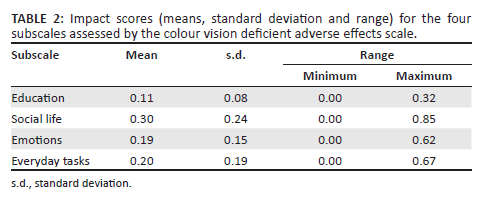
For each of the subscales, an impact score, which could range from 0 to 1, was calculated. Table 2 details the descriptive statistics for the impact scores calculated.
The higher the impact score, the more negative the impact. The highest impact score was noted for Subscale 2 (social life) and the lowest for Subscale 1 (education) (Table 2). Anova analysis revealed a significant difference (p = 0.014) in the means across the four subscales for the CVD participants. Multivariate regression analysis revealed no associations between demographics (age, year of study and college) and the impact scores for each of the subscales explored for the colour-deficient participants.
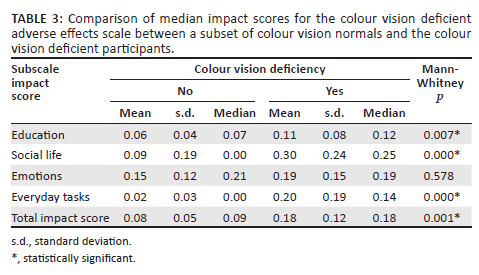
The CVD-AES was also administered to a small subset of the participants (n = 19) with normal colour vision for comparison. According to the Shapiro-Wilk test, all scores were not normally distributed. Thus, the nonparametric test (i.e. Mann-Whitney U test) was used to compare the mean and/or median value of scores between the two groups (Table 3).
Statistically significantly lower impact scores were noted for colour vision normal participants compared to colour vision deficient participants, for the total impact score and all subscales, with the exception of emotions.
Discussion
This study evaluated the occurrence of CVD among male students at a chosen South African university, as well as explored the possible adverse effects that could have an impact on the QoL of the affected individuals. Colour vision deficiency was detected in 7% of the sample in this study. When compared to previous reports on the prevalence of CVD among male university students, this finding of the current study was similar to those reported by Osman et al.2510268,9,11,15432611
Among the different types of colour vision deficiencies, only red-green deficiencies were found in the current study, with deutan deficiency being the most prevalent and protan deficiency noted in only one participant. This finding is similar to that reported in all studies that focused on colour deficiency among university students, as well as on all other age groups and ethnicities, including the one on South African school children, where the frequencies of deutans and protans in male subjects were 2.7% and 1.5%, respectively.4,8,9,10,11,12,25,2627
In the current study, although the mean impact scores for all subscales assessed by the CVD-AES tool remained in the lower half of the possible range, implying a lower negative impact, adverse effects from CVD were noted in all four subscales (education, social life, emotions, everyday tasks) which are expected to impact the QoL of an individual. Furthermore, when the impact scores of the participants with CVD were compared to those of a subset of colour vision normals, statistically significantly lower impact scores were noted in the latter for all subscales, with the exception of emotions.
Subscale 1 of the CVD-AES focused on the adverse effects of CVD on education. Subjects in which the colour vision-deficient participants reported a greater frequency of adverse effects were Arts, Science and Geography. Individuals with CVD may thus be at a disadvantage when undertaking subjects in which colour is often key in the didactic component - this finding is supported by the reports by Barry et al.1928,2929308,10,28203119
Colour vision deficiency also has a significant impact on one's social life, which was also noted in the current study, with the highest mean impact score produced for Subscale 2 focused on social life.19,20,321930292028,33
The adverse effects of CVD on one's education and social interactions can be expected to have a negative impact on emotional well-being. Responses to Subscale 3 revealed that the negative emotions more frequently experienced by CVD individuals were feeling self-conscious, like the odd one out, and embarrassed. It was also noted that positive emotions like feeling happy, proud and excited were experienced less frequently when compared to the negative ones. The experience of similar negative emotions of anxiety, depression and lack of self-esteem related to colour blindness was also noted by Barry et al.1929
Subscale 4 of the CVD-AES explored everyday tasks that were adversely affected by colour deficiency. Tasks more frequently affected were understanding information, which includes reading labels, graphs and maps, doing arts and crafts, and using software on computers and devices. Tagarelli et al.322030
The majority of the affected individuals in the current study were unaware of their CVD, which has been the general reporting from many previous studies.8,9,12,19,25,29,30 This finding is of significance based on the assertion by Barry et al.1928,29 This highlights the importance of colour vision testing early on in life and the awareness of the adverse effects of CVD.
The current study provides further insight into the adverse effects of CVD on various aspects of life, particularly as it relates to young individuals at the height of their studies and career choices. The use of the CVD-AES, which is a validated tool to assess the adverse effects of CVD in an educational context, makes the findings of this study relevant to the younger population with CVD. It is also the first study to use this tool in studying the QoL in young colour-deficient individuals and on the African continent. Although the onset of CVD and its adverse effects happen early on in life, the administration of the CVD-AES tool on a relatively mature learner in exploring the adverse effects of colour deficiency on education may provide more reliable findings than those from a school-going population. Furthermore, the CVD-AES allows for quantification of the adverse effects, which Stoianov et al.20
Conclusion
This study has noted that 7% of a male university population, selected with non-probability sampling, have a CVD, with a higher number of deutan colour deficient. A quantitative determination of the adverse effects of colour deficiency in the population under study revealed adverse effects on education, social life, emotions and everyday life related to the condition, which are expected to impact on quality of life.
Competing interests
The authors declare that they have no financial or personal relationships that may have inappropriately influenced them in writing this article.
Authors' contributions
R.H. and N.M.G. supervised this study and were involved in conceptualisation, data analysis and editing of all written drafts of the manuscript. R.H., N.M.G., N.C., X.H., A.H., T.N., M.R. and Z.N. were involved in data collection and writing of the manuscript. All authors read and approved the final article.
Funding information
The authors received no financial support for the research, authorship, and/or publication of this article.
Data availability
The datasets used and/or analysed during the current study are available from the corresponding author, R.H., upon reasonable request.
Disclaimer
The views and opinions expressed in this article are those of the authors and are the product of professional research. They do not necessarily reflect the official policy or position of any affiliated institution, funder, agency or that of the publisher. The authors are responsible for this article's results, findings and content.
Acknowledgements
References
-
1.Hasrod N, Rubin A. Deficiency of colour vision: A review of congenital and acquired colour vision deficiencies. Afr Vis Eye Health. 2016;75(1):1-6. https://doi.org/10.4102/aveh.v75i1.365
» https://doi.org/10.4102/aveh.v75i1.365 -
2.Taore A, Lobo G, Turnbull PR, et al. Diagnosis of colour vision deficits using eye movements. Sci Rep. 2022;12(7734):1-14. https://doi.org/10.1038/s41598-022-11152-5
» https://doi.org/10.1038/s41598-022-11152-5 -
3.Neitz J, Neitz M. The genetics of normal and defective colour vision. Vis Res. 2011;51(7):633-651. https://doi.org/10.1016/j.visres.2010.12.002
» https://doi.org/10.1016/j.visres.2010.12.002 -
4.Mashige KP, Van Staden DB. Prevalence of congenital colour vision deficiency among Black school children in Durban, South Africa. BMC Res Notes. 2019;12(324):1-5. https://doi.org/10.1186/s13104-019-4374-1
» https://doi.org/10.1186/s13104-019-4374-1 -
5.Hart WM. Acquired dyschromatopsias. Surv Ophthalmol. 1987;32:10-31. https://doi.org/10.1016/0039-6257(87)90070-1
» https://doi.org/10.1016/0039-6257(87)90070-1 -
6.Zarazaga AF, Gutiérrez Vásquez J, Pueyo Royo V. Review of the main colour vision clinical assessment tests. Arch Soc Esp Oftalmol. 2019;94(1):25-32. https://doi.org/10.1016/j.oftale.2018.08.010
» https://doi.org/10.1016/j.oftale.2018.08.010 -
7.Professional board for optometry and dispensing opticians of the Health Professions Council of South Africa [homepage on the Internet]. 2020 [cited 2023 Feb 20]. Available from: https://www.hpcsa.co.za/Uploads/ODO_2019/Policy%20and%20Guidelines/THE_BASIC_EYE_EXAM_2020.pdf
» https://www.hpcsa.co.za/Uploads/ODO_2019/Policy%20and%20Guidelines/THE_BASIC_EYE_EXAM_2020.pdf -
8.Alamoudi NB, AlShammari RZ, AlOmar RS, et al. Prevalence of colour vision deficiency in medical students at a Saudi University. J Fam Community Med. 2021;28(3):196-201. https://doi.org/10.4103/jfcm.jfcm_235_21
» https://doi.org/10.4103/jfcm.jfcm_235_21 -
9.Nwobodo E, Darawuzie N, Ikwuka DC. Colour perception studies on students of Nmandi Azikiwe University Nnewi Campus, Nigeria. Cyprus J Med Sci. 2022;7(2):191-195. https://doi.org/10.5152/cjms.2021.2216
» https://doi.org/10.5152/cjms.2021.2216 -
10.Ahadi M, Ebrahimi A, Rahmani S, et al. Prevalence of refractive errors and colour vision deficiency in a population of industry-workers in Abhar, Iran. Medicine. 2021;100:46(e27758). https://doi.org/10.1097/MD.0000000000027758
» https://doi.org/10.1097/MD.0000000000027758 -
11.Fakorede ST, Akpan LG, Adekoya KO, et al. Prevalence and population genetic data of colour vision deficiency among students from selected tertiary institutions in Lagos State, Nigeria. Egypt J Med Hum Genet. 2022;23(73):1-8. https://doi.org/10.1186/s43042-022-00287-9
» https://doi.org/10.1186/s43042-022-00287-9 -
12.Woldeamanuel GG, Geta TG. Prevalence of colour vision deficiency among school children in Wolkite, Southern Ethiopia. BMC Res Notes. 2018;11(838):1-5. https://doi.org/10.1186/s13104-018-3943-z
» https://doi.org/10.1186/s13104-018-3943-z -
13.Kim H, Ng JS. Prevalence of colour vision deficiency in an adult population in South Korea. Optom Vis Sci. 2019;96(11):866-873. https://doi.org/10.1097/OPX.0000000000001441
» https://doi.org/10.1097/OPX.0000000000001441 -
14.Krishnamurthy SS, Rangavittal S, Chandrasekar A, et al. Prevalence of color vision deficiency among school- going boys in South India. Indian J Ophthalmol. 2021;69(8):2021-2025. https://doi.org/10.4103/ijo.IJO_3208_20
» https://doi.org/10.4103/ijo.IJO_3208_20 -
15.Rezaei L, Hawasi E, Salari N, et al. Prevalence of color blindness in Iranian students: A meta-analysis. J Ophthalmic Vis Res. 2022;17(3):413-423. https://doi.org/10.18502/jovr.v17i3.11580
» https://doi.org/10.18502/jovr.v17i3.11580 -
16.Deeb SS, Kohl S. Genetics of colour vision deficiencies. Dev Ophthalmol. 2003;37:170-180. https://doi.org/10.1159/000072046
» https://doi.org/10.1159/000072046 -
17.Mandal A. Colour blindness prevalence. [homepage on the Internet]. c2023[updated 2023 Jul 06; cited 2023 Feb 18]. Available from https://www.news-medical.net/health/Color-Blindness-Prevalence.aspx
» https://www.news-medical.net/health/Color-Blindness-Prevalence.aspx -
18.Mitiku RG, Tolera BS, Tolesa ZG. Prevalence and allele frequency of congenital colour vision deficiency (CCVD) among students at Hawassa University, Ethiopia. J Egypt Public Health Assoc. 2020;95(10):1-6. https://doi.org/10.1186/s42506-020-00037-y
» https://doi.org/10.1186/s42506-020-00037-y -
19.Barry JA, Mollan S, Burdon AM, et al. Development and validation of a questionnaire assessing the quality of life impact of colour blindness (CBQoL). BMC Ophthalmol. 2017;17:179-180. https://doi.org/10.1186/s12886-017-0579-z
» https://doi.org/10.1186/s12886-017-0579-z -
20.Stoianov M, De Oliveire MS, Dos Santos Ribeiro Silva MCL, et al. The impacts of abnormal colour vision on people's life: An integrative review. Qual Life Res. 2019;28:855-862. https://doi.org/10.1007/s11136-018-2030-1
» https://doi.org/10.1007/s11136-018-2030-1 -
21.Suciu C, Suciu V, Perju-Dumbrova L, Nicoara SD. A review on today's burden affecting the quality of life for colour blind patients. Ro J Neurol. 2020;19(2):61-64. https://doi.org/10.37897/RJN.2020.2.1
» https://doi.org/10.37897/RJN.2020.2.1 - 22.Pattie C, Mullally S, Jordan G. CVD-AES: Construct and concurrent validity of a novel scale to measure the adverse effects of congenital colour vision deficiency. Journal of the International Colour Association. 2022;31:3-12.
-
23.Cole BL, Lian KY, Lakkis C. The new Richmond HRR pseudoisochromatic test for colour vision is better than the Ishihara test. Clin Exp Optom. 2006;89:73-80. https://doi.org/10.1111/j.1444-0938.2006.00015.x
» https://doi.org/10.1111/j.1444-0938.2006.00015.x -
24.Salvia J, Ysseldyke J. An analysis of the reliability and validity of the Ishihara color plates with mentally retarded males. Percept Mot Skills. 1971;33:243-246. https://doi.org/10.2466/pms.1971.33.1.243
» https://doi.org/10.2466/pms.1971.33.1.243 -
25.Osman S, Khalaf S, Mohhamed H, et al. Prevalence and predictors of colour vision defects among Egyptian university students. East Mediterr Health J. 2021;27(4):399-406. https://doi.org/10.26719/emhj.20.128
» https://doi.org/10.26719/emhj.20.128 -
26.Birch J. Worldwide prevalence of red-green colour deficiency. J Opt Soc Am A. 2012;29(3):313-320. https://doi.org/10.1364/JOSAA.29.000313
» https://doi.org/10.1364/JOSAA.29.000313 -
27.Bowmaker JK. Visual pigments and molecular genetics of colour blindness. News Physiol Sci. 1998;13(2):63-69. https://doi.org/10.1152/physiologyonline.1998.13.2.63
» https://doi.org/10.1152/physiologyonline.1998.13.2.63 -
28.Chan XBV, Goh SMS, Tan NC. Subjects with colour vision deficiency in the community: What do primary care physicians need to know?. Asia Pac Fam Med. 2014;13(10):1-10. https://doi.org/10.1186/s12930-014-0010-3
» https://doi.org/10.1186/s12930-014-0010-3 -
29.Grassivaro Gallo P, Panza M, Viviani M, et al. Congenital dyschromatopsia and school achievement. Percept Mot Skills. 1998;86(2):563-569. https://doi.org/10.2466/pms.1998.86.2.563
» https://doi.org/10.2466/pms.1998.86.2.563 -
30.Chakrabarti S. Psychosocial aspects of colour vision deficiency: Implications for a career in medicine. Natl Med J India. 2018;31(2):86-96. https://doi.org/10.4103/0970-258X.253167
» https://doi.org/10.4103/0970-258X.253167 -
31.Mashige KP. Impact of congenital colour vision defect on color-related tasks among schoolchildren in Durban, South Africa. Clin Optom. 2019;11:97-102. https://doi.org/10.2147/OPTO.S204332
» https://doi.org/10.2147/OPTO.S204332 -
32.Tagarelli A, Piro A, Tagarelli G, et al. Colour blindness in everyday life and car driving. Acta Ophthalmol Scand. 2004;82(4):436-442. https://doi.org/10.1111/j.1395-3907.2004.00283.x
» https://doi.org/10.1111/j.1395-3907.2004.00283.x -
33.Ugalahi MO, Fasina O, Ogun OA. Impact of congenital color vision defect on color-related tasks among Secondary School Students in Ibadan, South West Nigeria. Niger J Ophthalmol. 2016;24(1):20-24. https://doi.org/10.4103/0189-9171.179914
» https://doi.org/10.4103/0189-9171.179914

Accepted: 06 May 2025
Published: 18 July 2025