Impact of the COVID-19 pandemic on ophthalmic surgery at a tertiary hospital in South Africa
Abstract
BACKGROUND: The coronavirus disease 2019 (COVID-19) pandemic impacted the provision of ophthalmic care. AIM: This study aimed to quantify the pandemic on the number of ophthalmic surgeries. SETTING: The study was conducted at a South African tertiary academic hospital. METHODS: A retrospective comparative analysis of eye surgeries 1 year pre- and post- onset of the COVID-19 lockdown (27 March 2019 to 26 March 2021) was conducted. Theatre surgical records were analysed 1-year pre- and post-lockdown. All surgical procedures were recorded and subcategorised into cataract, cornea, glaucoma, oncologic, orbital, oculoplastic, strabismus, trauma, vitreoretinal, and other. Trauma surgeries in the post-pandemic year were sub-analysed based on the level alcohol restriction level. RESULTS: Total surgeries decreased from 3521 to 1551 (P < 0.001). Using multivariate analysis, the incidence rate ratio (IRR) for all surgeries during the pandemic was 0.47 (P < 0.001) with a significantly reduced IRR during the first wave of 0.427 (P = 0.003) and a non-significant change during wave two; IRR 1.25 (P = 0.36). All surgical subgroups decreased significantly except oncology, insignificant decrease from 211 to 180 (P = 0.12). Trauma significantly decreased during periods of total alcohol bans; IRR of 0.50 (P < 0.001). An insignificant decrease was found during periods of partial ban with an IRR of 0.83 (P = 0.06) compared with periods without alcohol restrictions. CONCLUSION: Post lockdown, the total number of surgeries decreased in all subgroups except oncology. Alcohol bans significantly decreased trauma surgeries. CONTRIBUTION: This article provides valuable insight, which may inform public health policy.
COVID-19; coronavirus; surgical procedures; ophthalmology; public health
Introduction
On 11 March 2020, the World Health Organization (WHO) declared severe acute respiratory syndrome coronavirus 2 (SARS-CoV-2) linked disease (coronavirus disease 2019 [COVID-19]) a pandemic.12334
A controversial aspect of the COVID-19 response in South Africa was a restriction on the sale of alcohol. This is because of the high burden that alcohol abuse places upon healthcare services in South Africa. Annually, 63 000 South African adults die because of alcohol-related causes. Alcohol accounts for between 26% and 79% of trauma presentations at South African emergency departments, compared with an international estimate of 15%.55,675,72,6,82
The effects of the pandemic on ophthalmology led internationally to a paradigm shift in clinical practice, with measures including the cancellation of elective surgery, ophthalmologist redeployment, awareness of the increased occupational risk and changed procedures for consultations.9,1011,12
The American Academy of Ophthalmology on 18 March 2020 recommended that ophthalmologists provide only emergent or urgent care.13141513,16,17,18,191613,1718,201921
The study therefore attempted to quantify the direct effect of the COVID-19 pandemic on the rates of surgery at St John Eye Hospital, by comparing surgical numbers in the first year post-lockdown with the previous year. The study also assessed the effect of the alcohol bans on the numbers of patients with ocular trauma requiring surgery.
Methodology
A retrospective analysis was conducted at St John Eye Hospital (SJEH), Johannesburg, South Africa. St John Eye Hospital is the largest academic tertiary ophthalmology institute in sub-Saharan Africa located in Gauteng province. A review of all surgical procedures conducted at the operating rooms of SJEH between 27 March 2019 and 26 March 2020 (the pre-pandemic year) was compared with those performed between 27 March 2020 and 26 March 2021 (the first year of the pandemic in South Africa).
Information collected included the total number of surgical procedures performed monthly in each year. The total number of surgical procedures in each year was compared and served as the primary outcome. The data was also grouped according to subspeciality, that is, cataract (phacoemulsification, manual small incision cataract surgery, paediatric cataract, secondary intraocular lens insertion), cornea (amniotic membrane transplant, Descemet membrane endothelial keratoplasty, Descemet stripping endothelial keratoplasty, patch graft, penetrating keratoplasty, pterygium excision), glaucoma (incisional glaucoma surgery, glaucoma drainage devices, bleb needling, cyclodestructive procedures), oncology (ocular surface mass excision, enucleation for retinoblastoma, exenteration), orbits/oculoplastic (blepharoplasty, orbital decompression, lid reconstructive procedures, incision and drainage, ptosis repair), strabismus (muscle surgery and botulinum toxin injection), trauma (primary repair, evisceration, lid repair, fracture repair), vitreoretinal (pars plana vitrectomy, scleral buckling procedures and other) and other were further analysed. Trauma cases were additionally analysed according to periods that included the alcohol bans.
The study was conducted in accordance with the tenets of the Declaration of Helsinki. Approval for the study was granted by the Human Research Ethics Committee of the University of the Witwatersrand.
The primary objective was tested using a one-sample proportion test that compared the number of surgeries in each period as a proportion of the total number of surgeries over both periods. The null hypothesis in this instance was that the pre-pandemic year and the post-lockdown year should contribute equally, that is, 50% of the cases each. The number of surgeries in each subspeciality was tested, firstly using a one-sample proportion test to compare the two time periods as described for the primary objective above. Secondly, a two-sample proportion test was used to assess the proportion of surgery in each subspeciality against the total number of surgeries in either the pre-pandemic or post-lockdown time period. Univariate negative binomial regression models using the period of the pandemic and COVID-19 waves as predictor variables were performed. Predictive margins were then generated from the model using the COVID-19 waves as predictors. Median splines and scatterplots were combined to graphically represent the number of surgeries performed over the 2 years.
For months with both partial and total bans, the type of ban present for over 15 days was used to represent the month. A P-value of <0.05 was considered significant. Data were stored on a password protected Microsoft Excel document. Data were analysed using Stata 16.1 (StataCorp™, College Station, Texas, USA).
Ethical considerations
Ethical clearance to conduct this study was obtained from the University of the Witwatersrand Human Research Ethics Committee (Medical) (No. M220421).
Results
Total ophthalmic surgical procedures
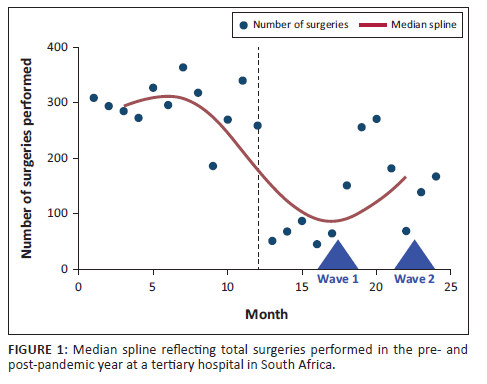
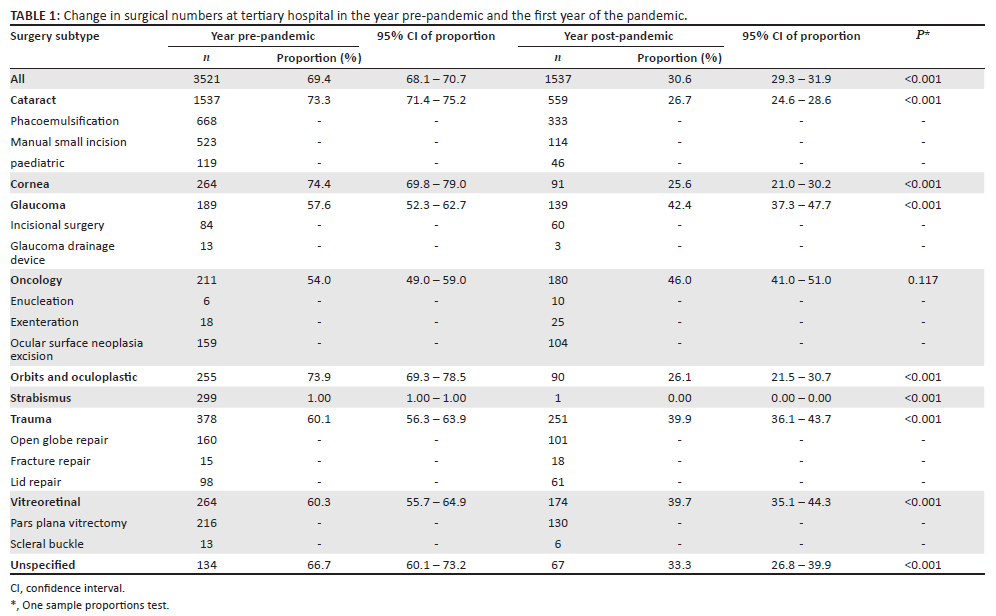
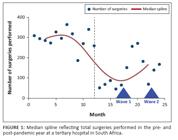
The change in the total number of ophthalmic surgeries and surgeries by subspeciality are summarised in Table 1. Of all the surgeries performed in the 2 years (n = 5072), 69.4% (95% confidence interval [CI]: 68.1-70.7; n = 3521) were performed in the pre-pandemic year and 30.6% (95% CI: 29.3-31.9; n = 1537) were performed in the post-lockdown year. The change in total surgical numbers during the 2 years is illustrated in Figure 1.
Ophthalmic surgical subgroups
A significant decrease was found in all subgroups apart from oncology. There were 391 oncology surgery cases performed over the 2 years, with 54% (95% CI: 49-59; n = 211) performed in the pre-pandemic year and 46% (95% CI: 41-51; n = 180) performed in the post-lockdown year. Cataract surgery, the most commonly performed procedure over the 2 years (n = 2096) significantly decreased, with 73.3% (95% CI: 71.4-75.2; n = 1537) of cases performed in the pre-pandemic year and 26.7% (95% CI: 24.6-28.6; n = 559) performed in the post-lockdown year. Table 1 summarises the change in each surgical subgroup with respect to the pandemic.
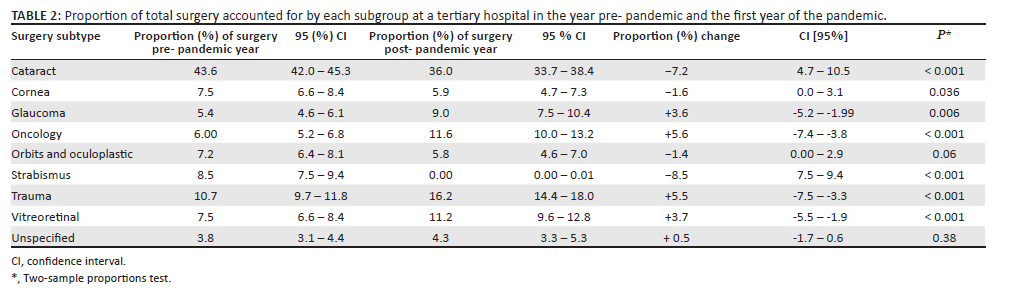
Strabismus surgery followed by cataract surgery saw the greatest decrease in terms of their contribution to the proportion of total surgical volume. Cataract surgery significantly decreased from 43.6% (95% CI: 42-45) of total surgical volume in the pre-pandemic year to 36% (95% CI: 33.7-38.4) in the post-lockdown year. Oncology surgery had the greatest increase with respect to proportion of total surgical volume, significantly increasing from 6% (95% CI: 4.5-6.0) in the pre-pandemic year to 11.6% (95% CI: 10.0-13.2) in the post-lockdown year. Proportionate changes of the various surgical subgroups with respect to the pandemic are summarised in Table 2.
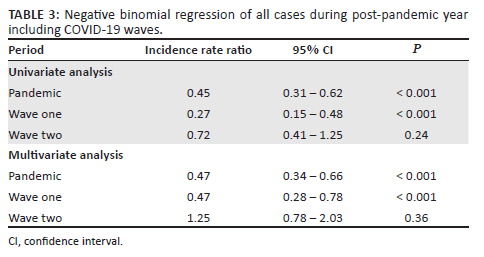
Univariate negative binomial regression of all cases revealed a significant incidence rate ratio (IRR) during wave one of 0.27 (95% CI: 0.15-0.48; P < 0.001) and a non-significant IRR of 0.72 (95% CI: 0.41-1.25; P = 0.24) during wave two (Table 3).
Predicted margins showed an expected 241 (95% CI: 192-292; P < 0.001) surgeries per month during the pandemic with 66 (95% CI: 21-100; P < 0.001) cases per month during wave one and 174 (95% CI: 85-263; P < 0.001) during wave two. Multivariate negative binomial regression, after adjusting for the pandemic (see Table 3 for summary) similarly revealed a significant IRR of 0.47 (95% CI: 0.28-0.78: P < 0.001) for wave one and a non-significant IRR of 1.25 (95% CI: 0.78-2.03; P < 0.36) for the total number of cases during wave two.
Change in trauma surgery cases during alcohol restrictions
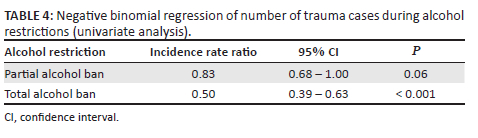
The post-lockdown year (during which alcohol was restricted) saw a significant decrease in trauma surgery with 60.1% (95% CI: 56.3-63.9; n = 378) of cases performed in the pre-pandemic year and 39.9% (95% CI: 36.1-43.7; n = 251) in the post-lockdown year. Univariate negative binomial regression found an insignificant decrease with an IRR of 0.83 (95% CI: 0.68-1.00; P = 0.06) during months with partial alcohol bans and a significantly decreased IRR of 0.50 (95% CI: 0.39-0.63; P < 0.001) during months with total bans (see Table 4 for summary).
Predicted margins showed an expected 32 (95% CI: 28-35) trauma surgery cases during months with no alcohol restrictions with 26 (95% CI: 22-30) cases during partial restrictions and 16 (95% CI: 12-19) during total bans.
Discussion
We analysed the effect of the COVID-19 pandemic on ophthalmic surgical practice at a tertiary referral centre in the most populous province of South Africa, Gauteng. South Africa is an upper middle income country of 59.2 million people, which in terms of economic distribution is one of the world's most unequal.2221,2324
St John Eye Hospital is the largest subspecialist academic ophthalmology centre in South Africa responsible for a large proportion of the South African population while also providing services to patients in other provinces and beyond the country's borders. The results of this study were concordant with international studies which documented the drastic decrease in ophthalmic surgeries, illustrated by the median spline in Figure 1, attributed to the COVID-19 pandemic (see Table 1 for summary of change in ophthalmic surgical numbers per year). Elective surgeries faced proportionate decreases in the post-lockdown year while surgical subgroups with emergent procedures such as trauma and oncology surgery saw proportionate increases (see Table 2 for summary of decrease as a function of proportion performed per year).
As St John Eye Hospital is an academic facility, not only do the decreased surgical numbers have a negative impact on healthcare provision but also on resident training. South African ophthalmology residents are expected to perform 300 cataract surgeries as part of their 4-year curriculum.25
This study, in comparison to most others which looked at the initial stage of the pandemic, evaluated the entire first year. The first year of the pandemic included two waves and was a period in which vaccines were unavailable to the South African public. Vaccines were rolled out to healthcare workers in February 2021 and became available to the public in May 2021.26,2728,29Table 3 for summary of univariate and multivariate analysis). The recovery in surgical numbers in wave two reflects the healthcare system adapting to the challenges brought forth by the pandemic.
Cataract surgery after strabismus suffered the worst decline in the post-lockdown year. This is of particular concern as the vast majority of patients rely on the state sector and even pre-pandemic South Africa lagged behind peers with its cataract surgery rate.3030,31
Glaucoma surgery significantly declined during the post-lockdown year albeit with the second smallest change in the subcategories examined. Holland et al. analysed the effect of COVID-19 pandemic on glaucoma surgical practice in the United Kingdom, and in concordance with this study found incisional glaucoma surgery as the most commonly performed procedure; however, their study found a change in practice favouring procedures such as diode lasers and glaucoma drainage devices, which require less postoperative visits.11
Oncological surgery had the smallest change from pre- to post-pandemic years and this change was not statistically significant. This is reassuring as these are potentially lifesaving procedures. The authors believe that this reflects a successful aspect of the triage system. This is similar to the Brazilian experience where Fontes Junior et al. reported no significant change in ocular oncology surgeries performed at a referral centre for ocular oncology in Sao Paulo.32
Vitreoretinal surgical procedures saw a significant decline. The reasons for this are potentially decreased presentations because of containment and reduced risk factors as a result of a decreased incidence of cataract surgery and trauma.33341
Trauma surgery significantly decreased in the first year of the pandemic. This is concordant with studies performed in other specialities in South Africa.5,6Table 4 for summary). Total alcohol bans resulted in a decreased burden of trauma surgeries when compared with partial bans. The predicted margins revealed an expected number of trauma cases during months with no alcohol ban at 32 cases. This contrasted with months with total bans at 16 cases and those with a partial alcohol ban at 26 cases. This highlights the deleterious effect that alcohol consumption has on the South African healthcare system.
The severe effect of the COVID-19 pandemic on ophthalmic surgery in a developing world setting is apparent from the decreased numbers and changed the proportionality of procedures, favouring emergent and urgent surgery. This impacts both patient care as well as resident and fellow training.
As a result of the retrospective nature of data collection that evaluated theatre records, data could not be ascertained on changes in surgical numbers caused by extenuating factors not related to the COVID-19 pandemic such as consumable shortages or equipment maintenance. In terms of trauma, records do not reflect whether alcohol consumption was a factor in individual cases.
Conclusion
In conclusion, ophthalmic surgical numbers in all subgroups decreased during the first year of the COVID-19 pandemic with elective procedures such as cataracts and strabismus surgeries facing the steepest declines. This change being as a result of the implications of the pandemic on surgical practice as well as resultant socioeconomic effects of political measures. This information is crucial in informing strategy for addressing the backlog as well as to prepare for the effect of possible future pandemics.
Competing interests
The authors declare that they have no financial or personal relationship(s) that may have inappropriately influenced them in writing this article.
Authors' contributions
I.M. was responsible for designing and writing the protocol, collecting data and writing the report and was also responsible for drawing tables. N.A. was responsible for designing the protocol, analysing data, interpreting results and writing the report and contributed to writing the methodology, conducting the statistical analysis and generating the splines. A.M. was responsible for the research topic choice, designing the protocol and editing the protocol and report.
Funding information
This research received no specific grant from any funding agency in the public, commercial or not-for-profit sectors.
Data availability
There are no accession codes, unique identifiers or weblinks for publicly available datasets. The figures of raw data are from theatre books at St. John Eye Hospital, and the raw data are available as per permission from the Head of Department at St. John Eye Hospital and the Medical Advisory Committee at Chris Hani Baragwanath Academic Hospital.
Disclaimer
The views and opinions expressed in this article are those of the authors and do not necessarily reflect the official policy or position of any affiliated agency of the authors.
Acknowledgements
References
-
1.Baudin F, Benzenine E, Mariet A-S, et al. Impact of COVID-19 lockdown on surgical procedures for retinal detachment in France: A national database study. Br J Ophthalmology 2023;107(4):565-569. https://doi.org/10.1136/bjophthalmol-2021-319531
» https://doi.org/10.1136/bjophthalmol-2021-319531 -
2.McIntosh A, Bachmann M, Siedner MJ, Gareta D, Seeley J, Herbst K. Effect of COVID-19 lockdown on hospital admissions and mortality in rural KwaZulu-Natal, South Africa: Interrupted time series analysis. BMJ Open. 2021;11(3):e047961. https://doi.org/10.1136/bmjopen-2020-047961
» https://doi.org/10.1136/bmjopen-2020-047961 -
3.Hale T, Angrist N, Goldszmidt R, et al. A global panel database of pandemic policies (Oxford COVID-19 Government Response Tracker). Nat Hum Behav. 2021;5(4):529-538. https://doi.org/10.1038/s41562-021-01079-8
» https://doi.org/10.1038/s41562-021-01079-8 -
4.Chu KM, Marco J, Bougard H, et al. Estimating the surgical backlog from the COVID-19 lockdown in South Africa: A retrospective analysis of six government hospitals. S Afr Med J. 2021;111(7):685. https://doi.org/10.7196/SAMJ.2021.v111i7.15686
» https://doi.org/10.7196/SAMJ.2021.v111i7.15686 -
5.Van Hoving DJ, Van Koningsbruggen C, De Man M, Hendrikse C. Temporal changes in trauma according to alcohol sale restrictions during the South African national COVID-19 lockdown. Afr J Emerg Med. 2021;11(4):477-482. https://doi.org/10.1016/j.afjem.2021.08.001
» https://doi.org/10.1016/j.afjem.2021.08.001 -
6.Reuter H, Jenkins LS, De Jong M, Reid S, Vonk M. Prohibiting alcohol sales during the coronavirus disease 2019 pandemic has positive effects on health services in South Africa. Afr J Prim Health Care Fam Med. 2020;12(1):a2528. https://doi.org/10.4102/phcfm.v12i1.2528
» https://doi.org/10.4102/phcfm.v12i1.2528 -
7.Moultrie TA, Dorrington RE, Laubscher R, et al. Unnatural deaths, alcohol bans and curfews: Evidence from a quasi-natural experiment during COVID-19. S Afr Med J. 2021;111(9):834. https://doi.org/10.7196/SAMJ.2021.v111i9.15813
» https://doi.org/10.7196/SAMJ.2021.v111i9.15813 -
8.Matzopoulos RG, Truen S, Bowman B, Corrigall J. The cost of harmful alcohol use in South Africa. S Afr Med J. 2013;104(2):127. https://doi.org/10.7196/samj.7644
» https://doi.org/10.7196/samj.7644 -
9.Danesh-Meyer HV, McGhee CNJ. Implications of COVID-19 for ophthalmologists. Am J Ophthalmol. 2021;223:108-118. https://doi.org/10.1016/j.ajo.2020.09.027
» https://doi.org/10.1016/j.ajo.2020.09.027 -
10.Breazzano MP, Nair AA, Arevalo JF, et al. Frequency of urgent or emergent vitreoretinal surgical procedures in the United States during the COVID-19 pandemic. JAMA Ophthalmol. 2021;139(4):456. https://doi.org/10.1001/jamaophthalmol.2021.0036
» https://doi.org/10.1001/jamaophthalmol.2021.0036 -
11.Holland LJ, Kirwan JF, Mercieca KJ. Effect of COVID-19 pandemic on glaucoma surgical practices in the UK. Br J Ophthalmol 2022;106(10):1406-1410. https://doi.org/10.1136/bjophthalmol-2021-319062
» https://doi.org/10.1136/bjophthalmol-2021-319062 -
12.Wolff D, Nee S, Hickey NS, Marschollek M. Risk factors for Covid-19 severity and fatality: A structured literature review. Infection. 2021;49(1):15-28. https://doi.org/10.1007/s15010-020-01509-1
» https://doi.org/10.1007/s15010-020-01509-1 -
13.Azad AD, Mishra K, Lee EB, et al. Impact of early COVID-19 pandemic on common ophthalmic procedures volumes: A US claims-based analysis. Ophthalmic Epidemiol 2022;29(6):604-612. https://doi.org/10.1080/09286586.2021.2015394
» https://doi.org/10.1080/09286586.2021.2015394 -
14.Anon. Ophthalmological Society of South Africa. COVID-19 information for the opthalmology patient [homepage on the Internet]. 2020 [cited 2020 May 11]. Available from: https://ossa.autoprax.co.za/api/images/pdf/5e788b26b09791041d2e7d8f
» https://ossa.autoprax.co.za/api/images/pdf/5e788b26b09791041d2e7d8f -
15.Nguyen AX, Gervasio KA, Wu AY. Differences in SARS-CoV-2 recommendations from major ophthalmology societies worldwide. BMJ Open Ophthalmol. 2020;5(1):e000525. https://doi.org/10.1136/bmjophth-2020-000525
» https://doi.org/10.1136/bmjophth-2020-000525 -
16.Al-khersan H, Kalavar MA, Tanenbaum R, et al. Emergent ophthalmic surgical care at a tertiary referral center during the COVID-19 pandemic. Am J Ophthalmol. 2021;222:368-372. https://doi.org/10.1016/j.ajo.2020.08.044
» https://doi.org/10.1016/j.ajo.2020.08.044 -
17.Felfeli T, Ximenes R, Naimark DMJ, et al. The ophthalmic surgical backlog associated with the COVID-19 pandemic: A population-based and microsimulation modelling study. CMAJ Open. 2021;9(4):E1063-E1072. https://doi.org/10.9778/cmajo.20210145
» https://doi.org/10.9778/cmajo.20210145 - 18.Scott DAR, Hadden PW, Wilson GA. Impact of the COVID-19 pandemic lockdown on public sector ophthalmic work by New Zealand's ophthalmologists. N Z Med J. 2021;134(1538):120.
-
19.Toro MD, Brézin AP, Burdon M, et al. Early impact of COVID-19 outbreak on eye care: Insights from EUROCOVCAT group. Eur J Ophthalmol. 2021;31(1):5-9. https://doi.org/10.1177/1120672120960339
» https://doi.org/10.1177/1120672120960339 -
20.Greyling T, Rossouw S, Adhikari T. A tale of three countries: What is the relationship between COVID-19, lockdown and happiness? S Afr J Econ. 2021;89(1):25-43. https://doi.org/10.1111/saje.12284
» https://doi.org/10.1111/saje.12284 -
21.Anon. 1789 patients waiting for cataract ops at Bara - Jack Bloom - POLITICS [homepage on the Internet]. Politicsweb. [cited 2022 Jul 16]. Available from: https://www.politicsweb.co.za/politics/1789-patients-waiting-for-cataract-ops-at-bara--ja
» https://www.politicsweb.co.za/politics/1789-patients-waiting-for-cataract-ops-at-bara--ja -
22.Moonasar D, Pillay A, Leonard E, et al. COVID-19: Lessons and experiences from South Africa's first surge. BMJ Glob Health. 2021;6(2):e004393. https://doi.org/10.1136/bmjgh-2020-004393
» https://doi.org/10.1136/bmjgh-2020-004393 -
23.Metelerkamp T. Cataract surgery: Cataract surgeries are backing up in the Western Cape, but it's not a new problem. Daily Maverick [serial online]. 2022 [cited 2022 Jul 16]. Available from: https://www.dailymaverick.co.za/article/2022-07-07-cataract-surgeries-are-backing-up-in-the-western-cape-but-its-not-a-new-problem/
» https://www.dailymaverick.co.za/article/2022-07-07-cataract-surgeries-are-backing-up-in-the-western-cape-but-its-not-a-new-problem/ -
24.Cockburn N, Steven D, Lecuona K, et al. Prevalence, causes and socio-economic determinants of vision loss in Cape Town, South Africa. PLoS One. 2012;7(2):e30718. https://doi.org/10.1371/journal.pone.0030718
» https://doi.org/10.1371/journal.pone.0030718 -
25.Anon. The Colleges of Medicine of South Africa: Fellowship of the College of Ophthalmologists of South Africa [homepage on the Internet]. [cited 2022 Aug 01]. Available from: https://www.cmsa.co.za/view_exam.aspx?QualificationID=17
» https://www.cmsa.co.za/view_exam.aspx?QualificationID=17 -
26.Cooper S, Van Rooyen H, Wiysonge CS. COVID-19 vaccine hesitancy in South Africa: How can we maximize uptake of COVID-19 vaccines? Expert Rev Vaccines. 2021;20(8):921-933. https://doi.org/10.1080/14760584.2021.1949291
» https://doi.org/10.1080/14760584.2021.1949291 -
27.Dzinamarira T, Nachipo B, Phiri B, Musuka G. COVID-19 vaccine roll-out in South Africa and Zimbabwe: Urgent need to address community preparedness, fears and hesitancy. Vaccines. 2021;9(3):250. https://doi.org/10.3390/vaccines9030250
» https://doi.org/10.3390/vaccines9030250 -
28.Maslo C, Friedland R, Toubkin M, Laubscher A, Akaloo T, Kama B. Characteristics and outcomes of hospitalized patients in South Africa during the COVID-19 omicron wave compared with previous waves. JAMA. 2022;327(6):583. https://doi.org/10.1001/jama.2021.24868
» https://doi.org/10.1001/jama.2021.24868 -
29.Bekker L-G, Ntusi NAB. Lessons from two SARS-CoV-2 waves in South Africa. Lancet Global Health. 2021;9(9):e1177-e1178. https://doi.org/10.1016/S2214-109X(21)00313-2
» https://doi.org/10.1016/S2214-109X(21)00313-2 -
30.Wang W, Yan W, Fotis K, et al. Cataract surgical rate and socioeconomics: A global study. Invest Ophthalmol Vis Sci. 2017;57(14):5872. https://doi.org/10.1167/iovs.16-19894
» https://doi.org/10.1167/iovs.16-19894 -
31.Anon. 13 603 patients wait for cataract ops in Gauteng - Jack Bloom - POLITICS [homepage on the Internet]. Politicsweb. [cited 2022 Jul 16]. Available from: https://www.politicsweb.co.za/politics/13-603-patients-wait-for-cataract-ops-in-gauteng--
» https://www.politicsweb.co.za/politics/13-603-patients-wait-for-cataract-ops-in-gauteng-- -
32.Fontes Junior VC, Fernandes AG, Morales MC, Belfort Neto R. The impact of the COVID-19 pandemic on the diagnosis and treatment of ocular cancer. Arq Bras Oftalmol 2023;86(2):127-130. https://doi.org/10.5935/0004-2749.20230023
» https://doi.org/10.5935/0004-2749.20230023 -
33.Feltgen N, Walter P. Rhegmatogenous retinal detachment - An ophthalmologic emergency. Dtsch Arztebl Int. 2014;111(1-2):12-22. https://doi.org/10.3238/arztebl.2014.0012
» https://doi.org/10.3238/arztebl.2014.0012 -
34.Kumar A, Arora A, Sharma P, et al. Is diabetes mellitus associated with mortality and severity of COVID-19? A meta-analysis. Diabetes Metab Syndr. 2020;14(4):535-545. https://doi.org/10.1016/j.dsx.2020.04.044
» https://doi.org/10.1016/j.dsx.2020.04.044

Accepted: 09 Oct. 2023
Published: 19 Dec. 2023