Patterns of refractive errors and visual function in school-going children in South Africa
Abstract
BACKGROUND: Uncorrected refractive error is the most significant contributor of VI in children and is usually detected through vision screenings or scheduled eye and vision examinations conducted among school children. AIM: To describe patterns of refractive errors (RE), visual function and amblyopia in school-going children. SETTING: Mankweng, Polokwane, South Africa. METHODS: Retrospective chart reviews were conducted on 837 clinical record cards of children attending selected schools and who were screened between 2019 and 2021 at the University of Limpopo Optometry clinic. Purposive sampling was used to sample the clinical record cards. RESULTS: About 134 children (16%) reported blurred vision, 197 (23.5%) failed distance visual acuity screening, while 173 (20.7%) had RE. Myopia among 168 (9.6%) children was the most common RE, followed by astigmatism and hyperopia at 60 (4.70%) and 28 (4.4%), respectively. Furthermore, 14 (1.7%) children had anisometropia. Amblyopia, colour vision deficiency and contrast sensitivity were also detected at prevalence rates of 4.4%, 9.8% and 8.2%, respectively. CONCLUSION: Vision screenings and regular comprehensive eye examinations are commonly conducted to detect and manage REs to prevent or delay the onset of amblyopia and strabismus. Children had a high prevalence of RE and amblyopia, which is similar to global estimates. CONTRIBUTION: To describe the pattern of REs, amblyopia and visual function, which is critical to understand the prevalence of amblyopia and associated conditions. Knowing the patterns of these conditions may provide an impetus for the implementation of strategies such as vision screenings and vision examinations in schools.
refractive error; amblyopia; visual impairment; vision anomalies in children; Polokwane; South Africa
Introduction
Globally, moderate to severe visual impairment (VI) and blindness in 2020 were estimated to be 295.0 million and 43.3 million, respectively.11212,33123
The impact of VI in children is dire and has long-term consequences. If not attended to, affected children may drop out of school, which has a potential of limiting their meaningful participation in economic activities such as formal jobs later in their life.4,561
Visual health has a significant impact in the educational achievement of children in schools, their quality of life in general and their ability to contribute to the economic activities as they grow older.7,8999
Children entering school at primary level or leaving school at secondary level or those presenting with apparent signs and symptoms such as white pupil, squint, red eyes, ocular torticollis, persistent headaches and inability to copy from the board should be screened for visual and eye health.810
In countries such as the United Kingdom (UK), neonates are examined after birth with red reflex to check for eye defects with follow-up done by a general practitioner at about 6-8 weeks to check whether the eyes of babies are free from abnormalities.111112,1312,131212
There is a battery of tests considered for vision screening in South Africa as outlined by the Health Professions Council of South Africa (HPCSA) guidelines.14151617,18,1920,2120,21
Methods
Study design
Quantitative retrospective chart reviews were conducted to analyse optometry clinical record cards medical records of 837 primary school children aged from 5 to 15 years who attended the University of Limpopo Optometry clinic in Polokwane, Limpopo province, South Africa, between 2019 and 2021.
Sampling
A purposive total population sample of optometry clinical record cards of school children from selected schools in Polokwane who consulted at the University of Limpopo Optometry clinic were selected for the study. Patient examination in this clinic was only conducted on children whose parents granted consent for their children's participation. Optometry clinic record cards without data on diagnosis on REs were excluded.
Data collection
A Microsoft Excel spreadsheet was created for extracted data from the patients' optometry clinical record cards. Demographic data, including age, gender, race and clinical data, including VA, reason for seeking a consultation, presenting signs and symptoms, RE, contrast sensitivity, colour vision and the 2 D test were collected.
Data analysis
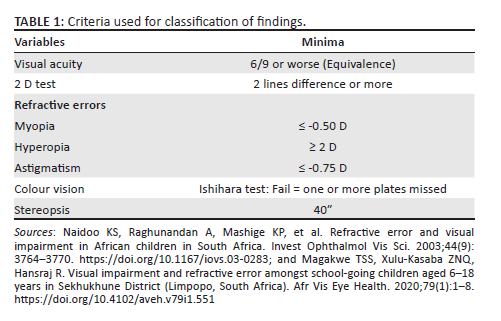
Data were exported into the Statistical Package for Social Sciences (SPSS) software version 28 (Armonk, New York, United States) for analysis. The pass and/or fail criteria for the vision screening are outlined in Table 1. Visual acuity for both distances was converted to decimal notation, for ease of analysis. The main reported reason for seeking a consultation was considered for analysis. The adapted Refractive Error Study in Children (RESC) protocol19,20Table 1 was used to define whether children had refractive errors or not.
The Kolmogorov-Smirnov and Shapiro-Wilk tests were performed to check normality of the distribution of continuous data. Both tests showed significant difference (p < 0.001) for all the variables tested; hence the null hypothesis was rejected, and it was concluded that the data were not normally distribution. Mann-Whitney-Wilcoxon test was then carried out to test symmetry between the two eyes and also between the distance visual acuity (DVA) and near visual acuity (NVA). Gender variation of variables on the left eye (OD) were tested using the Kruskal-Wallis test. Chi square tests were used to test the gender preference on amblyopia, colour vision anomalies and contrast sensitivity. Spearman rank correlation tested the association between tested variables and age. Significance level (p) was set to be 0.05.
Ethical considerations
The research process of study observed the Declaration of Helsinki. Ethical approval was obtained from the University of Limpopo Research and Ethics Committee (TREC) reference no. TREC/171/2021: UG.
Results
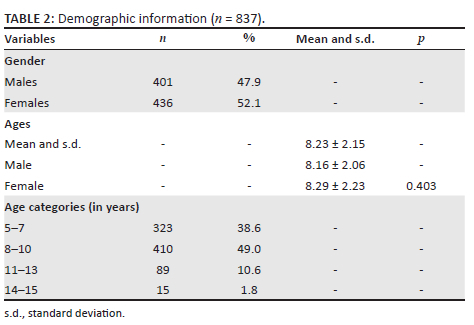
Table 2 presents relevant demographic results for the sample of 837 children as derived from their clinical records.
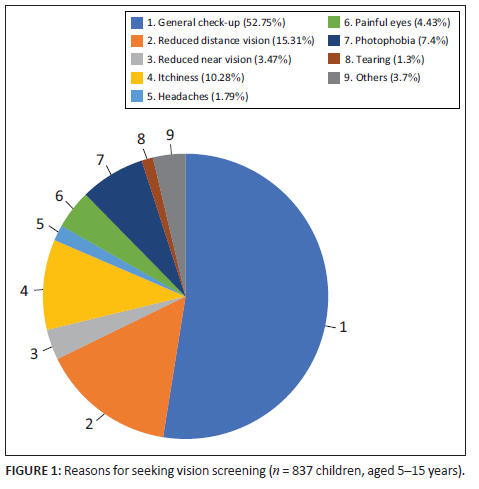
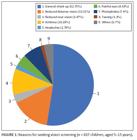
Figure 1 shows the main reason reported for seeking a consultation where 441 (52.7%) consulted for a general check-up, 128 (15.3%) reported having blurred distance vision, 86 (10.37%) had itchy eyes and 62 (7.4%) had photophobia. Thirty-seven (4.4%) participants were diagnosed with vernal keratoconjunctivitis (VKC) and were receiving treatment.
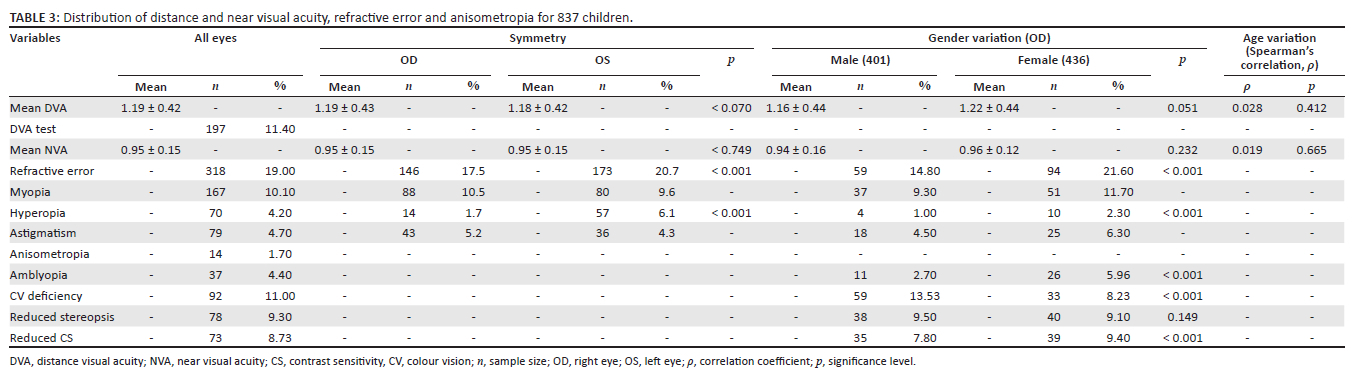
As shown in Table 3, the mean DVA in decimal notation for both eyes was 1.19 ± 0.42, and the mean NVA test was 0.95 ± 0.15. There was no significant difference in DVA (p = 0.070) and NVA (p = 0.749) between the right and left eyes (p = 0.070). There was a significant difference (p = 0.051) in DVA between females and males, but no significant difference (p = 0.232) was observed for NVA by gender. There was no correlation for DVA (r = 0.028; p = 0.412) and NVA (r = 0.019; p = 0.665) against age.
In terms of diagnosis (as shown in Table 3), 173 (20.7) children had RE in either eye, with 80 (9.6%) classified to have myopia, 57 (6.1%) had hyperopia and 36 (4.3%) had astigmatism. Refractive errors were asymmetrical between the two eyes (p < 0.001). Refractive errors were more common in females than in males (p < 0.001). Anisometropia was noted in 14 (1.7%) persons. For functional tests, 92 (11.0%) had colour vision deficiency, 78 (9.3%) had reduced stereopsis, 73 (8.7%) had reduced contrast sensitivity and 37 (4.0%) had amblyopia. Colour vision deficiencies (CVD), reduced stereopsis, reduced contrast sensitivity and amblyopia were more common in females than in males (p < 0.001).
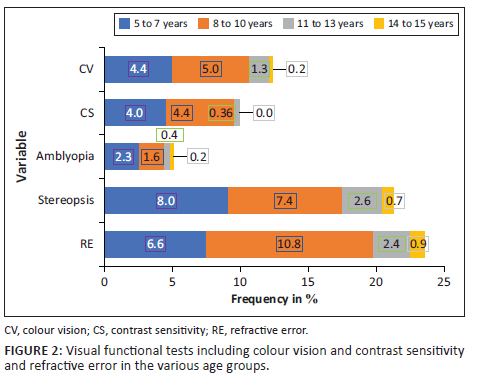
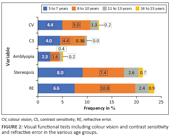
Figure 2 shows the association between RE and visual functions with age categories, and there was an association between age and REs (p < 0.001), colour vision (p < 0.001) and amblyopia (p < 0.001).
Discussion
Children (of mean age 8.13 ± 2.30 years) with ages between 3-18 years attended the clinic to receive an eye examination. The majority (49%) of the children were between ages 8-10 years and another significant proportion (24.5%) being between ages 3-6 years. An advantage of screening children early is that amblyopia and strabismus are usually established between ages 6-7 years, and response to treatment in children between ages 8-9 years or younger is greater.221,19,23,24,25,26,2714
Slightly more females (52.1%) attended the clinic for vision examination. This reflects the demographics of the area targeted.282930312931
Almost a half (47.1%) of the children in this study reported not seeing clearly at distance, at near or to have some ocular discomfort. Reduced vision or ocular discomforts can affect the quality of life to those inflicted.3230
Mankweng area has a warm and dry environment,33343536
About 11.4% of the children failed DVA test. Distance visual acuity measurement is commonly used in many screening programmes, with the 6/9 or poorer DVA necessitating referral for a comprehensive vision examination. This criterion is referred to as the 'golden standard' and an acceptable indicator to determine the visual well-being of children.1437373814
In all, 10.3% of the children failed the near NVA test. Near VA is an essential test and may be an indicator to check the ability of the children to see well at near when executing tasks in the classroom environment.1419,20,21,39,40,41
Prevalence of REs in this study was 20.7%. This finding is lower than that for another study also conducted in Limpopo province at the Mopani district (35.8%)212042
In terms of spread of the REs, myopia was the most prevalent RE at 9.6% of the sampled population. This finding is similar to the 10.4% found in the Sekhukhune area of Limpopo province,2021191719
This current study found astigmatism (4.7%) to be more common as compared to that of hyperopia (4.2%). This varied with findings of other studies elsewhere. Astigmatism was estimated to be higher than hyperopia in a South African population1939434421
Amblyopia was present in 4.4% of the children screened. This is in line with a study conducted by Mustafaie et al.224546224746p < 0.001) between age and presence of amblyopia. Amblyopia is more responsive to treatment at ages below 7 years4846
The study revealed a 9.2% presence of CVD. The prevalence of CVD varies between 2% and 14%.491850515250,51,52,5349
Amblyopia was prevalent in 4.4% of the children, which is in line with the global estimate although it was very high as compared to estimated prevalence in Africa. In addition, there multi-approaches of intervention are required to immediately address these challenges. Firstly, awareness campaigns should be organised at a larger scale in schools that are targeted at children to provide awareness about visual and ocular health. Secondly, government through the Department of Basic Education should implement mandatory screening for children entering various phases of education such as early childhood development phase (crèche; for 3-4-year-olds), foundation phase (grade R to 3; for 5-9 years old) and intermediate phase (grade 4-6; for 10-12 years old), senior phase (grade 7-9; for 13-15 years old). Thirdly, educational programs for teachers can be implemented such as to enable them to identify children that have challenges with their vision.54
This study did not explore the potential causative or risk factors that contribute to onset of REs and visual function deficiencies. The presence of REs is limited to this clinic population and may not be generalised to the entire population. A structured protocol was developed with a defined tool for transcription of data to ensure validity of the study.
Conclusion
This study outlines the profile of REs, amblyopia and visual functions. Most children had good vision although a significant number had REs, and some had amblyopia. Visual function tests found presence of CVD, poor contrast sensitivity and stereopsis, which were more common in females than males and varied according to age. The findings provide a good baseline to raise awareness on the need of mandatory vision screening and/or examination in schools or early life of children. Teachers and children may be educated such as to increase the rate of self-referral to eyecare facilities and to enable teachers to identify children that have visual and ocular challenges.
Competing interests
The authors declare that this article was written in the interest of knowledge contribution and not influenced by any financial or personal relationships.
Authors' contributions
R.M.L. was the study leader. R.M.L., N.S., M.T.M, T.K., K.E.M., R.G.M. and L.M. developed the study protocol and performed data collection. The study was performed under the supervision of P.M.W.N. and C.M.L.S, who provided feedback on the research protocol development. P.M.W.N., C.M.L.S. and M.G.R. wrote the manuscript.
Funding information
The authors received no financial support for the research, authorship, and/or publication of this article.
Data availability
Data used to support the findings of the study are available from the corresponding author, P.M.W.N., upon reasonable request.
Disclaimer
The views and opinions expressed in this article are those of the authors and are the product of professional research. It does not necessarily reflect the official policy or position of any affiliated institution, funder, agency, or that of the publisher. The authors are responsible for this article's results, findings, and content.
Acknowledgements
The authors like to acknowledge Mavhungu A. and Ntsobe L.S. for data capturing. The authors would also like to acknowledge the University of Limpopo Department of Optometry for providing resources towards the project.
References
-
1.Marques AP, Ramke J, Cairns J, et al. The economics of vision impairment and its leading causes: A systematic review. EClinicalMedicine. 2022;46:101354. https://doi.org/10.1016/j.eclinm.2022.101354
» https://doi.org/10.1016/j.eclinm.2022.101354 -
2.Al Wadaani FA, Amin TT, Ali A, Khan AR. Prevalence and pattern of refractive errors among primary school children in Al Hassa, Saudi Arabia. Glob J Health Sci. 2013;5(1):125. https://doi.org/10.5539/gjhs.v5n1p125
» https://doi.org/10.5539/gjhs.v5n1p125 - 3.Jan CL, Timbo CS, Congdon N. Children's myopia: Prevention and the role of school programmes. Community Eye Health. 2017;30(98):37.
- 4.Resnikoff S, Kocur I. Non-communicable eye diseases: Facing the future. Community Eye Health. 2014;27(87):41-43.
-
5.Hegazy NN, Farag1 NA, Kasemy Z. Quality of life among primary schools children with refractive errors in Menoufia, Egypt. Egypt Fam Med J. 2018;2(2):1-14. https://doi.org/10.21608/efmj.2018.68560
» https://doi.org/10.21608/efmj.2018.68560 -
6.Sharma R, Titiyal JS, Prakash G, Sharma N, Tandon R, Vajpayee RB. Clinical profile and risk factors for keratoplasty and development of hydrops in North Indian patients with keratoconus. Cornea. 2009;28(4):367-370. https://doi.org/10.1097/ICO.0b013e31818cd077
» https://doi.org/10.1097/ICO.0b013e31818cd077 - 7.Seema S, Vashisht S, Meenakshi K, Manish G. Magnitude of refractive errors among school children in a rural block of Haryana. Internet J Epidemiol. 2012;6(2):21-24.
- 8.Yasmin S, Minto H, Chan VF. School eye health - Going beyond refractive errors. Community Eye Health. 2015;28(89):14.
-
9.Ferebee A. Childhood vision: Public challenges and opportunities. A policy brief [homepage on the Internet]. The Center for Health and Health Care in Schools. School of Public Health and Health Services, The George Washington University Medical Center; 2004 [cited n.d.]. Available from: http://www.healthinschools.org/Health-in-Schools/Health-Services/School-Health-Services/School-Health-Issues/~/media/Files/PDF/visionfinal.ashx
» http://www.healthinschools.org/Health-in-Schools/Health-Services/School-Health-Services/School-Health-Issues/~/media/Files/PDF/visionfinal.ashx - 10.Bachani DD. School eye health in South Asia. Community Eye Health. 2017;30(98):S1.
-
11.O'Colmain U, Low L, Gilmour C, MacEwen CJ. Vision screening in children: A retrospective study of social and demographic factors with regards to visual outcomes. Br J Ophthalmol. 2016;100(8):1109-1113. https://doi.org/10.1136/bjophthalmol-2015-307206
» https://doi.org/10.1136/bjophthalmol-2015-307206 -
12.Grossman DC, Curry SJ, Owens DK, et al. Vision screening in children aged 6 months to 5 years: US preventive services task force recommendation statement. JAMA. 2017;318(9):836-844. https://doi.org/10.1001/jama.2017.11260
» https://doi.org/10.1001/jama.2017.11260 -
13.Gudgel D. Eye screening for children [homepage on the Internet]. American Academy of Ophthalmology; 2021 [cited 2023 Jan 11]. Available from: https://www.aao.org/eye-health/tips-prevention/children-eye-screening
» https://www.aao.org/eye-health/tips-prevention/children-eye-screening -
14.Metsing IT, Hansraj R, Jacobs W, Nel EW. Review of school vision screening guidelines. Afr Vis Eye Health. 2018;77(1):1-10. https://doi.org/10.4102/aveh.v77i1.444
» https://doi.org/10.4102/aveh.v77i1.444 - 15.Hall D, Elliman D. Health for all children: Revised fourth edition. 4th ed. New York, NY: Orford University Press; 2010.
-
16.Otutu M, Nachega J, Harvey J, Meyer D. The prevalence of refractive error in three communities of Cape Town, South Africa. Afr Vis Eye Health. 2012;71(1):a65. https://doi.org/10.4102/aveh.v71i1.65
» https://doi.org/10.4102/aveh.v71i1.65 -
17.Mashige KP, Jaggernath J, Ramson P, Martin C, Chinanayi FS, Naidoo KS. Prevalence of refractive errors in the INK Area, Durban, South Africa. Optom Vis Sci. 2016;93(3):243-250. https://doi.org/10.1097/OPX.0000000000000771
» https://doi.org/10.1097/OPX.0000000000000771 -
18.Mashige KP, Van Staden DB. Prevalence of congenital colour vision deficiency among Black school children in Durban, South Africa. BMC Res Notes. 2019;12(1):1-5. https://doi.org/10.1186/s13104-019-4374-1
» https://doi.org/10.1186/s13104-019-4374-1 -
19.Naidoo KS, Raghunandan A, Mashige KP, et al. Refractive error and visual impairment in African children in South Africa. Invest Ophthalmol Vis Sci. 2003;44(9):3764-3770. https://doi.org/10.1167/iovs.03-0283
» https://doi.org/10.1167/iovs.03-0283 -
20.Magakwe TSS, Xulu-Kasaba ZNQ, Hansraj R. Visual impairment and refractive error amongst school-going children aged 6-18 years in Sekhukhune District (Limpopo, South Africa). Afr Vis Eye Health. 2020;79(1):1-8. https://doi.org/10.4102/aveh.v79i1.551
» https://doi.org/10.4102/aveh.v79i1.551 - 21.Baloyi VHA, Akinsola HA, Mabunda JT. Pattern of distribution of refractive error among primary school children in Malamulele community of Limpopo province, South Africa. Afr J Phys Act Health Sci. 2018;24(3):142-152.
-
22.Mostafaie A, Ghojazadeh M, Hosseinifard H, et al. A systematic review of amblyopia prevalence among the children of the world. Rom J Ophthalmol. 2020;64(4):342. https://doi.org/10.22336/rjo.2020.56
» https://doi.org/10.22336/rjo.2020.56 -
23.Rajavi Z, Sabbaghi H, Baghini A, et al. Prevalence of amblyopia and refractive errors among primary school children. J Ophthalmic Vis Res. 2015;10(4):408. https://doi.org/10.4103/2008-322X.176909
» https://doi.org/10.4103/2008-322X.176909 -
24.Kedir J, Girma A. Prevalence of refractive error and visual impairment among rural school-age children of Goro District, Gurage Zone, Ethiopia. Ethiop J Health Sci. 2014;24(4):353-358. https://doi.org/10.4314/ejhs.v24i4.11
» https://doi.org/10.4314/ejhs.v24i4.11 -
25.Soler M, Anera RG, Castro JJ, Jiménez R, Jiménez JR. Prevalence of refractive errors in children in Equatorial Guinea. Optom Vis Sci. 2015;92(1):53-58. https://doi.org/10.1097/OPX.0000000000000448
» https://doi.org/10.1097/OPX.0000000000000448 -
26.Mehari ZA, Yimer AW. Prevalence of refractive errors among schoolchildren in rural central Ethiopia. Clin Exp Optom. 2013;96(1):65-69. https://doi.org/10.1111/j.1444-0938.2012.00762.x
» https://doi.org/10.1111/j.1444-0938.2012.00762.x - 27.Ndou NP, Malangu NG. Uncorrected refractive errors among primary school children of Moretele sub-district in North-west Province, South Africa. [Doctoral dissertation]. Pretoria; University of Limpopo (Medunsa Campus); 2014.
- 28.Department of Corperative Governance and Traditional Affairs. Capricorn District Municipality, Limpopo Province-District development model, profiles and analysis. Pretoria: Department of Corporate Governance and Traditional Affairs; 2020.
-
29.Nkoana PM, Moodley VR, Mashige KP. Self-reported knowledge and skills related to diagnosis and management of keratoconus among public sector optometrists in the Limpopo province, South Africa. Afr J Prim Health Care Fam Med. 2022;14(1):1-9. https://doi.org/10.4102/phcfm.v14i1.3668
» https://doi.org/10.4102/phcfm.v14i1.3668 -
30.Angeles-Han ST, Griffin KW, Harrison MJ, et al. Development of a vision related quality of life instrument for children 8-18 years of age for use in Juvenile Idiopathic Arthritis-associated Uveitis. Arthritis Care Res. 2011;63(9):1254-1261. https://doi.org/10.1002/acr.20524
» https://doi.org/10.1002/acr.20524 -
31.Surrati AM, Almuwarraee SM, Mohammad RA, et al. Parents' awareness and perception of children's eye diseases in Madinah, Saudi Arabia: A cross-sectional study. Cureus. 2022;14(2):e22604. https://doi.org/10.7759/cureus.22604
» https://doi.org/10.7759/cureus.22604 -
32.Stevelink SAM, Malcolm EM, Fear NT. Visual impairment, coping strategies and impact on daily life: A qualitative study among working-age UK ex-service personnel health behavior, health promotion and society. BMC Public Health. 2015;15(1):1118. https://doi.org/10.1186/s12889-015-2455-1
» https://doi.org/10.1186/s12889-015-2455-1 - 33.Holland H, McGregor G. Environmental impact assessment for the proposed Matimba-Witkop no. 2 400 kv Transmission line, Northern Province Specialist Study- Bird Impact assessment. Witkop, South Africa. 2004; p. 1-9.
- 34.Shetty R, Khamar P, Kundu G, Ghosh A, Sethu S. Inflammation in keratoconus. In: Izquierdo L, Henriquez M, Mannis M, editors. Keratoconus: Diagnosis and management. 1st ed. Philadelphia: Elsevier Inc., 2023; p. 159-168.
-
35.De Smedt S, Nkurikiye J, Fonteyne Y, et al. Vernal keratoconjunctivitis in school children in Rwanda and its association with socio-economic status: A population-based survey. Am J Trop Med Hyg. 2011;85(4):711. https://doi.org/10.4269/ajtmh.2011.11-0291
» https://doi.org/10.4269/ajtmh.2011.11-0291 - 36.Mohale V. Association of VKC and KC in patients attending Mankweng Hospital in Limpopo Province, South Africa [Masters dissertation]. Durban: University of KwaZulu-Natal; 2021.
-
37.Milling AF, O'connor AR, Newsham D. The importance of contrast sensitivity testing in children. Br Ir Orthopt J. 2014;11:9. https://doi.org/10.22599/bioj.79
» https://doi.org/10.22599/bioj.79 - 38.Castanes MS. Major review: The underutilization of vision screening (for amblyopia, optical anomalies and strabismus) among preschool age children. Binocul Vis Strabismus Q. 2003;18(4):217-232.
-
39.Sheeladevi S, Seelam B, Nukella PB, Modi A, Ali R, Keay L. Prevalence of refractive errors in children in India: A systematic review. Clin Exp Optom. 2021;101(4):495-503. https://doi.org/101111/cxo12689
» https://doi.org/101111/cxo12689 -
40.Alrasheed SH, Naidoo KS, Clarke-Farr PC. Prevalence of visual impairment and refractive error in school-aged children in South Darfur State of Sudan. Afr Vis Eye Health. 2016;75(1):a355. https://doi.org/10.4102/aveh.v75i1.355
» https://doi.org/10.4102/aveh.v75i1.355 - 41.Mayeku M, Robert K. A survey of the prevalence of refractive errors among children in primary schools in Kampala district. Afr Health Sci. 2002;2(2):69-72.
-
42.Omar R, Wong MES, Majumder C, Knight VF. Distribution of refractive error among chinese primary school children in a rural area in Pahang, Malaysia. Malaysian Fam Physician. 2022;17(1):29-35. https://doi.org/10.51866/oa1251
» https://doi.org/10.51866/oa1251 -
43.Tang Y, Chen A, Zou M, et al. Prevalence and time trends of refractive error in Chinese children: A systematic review and meta-analysis. J Glob Health. 2021;11:1-11. https://doi.org/10.7189/jogh.11.08006
» https://doi.org/10.7189/jogh.11.08006 -
44.Alghamdi W. Prevalence of refractive errors among children in Saudi Arabia: A systemic review. Open Ophthalmol J. 2021;15(1):89-95. https://doi.org/10.2174/1874364102115010089
» https://doi.org/10.2174/1874364102115010089 -
45.Mohd-Ali B, Abdu M, Yaw CY, Mohidin N. Clinical characteristics of keratoconus patients in Malaysia: A review from a cornea specialist centre. J Optom. 2012;5(1):38-42. https://doi.org/10.1016/j.optom.2012.01.002
» https://doi.org/10.1016/j.optom.2012.01.002 -
46.Hu B, Liu Z, Zhao J, et al. The global prevalence of amblyopia in children: A systematic review and meta-analysis. Front Pediatr. 2022;10:819998. https://doi.org/10.3389/fped.2022.819998
» https://doi.org/10.3389/fped.2022.819998 -
47.Eslayeh AH, Omar R, Fadzil NM. Refractive amblyopia among children aged 4-12 years in a hospital-based setting in Gaza Strip, Palestine. Med Hypothesis Discov Innov Ophthalmol. 2021;10(3):107-113. https://doi.org/10.51329/mehdiophthal1428
» https://doi.org/10.51329/mehdiophthal1428 -
48.Holmes JM, Lazar EL, Melia BM, et al. Effect of age on response to amblyopia treatment in children. Arch Ophthalmol. 2011;129(11):1451-1457. https://doi.org/10.1001/archophthalmol.2011.179
» https://doi.org/10.1001/archophthalmol.2011.179 -
49.Krishnamurthy SS, Rangavittal S, Chandrasekar A, Narayanan A. Prevalence of color vision deficiency among school-going boys in South India. Indian J Ophthalmol. 2021;69(8):2021-2025. https://doi.org/10.4103/ijo.IJO_3208_20
» https://doi.org/10.4103/ijo.IJO_3208_20 -
50.Ugalahi MO, Fasina O, Ogun OA, Ajayi BGK. Prevalence of congenital colour vision deficiency among secondary school students in Ibadan, South-West Nigeria. Niger Postgrad Med J. 2016;23(2):93. https://doi.org/10.4103/1117-1936.186301
» https://doi.org/10.4103/1117-1936.186301 -
51.Woldeamanuel GG, Geta TG. Prevalence of color vision deficiency among school children in Wolkite, Southern Ethiopia. BMC Res Notes. 2018;11(1):838. https://doi.org/10.1186/s13104-018-3943-z
» https://doi.org/10.1186/s13104-018-3943-z -
52.Osman S, Khalaf S, Mohammed H, El-Sebaity D, Osman D. Prevalence and predictors of colour vision defects among Egyptian university students. East Mediterr Health J. 2021;27(4):399-406. https://doi.org/10.26719/emhj.20.128
» https://doi.org/10.26719/emhj.20.128 -
53.Bechange S, Gillani M, Jolley E, et al. School-based vision screening in Quetta, Pakistan: A qualitative study of experiences of teachers and eye care providers. BMC Public Health. 2021;21(1):1-11. https://doi.org/10.1186/s12889-021-10404-9
» https://doi.org/10.1186/s12889-021-10404-9 -
54.Cicinelli M, Marmamula S, Khanna R. Comprehensive eye care - Issues, challenges, and way forward. Indian J Ophthalmol. 2020;68(2):316. https://doi.org/10.4103/ijo.IJO_17_19
» https://doi.org/10.4103/ijo.IJO_17_19

Accepted: 05 Sept. 2024
Published: 14 Oct. 2024