Knowledge of myopia control among newly qualified optometrists in South Africa
Abstract
BACKGROUND: Undergraduate education is a crucial practitioner knowledge base impacting clinical decisions and should incorporate the latest myopia control research AIM: To describe the knowledge of myopia control among optometrists who have recently qualified from higher education institutions in South Africa SETTING: An online survey was conducted among newly qualified optometrists (graduates of 2020 and 2021) in South Africa METHODS: A quantitative, descriptive, cross-sectional study was conducted through self-administered questionnaires circulated via social media and higher education institutions. Closed-ended questions assessed the knowledge of factors predicting myopia onset and progression, ocular pathologies associated with high myopia and myopia control strategies RESULTS: A response rate of 57.6% (n = 170) was obtained. Environmental factors and refractive status were considered important in predicting myopia progression, while parents' refractive status (60.59%) and ethnicity (40.59%) were less recognised. The link between primary open-angle glaucoma and high myopia was widely known (65.88%), with many other sight-threatening conditions not identified. Although orthokeratology (70%) and increased time spent outdoors (65.29%) were considered successful, participants' uncertainty of other strategies was evident by the significant percentage of unsure responses (24.71% - 44.12% CONCLUSION: Misinterpretation and outdated information resulted in knowledge gaps across the different sections, with the lowest performing section being knowledge of myopia control strategies. Ocular pathologies associated with high myopia are crucial to everyday clinical practice and the poor knowledge shown is most concerning CONTRIBUTION: Higher education institutions should incorporate more of the latest research and clinical guidelines by creating more educational and training opportunities within their curricula
myopia management; myopia onset; myopia progression; management strategies; undergraduate education
Introduction
Myopia is a global public health challenge because of its increasing prevalence, which is estimated to affect half the world's population by 2050.1234,567,89101112
The role of the optometrist in myopia control is to diagnose and manage patients, with the goal of delaying myopia onset and slowing myopia progression.1314131516171518192021,2215,16,17,19,20,21,2215,16,17,19,20,21,22
While continuing education and professional development courses have focused significantly on myopia control in recent years232415
Research methods and design
Study design and duration
The study design was a quantitative, descriptive, cross-sectional study using a questionnaire as a measurement tool. A self-administered online questionnaire was utilised to gather data from newly qualified optometrists in South Africa. The questionnaire was developed by reviewing literature and adapting an existing instrument used in a previous study with the author's permission.15
The study was conducted over a 2-month period from May 2022 to July 2022.
Population and sampling strategy
Newly qualified optometry graduates were chosen as the population for this study to best assess their existing knowledge base of myopia control from their undergraduate education and training in South Africa. In line with previous studies that considered newly qualified graduates,25,26
Development of the questionnaire
The questionnaire was developed and administered using the EvaSys system and contained closed-ended questions only. Initial questionnaire development was followed by reliability and validity testing prior to the pilot study. The questionnaire was only available in English, as English is the language of instruction at the Departments of Optometry in South Africa. Optometrists' knowledge of myopia control was tested in three sections that focused on the factors predicting myopia onset and progression, ocular pathology associated with high myopia and the strategies used in myopia control. These sections were deemed most crucial to describing the knowledge of myopia control, thereby underpinning clinical decision-making.
In the first section, participants indicated the importance of the different factors predicting myopia onset and myopia progression. Participants were required to assess the importance of six factors in predicting myopia onset and twelve factors in myopia progression. Each of the 18 factors had options of 'important', 'not important' or 'unsure'. Incorrect and unsure responses were allocated a zero point, while correct responses were assigned two points. In the second section, participants were required to select which ocular pathologies are associated with high myopia. From the thirteen ocular pathologies provided, seven were correct and were assigned two points, while incorrect options selected resulted in a one-point deduction. The penalty approach was used to achieve an accurate measure of knowledge in this section, as it was the smallest section containing only a single question where guessing would easily skew the result. The third section on strategies used in myopia control began with six statements relating to the diagnosis and management of myopia. These closed-ended questions used a three-point Likert scale which allowed participants to select 'agree', 'disagree' or 'unsure'. Correct responses were assigned one point, and incorrect or 'unsure' options were assigned a zero. Thereafter, participants proceeded to indicate the success of different management strategies in delaying myopia onset and slowing myopia progression. Correct responses were given two points, while incorrect and 'unsure' responses were given a zero.
Validity and reliability
Cronbach's alpha was computed for the first and third knowledge sections to indicate the level of correlation between questions within the section that it is found in. A reliability coefficient of 0.76 was found for the section centred on factors predicting myopia onset and progression, indicating adequate internal consistency.272727
Face and content validity was also conducted by two optometrists prior to data collection. One of the optometrists, considered an expert in myopia control and who has presented on the topic, was tasked with inspecting the myopia control content and ensuring the questions and answers were in line with the current research in the field of myopia control. The other optometrist, with expertise in survey development as a postgraduate researcher, was asked to advise on the language used in the survey and the alignment between the objectives and the questions.
A pilot study was conducted thereafter, using the think-aloud feedback method to receive immediate feedback regarding questions that appeared ambiguous or unclear. Thereafter, participants were asked to clarify their immediate feedback and provide their overall impressions in a short interview. The seven pilot study participants selected via convenience sampling were from the class of 2022 and did not participate in the final study. Feedback from the qualified optometrists and pilot study participants was used to finalise the questionnaire prior to the main data collection phase.
Data analysis
The responses to the questionnaire were captured by EvaSys. Data analysis was supported by the Department of Biostatistics, University of the Free State. Further analysis was performed by the researcher using Statistical Package for Social Sciences (SPSS) Version 28. Categorical data were analysed using descriptive statistics and expressed as frequencies and percentages in all sections. The numerical data, which constituted the scores per section, were analysed using medians and interquartile ranges. Non-parametric tests were used for data analysis as the data were not normally distributed. The Chi-square goodness of fit test was used to determine the P-value for each question within the questionnaire. The P-value generated indicates whether the responses provided follow a specific distribution. A P < 0.05 was regarded as a statistically significant result of the Chi-square goodness-of-fit test. The Mann-Whitney U test was used for further analysis, with α < 0.05 being considered statistically significant.
Ethical considerations
Full ethical approval was granted by the Health Sciences Research Ethics Committee (HSREC) of the University of the Free State. The ethics approval number was UFS-HSD2021/1936/2903. All procedures performed in the study were in accordance with the ethical standards of the institutional research committee and with the 1964 Helsinki Declaration and its later amendments of comparable ethical standards.
Participants accessed the online information document, which was presented prior to the start of the online survey (Online Appendix 1). It outlined the participants' rights regarding their voluntary participation and that their participation was confidential. No personal identifying characteristics would be requested from them. All data collected were handled in a strictly professional and confidential manner.
Results
Demographic profile
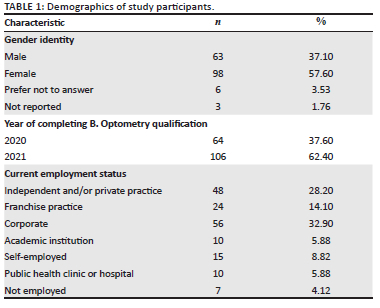
In total, 178 responses were received during the data collection period, with 170 meeting the inclusion criteria for data analysis. This represents a response rate of 57.6%. Most participants qualified in 2021 (62.4%). Over 60% of the participants are currently working in independent practices, franchise practices or corporate workplaces, with 4.12% currently not employed. Table 1 displays the demographics of participants.
Factors predicting myopia onset and progression
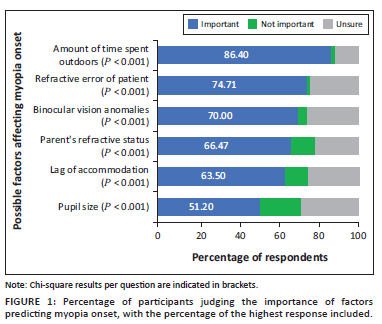
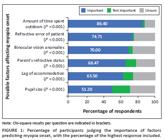
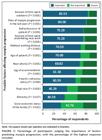
Based on their knowledge, participants were asked to judge the importance of six factors predicting myopia onset and twelve factors predicting myopia progression. The amount of time spent outdoors was selected as an important factor in predicting myopia onset by 86.4% of participants (P < 0.001), as seen in Figure 1. More than 65% of participants also identified parents' refractive status (P < 0.001) and the patient's binocular and refractive status (P < 0.001) as being important for myopia onset. The least selected factor was pupil size (P < 0.001). All questions in this section showed statistical significance with a P < 0.05 (Figure 1).
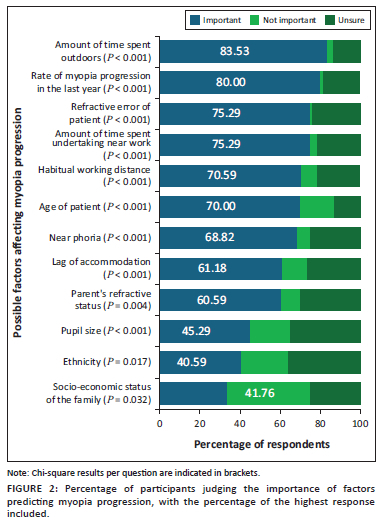
Of the factors important to myopia progression, time spent outdoors (P < 0.001) and time spent with near work (P < 0.001) were selected by 83.53% and 75.29% of participants, respectively (Figure 2). Other factors rated as important by more than 70% of participants include age (P < 0.001), refractive error of patient (P < 0.001), rate of myopia progression in the last year (P < 0.001) and habitual working distance (P < 0.001). The refractive status of the parents was only considered important by 60.59% of participants (P = 0.004) and ethnicity by 40.59% of participants (P = 0.017). Pupil size was only selected by 45.29% of participants (P < 0.001) and socio-economic status by 33.53% of participants (P = 0.032). All factors listed in the section regarding factors affecting myopia progression obtained a P < 0.05 (Figure 2).
Ocular pathology associated with high myopia
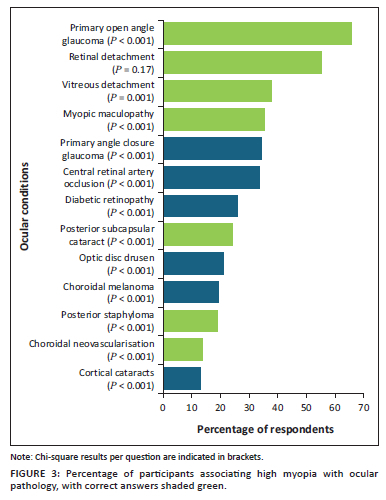
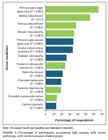
Participants were asked to identify pathologies that patients with high myopia are at increased risk for developing. The two ocular pathologies selected by most participants were primary open-angle glaucoma by 65.88% of participants (P < 0.001) and retinal detachment by 55.29% of participants (P = 0.17). The top four conditions selected have all been associated with high myopia (Figure 3). However, the third and fourth conditions, vitreous detachment (P = 0.001) and myopic maculopathy (P < 0.001), were selected by less than half of all participants at 37.65% and 35.29%, respectively. Conditions that were least selected but that are associated with high myopia include choroidal neovascularisation (13.53%), posterior staphyloma (18.82%) and posterior subcapsular cataract (24.12%).
Myopia diagnosis and strategies to delay onset and slow progression of myopia
Participants were first required to respond to statements regarding overall myopia diagnosis and management. Following this, based on their knowledge, participants were able to judge the success of various strategies to delay myopia onset and slow myopia progression.
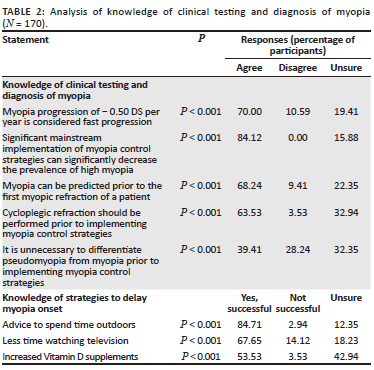
Based on their knowledge of myopia control strategies, the majority of participants (84.12%) agree that the significant mainstream implementation of myopia control strategies can significantly decrease the prevalence of high myopia (P < 0.001) (Table 2). Most participants (68.24%) believed that myopia can be predicted prior to the first myopic refraction (P < 0.001) and almost three-quarters of participants believed that fast myopia progression is a −0.50 DS annual change in prescription (P < 0.001). While 63.53% of participants do believe that cycloplegic refraction should be performed (P < 0.001), only 28.24% of participants considered it necessary to identify patients with pseudomyopia prior to myopia control implementation (P < 0.001). Almost one-third of participants (32.94% and 32.35%) responded as 'unsure' for the statements relating to cycloplegic refraction and pseudomyopia (Table 2).
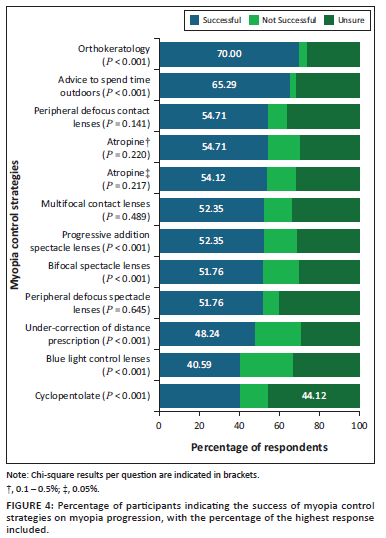
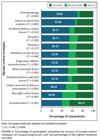
Of the strategies to delay myopia onset, most participants identified increased time outdoors (84.71%) and less time watching television (67.65%). All three strategies listed to delay myopia onset showed statistical significance (P < 0.001), as seen in Table 2. The strategy deemed to be most successful at slowing myopia progression was orthokeratology (70%) (Figure 4). The next most selected strategy was advice to spend time outdoors at 65.29% (P < 0.001). This was followed by atropine (0.1% - 0.5%) and peripheral defocus contact lenses tied at 54.71% and atropine (0.05%) at 54.12%. More than half of all participants also selected the following optical options: multifocal contact lenses (P = 0.489), progressive addition spectacle lenses (P < 0.001), bifocal spectacle lenses (P < 0.001) and peripheral defocus spectacle lenses (P = 0.645). Almost half of the participants deemed under-correction of a patient's distance prescription as being successful at slowing myopia progression (P < 0.001). For many strategies, between 24.71 and 44.12% of participants selected 'unsure' as a response.
Overall knowledge
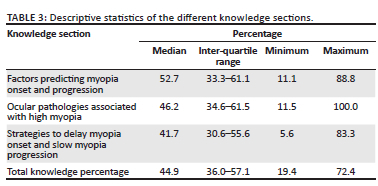
The knowledge section that tested the strategies used in myopia control resulted in the lowest median and interquartile range, as seen in Table 3. The highest median and interquartile ranges were found in the section relating to the factors predicting myopia onset and progression. A perfect result of 100% was achieved by one participant in the section on ocular pathologies. With all sections combined, the median percentage was 44.9%, with the lowest result of 19.4% and the highest result of 72.4%. Participants were also asked regarding additional myopia control education that was received since leaving undergraduate education. Almost a quarter of the participants (22.9%) indicated that they had attended a course or training post-qualification.
Further analysis of the results, using the Mann-Whitney U test, found a statistically significant difference between the graduating year and the overall percentage of knowledge found. The class of 2020 had a higher statistically significant knowledge percentage compared to the class of 2021, z = −3.199, P = 0.001.
Discussion
This was the first study that aimed to describe the myopia control knowledge of newly qualified optometrists in South Africa. Overall, participants in the study displayed the poorest knowledge in the section relating to myopia control strategies and performed best in the section regarding factors affecting myopia onset and progression. Most of the newly qualified optometrists who responded were currently employed in various settings and were mostly from the 2021 graduating year. This could be attributed to the two-pronged approach of advertising with both the HEIs and social media platforms. Potential participants in the 2020 graduating year were only accessed via distribution of the advertisement through social media.
Knowledge of factors affecting myopia onset and progression
Of the six factors listed in the survey, three have been proven to predict myopia onset. These factors were the amount of time spent outdoors, the refractive error of a patient and parents' refractive status. These factors were correctly identified by 86.4%, 74.71% and 66.47% of participants, respectively. However, more than 60% of participants also identified lag of accommodation and binocular vision anomalies to be important in predicting myopia onset. This could be attributed to earlier theories of myopia development and progression based on the lag of accommodation2829,30
Of the 12 factors listed in the survey, eight have been proven to predict myopia progression. While the exact process of myopia development is not precisely known, the contributions of both genetic and environmental factors have been well reported.31,3233,34,3533,3633,3415,16,17
Genetic factors of ethnicity and parents' refractive status were thought to be important by only 40.59% and 60.59% of participants, respectively. Ethnicity, which research has proven to be a risk for higher myopia progression,3715,16,173833,3915,16,17
The importance of factors relating to a patient's current refractive status was ranked high by participants: age (70.00%), current refractive status (75.29%) and rate of myopia progression in the last year (80.00%). These findings concur with previous studies assessing knowledge, where these three factors were ranked 'important' and 'very important' by between 70 and 98% of participants.15,16,1740,41
Lag of accommodation and near phoria were selected by about two-thirds of participants as being an important factor in myopia progression, which is incorrect.3015,16,17422830,40,43
The remaining factors that were included, with no proven impact on myopia progression, were pupil size and socioeconomic status of the family. While socioeconomic status was correctly deemed 'not important' by 41.76% of participants, only half this number (20.00%) regarded pupil size to be 'not important'. Similar findings regarding pupil size (20% and 21%) were consistent with studies from Saudi Arabia and India.16,17
Knowledge of ocular pathology associated with high myopia
From the list of thirteen ocular pathologies presented, seven of the conditions have been associated with an increased risk in patients with high myopia, with the other six conditions showing no proven link to high myopia. Of the seven correct conditions, two were correctly selected by the majority of participants, viz. primary open-angle glaucoma (POAG) (65.88%) and retinal detachment (55.29%). When comparing an emmetropic patient to a myopic patient, the risk of POAG is almost double.4151744
Another complication causing a three times greater risk in patients with high myopia compared to patients with low myopia is retinal detachment.4,5515,16,17445
The remaining conditions that are associated with high myopia were accurately selected by a small portion of participants: choroidal neovascularisation (13.53%), posterior subcapsular cataract (24.12%) and myopic maculopathy (35.29%). Patients presenting with myopia have a 100-fold higher risk of developing myopic maculopathy as compared to emmetropic patients.44,1215,174415,17
The six factors indicated as not being linked with high myopia were incorrectly identified by a minority of participants per condition. These included cortical cataracts (12.94%), choroidal melanoma (19.41%), optic disc drusen (21.18%), diabetic retinopathy (25.88%), central retinal artery occlusion (33.53%) and primary angle closure glaucoma (34.12%). The range of incorrect responses was thus between 13% and 34%. This range of incorrect responses is higher than similar studies which did not exceed 20%.15,16,1715
Optometrists' knowledge of the ocular pathologies associated with high myopia is crucial in everyday clinical practice. While some of the ocular pathologies require no immediate intervention, the knowledge of the increased risk could affect the tests performed, education provided to the patient, and the patient's follow-up schedule.5,444
Knowledge of myopia diagnosis and strategies to delay onset and slow progression of myopia
According to the WHO,1211136,45
Prior to the implementation of myopia control strategies for controlling myopia progression, the total amount of myopia should be correctly measured without the influence of accommodation.144615,16,17,18
An increase in axial length during childhood development does result in the worsening of myopia throughout the childhood years.1035
Of the eight optical strategies included in the survey, research has shown four strategies to be successful in slowing myopia progression. The success of orthokeratology has been highlighted by meta-analyses47,4849,5015,21,22
More than half of the participants also correctly regarded other optical strategies as successful - in particular, peripheral defocus spectacle lenses, multifocal contact lenses, and peripheral defocus contact lenses. Multifocal contact lenses, while intended for presbyopic patients, have proven to cause slower myopia progression.5152,5354,5520
While initially thought to be successful, bifocal and multifocal spectacle lenses have not been able to consistently show significant decreases in myopia progression.5015,16,17,20,21,22
Another early strategy employed was under-correction of distance prescription, which was thought to decrease accommodative demand.5657,58502021,22
A pharmaceutical approach that has yielded success is atropine (0.05%), which was proven in the Low-concentration Atropine for Myopia Progression (LAMP) study.5950,60,6115,172015,17
Second to orthokeratology, almost two-thirds of participants correctly identified the success of increased time spent outdoors on myopia progression. Studies have shown the protective benefits of increased time spent outdoors for children already diagnosed with myopia.62,6315,17,21
The lowest performing section for participants in this study was the strategies to delay myopia onset and slow myopia progression. Within this section, the majority of participants scored well in the first and second parts of the section testing overall management and success of strategies on myopia onset. However, the section on myopia progression was poorly answered. A large percentage of participants, in the range of 24.71% - 44.12%, selected 'unsure' for many of the strategies listed. All 'unsure' responses were graded zero, thus impacting the total score. This uncertainty could indicate a lack of confidence by participants to definitively state whether a strategy is successful or not.
The class of 2020 outperformed the class of 2021 in terms of overall knowledge. The additional 12-month work experience appeared to have a positive effect on knowledge of myopia control. The class of 2020 could also have benefitted from more exposure to continuous professional development activities relating to myopia control after leaving their undergraduate programmes. This benefit was limited for the class of 2021, as this study was conducted within their first 7 months post-graduation. Previous international studies assessing the knowledge of myopia control included qualified optometrists with varying years of experience who based their responses on their accumulative knowledge and clinical experiences. As the participants in this study completed the questionnaire in their first 7-19 months post-graduation, the results of this study are thus uniquely situated to provide insight into the knowledge gained at HEIs in South Africa.
While most participants were convinced of the impact myopia control implementation can have on myopia prevalence, this study identified several gaps in the knowledge base of newly qualified optometrists in South Africa. While some gaps in knowledge showed a lack of interpretation and background, others were because of a reliance on older myopia control research.
Limitations
While the survey did meet the minimum sample size for a 95% confidence interval, the survey was voluntary and could be limited by participants with a particular interest in myopia control choosing to participate. Surveys testing knowledge can sometimes feel tedious and result in fatigue, which could lead to participants simply choosing the middle option to complete it faster. While the participants were limited to the past two graduating classes, continuing professional development or additional courses attended could impact the knowledge tested. The completion of the survey did rely on participants having to recall their undergraduate knowledge. Lack of recall of content covered within the undergraduate training could influence the perception of undergraduate education and training regarding myopia control.
Recommendations
This study served as a baseline measure of myopia control knowledge of newly qualified optometrists in South Africa. With continuous revision of undergraduate syllabi and clinical training in the topic of myopia control at HEIs, future studies could be undertaken to compare to the current study to evaluate if a change in the current findings occurred. Future studies should also explore the management practices in controlling myopia beyond the knowledge and attitude of qualified optometrists in South Africa.
Conclusion
The sections tested in this questionnaire are essential for the implementation of myopia control but also for routine optometric clinical care. The low median percentages found across all sections indicate there are significant gaps in the knowledge of newly qualified optometrists as it relates to myopia control. With the large number of myopic patients of varying levels presenting in clinical practice every day, it is essential that all optometrists are equipped with the correct knowledge to help direct diagnosis and management. Thus, undergraduate educational development, regularly incorporating the latest research and clinical guidelines within their curricula, would be essential to generate new cadres of graduates that are adequately prepared to practice in the field of myopia control.
Competing interests
The authors declare that they have no financial or personal relationships that may have inappropriately influenced them in writing this article.
Authors' contributions
N.R. and N.N. developed the project's concept and methodology. N.R. conducted the investigation and part of the data analysis and wrote the initial manuscript. N.N. supervised the research process, analysis and the editing of the article. All authors, N.R. and N.N., approved the final version of the article.
Funding information
The research received no specific grant from any funding agency in the public, commercial or non-profit sectors.
Data availability
The data that support the findings in this publication are available on request from the corresponding author, N.N.
Disclaimer
The views and opinions expressed in this article are those of the authors and are the product of professional research. The article does not necessarily reflect the official policy or position of any affiliated institution, funder, agency or that of the publisher. The authors are responsible for this article's results, findings and content.
Acknowledgements
The authors acknowledge the statistician, Dr Omololu Aluko, for providing statistical support for the analysis of the data for this research investigation. This article is partially based on the Nasrin Rawat's thesis entitled 'Myopia control: Knowledge and attitude of newly qualified optometrists in South Africa' towards the degree of Master of Optometry in the Department of Optometry, University of the Free State, South Africa, on 28 July 2023, with supervisor Dr Nashua Naicker.
References
-
1. Holden BA, Jong M, Davis S, Wilson D, Fricke T, Resnikoff S. Nearly 1 billion myopes at risk ofmyopia-related sight-threatening conditions by 2050 - Time to act now. Clin Exp Optom. 2015;98(6):491-493. https://doi.org/10.1111/cxo.12339
» https://doi.org/10.1111/cxo.12339 -
2. Ovenseri-ogbomo G, Id ULO, Ekpenyong BN, Mashige P, Naidoo KS, Ogbuehi KC. Systematic review and meta-analysis of myopia prevalence in African school children. PLoS One. 2022;17(2):1-17. https://doi.org/10.1371/journal.pone.0263335
» https://doi.org/10.1371/journal.pone.0263335 -
3. Sankaridurg P. A less myopic future: What are the prospects? Clin Exp Optom. 2015;98(6):494-496. https://doi.org/10.1111/cxo.12358
» https://doi.org/10.1111/cxo.12358 -
4. Haarman AEG, Enthoven CA, Willem Tideman JL, Tedja MS, Verhoeven VJM, Klaver CCW. The complications of myopia: A review and meta-analysis. Investig Ophthalmol Vis Sci. 2020;61(4):49. https://doi.org/10.1167/iovs.61.4.49
» https://doi.org/10.1167/iovs.61.4.49 -
5. Jagadeesh D, Philip K, Fedtke C, Jong M, Ly A, Sankaridurg P. Posterior segment conditions associated with myopia and high myopia. Clin Exp Optom. 2020;103(6):756-765. https://doi.org/10.1111/cxo.13060
» https://doi.org/10.1111/cxo.13060 -
6. Flitcroft DI, He M, Jonas JB, et al. IMI - Defining and classifying myopia: A proposed set of standards for clinical and epidemiologic studies. Investig Ophthalmol Vis Sci. 2019;60(3):M20-M30. https://doi.org/10.1167/iovs.18-25957
» https://doi.org/10.1167/iovs.18-25957 -
7. Rose K, Harper R, Tromans C, et al. Quality of life in myopia. Br J Ophthalmol. 2000;84(9):1031-1034. https://doi.org/10.1136/bjo.84.9.1031
» https://doi.org/10.1136/bjo.84.9.1031 -
8. Magakwe T, Hansraj R, Xulu-Kasaba Z. The impact of uncorrected refractive error and visual impairment on the quality of life amongst school-going children in Sekhukhune district (Limpopo), South Africa. African Vis Eye Heal. 2022;81(1):a620. https://doi.org/10.4102/aveh.v81i1.620
» https://doi.org/10.4102/aveh.v81i1.620 -
9. Naidoo KS, Fricke TR, Frick KD, et al. Potential lost productivity resulting from the global burden of myopia: Systematic review, meta-analysis, and modeling. Ophthalmology. 2019;126(3):338-346. https://doi.org/10.1016/j.ophtha.2018.10.029
» https://doi.org/10.1016/j.ophtha.2018.10.029 -
10. Morjaria P. How myopia develops. Community Eye Heal J [serial online]. 2019 [cited 2021 Mar 14];32(105):4. Available from: https://www.ncbi.nlm.nih.gov/pmc/articles/PMC6688406/
» https://www.ncbi.nlm.nih.gov/pmc/articles/PMC6688406/ -
11. Johnson KL. Are we myopic about myopia control? Contact Lens Anterior Eye. 2014;37(4):237-239. https://doi.org/10.1016/j.clae.2014.05.004
» https://doi.org/10.1016/j.clae.2014.05.004 -
12. World Health Organization. The impact of myopia and high myopia [homepage on the Internet]. Sydney: World Health Organization-Brien Holden Vision Institute; 2015. Available from: https://myopiainstitute.org/wp-content/uploads/2020/10/Myopia_report_020517.pdf
» https://myopiainstitute.org/wp-content/uploads/2020/10/Myopia_report_020517.pdf -
13. McCrann S, Flitcroft I, Loughman J. Is optometry ready for myopia control? Education and other barriers to the treatment of myopia. HRB Open Res. 2020;2:30. https://doi.org/10.12688/hrbopenres.12954.2
» https://doi.org/10.12688/hrbopenres.12954.2 -
14. Wolffsohn JS, Kollbaum PS, Berntsen DA, et al. IMI- Clinical myopia control trials and instrumentation report. Investig Ophthalmol Vis Sci. 2019;60(3):M132-M160. https://doi.org/10.1167/iovs.18-25955
» https://doi.org/10.1167/iovs.18-25955 -
15. Douglass A, Keller PR, He M, Downie LE. Knowledge, perspectives and clinical practices of Australian optometrists in relation to childhood myopia. Clin Exp Optom. 2020;103(2):155-166. https://doi.org/10.1111/cxo.12936
» https://doi.org/10.1111/cxo.12936 -
16. Alanazi MK, Almutleb ES, Badawood YS, Kudam MA, Liu M. Perspectives and clinical practices of optometrists in Saudi Arabia concerning myopia in children. Int J Ophthalmol. 2023;16(2):267-273. https://doi.org/10.18240/ijo.2023.02.14
» https://doi.org/10.18240/ijo.2023.02.14 -
17. Chaurasiya RK, Sutar S, Gupta A, Pandey R, Agarwal P. Knowledge, attitude and practice of childhood myopia among Indian optometrists: A questionnaire-based study. Indian J Ophthlamology. 2023;71(3):951-956. https://doi.org/10.4103/IJO.IJO_2660_22
» https://doi.org/10.4103/IJO.IJO_2660_22 -
18. Shahzad MA, Khan HALI, Arshad MS, et al. Knowledge, perspectives and practice patterns of eye care providers in Pakistan regarding myopia. Pakistan J Med Heal Sci. 2022;16(3):746-750. https://doi.org/10.53350/pjmhs22163746
» https://doi.org/10.53350/pjmhs22163746 -
19. Martínez-Pérez C, Villa-Collar C, Santodomingo-Rubido J, Wolffsohn JS. Strategies and attitudes on the management of myopia in clinical practice in Spain - 2022 update. J Optom. 2024;17(1):100496. https://doi.org/10.1016/j.optom.2023.100496
» https://doi.org/10.1016/j.optom.2023.100496 -
20. Nti AN, Owusu-afriyie B, Levi U, et al. Trends in myopia management attitudes and strategies in clinical practice: Survey of eye care practitioners in Africa. Contact Lens Anterior Eye. 2023;46(1):101597. https://doi.org/10.1016/j.clae.2022.101597
» https://doi.org/10.1016/j.clae.2022.101597 -
21. Wolffsohn JS, Calossi A, Cho P, et al. Global trends in myopia management attitudes and strategies in clinical practice. Contact Lens Anterior Eye. 2016;39(2):106-116. https://doi.org/10.1016/j.clae.2016.02.005
» https://doi.org/10.1016/j.clae.2016.02.005 -
22. Wolffsohn JS, Calossi A, Cho P, et al. Global trends in myopia management attitudes and strategies in clinical practice - 2019 update. Contact Lens Anterior Eye. 2020;43(1):9-17. https://doi.org/10.1016/j.clae.2019.11.002
» https://doi.org/10.1016/j.clae.2019.11.002 -
23. Gifford K. Myopia matters. Contact Lens Spectr [homepage on the Internet]. 2020 [cited 2021 Feb 24];35:17. Available from: https://www.clspectrum.com/issues/2020/april-2020/myopia-matters
» https://www.clspectrum.com/issues/2020/april-2020/myopia-matters -
24. Suttle CM, Jalbert I, Alnahedh T. Examining the evidence base used by optometrists in Australia and New Zealand. Clin Exp Optom. 2012;95(1):28-36. https://doi.org/10.1111/j.1444-0938.2011.00663.x
» https://doi.org/10.1111/j.1444-0938.2011.00663.x -
25. Morgan K, Campbell KL, Sargeant S, Reidlinger DP. Preparedness for advancing future health: A national qualitative exploration of dietetics graduates' experiences. Adv Heal Sci Educ. 2020;25(1):31-53. https://doi.org/10.1007/s10459-019-09904-6
» https://doi.org/10.1007/s10459-019-09904-6 -
26. Ho SS, Stenhouse R, Snowden A. 'It was quite a shock': A qualitative study of the impact of organisational and personal factors on newly qualified nurses' experiences. J Clin Nurs. 2021;30(15-16):2373-2385. https://doi.org/10.1111/jocn.15777
» https://doi.org/10.1111/jocn.15777 -
27. Taber KS. The use of Cronbach's alpha when developing and reporting research instruments in science education. Res Sci Educ. 2018;48(6):1273-1296. https://doi.org/10.1007/s11165-016-9602-2
» https://doi.org/10.1007/s11165-016-9602-2 -
28. Mutti DO, Jones LA, Moeschberger ML, Zadnik K. AC/A ratio, age and refractive error in children. Investig Ophthalmol Vis Sci. 1996;41(9):2469-2478. https://doi.org/10.1364/VSIA.1999.SuA7
» https://doi.org/10.1364/VSIA.1999.SuA7 -
29. Chen Y, Drobe B, Zhang C, et al. Accommodation is unrelated to myopia progression in Chinese myopic children. Sci Rep. 2020;10:a12056. https://doi.org/10.1038/s41598-020-68859-6
» https://doi.org/10.1038/s41598-020-68859-6 -
30. Logan NS, Radhakrishnan H, Cruickshank FE, et al. IMI accommodation and binocular vision in myopia development and progression. Investig Ophthalmol Vis Sci. 2021;62(5):a4. https://doi.org/10.1167/iovs.62.5.4
» https://doi.org/10.1167/iovs.62.5.4 -
31. Wojciechowski R. Nature and Nurture: The complex genetics of myopia and refractive error. Clin Genet. 2011;79(4):301-320. https://doi.org/10.1111/j.1399-0004.2010.01592.x
» https://doi.org/10.1111/j.1399-0004.2010.01592.x -
32. Atowa UC, Wajuihian SO, Munsamy AJ. Associations between near work, outdoor activity, parental myopia and myopia among school children in Aba, Nigeria. Int J Ophthalmol. 2020;13(2):309-316. https://doi.org/10.18240/ijo.2020.02.16
» https://doi.org/10.18240/ijo.2020.02.16 -
33. Belete G, Anbesse D, Tsegaye A, Hussen MS. Prevalence and associated factors of myopia among high school students in Gondar town, northwest Ethiopia, 2016. Clin Optom. 2017;9:11-18. https://doi.org/10.2147/OPTO.S120485
» https://doi.org/10.2147/OPTO.S120485 -
34. Guo L, Yang J, Mai J, Du X, Guo Y, Li P. Prevalence and associated factors of myopia among primary and middle school-aged students: A school-based study in Guangzhou. Eye. 2016;30:796-804. https://doi.org/10.1038/eye.2016.39
» https://doi.org/10.1038/eye.2016.39 -
35. Hsu CC, Huang N, Lin PY, et al. Risk factors for myopia progression in second-grade primary school children in Taipei: A population-based cohort study. Br J Ophthalmol. 2017;101(12):1611-1617. https://doi.org/10.1136/bjophthalmol-2016-309299
» https://doi.org/10.1136/bjophthalmol-2016-309299 -
36. He M, Xiang F, Zeng Y, et al. Effect of time spent outdoors at school on the development of myopia among children in China a randomized clinical trial. J Am Med Assoc. 2015;314(11):1142-1148. https://doi.org/10.1001/jama.2015.10803
» https://doi.org/10.1001/jama.2015.10803 -
37. Rudnicka AR, Kapetanakis VV, Wathern AK, et al. Global variations and time trends in the prevalence of childhood myopia, a systematic review and quantitative meta-analysis: Implications for aetiology and early prevention. Br J Ophthalmol. 2016;100(7):882-890. https://doi.org/10.1136/bjophthalmol-2015-307724
» https://doi.org/10.1136/bjophthalmol-2015-307724 -
38. Tang S, Kam KW, French AN, et al. Independent influence of parental myopia on childhood myopia in a dose-related manner in 2,055 trios: The Hong Kong children eye study. Am J Ophthalmol. 2020;218:199-207. https://doi.org/10.1016/j.ajo.2020.05.026
» https://doi.org/10.1016/j.ajo.2020.05.026 -
39. Loh KL, Lu Q, Tan D, Chia A. Risk factors for progressive myopia in the atropine therapy for myopia study. Am J Ophthalmol. 2015;159(5):945-949. https://doi.org/10.1016/j.ajo.2015.01.029
» https://doi.org/10.1016/j.ajo.2015.01.029 -
40. Zadnik K, Sinnott LT, Cotter SA, et al. Prediction of Juvenile-Onset Myopia. JAMA Ophthalmol. 2015;133(6):683-689. https://doi.org/10.1001/jamaophthalmol.2015.0471
» https://doi.org/10.1001/jamaophthalmol.2015.0471 -
41. Matsumura S, Lanca C, Htoon HM, et al. Annual myopia progression and subsequent 2-year myopia progression in Singaporean children. Transl Vis Sci Technol. 2020;9(13):12-21. https://doi.org/10.1167/tvst.9.13.12
» https://doi.org/10.1167/tvst.9.13.12 -
42. Gifford KL, Richdale K, Kang P, et al. IMI - Clinical management guidelines report. Investig Ophthalmol Vis Sci. 2019;60(3):M184-M203. https://doi.org/10.1167/iovs.18-25977
» https://doi.org/10.1167/iovs.18-25977 -
43. Mutti DO, Mitchell GL, Hayes JR, et al. Accommodative lag before and after the onset of myopia. Investig Ophthalmol Vis Sci. 2006;47(3):837-846. https://doi.org/10.1167/iovs.05-0888
» https://doi.org/10.1167/iovs.05-0888 -
44. Williams K, Hammond C. High myopia and its risks. Community eye Heal J [serial online]. 2019 [cited 2021 Mar 14];32(105):5-6. Available from: https://www.ncbi.nlm.nih.gov/pmc/articles/PMC6688422/
» https://www.ncbi.nlm.nih.gov/pmc/articles/PMC6688422/ -
45. Cao K, Yusufu M. Significance of outdoor time for myopia prevention: A systematic review and meta-analysis based on randomized controlled trials. Ophthalmic Res. 2020;63(17):97-105. https://doi.org/10.1159/000501937
» https://doi.org/10.1159/000501937 - 46. Chia A, Tay SA. Clinical management and control of myopia in children. In: Ang M, Wong TY, editors. Updates on Myopia: A clinical perspective. Singapore: Springer, 2020; p. 187-200.
-
47. Si JK, Tang K, Bi HS, Guo DD, Guo JG, Wang XR. Orthokeratology for myopia control: A meta-analysis. Optom Vis Sci. 2015;92(3):252-257. https://doi.org/10.1097/OPX.0000000000000505
» https://doi.org/10.1097/OPX.0000000000000505 -
48. Sun Y, Xu F, Zhang T, et al. Orthokeratology to control myopia progression: A meta-analysis. PLoS One. 2015;10(4):1-9. https://doi.org/10.1371/journal.pone.0124535
» https://doi.org/10.1371/journal.pone.0124535 -
49. VanderVeen DK, Kraker RT, Pineles SL, et al. Use of orthokeratology for the prevention of myopic progression in children: A report by the American Academy of Ophthalmology. Ophthalmology. 2019;126(4):623-636. https://doi.org/10.1016/j.ophtha.2018.11.026
» https://doi.org/10.1016/j.ophtha.2018.11.026 -
50. Lawrenson J, Shah R, Huntjens B, et al. Interventions for myopia control in children: A living systematic review and network meta-analysis (Review). Cochrane Database Syst Rev. 2023;(2):CD014758. https://doi.org/10.1002/14651858.CD014758.pub2
» https://doi.org/10.1002/14651858.CD014758.pub2 -
51. Walline JJ, Walker MK, Mutti DO, et al. Effect of high add power, medium add power, or single-vision contact lenses on myopia progression in children: The BLINK randomized clinical trial. J Am Med Assoc. 2020;324(6):571-580. https://doi.org/10.1001/jama.2020.10834
» https://doi.org/10.1001/jama.2020.10834 -
52. Lam CSY, Tang WC, Tse DYY, et al. Defocus incorporated multiple segments (DIMS) spectacle lenses slow myopia progression: A 2-year randomised clinical trial. Br J Ophthalmol. 2020;104(3):363-368. https://doi.org/10.1136/bjophthalmol-2018-313739
» https://doi.org/10.1136/bjophthalmol-2018-313739 -
53. Bao J, Yang A, Huang Y, et al. One-year myopia control efficacy of spectacle lenses with aspherical lenslets. Br J Ophthalmol. 2022;106(8):1171-1176. https://doi.org/10.1136/bjophthalmol-2020-318367
» https://doi.org/10.1136/bjophthalmol-2020-318367 -
54. Ruiz-Pomeda A, Pérez-Sánchez B, Valls I, Prieto-Garrido FL, Gutiérrez-Ortega R, Villa-Collar C. MiSight Assessment Study Spain (MASS). A 2-year randomized clinical trial. Graefe's Arch Clin Exp Ophthalmol. 2018;256(5):1011-1021. https://doi.org/10.1007/s00417-018-3906-z
» https://doi.org/10.1007/s00417-018-3906-z -
55. Chamberlain P, Peixoto-De-Matos SC, Logan NS, Ngo C, Jones D, Young G. A 3-year randomized clinical trial of MiSight lenses for myopia control. Optom Vis Sci. 2019;96(8):556-567. https://doi.org/10.1097/OPX.0000000000001410
» https://doi.org/10.1097/OPX.0000000000001410 -
56. Wildsoet CF, Chia A, Cho P, et al. IMI- Interventions for controlling myopia onset and progression report. Investig Ophthalmol Vis Sci. 2019;60:M106-M131. https://doi.org/10.1167/iovs.18-25958
» https://doi.org/10.1167/iovs.18-25958 -
57. Sun YY, Li SM, Li SY, et al. Effect of uncorrection versus full correction on myopia progression in 12-year-old children. Graefe's Arch Clin Exp Ophthalmol. 2017;255:189-195. https://doi.org/10.1007/s00417-016-3529-1
» https://doi.org/10.1007/s00417-016-3529-1 -
58. Logan NS, Wolffsohn JS. Role of un-correction, under-correction and over-correction of myopia as a strategy for slowing myopic progression. Clin Exp Optom. 2020;103(2):133-137. https://doi.org/10.1111/cxo.12978
» https://doi.org/10.1111/cxo.12978 -
59. Yam JC, Li FF, Zhang X, et al. Two-year clinical trial of the Low-Concentration Atropine for Myopia Progression (LAMP) study: Phase 2 report. Ophthalmology. 2020;127(7):910-919. https://doi.org/10.1016/j.ophtha.2019.12.011
» https://doi.org/10.1016/j.ophtha.2019.12.011 -
60. Yam JC, Zhang XJ, Zhang Y, et al. Three-year clinical trial of Low-Concentration Atropine for Myopia Progression (LAMP) study: Continued versus washout: Phase 3 Report. Ophthalmology. 2022;129(3):308-321. https://doi.org/10.1016/j.ophtha.2021.10.002
» https://doi.org/10.1016/j.ophtha.2021.10.002 -
61. Zhang X, Zhang Y, Yip B, et al. Five-year clinical trial of the Low-Concentration Atropine for Myopia Progression (LAMP) study: Phase 4 report. Ophthalmology. 2024;131(9):1011-1020. https://doi.org/10.1016/j.ophtha.2024.03.013
» https://doi.org/10.1016/j.ophtha.2024.03.013 -
62. Huang PC, Hsiao YC, Tsai CY, et al. Protective behaviours of near work and time outdoors in myopia prevalence and progression in myopic children: A 2-year prospective population study. Br J Ophthalmol. 2019;104(7):956-961. https://doi.org/10.1136/bjophthalmol-2019-314101
» https://doi.org/10.1136/bjophthalmol-2019-314101 -
63. Tran XMT, Nguyen HTL, Tran TV, et al. Factors protecting against progression of myopia in school students exposed to societal change in Vietnam: A 3-year cohort study. BMJ Open. 2025;15(1):e085853. https://doi.org/10.1136/bmjopen-2024-085853
» https://doi.org/10.1136/bmjopen-2024-085853

Accepted: 14 July 2025
Published: 16 Oct. 2025