Evaluation of the performance of the Waggoner computerised colour vision test
Abstract
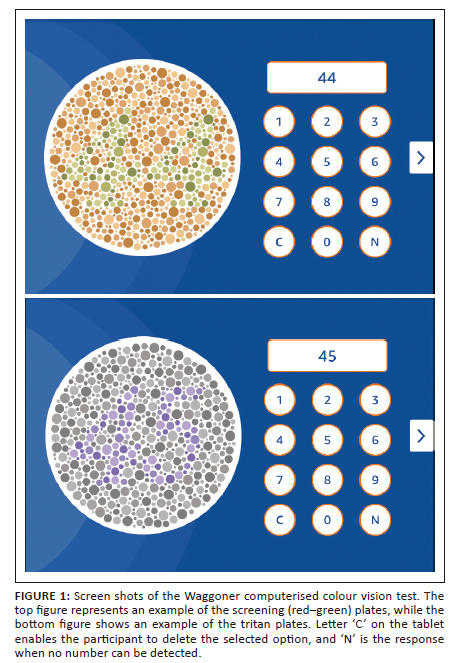
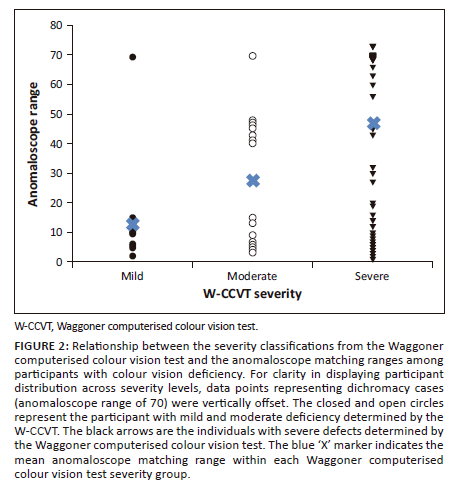
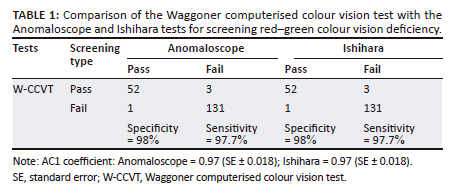
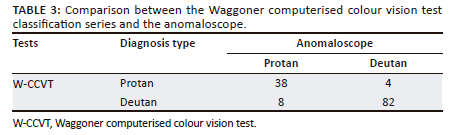
BACKGROUND: Individuals with colour vision impairments have a significant probability of misjudging colour. This high risk of colour-related inaccuracies is crucial for evaluating the ability of an individual to distinguish between different hues. The Waggoner computerised colour vision test (W-CCVT) is a novel colour test designed to detect colour vision deficiencies. AIM: This study aimed to validate the performance of the W-CCVT relative to that of the anomaloscope and Ishihara tests. SETTING: This study evaluated the W-CCVT relative to standard colour vision tests by recruiting 52 participants with colour-normal vision and 135 with colour vision deficiencies from different locations in the capital city of Saudi Arabia. METHODS: The performance of the W-CCVT was compared with that of the Ishihara test and the Heidelberg Multi-Colour Oculus anomaloscope. Participants were directed to identify the numbers on the Ishihara plates, and their responses were documented on a recording sheet. RESULTS: Concerning pass or fail agreement, good agreement was observed between the W-CCVT and anomaloscope, with a first-order agreement coefficient of 0.97. The sensitivity value was 97.7% and 98% value for the specificity. CONCLUSION: The Waggoner computerised colour vision test may serve as a reliable alternative screening tool for detecting colour vision deficiencies. CONTRIBUTION: The W-CCVT could be an appropriate screener colour vision test and a suitable alternative to the Ishihara test when implemented on an iPad.
colour vision; colour vision deficiency; Ishihara; Waggoner; iPad; colour vision testing
 Thumbnail
 Thumbnail