Myopia control awareness and practice of optometrists in KwaZulu-Natal, South Africa
Abstract
BACKGROUND: Eyecare practitioners play a pivotal role in implementing myopia control (MC) strategies to reduce the burden of progressive myopia. This awareness and execution, however, vary significantly across different regions. AIM: This study aims to establish the awareness and practices of MC among optometrists practicing in KwaZulu-Natal, South Africa, in 2023. SETTINGS: Public and private eyecare facilities in KwaZulu-Natal, South Africa. METHODS: A cross-sectional survey was conducted among optometrists in KwaZulu-Natal, South Africa. A validated questionnaire, formatted via Google Forms, was administered electronically through email and various social media platforms, targeting all optometrists in KwaZulu-Natal. RESULTS: Of the 53 participants, 58.5% % (n = 31) had 'Not good' awareness of MC methods, and 58.5% (n = 31) were active in its execution. The association between awareness and practice was statistically significant (P < 0.05). Patient education (86.8%; n = 46) was the greatest MC adopted, while 22.6% (n = 12) utilised spectacle under-correction. The major barriers to MC implementation were cost to parents (79.2%; n = 42) and practitioners (49.1%; n = 26), while cheaper products (75.5%; n = 40) were the main support needed. CONCLUSION: Despite poor awareness of MC, many optometrists adopted MC measures in their practices. Due to the strong association between awareness and practice, increasing awareness will increase participation in MC. Collaborative efforts are essential to effectively manage and reduce myopia in the region. CONTRIBUTION: This study offers regional data on myopia awareness and management to guide public health efforts and improve patient outcomes.
myopia control; awareness; optometrists; practice; barriers
Introduction
Myopia associated with an increase in axial length affects millions of people worldwide.121
Single-vision spectacles, contact lenses and refractive surgery may correct myopia; however, they may be limited in slowing its progression or mitigating its consequences,34
Optometrists play a crucial role in myopia control (MC) interventions, but there is a disparity in awareness and implementation across regions.5,6 While practitioners indicate knowing about MC, with others having little or no knowledge,7,8,9 single-vision spectacles appear to be the main measure for young myopes.10611,12 and high costs.7,13
As no study has been conducted in South Africa, this study aims to investigate the awareness and practice of MC by optometrists in KwaZulu-Natal, South Africa, the barriers limiting its use, as well as the support needed for effective implementation. The findings will inform interventions and guidelines to improve MC practices in the region aiming to reduce the prevalence and impact of myopia in KwaZulu-Natal and similar regions.
Research methods and design
A web-based cross-sectional research design was employed to collect data from a diverse group of practicing optometrists across KwaZulu-Natal, through the administration of a questionnaire. This questionnaire was adopted from previous studies focusing on MC among eyecare practitioners.7,14,15,16,17 As the tool had already demonstrated validity and reliability in earlier research, no additional pilot testing was conducted before its administration in this study. Optometrists working in the private, public and tertiary education sectors, who were registered with the Health Professions Council of South Africa (HPCSA) for the year 2023 and were actively practicing in KwaZulu-Natal (KZN), South Africa, were considered for this study. It did not include optometrists working outside of KZN, nor did it involve other eyecare professionals such as ophthalmic nurses or ophthalmologists.
The sample size for the study was calculated using the formula  where Z (1.96) is the standard normal distribution, d represents 5% margin of error, P is 80% of optometrists prescribing MC, Q is (1-P) and N is the 460 registered optometrists in KZN. The required sample size for 80% power was 159, with an additional 10% added for non-responses, resulting in a final sample size of 175. A sample population was recruited through a snowball sampling technique.
Data collection tool and procedure
The validated questionnaire was used from a previous study,7
Data management and analysis
The data were analysed using SPSS version 27 software (SPSS Inc., Chicago, Illinois, US). All data conformed to non-parametric distributions and inferential statistics, including Pearson Chi-square and Kruskal-Wallis tests, were applied, with a significance level of P < 0.05 determined. For the open-ended questions, content analysis was employed.
Ethical considerations
An application for full ethical approval was made to the Humanities and Social Sciences Research Ethics Committee and ethics consent was received on 15 June 2023. The ethics number is HSSREC/00005479/2023. The research adhered to the guidelines of the Declaration of Helsinki, and participants provided informed consent electronically after being informed about the study's objectives and potential outcomes.
Results
Sociodemographic profile
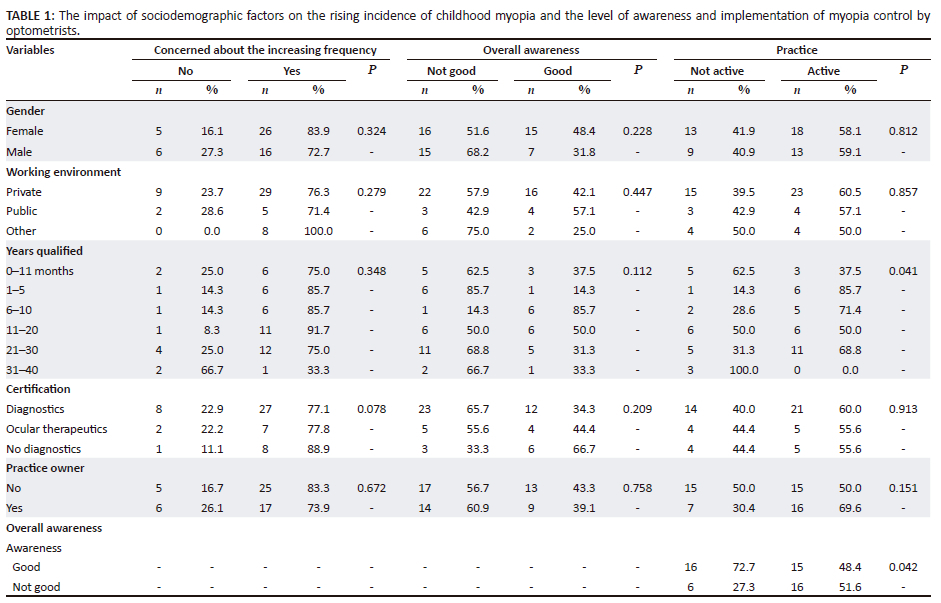
A total of 53 optometrists responded to the survey, with an average age of 37.0 ± 5.6 years, of which the majority were female (58.5%; n = 31), had 21-30 years of experience (30.2%; n = 16), were in private practice (71.7%; n = 38) and were employees (56.6%; n = 30) (Table 1). As the study only included registered optometrists, 77.4% (n = 41) held a bachelor's degree, 17% (n = 9) held a Master's degree and 5.7% (n = 3) had completed a PhD. Furthermore, 66% (n = 35) were certified with diagnostics, and only 17% (n = 9) held ocular therapeutics certification.
Source of education on myopia control
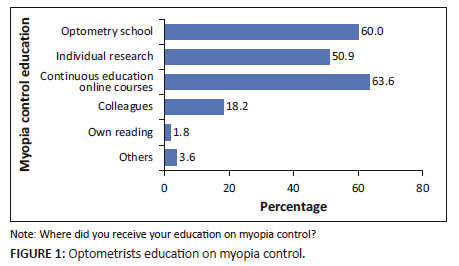
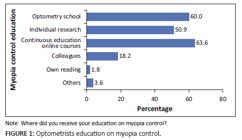
Optometrists acquired knowledge about MC through various methods, including online continuous education courses (63.6%; n = 34), optometry school (60%; n = 32), individual research (50.9%; n = 27) and information from optical suppliers and congress presentations (3.6%; n = 2) (Figure 1). Information acquired through personal reading was only 1.8% (n = 1).
Concern about the rise in paediatric myopia
With the incidence of paediatric myopia escalating within clinical practice, 79.2% (n = 42) of practitioners expressed concern, with no significant difference across diverse sociodemographic profiles (p > 0.05) (Table 1).
Risk factors warranting myopia control
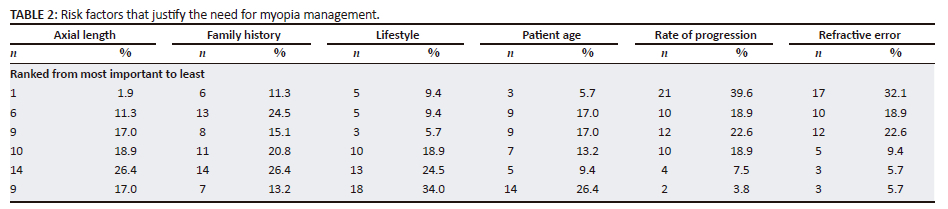
The primary risk factor warranting MC intervention, as reported by 39.6% (n = 21) of participants, was the rate of progression, followed by refractive error (32.1%, n = 17) (Table 2). The majority of the optometrists (50.9%; n = 27) deemed 0.51 D to 0.75 D per year of myopic progression sufficient to initiate MC, followed by ≥ 0.76 D per year (37.8%; n = 20). However, 1.9% (n = 1) indicated that MC is not warranted irrespective of myopic progression. Family history was ranked second (24.5%; n = 13), while the axial length, lifestyle and patient's age were not considered priorities in myopia management.
Overall awareness of myopia control
While 58.5% (n = 31) exhibited 'Not good' awareness of MC (Table 1), optometrists in each of their respective categories displaying 'Good' awareness of MC were females (48.4%; n = 15), employed in public hospitals (57.1%; n = 4), had been qualified for 6-10 years (85.7%; n = 6), were without diagnostics (66.7%; n = 6) and were employees (not practice owners) (43%; n = 13) (Table 1). No statistical difference (p > 0.05) was found for awareness across all sociodemographic variables.
Myopia control practices of optometrists
Most optometrists were active in prescribing MC in their practices (58.5%; n = 31) (Table 1) as well as across the various sociodemographic variables (P > 0.05) except for years qualified (P = 0.041). Those with 0-11 months (62.5%, n = 5) and 31-40 years of experience (100%, n = 3) showed no MC activity.
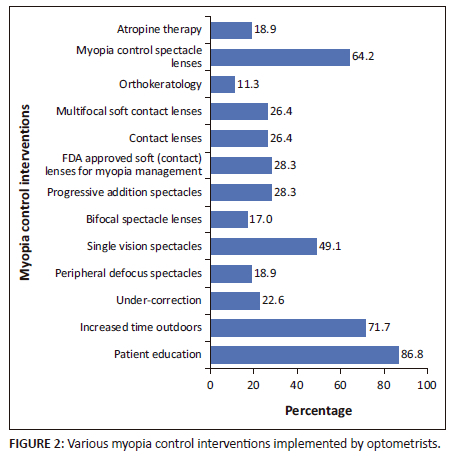
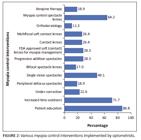
The most common MC interventions used by optometrists include patient education (86.8%; n = 46) and recommendation of increased time outdoors (71.7%; n = 38). Myopia control spectacle lenses (64.2%, n = 34) and single-vision spectacles (49.1%, n = 26) are the main spectacle strategies adopted, while bifocals are the least used (17.0%, n = 9) (Figure 2). Approximately 26.4% (n = 14) of optometrists considered contact lenses as a choice for MC, with some considering specifically MC-designed soft contact lenses (28.3%; n = 15); orthokeratology was the least preferred contact lens option (11.3%; n = 6). A smaller percentage of optometrists prescribe atropine (18.9%; n = 10) while under-correction is still utilised by 22.6% (n = 12). Finally, optometrists who actively prescribe MC display good overall awareness (51.6%; n = 16), with statistical inference between awareness and MC activity being significant (P = 0.042) (Table 1).
Restrictions for adopting myopia control interventions
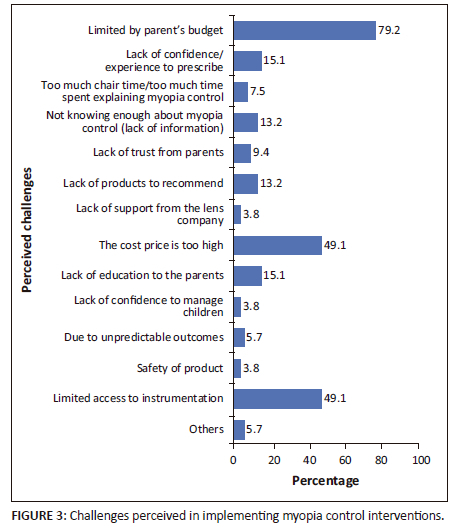
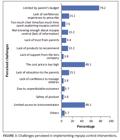
The greatest limitations faced by practitioners were parents' budget (79.2%; n = 42), high cost of MC interventions and limited access to instrumentation (49.1%; n = 26), respectively (Figure 3). Lack of support from optical companies (3.8%; n = 2), practitioners' lack of confidence in managing children (3.8%; n = 2) and concerns about the safety of MC products (3.8%; n = 2) were the least significant barriers to initiating MC interventions.
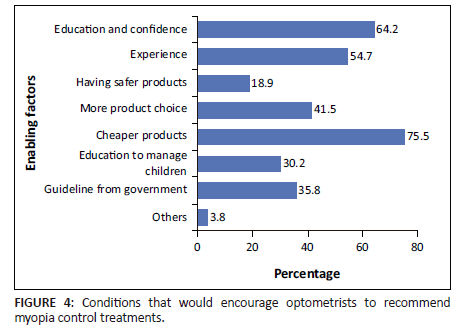
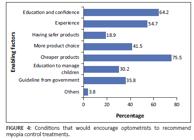
In Figure 4, 75.5% (n = 40) of the participants expressed that cheaper products would incentivise optometrists to adopt MC, while 64.2% (n = 34) suggested that an enhancement in education and confidence would be beneficial. Moreover, 54.7% (n = 29) emphasised the significance of experience in this context.
Discussion
With myopia being a global concern, practitioner education plays a pivotal part in increasing awareness and practice of MC, thereby mitigating its risks.10917181719
The rate of progression was ranked as the most important risk factor warranting MC followed closely by refractive error. Wolffsohn et al. reported that the risk of progression had not been extensively researched; however, refractive error was the key risk factor for progressive myopia.20212020,21 In this study, however, the majority of the participants ranked age as the least important risk factor to warrant MC intervention.
The majority of the optometrists considered MC when the progression rate of −0.50 D to −0.75 D per year was achieved, aligning with the report of American practitioners.202299
With the increase in the prevalence of paediatric myopia over the past few decades, followed by the risk of irreversible vision loss,20,23 the concern expressed by most optometrists in this study is legitimate. Such concern has also been articulated across various African nations as well as documented by the WHO based on reports from Asia, Europe, South America and North America.9,20,23 Despite the concern expressed by optometrists, however, the overall awareness of optometrists on MC in KZN is poor ('Not good'). This could impact appropriate MC uptake for patients at risk and with progressive myopia. While no statistical difference was noted between sociodemographics and awareness, optometrists who qualified between 6 and 10 years of ago showed the greatest awareness of MC. This could be attributed to a greater rise in research on MC over the last decade, making resources available for practitioners and possibly being included in the UG curriculum.23,24,25 Furthermore, optometrists in the public sector appear more aware of MC compared to the optometrists practicing in the private sector. A study by Ebrahim et al. revealed that optometrists in the public sector are more exposed to a larger volume of patients with a greater range of optometry cases and hence could contribute to a greater awareness.26
A greater proportion of practitioners who are concerned about progressive myopia are also active with MC interventions (P = 0.042), showing that a relationship exists between concern and practice. A similar correlation was found with practitioners in Australia and Spain.6,7 Over the past 4 years, with the increase in concern about the rise in myopia, there have been reports of the greatest number of MC interventions taking place in Asia.10711
In this study, most practitioners prioritise patient education and outdoor time to manage myopia. They commonly prescribe MC-designed and single-vision spectacles and less frequently recommend bifocals. Some optometrists use MC-designed contact lenses, but few consider atropine or orthokeratology in the management of progressive myopia. A previous study shows that low-dose atropine and orthokeratology are more effective than spectacles in slowing myopic progression,2728
The majority of optometrists cited cost as the main hindrance to implementing MC, which was similarly reported by practitioners in Singapore.11
This study includes optometrists who are key healthcare professionals involved in managing myopia, and their responses are critical to assessing both the existing knowledge gaps and the practical barriers they face. The results could guide improvements in how optometrists in the region approach MC, considering its growing public health concern. Furthermore, as the study focuses on actual practices and awareness in the field, not just theoretical or laboratory-based research, this makes the findings more directly applicable to improving the quality of optometric care in KwaZulu-Natal and similar regions. The study's required sample size was 159 participants; however, only 53 optometrists participated. This represents a significant limitation of the study, reducing the generalisability of the findings to the broader population of optometrists. Several factors could have contributed to the low participation, including a limited data collection period and challenges in reaching all optometrists across the KZN region, despite the survey being available on multiple platforms. Non-participation in the survey could be linked to issues such as poor connectivity and the survey's length,29711
Conclusion
The implementation of MC is crucial for preserving eye health and minimising the long-term risks of severe myopia. This study sheds light on the awareness and practices of optometrists in KwaZulu-Natal, South Africa, identifying the gaps and providing recommendations for evidence-based MC strategies in practice. Despite the concern expressed by optometrists on the rising cases of myopia, their overall awareness of MC interventions was poor. While many optometrists consider MC strategies on their patients such as patient education and MC-designed spectacle lenses, single-vision spectacles and under-correction are still being prescribed. Cost, practitioner education, poor confidence and experience are the key factors limiting MC uptake. Optometrists advised that with improved education and more cost-effective products, their activity in MC will improve.
Competing interests
The authors declare that they have no financial or personal relationships that may have inappropriately influenced them in writing this article.
Authors' contributions
U.N., M.D., S.K., B.M., S.M., N.N., A.N., M.N., T.P. and L.S. was responsible for the conception or design of the work, the drafting of the article and the data collection. U.N. contributed to the critical revision of the article, as well as the final approval. All authors contributed to the article, discussed the results and approved the final version for submission and publication.
Funding information
This research received no specific funding from any agency in the public, commercial or not-for-profit sectors.
Data availability
The data that support the findings of this study are available from the corresponding author, U.N., upon reasonable request.
Disclaimer
The views and opinions expressed in this article are those of the authors and are the product of professional research. They do not necessarily reflect the official policy or position of any affiliated institution, funder, agency or that of the publisher. The authors are responsible for this article's results, findings and content.
Acknowledgements
The authors would like to acknowledge the assistance of the statistician Dr Zelalem Getahun Dessie and all the optometrists who participated in the survey.
References
-
1. Holden BA, Sankaridurg P, Smith EJ, Aller TA, Jong M, He M. Myopia, an underrated global challenge to vision: Where the current data takes us on myopia control. Eye. 2014;28(2):142-146. https://doi.org/10.1038/eye.2013.256
» https://doi.org/10.1038/eye.2013.256 -
2. Grzybowski, A, Kanclerz, P, Tsubota, K, Lança, CC, Saw, S. A review on the epidemiology of myopia in school children worldwide. BMC Ophthalmol. 2020;20(1):1-11. https://doi.org/10.1186/s12886-019-1220-0
» https://doi.org/10.1186/s12886-019-1220-0 - 3. Chen, C, Cheung, SW, Cho, P. Myopia control using toric orthokeratology (TO-SEE study). Invest Ophthalmol Vis Sci. 2013;54(10):6510-6517. https://doi.org/10.1167/iovs.13-12527
-
4. Dhiman R, Rakheja V, Gupta V, Saxena R. Current concepts in the management of childhood myopia. Indian J Ophthalmol. 2022;70(8):2800-2815. https://doi.org/10.4103/ijo.IJO_2098_21
» https://doi.org/10.4103/ijo.IJO_2098_21 -
5. Jones D. Measure axial length to guide myopia management [homepage on the Internet]. Review of Myopia Management. 2020 [cited 2024 June 13]. Available form: https://reviewofmm.com/shouldnt-we-treat-axial-length-as-essential-in-treating-myopia/
» https://reviewofmm.com/shouldnt-we-treat-axial-length-as-essential-in-treating-myopia/ -
6. Douglass A, Keller PR, He M, Downie LE. Knowledge, perspectives, and clinical practices of Australian optometrists in relation to childhood myopia. Clin Exp Optom. 2020;103(2):155-166. https://doi.org/10.1111/cxo.12936
» https://doi.org/10.1111/cxo.12936 -
7. Martínez-Pérez C, Villa-Collar C, Santodomingo-Rubido J, Wolffsohn JS. Strategies and attitudes on the management of myopia in clinical practice in Spain. J Optom. 2023;16(1):64-73. https://doi.org/10.1016/j.optom.2022.03.002
» https://doi.org/10.1016/j.optom.2022.03.002 -
8. Shahzad MA, Khan HA, Arshad MS, et al. Knowledge, perspectives, and practice patterns of eye care providers in Pakistan regarding myopia. Pak J Med Health Sci. 2022;16(3):746. https://doi.org/10.53350/pjmhs22163746
» https://doi.org/10.53350/pjmhs22163746 -
9. Nti AN, Owusu-Afriyie B, Levi Osuagwu U, et al. Trends in myopia management attitudes and strategies in clinical practice: Survey of eye care practitioners in Africa. Cont Lens Anterior Eye. 2023;46(1):101597. https://doi.org/10.1016/j.clae.2022.101597
» https://doi.org/10.1016/j.clae.2022.101597 -
10. Wolffsohn JS, Calossi A, Cho P, et al. Global trends in myopia management attitudes and strategies in clinical practice-2019 Update. Cont Lens Anterior Eye. 2020;43(1):9-17. https://doi.org/10.1016/j.clae.2019.11.002
» https://doi.org/10.1016/j.clae.2019.11.002 -
11. Yang A, Pang BY, Vasudevan P, Drobe B. Eye care practitioners are key influencers for the use of myopia control intervention. Front Public Health. 2020;10:854654. https://doi.org/10.3389/fpubh.2022.854654
» https://doi.org/10.3389/fpubh.2022.854654 -
12. Alanazi MK, Almutleb ES, Badawood YS, Kudam MA, Liu M. Perspectives and clinical practices of optometrists in Saudi Arabia concerning myopia in children. Int J Ophthalmol. 2023;16(2):267-273. https://doi.org/10.18240/ijo.2023.02.14
» https://doi.org/10.18240/ijo.2023.02.14 -
13. McCrann S, Flitcroft I, Butler J, Loughman J. Myopia Outcome Study of Atropine in Children (MOSAIC): Design and methodology. HRB Open Res. 2019;2:5. https://doi.org/10.12688/hrbopenres.12914.1
» https://doi.org/10.12688/hrbopenres.12914.1 -
14. AOA survey shows nearly 70% of optometrists offer myopia management [homepage on the Internet]. Review of Myopia Management. 2020 [cited 2023 Mar 09]. Available from: https://reviewofmm.com/aoa-survey-shows-nearly-70-of-optometrists-offer-myopiamanagement
» https://reviewofmm.com/aoa-survey-shows-nearly-70-of-optometrists-offer-myopiamanagement -
15. British Contact Lenses Association. Myopia control survey [homepage on the Internet]. BCLA. 2015 [cited 2023 Mar 29]. Available from: https://www.surveymonkey.com/r/JHLWGKP
» https://www.surveymonkey.com/r/JHLWGKP -
16. Most optometrists offer myopia management services [homepage on the Internet]. Review of Optometry. 2022 [cited 2023 Mar 29]. Available from: https://www.reviewofoptometry.com/news/article/most-optometrists-offer-myopia-management-services
» https://www.reviewofoptometry.com/news/article/most-optometrists-offer-myopia-management-services -
17. Yang A, Pang BY, Vasudevan P, Drobe B. Eye care practitioners are key influencer for the use of myopia control intervention. Front Public Health. 2022;29:854654. https://doi.org/10.3389/fpubh.2022.854654
» https://doi.org/10.3389/fpubh.2022.854654 -
18. Chaurasiya RK, Sutar S, Gupta A, Pandey R, Agarwal P. Knowledge, attitude, and practice of childhood myopia among Indian optometrists: A questionnaire-based study. Indian J Ophthalmol. 2023;71(3):951. https://doi.org/10.4103/IJO.IJO_2660_22
» https://doi.org/10.4103/IJO.IJO_2660_22 -
19. Faucher C. Developing healthcare practitioners' professional expertise through effective continuing education: Commentary. Internet J Allied Health Sci Practice (serial online). 2016;14(4):7. [cited 2024 June 03]. Available from: https://nsuworks.nova.edu/ijahsp/vol14/iss4/7
» https://nsuworks.nova.edu/ijahsp/vol14/iss4/7 -
20. Wolffsohn JS, Flitcroft DI, Gifford KL, et al. IMI-myopia control reports overview and introduction. Invest Ophthalmol Vis Sci. 2019;60:M1-M9. [cited 2024 June 03]. Available from: https://www.myopiaprofile.com/articles/assessing-risk-of-myopia-onset-and-progression
» https://www.myopiaprofile.com/articles/assessing-risk-of-myopia-onset-and-progression -
21. Grifford K. Assessing risk of myopia onset and progression [homepage on the Internet]. Myopia Profile. 2019 [cited 2024 June]. Available from: https://www.myopiaprofile.com/articles/assessing-risk-of-myopia-onset-and-progression
» https://www.myopiaprofile.com/articles/assessing-risk-of-myopia-onset-and-progression -
22. Chua WH, Balakrishnan V, Chan YH. Atropine for the treatment of childhood myopia. Ophthalmology. 2006;113(12):2285-2291. https://doi.org/10.1016/j.ophtha.2006.05.062
» https://doi.org/10.1016/j.ophtha.2006.05.062 -
23. Vitale S, Ellwein L, Cotch MF, Ferris FL, Sperduto R. Prevalence of refractive error in the United States, 1999-2004. Arch Ophthalmol. 2008;126(8):1111-1119. https://doi.org/10.1001/archopht.126.8.1111
» https://doi.org/10.1001/archopht.126.8.1111 -
24. Williams KM, Bertelsen G, Cumberland P, et al. Increasing prevalence of myopia in Europe and the impact of education. Ophthalmology. 2015;122(7):1489-1497. https://doi.org/10.1016/j.ophtha.2015.03.018
» https://doi.org/10.1016/j.ophtha.2015.03.018 -
25. Jung SK, Lee JH, Kakizaki H, Jee D. Prevalence of myopia and its association with body stature and educational level in 19-year-old male conscripts in Seoul, South Korea. Invest Ophthalmol Vis Sci. 2012;53(9):5579-5583. https://doi.org/10.1167/iovs.12-10106
» https://doi.org/10.1167/iovs.12-10106 -
26. Ebrahim N, Karim F, Gasa M, Poonvaganum K, Gangat F, Van Staden DB. Public sector optometrists' perspectives on a decentralised model of clinical training for optometry in KwaZulu-Natal, South Africa. Afr Vis Eye Health. 2019;78(1):7. https://doi.org/10.4102/aveh.v78i1.489
» https://doi.org/10.4102/aveh.v78i1.489 -
27. Santodomingo-Rubido J, Villa-Collar C, Gilmartin B, Gutiérrez-Ortega R. Factors preventing myopia progression with orthokeratology correction. Optom Vis Sci. 2013;90(11):1225-1236. https://doi.org/10.1097/OPX.0000000000000034
» https://doi.org/10.1097/OPX.0000000000000034 -
28. Chung K, Mohidin N, O'Leary DJ. Undercorrection of myopia enhances rather than inhibits myopia progression. Vision Res. 2002;2(22):2555-2559. https://doi.org/10.1016/S0042-6989(02)00258-4
» https://doi.org/10.1016/S0042-6989(02)00258-4 -
29. Wu MJ, Zhao K, Fils-Aime F. Response rates of online surveys in published research: A meta-analysis. Comput Hum Behav Rep. 2022;7:100206. https://doi.org/10.1016/j.chbr.2022.100206
» https://doi.org/10.1016/j.chbr.2022.100206

Accepted: 01 July 2025
Published: 19 Sept. 2025