Patterns of prescribing contact lenses in Limpopo province, South Africa
Abstract
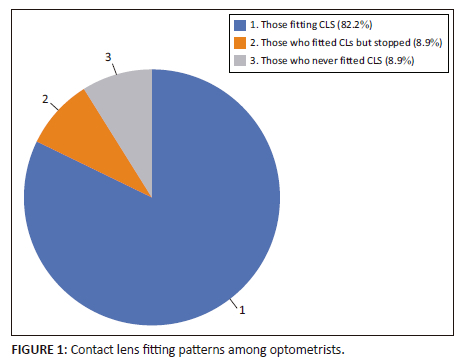
BACKGROUND: Contact lens (CL) prescribing is an essential strategy in vision correction. Patterns of CL prescribing are poorly reported globally, particularly in African countries irrespective of the high prevalence of uncorrected refractive error and corneal ectasia which can be corrected with CLs. AIM: This study aimed to determine the patterns of CL prescribing, their determinants, barriers and enablers among private practice optometrists in Limpopo, South Africa. SETTING: Participants were optometrists from Limpopo province, South Africa. METHODS: The study used a quantitative, cross-sectional, survey design, and data on the prescribing patterns of CLs were obtained through a self-administered online survey distributed to private practice optometrists in Limpopo, South Africa. RESULTS: Ninety (43.0%) of optometrists completed the questionnaires from which 88 (94.9%) were Black African and had a mean age of 29.77 ± 7.21 years. While 74 (82.2%) participants reported to fit CLs, 48 (64.9%) participants reported to initiate conversations of CL wear to their patients. The mean self-reported knowledge and competencies score was good at 3.65 ± 0.71 using the Likert scale. Soft material (100%) and spherical designs (90.5%) were fitted the most by participants. Patient affordability (68.9%), poor patient motivation (52.7%) and poor lens tolerance (44.6%) were cited as the most common barriers to fitting CLs among participants who fitted CLs. The lack of equipment (62.5%), poor patient motivation (62.5%) and trial CL availability (37.5%) were the common barriers to CL fitting among participants who reported not fitting CLs. CONCLUSION: Majority of participants were fitting soft spherical CL. Patient affordability together with a lack of motivation and a lack of equipment were the reported barriers to CL prescribing. It is essential to develop a comprehensive strategy aimed at encouraging practitioners to adopt CL use while simultaneously equipping them with the necessary skills and resources for effective CL fitting.
contact lenses; prescribing patterns; Limpopo province; Optometrists; barriers to CL prescribing
Introduction
Contact lenses (CLs) are medical devices made from polymer or silicone hydrogel materials, designed to be applied directly to the corneal surface of the eye for purposes such as vision correction, cosmesis or therapy.12,3 Similar to spectacles, CLs refract and focus light to enable clear vision.3456,7 Advancements in technology have led to the development of CLs with transitional tint technology. These CLs adjust to changing light conditions and selectively filter certain wavelengths of light, enhancing colour perception. As a result, they are particularly beneficial for patients involved in sports, those with high refractive errors and individuals with colour vision deficiencies.8
Recent studies have highlighted the advent of CLs as a superior option for myopia control,9101112
Irrespective of their benefits, CLs remain underutilised with only an estimated 140 million individuals globally wearing CLs with approximately 45 million in the United States (US).1213,14 Studies from developing countries report similar trends, with some countries in Africa reporting as little as 1.1% of CL use and up to 96.7% of the study population not having any knowledge of CLs.151617171717
Although the research is limited, South Africa shares similar results in CL fitting as seen in global trends. In the last decade, Noach et al.181918
In a study conducted in KwaZulu-Natal province, Khoza et al.19
Other studies of interest were based on keratoconus (KC) patient management. In the Limpopo province, only half of the KC patients attending public service facilities who require CL correction were fitted with CLs.20,21 Whereas in the KwaZulu-Natal province, patients consulting at public facilities requiring CLs fitting were only managed with spectacles, and only later referred to private optometrists or the University of KwaZulu-Natal optometry clinic for CL fitting.22
The trends and disease patterns of conditions such as KC and progressive myopia necessitate CLs as a model management strategy. Studying the trends and patterns of CL fitting is crucial for understanding the factors that facilitate or hinder the process. To gather data on optometrists' prescribing patterns, we utilised a structured, self-administered online questionnaire to collect information on the determinants, enablers and barriers for prescribing CLs.
This study therefore aimed to determine the patterns of CL prescribing among private optometrists in Limpopo province, South Africa.
Research methods and design
Study design
A quantitative, descriptive, cross-sectional survey design was employed to collect data from practising optometrists in Limpopo province between August and October 2023. A structured, self-administered online questionnaire was used to collect data on the prescribing patterns of CLs among optometrists, as well as their determinants, enablers and barriers for prescribing CLs.
Setting
The study was conducted among private optometrists practising within Limpopo province, South Africa. These optometrists were practice owners, employed within independent or group practices in residential settings, malls, and shopping centres in rural, semi-urban and urban areas within the province.
Study population and recruitment
A total of 208 independent practising optometrists are registered with the Health Professions of South Africa (HPCSA) under Limpopo province (K. Maupye, personal communication, 06 November 2023). The link (https://forms.gle/eMCuZR2wZ2oWdS639) was distributed via email, mobile numbers and social media (WhatsApp) to optometrists with accessible contact details on internet platforms and optometrist networks. A snowball sampling was utilised whereby those with the link were also requested to distribute to other optometrists in their mailing list for wider reach. Eligibility was also based on current registration with the HPCSA and the ability to provide consent online.
Data collection
Development of the questionnaire
The questionnaire was developed based on a review of optometry and CL practice literature. It gathered demographic data, determined fitting frequency, commonly fitted CL types and assessed self-reported knowledge and skills using a Likert scale. The questionnaire was created and administered using Google Forms, with responses captured in a Microsoft Excel spreadsheet.
Validation of the questionnaire
The questionnaire was created by five main authors and reviewed by three additional authors. The content validity of the questionnaire was confirmed by five optometrists who were either academicians or CL practitioners. A pilot study involving five participants was conducted, and their results were not included in the main study.
Reliability of the questionnaire
The reliability analysis of the Knowledge, Skills and Competencies (KSC) questions was conducted with the Cronbach's alpha value of 0.88 indicating the good reliability of the questions.
Statistical analysis
IBM Corporation Statistical Package for Social Sciences (SPSS), version 28.0. Armonk, New York was used for data analysis. Data were summarised as frequencies, means, standard deviation (s.d.), and presented in the form of figures and tables. Mean scores were calculated for responses to KSC questions with scores between 1.0 and 1.8 indicating poor knowledge, between 1.9 to 2.6 indicating fair knowledge, 2.7 to 3.4 indicating average knowledge, 3.5 to 4.2 indicating good knowledge and 4.3 to 5.0 indicating excellent knowledge. To determine existing relationships between variables, bivariate analysis was conducted with confidence set at 95% and 5% level of significance (p = 0.05).
Ethical considerations
This study acquired ethical approval from the Turfloop Research Ethics Committee with the TREC clearance TREC/485/2023: UG. Participants were asked to choose 'yes' or 'no' to consent to participation. Selecting 'yes' granted access to the complete questionnaire, while choosing 'no' redirected participants to the end of the questionnaire. Participation was voluntary, and participants were informed of their right to withdraw at any time before completing the questionnaire. No participants' information was collected to ensure confidentiality.
Results
The survey achieved a response rate of 43.0%, with 90 optometrists participating. Among the participants, 53.3% were males and 46.7% were females, and the average age was 30 years (29.7 ± 7.5). There was no significant age difference between male and female participants (P = 0.081). The majority (94.4%) of the participants were black Africans, with 0.2% being Caucasian and 0.2% Indian. On average, participants had been in practice for 6.67 ± 7.20 years. In addition, 28.6% had postgraduate qualifications, including 1.1% with doctoral degrees, 11.1% with master's degrees, 5.5% with postgraduate diplomas and 4.4% with postgraduate certificates. Only 8.9% of participants reported having received postgraduate training in CL fitting.
Rate of contact lens fitting
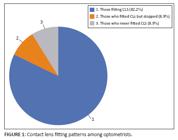
A total of 82.2% participants fitted their patients with CLs and other results are presented in Figure 1.
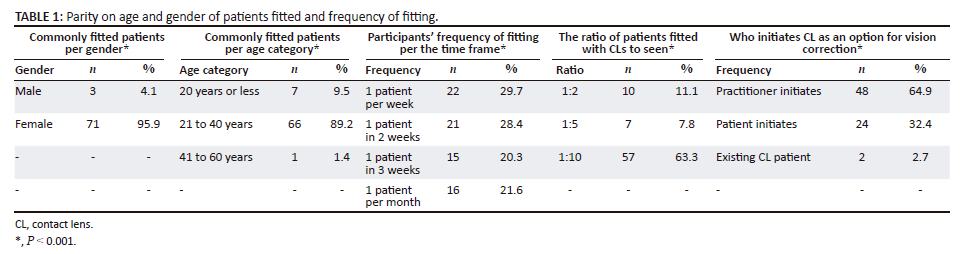
Out of 90 participants, 44.5% practised in urban areas, 32.2% in semi-urban areas and 23.3% in rural areas. There was a significant difference in whether optometrists fitted CL based on the area of their practice (p = 0.039). More than half of the participants (57.8%) had independent private practices, 21.1% had practices in medical centres, 16.7% in franchised practices and 4.4% had practices in other settings. Majority (64.9%) of the participants reported that they usually initiate the option of CLs to patients, 32.4% reported that their patients would initiate the need for CL and 2.7% were existing CL wearers who prefer to continue wearing them.
Thirty-eight per cent of the participants had their practices set up in a shopping complex, 22.0% in a mall, 16.0% in other locations and 14.0% in a residential area. There was no significant difference (p = 0.086) in the patterns of CL fitting based on the location of the practice in terms of business area.
Characteristics of the patients fitted with contact lens
As evident from Table 1, 96.0% of the participants reported fitting mostly female patients. In addition, 89.2% commonly fitted patients aged 21 to 40 years, while only 9.5% commonly fitted patients aged 20 years or younger.
Frequency of fitting contact lens
Table 1 shows that 41.9% of the participants fitted CL every 3 weeks to a month, and 63.3% commonly fitted CL for 1 out of every 10 patients visiting their practices.
Type of contact lens commonly fitted
As indicated in Table 2, 82.0% of the participants utilised soft CLs, with 90.5% using a spherical CL design and 43.2% using a toric CL design. Moreover, 87.8% of the participants used reusable monthly disposable CL, with 55.4% prescribed for daily wear.
Common conditions managed by contact lens
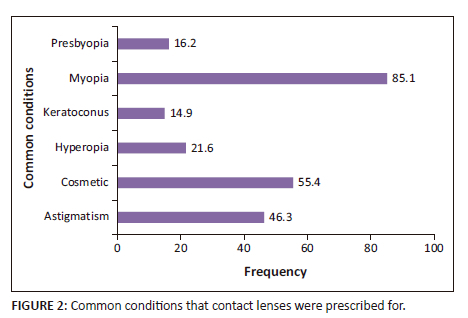
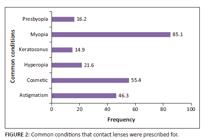
Figure 2 shows that near-sightedness (myopia) (85.1%) and astigmatism (46.3%) were the most common conditions for which CLs were fitted for. Approximately 55.4% of participants were commonly fitted with CL for cosmetic purposes. In addition, 16.2% and 14.9% of participants were fitted with CL to manage presbyopia and keratoconus, respectively.
Instructional tools, and continuous professional development
More than half of the participants (52.2%) used audio and videos to support their understanding of CL fitting, while 48.9% used these resources to train their patients during trial fitting. While 48 participants attended continuous professional development (CPD) on CLs at least once a year, 17.8% and 7.8% attended CPD sessions at least once in 2 years and once in 5 years, respectively. Furthermore, 23 (25.6%) participants reported never attending a CPD activity for CL.
Regarding reading habits, 35 (38.9%) participants read literature on CLs at least once in 6 months, 33.3% at least once a month, 2.2% at least once a week, and 23 (25.6%) participants reported never reading literature on CLs.
Knowledge and competencies
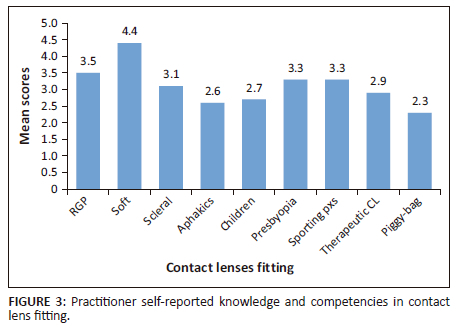
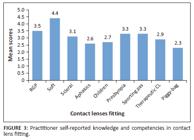
Figure 3 illustrates that the mean scores for self-reported knowledge and competencies were rated at 3.65 ± 0.71. Soft CL fitting competencies were rated at 4.4, RGP CL fitting at 3.5 and scleral CL fitting at 3.1.
Available resources
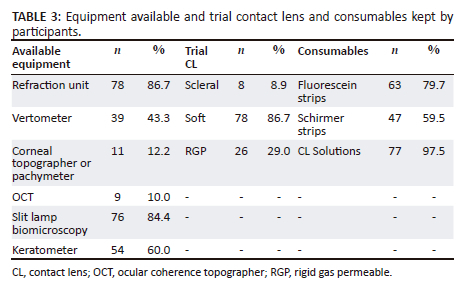
Table 3 reveals the availability of resources, with slit lamp biomicroscopy reported to be available in practices by 84.4% of participants, followed by the keratometer (60.0%). In addition, 86.7% of participants reported having refraction units, and other resources such as a vertometer, corneal topographer or pachymeter, and ocular coherence tomographer (OCT) were also available to varying degrees. Of all the participants who were fitted with CLs, 98.5% kept soft CL trials, 29.0% kept RGP diagnostic fitting sets and only 10.1% kept scleral diagnostic fitting sets.
Barriers to contact lens fitting
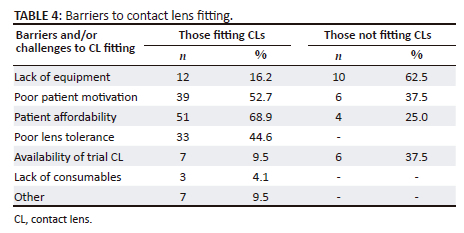
Table 4 displays barriers to CL fitting, with patient affordability (68.9%), poor patient motivation (52.7%) and poor lens tolerance (44.6%) cited as common barriers by participants who were fitted with CL. For those who were not fit CL, the lack of equipment (62.5%), poor patient motivation (37.5%) and the availability of trial CLs were reported as barriers to CL fitting.
Furthermore, 18.9% of participants referred their patients to another practitioner for CL fitting, while 2.7% prescribed spectacles for their patients. Some participants reported that they would consider the possibility of fitting CL (11.1%) or consider fitting them in the future (6.7%). In addition, 10.0% of participants reported considering fitting CLs depending on the acquisition of relevant equipment, 6.7% would consider depending on market demand and 1.1% would consider after improving their fitting skill set.
Discussion
The study describes the prescribing patterns of CLs by optometrists in Limpopo province, South Africa. The sample population in the study represented the general population in the province in terms of ethnicity (Statistics South Africa [StatsSA],232425
The study participants reported that females and patients between the ages of 21 and 40 years were commonly fitted with CLs, which is consistent with various other studies.26,27,28 In addition, it was observed that more females than males were fitted with CLs, and women tended to be more compliant with follow-up appointments and switching to newer, healthier CL options.292730
The majority of participants reported fitting soft CLs, with a smaller percentage fitting scleral lenses (10.8%) and RGP CLs (8.1%). Various studies support these findings and are consistent with the global trends in soft CL prescribing.26,27,28,29 This preference is attributed to the immediate comfort and easy adaptation3127322021
The survey's findings indicate that 87.8% of the participants commonly prescribe reusable CLs, with 55.4% prescribing daily wear CLs. These results are lower than the 91.8% reported for daily wear CLs in Nigeria.263333
The findings of this study align with those of Morgan et al.,292,34 In this study, optometrists prescribed CL for myopia correction at a higher rate of 85.1%. However, the proportion of practitioners prescribing CLs for presbyopia (16.2%) and keratoconus (14.9%) was significantly lower. While presbyopic patients can often be effectively managed with spectacles,23536
The study found that just over half of the participants (55.4%) fitted cosmetic CLs in their practice, showing significant potential for business growth with these lenses.21
In addition, 52.2% of the participants used technology such as videos and audio to improve their knowledge and understanding of CLs, while 48.9% used the technology to educate their patients. There is overwhelming support for the use of audio and video tools to suggest their effectiveness in patient education. According to Chan and Chen,3737
The mean scores of participants on KSC scale for CL fitting were good (3.65 ± 0.71) and while the KSC for soft CL fitting was self-rated to be excellent (4.4). However, the mean scores for RGP (3.5) and scleral (3.1) CL fitting were average to good, although the percentage of those who commonly fitted these CLs was still lower at 10.8% and 8.5%, respectively. The frequency of CL fitting which in this study was rare, about once every 3 weeks to a month, may influence the confidence of participants in the KSC.
The study also found that more than two-thirds of the participants reported patient affordability (68.9%) as the barrier for CL wear, while about half of their patients were poorly motivated to wear CLs (52.7%) and had poor len tolerance (44.6%). Other reported barriers to CL wear included a lack of awareness of CL wear by patients, the lack of equipment, poor patient motivation and availability of trial CLs, which aligned with another study conducted by Thite et al.38
This study aimed to describe the patterns of prescribing CLs, barriers to fitting and optometrists' self-reported knowledge of fitting CLs among South African optometrists. The findings reported in this study may not be generalised for all optometrists in South Africa, as only optometrists in the Limpopo province were sampled for the study.
Conclusion
The majority of the participants were optometrists working in independent private practices located in urban shopping complexes. Significant differences were found in the fitting of CLs based on practice setting, location and type of practice. Most practitioners fitted soft CLs, while a few fitted RGP and scleral CLs. Myopia and astigmatism were common conditions for which practitioners reported fitting CLs, and some also reported fitting cosmetic CLs. Practitioners had a mean KSC score of 3.65 ± 0.75, which was considered 'good'. Commonly reported barriers to CL fitting included patient's lack of affordability of CLs, poor motivation to use CLs, practitioners' lack of equipment for CL fitting and poor lens tolerance.
Competing interests
The authors declare that they have no financial or personal relationships that may have inappropriately influenced them in writing this article.
Authors' contributions
R.M.R.M., R.P.N., M.A.M., E.M. and A.M. contributed towards the conceptualisation and methodology. V.N.S. contributed to the conceptualisation, methodology, writing, review and editing. N.S. contributed to the conceptualisation, methodology, co-supervision, writing of the original draft, review and editing. P.M.W.N. contributed towards the conceptualisation, methodology, supervision, writing of the original draft, formal analysis, review and editing.
Funding information
This research work received no specific grant from any funding agency in the public, commercial or not-for-profit sectors.
Data availability
Data used to support the findings of the study are available from N.S., the corresponding author, upon request.
Disclaimer
The views and opinions expressed in this article are those of the authors and are the product of professional research. The article does not necessarily reflect the official policy or position of any affiliated institution, funder, agency or that of the publisher. The authors are responsible for this article's results, findings and content.
Acknowledgements
This article is partially based on the author's thesis entitled 'Prescribing patterns of contact lenses among optometrists in Limpopo Province of South Africa' towards the degree of Bachelor Optometry in the Department of Optometry, University of Limpopo, South Africa, 2023, with supervisor P.M.W. Nkoana and co-supervisors N. Shabalala and V.N. Sukati.
References
-
1. Boyd K. Contact lenses for vision correction [homepage on the Internet]. American Academy of Ophthalmology. 2016. [cited 2024 Sep 11]; p. 1-4. Available from: https://www.aao.org/eye-health/glasses-contacts/contact-lens-102
» https://www.aao.org/eye-health/glasses-contacts/contact-lens-102 -
2. Gurnani B, Kaur K. Contact Lenses. In: StatPearls [homepage on the Internet]. Treasure Island (FL): StatPearls Publishing; 2025 [Updated 2023 Jun 11]. Available from: https://www.ncbi.nlm.nih.gov/books/NBK580554/
» https://www.ncbi.nlm.nih.gov/books/NBK580554/ -
3. Prete K. How do contact lenses work? [homepage on the Internet]. Alberta: Calgary Optometry Centre; 2022 [cited 2024 Sep 16] Available from: https://calgaryoptometry.com/how-do-contact-lenses-work/
» https://calgaryoptometry.com/how-do-contact-lenses-work/ -
4. Segre L. Contact lens basics. All About Vision [homepage on the Internet]. Newark: 20/20 Jobson Optical Group; 2007 [cited 2024 Sept 16] Available from: https://www.allaboutvision.com/eyewear/contact-lenses/types/contact-lenses/
» https://www.allaboutvision.com/eyewear/contact-lenses/types/contact-lenses/ -
5. Conlin L. Explore specialty markets to build your contact lens business [homepage on the Internet]. New York; 2016 [cited 2024 Sep 20]. Available from: https://www.2020mag.com/ce/explore-specialty-markets-to-build
» https://www.2020mag.com/ce/explore-specialty-markets-to-build -
5. Shaker LM, Al-Amiery A, Takriff MS, Isahak WN, Al-Azzawi WK. Clear vision, green choices: A review of optics, environmental effects, and eco-friendly advancements in contact lenses. J Optics. 2023:1-4. https://doi.org/10.1007/s12596-023-01290-y
» https://doi.org/10.1007/s12596-023-01290-y - 7. Maruyama K, Yokoi N, Takamata A, Kinoshita S. Effect of environmental conditions on tear dynamics in soft contact lens wearers. Invest Ophthalmol Vis Sci. 2004;45(8):2563-2568.
-
8. Heiting G, Teig DS. Contact lenses that improve sports performance [homepage on the Internet]. All About Vision; 2019 [cited 2024 Sep 30]. Available from: https://www.allaboutvision.com/eyewear/contact-lenses/types/sport-contacts/
» https://www.allaboutvision.com/eyewear/contact-lenses/types/sport-contacts/ -
9. Chuang AY. How to effectively manage myopia. Taiwan J Ophthalmol. 2017;7(1):44-47. https://doi.org/10.4103/tjo.tjo_24_17
» https://doi.org/10.4103/tjo.tjo_24_17 -
10. Chamberlain P, Peixoto-de-Matos SC, Logan NS, Ngo C, Jones D, Young G. A 3-year randomized clinical trial of MiSight lenses for myopia control. Optom Vis Sci. 2019;96(8):556-567. https://doi.org/10.1097/OPX.0000000000001410
» https://doi.org/10.1097/OPX.0000000000001410 -
11. Lim L, Lim EW. Therapeutic contact lenses in the treatment of corneal and ocular surface diseases - A review. Asia Pac J Ophthalmol. 2020;9(6):524-532. https://doi.org/10.1097/APO.0000000000000331
» https://doi.org/10.1097/APO.0000000000000331 -
12. Sah R, Sharma N, Priyadarshini K, Titiyal JS. Contact lenses for the treatment of ocular surface diseases. Indian J Ophthalmol. 2023;71(4):1135-1141. https://doi.org/10.4103/IJO.IJO_17_23
» https://doi.org/10.4103/IJO.IJO_17_23 -
13. Pucker AD, Tichenor AA. A review of contact lens dropout. Clin Optom. 2020;12:85-94. https://doi.org/10.2147/OPTO.S198637
» https://doi.org/10.2147/OPTO.S198637 -
14. Chikasirimobi GT, Chepkeitany HC, Van-Staden DW, Shaviya N. Prevalence and knowledge of contact lens uptake in Kenya: A retrospective study. Eur J Public Health Stud. 2022;5(1):56-73. https://doi.org/10.46827/ejphs.v5i1.114
» https://doi.org/10.46827/ejphs.v5i1.114 - 15. Hui A. Where have all of the contact lens wearers gone? Contact Lens Spectr. 2019;34:25-27.
-
16. Efron N, Nichols JJ, Woods CA, Morgan PB. Trends in US contact lens prescribing 2002 to 2014. Optom Vis Sci. 2015;92(7):758-767. https://doi.org/10.1097/OPX.0000000000000623
» https://doi.org/10.1097/OPX.0000000000000623 - 17. Morgan PB, Woods CA, Tranoudis IG, et al. International contact lens prescribing in 2022: Key trends in prescribing highlighted by our 22nd global survey. Contact Lens Spectr. 2023;38:28-35.
-
18. Noach TB, Metsing TI, Booysen D. Attitude and behavior of soft contact lens wearers toward compliance in Gauteng, South Africa. Afr Vis Eye Health. 2023;82(1):822. https://doi.org/10.4102/aveh.v82i1.822
» https://doi.org/10.4102/aveh.v82i1.822 -
19. Khoza N, Moodley T, Sokhulu S, et al. Knowledge, attitudes and practices of contact lens use in a South African adolescent population. Afr Health Sci. 2020;20(2):768-774. https://doi.org/10.4314/ahs.v20i2.29
» https://doi.org/10.4314/ahs.v20i2.29 -
20. Nkoana PM, Moodley VR, Mashige KP. Keratoconic patient profile and management at public sector facilities in South Africa. Afr Vis Eye Health. 2023;82(1):780. https://doi.org/10.4102/aveh.v82i1.780
» https://doi.org/10.4102/aveh.v82i1.780 -
21. Nkoana PM, Moodley VR, Mashige KP. Self-reported knowledge and skills related to diagnosis and management of keratoconus among public sector optometrists in the Limpopo province, South Africa. Afr J Prim Health Care Fam Med. 2022;14(1):1-9. https://doi.org/10.4102/phcfm.v14i1.3668
» https://doi.org/10.4102/phcfm.v14i1.3668 -
22. Gcabashe N, Moodley VR, Hansraj R. Keratoconus management at public sector facilities in KwaZulu-Natal, South Africa: Practitioner perspectives. Afr Vis Eye Health. 2022;81(1):7. https://doi.org/10.4102/aveh.v81i1.698
» https://doi.org/10.4102/aveh.v81i1.698 -
23. Statistics South Africa. Statistical Release P0301 [homepage on the Internet]. Community Survey. 2016 [cited 2016 Jul 01]. Available from: https://cs2016.statssa.gov.za/wp-content/uploads/2016/07/NT-30-06-2016-RELEASE-for-CS-2016-_Statistical-releas_1-July-2016.pdf
» https://cs2016.statssa.gov.za/wp-content/uploads/2016/07/NT-30-06-2016-RELEASE-for-CS-2016-_Statistical-releas_1-July-2016.pdf -
24. American Optometry Association. Missed opportunities: Contact lens experts weigh in on gaps in consumer knowledge [homepage on the Internet]. St Louis; 2022 [cited 2024 Sep 30]. Available from: https://www.aoa.org/news/clinical-eye-care/diseases-and-conditions/contact-lens-experts-weigh-in-on-gaps-in-consumer-knowledge
» https://www.aoa.org/news/clinical-eye-care/diseases-and-conditions/contact-lens-experts-weigh-in-on-gaps-in-consumer-knowledge -
25. Kiely PM, Chappell R. A global competency-based model of the scope of practice in optometry [homepage on the Internet]. St Louis: World Council of Optometry; 2015 [cited 2024 Sep 30] Available from: https://worldcouncilofoptometry.info/wpcontent/uploads/2017/03/wco_global_competency_model_2015.pdf
» https://worldcouncilofoptometry.info/wpcontent/uploads/2017/03/wco_global_competency_model_2015.pdf -
26. Ezinne NE, Ekemiri KK, Harbajan GN, et al. Contact lens prescribing patterns in a University Clinic in Trinidad and Tobago. Vision. 2022;6(3):55. https://doi.org/10.3390/vision6030055
» https://doi.org/10.3390/vision6030055 -
27. Haddad MF, Bakkar M, Gammoh Y, Morgan P. Trends of contact lens prescribing in Jordan. Contact Lens Anterior Eye. 2016;39(5):385-388. https://doi.org/10.1016/j.clae.2016.06.004
» https://doi.org/10.1016/j.clae.2016.06.004 -
28. Noushad B, Mohamed Z, Vankudre GS, et al. Profile of contact lens prescribing in GCC countries. Cont Lens Anterior Eye. 2024;47(2):102128. https://doi.org/10.1016/j.clae.2024.102128
» https://doi.org/10.1016/j.clae.2024.102128 -
29. Challinor S. Contact lens fittings: how women are driving the market. Optician [homepage on the Internet]. 2016 [cited n.d.]. Available from: https://www.opticianonline.net/content/features/contact-lens-fittings-how-women-are-driving-the-market/
» https://www.opticianonline.net/content/features/contact-lens-fittings-how-women-are-driving-the-market -
30. Morgan PB, Efron N, Papas E, et al. BCLA CLEAR Presbyopia: Management with contact lenses and spectacles. Cont Lens Anterior Eye. 2024;47(4):102158. https://doi.org/10.1016/j.clae.2024.102158
» https://doi.org/10.1016/j.clae.2024.102158 - 31. Quinn TG. GP Versus soft lenses: Is one safer? When weighing the benefits to your patients and practice, one modality performs better. Contact Lens Spectr. 2012;27:34-39.
-
32. Hoy L. Ultra Dk contact lenses. Acuity Polymers [homepage on the Internet]. Available from: https://www.acuitypolymers.com/images/pdf/Acuity-Polymers-Ultra-DK-Contact-Lenses_White_Paper_CLS_USA032020_compressed.pdf
» https://www.acuitypolymers.com/images/pdf/Acuity-Polymers-Ultra-DK-Contact-Lenses_White_Paper_CLS_USA032020_compressed.pdf -
33. Mayers M, Bishop MJ, Walerius D, et al. Improving your spectacle patients' in-practice experience with contact lenses during frame selection. Cont Lens Anterior Eye. 2019;42(4):406-410. https://doi.org/10.1016/j.clae.2018.10.013
» https://doi.org/10.1016/j.clae.2018.10.013 -
34. Jones LW, Chauhan A, Di Girolamo N, Sheedy J, Smith III E. Expert views on innovative future uses for contact lenses. Optom Vis Sci. 2016;93(4):328-335. https://doi.org/10.1097/OPX.0000000000000700
» https://doi.org/10.1097/OPX.0000000000000700 -
35. Jacobs DS, Carrasquillo KG, Cottrell PD, et al. BCLA CLEAR - Medical use of contact lenses. Cont Lens Anterior Eye. 2021;44(2):289-329. https://doi.org/10.1016/j.clae.2021.02.002
» https://doi.org/10.1016/j.clae.2021.02.002 -
36. Andreanos KD, Hashemi K, Petrelli M, Droutsas K, Georgalas I, Kymionis GD. Keratoconus treatment algorithm. Ophthalmol Ther. 2017;6:245-262. https://doi.org/10.1007/s40123-017-0099-1
» https://doi.org/10.1007/s40123-017-0099-1 -
37. Chan KY, Chen C. YouTube as a learning source for contact lens insertion and removal. Clin Exp Optom. 2024;107(6):603-608. https://doi.org/10.1080/08164622.2023.2259918
» https://doi.org/10.1080/08164622.2023.2259918 -
38. Thite N, Shah U, Mehta J, Jurkus J. Barriers, motivators and enablers for dispensing multifocal contact lenses in Mumbai, India. J Optom. 2015;8(1):56-61. https://doi.org/10.1016/j.optom.2014.12.002
» https://doi.org/10.1016/j.optom.2014.12.002

Accepted: 21 Jan. 2025
Published: 30 Apr. 2025