Visualisation assessment and training in a group of university football players
Abstract
BACKGROUND: Visualisation is the ability to generate a mental image of a situation before it occurs, and it is important in sports such as football. The footballer mentally imagines and rehearses situations that can occur in football; they are also able to mentally modify patterns of play to be more efficient and correct. AIM: The study aims to assess and train visualisation in footballers. The trained visualisation is compared with the control data and the norms. SETTING: The study was conducted at the University of Limpopo Optometry Department and the offices of the University of Limpopo Soccer League. METHODS: A total of 97 footballers took part in the study. They were divided into experimental and control groups. Visualisation was initially assessed using the Getman Manipulation Tester in both groups before training the experimental group using the Ace-to-Seven method over a period of 6 weeks. The control group did not do any visualisation training. After training, the experimental group of both groups was assessed with the Getman Manipulation Tester. RESULTS: Pre- and post-training results in the experimental group showed improvement in visualisation, which was statistically significant (p = 0.012). CONCLUSION: Visualisation in the experimental group improved after training, and the improvement was statistically significant. Literature suggests that visualisation is trainable and the training transfers to improvements on the field of play. CONTRIBUTION: Visualisation improves after training, which demonstrates that visualisation should not be assumed as a natural attribute; it should be assessed and be trained according to need.
visualisation; visual skills; Getman Manipulation Tester; Ace-to-Seven training technique; sports performance
Introduction
Visualisation, or mental imagery, is the act of constructing mental images of an object or event that resemble the actual appearance of the object or event.1213
Athletes with lower skill levels require more time to execute visualisation of a physical performance than the actual time required to perform the physical act. Elite athletes have been shown to use visualisation strategies in preparation for performance.142513
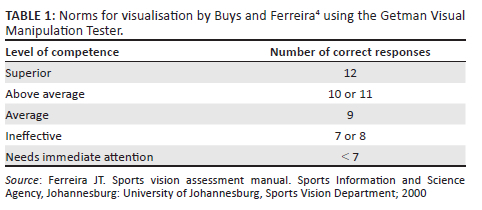
Studies6,789Ace-to-Seven training technique where playing cards are used. The current study was therefore an attempt to assess and train visualisation in football players and compare the skill with existing values (see Table 1) from Buys and Ferreira (2008).4
Methods
An experimental research design was used. The study received ethical clearance from the University of KwaZulu-Natal (BFC225/16) and the University of Limpopo (TREC/39/2017:IR), which was the study site. The participants signed the necessary consent forms before participating in the study.
One hundred (N = 100) university football players were randomly selected using simple random sampling to take part in visualisation assessment, training and re-assessment. The sample size was calculated using the Slovin's formula (n = N / (1 + Ne2N = population size, n = sample size and e = margin of error. The participants were split into goalkeepers, defenders, mid-fielders and strikers. They (the participants) ranged in age between 17 and 28 years. Fifty players were randomly assigned to the control group while the other 50 were part of the experimental group. Unfortunately, the experimental group lost 3 participants, leaving 97 participants in the study. Each participant had to have unaided visual acuity (VA) of at least 6/6 in each eye and 20 s of arc of stereo acuity. Participants who refused to sign the consent form, had disease or were using any form of medication that could affect their thinking and visual perceptual skills, were excluded from the study. The football players underwent pre-training assessment; the experimental group attended visualisation training using the Ace to Seven method, and the control group received no additional training relating to visualisation or placebo training. After the visualisation training of the experimental group, both groups were re-assessed for any changes in visualisation using the Getman Manipulation Tester. The collected data was analysed using the Statistical Package for the Social Sciences (SPSS), version 28.
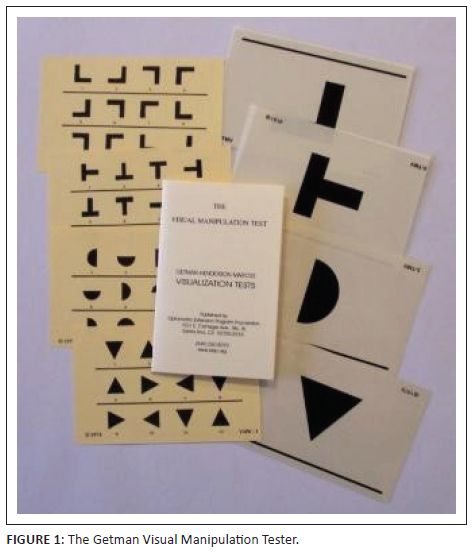
The Getman Manipulation Tester (Figure 1) was used to assess visualisation. The Getman Manipulation Tester was adapted from the Sports Information and Science Agency.310
•If you were to look at this figure from behind, what will it look like to you?
•If you were to flip this figure upside down, what will it look like to you?
•If you were to look at this figure from behind, and it was flipped upside down, what will it look like to you?
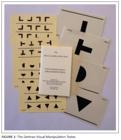
If all four figures were correctly identified, a maximum score of 12 was achieved. The manipulations must be done without hesitation.3
The training of visualisation in the experimental group was done in-office using the Ace to Seven Test over a period of 6 weeks.9
Ethical considerations
Ethical clearance to conduct this study was obtained from the University of KwaZulu-Natal, Biomedical Research Ethics Committee (No. BFC225/16) and the University of Limpopo, Turfloop Research Ethics Committee Clearance Certificate (No. TREC/39/2017:IR).
Results
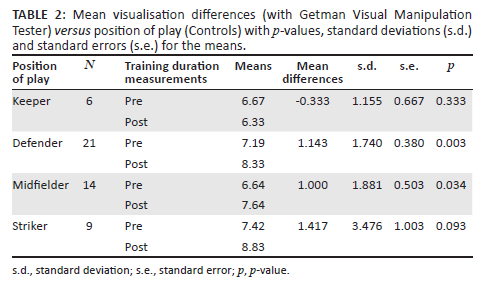
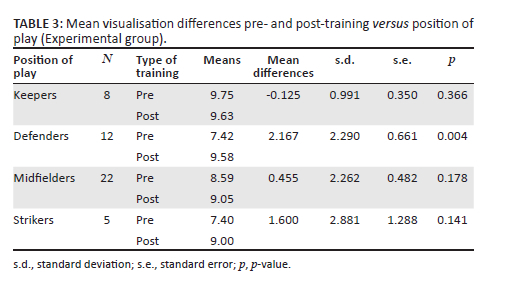
Visualisation in the control group was measured around the same time with the experimental group. The scores of the control and experimental groups players in different positions of play were subjected to the paired sample t-test. The mean difference of the defenders (pre-training duration 7.19; post-training duration 8.33) and midfielders in the control group yielded statistically significant result (Table 2), while the experimental group defenders (pre-training 7.42; post-training 9.58) had a statistically significant (p ≤ 0.05) mean difference (Table 3). The other positions had statistically non-significant mean differences (p > 0.05) (Table 2 and Table 3).
When compared with results for Buys and Ferreira,4Table 2). Strikers started the assessment with 'above average' visualisation (Table 3), and after training, the performances remained 'above average'.
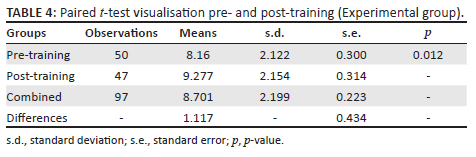
A paired t-test of visualisation shows an improvement in mean visualisation post-training score (pre-training, 8.16 ± 2.12; post-training, 9.28 ± 2.15). The improvement is statistically significant (p ≤ 0.05) (Table 4). Before training, the mean visualisation was 'ineffective' and became 'average' after training when compared to norms by Buys and Ferreira.4
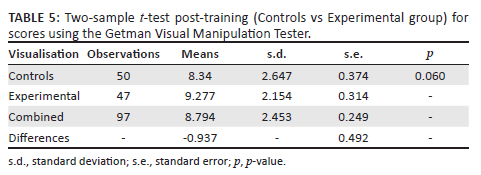
A two-sample t-test between the experimental and control groups (Table 5) shows an improvement in performance in mean visualisation in the experimental group (Controls 8.34 ± 2.65; Experimental 9.28 ± 2.15). The improvement is not statistically significant (p > 0.05). Comparing the experimental group after training with the control group, the experimental group is 'average', whereas the control group is 'ineffective'.
Discussion and conclusions
Elite athletes use visualisation strategies when preparing for competitions. Athletes with lower skill levels require more time to execute visualisation of a physical performance than the actual time required to perform the physical act.15111213
In another study by Du Toit et al.,9t-test was used to compare the pre-test and the post-test mean values for the control and experimental groups. Visualisation in the experimental group showed improvement, even though the improvement was statistically not significant.
In the current study, the paired t-test showed a statistically significant improvement in visualisation after visual skills training. The mean visualisation in the experimental group improved from 'ineffective' to 'average' after training. The improvement is statistically significant. Comparing the control group and the experimental group after training, the two-sample t-test results show an improvement in mean visualisation in the experimental group from 'ineffective to 'average'. The improvement is statistically non-significant and may have occurred by chance. The above results agree with several studies9,12,13,1415,16,17,1815,17,18
Competing interests
The authors, J.R.R. and R.H., declare that they have no financial or personal relationship(s) that may have inappropriately influenced them in writing this article.
Authors' contributions
J.R.R. and R.H. planned and carried out the study. J.R.R. and R.H. were involved in the data collection and analysis of the findings. The article was co-written by J.R.R. and R.H.
Funding information
The authors received no financial support for the research, authorship, and/or publication of this article.
Data availability
The authors confirm that the data supporting the findings of this study are available within the article and/or its supplementary materials.
Disclaimer
The views and opinions expressed in this article are those of the authors and do not necessarily reflect the official policy or position of any affiliated agency of the authors.
Acknowledgements
References
- 1.Erickson GB. Sports vision: Vision care for the enhancement of sports performance. Butterworth-Heinemann, St Louis, MO: Elsevier Incorporated; 2021.
-
2.Du Toit PJ, Kruger PE, De Wet KB, Van Vuuren B, Van Heerden HJ, Janse van Rensburg C. Influence of exhaustion on metabolism and visual motor performance of professional cricket players. Afr J Phys Health Edu Recreat Dance. 2006;12(1):50-59. https://doi.org/10.4314/ajpherd.v12i1.24708
» https://doi.org/10.4314/ajpherd.v12i1.24708 - 3.Ferreira JT. Sports vision assessment manual. Sports Information and Science Agency, Johannesburg: University of Johannesburg, Sports Vision Department; 2000.
-
4.Buys JHC, Ferreira JT. The development of protocols and norms for sports vision evaluations. S Afr Optom. 2008;67(3);106-117. https://doi.org/10.4102/aveh.v67i3.187
» https://doi.org/10.4102/aveh.v67i3.187 - 5.Williams AM, Davids K, Williams JG. Visual perception and action in sport. New York: Spon Press; 1999.
- 6.Bahdur K, Ferreira JT, Lategan L, Ludeke A. The effects of a visual intervention programme on the visual skills of professional football players. Afr J Phys Act Health Sci. 2016;22(3:2):920-931.
- 7.Ramaja J. The role and importance of visual skills in football performance [Masters thesis], UJ; 2015, p. 1-177.
- 8.Coopoo Y, Moss H, Fortuin C, Freese H, Cameron M. The art, philosophy and science of football in South Africa. Johannesburg: Mapungubwe Institute for Strategic Reflection; 2012.
-
9.Du Toit PJ, Kruger PE, Mahomed AF, et al. The effect of sports vision exercises on the visual skills of university students. Afr J Phys Health Edu Recreat Dance. 2011;17(3):429-440. https://doi.org/10.4314/ajpherd.v17i3.71094
» https://doi.org/10.4314/ajpherd.v17i3.71094 - 10.Buys JHC. The development of norms and protocols in sports vision evaluations [Masters thesis], UJ; 2002, p. 1-179.
-
11.Du Toit PJ, Kruger P.E., Chamane NZ, Campher J, Crafford D. Sports vision assessment in soccer players. Afr J Phys Health Edu Recreat Dance. 2009;15(4):594-604. https://doi.org/10.4314/ajpherd.v15i4.49546
» https://doi.org/10.4314/ajpherd.v15i4.49546 - 12.Du Toit PJ, Janse van Vuuren P, Le Roux S, et al. The effect of sport specific exercises on the visual skills of rugby players. World Acad Sci Eng Technol. 2012;6:11-20.
- 13.Du Toit PJ, Jansen van Rensburg A, Janse van Rensburg DC, et al. Influence of two sports vision training techniques on visual skills performance of university students. Afr J Phys Act Health Sci. 2016;22(1):428-444.
-
14.Du Toit PJ, Kruger PE, Fowler K, Govender C, Clark J. Influence of sports vision techniques on adult male rugby players. Afr J Phys Act Health Sci. 2010;16(3):487-494. https://doi.org/10.4314/ajpherd.v16i3.60931
» https://doi.org/10.4314/ajpherd.v16i3.60931 - 15.Thomas CK, Perumal V, Radhakrishnan T. Effects of vision training with skill practices on selected skill performance variables among inter collegiate male football players. Int J Phys Educ Sports Health. 2016;3(6):255-258.
- 16.Ali AAAA. The impact of a training program of complex skills and vision drills on specific visual abilities and quick and accurate motor performance in football juniors. World J Sports Sci. 2010;3(S):750-764.
- 17.Kumar V, Arumugan S. Effect of visual perceptual training on selected performance variables of football players. World Acad Inf Manage Sci. 2020;9(4):9401-9405.
-
18.Binu A. Effect of vision training among skill ability of football players. Indian J Appl Res. 2020;10(1):20-21. https://doi.org/10.36106/ijar/0912538
» https://doi.org/10.36106/ijar/0912538

Accepted: 18 July 2023
Published: 30 Mar. 2024