Exploring the association between asthenopia, vergence measures and the interpupillary distance
Abstract
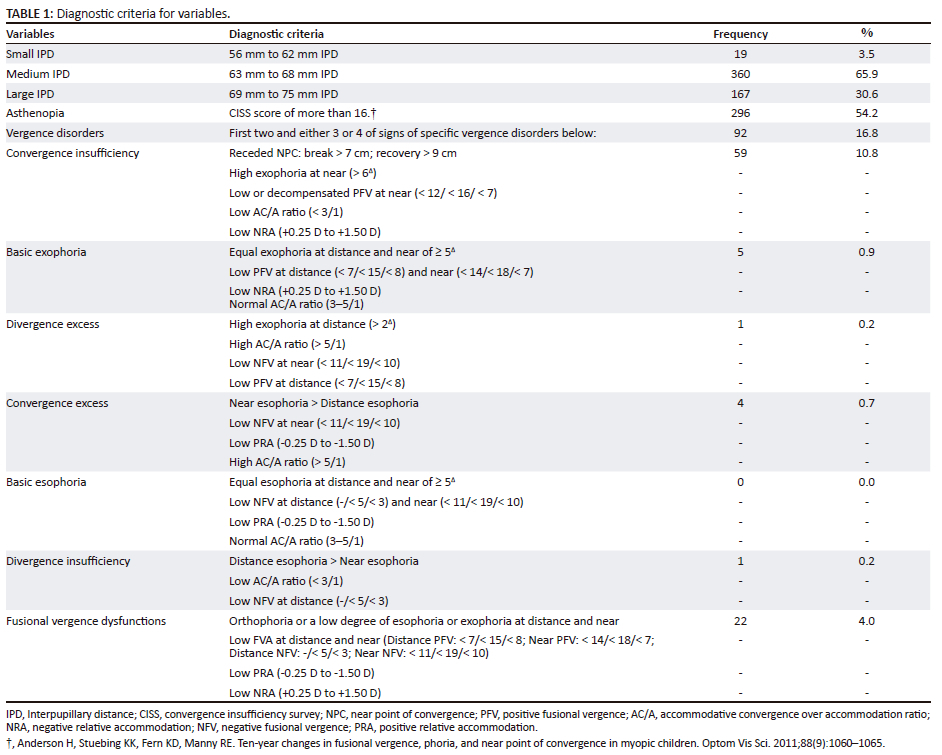
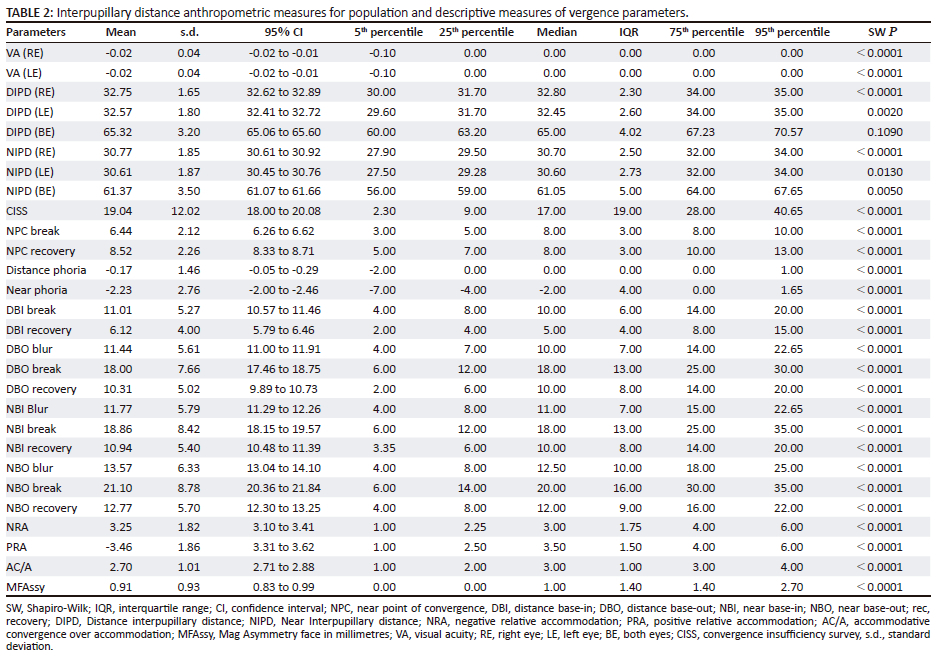
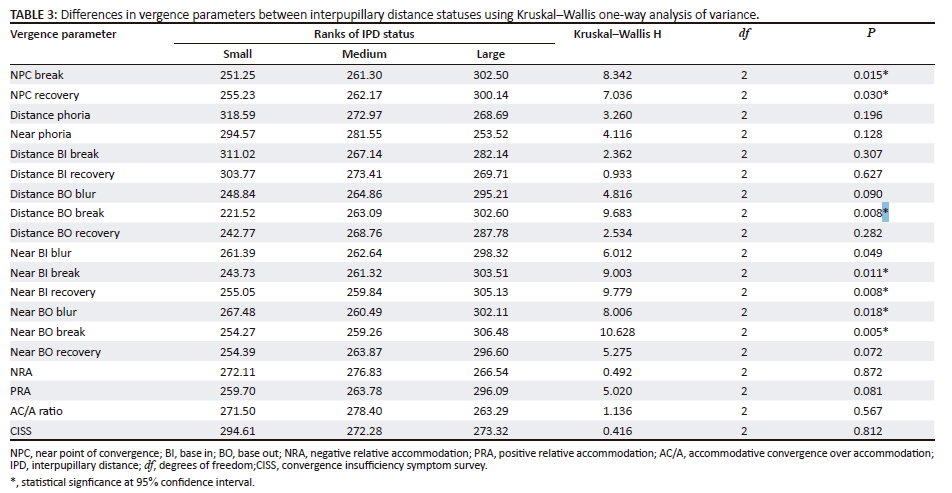
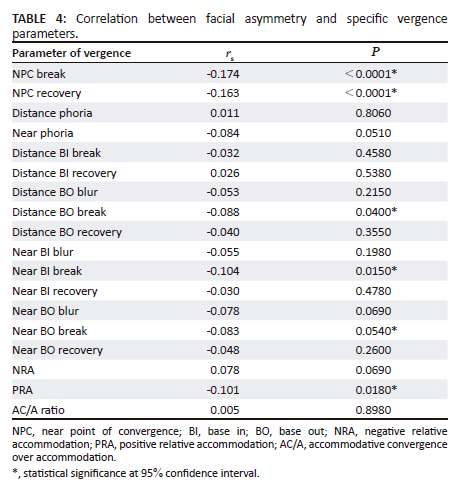
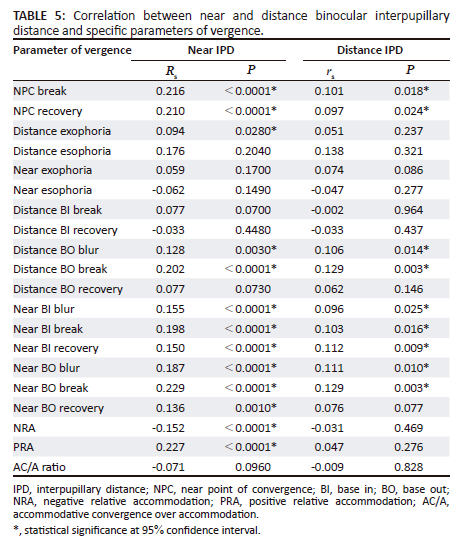
BACKGROUND: Exploring the possible association between Interpupillary distance (IPD), and vergence parameters (VPs) and asthenopia may give an impression of a vergence disorder (VD). AIM: To investigate the association between asthenopia, VPs, VDs, and IPD among junior high school (JHS) students SETTING: The study took place in JHSs in Cape Coast, Ghana. METHODS: A cross-sectional study design and a multi-stage sampling technique was employed. Five hundred and forty-six (546) students enrolled completed oculo-visual screening, Convergence Insufficiency Symptom Survey (CISS) administration, IPD measurements, and VPs assessments [near point of convergence (NPC), lateral heterophoria, positive fusional vergence (PFV), negative fusional vergence (NFV) amplitudes, Gradient AC/A ratio and relative accommodation] over maximum plus for best corrected visual acuity refractive correction. RESULTS: The IPD status (small [OR] = 0.542, CI = 0.200 - 1.470, p = 0.229), medium (OR = 1.182, CI = 0.818 - 1.708, p = 0.373), large (OR = 0.920, CI = 0.630 - 1.344, p = 0.668) was not a risk for asthenopia. Small (p = 0.598), medium (χ2 = 0.046, p = 0.831), and large (χ2 = 2.875, p = 0.090) IPD was not associated with VDs. There were significant correlations between IPD, and NPC break (rs = 0.101, p = ˂ 0.018); distance PFV blur (rs = 0.106, p = 0.014) and break (rs = 0.129, p = 0.003); near NFV blur (rs = 0.096, p = 0.025) and break (rs = 0.103, p = 0.016); near PFV blur (rs = 0.111, p = 0.010) and break (rs = 0.125, p = 0.003). CONCLUSION: VD and asthenopia cannot be predicted with IPD. CONTRIBUTION: The IPD is not diagnostic sign for vergence disorder.
interpupillary distance; facial asymmetry; asthenopia; vergence disorders; vergence parameters