Supply-side determinants of cataract surgery output in South Africa
Abstract
BACKGROUND: Cataracts are the leading global cause of blindness. Despite having an adequate number of ophthalmologists, South Africa has not achieved the World Health Organization (WHO) Vision 2020 target of 2000 cataract surgeries per million population annually. AIM: This study aims to examine supply-side factors influencing cataract surgery output by exploring provider characteristics, perceived barriers, enablers and proposed strategies to increase surgical volume. SETTING: South Africa. METHODS: A cross-sectional survey was conducted on the 399 medically trained members of the Ophthalmology Society of South Africa (OSSA) between May 2024 and June 2024. RESULTS: The response rate was 19.7% (79/399). In 2023, nearly half of the respondents performed fewer than 200 cataract surgeries, while only 15% performed more than 500. Surgeons performing ≥ 201 surgeries were more likely to be male (prevalence ratio [PR] = 2.26; 95% confidence interval [CI]: 1.33-3.85), older, particularly 56-65 years old (PR = 5.00; 95% CI: 1.73-14.49), more experienced (> 10 years: PR = 6.74; 95% CI: 1.78-25.48), qualified specialists (PR = 10.76; 95% CI: 1.61-72.10), full-time private-sector employed (PR = 4.50; 95% CI: 2.14-9.47) and performing phacoemulsification (PR = 1.35; 95% CI: 1.22-1.84). Common barriers to increased output included non-surgical responsibilities (28%), limited theatre time (25%), poor patient access (24%) and inconsistent consumable supplies (22%), particularly in the public sector. Respondents identified several enablers, such as adequate theatre staff (56%), dedicated eye theatres (49%), functioning equipment (43%) and motivated staff (41%). Proposed included improving theatre utilisation (24%), stabilising consumable supply chains (24%) and strengthening staff motivation (19%). CONCLUSION: Cataract surgery rates (CSR) in South Africa remain suboptimal. Addressing provider-identified barriers, leveraging enablers and implementing targeted strategies may enhance surgical output. CONTRIBUTION: This study provides insights into supply factors affecting cataract surgery output in South Africa.
cataract; South Africa; sub-Saharan Africa; cataract surgery output; cataract blindness
Introduction
Globally, 295 million people live with moderate and severe visual impairment (MSVI), and 43 million are blind.1122231,4 Population-based indicators for cataract surgery show low productivity in sub-Saharan Africa, largely reflecting the shortage of ophthalmologists in relation to the population.5,6
South Africa is a sub-Saharan African country with a population of 62 million,797Vision 2020: Right to Sight strategy recommended a target of 4 ophthalmologists per million population.101112
Although South Africa meets the Vision 2020 workforce target, it is unclear whether the country has consistently met the Vision 2020 target of 2,000 cataract surgeries per million people per year (Cataract Surgery Rate [CSR]).1051314665
Methods
Between May 2024 and June 2024, a cross-sectional study was conducted on all medically trained members of the OSSA. The 399 members consisted of ophthalmologists, registrars and ophthalmology medical officers. Ophthalmologists are specialists who have completed postgraduate training in ophthalmology and possess the most surgical experience. Registrars are doctors currently undergoing formal postgraduate training in ophthalmology. Ophthalmology medical officers are doctors working within ophthalmology departments who have completed undergraduate medical training. Thus, all medically trained members could potentially perform cataract surgery in South Africa. Participants were not excluded if they did not perform cataract surgery.
An online REDCap questionnaire was developed to collect data about the study objectives.15,16 The questionnaire was self-administered, anonymous and available only in English. The questionnaire consisted of three sections with 48 questions in total. Demographic and employment environment data, 2023 cataract surgical output, barriers, enablers and implementation strategy data were collected. Cataract surgical output was collected as a categorical variable. The questionnaire was distributed internally by OSSA via email to eligible members. Each participant received an introductory message with a hyperlink to an informed consent form, followed by the questionnaire.
The questionnaire was reviewed by a South African-trained ophthalmologist who was not an OSSA member to enhance the validity of the questionnaire prior to the study's data collection. The experience question was revised to better capture surgical experience, as most participants likely began performing cataract surgery before starting their registrar training. Cataract surgical output was validated by whether the surgeon estimated the number of surgeries, reviewed personal records or reviewed their facilities' records. Only 2023's cataract surgery output was collected to reduce recall bias and minimise low output because of the coronavirus disease 2019 (COVID-19) pandemic.
The response rate was determined by dividing the number of participants who completed all three questionnaire sections by the total number of eligible OSSA members. Data analysis was performed on completed questionnaires using R statistical software version 4.2.2.17p ≤ 0.05), whereas the Fisher's Exact and Pearson's Chi-squared Tests were used to determine which categorical variables were associated with performing ≥ 201 surgeries (p ≤ 0.05). Barriers, enablers and implementation strategies were summarised as the percentage agreement among participants. The free-text responses were classified into the following categories: human resources, equipment, facilities, financial factors and patient-related factors. The responses could be categorised into more than one category.
Permission was obtained from OSSA's research committee to perform the research on its members. Participation was voluntary and anonymous, and there was no financial incentive for participation. These specifications were emphasised to promote honest responses and limit bias.
Ethical considerations
An application for full ethical approval was made to the University of Cape Town Faculty of Health Sciences Human Research Ethics Committee, and ethics consent was received on 19 April 2024. The ethics approval number is HREC REF: 256/2024.
Results
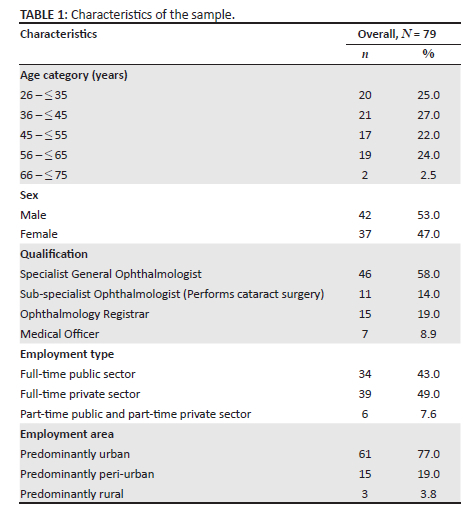
A total of 112 participants (28%) completed the questionnaire, of whom 79 (19.7%) completed all three sections and 33 submitted partial responses. Table 1 presents the demographic and professional characteristics of the sample. The sample's age ranged from 26 to 75 years. The gender distribution was 53% male and 47% female. The majority of the participants were qualified ophthalmologists (72%). Most participants (96%) worked in predominantly urban or peri-urban facilities, and nearly half of the participants (49%) were employed full-time in the private sector.
Objective 1: Determine the cataract surgery output per year among cataract surgery providers in South Africa
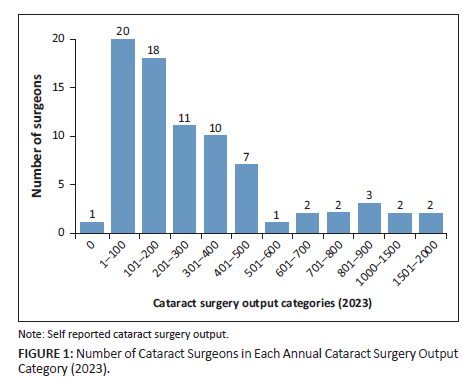
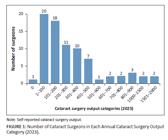
The number of cataract surgeries performed per surgeon in 2023 showed a right-skewed distribution (Figure 1). Among the 79 participants, 50% performed 200 or fewer cataract surgeries, and only 12 (15%) performed 500 or more surgeries in 2023. Two participants performed more than 1500 cataract surgeries. Both were experienced ophthalmologists with over 10 years of experience in private practice, one being male and the other female. Notably, one medical officer working in a rural district hospital performed between 801 and 900 cataract surgeries.
Objective 2: Determine which factors were associated with higher cataract surgery output (≥ 201 cataract surgeries in 2023|)
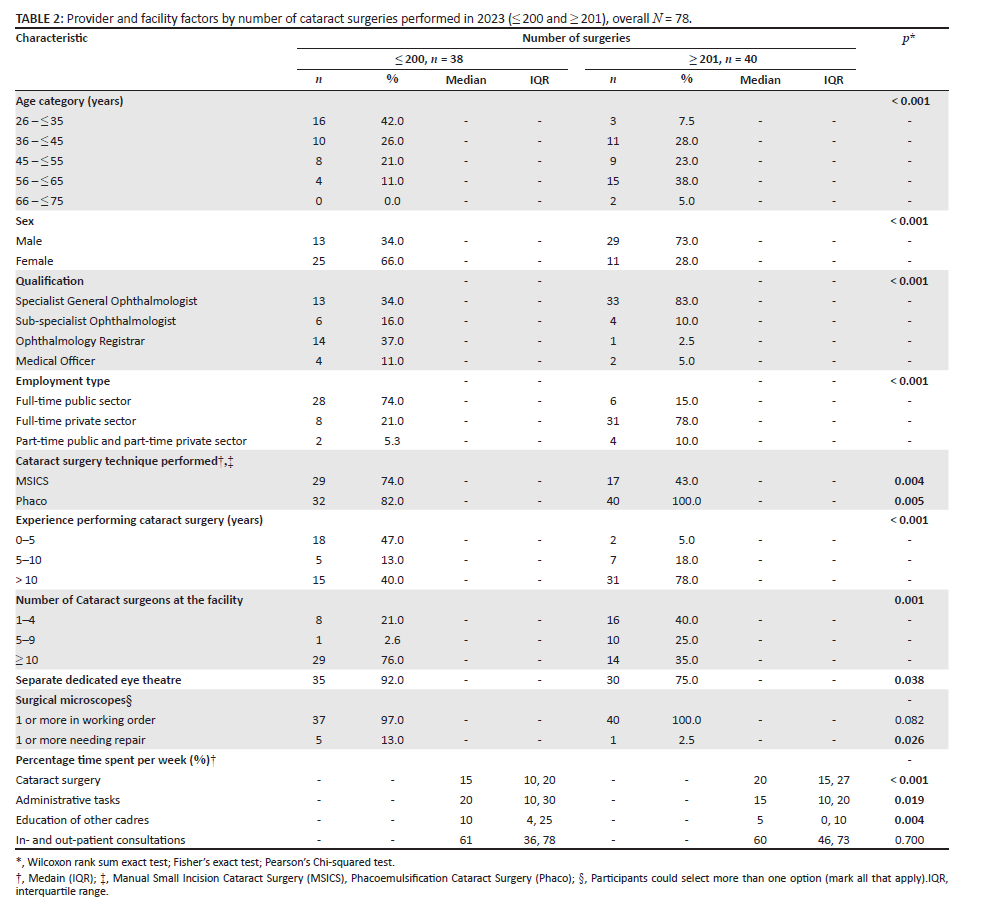
Of the sample, 78 participants performed cataract surgery in 2023. Table 2 compares statistically significant provider and facility factors between two cataract surgery productivity groups in the sample: lower productivity (≤ 200) and higher productivity (≥ 201). Older surgeons, particularly those aged 56-65 years (PR = 5.00; 95% CI: 1.73-14.49), those with more than 10 years of experience (PR = 6.74; 95% CI: 1.78-25.48) and male surgeons (PR = 2.26; 95% CI: 1.33-3.85) were more likely to perform at least 201 cataract surgeries. This group was predominantly composed of qualified ophthalmologists (PR = 10.76; 95% CI: 1.61-72.10) working in full-time private practice (PR = 4.50; 95% CI: 2.14-9.47) and performing phacoemulsification cataract surgery (PR = 1.35; 95% CI: 1.22-1.84). Key facility factors contributing to higher productivity included fewer than ten surgeons and no microscopes needing repair. In addition, these surgeons dedicated more time to surgeries and less to administrative and educational tasks than the lower productivity group. Unexpectedly, performing MSICS cataract surgery or having a dedicated eye theatre was statistically significantly associated with the lower productivity group.
Objective 3: Providers' views on perceived barriers, enablers and implementation strategies
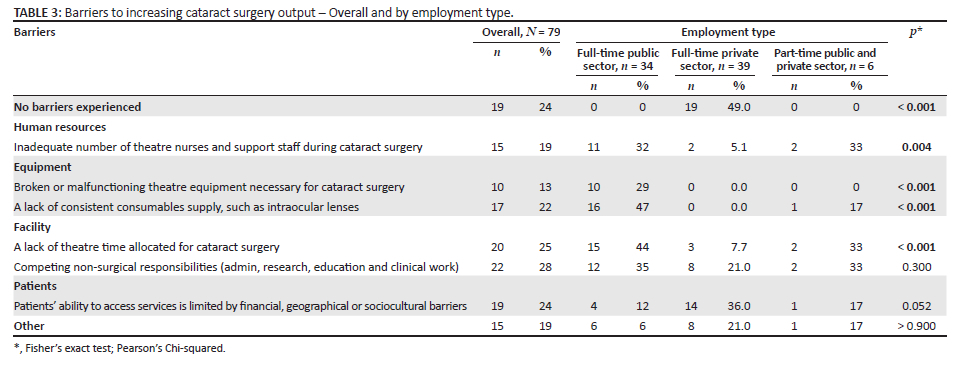
Facility and equipment factors were the most agreed upon barriers to increasing cataract surgery output, with competing non-surgical responsibilities most frequently reported (Table 3). No barriers were reported by 24% of the sample, all working in the private sector. The public sector showed greater agreement for barriers related to human resources, equipment and facility factors compared to the private sector and dual employment (p < 0.05).
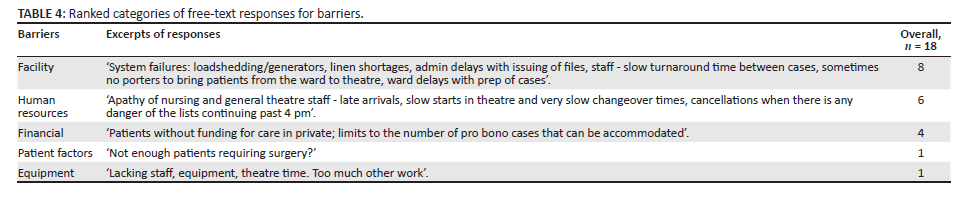
Table 4 ranks the categories in the 18 free-text responses about barriers. Excerpts of responses for barriers are listed in the Table 4. Facility factors were also the most frequently mentioned category in free-text responses, and barriers to patients accessing care were reported by private sector participants.
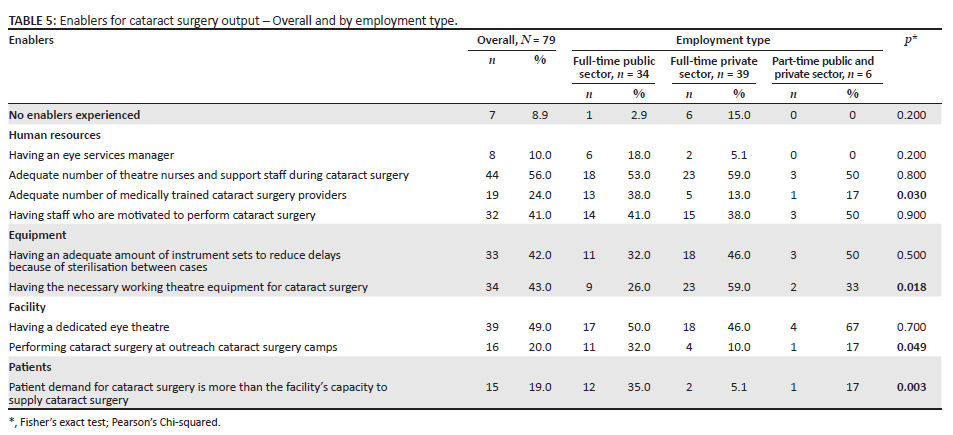
Human resources and equipment factors were seen as enablers for cataract surgery (Table 5). Having sufficient theatre support staff was the most widely recognised enabler. The public sector viewed a sufficient number of cataract surgeons and high patient demand as key enablers compared to the private sector and dual employment (p < 0.05). The private sector was more likely to report having functioning theatre equipment as an enabler (p < 0.05). The public sector's agreement on performing cataract surgery at outreach camps as an enabler was borderline statistically significant compared to the private sector and dual employment (p = 0.049).
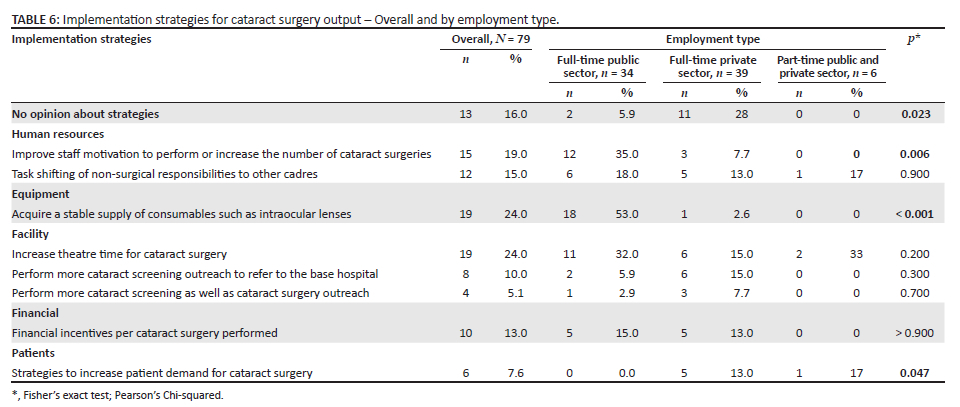
Equipment and facility strategies were the most frequently recommended to increase cataract surgery output (Table 6). Sixteen per cent of the sample had no opinion on strategies, which was significantly more common in the private sector than in the public sector. The public sector showed greater agreement for securing a stable supply of intraocular lenses, increasing theatre time and improving staff motivation as strategies to increase cataract surgery output compared to the private sector and dual employment (p < 0.05). The private sector was more likely to agree on increasing patient demand for cataract surgery than the public sector, which was also reported in the free-text responses.
Discussion
This study explored the supply-side determinants of cataract surgery output in South Africa by examining provider characteristics and perceived barriers, enablers and strategies to increase surgical volume. Nearly half of participants performed 200 or fewer cataract surgeries in 2023, with only 15% exceeding 500. Factors associated with higher surgical productivity (≥ 201 cataract surgeries performed in 2023) included male gender, greater surgical experience, private sector employment, use of phacoemulsification and reduced time spent on non-surgical duties. Commonly reported barriers included non-surgical duties, limited theatre time and inconsistent consumable supplies, with the public sector facing more challenges than the private sector. Enablers were sufficient theatre staff, dedicated theatres, necessary equipment and consumables and motivated teams, with the public sector benefiting from higher patient demand. Participants recommended securing stable consumable supplies, increasing individual theatre time and boosting staff motivation as strategies to improve cataract surgical output.
The study's low surgeon cataract surgery output is consistent with other Sub-Saharan African countries. In a multi-country study, only 20% of ophthalmologists performed more than 500 cataract surgeries annually, with no participants from Zambia exceeding this number.1920Vision 2020: Right to Sight set the target of 500 or more cataract surgeries per surgeon per year to address cataract blindness.21Eye Care in Health Systems: Guide for Action emphasises broader goals for integrating eye care into health systems and has a recommended list of eye care indicators to be collected but did not set targets for these indicators.22Vision 2020, its targets are still useful for guiding efforts to reduce preventable blindness. Performing at least 350 cataract surgeries per year has been associated with improved visual outcomes after surgery compared to surgeons performing fewer surgeries, indicating that increasing surgical output also leads to better outcomes.18
Our study reports several demographic and facility factors statistically significantly associated with the higher productivity group (≥ 201 cataract surgeries performed in 2023). Greater surgical experience was associated with the higher productivity group and correlates with other studies, which reported increased cataract surgical output.19,20 Male gender was associated with the higher productivity group, consistent with previous studies.23,24 However, this likely reflects confounding factors, as male participants were generally older, more experienced and more often worked in the private sector in our study. Notably, one of the two most productive surgeons in the study was female. Surgeons practising in the private sector were more likely to perform ≥ 201 cataract surgeries, possibly reflecting the substantially greater availability of theatre time, functioning equipment, consumables and support staff in private facilities. These resource advantages are consistently associated with higher cataract surgery output in Africa.18,25 Higher productivity surgeons in the sample surgeries spend more time operating than those in the lower productivity group. Although the difference in time spent doing other tasks was not statistically significantly less, freeing up time to perform more surgeries leads to higher output. The Aravind model uses task shifting of non-clinical responsibilities to other cadres to increase cataract surgical output.26Lancet Commission on Global Eye Health recommended that low-resource settings continue using the MSICS cataract surgery technique because of its lower cost than phacoemulsification.3 In many African countries, only half of surgeons have access to phacoemulsification.1918
Previous reported barriers for cataract surgery on the continent focused on patient factors and are mainly based on the Rapid Assessment of Avoidable Blindness methodology.6 The top three barriers reported by providers in Africa were patients' distance to a cataract facility, a lack of cataract surgery facilities and a lack of equipment for surgery.19553,19,27
The enablers and implementation strategies suggested to align with overcoming the barriers participants encountered. A systematic review of interventions for increasing cataract surgery uptake in LMICs reported conducting awareness campaigns, eliminating direct and indirect patient costs, using successfully operated individuals as champions, conducting community outreach and high-quality surgical outcomes.2829293019313232
Unexpectedly, patients' barriers to accessing cataract surgery services had low agreement among public sector participants as a barrier for increasing cataract surgery output. Public sector participants also reported demand exceeding the facility's capacity as an enabler for cataract surgery. Although there is significant demand in the public sector, patients likely face similar barriers to care as those reported in other African countries.6213318,19,26 Non-surgical duties were commonly cited as barriers, but task-shifting these responsibilities, a strategy shown to increase output in the Aravind model,26 was not widely endorsed. Furthermore, financial incentives per cataract surgery had low agreement as a strategy for increasing cataract surgery. Other providers in Africa have reported that their current financial reimbursements did not incentivise individual or support staff productivity.19
Study's limitations
This study has several limitations. The cross-sectional design cannot establish causality or the directionality of associations. The study used non-randomised sampling, which limits the generalisability of the results to the sample. Furthermore, OSSA only represents two-thirds of ophthalmologists in the country. This, coupled with the study's low response rate, may have resulted in an under-represented group of providers. Non-response bias is possible, as respondents differed from the full OSSA population: they were less often male (53% vs 72%) and more frequently worked in the public sector (43% vs 14%). This suggests over-representation of public-sector and female clinicians, which should be considered when interpreting the findings. Furthermore, the findings may have limited generalisability beyond OSSA-affiliated providers. Only 42% of the participants confirmed their cataract surgery output using records. The remaining 58% of participants estimated their cataract surgery output. Thus, self-reported figures may not accurately reflect actual surgical output. Furthermore, half of the sample worked in facilities where ten or more surgeons performed cataract surgeries, suggesting facility cluster responses, which further limits the study's generalisability. Despite the low response rate, the number of participants (n = 79) met the minimum required sample size of 78 for statistical analysis. However, the low response rate does limit the statistical analysis, as non-parametric tests were needed, resulting in lower precision than parametric tests on a larger sample.
Conclusion
The study highlights the importance of incorporating providers' views of barriers, enablers and implementation strategies to inform health system interventions to increase CSRs. Despite several limitations, the study revealed that cataract surgery output per surgeon in South Africa is low, identified possible reasons contributing to this based on providers' perspectives on barriers, and proposed solutions through enablers and implementation strategies.
Based on our findings, we recommend that key stakeholders engage in discussions with providers to address barriers, advance the proposed enablers and implement suggested strategies to improve cataract surgery in the country. For implementation, recommendations can be organised by feasibility. Short-term measures include improving theatre efficiency, stabilising consumable supply chains and reducing non-surgical duties. Medium-term measures involve strengthening equipment maintenance systems and addressing theatre staff shortages. Long-term measures possibly include integrating the private sector capacity to increase the national CSR through appropriate future implementation of UHC reforms.
Competing interests
The authors declare that they have no financial or personal relationships that may have inappropriately influenced them in writing this article.
CRediT authorship contribution
Charl F. Marais: Conceptualisation; Formal analysis; Investigation; Methodology; Project administration; Visualisation; Writing - original draft. Robert Geneau: Conceptualisation; Supervision; Writing - review & editing. Deon Minnies: Conceptualisation; Methodology; Supervision; Writing - review & editing. All authors reviewed the article, contributed to the discussion of results, approved the final version for submission and publication and take responsibility for the integrity of its findings.
Funding information
This research received no specific grant from any funding agency in the public, commercial or not-for-profit sectors.
Data availability
The data that support the findings of this study are not openly available because of the confidentiality of participants and are available from the corresponding author, Charl F. Marais, upon reasonable request. The data are securely stored on the University of Cape Town's REDCap server.
Disclaimer
The views and opinions expressed in this article are those of the authors and are the product of professional research. They do not necessarily reflect the official policy or position of any affiliated institution, funder, agency or that of the publisher.
Acknowledgements
The OSSA distributed the data collection tool to its members. This article is based on research originally conducted as part of Dr Charl Marais's master's thesis titled 'Supply-side Determinants of Cataract Surgery Output in South Africa', submitted to the Faculty of Health Sciences, University of Cape Town, in 2025. The thesis was supervised by Prof. Robert Geneau and Dr Deon Minnies. The manuscript has since been revised and adapted for journal publication. The original thesis is available at: http://open.uct.ac.za/handle/11427/29115.
References
-
1. Pesudovs K, Lansingh VC, Kempen JH, et al. Global estimates on the number of people blind or visually impaired by cataract: A meta-analysis from 2000 to 2020. Eye. 2024;38(11):2156-2172. https://doi.org/10.21203/rs.3.rs-3160383/v1
» https://doi.org/10.21203/rs.3.rs-3160383/v1 -
2. Liu YC, Wilkins M, Kim T, Malyugin B, Mehta JS. Cataracts. Lancet. 2017;390(10094):600-612. https://doi.org/10.1016/S0140-6736(17)30544-5
» https://doi.org/10.1016/S0140-6736(17)30544-5 -
3. Burton MJ, Ramke J, Marques AP, et al. The Lancet global health commission on global eye health: Vision beyond 2020. Lancet Glob Health. 2021;9(4):e489-e551. https://doi.org/10.1016/S2214-109X(21)00138-8
» https://doi.org/10.1016/S2214-109X(21)00138-8 -
4. Resnikoff S, Lansingh VC, Washburn L, et al. Estimated number of ophthalmologists worldwide (International Council of Ophthalmology update): Will we meet the needs? Br J Ophthalmol. 2020;104(4):588-592. https://doi.org/10.1136/bjophthalmol-2019-314336
» https://doi.org/10.1136/bjophthalmol-2019-314336 - 5. Lecuona K, Cook C. South Africa's cataract surgery rates: Why are we not meeting our targets? S Afr Med J. 2011;101(8):510-512.
-
6. Aboobaker S, Courtright P. Barriers to cataract surgery in Africa: A systematic review. Middle East Afr J Ophthalmol. 2016;23(1):145-149. https://doi.org/10.4103/0974-9233.164615
» https://doi.org/10.4103/0974-9233.164615 -
7. Stats SA. General household survey [homepage on the Internet]. 2024 [cited 2024 Oct 12]. Available from: https://www.statssa.gov.za/publications/P0318/P03182023.pdf
» https://www.statssa.gov.za/publications/P0318/P03182023.pdf -
8. The World Bank. World development indicators [homepage on the Internet]. 2022 [cited 2024 Oct 12]. Available from: https://databank.worldbank.org/source/world-development-indicators
» https://databank.worldbank.org/source/world-development-indicators -
9. The World Bank. Inequality in Southern Africa: An assessment of the Southern African customs union [homepage on the Internet]. 2022 [cited 2024 Sep 24]. Available from: https://documents1.worldbank.org/curated/en/099125303072236903/pdf/P1649270c02a1f06b0a3ae02e57eadd7a82.pdf.
» 2024 Sep 24 - 10. Organization WH. State of the world's sight: VISION 2020: The right to sight: 1999-2005. 2005.
-
11. Tiwari R, Chikte U, Chu KM. Estimating the specialist surgical workforce density in South Africa. Ann Glob Health. 2021;87(1):83. https://doi.org/10.5334/aogh.3480
» https://doi.org/10.5334/aogh.3480 - 12. Shelley-Ann M. Email correspondence: Ophthalmology Society of South Africa (OSSA) membership number and type, and previous online survey response rates. Personal correspondence. 2024.
-
13. Adelson J, Bourne RRA, Briant PS, et al. Causes of blindness and vision impairment in 2020 and trends over 30 years, and prevalence of avoidable blindness in relation to VISION 2020: The right to sight: An analysis for the Global Burden of Disease Study. Lancet Glob Health [serial online]. 2020 [cited 2024 Sep 25]. Available from: https://www.iapb.org/learn/vision-atlas
» https://www.iapb.org/learn/vision-atlas -
14. NDOH. National Health Act: National health insurance policy: Towards universal health coverage [homepage on the Internet]. 2015 [cited 2024 Jan 12]. Available from: https://www.gov.za/sites/default/files/gcis_document/201707/40955gon627.pdf
» https://www.gov.za/sites/default/files/gcis_document/201707/40955gon627.pdf -
15. Harris PA, Taylor R, Thielke R, Payne J, Gonzalez N, Conde JG. Research electronic data capture (REDCap) - A metadata-driven methodology and workflow process for providing translational research informatics support. J Biomed Inform. 2009;42(2):377-381. https://doi.org/10.1016/j.jbi.2008.08.010
» https://doi.org/10.1016/j.jbi.2008.08.010 -
16. Harris PA, Taylor R, Minor BL, et al. The REDCap consortium: Building an international community of software platform partners. J Biomed Inform. 2019;95:103208. https://doi.org/10.1016/j.jbi.2019.103208
» https://doi.org/10.1016/j.jbi.2019.103208 -
17. R Core Team. R: A language and environment for statistical computing [homepage on the Internet]. 2023 [cited 2024 Aug 22]. Available from: https://www.R-project.org/
» https://www.R-project.org/ -
18. Eliah E, Lewallen S, Kalua K, Courtright P, Gichangi M, Bassett K. Task shifting for cataract surgery in eastern Africa: Productivity and attrition of non-physician cataract surgeons in Kenya, Malawi and Tanzania. Hum Resour Health. 2014;12(S1):S4. https://doi.org/10.1186/1478-4491-12-S1-S4
» https://doi.org/10.1186/1478-4491-12-S1-S4 -
19. Herrod S, Sherief ST, Ahmed A, et al. Ophthalmologists' perspective on barriers to cataract surgery and surgical productivity in Ethiopia, Ghana, and Zambia: A descriptive, mixed-methods survey. Ophthalmic Epidemiol. 2024;31(5):409-419. https://doi.org/10.1080/09286586.2023.2301581
» https://doi.org/10.1080/09286586.2023.2301581 -
20. Cox JT, Subburaman GB, Munoz B, Friedman DS, Ravindran RD. Visual acuity outcomes after cataract surgery: High-volume versus low-volume surgeons. Ophthalmology. 2019;126(11):1480-1489. https://doi.org/10.1016/j.ophtha.2019.03.033
» https://doi.org/10.1016/j.ophtha.2019.03.033 -
21. Palmer JJ, Chinanayi F, Gilbert A, et al. Trends and implications for achieving VISION 2020 human resources for eye health targets in 16 countries of sub-Saharan Africa by the year 2020. Hum Resour Health. 2014;12(1):45. https://doi.org/10.1186/1478-4491-12-45
» https://doi.org/10.1186/1478-4491-12-45 -
22. World Health Organization. Eye care in health systems: Guide for action [homepage on the Internet]. 2022 [cited 2024 Oct 20]. Available from: https://iris.who.int/bitstream/handle/10665/354382/9789240050068-eng.pdf?sequence=1
» https://iris.who.int/bitstream/handle/10665/354382/9789240050068-eng.pdf?sequence=1 -
23. Gong D, Winn BJ, Beal CJ, et al. Gender differences in case volume among ophthalmology residents. JAMA Ophthalmol. 2019;137(9):1015-1020. https://doi.org/10.1001/jamaophthalmol.2019.2427
» https://doi.org/10.1001/jamaophthalmol.2019.2427 -
24. Cai CX, Klawe J, Ahmad S, et al. Geographic variations in gender differences in cataract surgery volume among a national cohort of ophthalmologists. J Cataract Refract Surg. 2022;48(9):1023-1030. https://doi.org/10.1097/j.jcrs.0000000000000938
» https://doi.org/10.1097/j.jcrs.0000000000000938 -
25. Elbieh I, Bascaran C, Blanchet K, Foster A. Trends in cataract surgical rate and resource utilisation in Egypt. Ophthalmic Epidemiol. 2018;25(5-6):351-357. https://doi.org/10.1080/09286586.2018.1481983
» https://doi.org/10.1080/09286586.2018.1481983 - 26. Ravilla T, Ramasamy D. Efficient high-volume cataract services: The Aravind model. Community Eye Health. 2014;27(85):7-8.
-
27. Habtamu E, Eshete Z, Burton MJ. Cataract surgery in southern Ethiopia: Distribution, rates and determinants of service provision. BMC Health Serv Res. 2013;13:480. https://doi.org/10.1186/1472-6963-13-480
» https://doi.org/10.1186/1472-6963-13-480 -
28. Mailu EW, Virendrakumar B, Bechange S, Jolley E, Schmidt E. Factors associated with the uptake of cataract surgery and interventions to improve uptake in low- and middle-income countries: A systematic review. PLoS One. 2020;15(7):e0235699. https://doi.org/10.1371/journal.pone.0235699
» https://doi.org/10.1371/journal.pone.0235699 -
29. Judson K, Courtright P, Ravilla T, Khanna R, Bassett K. Impact of systematic capacity building on cataract surgical service development in 25 hospitals. BMC Ophthalmol. 2017;17(1):96. https://doi.org/10.1186/s12886-017-0492-5
» https://doi.org/10.1186/s12886-017-0492-5 -
30. Tsimanyane M, Koetsie K, Makgotloe A. Operating theatre efficiency at a tertiary eye hospital in South Africa. S Afr Med J. 2023;113(5):1233-1237. https://doi.org/10.7196/SAMJ.2023.v113i5.16602
» https://doi.org/10.7196/SAMJ.2023.v113i5.16602 -
31. Limwattananon C, Limwattananon S, Tungthong J, Sirikomon K. Association between a centrally reimbursed fee schedule policy and access to cataract surgery in the Universal Coverage Scheme in Thailand. JAMA Ophthalmol. 2018;136(7):796-802. https://doi.org/10.1001/jamaophthalmol.2018.1843
» https://doi.org/10.1001/jamaophthalmol.2018.1843 -
32. Kitema GF, Morjaria P, Mathenge W, Ramke J. The appointment system influences uptake of cataract surgical services in Rwanda. Int J Environ Res Public Health. 2021;18(2):743. https://doi.org/10.3390/ijerph18020743
» https://doi.org/10.3390/ijerph18020743 - 33. Nieder-Heitmann N, Cook C. Outreach cataract surgery services: How good are their outcomes? S Afri Ophthalmol J. 2020;15(3):14-17.
- 34. Bourne R, Steinmetz JD, Flaxman S, et al. Trends in prevalence of blindness and distance and near vision impairment over 30 years: An analysis for the Global Burden of Disease Study. Lancet Glob Health. 2021;9(2):e130-e143.

Accepted: 20 Nov. 2025
Published: 09 Feb. 2026