Practitioner perceptions about optometric networks in South Africa
Abstract
BACKGROUND: Private healthcare in South Africa is largely financed by medical schemes. Optometrists reluctantly contract with administrators and networks to service these patients, despite them feeling networks are undesirable and exploitative. Networks contend that various mechanisms employed are necessary to ensure sustainability and prevent fraud, wastage and abuse. A working relationship between practitioners and networks should ideally be cordial and appreciated by each party as being mutually beneficial to the success of their respective businesses. AIM: To assess practitioners' knowledge and perceptions regarding optometric networks. SETTING: The study was conducted amongst optometric professionals in the private sector in South Africa. METHODS: A descriptive, mixed-method study was conducted using a semi-structured questionnaire. Interviews with senior personnel from the networks were conducted. RESULTS: Approximately 77% of respondents belonged to networks with 91% being knowledgeable about networks and their role within optometry. Opticlear had 72% members, while Iso Leso and preferred provider negotiators (PPN) had 67% and 41%, respectively. Most optometrists (69%) neither believed in the need for networks nor that they provide value to the profession, while 94.7% joined networks merely to receive direct payment and access patients, with no other benefits noted. CONCLUSION: Practitioners reluctantly contract to networks for direct payment and to access patients. Furthermore, practitioners feel that networks bully and victimise them while networks highlight their responsibility to reduce healthcare costs and negative practices of fraud, waste and abuse. CONTRIBUTION: Providing sustainable, cost-effective and quality eye care services requires collaboration between networks and practitioners and appreciating each other's roles in the delivery of eye care services.
networks; managed care organisations; designated service providers; Medical Schemes Act; Health Professions Council of South Africa; South African Optometric Association
Introduction
Private healthcare services, including optometric services, are largely pre-funded by private medical aid schemes and insurances.123
Option to participate (OTP) contracts with a network require participating providers to agree to predetermined tariff structures, reimbursement at levels that are often discounted below market rates and to conform to certain clinical protocols. Generally, practitioners reluctantly sign participation agreements to be able to receive direct payment and be endorsed to deliver eye care services to the respective medical scheme's beneficiaries. Practitioners often complain of unfair treatment meted out to them by the medical schemes, administrators and networks. The widespread dissatisfaction and perceived seriousness of their complaints were not exclusive to optometry as, in 2019, other healthcare disciplines also reported experiences of unfair treatment that escalated to the establishment of a Section 59 Commission of Inquiry into unfair and racial biases against some practitioners, especially when conducting audits and peer review activities.4
Healthcare services are funded by a diverse mix of public and private funding systems with different levels of access, affordability, patient care and health outcomes.567,89
Medical schemes are established and regulated under the Medical Schemes Act, No 131 of 1998 (MSA) and fall under the jurisdiction of the Council for Medical Schemes (CMS), an independent statutory body that reports to, and advises the Minister of Health on appropriate regulatory and policy interventions to achieve national health policy objectives.1,2,5Medical Schemes Act no 131 of 1998 Regulations.2,32,10
Networks and MCO within optometry provide administrative functions to medical schemes by ensuring that their beneficiaries receive eye care services through practitioners within their respective networks, known as DSP. Managed care is defined by Regulation 15 of the Medical Schemes Act, 131 of 1998, as 'a clinical and financial risk assessment and management of healthcare, with the view to facilitating appropriateness and cost-effectiveness of relevant healthcare services within the constraints of what is affordable, through the use of rule-based and clinical management-based programmes'.2,112
Managed care originated in the last century, when the railroad, mining and lumber companies organised their own medical services or contracted medical groups to provide care for their workers.1213,14,159,11
In the South African market, managed healthcare emerged in the 1990s, as a cost-reduction mechanism,14Medical Schemes Act, No 131 of 1998 incorporated managed care for the first time in 2000. It was introduced as a solution to the cost escalation problems inherent in the existing third-party payment fee-for-service (FFS) system of health finance in the private sector.1611171819
A health management organisation (HMO) and preferred provider organisation (PPO) are the common types and most recognised of managed care structures.12,161212
Managed care organisations use various utilisation management strategies to control the use of services.121220421
Methods
The study employed a mixed-methods, descriptive study approach, combining the use of both qualitative and quantitative methods within the paradigm.22,23,24,2526,2724,28,29,30® Version 14.2 software. Descriptive statistics were used to analyse and present the collected quantitative data.
For qualitative data, a purposive sampling strategy was employed where senior personnel from selected MCO or networks were invited to participate, based on their expertise and position within their organisations. Individual key stakeholder interviews were conducted with personnel in a natural setting. Responses from open-ended questions collected in the questionnaires, as well as from the interviews, were captured, coded and analysed using thematic content analysis, where key themes that commonly appeared in the responses were identified in accordance with qualitative data analysis strategy using themes.28,31,3224,28,30,33,34
Ethical considerations
Ethical clearance to conduct the study was obtained from the University of KwaZulu-Natal (UKZN) Humanities Ethics Committee (HSS/0228/018M). Informed consent was given by participants before proceeding to participate in the study.
Results
Although the key focus of the study was to ascertain practitioners' knowledge and perceptions of networks, interviews were also conducted with senior representatives of two of the three networks to understand their core business, roles within the optometric sector and challenges experienced in administering optometric benefits. Analysis of coded questions resulted in the emergence of three dominant themes, namely, ensuring availability of optical benefits, ensuring the correct benefit is paid to the appropriate practitioner and combatting fraud, waste and abuse.
In responding to questions relating to their core business, respondents indicated that their core business was to negotiate a fair medical aid patient benefit and fair reimbursement to the contracted practitioner, within the confines of Regulation 15 of the Medical Schemes Act 131 of 1998. Additionally, they indicated a responsibility to identify and minimise fraudulent and abusive claims, stressing that their primary client is the medical aid scheme and that they additionally represent the financial interests of their shareholders.
Networks identified irregular claim patterns as one of the challenges facing the sector and highlighted that many practitioners fall victim to this problem. Furthermore, that they have demonstrated, through their actions, an emphasis on combating what is known in the healthcare sector as fraud, waste and abuse. They have employed different mechanisms such as audits and peer review processes to fight these and ultimately rid the industry of unethical practices.
Although the two participating networks are providing a service to medical schemes, which are regulated under the MSA, both conceded that they were not accredited as MCO as required by Regulation 15 of the Medical Schemes Act.
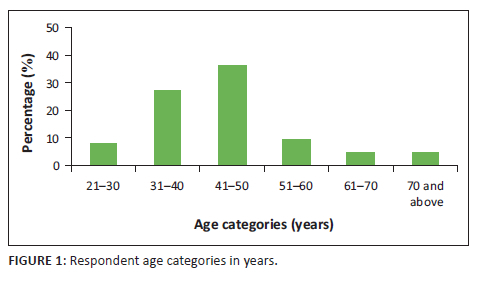
A total of 174 respondents completed the online questionnaires, of whom the majority (56%) were SAOA members, with 52% being males and 48% being females. Affiliation or not with the SAOA had no influence on the choice on membership of networks. The modal age group was 41-50 years old (39%) and a few 70 years and older (5%). The mean age of respondents was 42.76 years (standard deviation [s.d.] = 9.31 years), and the median age was 42.83 years. Figure 1 shows the age distribution of respondents.
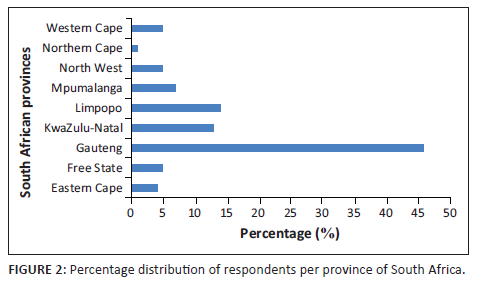
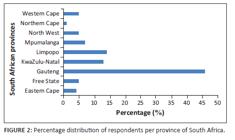
Most respondents confirmed their discipline as optometry (98%) and only 2% were dispensing opticians. Most respondents (84%) were in independent or solo practice, 6% in group practices and the remaining 10% were in franchised practices. Gauteng had the highest number of respondents (46%) followed by Limpopo and KwaZulu-Natal provinces with 14% and 13%, respectively (Figure 2).
Respondents who practised in the cities constituted 40%, towns (36%), townships (16%) and the remaining 8% practised in rural settings as defined in Statistics South Africa's 2001 Census Concept definition document.35
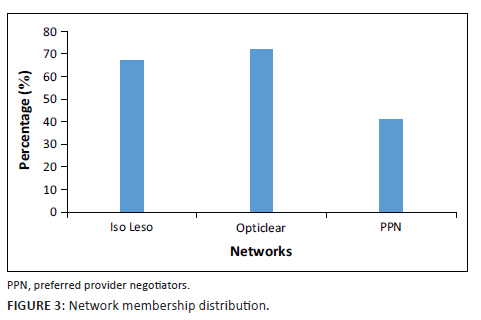
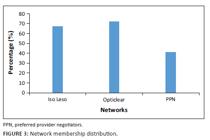
More than three-quarters (77%) of respondents belonged to one or more networks with 91% of them stating that they learnt of networks from the medical aid schemes, through the process of submitting optical claims. Of the respondents who belonged to networks, more than half of them (53%) were members of the SAOA. Opticlear had the largest membership, with 72% of the respondents being members, and PPN had the least (41%), as shown in Figure 3.
Most respondents (69%) indicated that there is no need for networks in optometry practice, even though more than three-quarters (77%) of them were members of such networks, and 88% did not think that the networks protected the profession. When asked as to why they were members of networks, the following were the two most common reasons for affiliation that emerged:
•Access to medical aid patients The main reason that most respondents (94.7%) indicated as motivation for them joining any of the networks was that it was the only means whereby they could get access to members and beneficiaries of the contracted medical aid schemes. They further explained that patients were channelled by the networks to their respective 'in-network providers' or sometimes just prevented from consulting with 'out-of-network providers', financially disadvantaging them.
•Direct payment The second common reason cited was that, although they did not want to be members of the networks, they were compelled to join for specific financial reasons. The rationale being that only if they are part of the network would they be paid directly by their contracted medical schemes, for services rendered to their members and dependents.
Some respondents further elaborated on reasons why they thought networks are not needed by making statements such as 'networks are self-profiteering vultures preying on practitioners and they set unreasonable and exclusionary conditions that must be met before acceptance'. Others added that networks 'exploit practitioners' and 'abuse their power and information'. Many claimed duress in their decision to participate in networks as they are generally presented with a forced-choice situation whereby, if they choose not to join, they ran the risk of losing a significant proportion of their patient base. There were no positive sentiments cited as additional comments on any of the network questions.
Respondents repeatedly raised two issues on their perceptions of the general relationship between practitioners and networks:
•Bullying and exploitation Most respondents (69%) voiced their disappointment with the modus operandi of the networks regarding the general treatment of respondents, with many citing that they feel that they are 'treated like criminals' and are exposed to networks 'dictating things without opening a window of negotiation with the practitioners'. Networks were accused of being police officer, investigator, prosecutor and judge when it pertains to dealing with cases relating to reviews and audits.
•Undue discounting Two-thirds (66%) of the respondents felt that the discounting that the networks impose on the tariffs is affecting the financial viability of practices and making them unsustainable. They elaborated further that managed care tariffs were already low and discounted, so further discounting was a problem. There was a general view that suggested that respondents perceived all the networks as being exploitative in their nature.
When asked whether the practitioners and/or practitioner groups were involved or engaged by networks when setting the tariffs, only 1.5% of respondents thought that the practitioners were consulted by networks when determining and setting the tariffs, while 9.5% of respondents were unsure whether practitioners had a say on the tariffs and 89% of them responded that practitioners played no role.
Discussion
This study found that respondents' age, gender and/or affiliation with the SAOA did not influence a decision on whether to join a network or not. One may have expected that more of the SAOA members will join as the SAOA advocates and lobbies various stakeholders, including networks, on behalf of its members on a range of issues, not limited to fair benefit allocation, clinical protocols and standards of care and coding. Although over three-quarters (77%) of the respondents are members of one or more of the optometric networks, responses from 94.7% of respondents indicated that their membership is a grudge membership, seen as purely for access to medical schemes beneficiaries and financial survival. There appears to be no true organisational value in networks identified by practitioners. The very strong negative sentiments about the existence, influence and approach of the networks imply that if there was an alternate mode for respondents to get access to medical aid patients and be paid directly for services rendered, networks could cease to exist. A strong view shared by 80.2% of general practitioners (GPs) who stated that if there were no financial considerations, they would not contract with MCO and therefore there would be no need for managed healthcare.15
Among the study respondents, PPN had the lowest numbers in network membership compared to its competitors although they claim to have the largest membership.1820
Managed care organisations and PPO act as intermediaries between the purchasers of healthcare services (medical aid schemes) and selected preferred providers (the participating practitioners), who agree to provide services on a discounted fee basis.12121010
As with any other profession, users of health services are aware that practitioner competence levels vary, a factor that generally plays a significant role in the selection of service providers. The financial penalties meted out to patients, in an economically constrained environment, for choosing to consult a practitioner of their choice, deprive them of receiving care from a practitioner that they may consider more competent than those on the network list. Decisions made by these networks should always factor in patients' rights. Although it is understood that both healthcare practitioners and patients have the freedom to choose the treatments they use or prescribe, the motivation to achieve cost effective and quality care where incentives could influence practitioner behaviour, thereby posing a threat to the autonomy of the patient and practitioner. This choice may be indirectly influenced and limited by the unavailability of funding and benefits.15,36
There was general unhappiness by respondents regarding the existence of networks with the majority (69%) being of the view that networks are not needed in the delivery of healthcare services in the private sector. The perceptions of optometric professionals are that the networks do not enhance or provide value to the profession and are irrelevant or undesirable in the profession because of the way they conduct their business as well as treating practitioners negatively. An earlier study among physicians also had a generally negative view of managed healthcare and almost 81% of them disagreed that managed healthcare has improved medicine (48% strongly disagreed and 32.9% disagreed).151526
Networks identified billing and coding as constituting most of the transgressions to which respondents fall victim. This view is validated by a study that found that most of the fraudulent claims are perpetrated through the submission of false claims, irregular billing of codes, duplicate claims, claiming for services that were not rendered and card farming, which refers to members utilising medical aid benefits for a person not covered on the medical aid.37381,39,40,41,42
A lack of coherence in the health system, organisational fragmentation, excessive resources utilisation (wastage), the lack of preventive services, growing incidents of under-treatment or over-treatment of patients and weak clinical accountability motivated the development of managed care,121112,1636
The concern by the majority (66%) of the respondents that the additional discount forced on to the already reduced tariffs is driving the practices out of sustainability corroborates findings from a study in the US that found that organised medicine viewed the emergence and rise to prominence of corporate medicine and intermediaries between doctor and patient as a threat to medical autonomy and potential loss of profits.1226
Conclusion
The relationship between the networks and optometric practitioners appears to be an acrimonious one. Networks feel that there is practitioner engagement in undesirable business practices such as fraud that threatens their sustainability and funding of private healthcare services. Practitioners are dissatisfied with the treatment meted out by networks towards them and what they consider to be unreasonable financial structures. It is imperative that both parties engage meaningfully to foster a better working relationship. The SAOA and other professional representative groups should lobby the CMS for the networks and MCO to take up accreditation in terms of Regulation 15 of the Medical Schemes Act, 131 of 1998, so that they fall within a regulatory framework to ensure accountability and encourage responsible and ethical conduct. Practitioners must be constantly reminded about their ethical obligations and the negative impact of medical aid fraud, waste and abuse on the health system as a whole and on individual medical scheme members in an already constrained economic environment. Positive transparent working relationships between these important stakeholders can only augur well for eye care in the country.
Competing interests
The authors declare that they have no financial or personal relationships that may have inappropriately influenced them in writing this article.
Authors' contributions
S.A.M. was the principal researcher and involved in concept development, data management and writing of the article. V.R.M. was the supervisor for the research project, aided with concept development and co-authored the article.
Funding information
This research received no specific grant from any funding agency in the public, commercial or not for profit sectors.
Data availability
Data collected has been stored and kept safely protected, accessible by the authors. Data supporting the findings of this study are available from the corresponding author, S.A.M., on request.
Disclaimer
The views and opinions expressed in this article are those of the author(s) and do not necessarily reflect the official policy or position of any affiliated agency of the authors.
Acknowledgements
Gratitude goes to the optometrists, dispensing opticians and network representatives that participated in the study and all those who assisted in the data management.
References
-
1.Erasmus D, Ranchod S, Abraham M, Carvounes A, Dreyer K. Challenges and opportunities for health finance in South Africa: A supply and regulatory perspective [homepage on the Internet]. Prepared for FinMark Trust by Insight Actuaries and Consultants. 2016 [cited 2019 Nov 24]. Available from: https://www.mm3admin.co.za/documents/docmanager/f447b607-3c8f-4eb7-8da4-11bca747079f/00104931.pdf
» https://www.mm3admin.co.za/documents/docmanager/f447b607-3c8f-4eb7-8da4-11bca747079f/00104931.pdf - 2.Republic of South Africa. Regulations in terms of the Medical Schemes Act, 1998 (Act no. 131 of 1998) Pretoria: 1999.
- 3.Murove C, Khumalo N. Managed care. PaperPresented at the Actuarial Society of South Africa's 2015 Convention; 2015 November 17-18; Sandton Convention Centre, p. 237-255.
-
4.Ngcukaitobi T, Williams K, Hassim A. Section 59 Investigation: Interim Report [Internet]. 2021 [cited n.d.]. Available from: https://cmsinvestigation.org.za/wp-content/uploads/2021/01/Section-59-Interim-Report-19-Jan-2021.pdf
» https://cmsinvestigation.org.za/wp-content/uploads/2021/01/Section-59-Interim-Report-19-Jan-2021.pdf -
5.Benatar S, Sullivan T, Brown A. Why equity in health and in access to health care are elusive: Insights from Canada and South Africa. Glob Public Health. 2018;13(11):1533-1557. https://doi.org/10.1080/17441692.2017.1407813
» https://doi.org/10.1080/17441692.2017.1407813 - 6.Ahadiat N. Public attitudes toward healthcare fraud: Reasons to commit fraud and common schemes. J Ethics Leg Issues. 2017;11:1-18.
-
7.Burger R, Christian C. Access to health care in post-apartheid South Africa: Availability, affordability, acceptability. Health Econ Policy Law. 2020;15(1):43-55. https://doi.org/10.1017/S1744133118000300
» https://doi.org/10.1017/S1744133118000300 -
8.Van den Heever AM. South Africa's universal health coverage reforms in the post-apartheid period. Health Policy. 2016;120(12):1420-1428. https://doi.org/10.1016/j.healthpol.2016.05.012
» https://doi.org/10.1016/j.healthpol.2016.05.012 -
9.Coovadia H, Jewkes R, Barron P, Sanders D, McIntyre D. The health and health system of South Africa: Historical roots of current public health challenges. Lancet. 2009;374(9692):817-834. https://doi.org/10.1016/S0140-6736(09)60951-X
» https://doi.org/10.1016/S0140-6736(09)60951-X -
10.Turnberry. The consequences of using a non-DSP [homepage on the Internet]. 2019 [cited 2022 Jun 6]. Available from: https://turnberry.co.za/the-consequences-of-using-a-non-dsp
» https://turnberry.co.za/the-consequences-of-using-a-non-dsp - 11.Klinck E. Health and finance. S Afr Med J. 2003;93(2):105-107.
-
12.Fairfield G, Hunter DJ, Mechanic D, Flemming R. Managed care: Origins, principles and evolution. BMJ. 1997;314(7097):1823-1826. https://doi.org/10.1136/bmj.314.7097.1823
» https://doi.org/10.1136/bmj.314.7097.1823 - 13.Block LE. Evolution, growth, and status of managed care in the United States. Public Health Rev. 1997;25(3-4):193-244.
-
14.Gotlieb D. Managed Care in South Africa [homepage on the Internet]. 2018 [cited 2019 Nov 15]. Available from: http://www.arthritis.co.za
» http://www.arthritis.co.za - 15.Scott MR. Perceptions around managed health care service delivery in private medical care in the Republic of South Africa. University of KwaZulu-Natal, Durban; 2008.
- 16.Kinghorn AWA. Implications of the development of managed health care in the South African private health care sector. S Afr Med J. 1996;86(4):335-338.
-
17.Opticlear. Opticlear [homepage on the Internet]. 2019 [cited 2019 Nov 22]. Available from: http://www.opticlear.co.za/home
» http://www.opticlear.co.za/home -
18.PPN. About PPN [homepage on the Internet]. [cited 2023 Jan 17]. Available from: https://www.ppn.co.za/about/about-ppn
» https://www.ppn.co.za/about/about-ppn -
19.Iso Leso. Who are we? [homepage on the Internet]. Iso Leso; 2019 [cited n.d.]. Available from: https://www.isoleso.co.za/about-iso-leso/index
» https://www.isoleso.co.za/about-iso-leso/index -
20.PPN. 2019 PPN manual [homepage on the Internet]. 2019 [cited 2019 Nov 24]. Available from: http://www.optimum.co.za/Display.aspx?pid=6
» http://www.optimum.co.za/Display.aspx?pid=6 -
21.Hugo PF, Loubser SS. The role of managed healthcare in the South African context: A systemic approach. S Afr J Bus Manag. 2005;36(3):75-86. https://doi.org/10.4102/sajbm.v36i3.637
» https://doi.org/10.4102/sajbm.v36i3.637 -
22.Morse JM. Simultaneous and sequential qualitative mixed method designs. Qual Inq. 2010;16(6):483-491. https://doi.org/10.1177/1077800410364741
» https://doi.org/10.1177/1077800410364741 -
23.Halcomb EJ, Hickman L. Nursing standard: Promoting excellence in nursing care. Mix Methods Res. 2015;29(32):41-47. https://doi.org/10.7748/ns.29.32.41.e8858
» https://doi.org/10.7748/ns.29.32.41.e8858 - 24.Saunders M, Lewis P, Thornhill A. Research methods for business students. Harlow, London: Pearson; 2012.
-
25.Burnard P, Gill P, Stewart K, Treasure E, Chadwick B. Analysing and presenting qualitative data. Br Dent J. 2008;204(8):429-432. https://doi.org/10.1038/sj.bdj.2008.292
» https://doi.org/10.1038/sj.bdj.2008.292 -
26.Health Market Inquiry. Health Market Inquiry: Final findings and recommendations report [Internet]. Pretoria; 2019. Available from: https://www.compcom.co.za/wp-content/uploads/2020/01/Final-Findings-and-recommendations-report-Health-Market-Inquiry.pdf
» https://www.compcom.co.za/wp-content/uploads/2020/01/Final-Findings-and-recommendations-report-Health-Market-Inquiry.pdf - 27.Rispel LC, Blaauw D, Ditlopo P, White J. Human resources for health and universal health coverage: Progress, complexities and contestations. In: Health Systems Trust, editor. South African Health Review [Internet]. 2018; p. 13-22.
- 28.Neuman WL. Social research methods: Qualitative and quantitative approaches. 7th ed. Harlow, London: Pearson, 2014; 380 p.
- 29.Naing L, Winn T, Rusli BN. Practical issues in calculating the sample size for prevalence studies. Arch Orofac Sci. 2006;(1):9-14.
- 30.Brink H, Van der Walt C, Van Rensburg G. Fundamentals of research methodology for healthcare professionals. Cape Town: Juta; 2016.
- 31.Maguire M, Delahunt B. Doing a thematic analysis: A practical, step-by-step guide for learning and teaching scholars. AISHE-J. 2017;3(3):3351-33514.
- 32.Saldaña J. Coding and analysis strategies. The Oxford Handbook of Qualitative Research. 1st ed. Oxford: Oxford University Press; 2014.
- 33.Vanderstoep SW, Johnston DD. Research methods for everyday life: Blending qualitative and quantitative approaches. San Francisco, CA: Jossey-Bass; 2009.
- 34.Singh K. Quantitative social research methods. Thousand Oaks, CA: Sage; 2007.
-
35.Statistics South Africa. Census 2001: Concepts and Definitions [Internet]. Pretoria; 2004 [cited n.d.]. Available from: http://www.statssa.gov.za/census/census_2001/concepts_definitions/concepts_definitions.pdf
» http://www.statssa.gov.za/census/census_2001/concepts_definitions/concepts_definitions.pdf -
36.Hattingh L. Moral challenges in managed care. S Afr J Bioeth Law. 2015;8(2):17-20. https://doi.org/10.7196/sajbl.431
» https://doi.org/10.7196/sajbl.431 -
37.Legotlo TG, Mutezo A. Understanding the types of fraud in claims to South African medical schemes. S Afr Med J. 2018;108(4):299-303. https://doi.org/10.7196/SAMJ.2018.v108i4.12758
» https://doi.org/10.7196/SAMJ.2018.v108i4.12758 -
38.Nortjé N, Hoffmann W. Seven year overview (2007-2013) of ethical transgressions by registered healthcare professionals in South Africa. Health SA Gesondheid. 2016;21:46-53. https://doi.org/10.1016/j.hsag.2015.11.004
» https://doi.org/10.1016/j.hsag.2015.11.004 -
39.Ikono R, Iroju O, Olaleke J, Oyegoke T. Meta-analysis of fraud, waste and abuse detection methods in healthcare. Niger J Technol. 2019;38(2):490. https://doi.org/10.4314/njt.v38i2.28
» https://doi.org/10.4314/njt.v38i2.28 -
40.Medical Academy. R22 billion lost to fraud waste and abuse.pdf [homepage on the Internet]. 2019 [cited 2020 Apr 13]. Available from: https://www.medicalacademic.co.za/post-summary/?post_refered=20067
» https://www.medicalacademic.co.za/post-summary/?post_refered=20067 -
41.Tell EJ, Smyth K, Eaton R. Long-term care insurance fraud, waste and abuse risk management: A survey of industry perspectives [homepage on the Internet]. 2019 [cited 2019 Nov 24]. Available from: https://www.soa.org/
» https://www.soa.org/ -
42.Pande V, Maas W. Physician medicare fraud: Characteristics and consequences. Int J Pharm Healthc Mark. 2013;7(1):8-33. https://doi.org/10.1108/17506121311315391
» https://doi.org/10.1108/17506121311315391

Accepted: 14 Feb. 2023
Published: 21 Apr. 2023