Prevalence and determinants of refractive errors at Sekororo District Hospital in Limpopo Province, South Africa
Abstract
BACKGROUND: Refractive errors are common eye disorders affecting people of all age groups worldwide. AIM: To determine the prevalence and determinants of refractive errors among patients attending a rural-based optometry clinic from January 2018 to December 2019. SETTING: The study was conducted at Sekororo District Hospital in Mopani District of Limpopo Province, South Africa. METHODS: A retrospective cross-sectional study comprising two stratified random samples (2018 and 2019) was conducted based on the clinical records of patients who consulted the clinic. Data were analysed with Statistics or Data Analysis software, STATA ed. 15. Determinants of refractive errors were identified using regression analysis and reported as odds ratios with 95% confidence intervals (CI). RESULTS: In the 2018 sample, the prevalence of myopia, hyperopia and astigmatism in the right eyes was 10% (95% CI: 7.0-14.2), 7.5% (95% CI: 4.5-1.3) and 43.4% (95% CI: 37.6-49.3), respectively. Left eyes had myopia 16.1% (95% CI: 12.2-21.0), hyperopia 7.5% (95% CI: 4.5-1.3) and astigmatism 40.1% (95% CI: 34.5-46.0). For the 2019 sample, the prevalence of myopia in right eyes was 13.3% (95% CI: 9.5-18.3), hyperopia 3.8% (95% CI: 2.0-7.3) and astigmatism 33.8% (95% CI: 28.0-40.1). Left eyes had myopia 17.5% (95% CI: 13.1-23.0), hyperopia 8.1% (95% CI: 5.2-12.4) and astigmatism 26.9% (95% CI: 21.6-33.0). CONCLUSION: Across the samples (2018 and 2019) and to laterality (right and left eyes), myopia prevalence ranged from 10% to 17.5% while hyperopia ranged from 3.8% to 8.1%. Astigmatism was most prevalent (ranging from 26.9% to 43.4%). CONTRIBUTION: This article provides useful information about the prevalence of REs in the district hospital setting. The Department of Health Authority may use the results for policy decisions.
refractive errors; myopia; hyperopia; astigmatism; determinants
Introduction and theoretical background
Uncompensated refractive errors (UREs) are very common eye disorders and a leading cause of mild, moderate or severe vision impairment (SVI).1,2,3,43
Refractive errors are related to second lower-order aberrations that occur because of an imperfect optical system not focusing retinal images of light from an object in the external world, thereby leading to blurred images in the absence of any optical or surgical compensation.51,2,3,4,5,6
Common causative factors for URE include longer or shorter axial lengths rather than the average axial length of the eyeball, which is approximately 24.4 mm.1,2,4,64
Other causative factors for uncorrected refractive errors include genetic, environmental and ocular degenerative or inflammatory factors associated with diseases such as diabetes, keratoconus or glaucoma where glaucoma prevalence is associated with the refractive state, increasing gradually with increasing myopia.1,2,3,4,5617,877,82,4,6
Presbyopia is another common eye disorder with ageing that occurs because of physiological insufficiency in the amplitude of ocular accommodation causing blurred near vision when reading fine print or perhaps threading needles.1,413,9
Ametropia or URE mainly occurs because of natural structural defects of the eyeball, and although they sometimes cannot be easily prevented, they can be diagnosed, measured and treated in clinical settings by healthcare professionals, such as optometrists, opticians, ophthalmologists and other trained healthcare professionals.1,2,31,2,3,43,933,103
Globally, as of 2022, at least 2.2 billion people are living with some form of VI or blindness, of which at least 1 bn are visually impaired because of URE and/or presbyopia. Of this 1 bn, URE affects at least 123 million people with 826 m presbyopes; thus, at least, 1 bn could be assisted with simple spectacles.33
The primary purpose of this study was to investigate URE and VI among African participants visiting the optometry clinic in a rural environment in the Mopani District of the Limpopo Province, South Africa. As stated earlier, URE is a common disorder of the eye, leading to VI in the absence of correction or compensation. To the best knowledge of the researchers, this study is the first retrospective study of URE and VI conducted in a public hospital setting for patients consulted at a rural clinic over an extended period of 2 years from January 2018 to December 2019 based on history records archived for clinical purpose rather than this research. The samples were compared over 2 years to investigate similarities or differences per annum.
Method and materials
The data were collected retrospectively in the optometry clinic at Sekororo District Hospital in the Mopani District of Limpopo Province in South Africa. Historical records were extracted from the clinical archive for the patients who had consultations at the clinic between 01 January 2018 and 31 December 2019. (The year 2020 was excluded because of coronavirus disease 2019 [COVID-19].) This study was ethically approved (FREC-1170-2021) by the Faculty Research and Ethics Committee (FREC) in the Faculty of Health Sciences at the University of Johannesburg, South Africa. Permission to conduct the study at the selected district hospital was granted by the Provincial Health Research and Ethics Committee of the Limpopo Department of Health (South Africa)11,12
The records of the patients from the clinic were randomly selected using a probability-stratified random sampling method with the aid of a random function: fx = rand (num) of an Excel spreadsheet (Microsoft 365) for Windows 11 where num is the patient record number. The restriction and stratification techniques were applied to avoid bias and confounding effects by excluding the sampled records with incomplete information and then stratifying sampled records into two subgroups or strata (2018 and 2019) according to the year in which the patients consulted at the clinic. The statistical formula of Cochrane shown in Equation 1 was used to determine the required minimum sample size:

whereby,
n = the required or minimum sample size.
P = the estimated proportion of refractive errors in a population. The degree of variability is not known. A proportion of 50% is assumed in this study for a maximum level of variability elected, suggesting that half of the sample would be emmetropic and the other half would be ametropic.
e = the margin of error, which is the risk the researcher is willing to accept, which could be because of factors such as missing or incomplete clinical records in the study.
Z = the probability value at a significant level of 0.05: here Z = 1.96 obtained from the published probability table of z-scores13
Therefore:
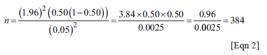
Therefore, the required minimum sample size for the study was 384 records. The stratified formula (sample size for the entire study divided by population size × stratum size)14
For refractive error, the prevalence of myopia, hyperopia and presbyopia for the right and left eyes was determined using the spherical equivalent refractive (SER) powers of ≤ ‒0.25 diopter (D), ≥ 0.50 D and 1 D, respectively, but the prevalence of astigmatism was determined using the cylindrical equivalent refractive power of ≤ ‒0.25 D.12
Statistical analysis
The data were captured in an Excel spreadsheet (Microsoft 365) for Windows, and statistical analysis was performed with the Statistics or Data Analysis (Stata) software special edition 15 (STATA Corporation, College Station, Texas 77845, United States). The results in this article include narration and tabulation of statistics. Chi-squared tests (χ2p < 0.05 was used to test for significance. Univariate and multivariate logistic regression analysis models were used to identify the determinants of any refractive errors. The results of univariate and multivariate logistic regression analysis models were reported as OR with 95% CI.
Ethical considerations
An application for the full ethical clearance to conduct this study was obtained from the University of Johannesburg Faculty of Health Sciences Research Ethics Committee on 06 August 2021. The clearance number is REC-1170-2021.
Results
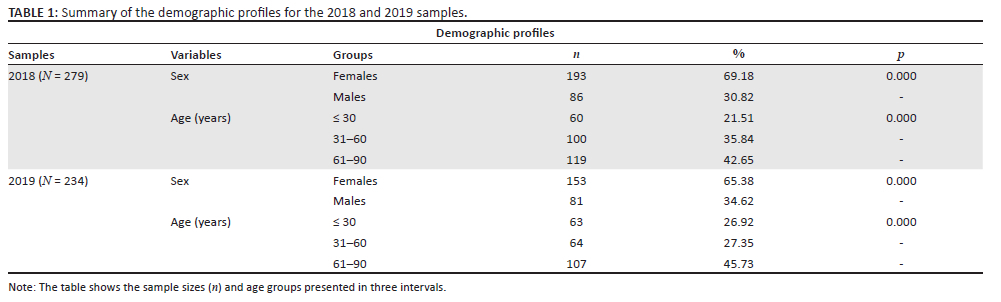
Table 1 shows demographic data of the clinical records extracted from the archive for patients who attended the optometry clinic. The demographic variables include age group and gender. For the 2018 sample, 279 clinical records were sampled comprising 193 (69.2%) records for females and 86 (30.8%) for males. The largest proportion of the sampled records were 119 (42.7%) and in the age group 61-90 years. The smallest proportion of sampled records was 60 (21.5%) in the age group ≤ 30 years. For the 2019 sample, a total of 234 clinical records were sampled comprising 153 (65.4%) records for females and 81 (34.6%) records for males. The largest proportion of sampled records were 107 (45.7%) and 44 (18.8%) in the age group 61-90 years. The smallest proportion of sampled records were 63 (26.9%) (2.6%) in the ≤ 30 years. The age and gender groups in both samples (for 2018 and 2019) were associated, and these factors (age and gender) were statistically significant (p = 0.000) to assess the strength of the association.
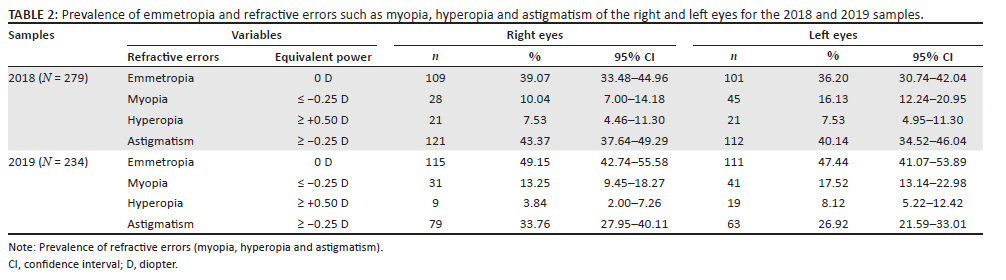
Table 2 shows the prevalence of myopia, hyperopia and astigmatism, as well as emmetropia in the 2018 and 2019 samples. Astigmatism was the most prevalent refractive error in both samples, and astigmatism was more in the right eyes than in the left eyes. The least prevalent refractive error for the right and left eyes in both samples was hyperopia, but the amount of hyperopia for the right and left eyes in the 2018 sample was similar. In contrast, hyperopia for the right and left eyes in the 2019 sample differed where the left eyes were more hyperopic than the right eyes. Emmetropia in both samples was more in the right eyes than in the left eyes.
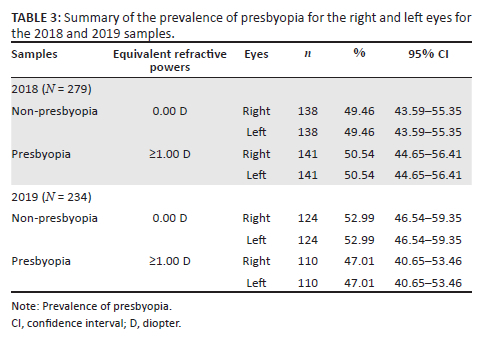
Table 3 refers to the prevalence of presbyopia (≈ 47% - 50% of eyes) irrespective of year (2018 or 2019) or laterality. Presbyopia was very slightly more prevalent at 50.5% in the 2018 sample versus 47% in the 2019 sample.
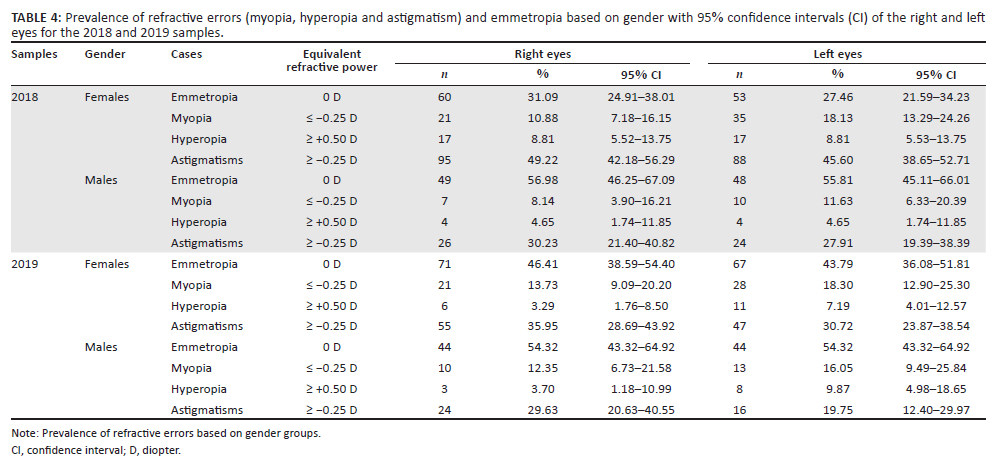
Table 4 shows that astigmatism was the most prevalent refractive error in the 2018 sample for females and males, and it was more in females than in males. However, more males were emmetropic as compared to females. For the 2019 sample, astigmatism remained the most prevalent refractive error in female and male patients, but males were more emmetropic than females. Moreover, the least prevalent refractive error was hyperopia in both samples for 2018 and 2019. The amount of hyperopia for males and females in both samples differed.
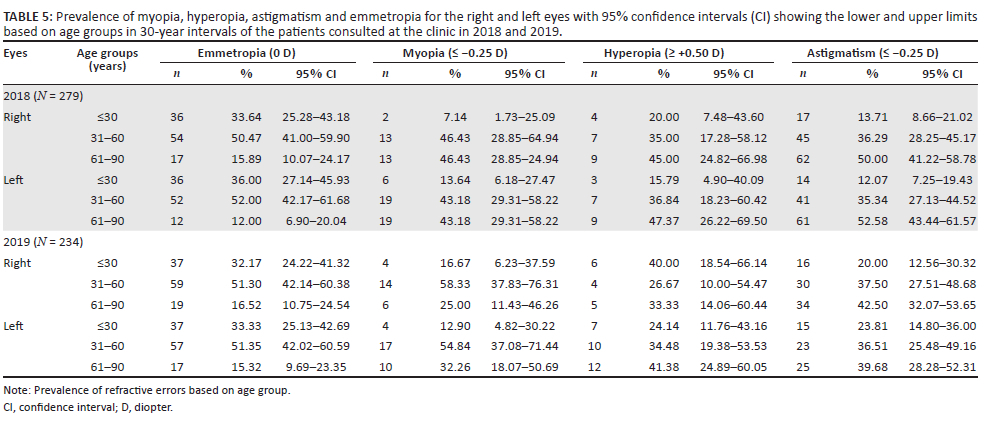
In Table 5, hyperopia was the most common refractive error for both the right and left eyes in the age group ≤30 years in both samples (2018 and 2019), but the age group 31-60 years was more myopic, and the age group 61-90 years was more astigmatic. Emmetropia in the right and left eyes for both samples was more in the age group 31-60 years. However, the age group 61-90 years in two stratified samples was less emmetropic in which the right eyes were more emmetropic than the left eyes.
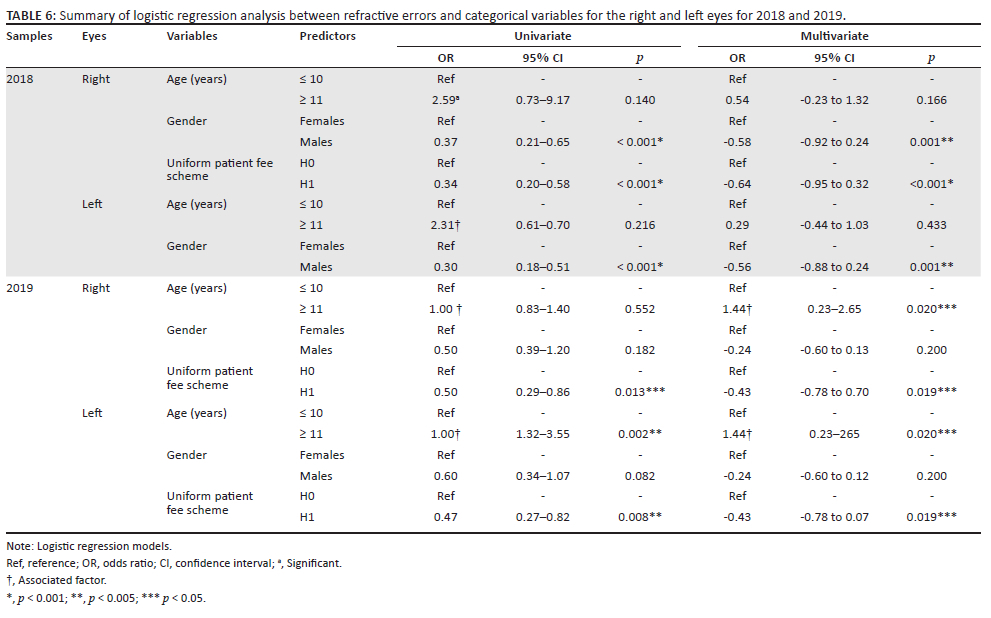
Table 6 summarises the results of the univariate and multivariate logistic regression analysis to identify determinants of refractive errors for the right and left eyes of all patients consulted at the optometry clinic at Sekororo District Hospital from 2018 to 2019. The table also includes the uniform patient fee scheme (UPFS) as a variable for refractive errors. The categories H0 and H1 indicate the applicable subsidy for services that patients receive. Univariate logistic regression analysis for the 2018 sample revealed that age is a determinant of refractive errors for the right eyes (OR = 2.59; 95% CI = 0.73-9.17; p = 0.166) and left eyes (OR = 2.31; 95% CI = 0.61-0.70; p = 0.433) in the 2018 sample but not statistically significant. Gender and UPFS classifications are not a determinant of any refractive errors for the right and left eyes but are statistically significant (p = 0.001 for gender and p < 0.001 for UPFS). However, the multivariate logistic regression analysis results further revealed that age, gender and UPFS are not the determinants of refractive error for the right and left eyes. For the 2019 sample, univariate logistic regression analysis revealed that the age of a patient is a determinant of (any) refractive error for the right and left eyes and is statistically significant (OR = 1.00; 95% CI = 0.83-1.40; p = 0.020). Again, gender and UPFS are not a determinant of refractive errors for the right and left eyes, but the UPFS is statistically significant (p = 0.013). Multivariate logistic regression analysis in Table 6 revealed that age is a determinant of refractive errors for the right and left eyes, statistically significant (OR = 1.44; 95% CI = 0.23-2.65; p = 0.020). Gender and UPFS are not the determinants of refractive errors for the right and left eyes, but the UPFS is statistically significant (p = 0.019).
Discussion
This study is the first retrospective cross-sectional study based on the clinical records extracted from the archive of Sekororo District Hospital aimed at investigating the prevalence and determinants of refractive errors among all patients who consulted a rural optometry clinic over 2 years from January 2018 to December 2019. The study comprised two stratified random samples (2018 and 2019). The results of the present study are comparable to those of previous studies from different parts of the world.
The overall prevalence of refractive errors for the right eyes and left eyes ranging from 50.8% to 63.8% for the 2018 and 2019 samples is not consistent with that of other previous studies, which could be because of different samples, settings and methodology used to gather the data. The prevalence of refractive errors for the right and left eyes of the present study in both samples is larger than that of other previous related studies in Africa, where the overall prevalence ranges from 4.7% to 48.8%15,16,17,1819,2021,2223,24,25,26,27,28,29,30,31,32,33,34
The prevalence of myopia in the right (10.0%) and left eyes (16.1%) of the present study with a range of 10.0% - 17.5% in both samples did not necessarily agree with that of other previous studies. For example, the prevalence of myopia in the right and left eyes is larger than that for previous studies with the prevalence ranging from 4% to 7% conducted inside and outside Africa19,22,27,35,36,37,38,39,40,4115,22,27,30,37,42,43,44,45,46
The prevalence of hyperopia for the right and left eyes of the present study in both stratified random samples (for 2018 and 2019) is not similar where the prevalence of hyperopia ranges from 3.8% to 7.53% to that of other studies conducted outside and inside the border of Africa. The prevalence of hyperopia for the right and left eyes of the present study in two samples is larger than that of other studies where the prevalence ranges from 4.5% to 6.5%15,18,26,28,30,34,35,36,39,43,45,47,4815,19,22,23,25,27,35,36,37,38,40,44,45,46,49,50,51,52,53
The prevalence of astigmatism in the right and left eyes of the present study in samples ranged from 33.8% to 43.4%. The prevalence of astigmatism in the right and left eyes of the present study is not consistent with other previous studies conducted outside and inside Africa and is smaller than that of some studies where the prevalence ranges from 45.6% to 68.1%19,22,27,38,5215,22,23,25,26,29,34,35,36,39,42,46,53
Thus, the results of the present study show that astigmatism is the most prevalent refractive error for the right and left eyes for both stratified random samples, and these results are consistent with previous systematic review and meta-analysis as reported by Hashemi et al.4915,37,42,46,5123,25,30,34,5419,35,36,52,5522,27,383615
The prevalence of presbyopia for the right and left eyes in the 2018 sample of the present study is similar at 50.5% but the prevalence of presbyopia for the right and left eyes is similar at 47.0% for the 2019 sample. The prevalence of presbyopia in the right and left eyes in both 2018 samples is not consistent with that of other previous studies conducted in different parts of the world. The prevalence of presbyopia for the right of the present study in the 2018 sample is larger than that of other studies conducted outside Africa where the prevalence ranges from 30.4% to 42.9%56,574656,5747
The age of patients consulted at a rural optometry clinic at Sekororo District Hospital in 2018 is associated with determinants of refractive errors based on the results of univariate logistic regression analysis as shown in Table 6, but with multivariate logistic regression analysis, age was not a determinant of refractive errors and not statistically significant. For the 2019 sample, age is the determinant of refractive errors based on the univariate and multivariate logistic regression analysis and statistically significant for the right and left eyes but not the right eyes for the 2019 sample. These results of the present study are consistent with the results of other studies from different parts of the world, including those conducted within the African continent but with all previous studies. The age of the patients consulted at the clinic is the determinant of refractive errors of the present study and is consistent with other studies conducted outside Africa42,52,5824,35,49,533415,17,40,42,45,46,58,5923,24,25,32,5311Table 6, the UPFS classifications were not determinants of any refractive errors but were statistically significant.
Limitations of the study
The present study was limited to one rural optometry clinic at a district hospital based on the historical clinical records extracted from the archive. The results of this study can only be generalised in the district hospital setting not in the general population. Another limitation of the present study is that the patients who consulted at the clinic were presenting with visual acuities, which could lead to an overestimation of the overall refractive errors. The study could also be susceptible to confounding effects because of the presence of associated factors of URE of the eye, such as the presence of cataracts and other ocular conditions where reduced vision could be restored after treatment.
Conclusions and recommendations
The most prevalent refractive error for the right and left eyes for both stratified random samples (2018 and 2019) is astigmatism, followed by myopia. Hyperopia for the right and left eyes was the least prevalent refractive error in both samples. In the 2018 sample, the prevalence of presbyopia for the right and left eyes was similar, but the 2018 sample had a larger prevalence of presbyopia compared to that of the 2019 sample. Females had a larger prevalence of refractive errors than males, but more females also attended the clinic. The optometry clinic provides a useful service to the rural community of the Maruleng subdistrict in the Mopani District, but more optometrists are required to expand and diversify the services on offer. Promotional activities will enhance the reach of the community service on offer.
Competing interests
The authors declare that they have no financial or personal relationships that may have inappropriately influenced them in writing this article.
Authors' contributions
K.D.M., N.H. and A.R. have contributed equally during the planning process and writing of this article, but K.D.M. was the principal investigator of this study.
Funding information
This research received no specific grant from any funding agency in the public, commercial or not-for-profit sectors.
Data availability
The data that support the findings of this study are available from the corresponding author, K.D.M., upon reasonable request.
Disclaimer
The views and opinions expressed in this article are those of the authors and are the product of professional research. It does not necessarily reflect the official policy or position of any affiliated institution, funder, agency, or that of the publisher. The authors are responsible for this article's results, findings, and content.
Acknowledgements
Special acknowledgement is extended to the Provincial Health Research and Ethics Committee in the Limpopo Department of Health, the Senior Clinical Manager and the Chief Executive Officer of Sekororo Hospital for allowing the researcher to conduct this study to take place in their facility.
References
-
1.American Optometric Association. Public and patients: Glossary of common eye and vision conditions [homepage on the Internet]. 2022 [cited 2022 Aug 03]. Available from: https://www.aoa.org/
» https://www.aoa.org/ -
2.American Academy of Ophthalmology. Public and patients: Eye health-common eye topics [homepage on the Internet]. 2022 [cited 2022 Aug 14]. Available from: https://www.aao.org/eye-health
» https://www.aao.org/eye-health -
3.World Health Organization. Home page: Health topics: Blindness and vision impairment [homepage on the Internet]. 2022 [cited 2022 Aug 05]. Available from: https://www.who.int/blindness/en/
» https://www.who.int/blindness/en/ - 4.Khurana AK. Comprehensive ophthalmology. 4th ed. New Delhi: New Age International; 2007.
-
5.Unterhost HA, Rubin A. Ocular aberrations and wavefront aberrometry: A review. Afr Vis Eye Health. 2015;74(1):1-6. http://doi.org/10.4102/aveh.v74i1.21
» http://doi.org/10.4102/aveh.v74i1.21 - 6.Bowling B. Kanski's clinical ophthalmology: A systematic approach. International edition. 8th ed. Edinburgh: Elsevier; 2016.
-
7.Czepita M, Czepita D, Lubiński W. The influence of environmental factors on the prevalence of myopia in Poland. J Ophthalmol. 2017:2017:5983406. https://doi.org/10.1155/2017983406
» https://doi.org/10.1155/2017983406 -
8.Tedja MS, Haarman AEG, Meester-Smoor MA, Verhoeven VJM, Klaver CCW, MacGregor S. The genetics of myopia. In: M Ang, T Wong, editors. Singapore: Springer; 2020. https://doi.org/10.1007/978-981-13-8491-2_5
» https://doi.org/10.1007/978-981-13-8491-2_5 -
9.Fricke TR, Tahhan N, Resnokoff S, et al. Global prevalence of presbyopia and vision impairment from uncorrected presbyopia: Systematic review, meta-analysis, and modeling. Ophthalmology. 2018;125(10):1492-1499. https://doi.org/1016/j.ophtha.2018.04.013
» https://doi.org/1016/j.ophtha.2018.04.013 - 10.Matsumura S, Ching-Yu C, Saw SM. Global epidemiology of myopia. Singapore: Springer; 2020.
-
11.Limpopo Department of Health. Home page: Services [homepage on the Internet]. 2022 [cited 2022 Nov 11]. Available from: https://www.dhsd.limpopo.gov.za
» https://www.dhsd.limpopo.gov.za -
12.Wong TY, Foster PJ, Hee J, et al. Prevalence and risk factors for refractive errors in adult Chinese in Singapore. Invest Ophthalmol Vis Sci [serial online]. 2000 [cited 2024 Jan 09];41(9):2486-2494. Available from: https://iovs.arvojournals.org
» https://iovs.arvojournals.org -
13.Taherdoost H. Sampling methods in research methodology: How to choose a sampling technique for research. Int J Acad Res Manag. 2016;5:hal-02546796. https://doi.org/10.2139/ssrn.3205035
» https://doi.org/10.2139/ssrn.3205035 -
14.William K. Stratified sampling: Definition, formula, examples, types [homepage on the Internet]. Survey Sparrow; 2022 [cited 2022 Dec 04]. Available from: https://surveysparrow.com
» https://surveysparrow.com -
15.Abuallut II, Alhulaibi AA, Alyamani AA, et al. Prevalence of refractive error and its associated risk factors among medical students of Jazan University, Saudi Arabia. Middle East Afr J Ophthalmol. 2020;27(4):210-217. https://doi.org/10.4103/meajo.MEAJO_240_20
» https://doi.org/10.4103/meajo.MEAJO_240_20 - 16.Anh VT, D'Esposito F, Van PT, Nga TTH. Prevalence of refractive errors and accuracy of school-based visual acuity screening programs among school children in Vietnam. Durham: Research Square; 2021.
-
17.Halim A, Suganda R, Sirait SN, Memed FK, Rini SM, Ratnaningsh N. Prevalence and associated factors of uncorrected refractive errors among school children in suburban areas in Bandung, Indonesia. Cognet Med. 2020;7(1):1737354. https://doi.org/10.1080/2331205X.2020.1737354
» https://doi.org/10.1080/2331205X.2020.1737354 -
18.Muhit M, Minto H, Parvin A, et al. Prevalence of refractive errors, presbyopia, and unmet need of spectacle coverage in a northern district of Bangladesh: A rapid assessment of refractive error study. Ophthalmic Epidemiol. 2018;25(2):126-137. https://doi.org/10.1080/09286586.2017.1370119
» https://doi.org/10.1080/09286586.2017.1370119 -
19.Alghamdi W, Ovenseri-Ogbomo. The prevalence and causes of visual impairment in Dariyah, a rural community in Saudi Arabia. Afr Vis Eye Health. 2021;80(1):a732. https://doi.org/10.4102/aveh.v80i1.579
» https://doi.org/10.4102/aveh.v80i1.579 -
20.Cui J, Fu J, Li L, et al. Prevalence and pattern of refractive error and visual impairment among schoolchildren: The Lhasa childhood eye study. BMC Ophthalmol. 2021;21:363. https://doi.org/10.1186/s12886-021-02134-8
» https://doi.org/10.1186/s12886-021-02134-8 -
21.Abokyi S, Ilechie A, Nsiah P, et al. Visual impairment attributable to uncorrected refractive error and other causes in the Ghanaian Youth: The University of Cape Coast survey. J Optom. 2016;9(1):64-70. https://doi.org/10.1016/j.optom.2015.04.002
» https://doi.org/10.1016/j.optom.2015.04.002 -
22.Onwukwe NA, Oboh RA, Osuji S, Omyekwere F, Wali J. Types, and magnitude of refractive errors among secondary school students in Obio/ Akpor Local Government Area of Rivers State, Nigeria. Int J Med Sci Appl Biosci [serial online]. 2018 [cited 2023 Feb 10];3(3):2536-7331. Available from: https://casirmediapublishing.com/wp-content/uploads/2019/09/Pages-1-12-3214.pdf
» https://casirmediapublishing.com/wp-content/uploads/2019/09/Pages-1-12-3214.pdf -
23.Alem KD, Gebru EA. A cross-sectional analysis of refractive error prevalence and associated factors among elementary school in Hawassa, Ethiopia. J Int Med Res. 2021;49(3):300060521998894. https://doi.org/10.1177/0300060521998894
» https://doi.org/10.1177/0300060521998894 -
24.Arafa AEED, Ewis AAE, Mahran WM, et al. Prevalence and risk factors of refractive errors among preparatory school student in Beni-Suef, Egypt. J Public Health. 2019;27:43-47. https://doi.org/10.1007/s10389-018-0930-8
» https://doi.org/10.1007/s10389-018-0930-8 -
25.Besufikad B, Hailemichael W, Tilahum L, et al. Refractive errors and associated factors among patients visiting BoruMeda Hospital's secondary eye Unit in Dessie Town, South Wollo Zone, Ethiopia. BMC Ophthalmol. 2020;22:312. https://doi.org/10.1186/s12886-022-02539-z
» https://doi.org/10.1186/s12886-022-02539-z -
26.Ebri AE, Govender P, Naidoo KS. Prevalence of vision impairment and refractive error in school learners in Calabar, Nigeria. Afr Vis Eye Health. 2019;78(1):8. https://doi.org/10.4102/aveh.v78i1.487
» https://doi.org/10.4102/aveh.v78i1.487 -
27.Elsabagh HM, Mohamed R. Screening of refractive error among primary school students at Tanta City Gharbia governorate Egypt. How serious is the problem? Clin Epidemiol Global Health. 2020;8(3):923-926. https://doi.org/10.1016/j.cegh.2020.02.025
» https://doi.org/10.1016/j.cegh.2020.02.025 -
28.Ezegwui IR, Oguego NC, Okoye OI, et al. Prevalence of refractive errors and vision impairment in school children in Enugu South-East Nigeria. Niger J Clin Pract. 2021;24(3):380-386. https://doi.org/10.1403/njcp.njcp_521_19
» https://doi.org/10.1403/njcp.njcp_521_19 -
29.Ghalib NM, Ibrahim SM, Bahakim NO. Prevalence of refractive errors among primary school children (6 to 15yrs) in Al-Khartoum-Sudan. Syst Rev Pharm. 2020;11(10):674-678. https://doi.org/10.31038/SRP.2020.10.99
» https://doi.org/10.31038/SRP.2020.10.99 - 30.Ogbonna GO. Prevalence of refractive error among early primary school age children in Ado-Odo Ota Local Government, Nigeria. Durham: Research Square; 2020.
-
31.Opoku-Yamoah V, Rampersad N, Gcabashe NT. Magnitude and causes of vision impairment amongst school children in the Bono Region of Ghana. Afr Vis Eye Health. 2021;80(1):a578. https://doi.org/10.4102/aveh.v80i1.578
» https://doi.org/10.4102/aveh.v80i1.578 -
32.Sengo DB, Isaura I, Santos D, et al. The prevalence of visual impairment and refractive errors among youth population in Mozambique: Evidence of the need for intervention. Children. 2021;8(10):892. https://doi.org/10.3390/children8100892
» https://doi.org/10.3390/children8100892 -
33.Tagoh S, Kyei S, Kwarteng MA, Aboagye E. Prevalence of refractive errors and vision impairment among rural dwellers in Mashonaland Central Province, Zimbabwe. J Curr Ophthalmol. 2020;32(4):402-407. https://doi.org/10.4103/JOCO_224_20
» https://doi.org/10.4103/JOCO_224_20 -
34.Wajuihian SO, Hansraj R. Refractive errors in a sample of black high school children in South Africa. Optom Vis Sci. 2017;94(12):1145-1152. https://doi.org/10.1097/OPX.0000000000001145
» https://doi.org/10.1097/OPX.0000000000001145 - 35.Ayatollah A, Abdi S, Mirfendereski SA, Nagdi T, Nander HZ, Rad ZK. Prevalence of refractive errors among boy students in Western Iran: High rate of astigmatism. Turk J Physiother Rehabil. 2021;32(3):2651-4451.
-
36.Khoshhl F, Hashemi H, Hoosmmad E, et al. The prevalence of refractive errors in the Middle East: A systematic review and meta-analysis. Int Ophthalmol. 2020;40:1571-1586. https://doi.org/10.1007/s10792-020-01316-5
» https://doi.org/10.1007/s10792-020-01316-5 -
37.Hashemi H, Abbastabar H, Yekta A, Heydarian S, Khabazkhoob M. The prevalence of uncorrected refractive errors in underserved rural areas. J Curr Ophthalmol. 2017;29(4):305-309. https://doi.org/10.1016/j.joco.2017.02.007
» https://doi.org/10.1016/j.joco.2017.02.007 -
38.Ajayi IA, Omotoye OJ, Omotoso-Olagoke. Profile of refractive error in Ekiti, Southwestern Nigeria. Afr Vis Eye Health. 2018;77(1):1-5. https://doi.org/10.4102/aveh.v77i1.415
» https://doi.org/10.4102/aveh.v77i1.415 -
39.Tsai T-H, Liu Y-L, Ma J-H, et al. Evolution of the prevalence of myopia among Taiwanese Schoolchildren: A review of survey data from 1983 through 2017. Ophthalmology. 2021;128(2):290-301. https://doi.org/10.1016/j.ophtha.2020.07.017
» https://doi.org/10.1016/j.ophtha.2020.07.017 -
40.Kleves J. Prevalence of refractive errors in the total population and the analysis of myopic progression in adults aged 20 to 39 in the urban area of Tirana, Albania. Open J Ophthalmol. 2021;11(4):293-312. https://doi.org/10.4236/ojoph.2021.114024
» https://doi.org/10.4236/ojoph.2021.114024 -
41.Ye H, Qian Y, Zhang Q, et al. Prevalence, and risk factors of uncorrected refractive errors among elderly Chinese population in urban China: A cross-sectional study. Br Med J Ophthalmol. 2018;8(3):bmjopen-2017-021325. https://doi.org/10.1136/bmjopen-2017-021325
» https://doi.org/10.1136/bmjopen-2017-021325 -
42.American Academy of Optometry. Home page: Optometry and Vision Sciences Journal [homepage on the Internet. 2022 [cited 2022 Dec 02]. Available from: https://aaopt.org/
» https://aaopt.org/ -
43.Mukazhanova A, Aldasheva N, Iskakbayeva J, et al. Prevalence of refractive errors and risk factors for myopia among school children of Almaty, Kazakhstan: A cross-sectional study. PLoS One. 2022;17(6):e0269474. https://doi.org/10.1371/journal.pone.0269474
» https://doi.org/10.1371/journal.pone.0269474 -
44.Sheeladevi S, Seelam B, Nukella PB, Borah RR, Ali R, Keay L. Prevalence of refractive errors, uncorrected refractive errors, and presbyopia in adults in India: A systematic review. Indian J Ophthalmol. 2018;67(5):583-592. https://doi.org/10.3390/ijo.IJO_1235_18
» https://doi.org/10.3390/ijo.IJO_1235_18 -
45.Alsaif BA, Aljindan MY, Alrammah HM, Almulla MO, Alshahram S. Refractive errors among Saudi College students and associated risk factors. J Clin Ophthalmol. 2019;13:437-443. https://doi.org/10.2147/OPTH.S193213
» https://doi.org/10.2147/OPTH.S193213 -
46.Dhaiban TSM, Ummer FP, Khudadad H, Veettil ST. Types and presentation of refractive error among individuals aged 0-30 years: Hospital-based cross-sectional study, Yemen. Adv Med. 2021;2021:5557761. https://doi.org/10.1155/2021/5557761
» https://doi.org/10.1155/2021/5557761 -
47.Wang M, Ma J, Pan L, et al. Prevalence of and risk factors for refractive error: A cross-sectional study in Han and Mongolian adults aged 40-80 years in Inner Mongolia, China. Eye. 2019;33:1722-1732. https://doi.org/10.1038/s41433-019-0469-0
» https://doi.org/10.1038/s41433-019-0469-0 -
48.Hashem H, Pakzad R, Ali B, et al. Prevalence of refractive errors in Iranian University students in Kazerun. J Curr Ophthalmol. 2018;32(1):75-81. https://doi.org/10.1016/j.joco.2018.08.001
» https://doi.org/10.1016/j.joco.2018.08.001 -
49.Hashemi H, Fotouchi A, Yekta A, Pakzad RO, Ostadimoghaddam H, Khabazhoob M. Global and regional estimates of the prevalence of refractive errors: Systematic review and meta-analysis. J Curr Ophthalmol. 2018;30(1):3-22. https://doi.org/10.1016%2Fj.joco.2017.08.009
» https://doi.org/10.1016%2Fj.joco.2017.08.009 -
50.Wu Q, Tian Q, Zhang X, et al. Prevalence of refractive error and visual acuity among school children in the plateau region of Qinghai, China. Int J Gen Med. 2021;14:5795-5805. https://doi.org/10.2147/IJGM.S326046
» https://doi.org/10.2147/IJGM.S326046 -
51.Galvis V, Tello A, Otero J, et al. Prevalence of refractive errors in Colombia: MIOPUR study. Br J Ophthalmol. 2018;102(10):1320-1323. https://doi.org/bjophthalmol-2018-312149
» https://doi.org/bjophthalmol-2018-312149 -
52.Varma R, Torres M, McKean-Cowdin R, Rong F, Hsu C, Jiang X on behalf of the Chinese American Eye Study Group. Prevalence and risk factors for refractive errors in adult Chinese Americans: The Chinese American Eye Study. Am J Ophthalmol. 2017;175:201-212. https://doi.org/10.1016/j.ajo.2016.10.002
» https://doi.org/10.1016/j.ajo.2016.10.002 -
53.Diress M, Yeshaw Y, Bantihum M, et al. Refractive error and its associated factors among pregnant women attending the antenatal care unit at the University of Gondar Comprehensive Specialized Hospital, Northwest Ethiopia. PLoS One. 2021;16(2):e0246174. https://doi.org/10.1371/journal.pone.0246174
» https://doi.org/10.1371/journal.pone.0246174 -
54.Obajolowo TS, Ademola-Popoola DS, Olatunji FO. Prevalence and causes of vision impairment among Nigerian children aged 3-5 years. Niger J Ophthalmol. 2019;27(2):76-81. https://doi.org/10.4103/njo.njo_2_9
» https://doi.org/10.4103/njo.njo_2_9 -
55.Barba-Gallardo LF, Salas-Hernández LH, Villafán-Bernal JR, et al. Refractive status of patients attending eye clinic of the public health system from Aguascalientes, Mexico. J Optom. 2021;14(4):328-334. https://doi.org/10.1016/j.optom.2020.08.011
» https://doi.org/10.1016/j.optom.2020.08.011 -
56.Gebru EA, Mekonnen KA. Prevalence and factors associated with myopia among high school students in Hawassa City, Ethiopia. Clin Optom. 2021;14:35-43. https://doi.org/10.10.2147/OPTO.S308617
» https://doi.org/10.10.2147/OPTO.S308617 -
57.Sumit M, Praveen V, Mani K, et al. Prevalence presbyopia, spectacles coverage and barriers for unmet need among adult population of rural Jhajjar, Haryana. J Fam Med Prim Care. 2022;11(1):287-293. https://doi.org/10.4103/jfmpc.jfmpc_1148_21
» https://doi.org/10.4103/jfmpc.jfmpc_1148_21 -
58.Umar M, Muhammad N, Alhassan M. Prevalence of presbyopia and spectacle correction coverage in a rural population of Northwest Nigeria. Clin Ophthalmol. 2015;9:1195-1201. https://doi.org/10.2147/OPHTH.S81194
» https://doi.org/10.2147/OPHTH.S81194 -
59.Chiang WY, Chen YW, Liu YP, Liu YH, Wu PC. The early age of the first myopic spectacle prescription, as an indicator of the early onset of myopia, is a risk factor for high myopia in adulthood. J Ophthalmol. 2021;2021:6612116. https://doi.org/10.1155/2021/6612116
» https://doi.org/10.1155/2021/6612116
Accepted: 09 Feb. 2024
Published: 22 Mar. 2024