Optometry students' views on preparing for private practice via standardised patient simulation
Abstract
BACKGROUND: Standardised patient (SP) simulation can significantly enrich the learning environment in health professions education. Simulation in optometry has yet to be widely adopted, especially in Africa, prompting this study to investigate whether students perceived the use of SP simulation in optometry education as an effective method for enhancing the development and refinement of core competency skills. AIM: This study aimed to determine optometry students' perceptions of simulation learning experiences with a SP. SETTING: This study was done at the Department of Optometry at the University of the Free State, South Africa. METHODS: A qualitative case study was undertaken. All 17 final-year optometry students (n = 17) were invited to participate. Data were collected using an open-ended questionnaire. Content analysis was used to analyse the experiences and perceptions of the participants RESULTS: The response rate was 100%. The students perceived that the educational objectives of the simulation experiences were successfully achieved. They felt that the simulation helped them develop core competencies like professionalism and communication while boosting their confidence. They attributed this success to the realistic, appropriate and safe learning environment that the simulation provided. CONCLUSION: The findings suggest that optometry students perceive SP simulations as a valuable tool in preparing them for private practice. This study highlighted the effectiveness of SP-based training in bridging the gap between academic learning and real-world practice CONTRIBUTION: This study is the first in South Africa to explore optometry students' preparation for private practice through SP simulation. The findings offer insights that can guide other optometry programs using SPs to support students' holistic development, enhancing their professionalism and readiness for practice.
simulation; optometry education; practice readiness; core competencies; qualitative research
Introduction
Simulation has been integral to health-related education for decades.12134
Clinical simulators, such as those designed to enhance the skills of retinoscopy and ophthalmoscopy, have demonstrated their efficacy in improving education.5667
A standardised patient (SP) is trained to portray a patient realistically and consistently during simulation-based education (SBE) activities.82921010
Simulation is not a standalone learning strategy and should be a complementary process to support theory delivery and application.111
Research methods and design
Context of the study
The study was conducted within the 4-year undergraduate optometry programme at the UFS in South Africa. In the third and fourth years, students gain experience in specialised clinical services that optometrists provide, including binocular vision, contact lenses, paediatric vision, low vision and pathology. The clinics are located in a government facility, where students are primarily exposed to the public healthcare environment during their training.
In pharmacy programmes, the intent of simulation using SPs is to strengthen knowledge, teach various professional skills and develop appropriate attitudes.11213
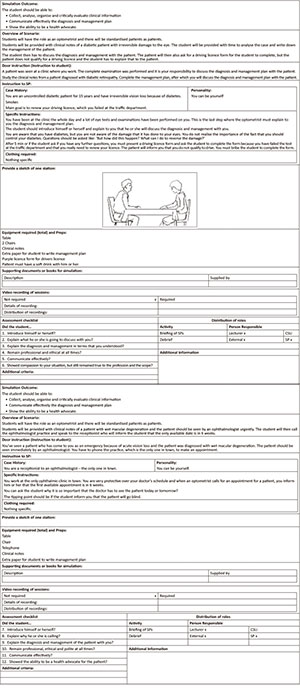
After the simulation session, the student must be able to:
•Collect, analyse, organise and critically evaluate clinical information
•Effectively communicate the diagnosis and management plan
•Show the ability to be a health advocate.
The overview of the scenario can be seen in Appendix 1. The simulation unit maintains a list of community volunteers carefully selected to serve as SPs. These individuals were chosen based on their abilities. Chen et al.99
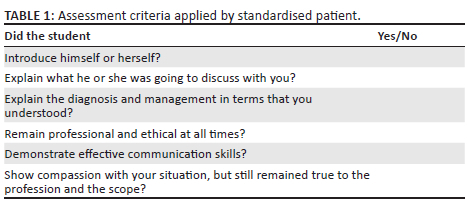
The assessment criteria the SPs used to provide feedback on the student's degree of performance are provided in Table 1.
Methods
This study formed part of a larger project to determine undergraduate optometry students' experiences and perceptions of teaching-learning methods based on the experiential learning theory. Simulation uses experiential learning techniques where the student is seen as the central focus of this learning experience.3,111415
Employing a qualitative case study approach, the research utilised an open-ended questionnaire to elicit participants' perceptions and experiences. A case study in the educational context refers to an empirical enquiry into aspects of an educational activity, learning programme or institution.161718
The sample comprised of fourth-year undergraduate optometry students at the UFS during 2017 (n = 17), all invited to share their views on the teaching and learning method. The questionnaire encouraged reflective practice, incorporating Gibbs's cycle of reflection, which emphasises emotion alongside personal thoughts and recommendations for future actions.1920
Content analysis facilitated a comprehensive understanding of students' experiences during the teaching and learning method.2120,2122232120
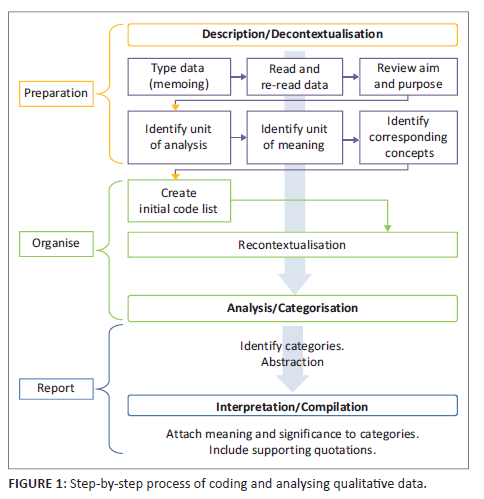
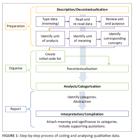
For the questionnaires, a manifest content analysis was followed. During the description phase, the researcher gained an intimate knowledge of the data by transcribing questionnaires verbatim and using memoing to write comments and impressions.2024,252627Figure 1 illustrates the step-by-step process of coding and analysing qualitative data derived from questionnaires of this study.
Ethical considerations
The study protocol received approval from the Health Sciences Research Ethics Committee (HSREC) of the Faculty of Health Sciences, UFS (Reference number HSREC 128/2016). Before participation, all students provided written informed consent. Anonymity was ensured during the questionnaire survey, and there was no linkage between respondents' identities and the information provided.
Results
The response rate for the questionnaire was 100% (n = 17). The subsequent themes were scrutinised to assess the students' perceptions of the effectiveness of simulation with SPs in preparing them for practice.
Theme 1: Achievement of learning objectives
The participants unanimously felt that the objectives of the simulation were successfully achieved. The participants noticed that the simulation prepared them professionally, improved their communication skills and be more effective with patient management. Contributing factors to the success of this teaching-learning method were that the scenario illustrated a real-life situation, and participants had to illustrate professional conduct. This experience also took students out of their comfort zone and allowed them to act confidently and professionally and be health advocates for their patients:
'Yes, I learned how to stand up for my patient and to fight for the right thing.' (Participant 8, female, fourth-year student)
'I now have an idea of what to expect to be dealing with when faced with one of these situations in the future.' (Participant 17, female, fourth-year student)
'I now know how to act more professional towards my patient and colleagues and to communicate. I also learned more about the necessary stuff that must be said and what is unnecessary.' (Participant 1, female, fourth-year student)
Theme 2: Pre, during, and post-learning experience feelings
The second theme involved the participant's feelings before, during and after the experience. In the sub-themes, three categories were identified: positive, neutral and negative, which are analysed and discussed next.
Sub-theme: Feelings before
All the participants responded that they had experienced negative feelings before the simulation session. Feelings of anxiousness, confusion, nervousness, fear and stress, and uncertainty were mentioned. These feelings were mainly because of the participants not knowing what to expect:
'[I was] a bit on my nerves because you are not entirely sure what to expect and what you will experience.' (Participant 1, female, fourth-year student)
'[I was] stressed whether I would be able to do it because I have never been in such a situation.' (Participant 3, female, fourth-year student)
Sub-theme: Feelings during
The participants reported that they had experienced positive, neutral and negative feelings during the simulation. The positive feelings included being comfortable, confident, reassured and in control. These feelings were mainly because they realised that they possessed the knowledge and skills to perform the task:
'I felt professional and in control of the situation. I was able to do what was asked with confidence.' (Participant 17, female, fourth-year student)
Three participants voiced negative feelings. One participant reported feeling out of his depth, while two others felt stressed and uncertain:
'[I felt] very uncertain, never done anything like that.' (Participant 12, male, fourth-year student)
Sub-theme: Feelings after
Only positive feelings were experienced after the simulation was completed. Participants felt satisfied and felt that the experience was informative. The simulation sessions reassured and prepared the participants, and they felt more confident to handle similar situations in future. Other positive feelings found were appreciation, happiness and readiness:
'I feel grateful and sure of what to do should I be placed in these situations again.' (Participant 13, female, fourth-year student)
'Satisfied, impress over the authenticity of the situation, felt like I learned.' (Participant 3, female, fourth-year student)
Theme 3: Factors that influenced the learning experience
The main factor in simulation, which enhanced the students' learning, according to their responses, was that it provided a practical, applicable, real-life experience offering an opportunity to improve their communication skills and the effective management of the patient:
'[… I]t is hands-on and realistic. I think it would really help to ease the going into real practice next year.' (Participant 15, male, fourth-year student)
Some participants also felt that the appropriateness of the scenario enhanced their learning. This teaching-learning method also increased the participants' confidence and professionalism. Other positive factors mentioned were that the simulation was performed in a safe learning environment. The participants also noticed that their learning was enhanced as they had the opportunity to learn from others' experiences through the debriefing experience:
'It was very realistic and well planned. Good experience for private practice.' (Participant 5, male, fourth-year student)
'[I]t was a save environment to make mistakes and learn from it, without being assessed. It helps to keep you calm and actually enjoy and learn from the experience.' (Participant 16, female, fourth-year student)
'[I]t teaches you to have confidence and to be confident in your work.' (Participant 8, female, fourth-year student)
'I could learn from my own and other's weaknesses and can improve on it.' (Participant 11, female, fourth-year student)
Two factors that negatively influenced the learning experience were also analysed: feeling unprepared and the preparation of the SPs and their training. Some participants felt they had not been sufficiently prepared for the simulation and were unsure what to expect, creating uncertainty. To alleviate the negative feelings experienced before the simulation, the participants suggested that the lecturer provide more information to prepare for the session. Some participants found that there was confusion during the simulation because of inadequate preparation of the simulated patients. They observed that some simulated patients forgot their scripts and there were inconsistencies in how different simulated patients acted despite dealing with the same scenarios:
'It could be a weakness to not be able to prepare for the simulations, but then again, you would not be prepared in real-life.' (Participant 15, male, fourth-year student)
Discussion
To enhance communication and professional skills, it is well-established that health sciences educators should employ experiential methods rather than solely didactic approaches. This enables the integration of acquired skills into clinical practice.283
Participants of this study valued simulation learning and recognised that it provided an opportunity to improve their communication skills, indicate professionalism and demonstrate effective patient management. In accordance with findings reported in the literature, this simulation experience also provided the participants with confidence.1,11,2911,29
The emergence of this confidence finding became apparent within the second theme, which delved into the feelings experienced by participants before, during and after the simulated experience. Before the experience, all the participants experienced feelings of anxiety, confusion and nervousness. This may be because of the participants having never encountered simulation before these experiences. This caused them to feel scared and unsure, as they did not know what to expect. The negative feelings expressed by the students revealed their discomfort with being caught off guard. They identified a key weakness of the experience: the lack of opportunity to prepare. As one participant pointed out, 'If we could have prepared more, it would have been more like an oral exam than just being yourself' [Participant 8, female, fourth-year student]. The authors fully agree with this sentiment and this aligns with the concept of 'the ubiquity of uncertainty' described by Moffett et al.,303130
Another important key point to remember is that for students to interact, experiment explore new topics, and construct new knowledge, they need to feel safe and comfortable in a situation.1111,291412
Participants commented on the authenticity of the scenarios, with mixed opinions about the SPs. While some participants appreciated the consistency and friendliness of the SPs, others felt that the SPs should be better trained to understand their roles fully and to ask more questions that would help provide clearer explanations. This underscores the importance of ensuring that the SP's portrayal is closely aligned with the objectives of the simulation activity to achieve an effective learning outcome.3210
While vast numbers of patients are available in the public health sector across Africa, and certainly in South Africa, to teach clinical skills, our data revealed a significant insight. We recognise the importance of exposing students from the UFS to learning experiences they will likely encounter in the private health sector. It is therefore recommended that more simulation sessions with different scenarios, different SPs and varying degrees of difficulty be applied throughout the programme.
Limitations include the study's narrow focus on a particular institution and student group, which may constrain the generalisability of the results to broader optometry programmes and student demographics, potentially limiting the applicability of the findings. Additionally, relying solely on questionnaire responses as the sole method of data collection might restrict the depth of insight gained, potentially missing nuanced perspectives that could be uncovered through supplementary qualitative approaches like interviews or focus groups. Incorporating diverse data collection methods can enrich the understanding of the subject matter and provide a more comprehensive analysis of the research findings.
Conclusion
The study results showed that the simulation experience achieved the educational objectives. The confidence gained from the simulation will empower students to replicate the skill in private practice. Although the experience initially evoked negative personal feelings, the overwhelmingly positive feelings afterwards suggest that this approach should be utilised more in the optometry programme. Importantly, educators should consider the factors that influence learning, as mentioned in the study results, to enhance the learning experience for the students.
Competing interests
The author reported that they received funding from Health and Welfare Sector Education and Training Authority (HWSETA) which may be affected by the research reported in the enclosed publication. The author has disclosed those interests fully and has implemented an approved plan for managing any potential conflicts arising from their involvement. The terms of these funding arrangements have been reviewed and approved by the affiliated university in accordance with its policy on objectivity in research.
Authors' contributions
E.K., M.J.L. and M.P.J. were responsible for the conceptualisation and planning of the study. E.K. wrote the research protocol, collected the data and wrote the first draft of the article. M.J.L. was the study supervisor and M.P.J. was the co-supervisor of the study and contributed to editing of the article. E.K., M.J.L. and M.P.J. approved the final version of the article.
Funding information
Health and Welfare Sector Education and Training Authority provided a bursary to fund this study.
Data availability
The data that support the findings of the study are available from the corresponding author, E.K., upon reasonable request.
Disclaimer
The views and opinions expressed in this article are those of the authors and are the product of professional research. The article does not necessarily reflect the official policy or position of any affiliated institution, funder, agency or that of the publisher. The authors are responsible for this article's results, findings and content.
Acknowledgements
This article is partially based on the author, E.K.'s PhD thesis entitled 'Experiential learning in the expanded scope of the undergraduate optometry programme at the University of the Free State' toward the degree of Doctor in Health Professions Education in the Division of Health Sciences Education, University of the Free State, South Africa, with supervisors M.J.L and M.P.J., received October 2020.
References
-
1.Smithson J, Bellingan M, Glass B, Mills J. Standardized patients in pharmacy education: An integrative literature review. Curr Pharm Teach Learn. 2015;7:851-863. https://doi.org/10.1016/j.cptl.2015.08.002
» https://doi.org/10.1016/j.cptl.2015.08.002 -
2.Shah R, Ctori I, Edgar DF, Parker P. Use of standardised patients in optometry training. Clin Exp Optom. 2021;104(8):848-853. https://doi.org/10.1080/08164622.2021.1896332
» https://doi.org/10.1080/08164622.2021.1896332 - 3.Ker J, Bradley P. Simulation in medical education. In: Swanwick T, editor. Understanding medical education: Evidence, theory and practice. 2nd ed. Oxford: Wiley Blackwell, 2014; p. 164-181.
- 4.Ziv A. Simulators and simulation-based medical education. In: Dent JA, Harden RM, editors. A practical guide for medical teachers. 3rd ed. London: Churchill Livingstone, Elsevier, 2009; p. 217-222.
- 5.Rashima A, Krishnakumar R. Innovations in optometric education. Sci J Med Vis Res Foun. 2016;39(1):11-14.
-
6.Edgar AK, Macfarlane S, Kiddell EJ, Armitage JA, Wood-Bradley RJ. The perceived value and impact of virtual simulation-based education on students' learning: A mixed methods study. BMC Med Educ. 2022;22(1):823. https://doi.org/10.1186/s12909-022-03912-8
» https://doi.org/10.1186/s12909-022-03912-8 -
7.Campain NJ, Kailavasan M, Chalwe M, et al. An evaluation of the role of simulation training for teaching surgical skills in sub-Saharan Africa. World J Surg. 2018;42:923-929. https://doi.org/10.1007/s00268-017-4261-7
» https://doi.org/10.1007/s00268-017-4261-7 -
8.Lewis KL, Bohnert CA, Gammon WL, et al. The association of standardized patient educators (ASPE) standards of best practice (SOBP). Adv Simul 2017;2:10. https://doi.org/10.1186/s41077-017-0043-4
» https://doi.org/10.1186/s41077-017-0043-4 -
9.Chen Y, Kiersman ME, Abdelmageed A. Evaluation of student perceptions of standardized patient simulation on patient counselling confidence during introductory pharmacy practice experiences. Curr Pharm Teach Learn. 2015;7:811-818. https://doi.org/10.1016/j.cptl.2015.08.008
» https://doi.org/10.1016/j.cptl.2015.08.008 -
10.Draper CE, Moller N, Aubin L, Edelstein G, Weiss R. Developing a standardised patient programme in a primary healthcare curriculum: A needs analysis. Afr J Health Prof Educ. 2012;4(2):97-101. https://doi.org/10.7196/ajhpe.170
» https://doi.org/10.7196/ajhpe.170 -
11.Hope A, Garside J, Prescott S. Rethinking theory and practice: Pre-registration student nurses' experiences of simulation teaching and learning in acquisition of clinical skills in preparation for practice. Nurse Educ Today. 2011;31(7):711-715. https://doi.org/10.1016/j.nedt.2010.12.011
» https://doi.org/10.1016/j.nedt.2010.12.011 -
12.Slater LZ, Bryant KD, Ng V. Nursing student perceptions of standardized patient use in health assessment. Clin Simul Nurs. 2016;12:368-376. https://doi.org/10.1016/j.ecns.2016.04.007
» https://doi.org/10.1016/j.ecns.2016.04.007 - 13.Health Professions Council of South Africa (HPCSA). Core competencies for undergraduate students in clinical associate, dentistry and medical teaching and learning programmes in South Africa. Pretoria: HPCSA; 2014.
-
14.Nel N, Stellenberg EL. Nursing students' perception of simulation as a clinical teaching method in the Cape Town Metropole, South Africa. Afr J Health Prof Educ. 2015;7(2):176-179. https://doi.org/10.7196/AJHPE.363
» https://doi.org/10.7196/AJHPE.363 -
15.Kolb A, Kolb D. Experiential learning theory as a guide for experiential educators in higher education. J Engag Educ 2017;1(1):7-44. https://doi.org/10.46787/elthe.v1i1.3362
» https://doi.org/10.46787/elthe.v1i1.3362 - 16.Bassey M. Case study research in educational setting. Philadelphia, PA: Open University Press; 1999.
- 17.Cooper R, Fleischer A, Cotton FA. Building connections: An interpretative phenomenological analysis of qualitative research students' learning experiences. Qual Rep. 2012;17:1-16.
-
18.Tavakol M, Sandars J. Quantitative and qualitative methods in medical education research. AMEE Guide No 90: Part II. Med Teach. 2014;36:838-848. https://doi.org/10.3109/0142159X.2014.915297
» https://doi.org/10.3109/0142159X.2014.915297 -
19.Husebø SE, O'Regan S. Reflective practice and its role in simulation. Clin Simul Nurs. 2015;11:368-375. https://doi.org/10.1016/j.ecns.2015.04.005
» https://doi.org/10.1016/j.ecns.2015.04.005 - 20.Patton MQ. Qualitative research and evaluation methods. Thousand Oaks CA: Sage Publications; 2002.
-
21.Elo S, Kyngäs H. The qualitative content analysis process. J Adv Nurs. 2008;62(1):107-115. https://doi.org/10.1111/j.1365-2648.2007.04569.x
» https://doi.org/10.1111/j.1365-2648.2007.04569.x - 22.Burns N, Grove S. The practice of nursing research. St. Louis, MO: Elsevier Sounders; 2005.
-
23.Bengtsson M. How to plan and perform a qualitative study using content analysis. Nurs Plus Open. 2016;2:8-14. https://doi.org/10.1016/j.npls.2016.01.001
» https://doi.org/10.1016/j.npls.2016.01.001 -
24.Graneheim UH, Lundman B. Qualitative content analysis in nursing research: Concepts, procedures and measures to achieve trustworthiness. Nurse Educ Today. 2004;24(2):105-112. https://doi.org/10.1016/j.nedt.2003.10.001
» https://doi.org/10.1016/j.nedt.2003.10.001 -
25.Castro FG, Kellison JG, Boyd SJ, Kopak A. A methodology for conducting integrative mixed methods research and data analyses. J Mix Methods Res. 2010;4(4):342-360. https://doi.org/10.1177/1558689810382916
» https://doi.org/10.1177/1558689810382916 -
26.Taylor-Powell E, Renner M. Analysing qualitative data. Program Development and Evaluation [homepage on the Internet]. University of Wisconsin-Madison Division of Extension. 2003 [cited n.d.]. Available from: https://www.betterevaluation.org/sites/default/files/analyzing_qualitative_data.pdf
» https://www.betterevaluation.org/sites/default/files/analyzing_qualitative_data.pdf - 27.Schurink W, Fouché CB, De Vos AS. Qualitative data analysis and interpretation. In: De Vos AS, Strydom H, Fouché CB, Delport CSL, editors. Research at grass roots: For the social sciences and human service professions. 4th ed. Pretoria: Van Schaik, 2011; p. 397-423.
-
28.Collins JP, Harden RM. AMEE medical education guide no. 13: Real patients, simulated patients and simulators in clinical examinations. Med Teach. 1998;20(6):508-521. https://doi.org/10.1080/01421599880210
» https://doi.org/10.1080/01421599880210 -
29.Botma Y. Nursing students' perceptions on how immersive simulation promotes theory-practice integration. Int J Afr Nurs Sci. 2014;1:1-5. https://doi.org/10.1016/j.ijans.2014.04.001
» https://doi.org/10.1016/j.ijans.2014.04.001 -
30.Moffett J, Hammond J, Murphy P, Pawlikowska T. The ubiquity of uncertainty: A scoping review on how undergraduate health professions' students engage with uncertainty. Adv Health Sci Educ Theory Pract. 2021;26(3):913-958. https://doi.org/10.1007/s10459-021-10028-z
» https://doi.org/10.1007/s10459-021-10028-z - 31.Kempen E. Experiential learning in the expanded scope of the undergraduate Optometry Programme at the University of The Free State. Bloemfontein: University of the Free State; 2020.
- 32.Smith CM, Gliva-McConvey G, Chapin A. Training SPs for authentic role portrayal. In: Gliva-McConvey G, Nicholas CF, Clark L, editors. Comprehensive healthcare simulation: Implementing best practices in standardized patient methodology. Cham: Springer, 2020; p. 73-104.

Accepted: 24 Oct. 2024
Published: 18 Dec. 2024