Congregations and the kingdom of the Triune God: Mapping the road ahead for Southern African congregations
Abstract
This article aims to map the development of Congregational Studies within the Southern African context over the past two decades. The journey starts with an introduction to the field of Congregational Studies as a subdiscipline within Practical Theology, which is also part of the study of General Ecclesiology, while congregations are local communities of faith situated in historical and social contexts. The mission of the congregation is to serve the coming of the kingdom of the triune God. Vital congregations are called into the coming of the kingdom of the Triune God. The Church Life Survey, as an empirical instrument, provides significant answers to assist in the journey towards the fulfilment of the congregation's calling. Collaborative research and the continuous development of a practical, missional theological ecclesiology should be important markers for mapping the road ahead.
Congregational studies; Congregation; Ecclesiology; Church Life Survey
1. INTRODUCTION
Cartography is the practice or science of drawing maps. This article aims to map the development of Congregational Studies within the Southern African context over the past two decades. This is not a detailed map, but attention is paid to a few subjective route markers along this journey:
Development in Congregational Studies over the past two decades.
Congregations as specific formations of the church.
Christianity and congregations in Southern Africa.
The coming of the kingdom of the triune God and congregations.
Congregational vitality.
Mapping the road ahead.
2. DEVELOPMENT IN CONGREGATIONAL STUDIES OVER THE PAST TWO DECADES
The journey begins with an introduction to the study field of Congregational Studies, a subdiscipline within the broader field of Practical Theology. It is also part of the study of Ecclesiology or the study of the church. This immediately creates a connection between Congregational Studies and other study fields in theology such as Biblical Studies, Church History, and Systematic Theology. Congregational Studies focuses on the local congregation (parish or community of faith), by reflecting and describing the practices of actual congregations within a specific context or describing a practical theological ecclesiology.
Congregational Studies "is the disciplined process of examining a congregation holistically that uses multiple research methods" (Niemandt 2012:133). Congregations should be studied from a holistic and interdisciplinary perspective within the discipline of Practical Theology (Schoeman 2015:67). From a multidisciplinary perspective, Congregational Studies is also in conversation with disciplines such as Sociology of Religion, Development Studies, and Demography, to name a few.
What has happened in the study field of Congregational Studies within the Southern African context over the past twenty years? It would not be possible to discuss or mention all the publications, but I would like to refer to three publications along this route: Hendriks (2004), Nel (2015), and Burger et al. (2017).
Hendriks' publication entitled Studying congregations in Africa (2004) is a significant milestone. Hendriks (2004:11) reworks Studying congregations (Ammerman et al. 1998) for the African context, stating:
Our purpose is to empower congregations to address their multiple problems, challenges, and sufferings in sub-Saharan Africa as they manifest, among others, in the pandemic of HIV/Aids, sexism, abuse of power, corruption and economic injustice.
This was a deliberate attempt to position congregations within the Southern African context. It uses examples from different congregations across the subcontinent.
In 2015, Nel published Identity-driven churches: Who are we and where are we going? This is a revision of his earlier work Who are we? Understanding and finding identity in the local church. The first part of the book (2015) discusses the building up of the local church from a theological perspective, with a strong emphasis on biblical metaphors. The second part focuses on the reformation of the missional local church as an analytical process.
Over the past two decades, a greater emphasis has been placed on a missional understanding of the church and, more specifically, the development of a missional ecclesiology. The current focus in the South African context is not on congregations
primarily sending missionaries to some or other mission field, but on where the congregation itself is sent to its local context, where its members live and work from day to day (Van Niekerk 2014:4).
Burger et al.'s book Cultivating missional change. The future of missional churches and missional theology (2017) focuses on an understanding of being missional and describes a biblical framework for the church as a missional church. In different chapters, the authors discuss a missional ecclesiology, but they focus more on a general ecclesiology for the church, or what Haight and Nieman (2009) would describe as an ecclesiology from "above". A missional ecclesiology from "below", in my opinion, would help congregations discern a more contextual and relevant ecclesiology. The missional calling of congregations then becomes more relevant and prophetic within their local context.
A significant aspect of Congregational Studies is the focus on the contribution of an empirical analysis in understanding the role of the congregation (Nell 2022:124). The development of practice-oriented research (POR) needs to be mentioned in this regard.1 POR may be used to analyse and understand congregational practices and the improvement of those practices (Hermans 2014; Hermans & Schoeman 2015:34). The following four markers for doing POR are part of an empirical congregational analysis:
The congregational leadership as the problem owner is tasked with the responsibility of solving the congregation's problem or challenge.
Moving the congregational ministry from the actual to the desired. The action problem is described as a discrepancy between an actual and desired practice.
Discernment is a consultative dialogue between all the different stakeholders within the congregational ministry.
Developing strategic actions and policies for the congregation to move from actual to desired practices may be an intervention, or a new strategy.
A significant aspect in the development of Congregational Studies (and Practical Theology) over the past two decades is the role of empirical research as an integral part of the study field (Hermans & Schoeman 2015:45-46). Empirical research is a significant part of doing Practical Theology,
with its empirical methodology and openness to methods and theoretical underpinnings derived from the social sciences, practical theology enables practitioners to understand their practices better and to be more effective in their interventions (De Roest 2020:28).
The task of a reliable methodology for Congregational Studies "is to discover exact and empirically valid knowledge about religion, instead of relying purely on assumptions" (Heimbrock 2005:278). The missional and contextual voice of congregational life and its leadership should be heard so that a valid and reliable conclusion can be drawn and general assumptions avoided. Two surveys need to be mentioned in this regard:
The Church Mirror surveys started in 1981 as a church census within the Dutch Reformed Church (DRC).2 It still is a four-yearly quantitative survey.3 The survey includes at least a congregational questionnaire and, for some time now, a leadership questionnaire. The congregational questionnaire is the primary survey instrument, with the aim to comprehensively describe the functioning of congregations in the DRC and later in other denominations.
As an international survey among denominations and congregations, the National Church Life Survey (NCLS) started in 1991 in Australia, with the intention to give a voice to congregational members (Kaldor et al. 2002:96). The survey was repeated in 1996 and extended to New Zealand in 1997 among roughly 6,900 congregations from 20 denominations. The success of the survey resulted in it being used in England and the United States of America. In 2001, roughly 1.2 million worshippers from four countries participated in the International Congregational CLS (Bruce & Woolever 2004:3). The US CLS was repeated in 2008, and approximately half a million worshippers completed a questionnaire (Bruce & Woolever 2010:4-6). The CLS was first done in South Africa in 2006 among attendees of the DRC and repeated in 2010.4 A partnership with NCLS Australia5 was established in 2013 and the surveys were then done every four years (2014, 2018, and 2023).
Congregational Studies, as a younger discipline within Practical Theology, has made significant contributions toward congregational life over the past two decades. It is worth noting, along this route, the development of a practical theological ecclesiology and an empirical methodology to assist congregations in understanding their calling.
3. CONGREGATIONS AS SPECIFIC FORMATIONS OF THE CHURCH
In mapping the route, it is important to know and understand what to look for along the way. It is necessary to understand what a congregation is and how it differs, for example, from the church, or not?
Ecclesiology is the study of the church and includes the study of congregations.
Ecclesiology may be defined as the discipline that is concerned with the comparative, critical, and constructive reflection on the dominant paradigms of the identity of the church (Avis 2018:3).
Ecclesiology has two fields of study: one focuses on the historical and doctrinal description of the church (General Ecclesiology), and the other is the church situated within a local context describing the local practices of actual congregations (the focus of Congregational Studies).
General Ecclesiology broadly describes the church:
What makes the church truly church consists in God's power within it as channelled to it through God's creative power revealed in Jesus Christ and experienced as God's Spirit (Haight & Nieman 2009:584).
The church should be visible, tangible, social, and concrete in the way it exists in the world. The critical question is: How does one measure and understand it? An option would be to look for success, popularity, growth or prosperity or the church may focus on maintenance and survival.
The self-critical search for the true church - in the spirit of Protestantism and of Bonhoeffer and Barmen - is often completely lost, exchanged for questions of maintenance and survival and perhaps relevance (Smit 2024a:xiv).
The question is: How could the real church be the true church? The church is called to be faithful to its message. Where do congregations fit into this search for integrity and vitality?
Congregations are about the local community of faith situated in a historical and social context. Smit (2024b:23) describes a congregation as people who
discover one another as brothers and sisters, as human beings who all differ from one another but precisely for that reason bring different talents; they accept one another as Christ accepted them; they take hands and begin to live and work together in each place, as congregations of the Lord.
Congregations have taken on many forms throughout history, there is not only one form for the Christian congregation, especially among different denominations such as mainline, Pentecostal or Charismatic, and Africa Initiated Churches.
Congregations need one another and have fellowship with one another. This can be observed since the early church in the New Testament. The travels and preaching of the apostles contributed towards the fellowship between congregations; the letters of the apostles were circulated between them; they had communal confessions and songs of praise, and they also had joint processes of decision-making on matters of mutual interest (Smit 2024b:25). Congregations need to function within networks and organised relationships when there are too many tasks for them to do. This would include communal service and a prophetic witness as a denomination or ecumenical network (Smit 2024b:26-28).
It is important to understand the church in terms of its history, doctrine, as well as its ecumenical and denominational relationships. However,
the church exists first and foremost on the level of a local community. Denominational structures and church hierarchies might be important, but the missional church is a local church (Niemandt 2012:7).
It is further important to note that an African ecclesiology is a liberation ecclesiology that transforms traditional ecclesiologies within the African context (Mwambazambi 2011:4).
African churches have rediscovered their identity and sense of belonging as a result of exposure to the impacts of the following three realities: imported faiths, traditional belief systems, and reactions to colonial mission mentality (Ofgaa 2022:195-196).
The search for a church or congregation is what Van Niekerk (2024:7) calls a homecoming, a place to feel at home. On the journey, one must take note of the congregation and the church within the African context when describing an ecclesiology from below.
4. CHRISTIANITY AND CONGREGATIONS IN SOUTHERN AFRICA
The next step in mapping the journey with congregations is to describe where one is moving along. The journey is through a specific area or countryside and, in this regard, the focus is on Southern Africa, although the original journey started in South Africa.
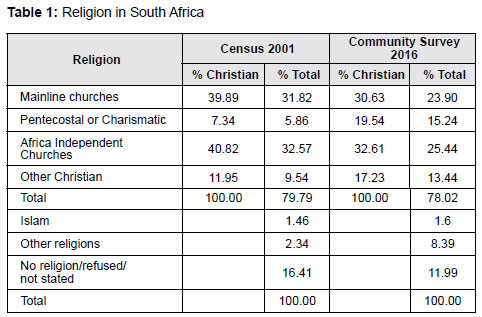
Recent information about the religious affiliation of the South African population is not readily available. Religion was an open question in the 2001 National Census, but that was, to a great extent, not a reliable report (Erasmus & Hendriks 2005:90). Religion was not questioned in the 2011 National Census, but a question on religious affiliation was included in the 2022 National Census, but the data is also not reliable. The religious landscape is illustrated using Census 2001 and the Community Survey 2016.
The vast majority of the South African population adheres to the Christian religion, with nearly 80 per cent nominally associated with the Christian faith since 2001. Within the Christian population, mainline churches have declined from 39.9 per cent in 2001 to 23.9 per cent in 2016. African Independent churches also declined, but the Pentecostal and Charismatic churches more than doubled from 2001 (7.63%) to 2016 (19.5%). The same trend may be identified for the "Other Christian" category. Islam remained at less than 2% of the South African population over the same period.
The General Household Survey (GHS) is an annual survey conducted by StatsSA since 2002. Two questions about religion from the 2010 Pew Research Center survey were included in the 2013 GHS questionnaire (Lugo & Cooperman 2010:20-23).6 How would you describe your religious affiliation? Aside from weddings and funerals, how often do you attend religious services?
Religious affiliation describes the different religions that are found in South Africa. In 2013, the vast majority (85.5%) of South Africans described their religious affiliation as "Christian", whereas 5.6 per cent of South Africans mentioned that they are not affiliated with any particular religion. Muslims comprised 2 per cent of the total. Hindus comprised about 1 per cent of the population of South Africa (Statistics South Africa 2014:12). The vast majority of South Africans are affiliated with the Christian religion, at least nominally.
Religious observance indicates the commitment of the religious membership group to certain activities associated with that group. For most of the religious groups, a weekly religious meeting, mainly in the form of a worship service, is an important ritual. Nearly three quarters (74.3%) of individuals that follow the Muslim faith attended religious services and ceremonies (excluding weddings and funerals) at least once a week. By comparison, 56.4 per cent of Christians and 55.0 per cent of Hindus attended services weekly (Statistics South Africa 2014:33).
What is the value of a national survey for congregations? The census surveys help congregations position themselves within the South African religious landscape. Congregations on the local level and denominations on the national level may use it as an essential instrument for critical discussions in the marketplace. Survey results also redefine ecumenical relationships as partnerships and not as evangelism projects. Congregations may also learn more about their positioning within society from the survey. The membership of the mainline churches (e.g. DRC) and their attendance of worship services may decline, but it is not so for the entire South African Christian population. The bigger South African picture gives congregations important contextual and unique information about their role and position in society.
The journey should, for obvious reasons, go beyond the boundaries of South Africa. Over the past decade and a half, the Pew Research Center has conducted religion-focused surveys globally.7 In each of these surveys, they asked one question: "How important is religion in your life?". Another question, "How often do you pray?", is also repeatedly asked. Using these questions, they found broadly similar patterns across the 102 countries and territories they surveyed between 2008 and 2023. From these two measures, the places that are most religious tend to be in sub-Saharan Africa, Latin America, and the Middle East-North Africa region. The places that are least religious tend to be in Europe and East Asia. By 2060, a plurality of Christians - over 40 per cent - will call sub-Saharan Africa home, up from 26 per cent in 2015, according to an analysis of demographic data by the Pew Research Center. At the same time, the share of Christians living in many other regions - notably Europe - is projected to decline. In sub-Saharan Africa, Christians are, on average, relatively young and have more children than their coreligionists elsewhere, contributing to the projected rapid population growth in the decades ahead.
The next Church Life Survey wave started in 2023 and was named CLS-SA (where SA refers to Southern Africa). The aim of this wave is to focus on denominations and congregations in the SADC8 countries. The wave will be completed in November 2025, but (excluding South Africa) congregations from five countries9 have already participated in CLS-SA.
5. THE COMING OF THE KINGDOM OF THE TRIUNE GOD AND CONGREGATIONS
The journey is, maybe always, about the bigger picture, looking at the wider landscape such as the faraway mountains and the sky or even the stars at night. The bigger picture helps direct the current pathway.
Jesus' preaching focused on the coming of the kingdom of God, or in the words of the Gospel of Matthew, the kingdom of heaven. The kingdom metaphor is at the core of Jesus' message and particularly in the Gospel of Mathew and "this makes Matthew the New Testament writer who makes the most profound use of the kingdom idea" (Du Toit 2000:246). A few main contours of Matthew's preaching on the kingdom may be identified (Du Toit 2000:548-560):
The kingdom is "of" God, indicating that he is not only the owner, but also actively at work in his kingdom. The kingdom has a theocentric character. God, as a father, is looking after his kingdom (Mt. 5:16, 45, 48; 6:1, 11).
The kingdom has a dynamic nature, referring more to the active ruling of God than a particular area or location. This would imply the active realisation of God's will (see the second petition of the Lord's prayer, Mt. 6:10).
The eschatological character of the kingdom implies an "already" and a "not yet" understanding of the kingdom. The "already" lies in Jesus Christ as the fulfilment of the promises of the Old Testament. The kingdom is to come, for example, as illustrated by the metaphor of the eschatological banquet (Mt. 8:11; 26:29).
Repentance is an essential requirement to enter the kingdom. Refer, for example, to the treasure in the field and the pearl of great value (Mt. 13:44-45). Entrance to the kingdom should be manifested in a specific lifestyle (Mt. 7:21).
Life in the kingdom has an important ethical aspect, and the Sermon on the Mount is a clear indication of this obligation. Metaphors such as salt, light, a city on the mountain, and a lamp clearly illustrate the task and identity of the people of Jesus.
The difference between the kingdom, the church, and the congregation should be acknowledged:
The basileia is the great divine work of salvation in its fulfilment and consummation in Christ; the ekklesia is the people elected and called by God and sharing in the bliss of the basileia (Ridderbos 1962:354).
The kingdom is much more comprehensive and presents an all-embracing perspective that includes all of history, grace, and judgment with cosmic dimensions. The church is the people gathered together by the preaching of the Gospel and being disciples of Jesus Christ. The church is the result of the coming of the kingdom. The church is called to proclaim the Gospel and obey the commandments.
In every aspect the church is surrounded and impelled by the revelation, the progress, the future of the kingdom of God without, however, being the basileia, and without ever being identified with it (Ridderbos 1962:356).
The kingdom and the church are related but not identical.
[T]he latter is a concrete, earthly reality, albeit with spiritual dimensions. As an assembly of flesh and blood beings, it is empirically observable. The kingdom, on the other hand, being the ruling activity of God, is essentially an abstract, heavenly, spiritual reality, but with earthly implications. It cannot be observed empirically, although its presence in the world, and the effects of that presence, can be recognised (Du Toit 2000:558).
The church should never lose sight of the kingdom, as it helps the church understand and discover its identity and mission. The kingdom is central to the entire ministry of Jesus and to the understanding of his own mission. It is the starting point and context for mission (Bosch 1991:31-32). The Missio Dei leads to an appreciation of the kingdom of God, present and eschatological. The coming kingdom is a present reality, with the expectation of the future completion of God's redemptive work. "The church is the community through which the kingdom is concretely manifested in history." (Niemandt 2012:5). The missio Dei informs the calling of both the kingdom and the church.
The missio Dei or, more accurately, the missio Trinitatis reflects the identity and mission of the triune God (Venter 2004:757-758). The immanent (God with us) or economic Trinity focuses on the actions or mission of God. God is known to us by his actions,
the one, living God - undivided, although to be distinguished; rich, complex, full of surprises, yet always faithful to the promises and according to character; full of grace, goodness, and mercy, although with many faces and forms (Smit 2009:65).
The triune God, Father, Son and Holy Spirit, is in a relationship or communion with one another, but also brings us into a personal relationship with him (Purves 1998:235).
Although the radical distinctiveness between God and church is fully recognised, the issue at stake is the quest for an appropriate ontology of the church, which is identified as a form of correspondence between the triune God as communion and the church as communion (Venter 2004:759).
The social or relational Trinity has profound implications for the church as a relational community.
A trinitarian understanding of the God of the church and the kingdom is not a turn away from the world but an engagement with it (Schoeman 2022). According to Venter (2004:761), it calls for an engagement with life, "what personhood, otherness, unity, relationship, community ultimately should be, are revealed by the triune identity of God".
At the heart of Christian life, the church is called to pray for the coming of God's kingdom (Smit 2024b:20). The central role of worship can thus not be underestimated and, with it, a reflection of the needs of the world.
True worship teaches us to look in the right direction, to start seeing with the eyes of Christ, to learn to distinguish with new priorities the things which really matter. The liturgy teaches us how to live life. And at the heart of this life, of this seeing, are people and their need. (Smit 2024b:22).
The diaconal service of the church is at the roots of the church praying for the coming of the kingdom of God. The deaconate is a ministry of the church in service of the kingdom (Smit 2024b:23). "The ministry of the congregation does not stop at the boundaries of the congregation." (Niemandt 2012:5). The congregation is called into realising the kingdom of the Triune God.
The implications of the intersection between kingdom and congregation require a few provisional remarks to draw the congregation's attention to their journey to the bigger landscape:
A social Trinitarian understanding asks questions about the integrity and incarnational aspects of congregational life:
In every new situation, our faith seeks to comprehend what the living God requires from us. The missional church is an incarnational movement sent to engage its context (Niemandt 2012:4).
The congregation, or the church, is not at the centre, but the focus is on the coming of the kingdom of God.
The best understanding of the church's mission at present is that each church must do what it can to extend the Kingdom of God and to make the positive transformation of African societies possible (Mwambazambi 2011:8). This implies a turn to the other and the world.
Other congregations are also serving the kingdom and this asks congregations to form networks and partnerships in serving the kingdom.
6. CONGREGATIONAL VITALITY
In undertaking a journey, it is essential to make sure that a reliable means of transport is available. The church and, more specifically, congregations may provide the transportation on the journey. The quest would be to look for growing and healthy congregations to provide the means in this regard.
Congregational vitality or health can be measured from different perspectives. Growth in membership, worship attendance or financial contributions may be viewed as indicators that the congregation is healthy.
The rationale was that growth in attendance was a measure of whether a church was effectively fulfilling Jesus' Great Commission (Mt. 28:16-20) to 'make disciples of all nations' - with disciples being understood as church-attending Christians (Powell, Pepper, Ward, Sterland & Jacka 2019:5).
Different approaches to congregational health share an important expectation "that, if congregations strengthen their practices, behaviours or attitudes, they will become more vital." (Bobbitt 2014:468). Various examples of congregational surveys focus on congregational health: Natural Church Development's eight quality characteristics (Schwarz 1996) and the ten strengths of US congregations (Bruce & Woolever 2004), to name but two (Schoeman 2020:141).
In 2001, the NCLS proposed that
vital churches would show signs of good relationships with God ('faith exploration' dimension of vitality), with each other ('attractional' dimension), and with the community at large ('incarnational' dimension) (Powell et al. 2019:6).
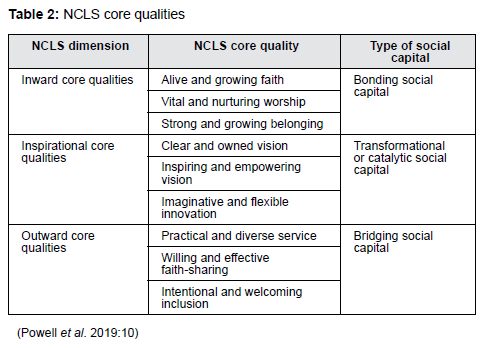
It proposed nine core qualities of healthy churches (Powell et al. 2019).
The NCLS has taken the empirical analysis of the core qualities a step further, by using an empirical reduction to identify two underlying factors among the nine:
Collective confidence emerged primarily from attendees' responses about their satisfaction and positive stance towards the church and its leadership. The most important, through confirmatory factor analysis; much growth in faith through this church, the leadership inspiring to action, inspiration experienced in worship services. In organisational studies, there is a concept known as "organisational culture".
Individual commitment emerged from attender responses to questions about personal commitment to faith and aspects of faith practice. Examples of items that loaded on this factor were "God is most important to me", regular private devotions, and financial giving to the local church. In organisational studies known as "organisational citizenship" (Powell et al. 2019:14-15).
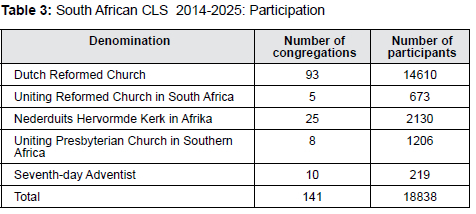
The South African CLS 2014-2015 was the first wave undertaken in partnership with NCLS Australia, to test CLS' suitability in the South African church and congregational context, by using the Australian CLS survey instrument to take a snapshot of the health and vitality of congregations in various denominations in South Africa. Other denominations expressed interest in doing empirical research on their churches and congregations. Congregations from five denominations took part.
The 2014 SA-CLS was mostly done among traditional mainline churches, predominantly within the White population group. The following are some of the conclusions regarding listening to the voice of attendees from DRC congregations:
Inward core qualities:
The local congregation plays an important role in the growth of the faith of the attenders. They spend almost daily time in private devotional activities, and in the context of the study, the emphasis that the attendees place on private religious activities is noteworthy (Schoeman 2020:149).
Inspirational core qualities:
The leaders encourage them to use their gifts and skills, and they inspire them to action. They are further positive about trying new things and that the leaders promote innovation (Schoeman 2020:150).
Outward core qualities:
They are more willing to share their faith but are not regularly involved in an outreach or evangelistic activity. They are also, to a lesser extent, prepared to welcome new people in the congregation (Schoeman 2020:152).
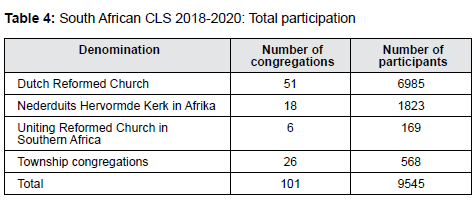
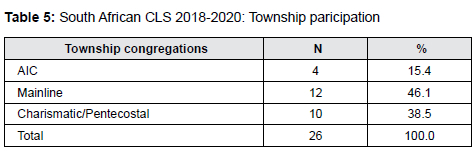
The 2018 SA-CLS 2018-2020 included 27 township congregations. The total participation in this wave was lower, due to the COVID-19 pandemic.
The following provisional remarks may be made regarding the voice of the attendees in township congregations in comparison with other mainline congregations. A growing faith is, to a lesser extent, a private activity for township attenders, because they focus more on communal activities in the congregation. Their involvement in the wider community is more profound; they are more prepared to be inclusive and talk about their faith, and they are more open and welcoming towards drifters and new attenders.
What is the value of survey research, in general, but more specifically the CLS (Hermans & Schoeman 2015)? A few remarks on the contribution of the surveys:
Survey research in the field of Congregational Studies is required to be contextual. Survey research could be done to describe and explore the contribution of the religious community in building social cohesion.
Congregations need valid and reliable information about their position. The NCLS methodology contributes to giving a trustworthy voice to attenders, but this needs to be developed to be used in different congregations and denominations within the Southern African context. This is not easy to achieve, but the challenge should be accepted.
Survey research is part of the methodology used within the social research field and is also used by Practical Theology. A significant challenge is to develop concepts and theories that are part of the field of Practical Theology.
Congregational vitality provides significant answers to assist in the journey towards the fulfilment of the congregation's calling. Valid and reliable empirical data contribute towards the development of an ecclesiology from below. This should be part of a strategic process of discernment in the congregation.
7. MAPPING THE ROAD AHEAD
The journey is continuing, and it is thus necessary, in conclusion, to identify a few markers to map the route that lies ahead.
Congregational research should not be done in isolation; it should involve different partners, within the congregation, as well as academic partners from other disciplines. De Roest (2020:26) argues in favour of collaborative research:
research is not only performed on behalf of or for the sake of practitioners, but projects as increasingly designed through explicit conversation with practitioners.
Practice-oriented research has particular intention to fall within the description of collaborative research. De Roest (2020:236) argues for the involvement of everyday believers in doing empirical work. The CLS methodology makes an essential contribution in this respect.
The research landscape should include congregations from different denominations in the sub-Saharan region, with a specific focus on the SADC countries. The SADC region has a population of roughly 350 million people, with a growing Christian population over the next few decades. The area has numerous challenges:
Extreme weather events such as the devastating storms and floods that affected SADC in the first half of 2019.
These extreme weather events have had undesirable impacts on food security. Based on the available data from 13 member states, it has been determined that 41.2 million people were food insecure in 2019-2020.
The region is currently grappling with rising levels of unemployment among the youth, which stood at 25.1 per cent on average in 2017.
Congregations and denominations are uniquely positioned in their local community to serve the kingdom on different levels.
The continuous development of a practical and missional theological ecclesiology should be an essential marker en route. The World Council of Churches is taking the church in the African context seriously and is involved through different publications and study groups. This may be illustrated with one example: Ofgaa (2022:200-202) identifies the following elements as essential to describe and develop the ecclesiology of African Independent Churches:
They view themselves as "a place to feel at home".
They often base their experiences on visions and dreams.
A factor defining the AICs and the vast majority of the Pentecostal churches is the spontaneity of worship incorporated with signs and wonders.
An emphasis on Christ and the Holy Spirit. While Western churches emphasise Christ, the AICs make the Holy Spirit the focus of their belief and practice.
An emphasis on the Bible and especially to apply this to the everyday experience of the people, which sometimes leads to individual interpretations.
Leadership may be viewed within the context of African messianism, and leaders are often called prophets, Black Messiahs, visionaries, presidents, and initiators.
The rejection of the stamp of individualism goes against the ethos of the communal life of African societies.
The further development of a practical and missional theological ecclesiology needs to be informed by a sound theological, empirical, and contextual framework. The formation of congregations as communities of practice and learning may assist in this instance.
In 2016, the World Evangelical Alliance (WEA) developed a report on Building Resilient Communities: A Guide to Faith Community Partnerships as part of a United Nations World Humanitarian Summit reflecting on world development.
The local faith community is a central part of the local community, and working with the community cannot succeed without all members of the community. Further, local faith communities have expert local knowledge. They know who are vulnerable, they are connected to different groups in the community, and they will be present in the community for the future (Boan 2016:3).
A congregation may be viewed from the following two perspectives:
The congregation as a community of discernment: The congregational hermeneutical process is a movement from the horizon of the text to the horizon of the reader, not as a one-way process, but as a two-way interaction between two horizons (Rogers 2013:496). The ecology of the congregation and its membership, its culture and tradition, current challenges and struggles are voices speaking alongside the voice of the text and the voice of the congregation as a second horizon. Within a congregation, members should read a text together, while reflecting on the understanding and application of the text (Schoeman 2024:195-199). Listening, critical discerning, challenging adversity, and a relevant prophetic response are necessary discernment capacities for the congregation to develop in discerning the text and context and in forming a resilient framework. The congregational leadership should be aware, especially within the Southern African context, to respond to inequalities as part of a discernment process in traumatic times.
The congregation as a community of practice: Leadership plays a central role in the functioning and growth of the congregation and its ministry. Leadership has the vital task of describing and interpreting reality, and the circumstances need to be interpreted before a responsible and appropriate response is possible. The congregation's engagement or interaction with its environment is an essential focus of the congregational ministry. The congregation and the local community have a symbiotic relationship, because the members of the congregation live, work, and play in the community. It is thus almost impossible for a congregation to isolate itself from the local community. A healthy congregation is, thirdly, a learning community that reflects on and evaluates current ministerial practices.
A last and critical marker is a commitment towards the coming of the kingdom of the triune God. Congregations, denominations, and the church should perceive themselves as servants to the coming of the kingdom. In praying for the coming of the kingdom, we are servants, signs, and a sacrament in the hands of the triune God.
In his book Spiritually of the road, Bosch (2004:10) maps the way in which we should commit ourselves to this journey:
Paul's spirituality was, however, never a kind permanent attribute, a possession or achievement; it was renewed again and again from within. As he writes to the Corinthians chapter after chapter, the letter develops, unfolds, deepens and matures. It remains unfinished, a spirituality that journeys from stage to stage. Paul never 'arrives', at least not before he reaches his true final destination. He is not a spirituality of the monastery but of the road.
Our calling is to continue on this journey ...
BIBLIOGRAPHY
- Ammerman, N.T., Carroll, J.W., Dudley, C.S. & McKinney, W. 1998. Studying congregations. A new handbook. Nashville, TN: Abingdon Press.
-
Avis, P. 2018. Introduction to ecclesiology. In: P. Avis (ed.), The Oxford handbook of ecclesiology (Oxford: Oxford University Press), pp. 1-30. https://doi.org/10.1093/oxfordhb/9780199645831.013.28
» https://doi.org/10.1093/oxfordhb/9780199645831.013.28 - Boan, D. 2016. Building resilient communities: A guide to faith community partnerships. Wheaton, IL: World Evangelical Alliance.
-
Bobbitt, L. 2014. Measuring congregational vitality: Phase 2: Development of an outcome measurement tool. Review of Religious Research 56(3):467-484. https://doi.org/10.1007/s13644-014-0158-1
» https://doi.org/10.1007/s13644-014-0158-1 -
Bosch, D.J. 1991. Transforming mission. Paradigm shifts in the theology of mission. New York: Orbis Books. https://doi.org/10.1177/009182969101900203
» https://doi.org/10.1177/009182969101900203 - Bosch, D.J. 2004. Spirituality of the road. IMER. Pretoria: University of Pretoria.
- Bruce, D. & Woolever, C. 2004. Beyond the ordinary: Ten strengths in U.S. congregations. Louisville, KY: Westminster John Knox Press.
- Bruce, D. & Woolever, C. 2010. A field guide to Presbyterian congregations. Louisville, KY: Westminster John Knox Press.
- Burger, C.W., Marais, F. & Mouton, D. 2017. Cultivating missional change. The future of missional churches and missional theology. Wellington: Biblecor.
-
De Roest, H. 2020. Collaborative practical theology. Engaging practitioners in research on Christian practices. Leiden: Koninklijke Brill NV. https://doi.org/10.1163/9789004413238
» https://doi.org/10.1163/9789004413238 -
Du Toit, A.B. 2000. The Kingdom of God in the Gospel of Matthew. Skrif en Kerk 21(3):545-563. https://doi.org/10.4102/ve.v21i3.639
» https://doi.org/10.4102/ve.v21i3.639 - Erasmus, J.C. & Hendriks, H.J. 2005. Religion in South Africa: The 2001 population census data. Journal of Theology for Southern Africa 121(March):88-111.
-
Evans, J. 2024. Where is the most religious place in the world? Pew Research Centre Short Reads. [Online.] Retrieved from: https://www.pewresearch.org/short-reads/2024/08/09/where-is-the-most-religious-place-in-the-world/ [9 August 2024].
» https://www.pewresearch.org/short-reads/2024/08/09/where-is-the-most-religious-place-in-the-world/ -
Haight, R. & Nieman, J. 2009. On the dynamic relation between Ecclesiology and Congregational Studies. Theological Studies 70(3):577-599. https://doi.org/10.1177/004056390907000303
» https://doi.org/10.1177/004056390907000303 -
Heimbrock, H.G. 2005. From data to theory: Elements of methodology in empirical phenomenological research in practical theology. International Journal of Practical Theology 9(March):273-299. https://doi.org/10.1515/ijpt.2005.9.2.273
» https://doi.org/10.1515/ijpt.2005.9.2.273 - Hendriks, H.J. 2004. Studying congregations in Africa. Wellington: Lux Verbi. BM.
-
Hermans, C.A.M. 2014. From practical theology to practice-oriented theology. International Journal of Practical Theology 18(1):113-126. https://doi.org/10.1515/ijpt-2014-0009
» https://doi.org/10.1515/ijpt-2014-0009 -
Hermans, C. & Schoeman, W.J. 2015. Survey research in practical theology and congregational studies. Acta Theologica Supplementum 22:45-63. https://doi.org/10.38140/at.v0i22.2726
» https://doi.org/10.38140/at.v0i22.2726 - Kaldor, P., Castle, K. & Dixon, P. 2002. Connections for life. Core qualities to foster in your church. Sydney: Openbook Publishers.
- Lugo, L. & Cooperman, A. 2010. Tolerance and tension: Islam and Christianity in sub-Saharan Africa. Washington, DC: Pew Research Center.
-
Mwambazambi, K. 2011. A missiological refection on African ecclesiology. Verbum et Ecclesia 32(1), Art. #482, 8 pages. https://doi.org/10.4102/ve.v32i1.482
» https://doi.org/10.4102/ve.v32i1.482 - Nel, M. 2015. Identity-driven churches. Who are we, and where are we going? Wellington: Biblecor.
- Nell, I. 2022. Revisioning congregational life. Reflections on researching congregations in South Africa. In: W.J. Schoeman (ed.), Moving methodologies. Doing Practical and Missional Theology in an African context (Wellington: Biblecor), pp. 117-139.
-
Niemandt, C.J.P. 2012. Trends in missional ecclesiology. HTS Teologiese Studies/Theological Studies 68(1), Art. #1198, 9 pages. https://doi.org/10.4102/hts.v68i1.1198
» https://doi.org/10.4102/hts.v68i1.1198 - Ofgaa, B. 2022. Distinctive elements of ecclesiology in the African context. In: C.M. Robeck, Jr., S. Boukis & A. Ghazaryan Drissi (eds), Towards a global vision of the church, Volume I, Explorations on global Christianity and ecclesiology, faith and order. Paper 234 (Geneva: WCC Publications), pp. 195-203.
- Powell, R., Pepper, M., Ward, N., Sterland, S. & Jacka, K. 2019. Models of church vitality: A literature review. Paper 30. August. Strawberry Hills, Australia: NCLS.
-
Purves, A. 1998. The trinitarian basis for a Christian practical theology. International Journal of Practical Theology 2(2):222-239. https://doi.org/10.1515/ijpt.1998.2.2.222
» https://doi.org/10.1515/ijpt.1998.2.2.222 - Ridderbos, H. 1962. The coming of the kingdom. Philadelphia, PA: P&R Publishing.
-
Rogers, A. 2013. Congregational hermeneutics: A tale of two churches. Journal of Contemporary Religion 28(3):489-506. https://doi.org/10.1080/13537903.2013.831657
» https://doi.org/10.1080/13537903.2013.831657 -
Schoeman, W.J. 2010. The Congregational Life Survey in the Dutch Reformed Church: Identifying strong and weak connections. Nederduits Gereformeerde Teologies Tydskrif 51(3&4):114-124. https://doi.org/10.5952/51-3-85
» https://doi.org/10.5952/51-3-85 -
Schoeman, W.J. 2011. Kerkspieël - ʼn Kritiese bestekopname. Nederduits Gereformeerde Teologies Tydskrif 52(3&4):472-488. https://doi.org/10.5952/52-3-57
» https://doi.org/10.5952/52-3-57 -
Schoeman, W.J. 2015. Exploring the practical theological study of congregations. Acta Theologica Supplementum 22:64-84. https://doi.org/10.38140/at.v0i22.2727
» https://doi.org/10.38140/at.v0i22.2727 -
Schoeman, W.J. 2020. The South African Church Life Survey 2014: An exploration of congregational health. In: W.J. Schoeman (ed.), Churches in the mirror: Developing contemporary ecclesiologies (Bloemfontein: SunMedia), 141-159). https://doi.org/10.18820/9781928424710
» ). https://doi.org/10.18820/9781928424710 -
Schoeman, W.J. 2022. Tracing the Trinity in doing practical theology. Verbum et Ecclesia 43(1):1-7. https://doi.org/10.4102/ve.v43i1.2671
» https://doi.org/10.4102/ve.v43i1.2671 -
Schoeman, W.J. 2024. Reading Galatians 3:28 from a congregational perspective. Acta Theologica Supplementum 37:121-123. https://doi.org/10.38140/at.vi.8245
» https://doi.org/10.38140/at.vi.8245 - Schwarz, C.A. 1996. Natural church development. A guide to eight essential qualities of healthy churches. Emmelsbüll, Germany: C & P Publishing.
- Smit, D.J. 2009. Could being Reformed have made a difference? On practical theology and ethics in South Africa. In: D.J. Smit, Essays on being Reformed. Collected essays 3 (Stellenbosch: Sun Press), pp. 259-274.
- Smit, D.J. 2024a. Author's introduction. In: S. Mahokoto (ed.), Essays on the real church (Stellenbosch: Sun Press), pp. xii-xx.
- Smit, D.J. 2024b. On various social forms of the real church. In S. Mahokoto (ed.), Essays on the real church (Stellenbosch: Sun Press), pp. 19-32.
- Statistics South Africa 2014. General Household Survey 2013. Pretoria: Statistics South Africa.
-
Van Niekerk, A. 2014, The missional congregation in the South African context. HTS Teologiese Studies/Theological Studies 70(1), Art. #2648, 6 pages. https://doi.org/10.4102/hts.v70i1.2648
» https://doi.org/10.4102/hts.v70i1.2648 -
Van Niekerk, A. 2024. Towards the sustainable well-being of communities. Africa, the modern empire and Christianity. Cape Town: AOSIS. https://doi.org/10.4102/aosis.2024.BK284
» https://doi.org/10.4102/aosis.2024.BK284 -
Venter, R. 2004. Trinity and mission: Challenges to a reformed witness in Africa today. Verbum et Ecclesia 2 (May):751-768. https://doi.org/10.4102/ve.v25i2.298
» https://doi.org/10.4102/ve.v25i2.298
Date accepted: 11 March 2026
Date published: 30 June 2026
2 The involvement and contribution of the Research Task Team of the Dutch Reformed Church, over several years, is acknowledged.
3 For a more comprehensive description of the Church Mirror surveys, see Schoeman (2011).
4 For a discussion of the 2006 CLS, see Schoeman (2010). For a discussion of the 2014 survey, see Schoeman (2015).
5 This is done in collaboration with Prof. R. Powell (Director of National Church Life Survey (NCLS), Australia, and associate professor at the Charles Sturt University in Sydney).
6 The cooperation of Dr C. Hackett, Associate Director, Research/Senior Demographer, Pew Research Centre, Washington, DC, USA, is acknowledged. The religious affiliation questions were also submitted to StatsSA to include in Census 2022.
7 Evans (2024).
8 Southern African Development Community (SADC) is a Regional Economic Community comprising 16 member states, namely Angola, Botswana, Comoros, Democratic Republic of Congo, Eswatini, Lesotho, Madagascar, Malawi, Mauritius, Mozambique, Namibia, Seychelles, South Africa, United Republic of Tanzania, Zambia, and Zimbabwe.
9 Botswana, Lesotho, Namibia, Zambia, and Zimbabwe.