Quality in oral Bible translation and performance
Abstract
Traditionally, the quality of a Bible translation is measured by the criteria of accuracy, clarity, naturalness, and acceptability to determine whether it is equivalent, that is, faithful, to the incipient text. This article describes the development of an instrument to assess the quality of oral Bible translations and their performances that differ from their incipient texts in form, function, and purpose. This instrument not only makes the assessment of non-equivalent translations a reality, but also makes the criteria explicit and tangible. Based on a complexity approach to translation, this total quality management (TQM) instrument can assess all textual and translation principles incorporated at different levels of language, thus making the assessment comprehensive and complete.
Biblical performance; Complexity approach; Total quality management; Sesotho
1. INTRODUCTION
Quality in translation is a serious issue and has the potential to be a matter of life or death. For a supposed translation error, the French humanist Étienne Dolet (1509-1546) was burnt at the stake.
In his translation of one of Plato's dialogues, he added the phrase rien du tout ("nothing at all") in a passage about what exists after death (Christie 1899:461-462).
Source-based approaches to translation result in a normative assessment based on the principle of equivalence, by comparing the incipient (that is, the source) text and the subsequent (that is, the target) text from a strictly linguistic point of view (Nida 1976; House 1977, 1998). Alternatively, in a process-oriented approach, the product will meet quality requirements, if all the steps of the processes are followed (Bell 1991:35-60; Goudec 2010).
Beekman and Callow (1974) stress the importance of quality assurance in Bible translation and handle quality as one of the three fundamental principles of translation. To measure quality in Bible translation, they use the criterion "fidelity" which, they argue, can be assessed with two questions:
(1) Does the translation communicate the same meaning as the original? (2) Does it communicate it as clearly and as idiomatically as the original did? If the answer to these questions is 'yes,' then it has every right to be called a faithful translation (Beekman & Callow 1974:34).
Traditionally, in SIL, three criteria, namely accuracy, clarity, and naturalness have measured the quality of a Bible translation. In 1997, Mudge proposed a fourth criterion, namely acceptability - if a translation is accepted or used by the readers, it is good. For Andersen (1998:1), quality is rather the criterion of perceived authenticity, that is, "the receptor audience's perception that the text is an authentic and trustworthy version of the original message". Since most of Andersen's viewpoints can be described under the criterion "acceptability", Larson (2001:44) proposed to use that term instead.
The existing quality standards and best practices for the assessment of Bible translations are implicit and intangible, namely the criteria fidelity/faithful (see also Ruge-Jones 2025), accuracy, clarity, naturalness, and acceptability, as mentioned earlier, as well as those proposed recently, namely function (Colina 2011) and loyalty (Houston 2025).
In the past decade, oral Bible translation and performance translation have emerged to play a crucial role in making the Bible accessible to people who are unable to read print. As a result, the need for high-quality oral translations has become a key issue and is the focus of this article.
The article is organised as follows. Section 2 describes new insights into translation studies concerning the nature of translation in general. Section 3 introduces an emerging quality assessment instrument. Finally, in order to illustrate the operation of the quality assessment instrument, a performative translation into Sesotho (one of the twelve official languages of South Africa) for Scripture engagement is assessed - a liturgy composed from a selection of biblical texts concerning forgiveness.
2. NEW INSIGHTS INTO TRANSLATION STUDIES
This section addresses new insights into translation studies for the understanding of the nature of translation, especially from the work of Marais (2014, 2019, 2023a, 2023b) as well as Meylaerts and Marais (2023). There are four important developments. First, the conceptualisation of translation has expanded to encompass translation as a complex, unpredictable process (rather than solely a product), involving much more than only written texts. Secondly, the multimodality of translation has grown, by dethroning the (literary) written text as the primary product of translation, resulting in the rediscovery of the roles of orality. This intersemiotic nature of translation means that it includes even translation between two different non-verbal sign systems. Thirdly, translation is no longer based on binaries such as source text-target text, original-translation, domestication-foreignisation; rather, translation is an "in-between" action to accommodate plurality and diversity. According to Nord (2023:180), the functionalist approach is
applicable to all forms of translation action (written translation, interpreting, sight translation, multimodal translation, etc.) without any expansions or adaptations. Thanks to its foundation in action theory, intersemiotic aspects have always been included in the concept.
Finally, the process of all translation, including oral Bible translation, does not involve the transference of linguistic items from a source text into a target text across linguistic, cultural, and semiotic barriers. Instead, translation is a meaning-making process driven by translation agents and attracted by a purpose or skopos that must satisfy the needs of the audience, and that is informed, among others, by the translation brief (Nord 2018). Translation produces knowledge as a complex process of constructing, reassembling, and reconnecting the sociocultural context.
Considering these new insights into translation, what are the implications for quality assurance for oral Bible translation and performance in terms of the four criteria mentioned in Section 1, namely accuracy, clarity, naturalness, and acceptability? It seems that the source-based approaches of quality assurance referred to in Section 1 ignore the sociocultural circumstances in which the translation has to be produced in order to function meaningfully in the subsequent culture. The source-based criteria are also useless for assessment in instances where the purpose (skopos) of a translation (the subsequent text) is different from that of the incipient (the source) text.
3. TOTAL QUALITY MANAGEMENT (TQM)
3.1 Concept of quality
The concept of "quality" in general means the degree to which an object or entity (whether a process, a product, or a service) satisfies a specified set of attributes or requirements. Quality more specifically refers to the standard of something as measured against other things of a similar kind - quality is the degree of excellence of something.
In the world of manufacturing, producing quality products depends on meeting the needs and expectations of the client, which may vary from client to client (Oakland 1995:ix). Furthermore, the needs and requirements of a particular client are not stagnant; they change from time to time (Morgan & Murgatroyd 1994:8). As a result, quality must be managed as a constantly moving target - if the products prove to be unacceptable to the client, the input phase must be assessed to localise the problem and decide upon an appropriate remedy (Oakland 1995:18; Morgan & Murgatroyd 1994:8).
However, quality assurance in translation is much more than the detection and elimination of errors. Instead, the concept of "quality" as a goal to be achieved must equally accompany the process from the outset, as a preventative measure. See, for example, Gile (1995:21-48), where quality assurance forms part of translator training; Arango-Keeth and Koby (2003:117-134) as well as Alfredo and Foster (2024:365-377), for translator training assessment; Kalina (2012), for the role of established accreditation systems and professional associations; Harmelink (2025:54-72), for the role of holistic exegesis to assure quality in multimodal translation, and Awakde (2025:23-34), for community participation in quality assurance. One should view translation and its assessment, not as separate processes, but as inextricably integrated into a single holistic and complex process.2
This notion paves the way for a total quality management model that is essential to guide the process, so that quality is promoted throughout the whole process of meaning-making - from the input, that is the incipient sign system (including the source text) to the output, that is, the subsequent sign system (including the product, translation, and performance). Furthermore, a total quality management model must measure the level of satisfaction of all the stakeholders, the translators, the quality managers (source language experts, linguists, translation consultants), the clients/audience, and so on. Quality assurance of the project design, translation agents, and project management as well as contextual aspects (infrastructure) must also be in place (McGoldrick 1994:15; see also Frost et al. [2024:1-62], for various aspects to be quality assured specific for oral Bible translation). This is a clear indication that managing the quality of any product, including oral Bible translation and performance, is a complex, holistic process involving total quality management.
3.2 Towards a total quality management model
3.2.1 Principles of textuality
To accommodate all these dimensions within a total quality management model, a quality assessment instrument must be used to address each dimension. The remainder of this article focuses on one of these instruments, namely the one whereby the whole process of meaning-making in oral Bible translation emerges from the input, that is, the incipient sign system (including the source text), to the output, that is, the subsequent sign system (including the product, translation, performance).
The instrument described, in this instance, for oral Bible translation and performance is based on the instrument developed by Botha and Naudé (2004) to facilitate the assessment of the quality of printed translations, which is based on the seven principles of textuality developed by the text linguists De Beaugrande and Dressler (1981:1-11). In adapting the instrument for oral Bible translation and performance, the insights of Shreve (2017) on applying the principles of textuality to translation and interpreting were particularly helpful. The following principles of textuality relate to both oral and written texts.
1. Coherence embodies the significance of the oral translation and performance to the audience. It is the way in which the audience forms a meaningful interpretation of the oral translation and performance in its entirety. "A coherent text has an underlying logical structure that acts to guide the reader through the text" (Neubert & Shreve 1992:94; see also De Beaugrande & Dressler 1981:4). Coherence is the unity that is built up via interaction between the language of a text and the knowledge the listener or reader brings to the text.
2. Contextuality or situationality concerns the external factors that have a bearing on the options available to the translator, which should be taken into consideration in the oral translation and performance (De Beaugrande & Dressler 1981:9). Texts are reflective of their contexts of use, their time and place of production, the intentions of their producers, and indeed the totality of what Halliday and Hasan (1976:21-26) call the "context of situation". This standard recognises that a text is above all a communicative event and not simply a product:
The original text has a specific situationality, but in translation, that original situationality is replaced by a new one that dislocates the text from its source circumstance. The text-aware translator proceeds in the production of the target text by understanding the new text in which the translation has to operate and how it is the same or different from the source text's context and conditions of use (Shreve 2017:172).
3. Intertextuality emanates from the notion that there are similarities between texts of a related type to be considered in oral translation and performance (De Beaugrande & Dressler 1981:182, 206). When one encounters oral/performative texts, one does so
with a previous experience of texts, and in particular of texts associated with the particular situation in which we are using the text.... Thus, intertextuality is a reference to the way a given text relates to other texts that are (or have been) relevant in a particular kind of situation or to a specific kind of purpose ... [T]here is a clear relationship between intertextuality and acceptability (Shreve 2017:173).
4. Intentionality refers to the fact that the intention of the author with respect to the function of the incipient text must be ascertained (De Beaugrande & Dressler 1981:7-8). A text is structured in such a way as to achieve that intended function, which may be referential, expressive, appellative, or phatic (Nord 2018:39-43). In creating a text,
an author 'intends' to accomplish something, has a purpose in mind ... intentionality implies that a text is structured (e.g. coherent and cohesive) in such a way as to achieve that intent (Shreve 2017:171).
5. Acceptability signifies the extent to which the audience accepts the oral translation and performance in their communicative circumstance (De Beaugrande & Dressler 1981:113-138).
Acceptability refers in some sense to the 'fitness of purpose' of the received text. An author's objective in writing a text, or a translator's in translating it, cannot be achieved if the reader cannot understand what the text in question is intended to do ... Intentionality and acceptability are a kind of cooperation between reader and writer (or hearer and speaker3) in the interests of communicative success (Shreve 2017:171).
6. Informativeness. The oral translation and performance qualify as informative, if the audience is provided with information not previously known (De Beaugrande & Dressler 1981:8-9).
Texts present new or novel information in the context of old or known information. The informativity of a text is calibrated by the writer at least partially on the basis of an appreciation of what knowledge the reader and writer share (mutual knowledge) and what authors expect [the] reader already know[s] (prior knowledge) ... Issues of informativity surround decisions about what to explicitate (or alternatively implicitate) depending on assessments of the knowledge differences between source audiences and target audiences (Shreve 2017:172).
7. Cohesion refers to the unity of the oral translation and performance; the utterances form a unified whole (De Beaugrande & Dressler 1981:3-4, 48-83). Cohesion is created through lexical and grammatical mechanisms (Halliday & Hasan 1976:293-328). Lexical cohesion uses devices such as repetition and collocation to mark the relatedness of words in a text, and grammatical cohesion uses grammatical mechanisms such as reference (specifically anaphoric and cataphoric reference), substitution, ellipsis, and conjunction.
To summarise: These seven principles of textuality form the constitutive principles of textual communication
via grammatical dependencies on the surface (cohesion); via conceptual dependencies on the textual world (coherence); via the attitudes of participants toward the text (intentionality and acceptability); via the incorporation of the new and the unexpected (informativity); via the setting (situationality); and via the mutual relevance of separate texts (intertextuality) (De Beaugrande & Dressler 1981:37).
3.2.2 Categories of the instrument
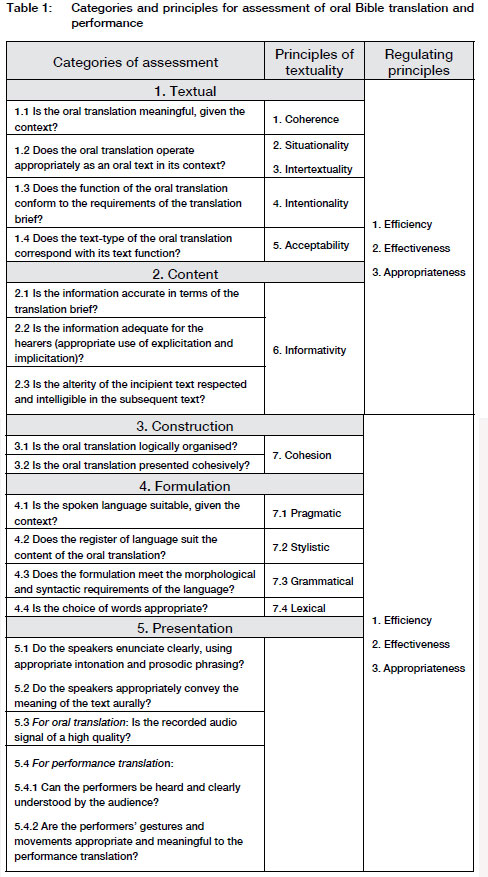
To operationalise these seven principles of textuality into a total quality assessment instrument for oral Bible translation, the principles are integrated into the following categories: textual aspects, content aspects, construction, formulation, and presentation. This instrument is unique in the sense that it is a top-down model, which assesses first the translation as a whole and only afterwards those elements constituting the oral translation and performance.
The first category of the instrument concerns the textual aspects. The instrument first assesses the oral translation and performance in its entirety, by examining its significance (meaningfulness) in the given context: (1) Is the oral translation and performance meaningful, given the context? This question refers to the overall coherence of the oral translation.
The second question is: (2) Does the oral/performative translation operate appropriately as an oral/performative text in its context? For example, an oral translation of Lamentations must function as a lament in the target culture; an oral translation of a praise psalm must function as a praise song, and an oral translation of Proverbs must function as proverbial sayings do. The textual aspects are situationality and intertextuality.
Next, the conformity of the text function of the oral translation and performance with the requirements of the translation brief is determined: (3) Does the text function of the oral translation/performance conform to the requirements of the translation brief? The question refers to the principle of intentionality.
The correspondence of the systemic features of the text type used in the oral translation and performance with the text function of the oral translation and performance has to be established: (4) Does the text type of the oral translation and performance correspond with the text function? This refers to the principle of acceptability.
The second category of the instrument concerns the aspects of content and refers to the principle of informativeness. First, the accuracy of the information given in the oral translation and performance has to be verified in terms of the translation brief: (1) Is the information accurate in terms of the translation brief? This is of paramount importance because accuracy is determined by means of the translation brief and not the incipient (source) text and culture. Secondly the instrument determines the adequacy of the information given: (2) Is the information adequate for the hearers (appropriate use of explicitation and implicitation)? Thirdly, the instrument addresses the issue of divergence or distance between the incipient sign system (language and culture of the source text) and the subsequent sign system (language and culture of the target text) under the rubric of alterity. The goal in translation should be for the subsequent text to respect the alterity of the incipient text while making it intelligible: Is the alterity of the incipient text respected and intelligible in the subsequent text?
The third category deals with the construction of oral translation and performance and, in particular, the logical argumentation thereof and the principle of cohesion. This aspect refers to the way in which arguments are presented: (1) Is the oral translation logically organised? The cohesion and unity of the oral translation and performance (i.e., the way utterances are put together) is germane to text construction and has to be determined accordingly: (2) Is the oral translation and performance presented cohesively?
The fourth category assesses the formulation of oral translation and performance. First, the compatibility of the language used to the specific context is assessed: (1) Is the spoken language suitable, given the context? This concerns the pragmatic level of language. Secondly, the level of formality of the language must be assessed: (2) Does the register of language suit the contents of the oral translation and performance? This refers to the stylistic level of language. The grammatical level of language is assessed by investigating the formulation and syntax and determining its compliance with the requirements of the target language: (3) Does the formulation meet the morphological and syntactic requirements of the language? Finally, the lexicological level assesses lexical choices: (4) Is the choice of words appropriate?
The last category concerns the presentation of oral translation and performance with two general questions: (1) Do the speakers enunciate clearly, using appropriate prosodic phrasing? and (2) Do the speakers appropriately convey the meaning of the text aurally? For oral translation, the question is: Is the recorded audio signal of a high quality? For performance translation, two questions are: Can the performers be heard and clearly understood by the audience? Are gestures and movements of the performers appropriate and meaningful to the performance of the text?
Finally, there are three regulatory principles (see De Beaugrande & Dressler 1981:11), namely efficiency (the text communicates with a minimum expenditure of effort by the participants, that is processing ease); effectiveness (the text leaves a strong impression and creates favourable conditions for attaining its goal, that is processing depth), and appropriateness (there is agreement between the setting of a text and the ways in which the standards of textuality are upheld, that is the mediation between the conventional and unconventional). The instrument does not measure the three regulatory principles separately to avoid overlap with the principles of textuality. The assumption is that the preceding questions of the instrument cover the regulatory principles implicitly.
The instrument provides the translation agents (translators, translation consultants, translation manager, and so on) with a checklist to assess both the process and the product of the oral translation and performance. From their viewpoint, the instrument is useful in top-down mode for self-evaluation. From the viewpoint of the participants/listeners/audience, the instrument is useful in a bottom-up mode to assess the various components and features of the oral translation and performance. From the viewpoint of translator training, the instrument is useful in bottom-up mode to inform the components of curriculum for translator training and to assess the output of translators-in-training in producing oral Bible translations/performances.
Returning to the four criteria mentioned in the beginning of the presentation, namely clarity, accuracy, naturalness, and acceptability, it is evident that these seminal concepts of quality have been extended to include all seven principles of textuality. Accuracy (the extent to which meaning has been preserved) is extended to include the semantic structure and content of the text as a whole - its coherence and informativeness. Clarity (communicating as clearly as the original), naturalness (communicating as idiomatically as the original), and acceptability (the perception that the translation is authentic and trustworthy) are extended to include considerations of cohesion and intertextuality. Adequacy (the extent to which the required function and purpose have been achieved) is extended to deal with situationality and intentionality (Shreve 2017:176).
4. AN ILLUSTRATION OF QUALITY ASSURANCE
4.1 The oral performative translation project on reclaiming humanness
The practical use of this assessment instrument for measuring the quality of oral Bible translation is illustrated by an oral performative translation in Sesotho, one of the twelve official languages of South Africa. This performative translation forms part of the research agenda of the Hebrew Department at the University of the Free State. Together with some of the postgraduate students in Bible translation, performative Bible translations are being developed that can be used to reclaim humanness in a post-human world, especially in African societies. An example is a book chapter in which the use of performative translations of biblical passages relating to Hebrew ʾašrê and Greek makarios ("happiness") is developed (Naudé, Miller-Naudé & Makutoane 2017:154-209). In this instance, it is demonstrated that performance translation of biblical texts provides a way to promote humanness, happiness, and equality through Scripture engagement.
The performance translation presented below relates to this broader project. It is produced for use in Sesotho-speaking congregations of the Dutch Reformed Church in Africa and especially for the congregation of Rehauhetswe, an informal settlement on the outskirts of Bloemfontein, whose members are largely in the "oral world", although some of them also function within the written world. The performance translation is a liturgy on forgiveness, an urgent need in South African society, which was composed from a selection of biblical texts on forgiveness, and which is described in detail in Makutoane (2022). In designing the oral performance, the Assessment Instrument for Oral Bible Translation and Performance served as a checklist for the process and will be distributed to assessors (after ethical clearance) to check the product.
The translation brief of the forgiveness performative text is as follows:
a. Intended function: To teach forgiveness, in order to promote social cohesion among the societies.
b. Addressees: Both oral and non-oral Sesotho speakers.
c. Medium of production: Performative translation based on orality and biblical performance criticism.
d. Space or place of use: Church setting during the liturgy and outreach endeavours in the informal settlements.
Designing a performative translation of forgiveness texts to be performed by and for individuals who are primarily oral enables the congregation to speak, hear, see, and internalise this challenging concept of forgiveness effectively, in order to promote social cohesion. The different voices are the presiding minister, mothers, fathers, and the youth. The different voices and different texts on forgiveness are packed in a stair-like format connecting to one another until they reach an apex which was the main message of the day: Many people on the planet earth cannot truly fulfil humanness without forgiving one another and staying happy. In that sense, happiness and forgiveness are the central pillars of humanness. Hence, the slogan: forgive, and stay happy!
4.2 Transcription and backtranslation of the oral performative translation
For the convenience of the reader, the transcription and backtranslation published as Makutoane (2022:370-377) is repeated here.
THEME: TSHWARELO ENA LE MATLA A MAHOLO, A TSOTEHANG! / FORGIVENESS HAS GREAT AND WONDERFUL POWER!
INTRODUCTORY REMARKS
Moruti/Pastor:
1 Tshwarelo ena le matla a maholo a tsotehang! / Forgiveness has incredible power!
Mophethi 1/Narrator 1:
2 E, Matla a tswang ho Modimo, / Indeed, the power from God,
3 Matla hodima maemo ohle - / power upon all circumstances -
Mophethi 2/Narrator 2:
4 E boelanya moetsadibe le Modimo, / it reconciles a sinner with God,
5 E hlola melato yohle,/ it overcomes all offences,
6 E bopa botjha dikamano tse senyehileng/ it builds anew broken relationships.
Mophethi 1 & 2/Narrator 1 & 2 (Ba buela hong/Speak in unison):
7 Ruri ke matla a tswang ho Modimo, / Indeed, it's the power from God.
8 E hlola kgalefo le moya wa ntwa / It overcomes rage and the spirit of war.
9 Matla a yona ke a tsotehang, a tswang ho Modimo! / Its strength is lovely; its (power) is from God!
MOTSOTSO WA KGUTSO / MOMENT OF SILENCE
Exodus 34:9
Moruti/Pastor:
10 Oho! Morena re tshwarele ditshito le dibe tsa rona / O! Lord forgive our iniquities and our sins.
2 Kings 5:18
Phutheho/Congregants:
11 Morena hle! A ko re tshwarele Morena, re tshwarele rona bahlanka ba hao / Please, Lord, please! Forgive us, forgive us, your servants.
Leviticus 4:20
Moruti/Pastor:
12 Modimo o re file konyana ya sehlabelo / God has given us a lamb of sacrifice.
Phutheho/Congregants:
13 Konyana ya sehlabelo hore ka yona re tshwarelwe / lamb of sacrifice that through it we are forgiven.
Batjha/Youth:
14 Ena ke Jesu, eo e leng tshwarelo ya rona / He is Jesus, our forgiveness
MOTSOTSO WA KGUTSO / MOMENT OF SILENCE
Moruti/Pastor:
15 Morena, nnete ya mmakoma ke hore ho na le seo re se tsebang ka wena! / Lord, the absolute truth is there is something we know about you!
Psalm 103:4
Phutheho/Congregation
16 hore o na le pelo e tshwarelang / That you have a forgiving heart
Bana/Children:
17 pelo e tletseng kutlwelobohloko le tshwarelo. / a heart full of compassion and forgiveness.
Daniel 9:9
Bomme/Mothers:
18 Morena Modimo, wa rona o a re tshwarela; o na le pelo e hauhelang; leha re o kwenehela / Lord our God, you forgive us; you have a merciful heart; though we turned against you.
Batjha/Youth:
19 empa o dula o re tshawrela. / but you remain forgiving us.
Psalm 86:5
Moruti/Pastor:
20 Morena, o lokile / Lord, you are good.
Bontate/Fathers:
21 mohau wa hao o moholo! / your mercy is great!
Phutheho/Congregants:
22 ho ba bitsang ho wena / to those who call upon you
23 hobane lerato la hao ha le fetohe. / for your love does not change.
24 Oho! Morena; oho Morena; oho Morena, re utlwele bohloko mme o re tshwarele! / O! Lord, O Lord, O Lord, have mercy on us, and forgive us!
Moruti/Pastor:
25 Hona le seo re se tsebang! / there is something we know!
Phutheho/Congregants:
26 ha wena moetsadibe o sa kgutlele ho Modimo, / when you sinner does not return to God,
Bontate/Fathers:
27 Modimo o ba lesisitheho ho o tshwarela! / God doubts to forgive you!
Bomme/Mothers:
28 jwale kgutlelang ho Modimo, o tla le tshwarela. / Now return to God, for He will forgive you.
Psalm 103:3
Bana/Children:
29 Ke yena ya fodisang malwetse a hao kaofela. / He is the one who heals all your diseases.
Phutheho/Congregants:
30 Morena, ha ho le jwalo; re ka belaela jwang?! / Lord, if it is like that; how can we doubt?!
4.3 Assessment of the oral performative text
As described earlier, the categories and principles of assessment of oral Bible translation/performance, as outlined in Table 1, provide rubrics for total quality management of the translation process from inception to reception by the intended hearers. This section describes how the Sesotho forgiveness performative text was created, in order to fulfil the translation brief and the categories and principles of assessment described.
Concerning the textual category, the performance is meaningful within the context of a Sesotho church service. What is new is the introduction of a performance of biblical passages on a theme as a participatory liturgy within the church service. The alteration of speaking voices, in which the pastor speaks and the congregation answers, is a characteristic of liturgy.4 The translation brief states a goal for the performance in promoting social cohesion, which is especially important in post-apartheid South Africa. This intentionality is explicitated in the liturgy at the beginning of the performance (lines 5-6, 8). Two "moments of silence" promote contemplation by the congregation concerning how the concept of forgiveness can be applied to their individual situations.
Concerning the category of content, the liturgy is largely composed of interwoven biblical passages relating to forgiveness, drawn from the wording found in the 1909/1961 and the 1989 Sesotho Bible translations (Makutoane 2022). For the oral performance, vocatives have been added five times "to show the intensity of a humble plea of the one who is praying" (Makutoane 2022:30). In addition, the biblical verses have been contextualised for the performance, by adapting the deixis of the biblical verses to fit the performance (e.g. "forgive us" in line 11 is adapted from the biblical "forgive me" in 2 Kgs 5:18, the verse that underlies the performance). The concept of the power of forgiveness (line 1) is repeated five times throughout the liturgy "to show the intensity of the meaning of forgiveness as having authority" (Makutoane 2022:30); the term "power" does not occur within any of the biblical verses incorporated into the performance but is an explicitation to enhance the oral performance and further its goals. The alterity of the concept of forgiveness, as drawn from the biblical texts, is both respected and made intelligible in the performance of the subsequent text.
Concerning the construction category, the performance is coherent and cohesive through the division of the speaking roles among individuals (pastor, narrator 1, narrator 2) and groups (narrator 1 and 2 speaking in unison, the mothers, the fathers, the youth, the children, and the entire congregation), so that the entire congregation is involved in the performance. The liturgy is structured with the pastor playing a leading role in providing an introductory sentence, which various groups take up and expand upon - the liturgy is thus "a two-way communication" between the pastor and the other participants, which "promotes an interactive-participatory mode of communication" (Makutoane 2022:23). For example, the pastor begins the liturgy with a general statement about forgiveness (line 1), which is expanded upon by the two narrators in three separate statements (lines 7-9). The pastor appeals to God to forgive (line 10), which is expanded upon by the congregation (line 11). The pastor describes God's provision of a sacrifice for forgiveness (line 12), which is expanded upon by the congregation (line 13) and the youth (line 14). The pastor speaks to God to indicate what is known about him (line 15), which is expanded by the congregation (line 16) and the children (line 17) (see also lines 25-29). The pastor acknowledges God's goodness (line 20), which is expanded by the fathers (line 21) and the congregation (lines 22-24). The liturgy ends with a spoken affirmation of trust in God's forgiveness by the pastor (line 20).
Concerning the formulation category, the Sesotho translation is stylistically, grammatically, and lexically suitable for the context of orality within a church service and the register is appropriate for the content. The choice of words is appropriate, drawing upon the wording found in the interwoven verses from the Sesotho Bible translations, which will be familiar to many of the congregants. Many of the portions of the performance translation are shaped as prayers to God (e.g. lines 10-11, 18-19, 24, 28-29) and as theological affirmation and exhortations (e.g. lines 1-9, 12-14, 15-17, 20-23, 25-29).
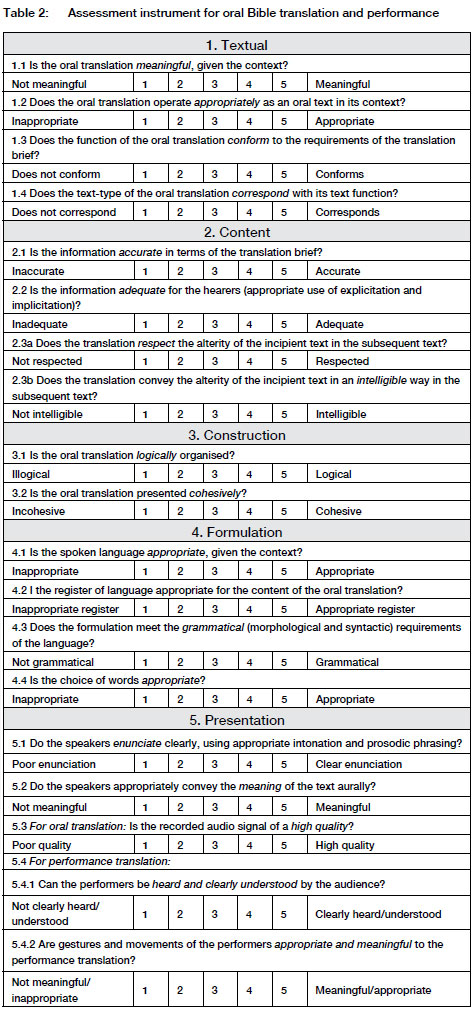
Assessing the process of the creation of the performative text is only the first step in the total quality-assessment process. However, it is a critical first step for the creator(s) of an oral text to provide their own assessment of the text based upon the robust categories of the assessment instrument. A future step in the research is to use the assessment instrument in Table 2 to evaluate the total quality management of the participants in the performance translation and the perceptions of the congregation as a whole concerning the outworking of the principles. It will also be important to perform the forgiveness liturgy in a number of congregations, in order to determine its effectiveness within a variety of church environments. As indicated in section 4.1, the assessment of the performative text through the perceptions of the participants in the performance and the congregations who experience it also provides crucial information for assessing every aspect of the performance. The use of a complex, multifaceted, and quantifiable assessment instrument for every step of the process avoids subjectivity.
5. CONCLUSIONS
This article focused on quality assessment of oral Bible translation and performance. The assessment was done within the framework of total quality management, which assesses the translated texts by examining several categories such as textual, content, construction, formulation, and presentation aspects as assessment tool and criteria. Through this framework, the categories were not viewed as single or separated entities, but as interacting entities. This affirms that as much as the translation or oral translation process is a complex issue which entails a conglomeration of systems, namely orality, performance, alterity and so on, these become part of the quality assessment process. This is also a complex process where its systems are not functioning as separated entities but as interactive and integrated. As a result of these systems flowing together in a holistic pattern, the article argues that quality assessment through total quality management is vital for ensuring an effective oral Bible translation.
Furthermore, by considering the linguistic challenges, cultural sensitivity and community involvement, oral translations can effectively communicate the biblical message and engage oral communities. In addition to that effect, by embracing collaborative approaches and leveraging technology will contribute to continuous improvement in the quality assessment process, resulting in more impactful oral Bible translations.
BIBLIOGRAPHY
-
Alfredo, J. & Foster, S. 2024. Quality translator training: Recent experience in Mozambique. The Bible Translator 75(3):365-377. https://doi.org/10.1177/20516770241273787
» https://doi.org/10.1177/20516770241273787 - Andersen, D. 1998. Perceived authenticity: The fourth criterion of good translation. Notes on Translation 12(3):1-13.
-
Arango-Keeth, F. & Koby, G.S. 2003. Assessing assessment: Translator training evaluation and the needs of industry quality assessment. In: B.J. Baer & G.S. Koby (eds), Beyond the ivory tower. Rethinking translation pedagogy (Amsterdam: John Benjamins), pp. 117-134. https://doi.org/10.1075/ata.xii.09ara
» https://doi.org/10.1075/ata.xii.09ara -
Awakde, B.T. 2025. Community participation in OBT quality assurance. The Bible Translator 76(1):23-34. https://doi.org/10.1177/20516770251323827
» https://doi.org/10.1177/20516770251323827 - Beekman, J. & Callow, J. 1974. Translating the Word of God. Grand Rapids, MI: Zondervan.
- Bell, R.T. 1991. Translation and translating. Theory and practice. London: Longman.
-
Botha, S. & Naudé, J.A. 2004. An instrument for assessing the quality of local government translations. Acta Academica 36(1):186-212. https://doi.org/10.38140/aa.v36i1.825
» https://doi.org/10.38140/aa.v36i1.825 - Christie, R.C. 1899. Étienne Dolet, the martyr of the Renaissance 1508-1546: A biography. Revised and corrected edition. New York: Macmillan.
-
Colina, S. 2011. Evaluation/Assessment. In: Y. Gambier & L. van Doorslaer (eds), Handbook of translation studies. Volume 2 (Amsterdam: John Benjamins), pp. 43-48. https://doi.org/10.1075/hts.2.eva1
» https://doi.org/10.1075/hts.2.eva1 -
De Beaugrande, R.A. & Dressler, W.U. 1981. Introduction to text linguistics. London: Longman. https://doi.org/10.4324/9781315835839
» https://doi.org/10.4324/9781315835839 -
Frost, J., Mustin, N. & Beal, H. 2024. Attaining quality in oral Bible translation: A guide to effective practice. Journal of Translation 20(2):21-62. https://doi.org/10.54395/JOT-FMBOBT
» https://doi.org/10.54395/JOT-FMBOBT -
Gile, D. 1995. Basic concepts and models for interpreter and translator training. Amsterdam: John Benjamins. https://doi.org/10.1075/btl.8(1st)
» https://doi.org/10.1075/btl.8(1st) -
Goudec, D. 2010. Quality in translation. In: Y. Gambier & L. van Doorslaer (eds), Handbook of translation studies. Volume 1 (Amsterdam: John Benjamins), pp. 270-275. https://doi.org/10.1075/hts.1.qua1
» https://doi.org/10.1075/hts.1.qua1 - Halliday, M.A.K. & Hasan, R. 1976. Cohesion in English. London: Longman.
-
Harmelink, B. 2025. The role of holistic exegesis in assuring quality in multimodal translation. The Bible Translator 76(1):54-72. https://doi.org/10.1177/20516770251315643
» https://doi.org/10.1177/20516770251315643 - House, J. 1977. Translation quality assessment. Tübingen: Gunter Narr.
- House, J. 1998. Translation quality assessment. A model revisited. Tübingen: Gunter Narr.
-
Houston, T.J. 2025. Experimenting with excellence: Quality assessment in a Mozambican oral Bible translation and transcription project. The Bible Translator 76(1):35-53. https://doi.org/10.1177/20516770251315431
» https://doi.org/10.1177/20516770251315431 -
Kalina, S. 2012. Quality in interpreting. In: Y. Gambier & L. van Doorslaer (eds), Handbook of translation studies. Volume 3 (Amsterdam: John Benjamins), pp. 134-140. https://doi.org/10.1075/hts.3.qua2
» https://doi.org/10.1075/hts.3.qua2 - Larson, I. 2001. The fourth criterion of a good translation. Notes on translation 12(3):40-53.
-
Makutoane, T.J. 2022. Promoting social reconciliation in post-apartheid South Africa: Engaging "forgiveness" texts in Bible translation performance. Old Testament Essays 35(2):348-377. https://doi.org/10.17159/2312-3621/2022/v35n2a12
» https://doi.org/10.17159/2312-3621/2022/v35n2a12 -
Marais, K. 2014. Translation theory and development studies. A complexity theory approach. London: Routledge. https://doi.org/10.4324/9780203768280
» https://doi.org/10.4324/9780203768280 -
Marais, K. 2019. A (bio)semiotic theory of translation. The emergence of social-cultural reality. New York: Routledge. https://doi.org/10.4324/9781315142319
» https://doi.org/10.4324/9781315142319 -
Marais, K. 2023a. Trajectories of translation. The thermodynamics of semiosis. London: Routledge. https://doi.org/10.4324/9781003379713
» https://doi.org/10.4324/9781003379713 -
Marais, K. 2023b. Translating constraints. Translation Studies. https://doi.org/10.1080/14781700.2023.2205407
» https://doi.org/10.1080/14781700.2023.2205407 - McGoldrick, G. 1994. The complete quality manual. A blueprint for producing your own quality system. London: Pitman Publishing.
- Meylaerts, R. & Marais, K. (eds) 2023. The Routledge handbook of translation theory and concepts. London: Routledge.
- Morgan, C. & Murgatroyd, S. 1994. Total quality management in the public sector. Buckingham: Open University Press.
- Mudge, J. 1997. Translation of some Hebrew idioms in the Book of Amos into the Roviana language. M.A.B.S. thesis, Denver Seminary.
- Naudé, J.A., Miller-Naudé, C.L. & Makutoane, T.J. 2017. Bible translation in postcolony Africa: Reclaiming humanness through Bible translation performance. In: K. Marais & I. Feinauer (eds), Translation studies beyond the postcolony (Newcastle upon Tyne, UK: Cambridge Scholars Publishing), pp. 154-209.
- Neubert, A. & Shreve, G.M. 1992. Translation as text. Kent, OH: Kent State University Press.
- Nida, E.A. 1976. A framework for the analysis and evaluation of theories of translation. In: R.W. Brislin (ed.), Translation. Applications and research (New York: Gardner Press), pp. 47-91.
- Nord, C. 2018. Translation as a purposeful activity. Functional approaches explained. Second edition. London: Routledge.
-
Nord, C. 2023. Functionalist approaches. In: R. Meylaerts & K. Marais (eds), The Routledge handbook of translation theory and concepts (London: Routledge), pp. 169-184. https://doi.org/10.4324/9781003161448-13
» https://doi.org/10.4324/9781003161448-13 - Oakland, J.S. 1995. Total quality management - Text with cases. Oxford: Butterworth Heineman.
-
Ruge-Jones, P. 2025. Performing faithfully: Mechanisms of fidelity in oral Bible translation. The Bible Translator 76(1):135-147. https://doi.org/10.1177/20516770251320336
» https://doi.org/10.1177/20516770251320336 -
Shreve, G.M. 2017. Text linguistics, translating, and interpreting. In: K. Malmkjaer (ed.), The Routledge handbook of translation studies and linguistics (London: Routledge), pp. 165-178. https://doi.org/10.4324/9781315692845-12
» https://doi.org/10.4324/9781315692845-12 - Watters, S. & De Blois, R. 2023. Quality in translation. A multi-threaded fabric. N.p.: SIL International.
Date accepted: 29 January 2026
Date published: 29 May 2026
2 See also the edited volume by Watters & De Blois (2023) on quality in translation as a fabric with multiple threads.
3 In fact, Shreve uses "listener", in this instance, but it should be "speaker".
4 See further exposition on this structural aspect of the performance below.