Reimagining outreach as inreach: A study of white DRC students at Stellenbosch University
Abstract
This article explores how a reimagined social imagination of Inreach can impact whiteness as a cultural imagination among White Dutch Reformed Church (DRC) students at Stellenbosch University. Racialised identity formation within the DRC has historically reinforced a missional imagination shaped by whiteness. Inreach is a programme designed to address White fragility and White fatigue, and sought to cultivate transformative, cross-cultural engagement among students born post-1994. Findings show a significant shift in participants' imagination of outreach to inreach - from individualistic and monocultural to more collective and inclusive. In particular, the collective external dimension of identity expanded, suggesting a redefinition of "us" that includes Black South Africans. The study contributes to reconciliation discourse and theological education by offering Inreach as a meaningful alternative to traditional outreach, promoting mutual, transformative engagement.
Dutch Reformed Church; Mission; Outreach; Social Imagination
1. INTRODUCTION
This article reflects on a larger study that explored how a specific form of intergroup contact might foster a greater willingness among White members of the Dutch Reformed Church (DRC) to develop intercultural relationships with Black amaXhosa South Africans. The study was initiated following a request by the DRC seminary at Stellenbosch University to devise an intervention that could assist White students in overcoming the phenomena of White fatigue and White fragility. It was hypothesised that these two features of whiteness would play a central role in the negative attitudes displayed by White students when engaging in interracial dialogue at the seminary. Such attitudes were theorised to manifest in disengagement, feelings of threat, or discomfort when topics such as race, reconciliation, or restitution were raised.
Pretorius (2018:1-12) proposed the term "woundedness" to describe this phenomenon, theorising that it is a psychological response to the historical experiences of racialisation endured by White South Africans. Scholars such as Kritzinger (1990) and Verwoerd (2022), among many others, have written about reconciliation particularly pertaining to White South Africans. However, the overarching theme driving the discourse is the need for White South Africans to partake in processes of reconciliation. This project and the resulting article approach this topic from a position of participants wanting to participate in cross-cultural experiences. This required designing an intervention with which participants want to engage, because it, to some extent, already exists within their imagination.
The study hypothesises that this woundedness - expressed as White fatigue and White fragility - has a detrimental effect on students' willingness to participate in cross-cultural encounters, thereby hindering the formation process the seminary envisions for its students. In this sense, the study is not aimed at reconciliation. Instead, it asks what should precede a process of reconciliation where White South Africans can participate in such processes without being influenced by White fatigue and White fragility.
In order to address this problem, the study drew on the existing social imagination within the DRC to design an intervention that encouraged participants to cross cultural boundaries in ways that could impact their cultural imagination.
The article commences with a delineation of the research problem and then puts forward the argument for the utilisation of the language of imagination as a means of articulating an understanding of identity and its formation. The article then introduces the social imagination of the DRC and the social imagination of outreach, respectively. It presents an alternative social imagination to outreach, with the aim of transforming the cultural imagination of participants. This section is concerned with the practice of Inreach. The article then presents the mapping of social imagination. After dealing with the methodology and the findings of the study, the article ends with a conclusion.
2. RESEARCH PROBLEM
There is no official programme of reconciliation within the DRC - a striking omission, given the church's historical ties to the apartheid state. Forster (2022:135-147) highlights the segregated positions of Black and White Christians in South Africa, underscoring the ongoing need for reconciliation. Drawing on Bhabha's (2012) concept of a third space, Forster explores how empathy for the narratives of others can be cultivated through mediated contact, envisioning a reconciled "home" in which the other is genuinely welcomed (Forster 2022:144-148). The cultural wounds left by apartheid continue to hinder the imagination of reconciliation, demanding a willingness to engage deeply with the lived realities of others:
It is precisely the willingness to enter into the cultural (even spiritual, or theological) milieu 'governed by the ethical and spiritual categories of the other' that makes translation possible and meaningful and leads to a new moral pedagogy for peaceful cohabitation (Forster 2022:144).
This study argues that the colonial project gave rise to a cultural imagination resistant to engaging with the other. This resistance was expressed through a social imagination embodied in White-only congregations. Any intervention aimed at transforming the cultural imagination of the other must, therefore, be framed within a social imagination that enables participants to engage with the other in a transformative way.
3. ENGAGING THE IMAGINATION
This study has opted to use the conceptual framework of imagination, a decision that is informed by two fundamental rationales. First, the formation of identity within a theological context necessitates a nuanced approach. Issues such as race and reconciliation demand more than cognitive conviction; they require a capacity to account for embodied experience and the interpretive ways in which human beings engage with the world. Secondly, a conceptual framework was required to examine participants' cognitive and affective postures towards "the other". This is significant because concepts such as "world view" do not fully capture the complexity of human interaction with "the other".
This article distinguishes between the concepts of social imagination and cultural imagination. These concepts have their origins in the work of Charles Taylor and have since been further developed by James Smith (2009) and Graham Ward (2018). Taylor (2004:2) employs the phrase "social imaginary" to articulate how modernity makes sense of itself, and how this self-understanding impacts our being in the world in social and structural ways. In his work, Taylor (2004:25) observes:
What I'm calling the social imaginary extends beyond the immediate background understanding that makes sense of our particular practices. This is not an arbitrary extension of the concept, because just as the practice without the understanding wouldn't make sense for us and thus wouldn't be possible, so this understanding supposes, if it is to make sense, a wider grasp of our whole predicament: how we stand to each other, how we got to where we are, how we relate to other groups, and so on.
This theory was further refined by Ward, who distinguishes between two interrelated imaginaries. Cultural imagination refers to the individual's imaginative realm that shapes interaction with the world, while social imagination denotes the systemic frameworks to which human beings subscribe. These two concepts are interwoven and mutually constitutive, and thus merit closer attention.
3.1 Cultural imagination
According to Ward (2018:180), the phrase "cultural imagination" refers to the understanding that individuals are shaped by physical, social, and emotional realities that exceed their conscious awareness. Furthermore, cultural imagination carries within it "dispositions, habits of mind, and behavioural responses that have internalised the value systems that each of us lives" (Ward 2018:190). Ward posits that cultural imagination is not a matter of choice; rather, it is inherited and transmitted through social interactions that are "not remembered and yet transposed" (Ward 2018:184). This phenomenon fosters a profound self-awareness, encompassing not only our interactions with the world, but also the intricate layers of our internalised realities that shape our identities.
Within the context of the present argument, whiteness is not regarded as an optional disposition or conscious choice. Rather, it is defined as an inherited and transmitted imagination, shaped by a history of social, theological, and structural forces that (mis)form identity. These dispositions, habits of mind, and behavioural responses, which constitute cultural imagination, influence how individuals and societies perceive and engage with reality, often prior to any explicit or conscious awareness (Ward 2018:190).
3.2 Social imagination
The concept of cultural imagination is characterised by its broad and amorphous nature, whereas social imagination pertains to the processes whereby societies institutionalise, organise, and enact the meanings and values produced by cultural imagination. Ward (2018:195) defines social imagination as that which emerges from the activity of cultural imagination and the values it generates. The concept of social imagination has been demonstrated to influence the structuring of institutions, social practices, and collective behaviours, thereby impacting the material conditions of human interaction. This institutionalisation, as posited by Ward (2018:224), functions as the collective articulation of cultural imagination, thereby endowing values held collectively with a tangible form.
While cultural imagination is an intrinsic aspect of individuals and is shared among communities, social imagination is expressed in systems and structures that render cultural imagination visible. It undergirds all social practices and institutions that regulate, disseminate, and evaluate societal values. However, it is important to note that not all cultural possibilities become social realities; cultural imagination presents multiple potential futures, while social imagination determines which of these are actualised (Ward 2018:195).
In this article, social imagination is defined as the social structures or systems that give expression to a specific cultural imagination present within a community. To illustrate this point, one may consider a group of individuals who, as a result of being shaped by whiteness as their cultural imagination, may carry within them a variety of visions for life in South Africa. When these visions manifest as segregated neighbourhoods or gated communities, they become the social imagination of that group. It is important to note that the existence of these social forms also reciprocally informs and reinforces the cultural imagination of those who participate in them.
This study approached the problem of race, particularly a specific manifestation of whiteness, not only as a personal disconnection from Christian identity, but also as a reflection of the social and cultural imagination in which that identity is formed and maintained. The formation and reformation of identity in relation to race remain defining features of South African society. Already in 1990, Kritzinger (1990:103-112) called for the "re-evangelisation of the white Church": A transformative reconfiguration of White Christian identity. This, he argues, was not merely a spiritual task, but also a theological imperative involving the reformation of identity itself (Kritzinger 1990:107-109).
Crucially, this study understands race as a construct with theological roots (Jennings 2011:6-45). This has far-reaching implications not only for how reconciliation is approached, but also for the foundational assumptions that shape identity formation. Put simply, whiteness as a cultural imagination has, through colonial systems, endowed the Western world with the belief that White people can choose who their neighbours are. This may be one of the central characteristics of whiteness as a cultural imagination.
4. THE SOCIAL IMAGINATION OF THE DRC
This study assumes that the racialised history of the DRC produced a social system capable of shaping a particular cultural imagination. It is, therefore, important to offer some reflections on the sociopolitical landscape - pre-and post-1994 - that gave rise to this discussion.
The DRC origins in South Africa are rooted in colonial endeavour (Saayman 2007:15-18). By the 17th century, Western Christianity had become firmly intertwined with a colonial imagination, characterised by entrenched assumptions and perspectives regarding other groups (Katongole 2012:25). It has been argued that this imagination was laden with soteriological notions: White people were perceived as inherently closer to God and divinely called to subjugate, transform, or convert other races into Western, Christocentric peoples (Jennings 2011:9). From its inception, the DRC grappled with its presence in Africa. What began as a space of worship for Europeans evolved into a mission to "benevolently" transform Africa, primarily through the conversion, education, and development of African people according to European norms (Saayman 2007:47; Muller 2022:8185).
The racial biases inherent in European thought found their way into the institutional structures of the church. By 1887, this racialised imagination had been formally institutionalised by the DRC through decisions taken at its Synod (Muller 2022:55-56). Consequently, the DRC played a significant role in both the development and the implementation of the apartheid policy during the turbulent first half of the 20th century (Elphick 2012:304; Saayman 2007:99).
Nell (2015:9-12) characterises the DRC in the post-1994 period as a cultural enclave or laager - a retreat for White South Africans amid the transfer of political power to the Black majority. It is evident that South Africa's transition to democracy did not result in the majority of White citizens adopting a non-racial identity (Institute for Justice and Reconciliation 2015). Furthermore, it has been observed that even those born post-1994 frequently exhibit characteristics of a racialised identity. This phenomenon, termed "woundedness" by Pretorius (2018:1-12), is attributed to a complex socio-historical and systemic habitus that shapes post-1994 identities.
As noted earlier, mission has been central to the DRC's theological self-understanding. While this has empowered many of its members, it has also served as a tangible mechanism for preserving racial prejudice (Elphick 2012:172, 238-239). Understanding the context in which a racialised imagination has been propagated is, therefore, essential not only for designing an intervention capable of positively shaping this imagination, but also for ensuring that the intervention is contextually relevant and aligned with participants' desires. Only then can it effectively invite participants into genuine engagement with the other.
5. SOCIAL IMAGINATION OF OUTREACH
The current imagination of the DRC has strong roots in the outreach movement (Van Wyngaard 2011:27-28). The church's strong missional identity - particularly as expressed in outreach or short-term missions (STMs) - represents a rare space in which White members actively seek connection with people of other races. This imagination manifests in numerous congregations pursuing benevolent engagement with Black Africans across Southern Africa.
However, these trips often reflect neo-colonial dynamics, serving Black communities in paternalistic ways (Adeney 2000:86-89). Such outreach missions typically take the form of proselytisation, education, development, and healthcare initiatives, in which local DRC congregations - most often through sending young people - seek to uplift Black communities. Although benevolent in intention, these practices have been critiqued from both theological (Rieger 2004:204-210) and sociological perspectives (Richter & Norman 2010). Rieger (2004:205-207), for example, argues that such missions, though pursued by well-meaning volunteers, are ultimately colonial in their approach. From a sociological standpoint, Richter and Norman highlight the negative effects that short-term volunteer programmes can have on children. They argue that the repeated presence of short-term volunteers undermines children's capacity to form stable, long-term relationships (Richter & Norman 2010:221-225).
That being said, the social imagination of outreach is one of a few places within the DRC where members actively choose and are willing to engage the other. This is particularly significant, given that these encounters often take place beyond predominantly White spaces and are conducted with a certain degree of sensitivity to the culture and values of Black Africans. It is within this manifestation of the DRC's social imagination that this study seeks to intervene. If White fatigue and White fragility inhibit White DRC members from engaging with the other, then outreach - or a reimagined form thereof - may serve as a facilitative context for breaking through the cultural imagination of whiteness. Briefly, a redesigned social imagination of outreach was hypothesised to impact the cultural imagination of whiteness among the participants.
6. SOCIAL IMAGINATION OF INREACH
Inreach is a postcolonial approach to mission first articulated by Rieger (2004:219-222) in a paper titled "Theology and mission between neocolonialism and postcolonialism". Inreach emphasises discerning God's actions already present within the host community, rather than "bringing" God to them. This requires a reversal of power dynamics, the recognition of the host community's authority, and a critical examination of the identities and privileges of visiting groups (Rieger 2004:220-221). Unlike traditional outreach, Inreach fosters self-transformation rather than the assimilation of others into Western norms. It focuses instead on empathetic proximity and the expansion of cultural imagination.
Defined as a praxis of short-term engagement, Inreach seeks to cultivate spaces of empathetic closeness to the other, with the aim of transforming racialised cultural imaginations. By dwelling in the suffering of others without the compulsion to "save" them, Inreach nurtures authentic love for neighbours, free from assimilationist motives. Although STMs have shown positive effects on reducing ethnocentrism and fostering inter-ethnic relationships among American theology students (Priest et al. 2006:444-445), such studies lack a South African context and generally fail to address whiteness explicitly.
Inreach addresses the DRC's particular context, where White individuals are often willing to engage with African communities but lack platforms for meaningful, mutual interaction. This study seeks to build upon existing desires within the DRC's cultural imagination that are often influenced by subtle neocolonial assumptions. Rather than directly confronting these assumptions, Inreach offers an alternative imagination for encounter, one that promotes reconciliation and transformation.
7. MAPPING THE IMAGINATION
The need for a mechanism to map the imagination is thus required. This mapping system would assist in tracing the impact that Inreach, as an intervention, can have on participants. Wilber's (2001:174-179) AQAL model provides a framework for integrating internal and external aspects of identity across both individual and collective dimensions. The model was chosen for two reasons. First, this model has been empirically tested within a South African context with White participants (Forster 2019). Secondly, the model provides the necessary theoretical framework to wholistically approach the imagination making use of both internal aspects (such as cognitive and affective), as well as external aspects (such as practices and actions). This model is part of Wilber's (2001:20-26) Integral Theory which aims to approach human identity in a wholistic manner.
The left-side quadrants represent subjective, internal beliefs - the individual (individual internal) and the collective (collective internal). Conversely, the right-side quadrants mirror external realities, encompassing the individual (individual exterior) and the collective (collective exterior). The upper quadrants are concerned with the formation of the individual, while the lower quadrants address the dynamics of the collective. When contextualised within the framework of this study, these quadrants manifest as follows:
• Individual interior is representative of, for example, the internal convictions that a person carries regarding the other, calling, being set to evangelise or a personal desire to commune with the other.
• The collective interior is representative of a person's convictions or desires as they relate to a collective. In this instance, the internal conviction might reflect belonging to a group of White reformed collective, or to oneself as part of a more diverse collective such as South African.
• Individual exterior refers to the elements that are visible within a person which form identity. Moreover, it is also related to visible actions such as listening or preaching. In this instance, race or the act of evangelisation are examples contextual to this study.
• The collective exterior in this article refers to the collective action or the systems associated with a group of people. In this study, the act of collective worship or partaking in collective action are examples.
This study integrates the notion of cultural imagination within the AQAL model to examine how each participant engages with the other. Wilber's theory facilitates the mapping of hermeneutic perspectives, by linking internal attitudes (II, CI) with external practices (IE, CE). Cognitive empathy is defined as intentional reflection, while affective empathy is defined as emotional response (Forster 2018:6-7). These concepts are considered essential in recognising the other. Practices and habits, in their external dimensions, express cultural imagination (Wilber 1997:7-9). Prejudice, understood as an unconscious social construct, permeates all four quadrants, shaped by both internal attitudes and external systems (Wilber 2005:35).
Within the context of the DRC, the concept of whiteness as a cultural imagination sustains racialised societal constructs that inhibit the recognition of other racial groups. These constructs shape outreach initiatives by framing interactions through racialised biases. Wilber's model, which encompasses both individual and collective convictions and practices, provides an effective tool for mapping these dynamics and informing how interventions such as Inreach might transform the imagination of the other. Each quadrant, therefore, contributes uniquely to understanding and addressing this imagination.
8. METHODOLOGY
8.1 Research questions
The research question for this study is: To what extent can the social imagination of Outreach of DRC students at Stellenbosch University become more collective and inclusive on the basis of practices of Inreach?
It was hypothesised that, prior to the intervention, the participants adhered to a social imagination of outreach that would engage the other in order to evangelise, uplift or transform them. This results in a cultural imagination that is threatened when confronted with issues related to race and, therefore, being unable to relate to the other.
As stated earlier, the social imagination of the DRC is laden with a history of whiteness. This created a social system in which a particular cultural imagination was sustained. This cultural imagination, carried by White persons, does engage with the other, but only in a particular manner that does not compromise the values of whiteness. Therefore, any attempt to engage the other in a manner that might threaten this imagination is understood as threatening. In this instance, the experiences of White fragility and White fatigue are present.
The intervention of Inreach was hypothesised to expand the cultural imagination, moving participants toward a more integral imagination. This transformation was expected to be observable in both quantitative and qualitative ways: quantitatively, through expansion into additional AQAL quadrants, and qualitatively, through changes in the content of each perspective - for example, a shift in understanding the collective as no longer confined to White identity.
The reason for the expansion was hypothesised to be related to a particular posture of engagement with the other. This posture of engagement is starkly different in the practices of outreach versus inreach. Within the practice of outreach, power and agency reside with the visiting White group who are agents of change. Within the practice of Inreach, agency and power are given to the local community to guide participants to spaces of engagement in which God is viewed as the main agent.
8.2 Intervention of Inreach: Set of practices
Inreach was designed as an intervention that took the form of three phases. These three phases were each designed to facilitate a particular role in facilitating contact. This is done to experience something of the imagination of the other that would transform the imagination of whiteness. These three phases of Inreach, as designed in this study, are:
• Orientation: The process of preparing the participants for a liminal experience with the other. This took the form of six encounters prior to the visit. This phase was to create a space where the cultural, historical, political, and social realities of the Zithulele community could be shared. This assists with cultural sensitivity and inculturation.
• Disorientation: The visit to the amaXhosa community located in Zithulele in the Eastern Cape. This was a ten-day trip in which the goal was only to partake in events organised by the local URCSA congregation. This was a liminal encounter designed exclusively by the leaders of the Zithulele community. This included house visits; sleepover with URCSA families; youth events; prayer events; eating together; cultural activities, and Holy Communion.
• Reorientation: This took the form of a time of reflection and integration of the experience. The DEAL method of reflective journaling was used for daily reflection (Ash et al. 2009:58-82). This was designed as a cornerstone in connecting the liminal experience to the transformation of identity.
8.3
Research designHermans and Schoeman (2015:26-29, 42-43) delineate practice-oriented research as an approach that engages with a problem arising not from theory but from a clearly defined challenge in practice. In this particular instance, the issue of whiteness and its manifestations impeded meaningful cross-cultural engagement at the DRC seminary at Stellenbosch University. The approach's pertinence stems from its contextual nature, which directly confronts challenges that are intricately linked to prevailing issues. This "action problem" is defined as the discrepancy between the actual and the desired conditions within a specific context (Hermans & Schoeman 2015:30).
For the present project, the DRC (as the problem owner) identified the action problem as the inability to establish a shared space for the formation and development of ministers that promote engagement across ethnic lines. For the seminary, the objective of the research was to support the creation of a "family dynamic" among students of different races, in order to foster unity between the two church bodies.1
Hermans and Schoeman (2015:32-33) distinguish between two strategic approaches in practice-oriented research. This study employed an improvement approach, whereby the design of the intervention was aimed at improving a particular practice, namely outreach. In line with Hermans and Schoeman's (2015:33-34) framework for improvement studies, the problem addressed in this study is the lack of desire among seminary students to engage cross-culturally. This woundedness is manifested through expressions of White fatigue and White fragility, which are diagnosed as symptoms of the cultural imagination in which White identity is formed. These symptoms are observable in the habits and practices that shield White individuals from engaging in difficult conversations about race with Black South Africans. White fatigue and White fragility are terms that describe this posture.
8.4
SamplingVarious factors were considered prior to the sampling process. The needs of the problem owner, the duration of the study, and the methodological implications led to the conclusion that purposeful sampling was most appropriate for this project. Palinkas et al. (2015:533-534) describe purposeful sampling as:
... a technique widely used in qualitative research for the identification and selection of information-rich cases for the most effective use of limited resources. This involves identifying and selecting individuals or groups of individuals that are especially knowledgeable about or experienced with a phenomenon of interest.
Participants in this study met the following criteria: members of the DRC; White, and members of the DRC/URC seminary.
To minimise bias, the entire second-year class was invited to participate in the study. An information session was held during which the research aims, requirements, and ethical considerations were explained. Students were then asked to respond individually and in writing to the invitation. All invited students agreed to participate and signed a formal consent form. Of the nine who initially accepted, seven participants were ultimately available and deemed suitable for inclusion in the study. Participants were aged between 19 and 21 years. For ethical reasons, all participants were anonymised and referred to in the data set as P1, P2, P3, P4, P7, P8, and P9.
8.5 Coding
After the sampling was done, the participants were invited for the pre-test interviews. At the conclusion of each of the pre- and post-test interviews, the recorded data was transcribed. The transcribed interviews were then validated as accurate by participants. The transcripts served as the basis on which the intervention could be analysed in relation to the theoretical framework of the study, the AQAL model. The data was analysed in Atlas-TI, by making use of the codes developed in relation to the AQAL model. This was then cross-checked by means of an interrater reliability test (IRR-test) to ensure the accuracy of the researcher's deductive reading of the data.
8.5.1 The individual interior state (II)
• Description: The II code relates to the cultural imagination based on internal and individual subjective criteria expressed in feelings, beliefs, theological convictions.
• Characteristics: Is observable in individual and personal belief, conviction, emotion, spiritual conviction, motivation, personal repentance, personal piety about the self or outreach. It articulates the understanding of God image, the calling to be sent and personal beliefs about reconciliation. These are internal and personal views that lack social engagement and transformative agency.
8.5.2
The collective interior state (CI)• Description: The CI code identifies collective identity as a relative stable understanding of the "we", based on internal and collective inter-subjective criteria.
• Characteristics: It is observable in collective and internal belief, conviction, confession, motivation or collective repentance. It articulates the understanding of God image, the calling to be sent, and personal beliefs about reconciliation with regard to a group, race, and culture as examples. These collective views lack social engagement and transformative agency.
8.5.3
The individual exterior state (IE)• Description: The IE code refers to observable individual attributes or action and is characterised by specific markers such as race or gender or expressing personal agency in engagement with another such as speaking or listening.
• Characteristics: Objective, individual, observable interpretations of sensory data. Personal agency, personal responsibility, activities and actions directed toward another. These include characteristics observable such as whiteness (as race), maleness, actions such as eating, pointing out a fault in another, one on one engagement. This code also includes the personal agency in engagement with the other as well as receiving agency from another such as listening.
8.5.4
The collective exterior state (CE)• Description: The CE code refers to observable collective action and is characterised by specific social markers such as systems or collective action.
• Characteristics: Objective and observational collective action based on sensory data, quantifiable, identifiable in a collective and objective sense. The IE code refers to collective social actions or habits as it is characterised by observable markers. This includes collective social actions within a system or networks such as church, and outreach with intended goals such as justice or reconciliation, expressing collective agency in engagement with society.
9. FINDINGS
The findings in this study are broken up into two main sections. The first section presents the findings as an overview of the amount of codes representative within each quadrant. This represents the weightedness of the quadrants to give a general overview of the data. Secondly, each quadrant is discussed in more detail to give nuance to the data representative in each respective quadrant.
9.1 Pre-intervention findings
The pre-intervention data demonstrates a tendency among participants to articulate their identity in an internal, individual manner. This finding aligns with the conclusions of previous studies (Forster 2022). The least amount of codes were collected within the collective external quadrant, thereby suggesting that a collective systemic understanding of the self was elusive.
It is imperative to consider not only the value of the quadrant, but also its nature. An illustration of this phenomenon can be observed in the collective interior quadrant. It appears that participants exhibited a notable inclination towards a communal imagination. However, the data shows that the collective in this quadrant was predominantly associated with White DRC or Afrikaner groups, with limited representation of a diverse collective internal imagination. The predominant motivation among participants for engaging in outreach missions is typically personal growth. Thirdly, the structure of this cultural imagination is heavily dependent on the nature of the community shaping identity. Within this conceptual framework, the influence of a monocultural society on participants' perceptions of others and their engagement in outreach initiatives is a salient factor. Finally, participants demonstrated an absence or minimal connection between engagement with others and their understanding or transformation of sociopolitical or historical realities (CE).
In this section, each quadrant is discussed in relation to quotations that were gleaned from the coding process. Each code is accompanied by a concise interpretation and discussion, exploring its manifestation within the context of the cultural imagination in the AQAL model.
9.1.1
The Individual Internal Quadrant (II)T0_P4_AQAL_II (4:35)
I: The first question is: how do you understand outreach?
P4: So to me, I think that outreach, I feel it has to, has to change something inside me, or I have to sacrifice something if I can put it that way. Maybe not only something physical, but also my comfort zone. And that's actually what I also want from an outreach is that I should be a bit like you said that stretch I actually want it. And that's why I'm looking forward to the outreach because I've never experienced it before. And that's why I said yesterday to (name), I'm looking forward to learning from myself, but also scared by what I'm going to learn.
This first quotation is an example of a participant voicing an individual and internal belief regarding her motive for participating in an outreach. In stating "I feel I have to, have to change something inside me", the participant notes a desire for outreach to change something in her inner world. Her understanding of outreach is connected to a sense of internal growth. The participant is seeking inner growth that requires some kind of sacrifice from her (ek moet iets opoffer). This sacrifice is expressed not only as something physical, but also as what she calls her "comfort zone" (gemaksone). This "comfort zone" is further explained as "being stretched". For the participant, this would result in learning more of her inner self, but she adds that this makes her scared because it is a new and unknown experience.
It is worth noting that the participant frames the topic of outreach, a missional practice, solely through a lens of personal growth. The participant's first intuitive response is exclusively expressed with an individualistic focus devoid of any mention of the other. This underlines the focus of the participant's cultural imagination to individualise and internalise engagement with the other.
9.1.2
Collective Internal Quadrant (CI)T0_P4_AQAL_CI (4:41)
I: What are the stories you have heard about outreach? Maybe in your congregation or. You have not been on one, what do you hear from people, what did they do there, or what?
P4: What I hear every time is, for example, our congregation has always gone to Eswatini, and when they come back all the time they talk about, how grateful we should be, but actually how, to a certain extent, how blessed those people are. As we always think, we are the ones that are blessed, or we are the privileged, but in a spiritual sense, because they are actually more dependent on the Lord, so I hear all the time about their relationship with God or sometimes they do not even know God, but their way of surviving.
The vast majority of the participants articulated a culture of outreach existing in their local congregations (CI). This reflects the missional imagination mentioned above. In this imagination, the collective internal understanding is centred around a common missional conviction of visiting and uplifting the other. This missional imagination carried by the collective, and transferred to the identity of this individual, shaped the participant's understanding of outreach projects and, by implication, engagement with the other.
The participant describes how congregations create liturgical events in which the testimonies of missionaries and members returning from outreach trips witness their experiences (IE), which, in turn, stimulates the cultural imagination (CI) of participating in such endeavours. These liturgical testimonies are formative as part of the missional culture which stimulates the affective part of the cultural imagination related to outreach.
Furthermore, the participant expressed the implications of hearing stories of outreaches and testimonies from missionaries. There is an internal, collectively held posture by the community which bends towards the CI rather than the CE. The participant describes a cultural imagination that asks the members of the collective to be "thankful" for what they have. This is, again, an affective trait. The language of "us and them" is crucial in understanding how this imagination functions. Although the pretest amounted to a substantial amount of CI codes, these codes refer to a monolithic us, meaning the collective is White and Dutch Reformed.
Lastly, this internal collective aspect of the cultural imagination carries with it an assumption of how "blessed" the other is. What this precisely entails for this participant is not clear, save to say that it does not allude to external and systemic aspects such as poverty, justice, or education. The blessed aspect refers to the other having to be more dependent on the Lord.
9.1.3
Individual External Quadrant (IE)T0_P3_AQAL_IE (3:45)
I: You have just said that there are two parts that are important to you when it comes to outreach. Something about doing something for people and preaching the gospel. Tell me a little about those two things.
P3: I think it's important to preach the gospel at the end of the day, but I think in outreach it's important not to go with the idea of I'm going to preach the gospel. I think the idea is ^ to go to people to make a difference in their lives, to spend time with them because people do not want to spend time with them, and then in the end it's just going to come to preaching the gospel.
This participant describes an internal belief (II) that the other is in need of upliftment. The act of spending time (IE) with the other is required because of the assumption that "people don't want to spend time with them". This is built on the assumption that the action of spending time with the other would open a door for him to share the gospel with those who he assumes have not heard it. This points to an imagination with a strong calling to mean something for the other, but it is built upon various problematic presuppositions pointing to an understanding of religious and cultural superiority.
9.1.4
Collective External Quadrant (CE)T0_P5_AQAL_CE (5:34)
I: This is great. Let's say if you now have to formulate like an academic definition of what outreach should be. I hear two things. You are talking about a spiritual side, but you are also talking about a practical helping people side ...
P7: (To) bring the message of God to people by helping them, kind of ... We watched a series last night, I cannot remember what the name of the series was, but the one rich guy gave money to a homeless person; he said that poverty is a very complex thing and he knows it cannot be solved by giving people money, but he hopes it helps. And it did, it kind of stood out to me, because usually people are just like throwing money at the problem, but that's the thing about outreach too. It's not just bringing money, there has to be a big plan because a lot of the time it's not just oh let's build a play area and then all your problems are solved. So it should also be more aimed at solving the problem. Like poverty for example is a big outreach (project) in which the church does a lot. But just handing out food parcels is not really a long term. It will not be long term. It's that they feel better for a day and then tomorrow they are hungry again.
In this quotation, the participant notes that the effects of outreach must move beyond handouts towards a solution for poverty. However, the participant articulates the complexities of poverty, and that handouts might sometimes be necessary. The result is the participant struggles to articulate a definition of outreach but she does work through the complexities of systemic problems such as poverty. One prominent aspect of the quotation is the participant speaking about a solution to poverty still dependant on a missional imagination emanating from a White church. For her, the solution is complex, but still dependent on the input from a White Christian community.
Pre-test conclusion
In the pre-test, the data showed a cultural imagination that is highly individualistic and culturally monolithic. The participants showed hardly any understanding of social systems as part of their identity and focused on their desire for personal growth when engaging the other. Moreover, the data showed that there is an inherent internal conviction that the other needs upliftment or salvation and there were strong links between this assumption and how participants articulate their calling. In short, the pretest data showed that the participants were willing to benevolently engage the other, but for personal growth and for the social and spiritual upliftment of the other.
Post-intervention findings
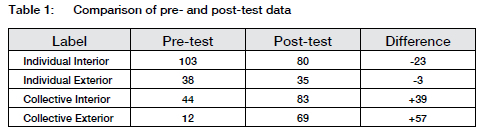
Following the intervention of Inreach, the data indicates that the participants transitioned from a predominant individualised and internal stance to a more balanced and distributed cultural imagination, which was more evenly distributed across the quadrants. This shift indicates an openness among the participants towards the concept of a collective identity, accompanied by a notable transformation in the nature of this collective identity, characterised by an emphasis on the other. This shift in perspective indicates an increased propensity to perceive or articulate their cultural imagination in relation to systems of diverse communal action.
Post-intervention, the value of the CI remained largely unchanged, suggesting an expansion in the cultural imagination towards a more collective and systemic orientation. This is evidenced by the CI being articulated in a diverse manner, signifying an expansion of the definition of "us" to encompass Black South Africans. The most significant increase was observed in the CE. This quadrant underwent a substantial expansion, signifying that participants became cognisant of the fact that their identity was not solely determined by personal conviction, but also influenced by social structures. Within the context of the Inreach, the exposure to the communal nature of amaXhosa people, who are heavily reliant on a collective network of society, seems to have had the effect of expanding the cultural imagination of the participants. The ensuing discussion will delve into each quadrant in greater detail.
9.1.5 The Individual Internal Quadrant (II)
T1_P7_AQAL_II (5:18)
I: I like what you say. You're saying there has been so many mind shifts changes within you. And, and you might want to use that to help other people make similar shifts. If you had to give that, that mind shift a name, what, what would you call it?
P7: I do not know if I can give it a specific name. I just feel like I'm less blind than I was before.
I: Blind for? Remember I'm on an island.
P7: Blind to the real world and how, how things actually are. We often talk in the faculty of rose-coloured glasses or you know the glasses that are on change how we read texts and how our own perspective and history change how we see things. And I do not know if my glasses are completely gone, but I know the lenses were thinner after the Inreach. I feel like I'm a little closer to seeing the world for what it really is, rather than behind the assumptions I grew up with. So I do not know if I can completely see now, but I feel I am definitely closer than I was before. So less blind than before.
This quotation illustrates the transformation in the II quadrant. When articulating his experience, the participant takes a confessional stance: "I just feel like I'm less blind than I was before" and "a little closer to seeing the world for what it really is". The participant tries to articulate that she no longer views the world as before, i.e. "the assumptions I grew up with". Her reference to "rose-coloured glasses" refers to a shift in hermeneutics. This points to not only viewing the world differently, but that her assumptions about the world have changed.
9.1.6
Collective Internal Quadrant (CI)T1_P4_AQAL_CI (4:7)
I: Thank you. What do you think is God's purpose with Inreach?
P4: I think it's bringing together people who are completely different, but who's still ... has common purpose. And that's to glorify Jesus and to be able to do things together. I think if we are not going to work together. If we are not going to learn together. Then we will not go, we will not have a resolution here on earth. Or we are not going to be able to do what Jesus wants us to do. And Inreach is where we learn from each other.
In the response, the participant articulates a common internal motivation present within the praxis of Inreach. The participant describes a collective goal carried by vastly different groups. In this instance, the participant describes a posture of engagement where diversity is something that is good and not a barrier. Learning from each other is regarded as an important common goal in humanity. Importantly, the "we" in this refers to a collective "we" dependent on learning from each other to then do what Jesus requires of us.
9.1.7
Individual External Quadrant (IE)T1_P2_AQAL_IE (2:2)
I: What did you say was submitted?
P2: It's when you go to someone who is completely different from you. In all respects, culture, language, race. Uhm, yes so. And you are going to learn how, who they are and how they do things and how they think about God.
In this quotation, the participant defines Inreach as an experience of learning from a person "completely different from you". There is a focus on two kinds of learning, first, how they do things (IE) and, secondly, how they think about God (II). The participant articulates an experience of learning as well as an openness to learn rather than articulating a need to defend his world view or disengaging from the other.
9.1.8 Collective External Quadrant (CE)
T1_P1_AQAL_CE (1:3)
I: You said, you had an idea about God's Kingdom that has changed or what. So, so you're a little vague. So say a little about what you struggled with and what changed.
P1: Oh I think what, what I struggled with is that it felt so individualistic. God's Kingdom felt individualistic to me because it was about my own spirituality and it was about what I want out of faith. And, to realise that this is not what it is, what God's Kingdom is, is to go to people to people and to live with them in a way that can uplift them and yourself at the end of the day. So it's not just the upliftment of yourself, but an upliftment of the people around you and how it manifests in the people and in the area and in communities. Yes. If it makes sense.
In this quotation, the participant articulates a cultural imagination opened up to mutual upliftment. She describes a prior state in which she understood the Kingdom of God to be focused on "individualistic" and internal "spirituality". The participant then describes this new conviction as the Kingdom of God being the act of going to people and living with them. She goes further in stating that merely living with people is not enough but it has to happen in a specific way with specific personal and individual outcomes: to live with them in a way that can uplift them and yourself ... and how it manifests in the people and in the area and in communities."
10. CONCLUSION
This section answers our research question: To what extent can the social imagination of Outreach of DRC students at Stellenbosch University become more integral and inclusive on the basis of practices of Inreach?
The findings of the data analysis demonstrate that the implementation of the Inreach programme had a significant impact on the participants' imagination. The most significant shifts observed pertained to the participants' understanding of the collective. This shift is characterised by a transition from a collective defined by race to a more inclusive concept of "us", encompassing a broader racial spectrum. Secondly, an expansion within the quadrants was observed. The individual internal quadrant remained unchanged; however, the collective external quadrant underwent an expansion. This suggests that individuals are not disregarding their own internal identity but rather becoming more open to a collective external identity. Finally, the participants transitioned from a need to engage with others for personal growth and the benevolent development of others, to articulating a need for collective growth and the establishment of mutual and communal relations. Table 1 illustrates the transition in these attitudes and shows the results of the pre- and post-test.
In this study, it was hypothesised that some participants would demonstrate an enhanced capacity for integration in their imagination. However, it was observed that one participant did not demonstrate any significant transformation. Furthermore, the shift in the nature of the collective interior is of crucial importance. The frequency of occurrence increased, and the value of this quadrant underwent a transformation. Prior to the intervention, the collective exclusively referred to a White collective. However, following the intervention, this collective underwent a transformation, becoming more diverse.
This transformation indicates that participants were able to use the experience to redefine a collective identity marker, thereby impacting their capacity to relate to others. This transformation, in conjunction with the shift in the quadrants, signifies a substantial progression in the participants' interactions with one another, exerting an influence on their experiences of White fatigue and White fragility.
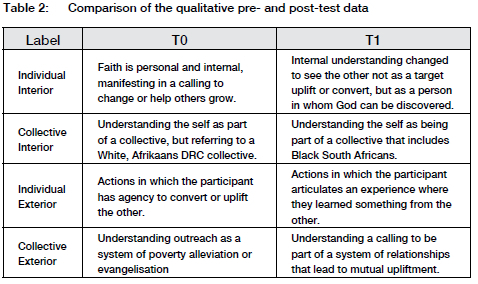
Furthermore, within each quadrant, the shift in imagination showed that the participants comprehended inclusivity not only in terms of tolerating others, but also in perceiving them as contributing to their own identity. This identity is articulated by the hope of participating in a shared calling. This transcends racial dynamics, moving towards a comprehensive understanding of the self that is intricately interwoven with the identity of the other. The analysis of the data indicates that, at certain points, the participants no longer felt the need to protect their White identity. Instead, they exhibited an inclusive openness, understanding a shared calling and belonging as a guiding factor in articulating their own life. This finding suggests the presence of an open, integral, and communal imagination, in which participants transcended the individualist and exclusivist tendencies that are often associated with White fatigue and White fragility. However, it is important to note that one participant did not demonstrate any significant change in imagination. Table 2 illustrates a comparison of the qualitative datasets. This table contains the positions observed in the pre- and post-tests.
The original objective of the study was to design an intervention to assist participants in transitioning away from manifestations of White fatigue and White fragility. The objective was to devise an intervention that would enable a shift in the social imagination of outreach, which is characterised by a cultural imagination of whiteness that hinders meaningful engagement with the other. The objective was to establish a space where the impact of White fatigue and White fragility could be mitigated, thereby enabling participants to broaden their cultural imagination. The results of the study demonstrate the intervention's efficacy in fostering a more integral and inclusive imagination. However, a notable shift in the nature of engagement was also observed, marking a transition from a focus on benevolent upliftment to a more mutual and reciprocal process of growth. A reimagined social imagination of Inreach did have an impact on the cultural imagination of participants.
BIBLIOGRAPHY
- Adeney, M. 2000. When the elephant dances, the mouse may die: The dangers of short-term missions. In: B. Berry (ed.), Short-term missions today (Pasadena, CA: Into All the World Magazine), pp. 86-89.
- Ash, S.L., Clayton, P.H. & Moses, M.G. 2009. Learning through critical reflection: A tutorial for service-learning students. Raleigh, NC: PHC Ventures.
-
Bhabha, H.K. 2012. The location of culture. New York: Routledge. https://doi.org/10.4324/9780203820551
» https://doi.org/10.4324/9780203820551 - Elphick, R. 2012. The equality of believers: Protestant missionaries and the racial politics of South Africa. Charlottesville, VA: University Of Virginia Press.
- Forster, D.A. 2018. Affect, empathy, and human dignity? Considering compassion at the intersection of theology and science. In: J. Claassens & F. de Lange (Eds), Consider compassion: Global ethics, human dignity, and the compassionate God (Port Elizabeth: Pickwick Publications), pp. 3-16.
- Forster, D.A. 2019. The (im)possibility of forgiveness?: An empirical intercultural Bible reading of Matthew 18:15-35. Eugene, OR: Wipf & Stock.
-
Forster, D.A. 2022. Social identity complexity and a politics of forgiveness among Black and White South Africans. In: T.A. Teklu (ed), Moral pedagogies for Africa: From ethnic enmity to responsible cohabitation (Abingdon, Oxon: Routledge), pp. 123-145. https://doi.org/10.4324/9781003178101-10
» https://doi.org/10.4324/9781003178101-10 -
Hermans, C. & Schoeman, W.J. 2015. Practice-oriented research in service of designing interventions. Acta Theologica 35:26-44. https://doi.org/10.4314/actat.v21i1.4S
» https://doi.org/10.4314/actat.v21i1.4S -
Institute for Justice and Reconciliation 2015. SA Reconciliation Barometer: 2015 report. [Online.] Retrieved from: http://www.ijr.org.za/home/wp-content/uploads/2016/11/IJR_SARB_2015_WEB_002.pdf [8 January 2025].
» http://www.ijr.org.za/home/wp-content/uploads/2016/11/IJR_SARB_2015_WEB_002.pdf - Jennings, W.J. 2011. The Christian imagination: Theology and the origins of race. New Haven, CT: Yale University Press.
-
Katangole, E. 2012. Mission and the Ephesian moment of world Christianity: Pilgrimages of pain and hope and the economics of eating together. Mission Studies 29(2):183-200. https://doi.org/10.1163/15733831-12341236
» https://doi.org/10.1163/15733831-12341236 - Kritzinger, J.N.J. 1990. Die herevangelisering van die wit kerk. In: M. Hofmeyr, J.N.J. Kritzinger & W. Saayman, Wit Afrikane? 'n Gesprek met Nico Smith. Johannesburg. Taurus.
-
Muller, R. 2022. The Scots Afrikaners: Identity politics and intertwined religious cultures. Edinburgh: Edinburgh University Press. https://doi.org/10.1515/9781474462976
» https://doi.org/10.1515/9781474462976 -
Nell, I. 2015. Transforming congregational culture: Suburban leadership perspectives within a circuit of the DRC. Scriptura 114. https://doi.org/10.7833/114-0-1047
» https://doi.org/10.7833/114-0-1047 -
Palinkas, L.A., Horwitz, S.M., Green, C.A., Wisdom, J.P., Duan, N. & Hoagwood, K. 2015. Purposeful sampling for qualitative data collection and analysis in mixed method implementation research. Administration and Policy in Mental Health and Mental Health Services Research 42(5):533-544. [Online.] Retrieved from: https://www.ncbi.nlm.nih.gov/pmc/articles/PMC4012002/ [26 January 2022]. https://doi.org/10.1007/s10488-013-0528-y
» https://www.ncbi.nlm.nih.gov/pmc/articles/PMC4012002/ -
Pretorius, H. 2018. Resurrecting wounds in the afterlife of apartheid. Unpublished paper delivered at the lecture series "Peace, trauma and religion in post-apartheid South Africa". 18 April 2018, Amsterdam. [Online.] Retrieved from: https://www.andrewmurraysentrum.co.za/wp-content/uploads/2019/05/HELGARD-PRETORIUS-Resurrecting-Wounds.pdf [20 December 2024].
» https://www.andrewmurraysentrum.co.za/wp-content/uploads/2019/05/HELGARD-PRETORIUS-Resurrecting-Wounds.pdf -
Priest, R.J., Dischinger, T., Rasmussen, S. & Brown, C.M. 2006. Researching the short-term mission movement. Missiology: An International Review 34(4)431-450. https://doi.org/10.1177/009182960603400403
» https://doi.org/10.1177/009182960603400403 -
Richter, L.M. & Norman, A. 2010. AIDS orphan tourism: A threat to young children in residential care. Vulnerable Children and Youth Studies 5(3):217-229. https://doi.org/10.1080/17450128.2010.487124
» https://doi.org/10.1080/17450128.2010.487124 -
Rieger, J. 2004. Theology and mission between neocolonialism and postcolonialism. Mission Studies 21:201-227. https://doi.org/10.1163/1573383042653677
» https://doi.org/10.1163/1573383042653677 - Saayman, W. 2007. Being missionary - Being human. An overview of Dutch Reformed mission. Pietermaritzburg: Cluster Publications.
- Smith, J.K.A. 2009. Desiring the Kingdom: Worship, world view, and cultural formation. Grand Rapids, MI: Baker Academic.
-
Taylor, C. 2004. Modern social imaginaries. Durham: Duke University Press. https://doi.org/10.1215/9780822385806
» https://doi.org/10.1215/9780822385806 -
Van der Riet, L.R. & Verwoerd, W. 2022. Diagnosing and dismantling South African whiteness: "white work" in the Dutch Reformed Church. HTS Teologiese Studies/Theological Studies 78(4), a7402. https://doi.org/10.4102/hts.v78i4.7402
» https://doi.org/10.4102/hts.v78i4.7402 -
Van Wyngaard, G.J. 2011. Post-apartheid whiteness and the challenge of youth ministry in the Dutch Reformed Church. Journal for Youth and Theology 21(2):23-34. https://doi.org/10.1163/24055093-90000037
» https://doi.org/10.1163/24055093-90000037 - Ward, G. 2018. Unimaginable: What we imagine and what we can't. London: I.B. Tauris.
- Wilber, K. 1997. An integral theory of consciousness. Journal of Consciousness Studies 4(1):71-92.
- Wilber, K. 2001. Sex, ecology, spirituality: The spirit of evolution. Second edition. Second revised edition. Boston, MA: Shambhala.
- Wilber, K. 2005. Introduction to integral theory and practice IOS basic and the AQAL map. Journal of Integral Theory and Practice 1:1-38.
Date accepted: 5 September 2025
Date published: 20 November 2025