Biblical stewardship and electricity management in Ghana
Abstract
The article discusses managerial challenge in Ghana's electricity sector. The analysis relies on field interviews and general observation, supplemented by extensive reviews of related literature, including annual reports by sector managers and energy access data available on the web. The article finds that, over the years, the sector was not well managed, due to government's appointments of party affiliates instead of those who do qualify to manage it. Noncommittal of sector managers has led to less productivity and less generation of energy. Even in a situation where there is enough generation, high levels of technical and non-technical losses reduce supply. The situation is worsened by high cost of production, and obsolete infrastructure caused by inability of sector managers to raise necessary capital, in order to invest in the sector. The article proposes how the incorporation of the biblical concept of "stewardship" into the theory of electricity management might help address the challenge.
Stewardship; Biblical stewardship; Electricity; Electricity management
1. INTRODUCTION
The role of electricity in global development has attracted a vast amount of research (Essah 2011; Jucker et ai. 2008; Nyarko-Kumi 2017; Ritchie & Roser 2019; Strbac & Wolak 2017; The World Bank 2019; USAID 2018). However, there is scant research on how the electricity resource is managed in developing countries such as Ghana. This article contributes to fill the gap in knowledge, by discussing the managerial challenge that affects the electricity sector in Ghana. It proposes how the incorporation of the biblical concept of "stewardship" (a religious resource for development intervention) into the theory of electricity management might help address the management challenge. This article addresses the main questions: What is the nature of the managerial challenge the electricity sector is facing in Ghana? and What contribution can the biblical concept of "stewardship" make for efficient management of the sector? The research is important because, among other things, it contributes to the existing debates on the role of religion in matters of development.
2. THEORY OF ELECTRICITY MANAGEMENT AND BIBLICAL STEWARDSHIP
It is important to theorise on electricity and its management, and the role the biblical concept of "stewardship" can play in this effort because the concepts constitute major variables that explain the perennial challenge that confronts the electricity management in Ghana.
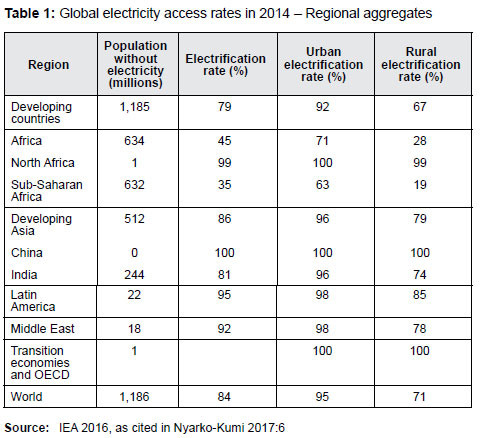
Electricity is the flow of a secondary energy power from primary energy sources such as water, coal, and wind, among others (EIA 2009). The average global electrification rate is roughly 87.4 per cent, while that of less developed economies is approximately 44.8 per cent (UNCDP n.d.). Data from the first half of 2023 suggests that the number of people without access to electricity decreased to 745 million at the end of 2023. For example, in sub-Saharan Africa, the number of people without access to electricity is said to be stabilising following three consecutive years of rise (IEA 2023: n.p.). Table 1 shows the global electricity access rates in 2014 with regional aggregates.
According to the table, in sub-Saharan Africa, roughly 632 million people do not have access to electricity. It also shows that, within the same region, while access to urban electricity is 65 per cent and access to rural electricity is only 19 per cent, only 35 per cent of the population in this region had access to electricity in 2014.
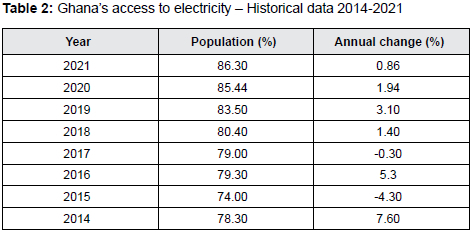
Recent statistics, however, show that the past decade has seen a greater share of electricity than the previous years. This means that countries without access to electricity have "declined from 1.2 billion in 2010 to 759 million in 2019" (The World Bank Group 2019:1). This implies that there has been some improvement in access to electricity in sub-Saharan Africa. For example, the 2019 report by Africa Development Forum on access to electricity in sub-Saharan Africa indicated 43 per cent improvement of access to electricity in the region (The World Bank 2019). The report also lauded Ghana as doing better than the remainder of the countries in the region, by raising its household's electrification to 78 per cent (The World Bank 2019:12). Yet, the World Bank report specifies that countries such as Nigeria, the Democratic Republic of Congo, and Ethiopia have "the biggest electricity access deficits, with Ethiopia replacing India in the Top 3" (The World Bank 2021:1). The World Bank 2021 report also cites how COVID-19 negatively affected policies and plans towards global access. As a result, it is estimated that "660 million people would still lack access in 2030" and that most of the countries involved are from sub-Saharan Africa (The World Bank 2021:1). Despite the electrification challenges in the region, Ghana has further improved its access to 86.30 per cent. Table 2 illustrates Ghana's access to electricity.
All the countries in the region share the limitedness in electricity consumption,
pervasive reliability challenges, prohibitive prices, and utilities in financial distress apparently caused by managerial challenges. These constraints pose a challenge to the region's economic and human development (The World Bank 2019:12).
The electricity sector was introduced in Ghana before the country gained political independence in 1957. At the time, the main source of electricity was diesel generators procured by industrial establishments such as factories, mines, and other institutions such as hospitals and schools (Nyarko-Kumi 2017). The completion of the Akosombo hydroelectric power station in the 1960s, under the auspices of the first President, Kwame Nkrumah, secured electricity production for domestic use and export to neighbouring countries in the West African subregion. This was possible because, at the time, Ghana's population was only approximately 6,000,000.
Ghana has committed itself to a countrywide access to electricity since the 1990s as its population increased. This idea led to the establishment of a National Electrification Scheme that would implement the National Electrification Master Plan for countrywide connection to the national grid. The year 2020 was targeted as the year for realising this vision. However, before attaining the 2020 target, the demand for electricity significantly outstripped the supply and resulted in a severe power challenge leading to its crisis in 2016 (Nyarko-Kumi 2017). The reason for this is that Ghana has not been able to accelerate the access rate beyond what it had achieved, due to managerial challenges. Figure 1 shows the trends of access to electricity rates for Ghana.
Electricity management covers all the strategies and techniques involved in controlling
the utilization of electricity, with a primary goal of improving efficiency, reducing waste, and implementing a more sustainable way of energy consumption (Study Smarter n.d.:1).
The theory of electricity management has suggested a number of measures, including diversification of electricity generation coupled with the introduction of renewable energy sources and solar power as well as expansion of the prepaid metering system to cover residential and public institutions that consume much of the energy resource (Jucker et ai. 2008:9). In addition, it suggests energy generation through wind parks and nuclear power plants, among others, which are environmentally friendly in relation to CO2 emissions and global warming as necessary options. The theory also stresses the need to promote a reduction of
local energy shortages or provide a better optimization base for utilities [through] either interconnections between grids [or] other local resources for generating electricity (Jucker et ai. 2008:9).
It also mentions restructuring the tariff regime that would ensure that utilities recover their cost of generation (Nyarko-Kumi 2017). Moreover, since critical institutions such as hospitals, the manufacturing and processing industries, the internet, and telecommunications infrastructure depend heavily on electricity, the energy supply reliability must be a priority. This means that, even if
the primary energy sources are nuclear power, wind energy or coal, for example, in those cases where generation and consumption are not collocated, countries [such as Ghana] must trigger investment in the transmission and distribution network to facilitate the delivery of larger volumes of power (Jucker et al. 2008:9).
It appears that Ghana has many challenges in that the electricity sector is not well managed to generate the necessary funds to be ploughed in as investment for the sustainability of the resource.
This also means addressing the grid reliability. This idea is important because the only way in which Ghana can reduce the energy shortage is either through "inter-connections between grids" or through the use of local resources, in order to generate electricity. Ensuring a reliable supply of electric power requires financial investment "in refurbishing grids, and new grids installations is a major challenge" (Jucker et al. 2008:9), since there is a shortage in materials used in the industry, and the fact that the aging assets of the electricity in Ghana need constant maintenance. Thus, the only way of mitigating cost is to reduce operation costs and change the way in which electricity is used or marketed. Furthermore, it would not suffice to only have sufficient power, but it is also important to have an energy surplus or an added generational capacity that can be used as a backup, so that grid stability is constantly or sustainably assured (Jucker et al. 2008).
According to the theory of energy management, there is the need for planning and streamlining operations in the production and consumption units of the electricity sector. It stresses "resource conservation, climate protection and cost savings" to make sure that consumers have continuous access to much-needed electricity. This is closely connected to environmental "management, production management, logistics and other established business functions" (The Free Encyclopedia n.d.:1).
The theory also suggests an integration of the electricity management in the organisational structure, so that programmes can be easily implemented. This would facilitate the regularisation of responsibilities and the interaction of the decision makers in the industry. For example, if done, functions delegation and competencies would extend "from the top management to the executive worker". This coordination may ensure the achievement of organisational tasks (The Free Encyclopedia n.d.:1). It also suggests the establishment of a separate organisational unit of electricity management to support senior management and keep track of what is happening in the units. This unit is dependent on the smallest form of organisational structure. Moreover, for an organisation to function effectively, the unit can be placed "directly between the first (CEO) and the second hierarchical level (corporate functions such as production, procurement, marketing)" (The Free Encyclopedia n.d.:1). Besides, there would be a central unit of energy management within the divisional organisation. At the same time, several sector-specific electricity management units would be created that are linked to the central unit and, therefore, the divisional organisation. If this is done, the various needs of the specific sectors and "the coordination between the branches and the head office can be fulfilled" (The Free Encyclopedia n.d.:1). In this matrix organisational structure,
there is more than one line of reporting managers. Effectively, it means that the employees of the organization have more than one boss (The Economic Times 2020:1).
This structure helps as a check and balance on activities of managers and others in leadership roles, making them effective and accountable. The other advantage is that it helps realise the ultimate goal of the organisation, to reach higher productivity. Apart from the fact that the structure is useful
in organizations which have diverse product lines and services, [it also removes] monotony and gives more flexibility to the organization (The Economic Times 2020:3).
3. METHODOLOGY
The main objective of the study is the managerial challenge facing the electricity sector in Ghana, and how the integration of the biblical concept of "stewardship" might improve the managerial practice, leading to a sustainable productivity in the sector. The analysis derives from qualitative in-depth field interviews and general observations on Ghana's electricity sector, supplemented by extensive reviews of related literature, as well as energy access data and annual reports by sector managers such as the Volta River Authority (VRA), Ghana Grid Company (GRIDCo), Northern Electricity Distribution Company (NEDCo), and the Electricity Company of Ghana (ECG), available on the web. The article also reviews biblical literature on the concept of "stewardship", judicious and accountable management of an entity. Holleman recommends the use of a general observation as a data-collection strategy. He indicates, among others, that, in a field situation where informants are unwilling to provide information concerning a variable under investigation, the researcher can always rely on the qualitative observation technique (Holleman 1986:116). In the case of this article, the field observations are supplemented by qualitative interviews and reviews of related literature. The theory of energy management frames the study. It is acknowledged that some of the citations in this work derive from the fieldwork.
4. RESULTS AND DISCUSSION
4.1 Biblical concept of "stewardship" and electricity management
This section first analyses the managerial structure of Ghana's electricity sector, including its challenges, and then provides the contribution that the biblical concept of "stewardship" could make in addressing the managerial problem.
4.1.1 Electricity management challenges
In accordance with the electricity generation plan of Ghana, the VRA was established on 26 April 1961 by the then Government of Kwame Nkrumah, with the mandate "to generate, transmit and distribute electricity under the Volta River Development Act 46" (VRA 2019:1). From 2005, VRA's mandate became largely limited to only the generation of electricity, while the transmission function was moved to GRIDCo. VRA's distribution agency, the Northern Electrification Department (NED), established in April 1987, also became the NEDCo, "a stand-alone, wholly-owned, subsidiary of VRA" (VRA 2019:1). The ECG, another power distribution agency of VRA, takes care of areas in southern Ghana. Thus, ECG and NEDCo buy power from VRA to, respectively, take care of the domestic, industrial, and commercial activities in the southern and northern areas within Ghana. These changes were enabled by the coming into force of a major amendment to the VRA Act 46 in consonance with Ghana government's power sector reforms.
VRA accesses its clients in both Ghana and sister countries with the help of GRIDCo's transmission system. This transmission system covers the entire country. It also connects the national electricity grids of Côte d'Ivoire (Compagnie Ivoirienne d'Électricité (CIE)), Togo, Communauté Électrique du Benin (CEB)), and Burkina Faso (SONABEL).
Unfortunately, state-owned agencies, with the oversight of the Ministry of Energy, are perennially unable to manage the electricity sector into a viable productive venture within Ghana's economy. This is shown in the chronic
high levels of technical and non-technical transmission and distribution network losses [and a] poor record in providing a reliable supply of electricity at reasonable price (Strbac & Wolak 2017:1).
This means that the amount of electricity billed by state agencies is significantly smaller in percentage point when compared with the total amount of electricity produced. Furthermore, "the amount of electricity ultimately paid for is an even smaller fraction of this amount" (Strbac & Wolak 2017:1). This problem, according to field informants drawn from Kumasi, Accra, Ho, and Tamale, respectively from the Ashanti, Greater Accra, Volta, and Northern regions of Ghana, is partly due to "an inadequate and poorly maintained electricity delivery and metering infrastructure". Field informants also indicated the finance to procure fuel for the generation of electricity, dilapidated transformers, and other equipment as additional problems associated with the electricity sector in Ghana. They attributed these problems to the non-committal of the sector managers. Speaking on JoyNews' Newsfile, Ben Boakye, Executive Director of the African Center for Energy Policy (ACEP), indicated how, for example,
power companies [in Ghana] are aware of [the current] generation shortfall in the power sector [but] are evading the reality (MyJoyonline. com 2024:1).
The public perception, including that of the ruling government, is that ECG, in particular, did not effectively manage its level of the electricity industry, thus resulting in massive losses.
Field informants further indicated that
ECG is incurring more loss than profit because its customers use various meters that are illegally connected and raped the supply of electricity without paying.
Informants also pointed out how "government institutions and various ministries, hitherto, misused the electricity resource and don't pay anything". Literature of energy-use corroborated the field information and indicated how the
vast majority of the difference between the amount of electricity generated and the amount that is paid for, can be explained by theft and non-payment of electricity bills (see also Strbac & Wolak 2017:1).
All this arguably contributes to high consumption rates, leaving the government with a huge debt to finance. By December 2012, the government's debt to Electricity Company of Ghana was about GHC 830.60 million (over US$14 million), forming approximately 65 per cent of the Electricity Company's total debt stock at the time (ECG 2013:13). By the end of October 2014, the government's debt for the use of the energy facility stood at roughly GHC 1.25 billion (over US$ 220,000,000) (Yao 2015). In 2023, the government was said to be owing over $480 million to ECG (Africa Report 2023). Currently, the government is said to be heavily indebted to ECG, with the latter disconnecting government offices connected to the electricity resource. In addition, the government is owing Independent Power Producers (IPPs) the cedi equivalent of $1.4 billion. CitiNews, one of the TV news broadcasters in Ghana, describes the situation as dangerous if the IPPs, which produce approximately 50 per cent of Ghana's electricity, decide to turn off their production (CitiNews.com 2024:1).
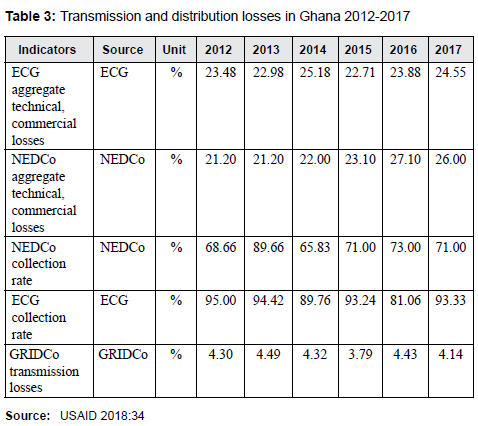
In order to resolve the managerial problem, the Akufo-Addo's NPP Government transferred the management of the electricity services from ECG to Power Distribution Services (PDS), a consortium of Ghanaian and foreign companies. The new managers (PDS) of the energy resource also faced similar challenges. The poor tariff structure made it impossible for the utility companies to recover the cost of electricity, in order to reinvest it for more generation of the facility. Thus, since taking over from ECG in February 2019, PDS finds it difficult to settle an amount of US$ 750,000,000 it owed private electricity producers in Ghana. With this challenge, the ruling government decided to abrogate the contract with PDS on alleged contract breaches and reinstated ECG to resume the management of the electricity affairs at this level. As a result of the high levels of technical and non-technical losses, state-owned companies find it extremely hard
to raise the capital needed for investments in new generation, transmission and distribution assets necessary to meet a rapidly growing demand for electricity (Strbac & Wolak 2017:1).
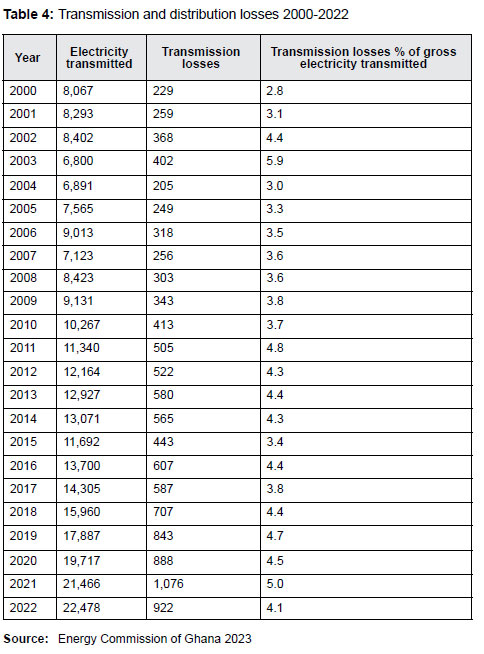
Table 3 shows transmission and distribution losses.
The managerial challenge in the electricity sector is serious in view of the fact that there appears to be a correlation between economic growth and energy consumption. That is, the demand for electricity in Ghana rises in relation to growth in gross domestic product (GDP) per capita. This means that the "higher the income, the greater is electricity consumption" (The World Bank 2019:14). While there appears to be no consensus among economists as to whether economic growth actually affects electricity consumption, it is incontestable that "electricity consumption levels have implications for economic development" (The World Bank 2019:14). In other words, it is indispensable not only for poverty alleviation, but also for economic growth and improved living standards of citizens (Ritchie & Roser 2019). That is why good management of the sector can never be overstressed.
4.2 Biblical concept of "stewardship" and electricity management
One denominator that runs across all the countries in the sub-Saharan Africa region is the limitedness in electricity consumption, "pervasive reliability challenges, prohibitive prices, and utilities in financial distress apparently caused by managerial challenges" (The World Bank 2019:12).
The electricity management challenge in Ghana relates to the biblical concept of "stewardship". The Greek word oikonomos ("steward"/"manager") refers to someone who manages a household. In all its biblical nuances, it can be deduced that the word refers to a person who is a steward/manager or an administrator entrusted with public goods or transcendent matters (Danker 2000:698). The theme of stewardship is built around another related word, namely oikonomia, which indicates responsibility or the moral dimension of management (Danker 2000:697). In the Old Testament, the expression עַַל־הַַבַַּיִִת ('al-habayit), translated in the Septuagint (Greek version of the Old Testament) as έπΙ του οίκου (epi tou oikou) meaning "over the house", is used to denote someone who is in charge of a house (see Gen. 39:4, 44:1, 4; 1 Kings 4:6; 2 Kings 18:37; Isa. 36:3, 22). Genesis 39:4-6 refers to Joseph as the manager of Potiphar's house (Walbon & Chan 2001:7). In this understanding, a steward takes good care of or judiciously manages another's property (Gen. 39:4). The concept also re-occurs in Genesis 44:1-4 to indicate Joseph's stewards who were at his service. The expression is also noted in 1 Kings 4:6 in reference to Ahishar as one of the officials of Solomon, but translated with οικονόμος ("oikonomos") in the Septuagint. It is used in a similar context in 2 Kings 18:18, 37 in reference to Hilkiah who was the caretaker or major-domo of Hezekiah's palace.1
Similarly, in the New Testament, people in charge of households and similar responsibilities were called managers or stewards (οικονόμος) (Luke 12:42, 16:1, 16:1-13, 12:42; 1 Cor. 4:1-2; Titus 1:7; 1 Peter 4:10). Most of the parables of Jesus refer to stewardship (Matt. 25:14-30, 31-46; Luke 16:1-5, 12:42-48) (Dillard 1953; Boaheng & Korankye 2022). The import of Jesus in the parables was to challenge his followers to live a life of faithful managers (stewardship) in every situation as they anticipated the full consummation of God's kingdom (Walbon & Chan 2001:11). According to Boaheng and Korankye (2022:156), as faithful managers (stewards), our faith in God "must be expressed in the public sphere in response to issues of societal concern", which, in this context, in Ghana, is the electricity sector. In Ghana, "God's resources" like water bodies which generate electricity, and the electricity resource itself are not judiciously taken care of. Rather, contemporary Ghanaian society "shows high levels of corruption and negligence to duty" in many state institutions (Boaheng & Korankye 2022:156). This sad state of affairs has seriously affected the electricity sector in Ghana that forms the subject matter of the present study. Thomas-Clapp and Brannan (2018:13) also explain that Christians, particularly protestants, have been influenced by "eisegesis of the scriptures" mainly that "the present Earth will be destroyed during the second coming of Christ through fire" in place of a new heaven and earth that will be created. This understanding, for Thomas-Clapp and Brannan (2018) hinders Christian stewardship for the sustainability of God's creation.
The concept of "stewardship", therefore, denotes responsibility of the people of God towards God's creation (Dwyer 1994:921-923; Boaheng & Korankye 2022:157; Thomas-Clapp & Brannan 2018:13). In the context of this study, this would mean that managers of the electricity industry have to manage it judiciously so that the sector can make much profit that can be used to further develop it.
The above biblical ideas relate to the theory of electricity management. For example, according to the theory of electricity management, as indicated, it is about all the strategies and techniques involved in controlling
the utilization of electricity, with a primary goal of improving efficiency, reducing waste, and implementing a more sustainable way of energy consumption (Study Smarter n.d.:1).
This implies prudent and judicious management of the energy resource. Managers of the energy resource in Ghana need to take a number of measures such as diversification of electricity generation mix, by both introducing renewable energy sources and solar power as well as expanding the prepaid metering system to cover residential and public institutions that consume much of electricity (Jucker et al. 2008:9). As indicated, there is also the need for energy generation through wind parks and nuclear power plants, among others, which are environmentally friendly in relation to CO2 emissions and global warming. The theory also stresses the need to promote a reduction of
local energy shortages or provide a better optimization base for utilities [through] either interconnections between grids [or] other local resources for generating electricity (Jucker et al. 2008:9).
This entails restructuring the hitherto tariff regime that would ensure that utilities recover their cost of generation (Nyarko-Kumi 2017). Furthermore, the energy supply reliability is a must because critical institutions such as hospitals, the manufacturing and processing industries, and installations such as the internet and telecommunications infrastructure depend heavily on electricity. Even if
the primary energy sources are nuclear power, wind energy or coal, for example, in those cases where generation and consumption are not collocated, countries [like Ghana] must trigger investment in the transmission and distribution network to facilitate the delivery of larger volumes of power (Jucker et al. 2008:9).
This can only happen if the biblical concept of "stewardship", which eschews corruption, misappropriation of resources, theft; and instead, transparent and accountable judicious management of resources, is applied to the electricity sector management in Ghana. This will help overcome the perennial challenge of mismanagement of the sector. With good stewardship in the sector, necessary funds can be generated and ploughed in as investment for the sustainability of the resource.
However, this also means addressing the grid reliability. This idea is important because, as indicated, the only way in which Ghana can reduce the energy shortage is either through "inter-connections between grids" or the use of local resources to generate electricity. Ensuring a reliable supply of electric power requires financial investment "in refurbishing grids; and new grids installations is a major challenge"; and the fact that the aging assets of the electricity in Ghana need constant maintenance (Jucker et al. 2008:9). As mentioned earlier, the only way of mitigating cost is to reduce operation costs and change the way in which electricity is used or marketed. This calls for judicious and accountable management of the energy resource. It would not suffice to have sufficient power only, but it is also important to have an energy surplus or an added generational capacity that can be used as a backup, so that grid stability is constantly or sustainably assured (Jucker et al. 2008). This involves planning and streamlining operations in the production and consumption units of the electricity. The analysis suggests "resource conservation, climate protection and cost savings", and making sure that consumers have sustainable access to the much-needed electricity. This also implies not only efficient environmental management and production management, but also logistics and other established business functions (The Free Encyclopedia n.d.:1).
Some scholars interpret the "stewardship" concept in light of the dominion mandate in Genesis 1:26-30, in which God puts human beings in charge of his creation as custodians (Wright 2004:118-121; Boaheng & Korankye 2022; Thomas-Clapp & Brannan 2017:17). This implies that human beings are to manage God's "household" (creation) as vice-regents, deputies, and trustees (Murphy 1985:210; Waltke 2007:302-303; Wright 2004:118-121; Boaheng & Korankye 2022; Thomas-Clapp & Brannan 2017:18). Being good stewards extends to judicious management or use of unnatural resources that are obtained from natural sources - God's creation (Hastings 1961:80-81).
Products such as electricity, a secondary and unnatural resource, obtained from natural resources such as water, wind and others, can also be taken good care of or managed judiciously since they originate from God's creation. In addition, human beings who create unnatural resources from natural creations are themselves owned by God. Thus, biblical stewardship is the acknowledgment of God's ownership, acceptance of trusteeship of life and possessions, and the administration of the same, according to the will of God (Dillard 1953:11; Thomas-Clapp & Brannan 2018:17). This fundamental understanding, according to Dillard, forms the superstructural assumptions of both the Old and the New Testament teachings on stewardship (Dillard 1953:3).
The stewardship of creation and the environment imply that anything, whether natural or unnatural such as electricity that is essential or impacts on creation, is also of concern to God (Vallet 2001:230; Baham 2020). According to Werning, human beings are responsible for maintaining the full diversity of created things. He adds that this responsibility of care for creation is essential, due to its indispensability for human life and survival (Werning 1982:92). The maintenance of creation includes all resources such as electricity that sustains life on earth. The analysis thus implicates technology as a stewardship issue.
Stewardship obliges people of God to be good managers in every sphere of life showing that they are responsible and accountable (Boaheng & Korankye 2022). The issues of responsibility and accountability demand, first, a base-line energy assessment that examines the pattern of existing electricity usage by government or sub-entities such as state-owned electricity agencies such as the VRA, GRIDCo, ECG, and VRA's distribution agency, NEDCo that, respectively, manage the generation, transmission, and distribution of the energy resource in Ghana. In this instance, the activities of state-owned electricity companies need to be dispassionately assessed, in order to find out whether they deserve to continue to manage the energy sector and, indirectly, the apparent state monopoly in the electricity sector. This assessment is crucial because experience has shown, in Ghana, that state-owned companies never do well. This is why their constant probe and assessment can serve as an effective energy cost control procedure. This exercise may determine the reference point for improvements in energy efficiency and improve the existing electricity usage and management. It is also important to benchmark "every individual section such as area, sub-area and the industry" in the electricity sector (The Free Encyclopedia n.d.:1).
This also means using resources for the right intended purposes. In the context of Ghana, people of faith or Christian politicians/public servants who handle the public purse for an investment in the electricity sector would manage it well, knowing that their actions will be accounted for sooner or later to God. In this sense, it may be argued that rewards and punishment in stewardship are principles to apply, in order to promote faithfulness and avoid abuse of trust. Secondly, the stewardship behaviour applies to all those who work either in the production, transmission, supply or distribution chain of the electricity resource. People of God, who are end-users of electricity, would also efficiently and judiciously use it to avoid the loss, misuse or theft of the resource. They would avoid stealing the resource through illegal connections or refuse to pay for the energy consumed.
One major advantage about integrating the biblical concept of "stewardship" with the electricity management theory is that it would lead to the judicious management of the electricity sector of the economy. The theory includes facility management, an important part of electricity energy management. This is much needed in view of the fact that a large percentage "(average 25 per cent) of complete operating costs are energy costs". This fact is corroborated by the International Facility Management Association, which, among other things, indicated that facility management "encompasses multiple disciplines to ensure functionality of the built environment by integrating people, place, processes and technology" (The Free Encyclopedia n.d.:1).
Good stewardship or judicious management of the energy sector would reduce the costs for the provision of electricity and ensure that the service life of equipment is maintained, in order to avoid breakdowns. All this is possible when managers of the sector view themselves as effective stewards who are responsible and accountable. Last but not least, in his study, Vallet (2001:230) argues that the steward seeks possible alternatives or possibilities and is committed to changing the norm as long as it would please God. This implies that a good steward/manager would seek alternative means of being more efficient in the use of resources such as electricity. For example, promoting alternatives such as using compact fluorescent lamps instead of incandescent lamps, and other electrical appliances that consume less electricity but provide same or improved benefits to the end-user would be part of the measures to ensure efficient use and management of electricity.
5. CONCLUSION
The article analysed the managerial challenge in the electricity sector in Ghana, based on unstructured qualitative in-depth field interviews, general observations, supplemented by extensive reviews of related literature, including annual reports by sector managers, and energy access data available on the web. Among other things, the findings show that the inability of the electricity sector to thrive well in terms of profitability, which can help investment into more generation, transmission, and distributary assets, illustrates the managerial challenge facing the sector. This is partly due to the fact that, over the years, state-owned electricity enterprises with the oversight of the Ministry of Energy, chronically experienced massive technical and nontechnical transmission and distribution network losses that they were unable to resolve. The sector managers are also unable to provide a reliable supply of electricity at reasonable cost. The amount of electricity billed is significantly less than the total amount of electricity produced. The amount of electricity ultimately paid for is even less than the amount produced. The managerial problem is also noted in the poorly maintained electricity delivery and metering infrastructure. Incidents of theft and non-payment of electricity bills explain most of the discrepancy between the amount of energy generated and the amount realised. These challenges seriously affect the supply of electricity resource. The article argued that, if the biblical suggestions are integrated with the theory of electricity management and implemented within the managerial practice, they might contribute to resolving the perennial managerial challenge that affects the viability of the electricity sector in Ghana. The contribution of the biblical concept of "stewardship" is crucial because it tries to inject sanity in the form of responsibility and accountability or morality into the way in which the electricity industry is managed or governed as well as into the way in which others use the energy resource. This is particularly practicable since Christians, according to the 2021 population and housing census in Ghana, less other people of other faiths, form roughly 71.3 per cent of the population in the country. That is, if Christians, who form the majority of the population in Ghana, alone can apply the biblical understanding of the concept of "stewardship" in their managerial and end-user positions of the energy resource, they would contribute to resolving the electricity challenge in Ghana. The study is important because, among other things, it has contributed to the existing debates on the role of religion in matters of development.
BIBLIOGRAPHY
-
Baham, M. 2020. Creation and the Christian environmental steward. [Online.] Retrieved from: https://www.researchgate.net/publication/342262492_Creation_and_the_Christian_Environmental_Steward [8 April 2025].
» https://www.researchgate.net/publication/342262492_Creation_and_the_Christian_Environmental_Steward -
Boaheng, I. & Korankye, J. 2022. A Christian view of stewardship: A study of Daniel 6:1-4. E-Journal of Religious and Theological Studies (ERATS) 8(6):156-165. https://doi.org/10.38159/erats.2022862
» https://doi.org/10.38159/erats.2022862 -
Citinews.com 2024. Power production in danger: ECG owes IPPs $1.4 billion. [Online.] Retrieved from: https://citinewsroom.com/2023/03/power-production-in-danger-ecg-owes-ipps-1-4-billion/ [12 April 2024].
» https://citinewsroom.com/2023/03/power-production-in-danger-ecg-owes-ipps-1-4-billion/ - Danker, F.W. (Ed.) 2000. A Greek-English lexicon of the New Testament and other early Christian literature. Chicago, IL: The University of Chicago Press.
- Dillard, E.J. 1953. Good stewards. Nashville, TN: Broadman Press.
- Dwyer, A.J. (Ed.) 1994. The new dictionary of Catholic social thought. Collegeville, MN: Liturgical Press.
- ECG (Elegtrigity Company of Ghana) 2013. Proposal for review in distribution service charge. Accra: Electricity Company of Ghana.
-
Energy Commission of Ghana 2017. National energy statistics 2007-2016 revised. [Online.] Retrieved from: http://energycom.gov/gh/_/Energy_Statistics_2017_Revised.pdf [17 September 2019].
» http://energycom.gov/gh/_/Energy_Statistics_2017_Revised.pdf -
Energy Commission of Ghana 2023. National Energy Statistical Bulletin. Accra. [Online.] Retrieved from: https://www.energycom.gov.gh/newsite/files/2023-energy-Statistics.pdf [12 April 2024].
» https://www.energycom.gov.gh/newsite/files/2023-energy-Statistics.pdf -
EIA (Energy Information Administration) 2009. Electricity - A secondary energy source. [Online.] Retrieved from: http://www.ei.lehigh.edu/learners/energy/readings/electricity.pdf [17 September 2019].
» http://www.ei.lehigh.edu/learners/energy/readings/electricity.pdf -
Essah, A.E. 2011. Energy generation and consumption in Ghana - Proceedings of 2011 West Africa Built Environment Research (WABER) Conference, Accra, 19-21 July. [Online.] Retrieved from: http://centaur.reading.ac.uk/20973/1/Energy_generation_and_consumption_in_Ghana.pdf [19 September 2019].
» http://centaur.reading.ac.uk/20973/1/Energy_generation_and_consumption_in_Ghana.pdf - Hastings, J.R. 1961. My money and God. Nashville, TN: Broadman Press.
- Holleman, J.F. 1986. Trouble-cases and trouble-less cases in the study of customary law and legal reform. In: K.V. Von Benda-Beckmann & F. Strijbosch (eds), Anthropology of law in The Netherlands: Essays on legal pluralism (Dordrecht: Foris Publications), pp. 110-131.
-
lEA (International Energy Agency) 2023. Access to electricity improves slightly in 2023, but still far from the pace needed to meet SDG7. [Online.] Retrieved from: https://www.iea.org/commentaries/access-to-electricity-improves-slightly-in-2023-but-still-far-from-the-pace-needed-to-meet-sdg [22 June 2024].
» https://www.iea.org/commentaries/access-to-electricity-improves-slightly-in-2023-but-still-far-from-the-pace-needed-to-meet-sdg -
Jucker, B., LEUPP, P. & Sjökvist, T. 2008. Electrical energy - The challenge of the next decades. Abb Asea Brown Boveri Ltd. Review 8-13. [Online.] Retrieved from: https://library.e.abb.com/public/47dff15b8fde2905c125742600521403/ABB%20Review%201_2008_72dpi.pdf [19 September 2019]
» https://library.e.abb.com/public/47dff15b8fde2905c125742600521403/ABB%20Review%201_2008_72dpi.pdf -
Macrotrends LLC 2010-2023. Ghana electricity access - Historical data. [Online.] Retrieved from: https://www.macrotrends.net/countries/GHA/ghana/electricity-access-statistics [8 December 2023].
» https://www.macrotrends.net/countries/GHA/ghana/electricity-access-statistics - Murphy, C.N. (Ed.) 1985. Teaching and preaching stewardship: An anthology. New York: Commission on Stewardship.
-
MyJoyonline.com 2024. People are deliberately shifting burden for power outages. [Online.] Retrieved from: https://www.myjoyonline.com/people-are-deliberately-shifting-burden-for-power-outages-ben-boakye/ [12 April 2024].
» https://www.myjoyonline.com/people-are-deliberately-shifting-burden-for-power-outages-ben-boakye/ -
Nyarko-Kumi, E. 2017. The electricity situation in Ghana: Challenges and opportunities. CGD Policy Paper. Washington, DC: Centre for Global Development. [Online.] Retrieved from: http://www.cgdev.org/publication/electricity-situation-ghana-challenges-and-opportunities [20 October 2019].
» http://www.cgdev.org/publication/electricity-situation-ghana-challenges-and-opportunities -
Ritchie, H. & Roser, M. 2019. Access to energy - Our world data. [Online.] Retrieved from: https://ourworldindata.org/energy-access [9 July 2020].
» https://ourworldindata.org/energy-access -
Strbac, G. & Wolak, F. A. 2017. Electricity market design and renewables integration in developing countries. [Online.] Retrieved from: https://www.google.com/search?client=firefox-b-d&q=Strbac+and+Wolak+%282017%29+on+electricity%3F [9 July 2020].
» https://www.google.com/search?client=firefox-b-d&q=Strbac+and+Wolak+%282017%29+on+electricity%3F -
Study Smarter n.d. Electricity management. [Online.] Retrieved from: https://www.studysmarter.co.uk/explanations/environmental-science/energy-resources/electricitymanagement/#:~:text=Electricity%20management%2C%20as%20the%20name,sustainable%20way%20of%20energy%20consumption [12 April 2024].
» https://www.studysmarter.co.uk/explanations/environmental-science/energy-resources/electricitymanagement/#:~:text=Electricity%20management%2C%20as%20the%20name,sustainable%20way%20of%20energy%20consumption -
The Africa Report.com 2023. Ghana: Power company ECG disconnects state bodies over $480 debt. [Online.] Retrieved from: https://www.theafricareport.com/295877/ghana-power-company-ecg-disconnects-state-bodies-over-480m-debt/ (12 April 2024).
» https://www.theafricareport.com/295877/ghana-power-company-ecg-disconnects-state-bodies-over-480m-debt/ -
The Economic Times 2020. Definition of matrix organization. [Online.] Retrieved from: https://economictimes.indiatimes.com/definition/matrix-organization [9 July 2020].
» https://economictimes.indiatimes.com/definition/matrix-organization -
The Free Encyclopedia. S.A. n.d. Energy management. [Online.] Retrieved from: https://en.wikipedia.org/wiki/Energy_management [9 July 2020].
» https://en.wikipedia.org/wiki/Energy_management -
The World Bank Group 2019. Africa development forum on electricity access in sub-Saharan Africa: Uptake, reliability, and complementary factors for economic impact. [Online.] Retrieved from: https://documents1.worldbank.org/curated/en/837061552325989473/pdf/135194-PUB-PUBLIC-9781464813610.pdf [12 April 2024].
» https://documents1.worldbank.org/curated/en/837061552325989473/pdf/135194-PUB-PUBLIC-9781464813610.pdf -
The World Bank Group 2021. Report: Universal access to sustainable energy will remain elusive without addressing inequalities. [Online.] Retrieved from: worldbank.org [26 February 2024].
» worldbank.org - Thomas-Clapp, M.B. & Brannan, D.K. 2018. Evolutionary ethics and Christian stewardship. European Journal of Science and Theology 14(2):13-29.
-
UNCDP (United Nations Capital Development Fund) n.d. Energy access and main challenges in LDCs: Support measures portal for least developed countries. [Online.] Retrieved from: https://www.un.org/ldcportal/energy-access-and-main-challenges-in-the-ldcs/ [2 November 2019].
» https://www.un.org/ldcportal/energy-access-and-main-challenges-in-the-ldcs/ -
USAID (United States Agency for International Development) 2018. Integrated power system master plan for Ghana: Volume 2, main report (draft). [Online.] Retrieved from: http://www.energycom.gov.gh/files/Ghana%20Integrated%20Power%20System%20Master%20Plan%20_Volume%202.pdf [20 November 2019].
» http://www.energycom.gov.gh/files/Ghana%20Integrated%20Power%20System%20Master%20Plan%20_Volume%202.pdf - Vallet, R.E. 2001. The steward living in covenant: A new perspective on Old Testament stories. Grand Rapids, MI: Wm B. Eerdmans.
-
VRA (Volta River Authority) 2019. Profile of VRA. [Online.] Retrieved from: https://www.vra.com/about_us/profile.php [20 November 2019].
» https://www.vra.com/about_us/profile.php - Walbon, R. & Chan, F. 2001. Stewardship and the kingdom of God. Colorado Springs, CO: Christian and Missionary Alliance.
- Waltke, B.K. 2007. An Old Testament theology: An exegetical, canonical, and thematic approach. Grand Rapids, MI: Zondervan.
- Werning, J.W. 1982. Christian stewards: Confronted and committed. St. Louis, MO: Concordia Publishing House.
- Wright, C.J.H. 2004. Old Testament ethics for the people of God. Downers Grove, IL: IVP Academic.
-
Yao, G. 2015. Electricity company of Ghana is a victim of government policies and practices. [Online.] Retrieved from: https://www.moderghana.com/amp/news/601568/the-electricity-company-of-ghana-ecg-is-a-victim-of-gover.html&ved [20 November 2019].
» https://www.moderghana.com/amp/news/601568/the-electricity-company-of-ghana-ecg-is-a-victim-of-gover.html&ved
Date accepted: 8 April 2025
Date published: 30 June 2025