Reimagining ecclesiological imagination within a Dutch Reformed Congregation in South Africa
Abstract
This research explores how Durbanville congregation's liturgical practices might reimagine "God's new world" amidst these sociocultural constraints. Drawing on Christi van der Westhuizen's work, the study critiques how these enclaves institutionalise prejudice under the guise of preserving familiar norms and orders, highlighting the identity crisis faced by White individuals in affirming racial exclusivity. It presents practices of change (an intervention) to address the limitations of whiteness. By fostering positive contact between racially diverse groups, these practices aim to reduce anxiety, increase empathy, and cultivate an inclusive and more integral ecclesiological imagination of the celebration of liturgy. The findings suggest that a set of contextual and intercultural practices can transform ecclesiological imagination into being more integral towards all dimensions of the basileia tou theou. Finally, the study presents some broader implications for reimagining liturgical practices in divided sociocultural contexts.
Dutch Reformed Church; Ecclesiological imagination; Whiteness; Basileia tou theou; Practices of change
1. INTRODUCTION
This article explores how ecclesiological imagination can be re-imagined in the racially and culturally constrained context of the Dutch Reformed Church in Durbanville, South Africa. The central question of this article is: To what extent can the ecclesiological imagination of a liturgical planning group in a Dutch Reformed Church in South Africa become more integral and inclusive through selected practices of change?
The study explores how liturgical practices within the Durbanville congregation shapes its ecclesiological imagination within sociocultural constraints. Drawing on Van der Westhuizen's critique of White enclaves and micro-apartheid, the research examines how deeply embedded racial and cultural exclusivity continues to shape congregational identity. In this context, the basileia tou theou is introduced as an eschatological vision that challenges exclusivity and calls the church to embody justice, reconciliation and communal flourishing. To address the transformation of ecclesiological imagination, the study employs Ken Wilber's Integral Theory, mapping shifts across four dimensions of identity formation:
• Hope and faith correspond to the individual interior perspective (II), shaping personal beliefs and emotions.
• Shared visions of justice and reconciliation reflect the collective interior perspective (CI), fostering a sense of communal identity.
• Acts of hospitality and service align with the individual exterior perspective (IE), offering concrete expressions of the values of the basileia tou theou.
• Systemic reforms for equity and inclusivity represent the collective exterior perspective (CE), demonstrating the institutional embodiment of the ideals of the basileia (Van der Ven 1998:225-227; Bevans & Shroeder 2004:45).
The theoretical framework is complemented by intergroup contact theory (Pettigrew & Tropp 2011) and two main hermeneutical approaches:
• African contextual hermeneutics emphasises the role of context, resistance, and resilience through practices such as contextual Bible reading (Forster 2017).
• Event hermeneutics envisions new possibilities of inclusion through transformative communal practices such as intergroup meals and shared liturgical experiences (Bevans & Shroeder 2004).
Section 2 explores the historical and sociocultural context of the Durbanville congregation and examines the role of whiteness in shaping its ecclesial identity. Section 3 outlines the research methodology, detailing the case study approach, data-collection process, and measurement tools. Section 4 presents the findings, highlighting shifts in participants' ecclesiological imaginations following the intervention. Finally, section 5 provides a summary and discussion, considering the broader implications of reimagining.
2. BACKGROUND TO THE STUDY
Within the Western Cape of South Africa, Durbanville is often referred to as
behind Cape Town's 'boereworsgordyn' - a term literally meaning a sausage 'curtain' associated with Afrikaners and used by Capetonians to refer to the geographical language and racial divide in the city (Van der Westhuizen 2017:181).
In her book, Van der Westhuizen directly refers to Durbanville as one of the two towns in South Africa where one can clearly see an Afrikaner contingent living within a laer (Centurion being the other town). She refers to these places as exclusive "Afrikaner neo-nationalist enclaves", where whiteness employs the technique of "inward migration" to create spatial modes of exclusion and install prejudice (Van der Westhuizen 2017:176182). This technique is deployed to ensure the safety and protection of all that is familiar and unthreatening to their norms and orders (Van der Westhuizen 2017:184). For Van der Westhuizen (2017:181), the problem with Durbanville is that, created by the norms and orders, it functions as a Trojan horse for racism, as it houses the dominance of whiteness without it looking suspicious at all to White people.
Van der Westhuizen (2017:184) calls this subtle tactic of creating exclusive White enclaves "the entrenchment of a micro-apartheid" that reinforces prejudice. This creates specific norms and orders for all people to follow, which becomes a method of cleansing to whiten the space around White people. Their pursuit most likely becomes the preservation of the master narrative of whiteness and everything that ensures their safety in this space (Van der Westhuizen 2017:186). This becomes their social imagination through which they imagine society and the church. According to Van Wyngaard (2019:239), "the Dutch Reformed Church remains for all intents and purposes a white church" because of the contexts, which, in turn, make the ability to critically reflect on whiteness almost impossible. Being able to critically engage such a narrative of whiteness for Van Wyngaard would require "some distance from the white community" itself (Van Wyngaard 2019:239).
In the middle of this White enclave stands a Dutch Reformed Church, the Durbanville congregation (founded in 1826), with its calling, Dissipeis van Jesus, saam in diens van God se nuwe wêreld.1 Imagining God's new world for a church becomes more difficult when the world around one affirms and protects the old world and its so-called masters. It is more likely to imagine the protection and institutionalisation of what it wants to maintain, even if it is unconsciously.
3. ECCLESIOLOGICAL IMAGINATION
This section first defines ecclesiological imagination as a form of social imagination that reflects the institutionalised imaginative pursuit of church members of a liturgy planning group (see section 3.1). It then discusses Parsons' structural-functionalism as a framework for understanding churches as institutional systems (see section 3.2). Liturgy is described as a function or field of work within congregations. The members of the liturgy group (evening song) of the congregation of Durbanville are motivated to create and maintain the cultural patterns that shape this motivation. For the members of the liturgy group, these cultural patterns are created by whiteness (see above). But they are also shaped by the eschatological imagination of the basileia tou theou (see section below).
3.1 Ecclesiological imagination as a form of social imagination
Social imagination can be defined as the multi-perspective configuration of identity in a particular circumstance and context (Ward 2018:207-233). It includes subjective beliefs, emotions and hopes (individual interior), objective actions and observations (individual exterior), shared cultural values and collective hopes (collective interior), as well as institutional systems and practices (collective exterior). When applied to ecclesiological imagination, this framework provides a way of mapping how individuals and collectives imagine and embody the church's role in the world.
The ecclesiological imagination, as a form of social imagination, reflects the institutionalised imaginative pursuits of people who have a role in planning liturgy based on their collective identity (Ward 2018:207-233). This imagination is informed by the cultural patterns of their immediate context and the eschatological vision they seek to embody. The members of the liturgical planning team think and act from a framework of exclusivity because of the cultural patterns of whiteness. From the eschatological perspective of the basileia tou theou, they are motivated to embody and enact the imperative of inclusivity. To explore this tension, the study uses a theoretical framework rooted in Wilber's integral theory and informed by Parsons' LIGA model and Van der Ven's ecclesiology in context (Schoeman 2002:70).
3.2 Structural-functionalism and ecclesiological identity
Parsons' structural-functionalism provides a framework for understanding churches as institutional systems that balance functional imperatives: adaptation, goal attainment, integration, and latency (Hermans 2024:3941; Parson 1951:13). These imperatives ensure the survival and quality of the system, by addressing both external and internal dynamics. Within this theoretical framework, Van der Ven's community formation model underscores the pivotal role of identity in comprehending ecclesiology. Congregations, as observed from a structural-functionalist vantage point, can be conceptualised as fiduciary systems whose principal objective is the propagation of culture, encompassing norms and values, to members, facilitating their internalisation (Ritzer 2011:246). The members of a congregation's liturgy group assume institutionalised roles within the overarching congregational system. According to Parsons' functionalist theory, this process aligns with the function of latency, or pattern maintenance, which refers to "both the motivation of individuals and the cultural patterns that create and sustain the motivation" (Ritzer 2011:242).
Van der Ven, in Ecclesiology in context, extends this concept, by identifying latency as the identity of the church, encompassing its beliefs, vision, and mission as influenced by its social context (Van der Ven 1993:7980). For Parsons, latency operates implicitly, with its underlying motives often left unexamined. Van der Ven, however, emphasises the need for congregations in contemporary societies characterised by conflicting value systems to critically engage with the realities of difference and conflict inherent in the process of "living with and for others". These tensions are also evident among the members of the liturgical group as they prepare for the evening service. Finally, it is important to distinguish between functions and sectors (or fields of work) within congregations. Areas of work refer to specific activities or practices whereby congregations pursue their ultimate goals and primary purpose, and these sectors operate within the framework of the congregation. This study focuses on the content and transformation of the cultural patterns (identity) that motivate the liturgical group as they prepare the evening service, particularly as these patterns intersect with the broader institutional and social imperatives of the Dutch Reformed Church.
3.3 Integral ecclesiological imagination: Basileia tou theou
Basileia tou theou, as an imaginative pursuit endeavour, manifests itself through a variety of metaphors that guide the church's ecclesiological imagination. These metaphors embody different dimensions of the basileia's life (Snyder 1993): hope and faith, visions of justice and reconciliation, acts of hospitality and reconciliation, equality and inclusiveness. By including all perspectives, these metaphors foster an integral ecclesiological imagination that challenges exclusivity and calls the church to embody God's new world. When integrated, these perspectives foster a holistic ecclesiological imagination that challenges exclusivity and calls the church to embody the eschatological vision of God's new world (Van der Ven 1998:225-227; Bevans & Shroeder 2004:45).
The basileia tou theou serves as the imaginative goal of ecclesiology, challenging the liturgical team of the Durbanville congregation to imagine God's future in the midst of their sociocultural realities. It represents the integration of beliefs, actions, shared values, and systems, all informed by the eschatological promise of God's new world. In contrast, the enclave-centred basileia of whiteness reflects exclusivity and domination, reinforcing a narrow social imagination.
By grounding the ecclesiological imagination in the basileia tou theou, this study seeks to reframe the liturgical practices of the Durbanville congregation as transformative acts that embody inclusivity, justice, and communal flourishing. This imaginative shift requires balancing Wilber's perspectives, fostering both individual and collective transformation, and challenging the congregation to live into the eschatological hope of the basileia tou theou.
4. MAPPING ECCLESIOLOGICAL IMAGINATION
This study aims to map the ecclesiological imagination of members of the liturgy group within specific roles in an institutionalised social system, in this case the Dutch Reformed Church in Durbanville. To this end, Wilber's AQAL (All Quadrants All Levels) Integral Theory is used as a tool for mapping four perspectives of identity (see above: latency), namely Individual-Interior (II) (subjective), Collective-Interior (CI) (inter-subjective), Individual-Exterior (IE) (objective), and Collective-Exterior (CE) (inter-objective). The AQAL Integral Theory will function as a map to plot the modes of existence of the participants' ecclesiological imagination of the liturgy (4.1). The next section presents the mechanisms and ways of transforming ecclesiological imagination (4.2). The integral theory of AQAL will serve as a framework for tracing potential shifts in these modes.
4.1 Integral modes of perspective in ecclesiological imagination
The ecclesiological imagination of a church is shaped by four interrelated dimensions, as outlined in Wilber's Integral Theory: the individual and the collective, each with internal and external expressions. This framework allows for a holistic understanding of how identity, belief, and action function within a liturgical community. The four perspectives are applied as follows:
• Individual-Internal (II): Personal beliefs, emotions, and reflections that shape the ecclesiological imagination. These experiences are expressed in statements using first person pronouns (e.g. I believe, I feel, I trust). We expect to see a limited focus on personal connection to Jesus and others within the community, reflecting cultural values of whiteness. We see personal expressions of hope, transformation, and inclusion in relation to God's new world (basileia tou theou) as more inclusive personal beliefs. Faith refers to the trust individuals place in God's action within the liturgy, shaping their belief in divine presence, renewal, and reconciliation through worship.
• Collective-Interior (CI): Shared cultural norms, values, and assumptions that shape ecclesiological imagination. This research focuses on shared visions of justice and reconciliation within the liturgical community, expressed in we-centred language (we believe, we envision, we strive), which defines the role of the community in embodying the basileia tou theou.
• Individual-Exterior (IE): Personal actions and behaviours in the liturgical context. The study examines individual acts of hospitality and service that are concrete expressions of inclusivity and transformation. Observable behaviours include welcoming newcomers, speaking different languages in worship, sharing meals with diverse groups, and engaging in justice-oriented liturgical acts. These actions demonstrate how an individual's internal ecclesiological imagination (II) is externally embodied through his/her practices (e.g. "I choose to sit with someone different from me"; "I serve food at intergroup gatherings").
• Collective Exterior (CE): Institutional structures and congregational actions that shape the liturgical imagination. This study explores systemic reforms for equity and inclusiveness within congregational worship practices. These include changes in church leadership, liturgical language, worship formats, and strategies for community engagement that go beyond individual actions to structural change.
The collective dimension is evident in group initiatives (e.g. "We have changed our liturgical planning to be more inclusive"; "Our church has introduced intergroup Bible readings and shared meals to promote reconciliation").
4.2 Transforming ecclesiological imagination
A critical factor in achieving an integral ecclesiology is the transformation of social imagination, particularly in relation to the perception of group identity (I and we) across interior and exterior perspectives. Ecclesiological imagination, as a form of social imagination, is influenced by processes of meaning-making, which are frequently influenced by entrenched labelling and categorisation. These processes have been shown to reinforce exclusionary dynamics, particularly when individuals or groups are viewed as static categories (e.g. "other") rather than as persons (Pettigrew & Tropp 2011). To address this, two mechanisms from intergroup theory are pivotal:
• Decreasing anxiety: Facilitating encounters with the "other" to reduce fear and defensiveness.
• Increasing empathy: Cultivating mutual understanding through genuine engagement with diverse perspectives. These mechanisms must be complemented by hermeneutical approaches that reshape how communities interpret and imagine their collective identity:
• African contextual hermeneutics emphasises the role of context, resistance, and resilience, and draws on the lived experiences of marginalised groups. Practices such as contextual Bible reading (Forster 2017:184-189) empower communities to critique exclusionary norms and reimagine their social realities through shared, liberating narratives.
• Event hermeneutics is characterised by an emphasis on imagining new possibilities that emerge from shared events such as communal meals or inclusive liturgical practices that foster the experience of a new, inclusive community (Pettigrew & Tropp 2011; Bevans & Schroeder 2004:90-93). Transforming the ecclesiological imagination requires integrating Wilber's perspectives with these hermenéutica! approaches. By addressing subjective beliefs, shared cultural narratives, personal actions, and systemic structures, the church can achieve a balance between its individual and collective dimensions (I and we). This integral perspective challenges the imaginaries of enclaves and replaces them with practices that promote inclusivity, justice, and community flourishing. For the Durbanville congregation, this shift involves a commitment to liturgical practices that bridge divisions and embody the eschatological hope of the basileia tou theou. The adoption of reflective practices, communal dialogue, inclusive gestures, and systemic reforms are identified as instrumental in facilitating this transformation. By reimagining its identity and practices, the church can become a dynamic community actively engaged in God's transformative work in the world (Van der Ven 1998:225-227; Bevans & Schroeder 2004:45).
5. METHODOLOGY
This section lists the research question. This is followed by a short description of the sampling and the data collection. Next, the practices of change (intervention) is described, and a detailing of the measuring instrument.
5.1 Research question
The research question leading our project was:
To what extent can the ecclesiological imagination of a liturgy planning group of a Dutch Reformed Church in a diverse and segregated context become more integral and inclusive on the basis of selected practices of change?
It was hypothesised that the ecclesiological imagination at the start of the project was less integral and less inclusive, due to the influence of whiteness and the associated prejudices it entailed. The subsequent practices of change by a set of practices aiming to transform ecclesiological imagination (see section 3) are hypothesised to lead to a more integral and inclusive configuration. The expectation of this enhanced integrality is twofold: (1) a quantitative shift towards all four perspectives on the ecclesiological imagination of the identity of the congregation, and (2) a qualitative shift in the content of each perspective, incorporating more aspects in each quadrant and thereby enhancing its complexity.
5.2
Sampling and data collectionA total of eight participants were enrolled in the research process, with a mean age of 21 years. Three participants identified as male and five as female. The research setting was situated within the Dutch Reformed Church in the centre of Durbanville, known as the Durbanville congregation. Each participant was interviewed twice, once before the changes were implemented and once after they had been put in place. These interviews were designed to assess the participants' perceptions of the changes made to the liturgy. The results were then used to plot the ecclesiological imagination of the celebration of liturgy according to Wilber's integral theory perspectives. This functioned as the measuring instrument within the project.
Three main questions were used in the pre- and post-interviews. For example: What is, according to you, a successful evening service? How do you think God works in the evening service? What if the future of God in Act 2 becomes present in the evening service?
These questions are instrumental in assessing the extent to which the ecclesiological imagination of the Christian community in liturgy evolved towards a more integral perspective following the practices of change. They reveal the participants' perceptions of liturgical goals and priorities, offering insight into shifts in values and expectations. The investigation also explores theological and experiential understandings of divine presence and action, highlighting changes in the participants' spiritual and communal engagement. Furthermore, it probes the participants' ability to envision eschatological ideals within the liturgical context, demonstrating whether the practices of change fostered a broader and more inclusive imagination of the church's role. Taken together, these questions provide a framework for mapping the transformation in beliefs, actions, and communal identity within the ecclesiological imagination on the celebration of liturgy.
5.3
Actual programme of practicesFirst, it was decided that the liturgical team should envisage the liturgy of the service in an innovative manner (as God's new world). To this end, they were asked to share meals and read the Bible with a group that was different to them in terms of race and power under specific circumstances within the space of the other (Spesbona Farm). The approach adopted was to present this initiative in a manner that did not compromise the stability and security of the White enclave, thereby fostering a sense of commitment among the participants to engage in this experience. The premise presented to them was that they were simply following the teachings of the Bible, which instructs them to share meals with one another. The model for this sharing was taken from Acts 2:44-47, which was incorporated into each event as part of a liturgy and also facilitated a thorough Dwelling in the Word Bible study reflection. Secondly, the contact had to be facilitated for it to be positive contact, which would bring the desired change. To this end, the implementation of intergroup contact theory, mediators, and moderators was a key strategy to facilitate such contact, a topic that will be discussed in the next section. The intervention practices were meticulously designed to target the prejudice of the participants within their ecclesiological imagination of liturgy. A holistic approach was adopted, with every interaction being viewed as part of the intervention. Certain practices were specifically designed and implemented to serve as the intervention's primary elements.
The intervention involves specific mechanisms aimed at stimulating a change in the ecclesiological imagination of the participants. This phase begins after conducting semi-structured individual interviews with the participants. Subsequently, the intervention cycle is repeated for six weeks and concludes with another round of semi-structured individual interviews, using the same set of questions as previously, enabling the study to compare the answers.
Throughout the cycle, facilitated contact meals and a Dwelling in the Word exercise are scheduled, followed by voice-recorded reflective group feedback and individual reflective online journaling. The participants engage in continuous reading of a short liturgy every week, which is distributed to them. The contact sessions are facilitated within the contours of intergroup contact theory, employing certain elements to foster positive interactions between the out-group and in-group. The sessions primarily consist of Sunday lunch meals incorporating a short liturgical rhythm each week, with the liturgy including a welcoming, a reading of Acts 2:44-47, some songs, and a prayer for the food. Participants are encouraged to discuss specific themes during the meal to promote positive contact. Another mode of contact involves Dwelling in the Word, facilitated by the researcher, where out-group persons and in-group participants are paired. They read a biblical text together, discuss what interests them about the text, and then retell their understanding to ensure active listening. The event of reading together becomes what is interpreted, which will be discussed in a section below. To assess the impact of the contact sessions, reflective group sessions are voice-recorded after each contact session, and participants engage in individual online journaling. Using a specific journaling technique, each participant describes the events that transpired during the contact sessions, thereby providing a comprehensive account that facilitates the identification of potential shifts in their ecclesiological imagination on liturgy. The core of the data analysis is to answer the main research question, which is addressed in the following section.
6. DATA ANALYSIS
In the course of analysing the data derived from the participant interviews, a comprehensive codebook was meticulously crafted to facilitate the systematic coding of the ecclesiological imagination, particularly concerning the liturgical aspects discussed by the participants. The creation of this codebook was grounded in the theological definition of an ecclesiological imagination, ensuring that the coding scheme aligned closely with the theoretical underpinnings of the study.
The definitions assigned to each code were carefully derived from the theological framework underpinning the study, ensuring that the coding process reflects a nuanced understanding of ecclesiological imagination as it pertains to liturgical experiences. This alignment between the codebook and theological foundations enhances the validity and reliability of the analysis, providing a robust framework for interpreting the participants' narratives. The following codes were used:
• Individual Interior. This code identifies expressions of personal identity, theological conviction on internal and individual subjective criteria (notably race, colour, God image, calling, values) expressed in feelings, beliefs, theological convictions, and processed in personal reflection and feedback in social interactions. It also identifies understandings of ecclesiological imagination as individual subject states of belief or knowledge (e.g. belief, religion, personal identity, spirituality).
• Collective Interior: This code defines shared collective identity through markers such as culture, group theological conviction, shared values and ideologies, as well as belief. These markers are common to a group and are rooted in the shared social imagination of a group.
• Individual Exterior: This code identifies expressions of individual action or object. These include observable characteristics such as whiteness (as race), actions such as eating, speaking, hearing, one-on-one engagement.
• Collective Exterior: This code identifies collective action or habits observable and related to systems or networks. This includes collective social action within a system and with an intended goal such as justice, community or worship.
To discern the impact of the intervention, the data derived from interviews conducted before the intervention is compared with the data collected after the intervention. First, the results of the pre-test results are presented. Next, the post-test, and then the results of the pretest and post-test are compared to find out whether the ecclesiological imagination has changed, and if so, in a more integral direction or not.
7. RESULTS OF THE FINDINGS
The next section answers the research question in three steps, namely presenting the findings of the pre-test results, presenting the findings of the post-test results, and finally, comparing the two sets with each other to show possible changes.
7.1 Pre-test findings
The findings showed that the vast majority of the participants understood their ecclesiological imagination regarding liturgy as individual internal (II) with a spiritual nature. One quote is presented and analysed to illustrate the tendencies in the individual interior mode of existence.
Individual Interior
Quotation 1
T0_P13_AQAL_II (4:3)
P13: use the people in your community who have the gift of praise and worship ... uhm ... praise and worship is for me, with that, an important part of it, that's how I really feel closer to Jesus ... uhm ... the ... I think not only to be serious, but to be able to connect with people when you speak. To not just stand up there and say: 'And in the name of the Father and the Son and the I like someone who is just real ... who ... who just literally talks to people from their own experience, people not having to feel uncomfortable, but what they actually feel is that they are part of a community, they are part of people who are like them, normal ... who are sinners, but who want to come to a place to have support from the fellow human beings who are also looking for ... Jesus.
Analysis 1
In this quotation, the participant predominantly understood ecclesiological imagination regarding liturgy as an experience of intimate connection to Jesus, herself, and others. This is the exclusive self-centralisation that comes with whiteness. She wants to connect to "someone who is just real
... who ... who just literally talks to people from their own experience". This "real" is a reference to a lived experience. She refers to the people who are leading the worship. Praise and worship is for this respondent "how I really feel closer to Jesus" where the focus was placed between the individual and Jesus within liturgy (II). This spiritual experience comes in the mode of feeling. Feeling is not only the mode in which she connects to others and herself, but also the mode of connectedness to Jesus.
Collective Interior
Quotation 2
T0_P5_AQAL_CI (2:14)
P5: So the the the, uhm, the most important thing to create a culture out of diversity and I think the most prominent or the most successful example in South Africa after Apartheid is to find something that, what, what that diversity has in common. So I think that diversity of the, the disciples if I can call it that, uhm, we have one thing in common, at least. And it is, uhm, God. A second thing we have in common is His love for us. The third thing we hopefully have in common is our love for Him. And the fourth thing that we then hopefully, hopefully have in common is our love for each other. And like each other, like man. Uhm, so I don't think it's that difficult, because I mean we come to Lesotho, we don't know how to speak Sotho, but because we know Jesus, because they know Jesus, because they know the name Oyeso, we know the name Jesus, there is immediately hey, we we have something..
Analysis 2
This quotation presents insight into why the second majority of the participants understood ecclesiological imagination regarding liturgy as collective internal and in an exclusivist manner. In attempting to argue for a collective culture in liturgy, her focus is on that which the different groups in South Africa have in "common" with each other. The respondent is voicing her belief about the common ground of the "we" who celebrate liturgy together. She confirms hypothesis 1 as she believes that the "common" beliefs, convictions, ideologies such as God's love for the community, the community's love for God and the community's love for each other in the shared culture are the things that will "unite" the nation. She does, however, underplay the complexity of true reconciliation and believes "I don't think it's that hard actually". This is an element of whiteness where she has a sense of superiority as she is in the powerful position to reorganise and reorder the space, by referring to reconciliation not being so difficult.
Individual Exterior
Quotation 3
T0_P5_AQAL_IE (2:2)
P5: I would like to do counselling. Uhm and feel like lately too and I sit there, and I really have the need to help someone, but just actually listen and then maybe give advice if I can, but just to give someone a safe space where they can unload, and where they can trust someone and where they can uhm, I don't know, really feel when they walk out there that they've seen something of Jesus. Uhm, what can also take them further and maybe even motivate them to help someone else and so on ...
Analysis 3
For this participant the individual acts of counselling to "just actually listen and then maybe give advice" would create "a safe space" that could lead that person to experiencing "something of Jesus". As expected, the individual acts would be in terms of helping someone. This is an example of the White participant being in the position to help because of the economic inequalities that have privileged them. Her actions put her in the position to be the carer or helper to someone in need.
Collective Exterior
Quotation 4
T0_P13_AQAL_CE (4:14)
P13: Totally. I mean uhm, crazy stuff started happening in my cell group recently. Me and the one guy now go to a soup kitchen and it's a cool place. It's actually very close to a place where I stayed for two years in Ysterplaat and the guy and I both felt we wanted to go wash people's feet on Valentine's Day. Then in our cell group we told the rest of our group and there were, I think, three, four other people from our cell group went with us and washed feet and it actually has such an awesome ripple effect in that place start. People spoke about it meaning something to them. It could mean something to me, I got a whole other revelation through it, but even last night I was at my cell group again and we talked about it, they just started asking us about it and it's so interesting to me. I really only went to do it because I felt I wanted to do it.
Analysis 4
The participant describes how she and her "cell group went ... and washed feet" (CE). What she predominantly defines as "transformation", by making a "difference in our world and bring uhm, transformation through Christ", does not correlate with the collective external definition of transformation, as this would have repercussions for the sociopolitical or economic circumstances of people. In this instance, whiteness is present in the answer as the deep lying economic inequalities are not recognised and examined, in other words there is no critical examination.
7.2 Post-test findings
The post-practices of change findings of the modes of perspectives show that participants were predominantly articulating their ecclesiological imagination as collective interior (CI) with the collective exterior (CE).
Individual Interior
Quotation 1
T1_P16_AQAL_II (7:12)
P16: I think it's God that opens and God in you, so in other words, God is in you, the Holy Spirit is in you, so God in you opens up and that makes you, then you open up ... I hope it ...
I: ... To what does it open you up to?
P16: It opens me up to opportunities, possibilities ... uhm ... opportunities where I could give a little of myself, can give my comfort away uhm ... where I want ... I always feel I am narrow-minded because I am in a white church ... but it will open me up for a beautiful community like we experienced at Spes Bona.
Analysis 1
In the pre-change context, participants primarily focused on their personal feelings and comfort within liturgy. This participant describes a shift, attributing it to a divine presence: "God in you opens up and that makes you, then you open up." They reflect on how this spiritual process fosters openness to opportunities for giving and moving beyond personal comfort.
The participants also acknowledge their "narrow-mindedness" as members of a predominantly white Afrikaans church. They express hope for greater inclusivity, envisioning a "beautiful community" like the one experienced at Spes Bona. This shift signifies a willingness to challenge ingrained racial biases and embrace diversity.
By opening themselves up to discomfort and self-awareness, the participants begin to engage critically with the norms of whiteness within their church context. This mirrors the transformative potential of liturgy, where spiritual introspection fosters inclusivity. The recognition of their own limitations and privileges demonstrates a movement toward a more inclusive ecclesiological imagination, capable of bridging divides and creating unity.
Collective Interior
Quotation 2
T1_P17_AQAL_CI (8:14)
P17: If it makes sense what I'm saying like you're going to have to start learning a culture of inclusiveness like you said you're going to have to learn a culture of endi of love and peace for all because that t- because love and peace for all is used but in one's brain you only connect it to your people, to your white people, your white friends, so if that's broken down and you can be returned to Jesus' love and peace, that really extended to everyone, like if I, so in other words there must be breaking down and there must be rebuilding again in every single white person ...
Analysis 2
Pre-change findings revealed that participants often view their collective culture as monolithic and ideal. However, this participant critiques that perspective, stating that White congregants "have to start learning a culture of inclusiveness". P17 highlights the necessity of dismantling ingrained racial biases: "[T]here must be breaking down and rebuilding again in every single white person." This "breaking down" refers to challenging the tendency to restrict values of "love and peace" to one's racial in-group, while the "rebuilding" entails embracing inclusivity in alignment with Jesus' teachings of universal love. In line with the imagination of the basileia, love and peace must transcend in-group boundaries reflecting the exclusivity of whiteness as a social norm. This transformation process requires critical engagement with these norms, advocating for a reorientation of identity and culture within the church to foster inclusivity. The participant's call to actively dismantle and reconstruct mental models aligns with efforts to reduce prejudice and promote equitable intergroup relations. This redefinition of collective culture reflects a deeper self-awareness and a commitment to expanding the ecclesiological imagination toward a more inclusive community.
Individual Exterior
Quotation 3
T1_P16_AQAL_IE (7:8)
P16: I feel like it's difficult because if a family comes in who is black and I want to make them feel welcome then I won't necessarily say for instance but they're sitting alone back there uhm ... and there are two rows of pews open in front of them because obviously nobody wants to sit there, I won't just say come forward come sit here, I might go sit with them and I might ask them where are you from? I might, if I can speak Xhosa I will, or maybe they are Zulu maybe they are Sotho uhm... I might talk to them and uhm if I know the language speak to them in their language.
I: Will you sing in their language?
P16: If I can, yes, I think yes that yes I will because language is just beautiful actually so I will I will do that yes ... I wouldn't necessarily want to do the service in Afrikaans of course because now they don't understand Afrikaans uhm ...
Analysis 3
This participant reflects critically on his/her prior focus on personal comfort during liturgy, acknowledging a shift toward creating an inclusive and welcoming environment for others. S/he notes, "I wouldn't necessarily want to do the service in Afrikaans ... because now they don't understand Afrikaans," recognising the comfort s/he derives from his/her home language and the exclusion it can create. Instead, the participant now prioritises making Black families feel welcome, stating, "I might go sit with them ... and if I know the language, speak to them in their language". This marks a significant move from self-centred actions to intentionally fostering inclusivity.
By engaging others in their home language and taking proactive steps to make them feel welcome, the participant challenges traditional social and cultural boundaries within the predominantly White church. These actions help bridge racial divides, reduce prejudice, and promote intergroup harmony. The willingness to embrace discomfort and address barriers of belonging demonstrates a shift in focus from maintaining White cultural norms to creating a shared, inclusive church environment.
Collective Exterior
Quotation 4
T1_P14_AQAL_CE (5:19)
P14: but in a future church and of dream I want to believe that we will all have enough and everyone's definition would differ and but it shouldn't be there are people who are so money greedy and just wants everything and it shouldn't be like that either don't be because then you actually have to ask yourself who this person worships ... uhm ... uhm but in a future church I want us all to take part in Communion together, all to go to the sea together.
P14: you know like the Karoo, the forest, the sea you know that type and I think the moment you take off your shoes uhm maybe you'll feel even more Holy if there are a lot of people together and we all have a common goal actually just to be good disciples and I also think with, that's a very big part that I hope for and I really hope that the church can be a place of forgiveness where people can confess what they did wrong or, the wrong that has been done or and I'm not just talking about apartheid I'm talking about small things like uhm or just being able to come and share their struggle ...
P14: ... but that it's a place where you know regardless of who I am, what my story is, people will still love me. Overall, it's just love, hospitality and feeling at home and diversity ...
Analysis 4
Pre-change findings indicated that participants struggled to connect liturgy with socio-economic injustices. Post-change, the participant integrates these aspects, envisioning the church as a community focused on shared spiritual and material well-being. This transformation shifts the church from a space of isolated spiritual practices to one that reflects communal care and mutual support. By calling for inclusivity across race and socio-economic status, this respondent redefines group boundaries to embrace a collective identity grounded in love and generosity rather than competition or privilege.
The respondent also critiques materialism and advocates for a community where wealth disparity is replaced by shared spiritual wealth and mutual support. The church becomes a unifying space, addressing potential conflicts over resources and fostering an egalitarian ethos. Communal acts such as sharing communion and engaging in inclusive activities promote empathy and challenge exclusivity. The participant also calls for forgiveness and reconciliation, moving beyond past wrongs, including apartheid, and dismantling systemic biases that perpetuate inequality.
7.3 Comparing findings and conclusion
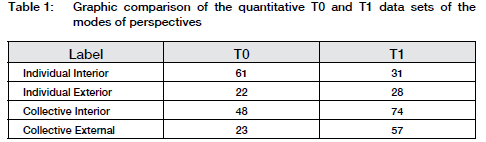
Participants tended to articulate their ecclesiological imagination on the celebration of liturgy after the practices of change within the perspectives of existence, from Individual Interior (II) to predominantly more integral (IE, CI, and CE).
To what degree can the ecclesiological imagination of a liturgy planning group of a Dutch Reformed Church in a diverse and segregated context become more integral and inclusive based on a programme of selected practices of change?
The following is a comparative quantitative representation of the findings within the modes of perspectives.
In conclusion, the findings of this study affirm the primary research question: "How do selected practices of change influence the ecclesiological imagination, particularly regarding identity, inclusivity, and the presence of God, within the liturgy of a Christian church in a diverse and segregated society?", demonstrating that the practices of change significantly enhanced the ecclesiological imagination of participants in the liturgical practices of the Durbanville congregation.
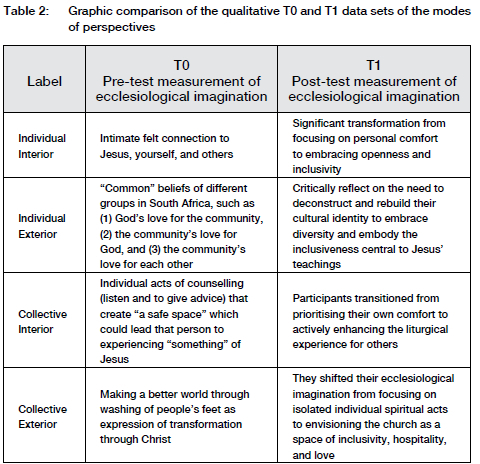
The expectations of a more integral ecclesiological imagination were met, as evidenced by both a qualitative shift toward encompassing all four perspectives and a qualitative shift in the depth and complexity of content within each perspective. The following is a comparative qualitative representation of the findings within the modes of perspectives.
The comparative analysis of the pre- and post-practices of change data sets reveals a clear migration from narrow, individualistic, and interior perspectives to a more balanced, collective, and action-oriented imagination. This shift reflects a holistic transformation, where participants not only redefined their understanding of liturgical identity, but also began embodying inclusive practices that align with the eschatological vision of God's new world. The results underscore the transformative potential of intentional interventions in fostering an integral ecclesiological imagination that challenges exclusivity and nurtures inclusivity.
Comparing the findings, it is clear to see that the intervention assisted the participants in viewing their ecclesiological imagination of liturgy as more integral across the perspectives of existence. The difference between the pre- and post-intervention data sets further confirms the above-mentioned finding that a clear migration has taken place on the integral map, not only from the individual to the collective, but also from interior to exterior.
8. CONCLUDING DISCUSSION
This study sought to address the following central research question: To what extent can the ecclesiological imagination of participants in the liturgical practices of Durbanville congregation be said to shift toward a more integral imagination of the church, rooted in the basileia tou theou? Using Wilber's Integral Theory as a guiding framework, this research explores the dominance of less integral imaginations shaped by enclave-based social realities and the constraints of whiteness.
The findings indicate that, through the practices of change, participants demonstrated significant shifts across Wilber's perspectives, moving from individualistic and internalised imaginations to more holistic, collective, and action-oriented perspectives. This transformation reveals that, when liturgical practices explicitly engage with God's future vision for humanity, as articulated in the basileia tou theou, they foster an ecclesiological imagination that transcends exclusivity and embraces inclusivity.
These insights underscore the potential for liturgy to function as a transformative space where participants not only reflect but also embody the eschatological hope of God's new world. The research emphasises the necessity of balancing all four perspectives of existence (interior/ exterior and individual/collective) in shaping an ecclesiology that resists enclave mentalities and cultivates integral visions of the church's identity and mission.
Beyond the immediate findings, this study opens avenues for deeper reflection on the broader implications of reimagining the church's identity and purpose in divided sociocultural contexts:
8.1 Reimagining the church: Markers of change
The results suggest that reimagining the church requires intentional practices that challenge entrenched narratives of exclusivity and whiteness while actively promoting inclusivity and justice. The basileia tou theou offers a powerful metaphor for envisioning a church that not only reflects God's new world, but also actively participates in its realisation. Markers of this change include shifts in personal reflection (individual interior), communal engagement (collective interior), embodied actions (individual exterior), and systemic reforms (collective exterior).
8.2
Intergenerational implicationsWhile this study focused on young participants, who may already be more exposed to racially diverse social contexts, questions arise about how these practices might work across different generations. Older generations may require different approaches or additional scaffolding to overcome deeply ingrained ecclesiological imaginations rooted in apartheid-era divisions. Future research could explore which elements of the practices of change are most effective in engaging these groups and how they might need to be adapted for intergenerational application.
8.3
Expanding beyond liturgy: Broader ecclesiological functionsDrawing on Van der Ven's functional ecclesiology, the findings suggest that the integral shifts observed in liturgical practices could inform other aspects of the church's mission and identity. Functions such as church governance, pastoral care, and community outreach could similarly benefit from the application of Wilber's framework. For example, governance might integrate the four perspectives to balance internal cohesion with external adaption, while outreach programmes could embody the inclusive vision of the basileia tou theou in practical and systemic ways.
This study posits that the ecclesiological imagination, grounded in the multi-dimensional vision of the basileia tou theou, possesses the capacity to transform liturgical practices, thereby reimagining the church as an inclusive and integral community. While the study's primary focus was on a specific context, its findings suggest broader applicability to other churches grappling with the legacies of exclusion and the challenges of embodying God's ultimate communal future. Future research could explore how these insights can be scaled and adapted to other institutional and cultural settings, furthering the church's mission as a sign and foretaste of the basileia tou theou.
BIBLIOGRAPHY
- Bevans, S.B. & Schroeder, R.P. 2004. Constants in context: A theology of mission for today. Maryknoll, NY: Orbis Books.
-
Forster, D.A. 2017. The (im)possibility of forgiveness? An empirical intercultural Bible reading of Matthew 18:15-35. Stellenbosch: SUN Media. https://doi.org/10.2307/j.ctvlnzfwnk
» https://doi.org/10.2307/j.ctvlnzfwnk -
Hermans, C.A.M. 2024. Towards an agency-oriented model of congregational vitality: How (not) to transform congregational vitality South Africa. Acta Theologica Supplementum 38:35-52. https://doi.org/10.38140/at.vi.8757
» https://doi.org/10.38140/at.vi.8757 - Parsons, T. 1951. The social system. Glencoe: Free Press.
- Pettigrew, T.F. & Tropp, L.R. 2011. When groups meet: The dynamics of intergroup contact. New York, NY: Psychology Press.
- Ritzer, G. 2011. Sociological theory. Eighth edition. New York: McGraw-Hill.
- Schoeman, W.J. 2002. A practical theological basis for congregational analysis. Unpublished doctoral dissertation. Bloemfontein: University of the Free State.
-
Snyder, H. 1993. Models of the kingdom: Sorting out the practical meaning of God's reign. Transformation 10(1):1-6. https://doi.org/10.1177/026537889301000101
» https://doi.org/10.1177/026537889301000101 - Van der ven, J.A. 1993. Practical theology: An empirical approach. Leuven: Peeters.
- Van der ven, J.A. 1998. Ecclesiology in context. Grand Rapids, MI: Wm B. Eerdmans.
- Van der Westhuizen, C. 2017. Sitting pretty: White Afrikaans women in post-apartheid South Africa. Pietermaritzburg: University of KwaZulu-Natal Press.
- Van Wyngaard, C. 2019. In search of repair: Critical White responses to whiteness as a theological problem - A South African contribution. Unpublished doctoral dissertation. Pretoria: University of South Africa and Vrije Universiteit, The Netherlands.
- Ward, G. 2018. Unimaginable: What we imagine and what we can't. London: IB Tauris.
Date accepted: 5 September 2025
Date published: 20 November 2025