
 Equivalent terminology in the late Chagatai Turkish (Eastern Turki) translation of the Gospel of Luke
Abstract
Many texts written in Eastern Turki, the short-lived successor to Chagatai (ISO 639-3 code CHG) used in East Turkistan from the late 19th to the mid-20th century, have survived thanks to Western, particuiariy Swedish, missionaries. The Swedish Mission, active in Kashgar, Yarkent, and Altishahr played a major role in producing and preserving these texts. Their 50-year effort to translate the Bible into Eastern Turki culminated in the 1922 Gospel of Luke (Incil-i Luqa/Lucas Evangelium), prepared by David Gustafsson and Oskar Hermansson in Kashgar. This article analyses the equivalence of religious terminology in this translation and compares it with the Greek and Hebrew originals. Particular attention is paid to the translators' use of Islamic or "Muslim-friendly" terminology - an issue that remains highly relevant to modern Bible translation debates. The findings show that adopting culturally familiar expressions enhanced both the comprehensibility and acceptability of the text among East Turkistani readers.
Gospel of Luke; Eastern Turkey; Equivalence; Islamic terminology
1. INTRODUCTION
Distinguishing "cultural" language1 from "personal" language,2 Newmark emphasised that there is generally no issue with translating words from personal language. However, in cultural language, the cultures of both the source and the target texts (and readers) must overlap so as not to encounter any problems while translating culturally significant words. Furthermore, it is essential to consider the educational status of the reader (Newmark 1988:93, 102). The elements of importance in a translation process have varied throughout history. Since the emergence of nation states,3 and especially in the 19th and 20th centuries when national and cultural identities were being built, national and cultural images have influenced choices in translation. In the creation process of nation states and related national identities in the 19thand 20th centuries, it was inevitably important that national histories, national literatures, and national characters be created. The emergence of national writings, languages, and canons has occurred through translation, with implicit or explicit translation policies, and with the unrecognised role that translation has played in these areas (Doorslaer 2012:122).
Translating religious texts has been a key element in spreading sacred messages throughout history. Using these translations to teach new converts the fundamentals of a religion or to reflect the beauty of faith and morals in the world can be given as examples. Language, as a powerful tool for missionary goals, must align with the faith accurately and robustly to the greatest extent possible (Elewa 2014:25). There is a strong grammatical identity to prayers, rituals, and other public or private religious ritual forms. An apparent lexical identity pervades the entirety of religious texts, constituting a rather distinctive discourse identity (Crystal 1995:371). Although this similarity of religious texts might seem to make them easy for the translator, there are many significant translation issues such as metaphors consisting of single words or multiple words, idioms, proverbs, or other sentences when these texts are to be translated (Newmark 1988:103). Furthermore, the nature of the language (terms, phrases, sentences, and so on) used in religious texts, which are believed to be divine, increases the importance attached to the translation of a text.
Such translation works gained momentum as the need for new translations of the Bible increased in the 20th century. As more ancient scripts were found, Greek papyri were discovered, and knowledge of classical languages increased, these translations were increasingly encouraged. It is known that the New Testament was written in a simple and plain style to meet the needs of ordinary people. To convey the real message, such texts had to be translated into non-literary, modern colloquial English that would satisfy the needs of those who did not know the language of traditional or scholarly English texts (Naudé 2005:72). However, religious languages have distinctive technical terminology such as "incarnate", "grace", "redemption", and "purgatory". Furthermore, some language elements are unique to the language of religion, including phrases such as "works of supererogation", formulas such as "world without end" and "this day and always",4 as well as figurative phrases such as "the lamb of God" (Brook 1981:136). The use of such language creates serious challenges for those translating religious texts.
The translation of sacred texts constitutes a crucial area of inquiry within the broader philosophy of language and culture. Rather than a mechanical act of linguistic transfer, translation operates as a semiotic transformation of meaning - a process whereby one system of signs is reinterpreted and reconstituted with another (Jakobson 1959). When sacred texts are involved, this interpretive process assumes a deeper ethical and theological dimension, for the signs in question mediate not only language but also faith, ritual, and collective memory. As Eco (2004) observes, every translation is an act of negotiation between fidelity and reinterpretation, a space where equivalence is always provisional and culturally situated. Consequently, the faithful and meaningful translation of sacred texts transcends linguistic accuracy to become a religious, social, and cultural obligation. From this standpoint, translators must engage with the subtle interplay of language, theology, and culture, acknowledging that each act of translation both preserves and transforms the sacred within a new semiotic horizon.
2. TRANSLATION OF THE BIBLE INTO EASTERN TURKI
In addition to the Chinese and Russians who influenced East Turkistan politically and commercially in the 19th century, European travellers, traders, and missionaries were also interested in the region. The first work by Swedish missionaries5 coming from Europe to East Turkistan began in 1894, with the establishment of Svenska Missionsförbundet in Kashgar. Svenska Missionsförbundet, or the Swedish Mission Covenant, produced significant results with its systematic activities throughout East Turkistan, following its establishment in Yarkent in 1897 and Yengi-Hisar in 1912.6 According to their own statement, the objective of the Swedish Mission was to engage in missionary activities, preach, and distribute sacred texts and brochures. However, the organisation is also known for the education they provided in the girls' and boys' schools that they opened in many cities of East Turkistan (Erbay 2023:470-1; Hultvall 1981).
Until 1919, news about foreign missions dominated the magazine of the Swedish Mission, published in Sweden. At the time, the magazine provided information as the "Illustrated Magazine for the Swedish Missionary Association's Foreign Mission" (Illustrerad tidning for Svenska Missionsförbundets yttre mission). It is interesting to see Congo, China, Turkistan, and Russia on the covers of the magazine as mission areas of the Swedish Mission (see Kussak 1982:73). In this period, one of the activities undertaken by the Swedish Mission in Kashgar was the establishment of printing houses to introduce Christianity among the peoples of East Turkistan using Eastern Turki. The first activity planned by the missionaries was to translate the Bible into Eastern Turki in Kashgar and Yarkent, two major cities of East Turkistan (see Pierson 1899:157). Therefore, one of the first books published by this printing house was the Eastern Turki translation of the Gospel of Luke in 19227 (see IncJI-i Luqa/Lucas Evangelium 1922).
The translation of the Bible into Eastern Turki had already begun at the end of the 19th century. Johannes Avetaranian,8 one of the first missionaries in East Turkistan, translated some chapters of the Bible into Eastern Turki in 1898.
However, those translations were far from accurate. Even though Swedish missionaries Lars Erik Högberg and Gustaf Raquette, in close association with Johannes Avetaranian, tried to edit the translations by Avetaranian, they did not succeed. In 1914, the translation by Avetaranian was published and prepared for distribution; however, the Swedish missionaries decided to undertake a new translation. Oskar Andersson, who left East Turkistan in 1915, started his Bible translation chapter by chapter, and Gustaf Raquette continued that translation process. Due to later turmoil in the region, however, these translations did not survive to the present day (see Hultvall 1981).
There were no developments in this field until 1922, when the Eastern Turki translation of the Gospel of Luke was published in Kashgar by David Gustafsson and Oskar Hermansson (see IL 1922). At the beginning of the 1930s, the idea of republishing the entire Bible, but the New Testament first, emerged. However, the publishing process was completed in Cairo in 1939 after the Swedish Mission in East Turkistan ended its operations, due to political developments there. The translation of the Old and the New Testaments as a whole (Kitãb-i Muqaddas) was published in 1950 in Cairo (see Hultvall 1981). On the first page of this translation, published by the British and Foreign Bible Society, a note states that it is a translation of the Bible, originally written in Hebrew and Greek, into the East Turki Kashgari dialect: asli Ibrani ve Junani tilidin Kasyar Sarq-ï Türkistãn tiliya tärcämä qïlïndï (Kitãb-i Muqaddas 1950). Considering the historical context of Bible translation into Eastern Turki, although the 1922 Gospel of Luke does not explicitly specify its source, it can be reasonably inferred that the Greek original functioned as the principal source text for the translation.
3. EQUIVALENTS
An equivalent is a translator's choice of word that is already present in the target culture, the meaning of which overlaps with the context of the target text. This choice helps the translator overcome many challenges in the translation process. Since the goal is to convey meaning and feeling, especially in translations of religious texts, the terms chosen from the target culture preserve the effect of the text and ensure the translation's acceptability. In opposite cases, readers may struggle to understand the text and resistance to the translation might occur.
The notion of equivalence in translation has been widely discussed in translation theory. According to Catford (1965:20), translation theory is concerned with "a certain type of relation between languages" and, therefore, constitutes a branch of comparative linguistics. From this perspective, the synchronic or diachronic distinction between languages is irrelevant; translation equivalences can be established between any pair of languages, whether related or unrelated. However, while linguistic relations are often bidirectional, translation itself is unidirectional. It always proceeds from a source language to a target language.
In this sense, equivalence in a translation means that the source text and the target text share the same values in certain respects. Those values might be related to the style, the message, or the function of the text. Equivalence does not dictate what type of value should be equivalent in all instances; it only indicates that equal value can be achieved on some level (Pym 2007:3). As Naudé (2000:4) observes, translation equivalence should also be viewed within a broader sociocultural and functional framework, since the meaning and acceptability of a translated text depend not only on linguistic correspondence, but also on the norms and expectations of the target culture.
Translations of the Bible have faced issues that differ from those noted in other types of translations. These include the relative distance of the time period in which the Bible was produced, the cultural differences between that period and ours, translators' tendencies to separate chapters and verses arbitrarily, and the predominating significance of theological ideas over the original message (Nida 1964:5).
Nida further distinguishes between formal and dynamic equivalence as two basic orientations in translating. While formal equivalence aims to preserve the form and content of the source text as closely as possible, dynamic equivalence seeks to reproduce the same effect on the target audience that the original text had on its first readers. This dynamic approach prioritises naturalness and communicative clarity, allowing the translation to resonate meaningfully within the cultural and linguistic framework of the target audience (Nida 1964:159-160).
3.1 Equivalent terminology in the Eastern Turki translation of the Gospel of Luke
When the first Eastern Turki9 translation of the Bible prepared by Johannes Avetaranian in 1909 was evaluated by P.P. Waldenstrom, it was found to be full of errors. Major mistakes such as Avetaranian's translation of the phrase "Your God" as the plural "Your Gods" proved unacceptable among monotheist Muslim Uyghurs, who were the target audience (see Hultvall 1981). Thus, the first translations into Eastern Turki were far from utilising a proper translation technique. This changed with the translations and religious texts of Swedish missionaries10 after Avetaranian's work (see Erbay et al. 2025). The translation of the Gospel of Luke issued for Muslim Uyghurs in 1922 was published after a 20-year translation process. Words with equivalents in the reader's mind were preferred to make the translation more comprehensible and acceptable to the target audience.
3.2 Methods
The style and meaning of the equivalent terms used in the Gospel of Luke in the Greek Bible and the words chosen for those terms in the target language in the text's translation into Eastern Turki by Gustafsson and Hermansson11(IL 1922) are provided in this section. The English equivalents, the spelling/ transcription/meaning in the Greek Bible, and the transcription and meaning used in incil-i Luqa for the selected terms (Sabbath, lawful, tenth, Pesach, Passover, the deep, temple, upper room, publican, lawyers, law, chief priest, scribes, offer, captains) are provided. In the tables of sentences, given as examples of the terms, the first line (in italics) is the transcription of the Arabic alphabet used in incil-i Luqa into Latin letters. The pages and verse numbers in inciI-i Luqa are provided (e.g. IL 21, 4:16: page 21 of incil-i Luqa, verse 4:16). The last line is the translation provided in The 21st century King James Version of the Holy Bible (1994), selected due to its widespread use among English Bible translations.
3.3 Sabbath - Greek σαββάτων (sabbatön), "the Sabbath" > Sanbih, "Day, Saturday" / Sabat and Preparation Day - παρασκευής (paraskeuës), "the Preparation" > Tajjarlïq küni, "Day of Preparation"
The concept of the Sabbath, an important day for both Jews and Christians, was conveyed with different words in Incil-i Luqa. In Luke 4:16, the word Sabat is used for this concept as follows:
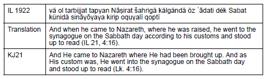
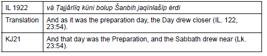
In Incil-i Luqa, in addition to the word Sabat for the concept of Sabbath, the Persian word Sanbih, meaning "day, Saturday", was also used. This is associated with the fact that the word "Sabbath" represented both Friday and Saturday. Moreover, to convey the concept of the day of preparation before the Sabbath ("preparation day" or "parasceve"), the term Tajjarlïq küni, meaning "preparation day", was used:
3.4 Lawful - εξεστιν (exestin), "Lawful" > ca'iz, "What is not prohibited by religion"
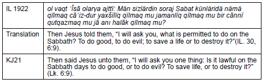
Another example of an established equivalent of the terminology used in the Bible is the Arabic word ca'iz, meaning "What is not forbidden but permitted because there is no prohibition by religion". This meaning, which is generally used as permitted and lawful in English translations of the Bible, was translated into Eastern Turki with the term ca'iz, which is the same or close to the meaning in Islam.
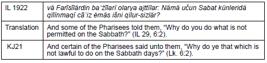
For the opposite case, the term caiz émas, or "prohibited" was used as not permitted or not lawful:
3.5 Tenth/Tithe - άποδεκατοΰτε (apodekatoute), "For you pay tithe" >'usr bar-, "Giving a tenth of a share of something to someone"
In Islamic law, usr(< Arabic ushr عشر), a type of tax imposed on land products or certain other earnings, is derived from the Arabic number ten, meaning "one-tenth". The term usr, which was known to the Uyghurs living in East Turkistan, was used as an equivalent of the term "tenth/tithe" as used in the Bible:
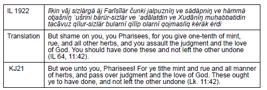
3.6 Pesach - έορτn (heortë), "the Feast" > Fasih and Passover - πάσχα (pascha), "the Passover^' > Fattir "Ramadan"
Passover is a day deemed holy by both Jews and Christians (see Leonhard 2006). In Incil-i Luqa, the word Fatir, derived from the word fitr (< Arabic fitr for the holiday celebrated according to the Hijri calendar by Muslims after fasting in Ramadan, was used as an equivalent of Passover. The same verse also contains FasJh, the Arabic spelling of the word Pesach:
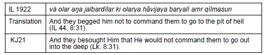
3.7 The Deep - αβυσσον (abysson), "the Abyss" > hãvija, "Hell, the Pit of Hell"
The phrase "the deep" from the Gospel of Luke (8:31) was translated in Incil-i Luqa as فطر, hãwiyat, which is a loanword from Arabic used in Eastern Turki. This term, which means "Hell, to which the damned are consigned" (see Catafago 1858:310) in the Islamic belief system, can be easily understood by the reader of the target language. The translators' choice of hãvija ("Hell, the Pit of Hell") as an equivalent to the άβυσσον (abysson), "the abyss", in the Greek Bible, can be explained with the concept of functional equivalence (see Nida 1964):
3.8 The Temple - ίερώ (hiero), "the Temple" > bajt, "Temple"
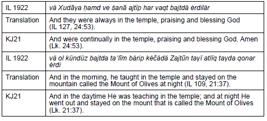
In addition to the Turkic word öj, "house", used in Eastern Turki, the Arabic bajt, meaning "house", was also known to society in East Turkistan. While these two words have the same meaning in East Turki, the Turkic öj was used as "house/home" and the Arabic bajt was used as "the temple":
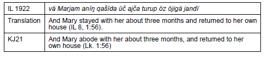
In this way, the translators added an equivalent meaning to another word, bajt (< Arabic bayt بيت), because the Greek word ΐερω (hiero), "the temple", did not have an equivalent in Eastern Turki:
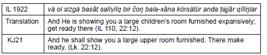
3.9 Upper Room - άνάγαιον (anagaion), "upper room" > bala-xãna, "Small Room"
This term, which is usually used to mean "upper room", "upstairs room", or "dining room" in the English translations of the Gospel of Luke, is translated as bala-xãna, "small room", in Eastern Turki for IncTl-i Luqa. It is safe to say that the cultural structure of the Uyghurs influenced the choice of this word for the translation. At the time of the translation, the attic room commonly used by the Uyghurs living in East Turkistan was known as "bala-khana", due to its smaller size compared to other rooms. Therefore, it is understood that the translators translated the source text by considering word choices such as this that would help society understand the text better. This choice of the translators can again be explained by the concept of cultural equivalents (see Baker 2018):
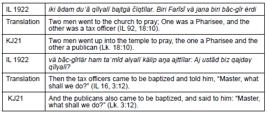
3.10 Publican - τελώνης (telones), "Tax Collector" > bãc-gir, "Tax Officer"
The word τελώνης (telones), meaning "a tax collector" and used in verses 3:12 and 18:10 in the Greek Gospel of Luke, was translated as bãc-gTr, meaning "tax officer" in Eastern Turki. Although the lexical meaning of the word bãc-gTr, consisting of the Persian word bãc, meaning "tax <باج", and the word gir, meaning "holder, retainer, collector < گرفتن giriften", is "tax officer, tax collector, collector", it was used as an equivalent to the word publican in the translation. When we consider that the word was used as in τελώνης {telones), "a tax collector", in the Greek Bible, it is evident that the Incil-i Luqa translation was made from the Greek version:
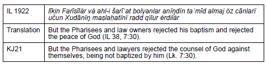
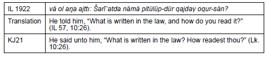
3.11 Lawyers - oi νομικοί (nomikoi), "the Lawyers" > ahl-i sari'at, "A person who abides by the rules of religion" and law - τω νόμω (to nomo), "the law" > Sari'at, "Rules and Laws of God"
Although this term, which is used as οΐ νομικοί {nomikoi), "the lawyers", in the Greek Bible, can be translated into East Turki in many ways; the term's deep meaning is easy to miss. Gustafsson and Hermansson preferred to use an established equivalent for this term: ahl-l sari'at (< Arabic ahl-i shariat اهل شريعت, "A person who abides by the orders of the religion"). The translators' choice increased the comprehensibility and acceptability of the translation:
Similarly, for the word τω νόμω (to nomo), "the law", in the Greek Bible, the Arabic loanword sarT'at (< shariat, "rules and laws of God"), which could be easily understood by the Muslim people of East Turkistan, was used:
3.12 Chief Priest - αρχιερείς (archiereis), "the Chief Priests" > imamlarnïn conlarï, "Religious Leaders" and Scribes - γραμματείς (grammateis), "the Scribes" > kãtiblär, "Writers"
Another example of equivalent terms used in the translation of the Gospel of Luke into Eastern Turki is the translation of the word αρχιερείς (archiereis), meaning "the chief priests" in the Greek Bible, as imamlarnin conlarï (< Arabic imam امام, "religious leader"). The Islamic term imam means "the leader of the Muslims in prayer and religious life". Choosing imam for the translation of verse 22:2 of the Gospel of Luke stands out in terms of its negative connotation in the verse and its known meaning by the Muslim community in association with the religion of Islam. As another example from Luke 22:2, the word γραμματείς (grammateis), "the scribes", was translated as kãtib (< Arabic katib كاتب, "author, writer").
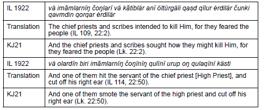
3.13 Offer/an Offering - προσένεγκε (prosenenke), "Offer, Offering, Submission" > qurbãn, "Animal, offering slaughtered to approach God"
The term offer/an offering- - προσένεγκε (prosenenke), meaning "offer, offering, submission", in verse 5:14 of the Gospel of Luke was translated in incil-i Luqa as qurban (<Arabic قربان), which derives from the word qurb (< قرب), meaning "approach, get close to" in Arabic, and means "an animal slaughtered to approach God' in Islamic terminology. As an equivalent of this word, the term קָרַַָב (qarab), meaning "to come near, approach, bring near", was used in the Hebrew Bible. The translators of incil-i Luqa preferred qurban, which is the Arabic sound-altered form of the original Hebrew word קָרַַָב (qarab) and has a place in Islamic terminology:
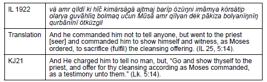
3.14 Captains - στρατηγοϊς (stratëgois), "Officers" > pãsbãn, "Watcher, Guard"
As an equivalent to the term στρατηγοΐς (stratëgois), "officers", as used in verse 22:4 of the Greek Gospel of Luke, the word pãsbãn (<Persian pãs-bãn پاسبان, "guard") was used in the Eastern Turki translation:
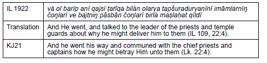
4. CONCLUSION
The process of translating the Bible into Eastern Turki started at the end of the 19th century and continued for over fifty years until it was published in 1950. The Bible was published in Cairo with the title Kitãb-i Muqaddas in 1950 after different missionaries had translated the text chapter by chapter and various other people had evaluated those translations. This article has examined the equivalent terms used in the Gospel of Luke as translated into Eastern Turki (IncJI-i Luqa/Lucas Evangelium 1922) by Swedish missionaries Gustafsson and Hermansson as part of the process leading to the full translation of Kitãb-i Muqaddas.
1. The source language was not specified in Incil-i Luqa (1922). However, considering the words analysed in this article, the source texts of that translation, as also stated in the Kitãb-i Muqaddas as published in Cairo in 1950, were the Greek and Hebrew Bibles. Therefore, comparisons in future studies should be based on Greek and Hebrew Bible translations, not Bibles translated into English and Swedish.
2. The equivalent terms used in the Eastern Turki translation of the Gospel of Luke were generally selected from among words known to followers of Islam or from Arabic loanwords that had an equivalent in that religion's terminology (usr, cã'iz, fatir, hãvija, sari'at, qurbãn, imãm, kãtib, and so on). The reason for these choices by Gustafsson and Hermansson must have been the idea that it would be easier to introduce Christianity to the Muslim society of East Turkistan and lead them to accept the translation if the translation contained words and terms they were already acquainted with and actively used rather than concepts and words that did not have equivalents in the target language.
3. When the sample verses taken from the Eastern Turki translation of the Gospel of Luke are considered, it is noted that InciI-i Luqa (1922) used rather comprehensible language for the target language reader. It was not language that would challenge readers of the target language or distract from the text.
4. Considering the society of East Turkistan at the beginning of the 20thcentury, the Persian loanwords used in the translation are words that the reader could have comprehended and used at the time (pãs-bãn, bãc-gir, and so on). The Eastern Turki language, which was the successor of the Chagatai literary tradition, was already using Persian loanwords to a significant extent.
5. Building on Nida's (1964) concept of dynamic equivalence, the translation of the Gospel of Luke into Eastern Turki appears to have been carried out with an emphasis on communicative clarity and cultural accessibility rather than strict formal correspondence. The translators aimed to make the text meaningful to local readers by adapting linguistic expressions and stylistic elements to the norms of Eastern Turki. This approach is a deliberate effort to balance fidelity to the source text with functional clarity, reflecting both theological sensitivity and cultural adaptation. Moreover, it can be viewed as a response to the sociolinguistic conditions of late 19th- and early 20th-century East Turkistan, where varying literacy levels, oral traditions, and the pervasive influence of Islamic terminology required a dynamic and contextually responsive translation strategy.
BIBLIOGRAPHY
- Avetaranian, J. 2002. A Muslim who became a Christian / The story of John Avetaranian (born Muhammed Shükri Efendi). Compiled after his death by Richard Schäfer and translated by John Bechard. England/Hertfort: Authors OnLine.
-
Baker, M. 2018. In other words: A coursebook on translation. London: Routledge. https://doi.org/10.4324/9781315619187
» https://doi.org/10.4324/9781315619187 -
Brook, G.L. 1981. Words in everyday life. St Antony's. London: Palgrave Macmillan. https://doi.org/10.1007/978-1-349-06817-3
» https://doi.org/10.1007/978-1-349-06817-3 - Catafago, J. 1858. English and Arabic dictionary in two parts, Arabic and English, and English and Arabic. London: Bernard Quaritch.
- Catford, J.C. 1965. A linguistic theory of translation. Oxford: Oxford University Press.
- Crystal, D. 1995. The Cambridge encyclopaedia of the English language. Cambridge: Cambridge University Press.
-
Doorslaer, L. 2012. Natural and cultural images. In: Y. Gambier & L. Doorslaer (eds), Handbook of translation studies (Amsterdam/Philadelphia: John Benjamins Publishing), pp. 122-127. https://doi.org/10.1075/hts.3.nat2
» https://doi.org/10.1075/hts.3.nat2 - Eco, U. 2004. Mouse or rat? Translation as negotiation. London: Phoenix.
-
Elewa, A. 2014. Features of translating religious texts. Journal of Translation 10(1):25-33. https://doi.org/10.54395/jot-j2ccn
» https://doi.org/10.54395/jot-j2ccn -
Erbay, F. 2023. Two stories written in Eastern Turki as part of the Swedish missionary work (Svenska Missionsförbundet) in East Turkistan. Acta Orientalia Academiae Scientiarum Hungaricae 76(3):469-486. https://doi.org/10.1556/062.2023.00331
» https://doi.org/10.1556/062.2023.00331 -
Erbay, F., Dogan, E. & Karavelioglu, M.A. 2025. Use of 20th century terminological language in their missionary work: The case of the Eastern Turki. Trames A Journal of the Humanities and Social Sciences 29(74):79-104. https://doi.org/10.3176/tr.2025.1.05
» https://doi.org/10.3176/tr.2025.1.05 - Fairbank, J.K. 1986. The great Chinese revolution, 1800-1985. New York: Harper & Row.
- Hultvall, J. 1981. Mission och revolution i Centralasien: Svenska Missionsförbundets i Östturkestan 1892-1938 (Mission and revolution in Central Asia). Stockholm: Gummessons. IL: Lucas Evangeliüm
- Hultvall, J. 1922. Incil-i Luqa / Lucas Evangelium. Kashgar: Sutiyan Fuyng Tang.
- Ínayet, A. 2012. Dogu Türkistan'da Ceditçilik hareketi ve bu hareketin önemli temsilcileri (The Jadidist movement in Eastern Turkistan and its prominent representatives). Düsünce Dünyasinda Türkiz 3(17):199-214.
-
Jakobson, R. 1959. On linguistic aspects of translation. In: R.A. Brower (ed.), On translation (Cambridge, MA: Harvard University Press), pp. 232-239. https://doi.org/10.4159/harvard.9780674731615.c18
» https://doi.org/10.4159/harvard.9780674731615.c18 -
Jarlert, A. & Tammela, J. 2023. Church history ofthe Swedish realm, 1520-1809. In: M. Kuha & P. Karonen (eds), Swedish and Finnish historiographies of the Swedish realm, c. 1520-1809 (London-New York: Routledge), pp. 98-118. https://doi.org/10.4324/9781003219255-8
» https://doi.org/10.4324/9781003219255-8 - Kitãb-I Muqaddas 1950. Qãhira [Cairo]: Biritis Farajn Bajbil Sosajiti [British and Foreign Bible Society].
-
KJ21: Biblegateway 1994. The 21st century King James version of the Holy Bible. [Online.] Retrieved from: https://www.biblegateway.com [10 February 2025].
» https://www.biblegateway.com - Küssak, A. 1982. Författaren som predikant Ett frikyrkosamfunds litterara verksamhet 1910-1939 (The writer as preacher. The literature of an evangelical denomination in Sweden 191019-39). Stockholm: Gummessons.
-
Leonhard, C. 2006. The Jewish Pesach and the origins of the Christian easter. Berlin: De Gruyter. https://doi.org/10.1515/9783110927818
» https://doi.org/10.1515/9783110927818 - Lord, A.B. 1971. The singer of tales. New York: Harvard University Press.
- Naudé, J.A. 2000. Translation studies and Bible translation. Acta Theologica 20(1):1-27.
-
Naudé, J.A. 2005. Twentieth-century English Bible translations. Acta Theologica 25(2):70-89. https://doi.org/10.4314/actat.v25i2.49018
» https://doi.org/10.4314/actat.v25i2.49018 - Newmark, P. 1988. A textbook of translation. London: Shanghai Foreign Language Education Press.
-
Nida, E.A. 1964. Toward a science of translating. Leiden: Brill. https://doi.org/10.1163/9789004495746
» https://doi.org/10.1163/9789004495746 - Pierson, A.T. (Ed.) 1899. The missionary review of the world. Volume XII. New York-London: Funk & Wagnalls Company.
-
Pym, A. 2007. Natural and directional equivalence in theories of translation. Target 19(2):271-294. https://doi.org/10.1075/target.19.2.07pym
» https://doi.org/10.1075/target.19.2.07pym - Teng, S. & Fairbank, J.K. 1963. China's response to the West: A documentary survey, 1839-1923. New York: Atheneum.
- Topal, E. 2023. Incil-i Luka Giris-Metin-Sözlük-Dizin (Gospel of Luke Introduction-Text-Dictionary-Index). Ankara: Sonçag Akademi.
Date accepted: 6 November 2025
Date published: 12 December 2025
2 Denotes an individual's distinctive mode of linguistic expression (e.g. you're weaving, he's a monologger). This form of language reflects personal rather than social usage and typically resists straightforward translation, due to its idiosyncratic nature (Newmark 1988:93).
3 With the emergence of nation states, translation has come to function as an ideological instrument in the formation and evolution of national identities, languages, and literary traditions.
4 For extensive information on the term "formula" as used in this context, see Lord (1971:31).
5 Missionaries were a part of the Swedish Evangelical Free Church from the Radical Pietist tradition based on Nyevangelism or "new Evangelism", established in 1878. For the church's history until the beginning of the 19 century, see Jarlert and Tammela (2023).
6 Considering the missionary letters sent from East Turkistan to Sweden in 1919, it is safe to say that the Swedish Mission was active in East Turkistan at that time (Kussak 1982:84).
7 The first publication on the Gospel of Luke as translated into Eastern Turki was that of Erol Topal (2023). However, due to shortcomings such as the lack of a review chapter, mistakes in the transcription of a manuscript written in Arabic letters into Latin letters, and a failure to include all words in the glossary or explain the meanings of words in the index, we did not benefit from Topal's work.
8 Johannes Avetaranian, previously Muhammad Shükri Efendi, was born in Erzurum in the Ottoman Empire in 1861 and was believed to be a sayyid, or a descendant of the Islamic prophet Muhammad. He served as a mullah, or religious scholar, in that region until 1885, when he was baptised and converted to Christianity in Tbilisi, then under Russian control. He subsequently met Swedish missionaries during his journeys as a traveller and missionary and came to lead the activities of the Swedish Mission in East Turkistan. For his detailed biography, see Avetaranian (2002).
9 At the beginning of the 20 century, the written language used in Eastern Turkistan represented the final stage of Chagatai - a literary medium that had served as the principal vehicle of written expression across Central Asia for nearly five centuries. This later phase, known as Eastern Turki, emerged through the incorporation of lexical and morphological elements from local Eastern Turkistan dialects. As in classical Chagatai, the Arabic script continued to be used. Although this written form (Eastern Turki) appears, in its orthographic and structural features, to be a continuation of the Chagatai literary language, it in fact constitutes a transitional stage between the historical Chagatai and the emerging modern Turkic written languages such as Modern Uyghur and Uzbek, due to the increasing influence of spoken dialectal features on the written form. The Swedish Mission employed this written variety - familiar to the literate community of Eastern Turkistan - both in the school it established in Kashgar and in the printing press it operated there. For details on the schools established by the Swedish Mission in Eastern Turkistan and the number of students, see Erbay (2023:470-471).
10 In the 19 century in China, and later toward the end of the same century in the region of Eastern Turkistan, schools established by Christian missionaries made significant contributions to the educational development of local communities (Fairbank 1986:67, 134; Teng & Fairbank 1963:134-135). Although there are no comprehensive studies based on reliable data concerning literacy levels in the region during this period, it is reasonable to assume, given the social conditions of the time and the predominance of rural life, that literacy was relatively low. Beginning in the mid-19 century, however, the establishment of Usul-i Jadid (Jadidist) schools in several cities of Eastern Turkistan, particularly in Kashgar, also contributed to the gradual increase in literacy rates through instruction in Eastern Turki (inayet 2012).
11 The translation of the Gospel of Luke into Late Chagatai Turkish was published in 1922 under the title InciI-i Luqa /Lucas Evangelium at the Sutiyan Fuyng Tang Printing House in Kashgar. It was printed in Arabic script and reflects the linguistic features of the final stage of Chagatai Turkish, also referred to as "Eastern Turki".
