
 Translating the Psalms: Considering target language orality strategies
Abstract
Can biblical poetry be rendered into a poetic style that suits the culture of the target language, using its oral strategies? Many translations of biblical poetry are produced without considering the poetic system of the intended audience. This article proposes that translating biblical poetry into the language's poetic style would enhance orality and resonate more deeply with the target audience. It explores the implications of oral versus written traditions in biblical performance, performance and translation theory, and the similarities and differences between the source and target contexts in translating the psalms into Rigwe, a language of central Nigeria. It further gives practical examples of the translation of Psalm 103. The goal is to maintain the poetic power of the incipient text in the subsequent product, enriched with the target community's traditional means of expressing similar or near-similar genres for performance.
Psalms; Psalm 103; African traditional praise songs; Rigwe language (Nigeria)
1. INTRODUCTION
This article draws ideas from ancient Rigwe songs for translating the Psalms, considering the artistic performance of the target community. It also identifies the similarity and alterity of the source and target systems with practical examples of how biblical poetry can be translated into Rigwe, a Plateau language spoken in Central Nigeria.
Since the institutionalisation of dynamic equivalence in the works of Nida (1964) and the subsequent Theory and practice of translation (Nida & Taber 1982 [1969]), "meaning" has been emphasised (see also Barnwell (2020 [1986]). Translators trained to translate biblical poetry with the meaning-based approach focus on reproducing the meaning of the source text, often without corresponding poetic styles in the target language. While scholars emphasise the study of culture and discourse analysis of various genres in target languages, including poetry, a systematic study of the poetic structures of many languages is yet to be carried out. Since the emphasis has been on conveying the meaning, some translations of biblical poetry are made in prose, or prose but formatted like poetry, without considering the oral literary norms of the target cultures.
This article proposes a translation that draws insights from the poetic and rhetorical structures in the target context for translating the Psalms. The aim is to situate the Psalms in the most natural form in the target context as poetry.2
2. ORAL-WRITTEN DIVIDE IN BIBLICAL PERFORMANCE
Until recently, the discussion on the similarity and dissimilarity between the contexts of the biblical texts, like other literate cultures, on the one hand, and most of the African cultures, on the other, has been the distinction between literacy and orality. Ong's (2002 [1982]) Orality and literacy deals with the divide between orality and literacy, and it is cited as the proponent of the "Great Divide" (Maxey 2009; Perry 2019).3 This distinction between orality and literacy is regarded as a technological divide that affects people's thought processes and social organisation (Maxey 2009). Niditch (1996:2) notes how Gunkel, in earlier work, portrayed the Israelite oral culture as naïve, rural, either pastoral or agrarian, living in a world of family-centred societies without kings or bureaucracy, somewhat like African cultures. She argues that "we err if we view oral and written cultures, oral and written literatures, as incompatible", noting that John Foley, Finnegan, and others have proven the relationship between the oral and written in traditional cultures, whether modern or ancient (Niditch 1996:4). The traits of oral immanence in written literature are evident in biblical Scriptures as well as in the literature of other cultures. Scholars have identified recurring features such as repetitions, formulas, epithets, and longer formulas that are characteristic of oral registers (Niditch 1996; Wendland 2013) and that are prevalent oral traditions in literary works. However, these are not proof of oral composition predating the written biblical Scriptures.
While biblical works cannot be proven in any instance to have been orally composed, the written works of the Hebrew Bible evidence traits typically associated with ascertainably orally composed works. They belong somewhere in an 'oral register.' This phrase refers not to modes of composition but to the style of compositions, whether the works were created orally or in writing, whether they are performed or read to oneself (Niditch 1996:10).
Thus, as they explore the media history of the Bible in their article, Makutoane et al. (2015:159) posit that the oral and the written dimensions are intimately connected. Scholars have noted that the recurring oral registers, which are carried onto the written text as in the Hebrew Bible, are not merely mnemonic devices for the oral performers, but also have to do with meaning and stylistic preferences. Repetition unifies the work and reiterates essential messages or themes that the author wishes to emphasise and are important in the larger tradition (Niditch 1996:10-11).
Performance has been a central point in the discussion of orality and literacy.4 Biblical Performance Criticism is a new field of biblical research to "reframe the biblical materials in the context of traditional oral cultures" (Makutoane et al. 2015:4). Perry (2019:2) summarises what he terms "disciplines" of biblical texts in terms of the interaction of "(1) someone speaking; (2) someone hearing; (3) a tradition; and (4) a social situation", as he gives a brief history of Biblical Performance Criticism. These are critical performance factors. The Psalms were meant to be sung or performed during the Israelite worship practices. Someone performed it to an audience in the context of their tradition, and each psalm had a peculiar situation. The performance carries with it the aesthetic beauty of the poetry of its context. The article thus proposes a translation of the Psalms that aims at producing a text with similar poetic, cultural, and aesthetic elements of the oral styles in the target context. The aim would be to enhance oral performance, even though the translation would be published as a written text for the target community that has had a long history of oral traditions.
3. PERFORMANCE AND TRANSLATION
Rhoads (2012) is cited as one who gave new insights for examining the orality of the Old Testament vis-à-vis translating it to a target culture through Biblical Performance Criticism (Makutoane et al. 2015). It emphasises the oral nature and the oral traditions behind the biblical text, which underlie the performance. The translation of and for performance has also been emphasised (Makutoane et al. 2015; Maxey 2009; Perry 2019). The translation of performance entails translating the aesthetic qualities of the oral performance.
[O]riginators of stories and speeches, like musical composers, probably would have composed in their imagination or sounded out what they were composing and later transcribed it. They likely visualized their whole embodied performance - gestures, movements and facial expressions - as they composed ahead of actually performing. The written records (scrolls) served mainly to assist a performer's memory to enable performances to be repeated on new occasions and in other locations, even though it is likely that compositions would also have passed in memory from oral performance to oral performance without the aid of a manuscript. The biblical writings preserved are like the fossil remains of living oral performances (Makutoane et al. 2015:161).
It is also true that traditional African songs, which were composed orally, performed, and passed down through generations, could be transcribed and analysed. The written manuscripts would serve as fossil remnants of the actual oral performance, since the "embodied performance", including dances, gestures, rhythm of drums or working tools, the interjections from onlookers, and facial expressions, has not been transcribed. These elements of artistic performance of the Psalms are not usually included in the written text, nor in the translated text. However, oral performers of the translated psalms, who are not necessarily translators, would add other aspects of the aesthetic beauty associated with poetry in the target context. Therefore, the translation of performance has its limitations, yet the goal would be to translate for performance.
Some psalms provide an instructional guide for performance such as the features indicated in the superscriptions. Bratcher and Reyburn (1991) outline features of the psalm superscriptions. They include information about the authorship of the psalms, the type of composition, musical notations, names of melodies, liturgical use, and historical references. All these hint at aspects of the composition and performance of the Psalms. For example, the term "psalm" itself, which translates מִִזְְמוֹר, means "a song sung to an instrumental accompaniment" (HALOT). Some psalms specify the type of musical instrument(s), for example lamnaṣṣēᵃḥ binḡînôṯ mizmôr ləḏāwīḏ "to the choirmaster, with stringed instruments, a psalm of David" (Ps. 4:1); lamnaṣṣēᵃḥ ʾel-hannəḥîlôṯ mizmôr ləḏāwīḏ "to the choirmaster, to (the tune) of the flutes (ḥalîl),5 a psalm of David" (Ps. 5:1). Craigie (2004:84), citing Mowinckel, notes the association between flutes and laments in the Babylonian psalmody. The meaning of some musical terms in the psalms is uncertain and is often left untranslated, such as maśkîl,6 miḵtām,7 and šiggāyôn (Ps. 7:1).8
The expression lamnaṣṣēᵃḥ "to the choirmaster" in the superscriptions, which appears in fifty-five psalms, probably means that the composition was handed over to a choir director for performance in the Temple (Bratcher & Reyburn 1991). Other terms in the superscriptions, for example ʿal-ʿălāmôṯ (Ps. 46:1) translated "according to alamoth" (NIV) or "to be sung by soprano voices" (NLT),9 or ʿal-haššəmînîṯ (Ps. 6:1; 12:1) translated "upon an eight-stringed lyre" (NAS) or "to be accompanied by an eight-stringed instrument" (NLT), and other terms in the superscriptions, for example ʿal-haggittîṯ, usually translated, "according to the Gittit" (ESV), "according to the gittith style" (NET), "to be accompanied by a stringed-instrument" (NLT), are unclear (musical) terms. These obscure terms and other information in the psalm superscriptions, in addition to oral transmission, provided a guide to performers of the psalms. The specific directions they give for performance are lost, so the exact mode of performance or tune, for example, a psalm to be performed on "an eight-stringed instrument", remains unknown.
The unknown term selāh is regarded as a musical notation and appears within the psalms seventy-one times in thirty-nine psalms (Bratcher & Reyburn 1991). HALOT suggests possible meanings: it is probably derived from the word סלל "raising the voice to a higher pitch"; the LXX translates it διάψαλμα, meaning "interlude of instrumental music or break", or an abbreviation for סִימָן לִשְׁנוֹת הַקּוֹל "sign to change the voice". All these would be written directions to performers of the psalms. Translators may adopt any of these meanings, but the re-composition of the psalms for musical performance might change the stanzaic forms and lengths, providing pauses and refrains at different locations. These make a translation of the original form of performance difficult, except that:
… there are certain generalities …, presented by Bauman as 'keys to performance': special codes, figurative language, parallelism, special paralinguistic features, special formulae, appeal to tradition, disclaimer of performance (Maxey 2009:85).
These "keys to performance" are the extant fossils of oral features in the written text that need to be interpreted and translated. Maxey (2009) notes that, when the "keys" appear, they alert the target community that what follows must be understood as performance, thus moving beyond a direct transfer of information to a poetic use of language that taps into the community's culture and identity. There is room, therefore, for the contemporary translator of the psalms to apply creativity in his local context and orality structures and to then create a localised translation for performance. Maxey suggests that Bauman's insights on performance from ethnopoetics could be adapted to Bible translation. Bauman conceives ethnopoetics as being "performance-centered". In his article "Folklore", Bauman (1992:39) defines ethnopoetics as
centrally concerned with the aesthetic patterning of oral literary forms and the problems of translating and rendering them in print in such a way that the artfulness of their oral performance is not lost.
The article now returns briefly to the aspects of translation theory that are related to this.
4. PERFORMANCE AND TRANSLATION THEORY
Nida and Taber (1982 [1969]:12) conceptualise translation as
[t]ranslating consists in reproducing in the receptor language the closest natural equivalent of the source-language message, first in terms of meaning and secondly in terms of style,
which was called "dynamic equivalence". This summarises their primary priority, "meaning" and secondary priority, "style", which are to be attained in producing "the closest natural equivalence" in the target or receptor language, the text of the source language. Nida and Taber (1982 [1969]:14) argue that a "formal equivalence" in terms of style alone does not amount to equivalence, but that a "functional equivalence" both at the level of content and style is required. While Nida's approach is linguistic-based, Reiss and Vermeer (2014 [1984]) and Nord (2018 [1997]) introduced the notion of "functionalism". The functionalist approach deals with translation as information about an offer of information, in which case the target text is information about an information offered by the source text. Adequacy in this approach is defined based on the purpose (skopos) of the translation (Reiss & Vermeer 2014 [1984]:123-124), and a
translation is adequate if the choice made of target language signs is consistently in line with the requirements of the translation purpose (Reiss & Vermeer 2014 [1984]:127).
Wendland (2006) takes the idea of "functional equivalence" and develops it to "literary-functional equivalence". He applies his principle of literary-functional equivalence to "poeticizing the Psalter in an African language" (Zogbo & Wendland 2020 [2000]). Wendland (2020 [2000]:281) widens his focus, illustrating a "literary-structural" analysis that results in a "literary functional equivalence" (LiFE), and includes a "literary-functional and structural equivalence". He notes that, for a successful outcome, translators must have exceptional linguistic and literary competence in both the source and target languages and literatures, in addition to a good measure of intuitive intercultural conceptual creativity.
An aspect of the theoretical framework of this research is the work of Gutt (2014 [2000]), who suggests a functional-equivalence approach to Bible translation in light of psychological insights from relevance theory. Our interest in Gutt's conceptualisation of translation from relevance theory is the notion of "cognitive environment". According to Gutt, the cognitive environment comprises a huge amount of very varied information, including information that can be perceived in the physical environment or retrieved from memory, and might include those from preceding utterances. Marais' (2014; 2019) conceptualisation of translation from the theory of complexity and emergent semiotics goes beyond "utterances". The environment encompasses a variety of complex factors within the geographical, physical, ecological, biological, cultural, and even religious systems through which meaning emerges. Cognition is shaped by the complexity of adaptive systems in the environment that play a role in emergent semiotics.
The biblical text is thus understood as a link to understanding the translational phenomena in the environment in which it was produced, considering the complex adaptive systems that shape meaning-making and meaning-taking, and then endeavour to find corresponding complex adaptive systems that shape meaning, or through which meaning emerges, in the target environment. Since the factors and systems in the source environment may be different from those in the target environment, the same idea or meaning may be shaped using different translational phenomena expressed using the systems of the target environment. The alterity between biblical poetry and target community poetry would be the expression of the dissimilar poetic structures and unique systems in both environments.
A translation for performance would then be made from understanding the "keys to performance" in the incipient environment, as well as those in the subsequent environment, which can be reduced to text, but the text itself serves as a link to a body of meaning in the environment. Performers of the poetry in the target language who have knowledge of their community systems will find the translated poetry performable, because it consists of elements that can be performed in their culture.
Perry (2019) captures it well in his definition of "biblical performance". A performance has four critical elements: a performer (someone speaking), an audience (someone hearing), a tradition, and a social situation. A translator of the biblical text into written or oral text is not necessarily the performer, but someone who produces the text, and then the four elements of performance can happen. The performance happens according to the local tradition in a given situation. Perry deals with the concept of a "tradition" and notes that it may include a written text but is always more, and the text is a locus of meaning within a network of other memories, values, attitudes, behaviours, and objects. All these are components of tradition in an environment. In terms of Peircean semiotics, as portrayed by Marais (2019), the biblical text would be viewed as pointing to a "sign", a representamen, or something that stands for something else to someone. The body of meaning it represents is defined by the network of the tradition. Thus, according to Perry (2019:8), "'tradition' constitutes a body of meaning in which groups compose, receive, and perform". Since the situation also plays a role and differs in each performance, "tradition" is flexible, and Perry adds, "tradition is living; something new happens in each performance" (2019:8). This accounts for variation in the performance of verbal arts.
For example, the song titled Ke̱e̱rie̱10 in Rigwe, usually a prelude to the e̱dzie̱ genre performed during the knighthood initiation ceremony, has three versions performed by different groups at different times.
Version A11
1. We refuse (to sing) ke̱e̱rie̱, why? Ke̱e̱rie̱ is for (ne) dodo masquerade.
2. You want to see her here, you want E̱ki Zoore12
3. A woman passed-by here, she had tuntu13 hairstyle behind.
4. The woman had tuntu hairstyle, the tuntu even fitted her.
5. What does ke̱e̱rie̱ portend, ke̱e̱rie̱ is for dodo.
6. We went to Nkwale's house, Nkwale drank gruel ("beer").
7. Nkwale drank gruel ("beer"), the gruel even got him drunk.
Version B14
1. What does ke̱e̱rie̱ portend? Ke̱e̱rie̱ is for (rre) dodo.
2. You refused (to sing) ke̱e̱rie̱. Why? Ke̱e̱rie̱ is for (rre) dodo.
3. Ke̱e̱rie̱ is for (ne) dodo. Where is 'Do Nggeni?
4. Where is 'Do Nggeni? 'Do Nggeni is here.
5. The bell rings gberengberen15; it is the Hweli ritual16 day.
6. A woman passed-by here; the woman has tuntu (hairstyle) behind
7. The woman has tuntu (hairstyle), the tuntu hairstyle even fitted her.
8. I will go to Nkwale's house, as Nkwale drank gruel.
9. As Nkwale drank gruel, even as the gruel got him drunk.
10. Coarse-skinned17 Tibe, Tibe is well dressed.
11. Where is 'Do Nggeni? 'Do Nggeni is here.
12. The bell rings gberengberen; it is the Hweli ritual day.
13. You refused (to sing) ke̱e̱rie̱. Why? Ke̱e̱rie̱ is for (rre) dodo.
14. Ke̱e̱rie̱ is for (ne) dodo. Where is Dodo Nggeni?
Version C18
1. What does ke̱e̱rie̱ portend? Ke̱e̱rie̱ is for (rre) dodo.
2. You refuse (to sing) ke̱e̱rie̱. Why? Ke̱e̱rie̱ is for (rre) dodo.
3. Ki ce ki riye a ki ce ki rinzo (Nonsense words, probably pretending to sing in neighbouring Kuce language.)
4. Coarse-skinned Tibe, Tibe is well-dressed.
5. Coarse-skinned Tibe, Tibe is well-dressed.
6. I will go to Nkwale's house, as Nkwale drank gruel ("beer").
7. Nkwale drank gruel, the gruel even got him drunk.
8. A woman passed-by here; the woman has tuntu (hairstyle) behind.
9. The woman has tuntu behind, the tuntu hairstyle even fitted her.
10. I will go to Bawe's house, Bawe's (people are our) kinsmen.19
11. Coarse-skinned Tibe, Tibe is well-dressed.
12. Ki ce ki riye a ki ce ki rinzo (Nonsense words, probably pretending to speak neighbouring Kuce language.)
13. You refuse (to sing) ke̱e̱rie̱. Why? Ke̱e̱rie̱ is for (rre) dodo.
The same song has seven lines in Version A, fourteen in Version B, and thirteen in Version C. Versions B and C were performed by the same group at different times and have more similarities. The reduced number of lines in Version A compared to Version B and C may be a factor of the "social or collective memory", which Maxey (2009:108) describes as the "relationship between remembered pasts and constructed presents". The "remembered pasts" are not necessarily reproduced verbatim. All seven lines of Version A occur in C with some alterations, but line 2 of A is missing in B. The performers of Version B and C change the pronunciation of the word ne in A (as used in prose) to rre "to belong to" (used optionally in songs) in B and C for stylistic purposes. Perry (2019: 8) notes that oral tradition is embodied collective memory, although not comparable to a computer accessing RAM - a static retrieval mechanism for data, but it is a kinetic, emergent, and creative activity that links to performance. The memory itself entails an oral/aural communication that requires an audience.
The performers of Versions A, B, and C use their salient past to recreate their present performance. Maxey (2009:100) notes that the special features in performance are often mnemonic in a double sense:
they aid the performer in the remembrance of what to perform, but they are also the metonymic references that engage an audience in their tradition.
The role of the social or collective memory is not conscious memorisation of the ancient oral texts, but internalisation of the traditions. The oral tradition internalised through repeated performances for many years becomes alive on the mere mention of the term Ke̱e̱rie̱, which is the title and a key term in the song.
Rather than speaking of memorization of traditions, which suggests rote, word-for-word recall, we speak of internalization. Internalization happens when a person or group has repeated experiences of a tradition to the point that they embody the tradition in their speech, thought patterns, and even bodily responses. A single word may trigger the entire tradition in a way that a person who has internalized a song can imagine the whole song simply by hearing a few notes (Perry 2019:8-9, emphasis his).
The variation in the performances is a dynamic modification or reframing of the oral material internalised for specific audiences in particular situations. The performers do not aim at reciting word-for-word the oral materials received from the past, but spontaneously improvise with stylistic changes and more artistry as the materials of the oral tradition come to mind.
A translation of the Psalms for performance brings a new tradition into the systems of the target environment. If the translation is made with rhetorical, orality features that enhance the poetic beauty, and effects that constitute mnemonic devices that enhance internalisation, they signal to the artistic performers that the text can be sung.
5. DEALING WITH THE ALTERITY AND SIMILARITY OF THE SOURCE AND TARGET SYSTEMS
The question about the alterity of the source from the target culture has been dealt with in recent decades by scholars following Ong's (2002 [1986]) notion of the "Great Divide". Scholars have shown that the characteristics of oral registers and formulaic-mnemonic styles: repetitions, epithets, parallelisms and symmetrical patterns, figurative language, and others, essentially, are features in biblical Hebrew as well as the "so-called" non-literate cultures. Every social environment has its unique semiotic processes. There might be similarities, but there are always differences. The social environment shapes the semiotic processes. The next sections provide an example translation of a psalm into Rigwe.
6. EXAMPLE FOR TRANSLATING PSALM 103
The superscript of the Psalm simply says, ləḏāwīḏ "for David", and says nothing more about the circumstance, situation, or context of the performance, nor does it give any direction regarding instrumental accompaniment. However, it is noteworthy to mention that the psalm, as praise, combines individual thanksgiving and corporate hymnody (Hubbard & Johnston 2012). Tanner and Jacobson (2014), following Nancy deClaissé-Walford, note that some scholars classify the psalm as an individual song of thanksgiving sung by one who has passed through a crisis (likely physical illness, based on the language in vv. 3-5, 15-16).20 The identity of the individual, however, is uncertain. Dahood (1970:25) suggests that the second-person feminine singular suffix -ḵî (vv. 3-5), as in ʿăwōnēḵî, taḥălūʾāyḵî, ḥayyāyḵî, and nəʿûrāyḵî, is Aramaic, usually termed Aramaism and cited as an argument for post-exilic dating of the psalm. In this case, the superscript ləḏāwīḏ would imply a psalm "attributed to David" rather than a Davidic composition. Dahood still argues that the suffix -ḵî might be a Canaanite archaism, which "drains" the argument of a later date.
The psalmist praises YHWH for the many benefits bestowed on him, his covenantal people, and all creation (VanGemeren, 2008:755). He composes the psalm in a chiastic stanza structure of A-B-C-C'-B'-A'.21 Each stanza has its unique pattern with verses in bicolon and tricolon line formats. Other features include formulaic wordings, such as
1. the repetition of bārăḵî nap̄ šî "bless (or praise), oh my soul" (vv. 1, 2);
2. the prosody of sound patterns in the repetition of the article and participles: hassōlēᵃḥ, hārōp̄ ēʾ, haggôʾēl, and so on - the grouping of the lines appears to demarcate a stanzaic unit;
3. another prosody of participles without the article in the next stanza: ʿōśēh and yôḏîᵃʿ, which syntactically begin the lines of verses 6 and 7.
4. The peak of the psalm, which appears to be its theme, comes in verse 8, raḥum wəḥannûn YHWH … wəraḇ-ḥāseḏ "compassion and grace of YHWH … and much loving-kindness".22 This is a distinct stanza, but it can also be merged either to the preceding stanza (vv. 6-7) or to the following stanza (vv. 9-10), both of which have two verses with four lines.
5. Following the high point of the psalm, the psalmist resumes with another set of repetitions of lōʾ… wəlōʾ (vv. 9-10), and then
6. switches to a repetition of the preposition kə "like/as" along with semantic parallels: ḵiḡḇōᵃh … gāḇar "as high as … so strong is," kirḥōq … hirḥîq "as far as … so far he has", and kəraḥēm … riḥam "as compassionate as … so the compassion" (vv. 11-13). As the formulaic wordings create an alliterative sound of [k] with the preposition kə, the figurative expressions in the use of similes add descriptive imageries in the stanza.
7. In the next stanza (vv. 14-16), the psalmist employs the use of rhetorical effects, beginning with a metaphor kî-hûʾ yāḏaʿ yiṣrēnû zāḵûr kî-ʿāp̄ ār ʾănāḥnû "for he knows our form to remember that dust we are" (v. 14). Having made this direct comparison, giving an image of the frailty of mankind compared to "dust", he expands the theme using a simile ʾĕnôš keḥāṣîr yāmāyw kəṣîṣ haśśāḏeh kēn yāṣîṣ "humankind is like grass in his days, like the flower of the field so he flourishes". He extends the imagery further in the next verse: kî rûᵃḥ ʿāḇrāh-bô wəʾênennû wəlōʾ yakkîrennû ʿôḏ məqômô "for wind passes by it and it is no more, and its place recognises it no more" (v. 16).
8. Following the description of human mortality and frailty in verses 14-16, the next stanza, which Tanner and Jacobson (2014) regard as the last stanza, shifts the focus to YHWH's hesed again with a stark counterconfession:23 "but the ḥeseḏ of YHWH - it is from everlasting to everlasting on those that fear him".
9. Having recounted the ḥeseḏ of YHWH as the benefits of an individual, the community, and the whole of humanity, the psalmist concludes the psalm in praise of YHWH with a series of repetitions of bārăḵû yhwh "bless (or, praise) YHWH", a plural imperative beginning each of verses 20-22. It changes the rhythmic pattern of the psalm in this final chorus to another formula having a phonological effect, and calling angels (מַלְאָכָיו "his angels"), addressed as a third party and described with other parallels in each verse of the stanza, to join in praise of YHWH. The psalm ends with the repetition of the first line in verse 1, bārăḵî nap̄ šî ʾeṯ-yhwh, creating an inclusio.
The panegyric songs in Rigwe culture, even though they are structured in similar parallelistic lines, often sung by dual soloists leading alternately with responders singing half-lines and occasionally overlapping with the soloists, are not sung in praise of a deity, but for war and hunting heroes. Every line requires a response. The mode of performance, the instruments used, the environment, values, situations, and traditions, through which rhetorical effects are created, differ from those of the psalms. However, some rhythmic and rhetorical devices are similar, considering the text of the psalms compared to the lyrics of the Rigwe traditional songs, and can be maintained in the translation of the psalms for performance. Some rhetorical devices such as figurative expressions might have the same meaning and engender a similar response. The translator, however, needs to carefully understand the figures of speech in the psalms and the most appropriate similar expressions in the subsequent context. It is on this basis that this article proposes a translation of Psalm 103.
Strophe A
A section heading: Ce̱ Be̱ne̱ "love of God" is provided, as it is the custom in Rigwe translation and in the vast majority of Rigwe traditional songs. The superscript ləḏāwīḏ is translated Ve Dooda (italicised) "A song of/for David", being the brief background information available for the Psalm. Strophe A has only one stanza:
1 O ce nje, de Yawe! Oh life24 my, praise YHWH! "Oh my life, praise YHWH!"
Ehwie nje zhwozhwo, de lo wiri ngu! Stomach my25 all, praise name clean26 his "All my mind, praise his holy name!"
2 O ce nje, de Yawe! Oh life my, praise YHWH! "Oh my life, praise YHWH!"
De̱ ga re re brru ne ehwie rina ngu we̱. Not forget 2S.Dat 3S.Sj looses Cj stomach good 3S.Pos not. Lit., do not let forgetfulness make you forget his good stomach (mind). "Do not forget his grace."
Strophe A is set off like the refrains in traditional and contemporary Christian Rigwe songs. Verses 1 and 2 might be compared with the structure of the chorus of a traditional e̱dzie̱ love song that has two lines repeated over and over:27
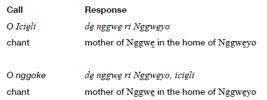
The syntactical order of bārăḵî nap̄ šî ʾeṯ-yhwh changes to fronting O ce nje "Oh my life" according to the canonical order of the imperative clause in Rigwe. However, instead of the literal translation of nap̄ šî "soul", which would be 'wu or ru in Rigwe, ce "life" carries a better idiomatic metonym similar to nap̄ šî in this context.
Strophe B
We have subdivided strophe B into stanzas. Stanza 2 is the section with the repetition of the article ha, followed by masculine singular participles (Po'el verbs) beginning each line, except the concluding line of the last verse (v. 5b). Most of the lines also end with the feminine singular suffix ḵî "you". The same rhythm of the alliterative and assonant sounds in the Hebrew text cannot be recreated, but the lines with similar sounds can be translated to enhance the poetic rhythm in the translation.
3 Aa ning we re-e̱ngwie̱ nje zhwozhwo. He 1S.Dat leave Pl.sin 1S.Pos all "He has forgiven all my sins."
Aa ning kyia ne re-ruhu nje zhwozhwo. He 1S.Dat save from Pl.disease 1S.Pos all "He has healed me from all my sins."
4 Aa ning se̱ shi ning ti yarri ruvo. He.COMP 1S.Dat purchase as 1S.Dat remove from pit "He delivered me as though I was removed from a pit."
Aa ning grra ne ce̱ ngu ngbe naana ngu. He.COMP 1S.Dat surround with love 3S.Pos and compassion 3S.Pos "He surrounded me with his love and compassion."
5 Aa ning ci rishwe ne ankya rina kre nje. He.COMP 1S.Dat put satisfaction with things good seeking 1S.Pos "He satisfied me with good things that I seek,"
A ning ngwá igbe̱ a nze̱ nje shi ya nkyi. He 1S.Dat gives strength in youth 3S.Pos like some eagle "and then he gave me strength in my youth like an eagle"
The repetition of the expression Aa ning ... (the pronoun aa "he" is perfective) all through the lines of verses 3-5a and A ning … (v. 5b, the pronoun a "he" is imperfective) create similar sounds through the lines. Most of the poetic lines in Rigwe have usually completed sentences, often divided into two parts for the call and response. Chanted epithets are usually panegyric noun phrases. If the participles that begin the lines of verses 3-5 are translated literally, which is possible, they will fit the form of chanted epithets in Rigwe songs. However, all lines of Strophe B have been translated uniformly with similar syntactic order of sentences in the language rather than in the form of fragmented sentences of the Hebrew lines to match the rhythm of all the lines. In Rigwe, when the indirect object (IO) is a pronoun, it is repositioned syntactically to the order: S+IO+V+DO. Depending on the number of syllables in a line, the Rigwe pronoun ning "me" (first person dative) can be reduced to n, which fuses to the preceding or the following word. Other words or particles can also be omitted or added for poetic purposes by musical performers as a syllabic meter-balancing mechanism.
The imagery in verse 4, haggôʾēl miššaḥaṯ ḥayyāyḵî "the deliverer from pit your life", gives a picture of Joseph28 or Jeremiah29 in a cistern. In many places in Rigweland, old mining wells are disastrous to fall into. They often result in the death of the miners, even during the mining process, besides accidental falls into long-forgotten, abandoned wells. The imagery of "the deliverer from pit" gives a vivid metaphorical picture, but it is changed in translation into a simile, thus: "He delivered me as though I was removed from a pit." This is to avoid a literal interpretation of the figure of speech. The imagery in verse 5: tiṯḥaddēš kannešer nəʿûrāyḵî "your youth will renew like an eagle", also resonates with an epithet for the eagle in Rigwe: nkyi ko rewenve "the eagle that snatches young-goats". The eagle is known to be strong and swift when it descends to snatch a young goat. Tanner and Jacobson (2014) note that the expression carries a double entendre. It refers to the swiftness with which God moves to renew and heal. It also depicts the renewed youth of the psalmist as one of soaring and powerful vitality (Tanner & Jacobson 2014:764).
Stanza 3 is part of Strophe B.
6 Yawe nyí re-cwuo redziee. YHWH do.HAB works righteousness "YHWH does righteous works."
A nyí nné ne e we yarra raywrra. He do.HAB people who PAS them oppress justice "He does justice to people that are oppressed."
7 Yawe i ti Musa nhwie̱ rê ngu. YHWH PAST show Moses paths way 3S.Pos "YHWH showed Moses his path ways."
A i ci nné Isrreela ré hu re-cwuo ngu. He PAST cause people Israel they know works 3S.Pos "He caused the people of Israel to know his works."
The priority is to communicate the meaning of the source with its poetic structure in mind while translating it into the target language using its structure and devices for oral performance. Syllabic meter may be necessary for oral performance, the performers will use their discretion to fuse grammatical particles, such as the passive marker e and the past marker i to the preceding words, reducing the syllables or keeping them as syllables where needed. The syntactic order in verse 6: ʿōśēh ṣəḏāqôṯ yhwh // ûmišpāṭîm ləḵol-ʿăšûqîm "he does righteousness YHWH // and justice to all oppressed" (a-b-c // b'-d) with ellipsis is changed into two complete sentences. Similarly, the chiastic structure a-b-c // c'-b' is also changed into two complete sentences. The poetic usage of the yqtl (v. 7) to express the past while keeping to the assonant pattern ʿōśēh // yôḏîᵃʿ of the stanza (vv. 6-7) is recognised and translated as past. In the translation, the name Yawe "YHWH" is used at the beginning of the two verses to create the same sound effect.
Although verse 8 is set off as a separate stanza 4, as it summarises the whole psalm, it may be appended to the preceding and the following stanzas, which have four lines, in a performance, increasing the number of lines of both to six. The repetition of the main theme of a song throughout the song is common in Rigwe.
v. 8 Naana ngbe ehwie rina shi ne Yawe. pity and mind good is with YHWH "Pity/compassion and good-mind are with YHWH."
Rimwi ngu shi esheng, ce̱ ngu zhwo we zhwo. anger his is slow, love his is-much just much "His anger is slow, his love is so much."
Strophe C
As the preceding stanza summarises the description of YHWH's ḥeseḏ, which is the overall theme of the psalm, stanza 5 in strophe C spells out what YHWH does not do to the community of those who fear him:
9 Ko tí ren ko zohu zhe we̱. NEG.3S show.HAB anger every which time NEG "He does not get angry all the time."
Ko rimwi ngu shi he̱rri tiya we̱. NEG.3S anger his is until everlasting NEG "His anger is not forever."
10 Ko níng nying ye̱ye̱rr ne re-e̱ngwie̱ nzhi we̱. NEGt.3S 1.Pl.IO do-Obj according with sins us NEG "He does not do to us according to our sins."
Ko níng trrang ye̱ye̱rr ne re-vini nzhi we̱. NEG.3S 1.Pl.IO pay-Obj according with faults us NEG "He does not repay us according to our faults."
The repetition of the negative particle lōʾ through the four lines results in a symmetrical rhythmic pattern of enveloping negative particles Ko ... we̱ ("NEG ... NEG") all through the four lines of the Rigwe translation of the fifth stanza. The lengths of all four lines become equal if the first person plural dative pronoun níng "us" reduces to n and fuses to the preceding or the following word.
Strophe C'
As Strophe C outlines what YHWH does not do to those who fear him, C' (stanza 6) spells out what he does to them in a recurring pattern of dramatic imageries expressed in similes. The translation realises a pattern of assonance through the lines of the whole stanza.
11 We shi ne zinye̱ shi ze̱nze̱ ne ebe, just as that heaven is far from ground, "Just as the heaven is far from the ground,"
ce̱ ngu zhwo we zhwo nwie nné mbe ki to ni. love his is-much just much to people they him fear so "his love is so much to people who fear him like that."
12 We shi ne nvaze shi ze̱nze̱ ne nvata, just as that east is far from west, "Just as the east is far from the west,"
aa wa re-e̱ngwie̱ nzhi ze̱nze̱ ne nzhi we ni. he.COMP throw sins our far from us just so "he has thrown our sins far from us like that."
13 We shi ne 'be̱ ngu bi naana rewe ngu, just as that father he has pity children his, "Just as a father is compassionate to his children,"
Yawe rí naana nné mbe ki to we ni. YHWH sees pity people they him fear just so "YHWH is compassionate to people that fear him like that."
The first line of each couplet in the translation begins with We shi ne ... "Just as ...", followed by an appositive illustration in the second line, which states the topic, namely that which is compared with the illustration, and ends with a recurring particle ni "so/like that", completing the comparison. The imageries of the distance of heaven from the earth (v. 11), the distance of east from the west (v. 12), and the love of a father for his children (v. 13) have similar semiotic value in both the incipient and subsequent contexts. The figurative expressions, therefore, do not need to be changed. In addition, the term yərēʾāyw "those who fear him" is rendered literally nné mbe ki to "people who fear him". The Rigwe verb to covers the semantic domain: "to fear, be afraid of, revere, and respect". These cover the categories of the meaning of the Hebrew יָרֵא "fearing, reverent, afraid".30
Strophe B'
Strophe B' divides into two stanzas (7 and 8). Stanza 7 (vv. 14-16) mirrors human frailty and weakness, shown in its susceptibility to sin, diseases, and dangers in Strophe B, stanza 2 (vv. 3-5), which reflects on YHWH's ḥeseḏ in forgiving, healing, and delivering from danger. Strophe B', stanza 7 points out that YHWH actually "knows our form" (kî-hûʾ yāḏaʿ yiṣrēnû). The psalmist uses the particle kî "for/indeed" to emphasise YHWH's knowledge of the human form, which he describes with dramatic imageries in verses 14b-15, and uses it again in verse 16 to emphasise human transient mortality.
14 Aha aa hu zhwe shî nzhi. Because he.COMP know type form us "Because he knows the type of our form."
A lú he nzhi nyi we ruvu mbè. He remember.HAB that we are just dust soil "He remembers that we are just like dust of the ground."
15 Nneywi a rotu ngu a shi we shi ntsi. Human in days his he is just like grass "Human in his days is just like grass."
A wrú we shi nkpe̱ rekwe yi, He blossom.HAB just like flower tree wild, "He blossoms just like flowers of wild trees."
16 wu ri ki yhwa ngbe we̱ bru. wind FUT it blow and it-will disappear "when wind blows it, it will disappear."
Ko shi ewie ngu re lu ne ngu we̱. NEG FUT place its it remember with it NEG "Even its place will not remember about it."
The particle kî in verses 14 and 16 are regarded, in this instance, as stanza boundary markers, bonding the lines describing human mortality. It is translated in verse 14 as aha "because"31 to give the reason for YHWH's ḥeseḏ and compassion described in the preceding stanza (vv. 11-13) but left untranslated in verse 16.
Like many African rural communities, the Rigwe community is principally an agrarian society. Terms such as dust, grass, and flowers on trees blown off are common metaphorical objects. For example, in Rigwe, aa a ya ye ebe "he has already eaten the ground" is a euphemism meaning "he has died". The fields in the wet season are lush green with grass, which turn colourful in autumn as several species blossom with different kinds of flowers such as tithonia diversifolia (mu, in Rigwe), widespread with yellow flowers, but all shortly dry up, and the fields turn brown in anticipation of bush-burning. The message of the psalm is more vivid in both the incipient and the subsequent language, with the comparisons using these imageries.
Stanza 8 (vv. 17-19) provides a sharp contrast to stanza 7: wəḥeseḏ yhwh mēʿôlām wəʿaḏ-ʿôlām ʿal-yərēʾāyw "but the ḥeseḏ YHWH is from eternity to eternity on those who fear him". It serves as the poetic and theological counter to the ephemeral fate of human finitude described in verses 14-16 (Tanner & Jacobson 2014:767), which contrasts with YHWH's never-ending ḥeseḏ.
17 Me̱di ce̱ Yawe e̱ nyi gannyi tiya, But love YHWH FOC came since eternity But YHWH's love originated from eternity
A bra shi he̱rri tiya ngbe nné mbe ki to. It and is until eternity with people they him fear. and it is until eternity with people who fear him.
Redziee ngu shi ngbe re-enve re-enve mbe - Righteousness 3S.POS is with grandchildren grandchildren 3P.POS His righteousness is with their grandchildren's grandchildren-
18 Nné mbiye ne mbe bro 'jee ngu, people DET.P who 3P.Sj hold promise 3S.POS those people who hold/keep his covenant,
Ne mbe lu aha mbe zhwe re-nka ngu. Who 3P.Sj remember so-that 3P.Sj follow words his who remember to follow his words.
19 Yawe sa ncwu ringgwe̱ ngu a zinye̱, YHWH put chair ruling 3S.POS in heaven YHWH has established his ruling chair in heaven,
ringgwe̱ ngu shi a ko nye̱ ngu ning yé ringgwe̱. kingdom 3S.POS is on every who he 3S.Dat eat ruling his kingdom/rulership is on everyone he rules over.
Poetic lines in Rigwe are usually completed sentences, often with overlapping syllables for metrical stability, except for chanted epithets, mostly in work songs and eulogising chants in mortuary epic poems. Enjambment rarely occurs at the syntactic or morphological level. Dealing with a line length such as wəḥeseḏ yhwh mēʿôlām wəʿaḏ-ʿôlām ʿal-yərēʾāyw "but the ḥeseḏ of YHWH is from eternity to eternity on those who fear him" would require breaking the line into dis-enjambing clauses, each making a complete sense for near uniformity of the length of lines. The structure of verses 17-19 is chiastic with a-a-b-b-a'-a'. The b lines in the Hebrew text, which both have double ellipsis, are a continuation of the second a; verse 17b continues to the end of verse 18, resulting in another long sentence broken into three lines.
2a wəṣiḏqāṯô … liḇnê ḇānîm and his righteousness to the children's children
1b … … ləšōmrê ḇərîṯô to those who keep his covenant
2b … … ûləzōḵrê p̄iqqūḏāyw laʿăśôṯām and to those who remember to do his directives.
The subject and the implied verb of the verbless clause of verse 17b, namely line 2a, govern the lines in verse 18, namely lines 1b and 2b, which are similar to the prepositional phrase in verse 17b. In Rigwe, both lines of verse 18 are rendered as relative clauses, which link up with the whole of verse 17. The metaphors of "throne" and "kingdom" in the lines of verse 19 have also been translated literally with the local terms "ruling chair" and "rulership", respectively. This further pictures YHWH as the "righteous" king who rules over those who fear him. The Rigwe term redziee, which translates the Hebrew צדק, means "act of kindness, goodness, and doing what is right".
Strophe A'
This stanza serves as the conclusion of the psalm. It can serve as a concluding chorus of a song with calls and responses.
20 Nyi de Yawe, nyi re-njeli, 2P.Sj praise YHWH, 2P.VOC angels "Praise YHWH, you angels,"
nyi brrankyá bi igbe̱ ne nyi zhwe nka ngu, 2P.VOC big-things having power who 2P.Sj follow word 3S.POS "you mighty ones having power who obey his word,"
ne nyi ho cwue nti nka ngu. who 2P.Sj hear voice roots word 3S.POS "who hear the voice of his commandment."
21 Nyi de Yawe, nyi re-shezhi zinye̱, 2P.Sj praise YHWH, 2P.VOC soldiers heaven "Praise YHWH, you soldiers of heaven,"
nyi nnencwuó nyi kya ce̱ ngu. 2P.VOC workers do thing want 3S.POS "you workers doing his will."
22 Nyi de Yawe, nyi ga ankya ne ngu nyi 2P.Sj praise YHWH, 2P.VOC all things which 3S.Sj do "Praise YHWH, you all things that he made"
zhwozhwo ko he a ringgwe̱ ngu. all every here in kingdom 3S.POS "all everywhere in his kingdom."
O Ce nje, de Yawe! Oh Life 1S.POS, praise YHWH "Oh my life, praise YHWH!"
The psalmist uses imperative sentences to call angels (also addressed with other appellations such as "mighty ones", "heavenly hosts", and so on) and all creatures (kāl-maʿăśāyw) to praise YHWH are structured in two parts: a command and a vocative part suitable for calls and responses in a responsive style.
7. CONCLUSION
The article attempted to find similarities between the incipient and subsequent systems and use them to translate the Psalms while considering their alterity. It pointed out the importance of finding features of orality in the target context, which are formed by the multiple cultural, social, ecological, and various factors that shape cognition and contribute to forming the patterns of poetic and rhetorical devices that enhance memory and internalisation of the content of poems.
For a translation for performance, incorporating elements of poetic features and rhetorical devices known in the target community would tell the readers or users of the translation that the text is intended to be sung. The translation should produce a stimulus to a musician in the language that the text of the psalm before him is likely to be a song. The role of a translator, who is not a musician, may not include composing the psalms into songs with metrical qualities and tunes. However, for a Rigwe translation of the psalms, as demonstrated with Psalm 103, rhythmic patterns such as rhymes, ideophones, and features such as metaphors, similes, and other figurative expressions, as are found in the language's poems that have similar rhetorical or poetic effects, may be replicated in the translation. The translator may prepare the lines towards realising a near poetic meter, if possible. Since the language has a process of repetition, adding particles or phrases, or omitting certain particles to balance poetic lines, musical composers, who find the lines unmetrical, can use such poetic tools of omissions and additions to balance the lines as they may desire to do so.
BIBLIOGRAPHY
- Allen, L.C. 2002. Psalms 101-150. Nashville, TN: Thomas Nelson Publishers. Word biblical commentary. Volume 21.
-
Barnwell, K. 2020 [1986]. Bible translation. An introductory course in translation principles. Dallas, TX: Summer Institute of Linguistics. https://doi.org/10.54395/K8VP-T5WD
» https://doi.org/10.54395/K8VP-T5WD -
Bauman, R. 1992. Folklore. In: R. Bauman (ed.), Folklore, cultural performances, and popular entertainments. A communications-centered handbook (New York: Oxford University Press), pp. 29-40. https://doi.org/10.1093/oso/9780195069198.003.0004
» https://doi.org/10.1093/oso/9780195069198.003.0004 - Bratcher, R.G. & Reyburn, W.D. 1991. A translator's handbook on the book of Psalms. New York: United Bible Societies.
- Broyles, C.C. 2012. Psalms. Understanding the Bible commentary series. Grand Rapids, MI: Baker Books.
- Craigie, P.C. 2004. Psalm 1-50. Nashville, TN: Thomas Nelson Publishers. Word biblical commentary. Volume 19.
- Dahood, M. 1970. Psalms III 101-150. New York: Doubleday. Anchor Bible.
-
Finnegan, R. 2012 [1970]. Oral literature in Africa. Cambridge: Open Book Publishers. https://doi.org/10.11647/OBP.0025
» https://doi.org/10.11647/OBP.0025 - Foley, J.M. 1995. The singer of tales in performance. Bloomington, IN: Indiana University Press.
-
Gutt, E.-A. 2014 [2000]. Translation and relevance. Cognition and context. New York: Routledge. https://doi.org/10.4324/9781315760018
» https://doi.org/10.4324/9781315760018 - Gya, D.M. 2024. Translating biblical poetry in the context of African oral literature: A case study of the Rigwe language of central Nigeria. Unpublished PhD thesis. Bloemfontein: University of the Free State.
- Hubbard, R.L. & Johnson, R.K. 2012. Foreword to Psalms, by Broyles, C.C. In: W.W. Gasque, R.L. Hubbard & R.k. Johnston (eds), Understanding the Bible commentary series (Grand Rapids, MI: Baker Books), pp. xi-xii.
-
Makutoane, T.K., Miller-Naudé, C.L. & Naudé, J.A. 2015. Similarity and alterity in translating the orality of the Old Testament in oral cultures. Translation Studies 8(2):156-174. https://doi.org/10.1080/14781700.2014.992462
» https://doi.org/10.1080/14781700.2014.992462 -
Marais, K. 2014. Translation theory and development studies. A complexity theory approach. London: Routledge. https://doi.org/10.4324/9780203768280
» https://doi.org/10.4324/9780203768280 -
Marais, K. 2019. A (bio)semiotic theory of translation. The emergence of social-cultural reality. London: Routledge. https://doi.org/10.4324/9781315142319
» https://doi.org/10.4324/9781315142319 - Maxey, J.A. 2009. From orality to orality. A new paradigm for contextual translation of the Bible. Eugene, OR: Cascade Books.
-
Nida, E.A. 1964. Towards a science of translating. Leiden: Brill. https://doi.org/10.1163/9789004495746
» https://doi.org/10.1163/9789004495746 -
Nida, E.A. & Taber, C.R. 1982 [1969]. The theory and practice of translation. Leiden: Brill. https://doi.org/10.1163/9789004669147
» https://doi.org/10.1163/9789004669147 - Niditch, S. 1996. Oral world and written word. Ancient Israelite literature. Louisville, KY: Westminster John Knox Press.
- Nord, C. 2018 [1997]. Translating as a purposeful activity. Functionalist approaches explained. Manchester: St. Jerome Publishing.
- Ong, W.J. 2002 [1986]. Orality and literacy: The technologizing of the word. London: Routledge and Taylor and Francis Group.
-
Perry, P.S. 2019. Biblical performance criticism. Survey and prospects. Religions 10(117):1-15. https://doi.org/10.3390/rel10020117
» https://doi.org/10.3390/rel10020117 -
Reiss, K. & Vermeer, H.J. 2014 [1984]. Towards a general theory of translational action. Translated by C. Nord. London: Routledge. https://doi.org/10.4324/9781315759715
» https://doi.org/10.4324/9781315759715 - Rhoads, D. 2012. The art of translating for oral performance. In: J.A. Maxey & E. Wendland, Translating the scripture for sound and performance: New directions in biblical studies (Eugene, OR: Cascade Books), pp. 22-48.
- Tanner, B. & Jacobson, R.A. 2014. Book four of the psalter. Psalms 90-106. Grand Rapids, MI: Wm B. Eerdmans Publishing Company. The new international commentary on the Old Testament (NICOT).
- Vangemeren, W.A. 2008. Psalms. Grand Rapids, MI: Zondervan. The Expositor's bible commentary. Volume 5.
- Wendland, E.R. 2006. LiFE-style translating. A workbook for Bible translators. Dallas, TX: SIL International.
-
Wendland, E.R. 2013. Orality and its implications for the analysis, translation, and transmission of scripture. Dallas, TX: SIL International. [Online.] Retrieved from: https://www.academia.edu/3657392/Orality_and_the_Scriptures_Composition_Translation_and_Transmission [21 April 2026].
» https://www.academia.edu/3657392/Orality_and_the_Scriptures_Composition_Translation_and_Transmission - Zogbo, L. & Wendland, E.R. 2020 [2000]. Hebrew poetry in the Bible: A guide for understanding and for translating. New York: United Bible Societies.
Date accepted: 3 February 2026
Date published: 29 May 2026
2 The naturalness, or fluency, when performed aloud, according to Barnwell (2020:30), enhances acceptability in the target audience.
3 Maxey (2009) points to Ong and others of his contemporaries as those who advocated a strong separation between the written and the oral, due to the hegemonic understanding of communication based on literary principles.
4 See, for example, Finnegan (2012 [1970]), whose research focuses on performance: the role of the performer, and his or her innovations, the cultural context in which the performance occurs, and how the audience participates in shaping the performer and performance. Similarly, Foley (1995) and Maxey (2009) discuss orality from the perspective of contextualisation. Perry (2019) and Makutoane et al. (2015) focus on Biblical Performance Criticism.
5 Bratcher and Reyburn (1991) note that it may mean "wind instruments", in general, or "flutes", in particular. According to Craigie (2004), the precise sense of נחילות is uncertain; the translation "flute music" assumes a relationship with חליล, "flute, pipe". It is known that flutes were used in the music of Israel's worship (Isa. 30:29, "pipe").
6 See Ps. 32; 42; 44; 45; 52-55; 74; 78; 88; 89; 142. It is translated in Ps. 47:7 with the sense of "artistic skill". See NASB "with a skilful psalm"; ASV and KJV "with understanding", following the LXX συνετῶς "being able to understand with discernment, intelligent, sagacious, wise, with good sense" (BDAG).
7 See Ps. 16; 56-60.
8 Craigie (2004:97) suggests that it may be related to the root שגה, "to go astray, reel", and that it might indicate a psalm of a particular type (e.g. characterised by "wandering" style, uneven meter, or a type of lament characterised by distracted thoughts and words), but there can be no certainty.
9 Scholars generally agree that the meaning of the phrase ʿal-ʿălāmôṯ is uncertain. It is probably derived from the noun עַלְמָה "a marriageable girl", so עַל־עֲלָמוֹת probably means "in the style of young girls" or "a high-pitched musical instrument" (HALOT).
10 Ke̱e̱rie̱ is an archaic word, whose meaning is unknown.
11 This version (Song 6) was performed by women of Zoovo shrine-house.
12 This line is missing in Version B, and the entire line in Version C has nonsense words said to be from the neighbouring Kuce language. The performers mentioned that the word "Zoore" is the Hausa Zaure "hallway, foyer" (https://hausadictionary.com/zaure).
13 Tuntu is a type of women's hairstyle.
14 This version (Song 7) was performed by women of Te̱gbe̱ clan.
15 The ideophone gberengberen (untranslated) onomatopoeically describes the sound of a bell such as one tied to a horse.
16 Hweli ritual is the ritual bush-burning of the area known as Hweli, a build-up of rituals preceding the pan-tribal 'Zrre̱ci festival.
17 The adjective "coarse-skinned" is an ideophone caarra [tʃáárá] that describes a rough and bumpy skinned person or a rough surface. It ridicules the person it refers to in a panegyric song.
18 This version (Song 8) was performed by the performers of version B at a different time.
19 Bawe "God" is a word in the Atsam language, which is used in this line figuratively to refer to the Atsam tribe (west of Rigwe) as kinsmen of the performers, who might have relatives from among them.
20 See also VanGemeren (2008) and Broyles (2012).
21 Other scholars identify different structural patterns, which may define the stanzaic structure of the original performance. For example, VanGemeren (2008) sees an A-B-B'-A' structure.
22 Several scholars consider this to be the theme of the psalm, for example, Tanner and Jacobson (2014) agree with Seybold that the psalm is a meditation on YHWH's hesed; Bratcher and Reyburn (1991) suggest the title, "The love of God"; Allen (2002) titles it "grace that forgives", the CEV titles it "the LORD's wonderful love" and the title in the Hausa Bible (LMT) is Yabon Kaunar Allah ("the praise of God's love").
23 Tanner & Jacobson (2014:767).
24 The phrase "my life" is a metonymic representation of the whole person.
25 The phrase "all my stomach" is an idiom for one's thoughts, mind, or the total being of a person.
26 An appropriate term for the Hebrew קדש is not yet found. It is usually translated in the language as "belonging to, or of God". In this context, using the term for purity that sets God aside from others seems more appropriate.
27 Excerpt from Song 3: Love Song.
28 See Gen. 37:22.
29 See Jer. 38:6.
30 See BDB and HALOT. Scholars agree that yərēʾāyw "those who fear him" usually translated in the LXX as φοβούμενοι or σεβόμενοι (in the NT) refers to those "not yet proselytes in OT". Tanner & Jacobson (2014) mention that it specifically refers to non-Israelites who worship the Lord, but have yet to join themselves completely to Israel.
31 The CEV also translates it as "because"; most of the English versions translate it as "for" (e.g. RSV, NIV, NET, NLT, and so on).
