YouVersion verses-of-the-year in relation to Afrikaans prepositional met and van constructions expressing fear and loneliness
Abstract
How do the 2022 YouVersion Bible verses-of-the-year reflect the way in which fear and ioneiiness were communicated via prepositional phrases that year? The associated objectives of this article are to compare Afrikaans met and van prepositional constructions expressing fear and loneliness in 2022 in two print books with the top 2022 YouVersion Bible verses; to establish how met and van relate to other prepositions in this regard, and to determine how these related prepositional constructions can expand a trauma-informed gradient of uses. This article considers Afrikaans met (with) and van (of) prepositional constructions expressing fear and loneliness in a subset of a corpus of such constructions produced in 2022. The Cognitive Linguistics analysis of the prepositional constructions centres on them as asymmetrical constructions on a spatiotemporal continuum of use in relation to the human body.
Embodiment; Force-dynamics; Migration; Love
1. INTRODUCTION
According to YouVersion.com (2008), "the Bible verse shared, bookmarked, and highlighted most often by the global Bible study software YouVersion Community during 2022" is
So do not fear, for I am with you; do not be dismayed, for I am your God. I will strengthen you and help you, I will uphold you with my righteous right hand (Isa. 41:10; YouVersion.com 2008).
Initially, a global, post-COVID life stage of fear and anxiety was assumed, given the choice of verse. The use of the preposition with in this verse also sparked our immediate research interest in relation to Bergh's (2021a) comparative analysis of this preposition and the Afrikaans translations using met (with) or van (of).
Bergh (2023) views the companionship (I am with you) and the instrumental/how (uphold you with my righteous right hand) as uses of the preposition with in this verse in both the current and the ancient Near East context and in relation to Cognitive Linguistics analyses. This article builds on Bergh (2024; 2023; 2021a; 2021b), together with Bergh and Beelders (2023), by focusing on Afrikaans prepositional constructions using met and/or van expressing fear and/or loneliness written, read, highlighted or shared during 2022. The research question is: How do the 2022 YouVersion Bible verses-of-the-year reflect the way in which fear and loneliness were communicated via prepositional phrases that year? The objectives are to compare Afrikaans met and van prepositional constructions expressing fear and loneliness in 2022 in two print books with the top 2022 YouVersion Bible verses; to establish how met and van relate to other prepositions in this regard, and to determine how these related prepositional constructions can expand a trauma-informed gradient of uses.
Our interest in prepositions aligns with our research in cognitive science, of which Cognitive Linguistics is a branch with particular focus on space and time. Directional elements such as prepositions link the latter phenomena linguistically in word pictures. In turn, the link between linguistics and theology is sealed in John 1:14:
So the Word became human and made his home among us. He was full of unfailing love and faithfulness. And we have seen his glory, the glory of the Father's one and only Son (NLT).
The Gospels reveal how Jesus Christ, the eternal word, communicates with attentive audiences through parables, miracles, and the cross and speaks to individuals. One especially clear example of how careful, spoken language analysis completes written text (Bergh 2024:178-179) is found in Luke 24:27 and 32 during the walk to Emmaus:
Then Jesus took them through the writings of Moses and all the prophets, explaining from all the Scriptures the things concerning himself. ... They said to each other, didn't our hearts burn within us as he talked with us on the road and explained the Scriptures to us? (NLT).
Led by the Holy Spirit, Philip follows this example when he answers the questions of the travelling treasurer of Ethiopia concerning the Scriptures in his heart language (Acts 8:26-40). Tomasello (2007:1094) points out that the foundational role of general cognition in language description in Cognitive Linguistics does not preclude the possibility
that acquiring a particular language may lead the people of a particular cultural group to construe the world to some extent in their own individual way.
Methodologically, this article views Afrikaans met (with) and van (of) as prepositional constructions expressing fear and loneliness in a corpus of such constructions produced in 2022. This corpus was compiled in response to the comparable, combined print, Internet, and Viva corpus in Bergh (2021a). Among other sources, including eye-tracking results, the texts of the two biographies Met my honde and Sonneblomme en sneeu in Oekraïne as research instruments in the study were granted ethical clearance.1
The analysis is divided into two parts. In the first part, the Afrikaans translation of the global 2022 YouVersion verse is considered in relation to the verse most prominent in South Africa. Part two examines Afrikaans met (with) and van (of) prepositional constructions expressing fear and loneliness in a subset of a corpus of such constructions produced in 2022. We narrow down our focus to examples from the two afore-mentioned popular biographies, given their extraordinary relevance to the title of this article, the 2022 global YouVersion text and linked, identified 2022 Ukrainian language pattern use and context. In doing so, we abide by Cognitive Linguistics as a context-dependent, usage-based model. The Cognitive Linguistics analysis of the prepositional constructions centres on them as asymmetrical constructions on a spatiotemporal continuum of use in relation to the human body, as proposed in Bergh (2021a), based on earlier examples. Similarly, although a corpus is used, this is not a corpus linguistics study.
Our Cognitive Linguistics analysis resides within the conceptual framework presented in Bergh (2021b; 2023; 2024). Especially three aspects in our conceptual framework are pertinent to the analysis in this article. The flrst concerns the notion of embodiment. Langacker (2008:535) explains that, in Cognitive Linguistics, it is held that
cognition is embodied. It resides in the processing activity of the brain, which is part of the body, which is part of the world; [this means that] the world we construct and apprehend is grounded in sensory and motor experience.
Secondly, emotion and language are viewed as complex mental systems comprising various knowledge subsystems that interact in multiple ways (Schwarz-Friesel 2015a:157). Particularly in contexts of trauma, it can be meaningful to distinguish between emotion and feelings, where feelings are a "subjective awareness of our own emotional states" (Schwarz-Friesel 2015b:292).
Emotion fulfils a crucial role in human experience, because it determines our processes of perception, thought, and action to a large extent (Schwarz-Friesel 2015b:292). This article adds to Bergh (2024), by considering religious experience and thought within our conceptual model.
Thirdly, Richardson et al. (2021:10) point out that Cognitive Linguistics endeavours to describe language use and thought "beyond what individuals can report about their own mental models and cognitive patterns". In this regard, Sanders (2018:544) emphasises that there is no discrete section of the brain or mind that is elected for religious experience or thought. Moreover, we
have no mental tools specifically allocated to think about the divine. Rather, we use the same set of tools to think about God and salvation that we use to think about chairs and politics. That is why a study of the human mental tools and the principles by which they operate is important for theology.
Richardson et al. (2021:12) corroborate this, by reasoning that, as Cognitive Linguistics has the potential for revealing aspects of religious thought, the analysis of religious language can enhance the field of Cognitive Linguistics. They point out that this is so, because religious language is exceptionally rich in elements such as metaphor and agency; it also "contains intriguing aspects of human experience that lie at the edge of what can be understood about human cognition".
Our analysis emanates from our research on prepositions thus far. Messerschmidt and Bergh (2011:107, in Bergh 2021a:33) posit that the use of met extends, after Langacker's (1993; 1987) model, over the spectrum in Figure 1:

from (a) immediate concrete control; to (b) abstract control; to (c) disposal; to (d) abstract disposal and access; to (e) inner, emotional, involuntary action; to (f) situations where the trajectory (Langacker, 1987:217) interacts with the landmark (Langacker, 1987:231) without controlling it; to (g) cases where the trajector or subject of the preposition's role is limited to its reference-point function.
From (a) to (g), characteristics of immediate physical control are stripped gradually until only the reference-point function remains. Rightward on the spectrum and towards the human body, movement is from close enough to be able to reach, contact, and influence with a discrete object, closer and closer inwards, first in a part-whole sense (for example, body parts-body), then emotionally; eventually only the container as domain remains. The companion comes closer and closer, while the reference-point function becomes stronger and metaphorical extension decreases:
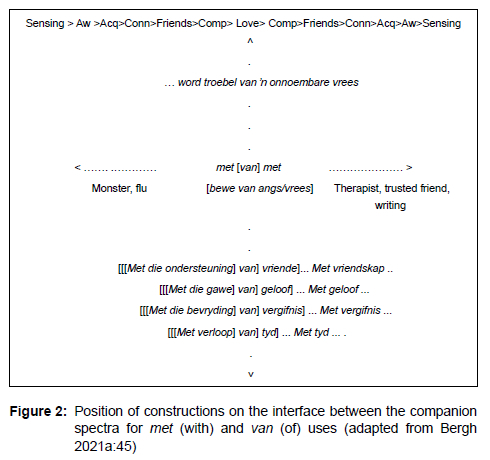
In Bergh (2021a), the preposition van (of) is investigated against this spectrum, whereafter the intersection between met and van are combined with Giglio's (2004) human levels of knowing continuum as well as force-dynamic emotion metaphors and extended rightwards in reverse to include Van der Kolk's (2014) trauma therapy experience and help the reader move in both directions. This is shown partly in Figure 2, which also enlightens our analyses in this article.
2. ANALYSIS
In section 2.1, the Afrikaans translation of the global 2022 YouVersion verse is considered in relation to the verse most prominent in South Africa. Section 2.2 explores Afrikaans met (with) and van (of) prepositional constructions expressing fear and loneliness in the two Afrikaans biographies written in 2022.
2.1 YouVersion
YouVersion is the world's most downloaded Bible application, and provides an interface in 85 languages, including Afrikaans. The Bible Text can be given independently or in conjunction with the interface in 2,000 languages, and free offline Bibles can be downloaded and listened to. The 2020 and other Afrikaans Bible translations are available in these formats and for the verse-of-the-day, for which the default is the 1983 Afrikaans translation. This also holds for the 2022 verse-of-the-year mentioned in section 1, namely, Isaiah 41:10.
This verse was read, highlighted, and shared most globally. In South Africa, Ghana, Indonesia, New Zealand, Nigeria, and the United Kingdom, it was Jeremiah 29:11:
'For I know the plans I have for you,' declares the Lord , 'plans to prosper you and not to harm you, plans to give you hope and a future' (NIV).
Because of migration (including exile and general travelling), among other factors, we argue that, for language patterns, both the global and the country-specific verse-of-the-year need to be considered, also given reciprocal sharing of verses between countries via the application in such contexts.
For 2022, one of the most remarkable language-related engagement reports on the application relates to Ukrainian (YouVersion.com). At the beginning of the war, YouVersion searches in Ukrainian nearly doubled compared to the previous month. Initially,
trending search terms were words like war, fear and anxiety. As time passed, the top search term in Ukrainian became love.
As Ukrainians fled the war and relocated to different European countries, YouVersion saw Ukrainian-language Bible engagement increase substantially in those countries. For instance, Ukrainian Bible engagement has increased in Poland by 241 per cent and in Germany by 733 per cent (YouVersion.com). Bobby Gruenewald, Founder and CEO of YouVersion, pointed out:
These families are going through something most of us can't imagine. In the middle of what's likely the most difficult time of their lives, they're turning to the Bible for comfort, peace and hope.
The verse-of-the-year in Ukraine was the same as the global verse, Isaiah 41:10.
Israel is mentioned as one of the countries where the YouVersion application use has increased during 2022 (YouVersion.com). The name Israel is used in the Bible with a number of referents, including the remnant of Israel who survived the Babylonian exile and the ethnoreligious community known as God's people (Ryken et al. 1998:430). Ryken et al. (1998:430) explain that, in the Old Testament, two streams of tradition formed the image of Israel. One is the stream of promise; first to Abraham and Sarah, and ultimately in the divine promises made to David in 2 Samuel 7. The other is the stream of deliverance and covenant conveyed in the book of Exodus. Accordingly, as a community, Israel was always to remember that its identity was to be modelled by its memory of slavery in Egypt and deliverance by the Lord, "with a mighty hand and an outstretched arm" (Deut. 5:13 NRSV). Living with the promise, the memory of its past slavery and deliverance, and the covenant, Israel was called to become a faithful community.
As explained in the Filament Bible application notes, the three parts of the verse in Isaiah 41:10 reflect these three aspects. First, the promise of God's presence (Isa. 7:14) is central to the Bible. Because God is present, his people need not fear (also in Isa. 43:1-2, 5). The second part emphasises the language of the covenant (also Jer. 7:23, 31:1, 33; Ezek. 14:11, 36:28, 37:27; Zech. 8:8). In the third part, the words (such as right hand) are reminiscent of the Exodus (15:6) to encourage Israel (Isa.15:13, 63:12).
While the hand is a body part at the end of the arm, it is much more than this in Biblical imagery (Ryken et al. 1998:362-363):
Whether in performing tasks, expressing power and authority, or designating purpose and function, the hand is a pervasive picture reflecting the wishes and will of the entire person.
The word hand occurs approximately 1,800 times in the English Bible, and approximately two-thirds of these occurrences are used in a figurative way (Ryken et al. 1998:360). The notion of the right hand is prominent, giving rise to two domains of imagery (Ryken et al. 1998:360-3). First, a favoured position, for instance, Solomon's mother was given a throne at the right hand of the King (1 Kings 2:19). Secondly, intense power and strength, as in the third part of Isaiah 41:10, which fits into a sub-context of a court case about God's strength. Ryken et al. (1998:363) point out that this image is most frequently used by the psalmists of the Lord as a God who rescues and sustains by means of his mighty "right hand" (Ps. 17:7, 18:35, 21:8, 118:156-16, 138:7) as compared with Exodus 15:6 and 12. By the same token, John observes that Jesus is holding the seven stars in his "right hand" (Rev. 1:16, 20, 2:1).
In several English and Afrikaans translations, it is especially the last part of Isaiah 41:10 that varies in wording concerning "right hand". The eye-tracking results in Bergh and Beelders (2023) revealed that salience concerning right-hand movement is still entrenched at present, even more so than natural, embodied left-hand gesturing. The 2020 direct Bible translation in contemporary Afrikaans uses met my seëvierende regterhand (with my victorious right hand) in the last part of Isaiah 41:10. In the 1983 translation (the default on YouVersion), met my eie hand (with my own hand) is used. As in the case of the prepositional construction in English, there could be various views as to whether an instrument, means, manner and/or how is involved (Lindstromberg 2010:149). In Cognitive Linguistics, absolute distinctions need not be drawn between these categories as they can be considered on a continuum such as in Figure 1. Our stance leans towards manner and (f) in Figure 1, based on our exposition so far, the analyses in Messerschmidt and Bergh (2011) and Bergh (2021a) as well as the symbolic use in the source text. The Afrikaans met translation alternatives can be placed on the restoration, rightwards side of Figure 2.
Most of the Afrikaans translations of Isaiah 41:10 use the preposition by ("by") and not met ("with") in the first part of the verse. This is also the case in the 1983 translation used on YouVersion:
Moenie bang wees nie, ek is by jou
[Don't be afraid, I am with you]
One of the entrenched, conventional Afrikaans religious expressions is Immanuel - God met ons (Immanuel - God with us). The use of the preposition by (by) could be for a more informal, contemporary sound, yet the eye-tracking results in Bergh and Beelders (2023) revealed that readers easily grasped companionship uses of met in a children's story. The use of by could indicate an uninvolved onlooker (Müller 2003:58-59) in Afrikaans, but Ponelis (1979:329) explains that the place preposition by is used when an animated or inspired referent is involved, as in Ek staan by Piet/jou/Pa (I stand by Piet/your/Dad). Lindstromberg (2010:144) points out that, in such English constructions, spatial by concerns location in the horizontal plane, but in addition it has a functional meaning that ensures a connection between the Subject (I) and the Landmark (Piet/your/Dad), which makes
certain expressions with by emotionally warmer than corresponding ones with near. We see this, for instance, in the warmth of Come sit/ stand by me (where touching is not out of the question).
Lindstromberg's mention of touching may tie in with verse 13 following Isaiah 41:10, where the Lord promises to take the hand (1983) or right hand (2020) of the listener(s) and help them.
The prepositions, in particular, open mental spaces that facilitate movement and a reference point analysis of the constructions in the verse (Messerschmidt & Bergh 2011; Bergh 2021a). Each of the prepositional constructions structures an asymmetric reference-point relationship around companionship. In the first part, the companion schema combines with at least the conceptual archetypes person, support, link, social interaction, and spiritual awareness. In the third part of the verse, the companion schema combines with at least the conceptual archetypes person, helper, agent, force exerted to bring about change, and part-whole relations.
The 1983 Afrikaans Bible translation of the verse in Jeremiah 29:11 reads as follows:
Ek weet wat Ek vir julle beplan, sê die Here: voorspoed en nie teenspoed nie; Ek wil vir julle 'n toekoms gee, 'n verwagting!
[I know what I plan for you, says the Lord: prosperity and not adversity; I want to give you a future, an expectation!]
The preposition repeated twice in Jeremiah 29:11 to introduce the indirect plural person object is vir, which corresponds with the preposition for in the English translation. Lindstromberg (2010:226) points out that for often serves the function of "earmarking" the Subject as "something offered, or reserved for immediate or eventual use, consumption or possession by the Landmark", as in: That cake is for my mother.
In the Afrikaans text, the colon and preposition open the mental space and together with the promises could enhance this sense of for me/us in a 2022 context of bleak prospects, uncertainty, emotional frailty, adversity and the prevalence of (war) against me/us.
From a historical perspective, Raidt (1994:107) points to variation between aan (to) and vir (for) in translations of Jeremiah 29:11. Raidt (1994:88-147) provides an extensive exposition of vir in direct-object constructions in Afrikaans and concludes with five observations. First, the use of vir for an object that indicates a person is a striking characteristic of Afrikaans language structure; secondly, vir is sometimes compulsory, but mostly a matter of emotion and style - where it can create vibrancy; thirdly, it is characteristic of spoken language; fourthly, it can make the relationship between the speaker and the hearer more personal. Lastly, it also adds emphasis and so avoids ambiguity.
For Petersen (2002:485), Isaiah is "the supreme poet-prophet to come out of the Hebrew people". Poetry provides the prophet with a vehicle to share symbols and emotion. Isaiah's words were first spoken to the leaders of Israel before the exile, in approximately 720 BC, and later read from the preserved scrolls to the returning exiles, in roughly 530 BC (Filament Bible notes). All these factors could make the content seem quite complicated; still, so many YouVersion application users and readers identified with its essence and saw the Invisible in 2022. At the beginning of Jeremiah 29, it is pointed out that "this" is a copy of the letter from the prophet Jeremiah from Jerusalem to the leaders of the exiles in Babylon, and, in verse 10, that in exactly 70 years they would return to Jerusalem. We argue that the two popular YouVersion verses from Isaiah and Jeremiah are linked by the notions of "exile", then "hope" and, ultimately, "glory".
For Ryken et al. (1998:399), the essential quality of hope is captured in Romans 8:24 and 25, namely that it is oriented to something in the future that one expects but does not yet possess. This sense is expressed in the Afrikaans 1983 use of the synonym verwagting (expectation), and at the end of the Jeremiah verse, as in the source text. As such, future-focused readers may be drawn to this text, perhaps more so than the one in Isaiah. Hope is polysemous among its everyday and eternal senses, though, and can sound rather abstract. Ryken et al. (1998:399) argue that
the abstraction begins to assume some of the concreteness of an image when we observe the prepositions with which hope is linked in the Bible.
Some of their examples are that people hope for God's salvation (Ps. 139:166) and a future relocation from exile (Jer. 17:13). Hope is something inside a believer (1 Pt. 3:1 RSV) and something into which one is born (1 Pet. 1:3). We also read about the hope of eternal life (Tt. 1:2) and of glory (Col. 1:27).
Glory is one of the master images that contribute to the story of the Bible, with at least 275 references in the English Bible (Ryken et al. 1998:330). God revealed his glory in a unique way in the Old Testament as a pillar of light by night and a pillar of cloud by day in the desert. This visual expression of the divine presence of God was a perpetual reminder of God's commitment, love, and care. Glory is also a prominent image among the eschatological images in the Old Testament, as the prophets foresee a day - a time when the glory of the Lord shall be revealed and seen by all in (the New) Jerusalem (Isa. 40:5; 60:2; 66:13).
To those in need of hope, the promised theophany inspires the stamina to face difficult circumstances and believe once again (Ryken et al. 1998:331).
In John 1:14, the New Testament "boldly identifies" Jesus' birth as glory, announced by the angels and shepherds, and in doing so, "weaves together nearly all the strands of glory" (Ryken et al. 1998:331). In Acts 7:55 (RSV), when the stoned, dying Stephen looks into heaven, he sees "the glory of God, and Jesus standing at the right hand of God".
One of the most comforting images in the Bible (Ryken et al. 1998:44) is that communicated by the symbolic use of the plural arms: "God carrying his people", in a verse immediately before the profiled verse in Isaiah. The preceding verse in Isaiah 40:11 depicts God as a shepherd leading his flock and carrying the lambs in his arms. Such symmetry provides us with an abiding conceptual picture. Yet, it is asymmetrical prepositional constructions and those profiling one side that host the potential for movement and revealing the overall story for plotting it on Figure 2 and empowering readers to follow the Ukrainian pattern in progressing from fear to the new covenant of love.
2.2 Examples from the two biographies
Two Afrikaans-speaking South Africans chronicled their experiences in Ukraine in 2022: Kobus Olivier in Met my honde (With my dogs) and Michele Potgieter in Sonneblomme en sneeu in Oekraïne (Sunflowers and snow in Ukraine).
2.2.1 Met my honde
Kobus decides to do the seemingly impossible: to escape the besieged Kiev with his four dogs. Every decision is motivated by keeping his pets with him and reducing the effects of trauma on them.
The first-person narrator expresses anger at political bullying and gas-lighting, resulting in death, devastation, financial hardship, and destruction in addition to the emotions of fear and loneliness experienced in Ukraine. Olivier (Olivier & Van Dyk 2023:77, 79, 111, 127, 132, 149) keenly observes how situations are embodied and how prayer and assisting hands and paws bring progress, hope, and peace:
Toe kom die slag. Dit voel of dit reg hier buite my woonstel is. Ek het nog nooit só 'n vrees beleef nie; dis 'n bang wat in jou beendere kom sit.
Almal was vreesbevange.
Maar hier, hier in Warschau op die Sentraal-stasie, sien jy dit: Die ellende op mense se gesigte en die manier hoe hulle loop. Die moedeloosheid. Die hulpeloosheid. Die hopeloosheid ...
Hulle gaan my deporteer en hulle gaan nie die honde saam met my stuur nie. Ek gaan my honde verloor. Ek is moedeloos. Vir die eerste keer sedert ons uit Kijif weg is, begin ek hoop verloor.
Ongelooflike mense wat ons gehelp het, saam met duisende gebede.
... Wéér 'n wonderwerk. Wéér die Here wat op Sy manier en op Sy tyd na my kyk ... Wéér is daar hoop in my. En die versekering dat ons dit gaan maak. Op een of ander manier.
[Then came the clap. It feels as if it is right here outside my flat. I have never experienced such a fear; it is a fear that takes a seat in your bones.
Everyone was fear-stricken.
But here, here in Warsaw at the Central station, you see it: The distress on people's faces and the way they walk. The despondency. The helplessness. The hopelessness ...
They are going to deport me and they are not going to send the dogs with me. I am going to lose my dogs. I'm discouraged. For the first time since we left Kiev, I start losing hope.
Amazing people who helped us, together with thousands of prayers.
... Agáín a miracle. Agáín the Lord who looks after me in His own way and in His own time ... Agáín there is hope in me. And the assurance that we are going to make it. In some or other way.]
With the help of a friend, Kobus is able to arrange transport from Kiev to the Poland border. The journey starts with an unforgettable scene (Olivier & Van Dyk 2023:83):
Kaya lê styf teen my en ek kan voel hoe sy bewe van die bangheid.
[Kaya snuggles up against me and I can feel how she trembles with fear.]
The Afrikaans phrase bewe van die bangheid [trembles with fear] is salient as a result of alliteration and trembling in the narrative, but also because it represents a fixed expression incorporating the preposition van as an example of emotional causality (Bergh 2021a) in that the prepositional construction in this example expresses force relationships in the response (Bergh 2021a:38). Specifically, a cause leads to an emotion and emotion leads to some response. In this instance, particularly, it is an enriched version of force dynamics where the response also includes a compensatory event and the restoration of equilibrium. As in Bergh (2021a:40), the Afrikaans preposition van expresses the precision with which the counterforce proceeds. The first part of Isaiah 41:10 can also be analysed as an example of enriched emotional causality, with God present and strong as a counterforce to fear.
After the analogy of Bergh (2021a:40), the construction bewe van die bangheid can be classified under absolute love in Figure 2. Following Bergh (2021a:40), trembling can be regarded as an
audible-visible, recognisable emotional body language that reveals an inner love is a force relationship, as well as ways in which the body does the (therapeutic) talking to heal emotional hurts.
Similar to the analysis in Bergh (2021a:44), the bewe van die bangheid prepositional construction is structured by force-related love metaphors, given that a relationship that is also an emotion pertains. In the construction, bewe is selected as the phrase-initial, body-movement, salient reference point that becomes a target and directs blending towards the next reference point die bangheid that becomes the landmark in an asymmetrical construction in forming complex love metaphors that include physical force and natural force. As a counterforce to fear here, "love is the only force and emotion strong enough to restore harmony" (Bergh 2021a:44). Amid the chaos, anxiety and violence, a "present tense, show-not-tell, sophisticated in simplicity, inner love story nested in an overall life story" (Bergh 2021a:46) unfolds.
The following observations are from their journey towards the border (Olivier & Van Dyk 2023:103) and at the cottage in Poland (Olivier & Van Dyk 2023:110-111):
Die mense stap in hulle honderde om by die grens te kom. Om weer vry van vrees te wees. ... Omtrent 'n week gelede was ek en die honde in die klein badkamer vasgevang terwyl die bomme om ons ontplof het. Die honde was bang; ek het gedink ek gaan dood. En hier is ons nou. Vir die eerste keer sedert daardie Donderdagoggend se eerste ontploffings is ek nie met 'n byna verlammende vrees gevul nie.
[The people walk in their hundreds to reach the border. To be free of fear again. About a week ago, the dogs and I were trapped in the small bathroom while the bombs exploded around us. The dogs were scared; I thought I was dying. And here we are now. For the first time since that Thursday morning's first explosions, I'm not filled with an almost paralysing fear.]
Although the met and van constructions in this excerpt indicate the absence of fear (that is, as negated versions of the discussed prepositional phrases), they can also be included in Figure 2; on the restoration side where movement has brought freedom from fear. The said constructions remind us of the clause-initial negations in the first and second parts of Isaiah 41:10.
Kobus is not permitted to stay in Poland and drives to Croatia, via Hungary. In Zagreb, he writes as follows (Olivier & Van Dyk 2023:132, 133, 153):
Daai vrees wat ek in my woonstel gevoel het, kom skop weer nes in my.
... Vir dae loop ek met hierdie bekommernisse diep weggebêre.
... Die lewe in Zagreb is 'n tuimeltreinrit. Dit is 'n pragtige stad, maar dit is 'n ontsettend moeilike tyd gegewe die onsekerheid waarmee ek elke dag saamleef. ...
Maar eintlik is mens glad nie oukei nie; mens is doodeenvoudig eensaam. Daar is niemand met wie jy kan praat nie.
Die enigste wat eintlik begrip het, is die honde. Hulle luister en kom vryf met hulle lyfies teen my been. Asof hulle wil troos, asof hulle sê alles sal oukei wees.
[That fear that I felt in my flat makes a nest in me again.
... For days, I walk with these anxieties deeply stored in me.
... Life in Zagreb is a rollercoaster ride. It is a beautiful city, but it is an extremely difficult time given the uncertainty that I live with every day.
But actually you're not okay at all, you're quite simply lonely. There is no one you can talk to. ...
Actually, only the dogs really understand. They listen and come rub against my leg with their small bodies. As if they want to console, as if they say everything will be okay.]
This excerpt contains uses of met as well as its postposition mee as part of waarmee. In the passage, fear and anxieties are portrayed as personalised forces that can be considered along the (a)-(g) in Figure 1. They approach and enter the body as container in an attempt to have the upper hand there. They are allowed to settle in for days or longer as life companions, though. This may be because their host feels lonely in the absence of human companions and so compensates for that emotion in this way.
Notwithstanding, the host made the wise choices: to depart with his dogs and have them close by as his abiding family. Van der Kolk (2014:101, 205, in Bergh 2021a:41) explains:
especially clinging, but also being hugged, touched or gently vibrated or moved rhythmically represents the most natural ways for humans to be calmed.
From Kaya's trembling nestling against him at the start of the journey to their current rubbing against his leg, the dogs will aid his healing and restoration from wavering feelings.
2.2.2 Sonneblomme en sneeu in Oekraïne
The first-person narrator shares her experience of the events in 2022 in the context of her overall life story and their residence in Ukraine since the 1990s. When their eldest son was still a baby, a life-changing point occurred when the mafia stormed into their house and held them hostage. Michele admits that fear had always been an issue in her life, but that after that experience, she found herself unable to leave their house for five years; petrified with fear. She was also not able to be alone there for beyond five minutes. She explains that it was through the love, support, and counsel of her husband Ockert, tears, a vivid dream, and prayer that she was eventually able to overcome her fearfulness.
Sadly, Ockert passed away when they visited South Africa in September 2021. Michele then had to decide whether she would return to Ukraine, where a war was looming, or stay in South Africa. She decides to go back to Ukraine to continue serving their congregation, community, and ultimately the refugees who arrived in their small town. Their home and building have literally become beacons of light and nourishment to the weary, bereaved travellers in the reality of load-shedding and scarcity of safety, heat, food, and water.
Michele uses descriptive met and van prepositional constructions amply, but not to express fear or loneliness. Although there are easier and tougher days, she is able to describe the situation in her vicinity in 2022 objectively and collectively (Potgieter 2023:224):
Vir die soveelste keer het ek gewonder wat Ockert van die oorlog en Reni en Odessa sou sê as hy dit nou moes sien. Daar heers 'n totaal ander gevoel in die strate. Vrees hang in die lug. Daar is nie meer vrede in die strate nie. Mense is bekommerd. Niemand kan werklik ontspan nie. Dit is 'n ander wêreld as toe ek en Ockert laas daar was. Daar is sandsakke teen die geboue en standbeelde opgestapel; daar is groot betonblokke en soldate oral; ons hoor die sirenes en sien die missiele.
[For the umpteenth time, I wondered what Ockert would have said about the war and Reni and Odessa if he were to see it now. A totally different feeling reigns the streets. Fear hangs in the air. Peace no longer fills the streets. People are anxious. No one can truly relax. It is a different world from when Ockert and I were there the last time. There are sandbags stacked against the buildings and statues; there are huge concrete blocks and soldiers everywhere; we hear the sirens and see the missiles.]
On the penultimate pages (Potgieter 2023:236, 237), Michele's words capture her embodiment of both the 2022 YouVersion verses:
Ek mis vir Ockert so verskriklik baie. Die ergste is wanneer ek van hom droom, en dan wakker word en sien sy plek langs my is leeg. Elke keer sny dit deur my: My maatjie is weg.
Maar elke keer vertroos die Here my. Hy gee vir my hoop en 'n toekoms. Hy maak my sterk.
... Dikwels wanneer ek bid, staan ek in my gedagtes op Kleinbrak se strand. Die Here se teenwoordigheid straal helderder rondom my as die son, met kleure mooier as dié van 'n reënboog. Ek sien hoe ek in die vlakwaters staan terwyl die branders om my voete spoel. Met my hande in die lug loof en prys ek die Here.
... En ek weet nou, meer as ooit tevore, dat ek nooit alleen is nie.
Want Hy is hier, by my.
Hy was nog altyd hier, by my.
[I miss Ockert so terribly much. The worst is when I dream of him, and then wake up and see that his spot next to me is empty. Every time it cuts though me: My hubby's gone. But every time the Lord comforts me. He gives me hope and a future. He makes me strong.
... When I pray, I often imagine that I'm on the beach at Kleinbrak. The radiance of the Lord's presence surrounds me more brightly than the sun, with more beautiful colours than those of a rainbow. I see how I stand in the shallows while the waves lap my feet. With raised hands, I praise and glorify the Lord.
... And I know now, more than ever before, that I'm never alone.
Because He is here, by me.
He has always been here, with me.]
3. DISCUSSION
When the examples of the Afrikaans prepositional met and van constructions expressing fear and loneliness in Met my honde and the links to two Bible verses in both biographies are read in the overall European settings of the stories in 2022, the usage patterns of the Ukrainian YouVersion application searches are concretised.
The YouVersion verses-of-the-year for 2023 were announced on 28 November 2023 (YouVersion.com/share2023) amid more wars in Africa and the Near East. Again, Isaiah 41:10 was the verse that the global YouVersion community engaged with most in 2023.
Across its family of applications, YouVersion saw Bible engagement surge worldwide throughout 2023. Notable growth in Bible use in 2023 was, among other countries, as much as 57 per cent in Israel and 37 per cent in South Africa (You Version.com/share2023).
The Bible verse shared, bookmarked, and highlighted most in South Africa in 2023 was Jeremiah 29:11; once again also in Nigeria. In addition, it was the verse engaged with most in India and, remarkably, also in Ukraine in 2023.
In light of the exposition above, Figure 2 can be expanded with some new met-constructions on the left side and some on the right side (as discussed); bewe van die bangheid in the middle; new van-constructions on the right side, and the Bible by and vir constructions on the right side in their crossing spectra (to be further determined). Although the entry points specified by the respective prepositions are noteworthy and in themselves meaningful, the endeavour is to relate the uses of prepositions with the reference points in the overall chronological and emotional time frames together with the specific contexts and unfolding of the stories, so that texts can be explored and read in full in print or digitally and complementarily to the YouVersion Bible study plans.
4. CONCLUSION
This article contributes theoretically by corroborating earlier findings in our research, first, concerning met and van; also in revealing how these prepositions relate to the prepositions by and vir in the contextual theme, and in expressing the absence of or freedom from fear and/or loneliness. Secondly, it provides fresh insight regarding the interaction between online and print formats and communication selections made (Bergh & Beelders 2017). In this instance, specifically the current everyday ritual of sharing verses, short messages, and memes via online platforms, and overall life stories as printed books.
In the biography Met my honde, the prepositional construction bewe van die bangheid (tremble with fear) is a first-person observation by someone who knows the character very well, whereas met (with) indicates fluctuating feelings of companionship of fear and loneliness. Examples from both biographies also indicate some of the other ways in which fear and loneliness (and restoration) were expressed in 2022 and link to the 2022 YouVersion verses-of-the-year.
Sociolinguistically, the article contributes in pointing to the current way in which the love, peace, and presence of God as searched for and found in the text of the Bible can be shared technologically on a platform easily accessible to the vast majority of people in societies across the globe, and in revealing how this platform furthermore provides an online community to such explorers.
In 2023, 90 years of Afrikaans Bible translation was celebrated. With this article, we join in this commemoration by reflecting on an application made available to read a variety of Bible translations, and also present a tool as a design to open up stories and the overall biblical text three-dimensionally.
BIBLIOGRAPHY
-
Bergh, L. 2021a. To be with or not: Emotional causality and Afrikaans prepositional met and van constructions. Language Matters: Studies in the Languages of Africa 52(2):29-50. https://doi.org/10.1080/10228195.2020.1825513
» https://doi.org/10.1080/10228195.2020.1825513 -
Bergh, L. 2021b. Radio and everyday financial ritual in South Africa. In: S. Chiumbu & G. Motsaathebe (eds), Radio, public life and citizen deliberation in South Africa (London: Routledge), pp. 267-282. https://doi.org/10.4324/9781003027744-20
» https://doi.org/10.4324/9781003027744-20 - Bergh, L. 2023. Holding with hope: A spatiotemporal analysis of Isaiah 41:10. Combined SASNES (Near Eastern Studies) and International Society of Biblical Literature (ISBL) Conference, University of Pretoria, 3-7 July 2023.
-
Bergh, L. 2024. Brave broken heart? The story of the late radio journalist Suna Venter. In: S. Nkoala & G. Motsaathebe (eds), 100 years of radio in South Africa (London: Palgrave Macmillan), pp. 171-187. https://doi.org/10.1007/978-3-031-40702-4_10
» https://doi.org/10.1007/978-3-031-40702-4_10 - Bergh, L. & Beelders, T. 2017. Eye-tracking studies concerning print media in South Africa. Fifth Annual Book History Seminar, University of Pretoria, UP Hatfield Campus, 3 October 2017.
- Bergh, L. & Beelders, T. 2023. Afrikaans met and van prepositional constructions expressing fear and loneliness. Fourth International Afrikaans Grammar Workshop, Muldersdrift, 27-28 November 2023.
- Giglio, L. 2004. Pursuing God. Disc 2, Enjoying the Almighty; 2-part DVD Video Series. Choice Resources.
- Langacker, R.W. 1987. Foundations of cognitive grammar. Vol. I. Stanford, CA: Stanford University Press.
-
Langacker, R.W. 1993. Reference-point constructions. Cognitive Linguistics 4(1):1-38. https://doi.org/10.1515/cogl.1993.4.1.1
» https://doi.org/10.1515/cogl.1993.4.1.1 -
Langacker, R.W. 2008. Cognitive grammar. A basic introduction. Oxford: Oxford University Press. https://doi.org/10.1093/acprof:oso/9780195331967.001.0001
» https://doi.org/10.1093/acprof:oso/9780195331967.001.0001 -
Lindstromberg, S. 2010. English prepositions explained. Revised edition. Amsterdam: John Benjamins. https://doi.org/10.1075/z.157
» https://doi.org/10.1075/z.157 -
Messerschmidt, J. & Bergh, L. 2011. Met kerse op met-konstruksies: 'n Verwysingspuntperspektief. Southern African Linguistics and Applied Language Studies 29(1):97-113. https://doi.org/10.2989/16073614.2011.583163
» https://doi.org/10.2989/16073614.2011.583163 - Müller, D. 2003. Skryf Afrikaans van A tot Z. Kaapstad: Pharos.
- Olivier, K. & Van Dyk, H. 2023. Met my honde. Kaapstad: Tafelberg.
- Peterson, E.H. 2002. The message. The Bible in contemporary language. International edition. Colorado Springs, CO: NAVPRESS.
- Ponelis, F.A. 1979. Afrikaanse sintaksis. Pretoria: J.L. van Schaik.
- Potgieter, M. 2023. Sonneblomme en sneeu in Oekraïne. Kaapstad: Lux Verbi.
- Raidt, E.H. 1994. Historiese taalkunde. Johannesburg: Witwatersrand University Press.
-
Richardson, P., Mueller, C.M. & Pihlaja, S. 2021. Cognitive Linguistics and religious language. An Introduction. New York: Routledge. https://doi.org/10.4324/9781003041139
» https://doi.org/10.4324/9781003041139 - Ryken, L., Wilhoit, J.C. & Longman III, T. 1998. Dictionary of biblical imagery. Downers Grove, IL: InterVarsity Press.
-
Sanders, J. 2018. Cognitive Linguistics and theology editorial. Open Theology 4:541-544. https://doi.org/10.1515/opth-2018-0042
» https://doi.org/10.1515/opth-2018-0042 -
Schwarz-Friesel, M. 2015a. Language and emotion. The cognitive linguistic perspective. In: U.M. Lüdtke (ed.), Emotion in language (Amsterdam: John Benjamins), pp. 157-174. https://doi.org/10.1075/ceb.10.08sch
» https://doi.org/10.1075/ceb.10.08sch -
Schwarz-Friesel, M. 2015b. Giving horror a name: Verbal manifestations of despair, fear and anxiety in texts of Holocaust victims and survivors. In: U.M. Lüdtke (ed.), Emotion in language (Amsterdam: John Benjamins), pp. 289-304. https://doi.org/10.1075/ceb.10.15sch
» https://doi.org/10.1075/ceb.10.15sch - Tomasello, M. 2007. Cognitive linguistics and first language acquisition. In: D. Geeraerts & H. Cuyckens (eds), The Oxford handbook of cognitive linguistics (Oxford: Oxford University Press), pp. 1092-1112.
- Van der Kolk, B. 2014. The body keeps the score: Mind, brain and body in the transformation of trauma. Penguin Random House UK.
-
YouVersion. 2008. [Online] Retrieved from: https://YouVersion.com [3 August 2023] and https://YouVersion.com/share2023 [5 December 2023].
» https://YouVersion.com
Date accepted: 14 June 2024
Date published: 17 December 2024