Cannabis Sativa, religion and society: Historical, medicinal, legal, and sacramental perspectives
Abstract
As South Africa and the global community confront the changing dynamics of cannabis decriminalisation and legalisation, this article examines the intricate nexus between Cannabis sativa and religious belief and practice. With evolving societal perspectives and legal paradigms, the overview probes into the historical underpinnings of Cannabis sativa, specifically its drug form, i.e. cannabis and its chemical structure, criminalisation, medicinal uses, industrial applications, and its connections to various religions. The article illuminates the ancient origins of Cannabis sativa, its cultural diffusion, and introduction to Southern Africa. It discusses the complexities in assessing the tetrahydrocannabinol (THC) effects, due to legal constraints. The article explores the plant's historical medicinal uses from ancient China to contemporary health applications. It scrutinises the criminalisation of cannabis, questioning the constitutional adherence of existing legal frameworks. It thus explores the use of cannabis within the larger ambits and debates on legislation, health ethics, and religious freedoms. Finally, the article suggests future research directions, particularly investigating the interplay of religious beliefs and attitudes toward cannabis through a comprehensive questionnaire.
Dagga; Cannabinoids; Religious use; Opposition
1. INTRODUCTION
With South Africa - and much of the world - on the cusp of the complete decriminalisation and legalisation of cannabis - the drug form of Cannabis sativa - an overview of how the use of this interesting plant is referenced in religion may be instructive. The emergence of cannabis use in various social contexts, religion being one of them, requires examination. Although religious participation has been correlated with lower rates of substance consumption including alcohol, tobacco, and cannabis (Chitwood et al. 2008; Krause 2017), it is significant that there are well-established religious traditions that incorporate cannabis in their sacramental practice and rituals. Rastafarians and other religions are committed to the plant's usage as part of their sacrament.1 It is generally acknowledged that certain religious denominations proscribe the use of cannabis. This dichotomy has prompted the review of Cannabis sativa and its relationship to religion. This article posits the ancient origin of the plant, with a brief look at its chemical composition(s), its criminalisation, as well as its medicinal value and references in religion. It also notes the tension between the prohibition of the recreational use of cannabis, on the one hand, and the sacramental use, on the other.
The question may be raised as to whether cannabis use can be regarded as a legitimate sacrament within the broader concept of religious practice and, if so, should certain safeguards based on ethical, legal, and health concerns be considered?
The article cites literature reporting states of spiritual enlightenment and transcendental states when cannabis is consumed. Such states suggest that some consumers experience heightened awareness and a sense of spiritual receptivity. The authors emphasise that even the religious experience should be within the restrictions of legal compliance, voluntary usage, age limitations, and, importantly, be medically approved.
2. METHODOLOGY
This narrative review focused on the historical and contemporary relationship between cannabis and religious practice, and how the legal, medicinal, and social discourses influenced religious attitudes and sacramental practice towards cannabis and, broadly, towards psychedelic substances.
The literature search strategy employed grouping historical, medicinal, and legal themes related to religious (sacramental), legal, and health use of cannabis. The following databases were searched, using keywords: ATLA Religion Database, Scopus, Web of Science, PubMed/MEDLINE, PSYCINFO, JSTOR, and Google Scholar. The inclusion criteria were national statistical reports, peer-reviewed studies, and legal literature. The exclusion criteria entailed general literature and anecdotes without sources. The limitations of the study were those studies in foreign languages and the understanding of the many legal frameworks within the international community.
As mainstream religious denominations support legislation through the prohibition on intoxicants, and as religious use of cannabis is not (yet) studied widely, the review was guided by the relevant legislation in some jurisdictions.
3. RESULTS AND DISCUSSION
3.1 Origin of the plant
Cannabis sativa is native to the Tibetan plateau. Its narcotic qualities and mystic experiences, i.e. its psychoactive effect, together with its industrial applications, ensured its global diffusion. It reached China as early as 4000 BC and, India by 1500 BC to 1000 BC. Its cultivation and use spread, and Cannabis sativa is believed to have been introduced to Jamaica in roughly 1845. It was brought to the island by indentured East Indian servants, where it became known as Ganja (Crampton 2015:63). Cannabis was introduced to Europe through Western physicians who came to appreciate the medicinal value of the plant (Crocq 2020).
The ancient Near East and Mediterranean regions were also acquainted with cannabis. According to historical records, the Indo-Iranian people introduced Cannabis (qunub in their language) to the Assyrians, Scythians, Thracians, and Dacians. The historian Herodotus mentions it in the Greek context (see Brummer 1973). According to Benner (2021), it is conceivable that the Hebrew people were familiar with this plant. Despite some contestation, several Hebrew language linguistics scholars conclude:
The Hebrew phrase qaneh bosem can be defined as "an aromatic resinous reed plant" and is descriptive of the Cannabis plant. Some linguistics scholars argue that there is an undeniable linguistic link between qaneh bosem and Cannabis.
Just as the word "cinnamon" is of Semitic origin, kinnamonon, it is also possible that "Cannabis" may be of Semitic origin.
Cannabis was known and used in the Middle East at the time of the Hebrew people (Benner 2021).
According to Booth (2003), when Linnaeus named Cannabis sativa, he based the first word kannabis on the classical Greek word for hemp, derived from the Sanskrit cana. Cana means "cane", while bis is believed to come from the Hebrew bosm or Aramaic busma, meaning "aromatic" (Crampton 2015).
Cannabis sativa was introduced to Southern Africa via the Mozambican coast, and this coastal dissemination can be deduced from its linguistic trail (Crampton 2015). The Sanskrit word for it is bhanga; in Hindi it is called bhang. From the 13th century, the word appears in Islamic writing as banj. This was the word by which it first became known in Southern Africa, and by variations of which it is still known to the people in the northeast of the country and along the Mozambique coast.
According to Crampton (2015), the word dagga, which is now commonly used to refer to Cannabis, first appears in writing in 1658, in the journal of Jan van Riebeeck, commander of the Cape of Good Hope. On 21 June 1658, Eva, a young member of the indigenous Khoikhoi who acted as Van Riebeeck's interpreter, told him of the "Hancumqua" who lived further inland
cultivating the soil in which they grew dacha, a dry herb which the [Khoikhoi] chew, which makes them drunk, and which they highly esteem.
This herb, dacha, was actually found to be Leonotis Leonurus, now known as wild hemp (Mossop 1947).
3.2 Chemistry and psychoactive effects
As a botanically versatile plant, Cannabis sativa is able to adapt to a variety of climates and conditions. It only begins flowering with the onset of winter when the plant is at its most potent, with the tetrahydrocannabinol, THC, the psychoactive principle of the plant, being the most concentrated. THC is concentrated in the female flower buds, and its concentration depends on the strain. Determining the plant strain or even the THC content is not straight forward. As Stuyt (2018:408) points out:
without any clear guidelines or regulations from government officials, the cannabis industry has taken a page from the tobacco and alcohol industries' play book and developed strains of marijuana and concentrated marijuana products with much higher concentrations of THC.
The potency of any strain may be increased, according to Lynch (2021), by harvesting at the correct time; by using the correct lighting; by selecting healthy plants, and by employing the correct procedure in the curing process. These developments befuddle public health regulations, ethical, and religious perspectives when it comes to cannabis use.
Cannabinoids represent the most studied group of compounds. It is indeed naïve to think that cannabis is simply used for its therapeutic effects, as is evidenced archaeologically. Since earliest times, the plant has been refined to produce increased THC content, as Crocq (2020:223) suggests, referencing the excavation of a grave of a man who had with him 800g of cultivated cannabis - i.e. purposely produced - with high THC content. This was confirmed as further analyses revealed that the cannabis had been specifically cultivated for its THC content by selecting certain strains of the plant. According to Crocq (2020:223) this is evidence of the long-standing link between human beings and cannabis as a psychotropic drug.
The plant's complexity as well as quantifying and qualifying the effect of THC are currently a challenge because of the legal restrictions on cannabis in many countries, making it difficult to determine acceptable standards of use. Approximately 144 cannabinoids have been identified in the cannabis plant (Lazarjani et al. 2020), with more than 400 chemical entities contained in the plant, adding to the challenge. Among the cannabinoids and chemicals, THC and CBD (cannabidiol) are the most prominent ones.
The effects of the plant vary widely, not only according to the method of consumption, but also from individual to individual. They affect the same individual differently at various times and under different conditions (Atakan 2012). The variability of effects and responses to ingesting cannabis would be problematic in sacramental contexts. The fact that individuals may react idiosyncratically to cannabis consumption would undermine the solidarity required in ritual, which depends on a truly communal and not necessarily individual experience.
In terms of the chemistry, ganja is said to have the lowest toxicity of all commonly used toxicants. It can, however, aggravate and, some have claimed, even precipitate, psychotic disorders such as schizophrenia (Adréasson et al. 1987). Recent research indicates that there is still a need for further investigation on the relationship between cannabis use and schizophrenia. Patel et al. (2020) recommend case-control and robust clinical trials to resolve clinical debates that have an influence on policymaking and legislation and to attenuate religious scepticism regarding cannabis use.
In the words of one of ganja's detractors,
calm and mild delirium may result in pathetic people; imaginative personalities may experience brilliant and varied hallucinations; savage reactions such as mad rage may be precipitated in the human brute (Young 1894:204).
Herein has always resided the problem regarding the legal status of Cannabis sativa, an indicator of the reason, possibly, why some religions have grappled with embracing its use. Within the contested moral and religious terrain, religious traditions and rituals have had to carve out a place for cannabis use.
3.3 Medicinal and industrial use
3.3.1 Benefits
There has been increased research attention towards the medicinal use of cannabis, due to changing regulations globally (Sarris et al. 2020). Nowadays, cannabinoids such as CBD (cannabidiol) are commonly extracted from cannabis to create medicinal treatments without psychoactive effects. Natural extracts of cannabinoids are growing in use for treatment of psychological conditions such as depression and anxiety, as well as targeting physical ailments such as pain and nausea.
Some of the earliest recorded medicinal uses of cannabis originated in China. Historically, cannabis was reportedly used by Chinese surgeons as an anaesthetic during surgery (Azizxonovna 2024). In ancient Egypt, it was used topically for the treatment of inflammation. In approximately 1500 BC, its use for mental health treatment was documented on Assyrian clay tablets (Crocq 2020).
Latterly, Touw (1981) listed anti-senility effects as one of the medicinal benefits of cannabis, while a qualitative study revealed that adults suffering from attention-deficit/hyperactivity disorder (ADHD) self-medicated with cannabis to offset the effects of their condition (Mitchell et al. 2016). In the 21st century, chronic pain has been the most commonly cited ailment for which medical cannabis is sought (Whiting et al. 2015). Some research has also reported cannabis as having antitumour effects for the treatment of cancer (Rocha et al. 2014).
These accounts reveal how the medicinal importance of cannabis has transcended the strictures of cultures and time.
3.3.2 Risks
There are documented health and social risks associated with the use of cannabis.
Cannabis use disorder (CUD), a risk associated with frequency of dosage and potency, is fairly prevalent (Hasin et al. 2015).
Dependence syndrome, impaired respiratory function, cardiovascular disease, adverse effects on adolescent psychosocial development and mental health, as well as residual cognitive impairment are the dangers faced when using cannabis regularly (Hall & Degenhardt 2014).
Driving impairment, with the risk of causing accidents, making a case for not driving after the sacramental use of cannabis (Rogeberg & Elvik 2016).
Various other health issues such as, for example,
Respiratory problems (Ghasemiesfe et al. 2018).
Cardiovascular problems such as arrhythmia, tachycardia, ischemic events, and so on (Desai et al. 2018).
Pregnancy problems such as lower birth weight and neurodevelopmental concerns (Corsi et al. 2025).
Accidental ingestion of legalised cannabis edibles by minors (Myran et al. 2023).
Health cost increase, due to the use of delta9-tetrahydrocannabinol (Hassunah & McIntosh 2016).
These concerns within the recreational, medicinal, and religious contexts are applicable in considering the case for the use of cannabis in the sacrament.
3.3.3 Industrial use
Cannabis sativa has been documented as a versatile crop. Hemp has been cultivated particularly for industrial use (Rehman et al. 2021), including the production of construction material, electrical insulation paper, paper packaging, cigarette paper, fuel, fibreglass, and synthetic plastic. Hemp has also been identified as a beneficial raw material for clothing, rope, home furniture, industrial oils, cosmetics, food products, and pharmaceuticals (UNCTAD 2022). In South Africa, hemp has been used for thermal insulation and touted for its mould-resistant properties as a building material and presents a myriad opportunities (Nortje 2020).
4. CRIMINALISATION AND LEGISLATION
Generally speaking, modern Western religions tend to be defensive in their approach to adopting or prohibiting the use of psychoactive substances such as cannabis. In fact, Pope Francis, who is still regarded as having been perhaps the most liberal pope to date, spoke out against the legalisation of recreational drugs (Mac Donald 2013), while the current pope, Pope Leo XIV, calls the use of drugs an "invisible prison" (Collins 2025). The tension between ancient ritual customs and more modern religious obeisance of legislation anticipates the wider incongruities between tradition, legislation, and morality.
Mills (2003) posits that historians have struggled to define the exact moment when ganja began its fall from grace on the international stage, and even more so its eventual listing as an opiate such as heroin. In 1916, for example, at the height of the First World War, rumours began to circulate about the use of opium and cocaine among off-duty soldiers in London. The authorities acted quickly: to keep the soldiers focused on fighting, they issued an order in the name of the Army Council prohibiting the sale of certain drugs to members of the Armed Forces. The order was aimed at opiates but somehow cannabis, despite its pharmacological application, became subject to the same regulatory framework, indicating how cannabis would be grouped and regulated in future.
It is an axiom that no social practice can be understood in isolation. This is also true of the use of cannabis in its legal, historical, social, or religious context. The prevailing mores of a society will necessarily impose themselves on practices and beliefs and disadvantage minority cultural or religious communities whose practices do not conform to the dominant social norms. As a result, in addition to acting as impartial regulators, legal systems frequently function as instruments that favour existing moral frameworks.
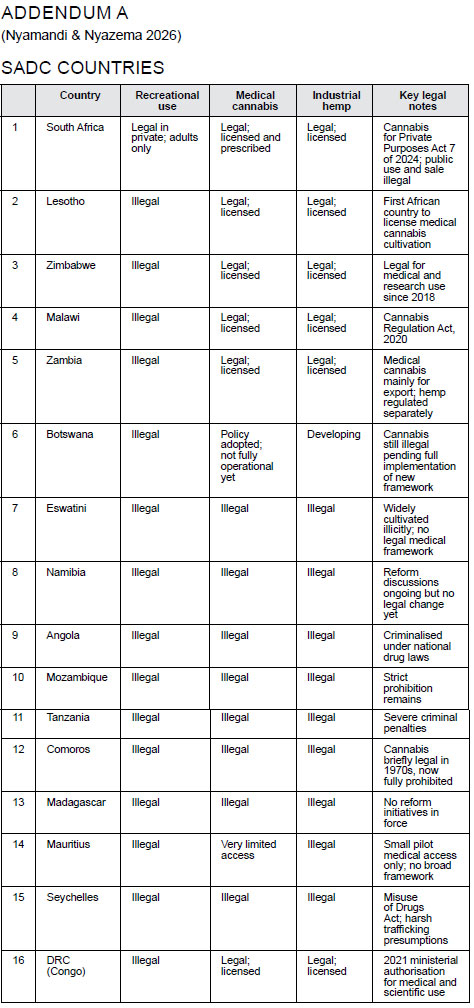
As far as global legalisation of the use of cannabis is concerned, a brief summary should suffice.2 The following is a sample of the prevailing legal environment in some countries and illustrates the diversity and incongruity between the cannabis regulatory environments.
Canada: The Cannabis Act (2018) controls the use of cannabis. Its stated policy objectives, according to the same source, are noble and congruent with social norms (protect public health and safety, by allowing responsible adults access to legal cannabis).
United States: According to the Centers for Disease Control and Prevention (2024),
… 47 states, the District of Columbia, and 3 territories (Guam, Puerto Rico, U.S. Virgin Islands) allow for the use of cannabis for medical purposes,
while the recreational use by adults is allowed in 24 states, and in the District of Columbia, Guam, and North Mariana Islands. The complication in the US is that Federal Law and State Law may be in opposition. The fact sheet on drugs issued by the Department of Justice stipulates, unequivocally, that it is a Schedule 1 substance and is considered to be without any medicinal purpose (US Department of Justice 2020), thus no recreational use was allowed. However, in December 2025, the White House issued a directive to classify marijuana as a Schedule III substance (The White House 2025), bringing with it the possibility of recreational use. This is simply a signal of potential regulatory amendments and not legalising of the recreational use of cannabis at the federal level.
Uruguay: In 2013, Uruguay fully legalised the use of cannabis, making it the first country in the world to do so (Cerdá & Kilmer 2017). Cerdá and Kilmer mention that adults who wish to consume non-medical cannabis must exercise one of three options: grow their own at home; join a club; purchase from a pharmacy.
Malta: This country has the distinction of being the first country in the European Union to legalise (albeit in a limited sense) the possession and cultivation of non-medical cannabis (Borg 2023).
More particularly, in the South African context, there was a veritable stirring of the waters when, in 2018, the Constitutional Court decriminalised the private use of cannabis as well as its cultivation. As this assertion is widely, but too briefly, made, it is worthwhile quoting from the case (Constitutional Court of South Africa 2018):
10. It is declared that, with effect from the date of the handing down of this judgment, the provisions of sections 4(b) of the Drugs and Drug Trafficking Act 140 of 1992 read with Part III of Schedule 2 of that Act and the provisions of section 22A(9)(a)(i) of the Medicines and Related Substances Control Act 101 of 1965 read with Schedule 7 of GN R509 of 2003 published in terms of section 22A(2) of that Act are inconsistent with right to privacy entrenched in section 14 of the Constitution and, therefore, invalid to the extent that they make the use or possession of cannabis in private by an adult person for his or her own consumption in private a criminal offence.
11. It is declared that, with effect from the date of the handing down of this judgment, the provisions of section 5(b) of the Drugs and Drug Trafficking Act 140 of 1992 read with Part III of Schedule 2 of that Act and with the definition of the phrase "deal in" in section 1 of the Drugs and Drug Trafficking Act 140 of 1992 are inconsistent with the right to privacy entrenched in section 14 of the Constitution and, are, therefore, constitutionally invalid to the extent that they prohibit the cultivation of cannabis by an adult in a private place for his or her personal consumption in private.
The South African Constitution emphasises the right to privacy with the implication that this right extends to religious practice, especially where the sacramental use of psychoactive substances, including cannabis, takes place within the confines of a private space.
5. DEMONISATION
The story of the demonisation of cannabis is "one of shaky science, mis judgement and misunderstandings, media scares, and once-important but now long-dead political agendas" (Crampton 2015:82). Nowadays, in the United States, current legal argument against cannabis is that the laws are constitutional, because they prohibit no specific religion from growing or consuming this plant. Effectively, though, these arguments rely on semantics as such laws may be applied to prohibit the use of cannabis without targeting any specific religion or denomination. From the freedom of religion perspective, however, Michaels (2020: n.p.) argues:
My conclusion is that all laws that prohibit cannabis in any way contradict the Constitution of the United States on behalf of Christianity, Judaism, Hinduism and especially Rastafarianism and Cantheism.
It appears that Michaels strongly supports the view that there is a sacramental aspect to the use of cannabis. The criminalisation of cannabis is, fundamentally, only a legal issue, but it is also an indication of the oppositional forces at play between history, ritual, religious freedom, and the interpretation of the Constitution.
6. USE IN RELIGION
Religiously and culturally, cannabis has been used in and during traditional spiritual rituals, including meditation, prayer, chanting, and fasting as a medium through which spiritual experiences are enhanced, facilitating altered mental and spiritual states. Diverse researchers have, to some extent, studied its use in connection with historical and modern religion.3
As far as religion is concerned, it is not simply a matter of unconditionally accepting the use of cannabis, because an interpretation of Scripture may serve as an admonishment and an injunction to remain sober, although the reference regarding sobriety is to the consumption of wine. Stoltz (2018: n.p.), for example, writes:
Although there's not a single verse in the Bible that explicitly says, 'you may not use any form of cannabis,' 1 Peter 4:7 does say, 'The end of all things is at hand; therefore be self-controlled and sober-minded for the sake of your prayers' (The Holy Bible, ESV 2001).
The interpretation of such passages tends to conflate the use of marijuana with that of alcohol. This is overly simplistic. Jesus himself consecrates the use of wine - albeit responsibly and within a specific context - when he enjoins the disciples to drink the beverage to remember him in their sacraments (Mt. 26:17-32). In fact, Jesus' first miracle was turning water into wine (Jn. 2:1-11). Throughout the Bible, various references point to the imbibing of wine in a festive setting and for the purpose of enjoyment (Dt. 7:1-13; Jr. 31:5-12; Is. 25:6-9; Jl 3:18; Ps 104:15).
Thus, one should bear this in mind when examining the use of cannabis through the ages, even beyond its medicinal use, in the religious context. One is again faced with the selective moral differentiation between substances leading one to deduce that cultural and theological imperatives may be foundational to the selective opposition to the ingestion of a substance.
As will be illustrated below, in many diverse cultures and religions that predate Christianity, the cannabis plant has been used as a spiritual and religious sacrament. Much like the use of wine in Christianity, cannabis has also been used as part of spiritual rituals and ceremonies, with the understanding that a modern Christian church is not necessarily one of the mainstream churches.
6.1 Cantheism
Cantheism is an entirely new religious philosophy or framework first defined and founded by Chris Conrad (Chatterly 2019) in 1996 as "Kantheism", derived from the Greek root word kannabis; the proposed linguistic similarity of kaneh bosm to kannabis is explained later. This word signifies any and all attitudes towards the cannabis plant as a religious experience. While not technically a religion itself, Cantheism is a philosophy that examines the inherent religious nature of man's interaction with the cannabis plant.
6.2 Zoroastrianism
Cannabis is said to have been cultivated and used in rituals by Zoroastrian priests, for spiritual performance during the Islamic era, and was known to be popular during the 13th century Mongol conquests (Ghiabi et al. 2018).
6.3 Cannabis churches
These modern institutions exemplify how the sacramental use of cannabis has become accommodated within contemporary religious frameworks. For example, in both the United States and Canada, there are churches that could, broadly, be termed "Cannabis churches". Among these churches are The International Church of Cannabis (in Denver, Colorado), the First Church of Cannabis (in Indianapolis, Indiana), and the Sacramental Life Church (in Redondo Beach, California) that use cannabis as a sacrament, to intensify one's spiritual state (Stoddard 2023). In Canada, the Church of the Universe, like the Rastafarians, believes that the tree of life is, in reality, the cannabis plant (Cozad 2018).
6.4 Hebrew and Judaism
The Israelites are known to have been in constant contact with cannabis-using cultures. At Tel Arad, in the Negev desert, residues of cannabis were found on altars, indicating that, like the tribes and nations with which the Israelites came into contact, they adopted the use of cannabis sacramentally (Arie et al. 2020). The Israelites came into contact with the Scythians who used cannabis as incense, as did the Assyrians and the Babylonians (Liverani 2014; Bottéro 2001). Contact between the Egyptians and the Israelites is widely documented. Cannabis pollen was recovered from the tomb of Rameses II (Merlin 2003). In the chalices of the Philistines, traces of psychoactive substances were found during archaeological explorations (Yasur-Landau et al. 2013).
As archaeological findings have progressed, increasingly stronger evidence has been found to support the textual evidence, such as that of Sula Benet (1975), an etymologist of the Institute of Anthropological Sciences in Warsaw. She is reported to have found biblical references to the use of cannabis as both an incense and a psychoactive drug. Her evidence is said to have come from Sh'mot (Ex. 30:22-33):
22 ADONAI said to Moshe, 23 "Take the best spices - 500 shekels of myrrh [12 ½ pounds], half this (250 shekels) of aromatic cinnamon [6 ¼ pounds], 250 shekels of aromatic cane, 24 500 shekels of cassia (use the sanctuary standard) and one gallon of olive oil - 25 and make them into a holy anointing oil; blend it and perfume it as would an expert perfume-maker; it will be a holy anointing oil. 26 Use it to anoint the tent of the meeting, the ark for the testimony, 27 the table and all its utensils, the menorah and all its utensils, the incense altar, 28 the altar for burnt offerings and all the utensils, and the basin with its base. 29 You are to consecrate them - they will be especially holy, and whatever touches them will be holy. 30 Then you are to anoint Aharon and his sons - you are to consecrate them to serve me in the office of cohen. 31 'Tell the people of Isra'el. 'This is to be holy anointing oil for me through all your generations. 32 It is not to be used for anointing a person's body; and you are not to make any like it, with the same composition of ingredients - it is holy and you are to treat it as holy. 33 Whoever makes any like it or uses it on any unauthorized person is to be cut off from his people' (Complete Jewish Bible 1998).
In the above verses taken from the Complete Jewish Bible - not dissimilar from the Orthodox Jewish Bible - God instructs Moses to produce a holy anointing oil, one of the ingredients being kaneh bosem or qaneh bosem - sweet flag or fragrant cane according to some Bible versions. According to Crampton (2015:75), the Old Testament texts show that the oil, used at the altar of incense, according to the New King James version, may have been associated with altered states of consciousness within the ritual context, during which God "spoke" to them (Booth 2003; see also Thompson 1949; Liverani 2014).
Recently, cannabis residues have been found at a Judahite shrine of Arad in Israel. Two limestone monoliths, interpreted as altars, were found. On the smaller altar, residues of cannabinoids such as Tetrahydrocannabinol (THC), cannabidiol (CBD), and cannabinol (CBN) were detected, along with an assortment of terpenes and terpenoids, suggesting that cannabis inflorescences had been burnt on the altar. There was also evidence that the cannabis resin had been mixed with dung to enable mild heating (Arie et al. 2020).
In the Complete Jewish Bible, B'reshheet (Gn. 1:11-12) says:
11 God said, 'Let the earth put forth grass, seed-producing plants, and fruit trees, each yielding its own kind of seed-bearing fruit, on earth', and that is how it was. 12 The earth brought forth grass, plants each yielding its own kind of seed, and trees each producing its own kind of seed-bearing fruit; and God saw that it was good.
6.5 Hinduism
Religion is not confined to the Talmudic/Judeo-Christian traditions. In fact, according to Vedic accounts (early Hindu religious texts written in Sanskrit), ganja was created when God "stirred the heavenly oceans with the peal of Mount Mandra", possibly Mount Everest, and a drop of the celestial nectar fell to earth.
Vedic scriptures refer to it as one of the five sacred plants of Hinduism; one of the major beliefs being that a guardian angel exists within its leaves (Hand et al. 2016). These scriptures refer to it as "a source of happiness", a "donator of joy", and a "bringer of freedom" (Zuardi 2006).
It became the favourite plant of Indra, Lord of Lords, and was subsequently brought down from the Himalayas by the god Shiva for the "use and enjoyment" of humanity (Booth 2003). Referred to with names such as Vijaya, it had reportedly been used for thousands of years in the Hindu religion for the treatment of various ailments such as nausea, pain, loss of appetite, anxiety, insomnia, and to induce euphoric feelings (Crocq 2020). It was used specifically for mental health treatment by the Hindu deity Shiva, resting under a cannabis plant and consuming its leaves to reduce anxiety after a family argument (Tackett 2022). Cannabis was historically and is still commonly used in India in rituals observing the goddess Shiva (Aldrich 1977). Due to the substance's inviolable association with religious worship, the Indian government has not been able to completely ban it (Aroonsrimorakot et al. 2019).
During the festival of Holi, the plant is consumed in a religious drink called bhang.
Holi, the festival of colours, a major Hindu celebration where cannabis plays a significant role, especially in the form of bhang. … Amid the celebratory atmosphere, cannabis particularly in the form of bhang is consumed as part of the festivities, contributing to both the physical enjoyment of the celebration and the spiritual dimension of the event (Kapoor 2025:2185).
It can be deduced that cannabis was (and is) treated as a plant central to the ritual and sacramental use; to outlaw the use of cannabis would be tantamount to outlawing traditional Hinduism.
6.6 Buddhism
The Buddhists' legendary Prince Siddharta is said to have subsisted on an exclusive diet of the seeds from the ganja plant for six years in search of enlightenment - the slow pace of which may have been due to the fact that he limited himself to only one seed a day (Booth 2003).
6.7 Islam
The plant's later distribution has been linked to the expansion of Islamic cultural networks, and especially to that of the mystical Sufis, sometimes described as the "hippies of the Arab world" (Du Toit 1996).
6.8 Rastafarianism
Rastafarianism is the belief system best known for the use of cannabis or marijuana in its practices, particularly in the eucharist. Rastafarianism is rooted in Christianity and African spiritual traditions, with a reliance on the Old Testament in its teachings (Pretorius 2006; Chawane 2014); it considers the cannabis plant to be the original tree of life. Importantly, the Rastafarians revere the "holy herb", the "supreme herb", and
they ingest it as a medicine in tea and food and give it a prominent place in ritual communal activities (Ferrara 2020:188).
In other words, it is part of their religious sacrament.
For Rastafarians too, marijuana leads one out of the false consciousness of Babylon (consumerism, materialism, inequality, injustice, racism, and exploitation) and toward a discovery of the True Self … (Ferrara 2020:188).
Such esoteric idealism, based on conflictual interpretation of legislation and religious practice, exemplifies the impingement of the law on religion.
6.9 Maslow's peak experience
Mention should be made of Abraham Maslow's "peak experience" theory. In his publication, "Religions, values, and peak experiences" (1964), he avers that it is during our states of "peak experiences" that we enter a state of transcendence, a state in which we become less driven by ego and become more objective, and altruistic. To achieve such a state, Maslow suggests that the use of psychotropics such as LSD (and, by extrapolation, cannabis) could act as a facilitating agent.
6.10 Cannabis and Christianity
More recently, cannabis in Christianity has received some attention, due to Pastor Craig Gross establishing Christian Cannabis, an organisation aimed at embracing the use of cannabis to experience a deeper connection to God, and to enhance praise and worship practices (Kruzman 2022). He follows more historical uses of cannabis in Christianity such as the Church of the Universe, based in Christian Scripture, which connect the plant with the "tree of life" in the book of Genesis and smoke during church services (Kruzman 2022).
The benefits derived from entering this realm of the suspended senses include being more loving, self-actualising, and self-transcendent - an apt description of the spiritual condition religious adherents wish to achieve. Thus, given that cannabis usage may facilitate a mental and spiritual condition that leads to the "most inclusive or holistic levels of human consciousness" (Maslow 1971:269), the acceptance of the cannabis plant and its uses challenge the mainstream churches with respect to their theological and ethical perspectives.
Even users who do not consume cannabis as part of any recognised religion still use it in a manner congruous with spiritual intentions, or as an expression of the related concept of unreservedly exercising supremacy over one's consciousness (Bone & Potter 2021).
7. CONCLUSION
Despite the myriad objections to the use of Cannabis sativa, mostly recreationally, it is undeniably linked historically and contemporarily to religious practice, although it is worth mentioning that its use in Africa has been excluded from extant literature (Duvall 2019). Its role as a sacramental substance is intrinsically complex, given its widespread demonisation and the blurred legislative global environments.
Globally, at present, the vast majority of people associate cannabis use with the more recreational base of THC, which has undergone wild pendulum swinging of social acceptance and rejection throughout history. Nowadays, many patients are receiving effective care in the form of other cannabinoids such as CBD, either alone or in conjunction with other treatments. Cannabis efficacy is still debated with empirical studies finding for and against the medicinal use.
It is parochial to associate cannabis with any one specific religion. As indicated earlier, an ancient biblical scripture is currently the oldest known record of the use of cannabis as sacrament.
One may hypothesise that religious people of many denominations - perhaps officially - would be opposed to the use of cannabis. This hypothesis may especially be true of those members of society considered to be conservative, traditional adherents to one of the major religions in the world, i.e. Islam, Christianity, and Judaism, in contrast to the Rastafarians, for example. Despite a particular denomination's official stance, religion and spirituality do not attenuate the use of cannabis (Yeterian et al. 2018).
This article's intention is neither to prescribe nor to proscribe the use of cannabis in religion. Instead, it advocates a necessary exchange of ideas between empirical evidence and tradition. For example, the authors advocate establishing boundaries for the safe use of cannabis in rituals proceeding from the viewpoint held by Johnson that, when examining the effect of psychedelics in religion,
it is important to operate instead from a secular framework that is nonetheless open to working with [people] of any religious/spiritual background (Johnson 2021:580).
Furthermore, within the context of religion, theological perspectives require deeper understanding. The most obvious dichotomy is the acceptance of the use of sacramental wine (alcohol), yet the vehement (in some quarters) rejection of cannabis and psychedelic substances.
The indigenous knowledge gap is acknowledged. African spirituality and sacramental practices require interdisciplinary research to allow ancient wisdom, local lore, and experience to be uncovered. This may be a fertile avenue of exploration. In addition, a probing of the antipathy towards the plant from a certain - but not every - religious faction may be instructive and may be as informative to those opposing the use of cannabis as it may be to its adherents.
BIBLIOGRAPHY
-
Aldrich, M.R. 1977. Tantric cannabis use in India. Journal of Psychedelic Drugs 9(3):227-233. https://doi.org/10.1080/02791072.1977.10472053
» https://doi.org/10.1080/02791072.1977.10472053 -
Andréasson, S., Engström, A., Allebeck, P. & Ryberg, U. 1987. Cannabis and schizophrenia: A longitudinal study of Swedish conscripts. The Lancet 330(8574):1483-1486. https://doi.org/10.1016/S0140-6736(87)92620-1
» https://doi.org/10.1016/S0140-6736(87)92620-1 -
Arie, E., Rosen, B. & Namdar, D. 2020. Cannabis and frankincense at the Judahite shrine of Arad. Tel Aviv: Journal of the Institute of Archaeology of Tel Aviv University 47(1):5-28. https://doi.org/10.1080/03344355.2020.1732046
» https://doi.org/10.1080/03344355.2020.1732046 - Aroonsrimorakot, S., Laiphrakpam, M. & Metadilogkul, O. 2019. Social, religious, recreational and medicinal usage of cannabis in India and Thailand. Interdisciplinary Research Review 14(4):43-50.
-
Atakan, Z. 2012. Cannabis, a complex plant: Different compounds and different effects on individuals. Therapeutic Advances in Psychopharmacology 2(6):241-254. https://doi.org/10.1177/2045125312457586
» https://doi.org/10.1177/2045125312457586 -
Azizxonovna, N.E. 2024. Positive and negative aspects of medical cannabis. Web of Medicine: Journal of Medicine, Practice and Nursing 2(3):38-41. [Online.] Retrieved from: https://webofjournals.com/index.php/5/article/view/926 [29 January 2026].
» https://webofjournals.com/index.php/5/article/view/926 -
Benet, S. 1975. Early diffusion and folk uses of hemp. In: V. Rubin (ed.), Cannabis and culture (Berlin: De Gruyter Mouton), pp. 39-50. https://doi.org/10.1515/9783110812060.39
» https://doi.org/10.1515/9783110812060.39 -
Benner, JA. 2021. The facts about Kaneh Bosem. [Online.] Retrieved from: www.ancient-hebrew.org [27 August 2021].
» www.ancient-hebrew.org -
Bone, M. & Potter, G.R. 2021. Medical cannabis in the UK: The (false) dawn of a new era? In: D. Corva & J. Meisel (eds), The Routledge handbook of post-prohibition cannabis research (London: Routledge), pp. 81-90. https://doi.org/10.4324/9780429320491-8
» https://doi.org/10.4324/9780429320491-8 - Booth, M. 2003. Cannabis: A history. New York: Picador.
-
Borg, C. 2023. An analysis of the legislation regulating cannabis for personal use in light of Malta's legal reform. Unpublished Bachelor's dissertation. Malta: L-Università ta' Malta. [Online.] Retrieved from: https://www.um.edu.mt/library/oar/handle/123456789/116790 [28 January 2026].
» https://www.um.edu.mt/library/oar/handle/123456789/116790 -
Bottéro, J. 2001. Religion in ancient Mesopotamia. Chicago: University of Chicago Press. https://doi.org/10.56021/9780801868627
» https://doi.org/10.56021/9780801868627 - Brummer, T F. 1973. Marijuana in ancient Greece and Rome: The literary evidence. Bulletin of the History of Medicine 47(4):344-352.
-
Canada 2018. Cannabis Act, SC 2018, c 16. [Online.] Retrieved from: https://laws-lois.justice.gc.ca/eng/acts/c-24.5/ [2 February 2026].
» https://laws-lois.justice.gc.ca/eng/acts/c-24.5/ -
Centers for Disease Control and Prevention 2024. State medical cannabis laws. [Online.] Retrieved from: https://www.cdc.gov/cannabis/about/state-medical-cannabis-laws.html [23 January 2025].
» https://www.cdc.gov/cannabis/about/state-medical-cannabis-laws.html -
Cerdá, M. & Kilmer, B. 2017. Uruguay's middle-ground approach to cannabis legalization. International Journal of Drug Policy 42:118-120. https://doi.org/10.1016/j.drugpo.2017.02.007
» https://doi.org/10.1016/j.drugpo.2017.02.007 -
Chatterly, C. 2019. Cantheism - A religion centered around marijuana. [Online.] Retrieved from: https://cannabis.wiki/lifestyles/cantheism-a-religion-centered-around-marijuana [27 August 2021].
» https://cannabis.wiki/lifestyles/cantheism-a-religion-centered-around-marijuana -
Chawane, M.H. 2014. The Rastafarian movement in South Africa: A religion or way of life? Journal for the Study of Religion 27(2):214-237. [Online.] Retrieved from: http://www.scielo.org.za/scielo.php?script=sci_arttext&pid=S1011-76012014000200011 [27 January 2026].
» http://www.scielo.org.za/scielo.php?script=sci_arttext&pid=S1011-76012014000200011 -
Chitwood, D.D., Weiss, M.L. & Leukefeld, C.G. 2008. A systematic review of recent literature on religiosity and substance use. Journal of Drug Issues 38(3):653-688. https://doi.org/10.1177/002204260803800302
» https://doi.org/10.1177/002204260803800302 - Collins, C. 2025. Drugs are an "invisible prison", says Pope: Governments must target pushers, not victims. The Catholic Herald, 26 June.
- Complete Jewish Bible 1998. An English version of the Tanakh (Old Testament) and B'rit Hadashah (New Testament). Translated by D.H. Stern. Clarksville, MD: Jewish New Testament Publication.
-
Constitutional Court of South Africa 2018. Minister of Justice and Constitutional Development and Others v Prince; National Director of Public Prosecutions and Others v Rubin; National Director of Public Prosecutions and Others v Acton and Others [2018] ZACC 30. [Online.] Retrieved from: https://www.saflii.org.za/za/cases/ZACC/2018/30.pdf [2 February 2026].
» https://www.saflii.org.za/za/cases/ZACC/2018/30.pdf -
Corsi, D.J., Morris, T.T., Reed, Z.E. & Smith, G.D. 2025. Maternal cannabis use in pregnancy, perinatal outcomes, and cognitive development in offspring: A longitudinal analysis of the ALSPAC cohort using paternal cannabis use as a negative control exposure. European Journal of Epidemiology 40(5):549-562. https://doi.org/10.1007/s10654-025-01233-w
» https://doi.org/10.1007/s10654-025-01233-w -
Cozad, L. 2018. God on high: Religion, cannabis, and the quest for legitimacy. Lanham, MD: Rowman & Littlefield. https://doi.org/10.5040/9781666999341
» https://doi.org/10.5040/9781666999341 - Crampton, H. 2015. Dagga: A short history. Johannesburg: Jacana Media.
-
Crocq, M.A. 2020. History of cannabis and the endocannabinoid system. Dialogues in Clinical Neuroscience 22(3):223-228. https://doi.org/10.31887/DCNS.2020.22.3/mcrocq
» https://doi.org/10.31887/DCNS.2020.22.3/mcrocq -
Desai, R., Shamim, S., Patel, K., Sadolikar, A., Kaur, V.P., Bhivandkar, S., Patel, S., Savani, S., Mansuri, Z. & Mahuwalal, Z. 2018. Primary causes of hospitalizations and procedures, predictors of in-hospital mortality, and trends in cardiovascular and cerebrovascular events among recreational marijuana users: A five-year nationwide inpatient assessment in the United States. Cureus 10(8), e3195. https://doi.org/10.7759/cureus.3195
» https://doi.org/10.7759/cureus.3195 - Du Toit, B.M. 1996. "Pot by any other name is still …". A study of the diffusion of cannabis. South African Journal of Ethnology 19(3):127-135.
-
Duvall, C.S. 2019. A brief agricultural history of cannabis in Africa, from prehistory to canna-colony. Echogéo 48. https://doi.org/10.4000/echogeo.17563
» https://doi.org/10.4000/echogeo.17563 -
Ferrara, M.S. 2020. Peak-experience and the entheogenic use of cannabis in world religions. Journal of Psychedelic Studies 4(3):179-191. https://doi.org/10.1556/2054.2020.00122
» https://doi.org/10.1556/2054.2020.00122 -
Ghasemiesfe, M., Ravi, D., Vali, M., Korenstein, D., Arjomandi, M., Frank, J., Austin, P.C. & Keyhani, S. 2018. Marijuana use, respiratory symptoms, and pulmonary function: A systematic review and meta-analysis. Annals of Internal Medicine 169(2):106-115. https://doi.org/10.7326/M18-0522
» https://doi.org/10.7326/M18-0522 -
Ghiabi, M., Maarefvand, M., Bahari, H. & Alavi, Z. 2018. Islam and cannabis: Legalisation and religious debate in Iran. International Journal of Drug Policy 56:121-127. https://doi.org/10.1016/j.drugpo.2018.03.009
» https://doi.org/10.1016/j.drugpo.2018.03.009 -
Gibson, M. 2010. Rastafari and cannabis: Framing a criminal law exemption. Ecclesiastical Law Journal 12(3):324-344. https://doi.org/10.1017/S0956618X10000384
» https://doi.org/10.1017/S0956618X10000384 -
Gritsenko, V., Kogan, M., Konstantinov, V., Marinova, T., Reznik, A. & Isralowitz, R. 2020. Religion in Russia: Its impact on university student medical cannabis attitudes and beliefs. Complementary Therapies in Medicine 54, 102546. https://doi.org/10.1016/j.ctim.2020.102546
» https://doi.org/10.1016/j.ctim.2020.102546 -
Hall, W. & Degenhardt, L. 2014. The adverse health effects of chronic cannabis use. Drug Testing and Analysis 6(1-2):39-45. https://doi.org/10.1002/dta.1506
» https://doi.org/10.1002/dta.1506 - Hand, A., Blake, A., Kerrigan, P., Samuel, P. & Friedberg, J. 2016. History of medical cannabis. Journal of Pain Management 9(4):387-394.
-
Hasin, D.S., Saha, T.D., Kerridge, B.T., Goldstein, R.B., Chou, S.P., Zhang, H., Jung, J., Pickering, R.P., Ruan, W.J., Smith, S.M., Huang, B. & Grant, B.F. 2015. Prevalence of marijuana use disorders in the United States between 2001-2002 and 2012-2013. JAMA Psychiatry 72(12)1235-1242. https://doi.org/10.1001/jamapsychiatry.2015.1858
» https://doi.org/10.1001/jamapsychiatry.2015.1858 -
Hassunah, R. & Mcintosh, J. 2016. Quality of life and cannabis use: Results from Canadian sample survey data. Health 8(14):1-10. https://doi.org/10.4236/health.2016.814155
» https://doi.org/10.4236/health.2016.814155 -
Heide, F.J., Chang, T., Porter, N., Edelson, E. & Walloch, J.C. 2022. Spiritual benefit from cannabis. Journal of Psychoactive Drugs 54(2):149-157. https://doi.org/10.1080/02791072.2021.1941443
» https://doi.org/10.1080/02791072.2021.1941443 -
Johnson, M.W. 2021. Consciousness, religion, and gurus: Pitfalls of psychedelic medicine. ACS Pharmacology & Translational Science 4(2):578-581. https://doi.org/10.1021/acsptsci.0c00198
» https://doi.org/10.1021/acsptsci.0c00198 -
Johnstad, P.G. 2020. Cannabis as entheogen: Survey and interview data on the spiritual use of cannabis. Journal of Cannabis Research 2(1):1-17. https://doi.org/10.1186/s42238-020-00032-2
» https://doi.org/10.1186/s42238-020-00032-2 -
Kapoor, R. 2025. The role of cannabis in Indian traditions and its evolving perception among youth. International Journal of Innovative Research and Technology 12(6):2183-2207. [Online.] Retrieved from: https://ijirt.org/article?manuscript=186753 [2 February 2026]. https://doi.org/10.64643/IJIRTV12I6-186753-459
» https://ijirt.org/article?manuscript=186753 -
Kohek, M., Sanchez, A., Viles, C., Romani, O. & Bouso J.C. 2021. Ancient psychoactive plants in a global village: The ritual use of cannabis in a self-managed community in Catalonia. International Journal of Drug Policy 98, 103390. https://doi.org/10.1016/j.drugpo.2021.103390
» https://doi.org/10.1016/j.drugpo.2021.103390 -
Krause, N., Pargament, K.I., Ironson, G. & Hill, P. 2017. Religious involvement, financial strain, and poly-drug use: Exploring the moderating role of meaning in life. Substance Use & Misuse 52(3):286-293. https://doi.org/10.1080/10826084.2016.1225096
» https://doi.org/10.1080/10826084.2016.1225096 -
Kruzman, D. 2022. This pastor wants to promote the spiritual side of marijuana. The Washington Post, 31 March. [Online.] Retrieved from: https://www.washingtonpost.com/religion/2022/03/31/christian-cannabis-craig-gross/ [30 May 2022].
» https://www.washingtonpost.com/religion/2022/03/31/christian-cannabis-craig-gross/ -
Lazarjani, M., Torres, S., Hooker, T., Fowlie, C., Young, O. & Seyfoddin, A. 2020. Methods for quantification of cannabinoids: A narrative review. Journal of Cannabis Research 2, 35. https://doi.org/10.1186/s42238-020-00040-2
» https://doi.org/10.1186/s42238-020-00040-2 - Liverani, M. 2014. The ancient Near East: History, society and economy. Translated by S. Tabatabai. London: Routledge.
-
Lynch, P. 2021. 5 hacks to increase THC when growing your own weed. WayofLeaf, 23 March. [Online.] Retrieved from: https://wayofleaf.com/cannabis/growing/5-hacks-to-increase-thc-when-growing-weed [23 March 2022].
» https://wayofleaf.com/cannabis/growing/5-hacks-to-increase-thc-when-growing-weed -
MacDonald, S. 2013. Legalising drug use will not help addicts Pope warns. Catholic Ireland, 23 March. [Online.] Retrieved from: https://www.catholicireland.net/pope-francis-criticises-moves-legalise-drugs/ [23 March 2022].
» https://www.catholicireland.net/pope-francis-criticises-moves-legalise-drugs/ -
Macrae, E. 1998. Santo Daime and Santa Maria: The licit ritual use of ayahuasca and the illicit use of cannabis in a Brazilian Amazonian religion. International Journal of Drug Policy 9(5):325-338. https://doi.org/10.1016/S0955-3959(98)00045-0
» https://doi.org/10.1016/S0955-3959(98)00045-0 - Maslow, A. 1964. Religion, values and peak experiences. Columbus, OH: Ohio State University Press.
- Maslow, A. 1971. The farther reaches of human nature. New York: Penguin.
-
Merlin, M.D. 2003. Archaeological evidence for the tradition of psychoactive plant use in the Old World. London: Allen & Unwin. https://doi.org/10.1663/0013-0001(2003)057[0295:AEFTTO]2.0.CO;2
» https://doi.org/10.1663/0013-0001(2003)057[0295:AEFTTO]2.0.CO;2 -
Michaels, R. 2020. Peace and love: The spirituality of cannabis. [Online.] Retrieved from: https://masscann.org/education-village/peace-and-love-the-spirituality-of-cannabis/religious-use-of-cannabis/ [30 May 2022].
» https://masscann.org/education-village/peace-and-love-the-spirituality-of-cannabis/religious-use-of-cannabis/ -
Mills, J.H. 2003. Cannabis Britannica: Empire, trade, and prohibition 1800-1928. Oxford: Oxford University Press. https://doi.org/10.1093/oso/9780199249381.001.0001
» https://doi.org/10.1093/oso/9780199249381.001.0001 -
Mitchell, J.T., Sweitzer, M.M., Tunno, A.M., Kollins, S.H. & McClernon, F.J. 2016. "I use weed for my ADHD": A qualitative analysis of online forum discussions on cannabis use and ADHD. PLOS ONE 11(5), e0156614. https://doi.org/10.1371/journal.pone.0156614
» https://doi.org/10.1371/journal.pone.0156614 - Mossop, E.E. (Ed.) 1947. The journals of Brink and Rhenius. Cape Town: Van Riebeeck Society.
-
Myran, D.T., Tanuseputro, P., Auger, N., Konikoff, L., Talarico, R. & Finkelstein, Y. 2023. Pediatric hospitalizations for unintentional cannabis poisonings and all-cause poisonings associated with edible cannabis product legalization and sales in Canada. JAMA Health Forum 4(1), e225041. https://doi.org/10.1001/jamahealthforum.2022.5041
» https://doi.org/10.1001/jamahealthforum.2022.5041 -
Nortje, M. 2020. Hempcrete advantageous for construction. Engineering News, 17 July. [Online.] Retrieved from: https://www.engineeringnews.co.za/article/hempcrete-advantageous-for-construction-2020-07-17/ [31 May 2022].
» https://www.engineeringnews.co.za/article/hempcrete-advantageous-for-construction-2020-07-17/ - Nyamandi, S. & Nyazema, A.M. 2026. Interviewed by N. Nyazema, 4 January.
-
Patel, S., Khan, S., Saipavankumar, M. & Hamid, P. 2020. The association between cannabis use and schizophrenia: Causative or curative? A systematic review. Cureus 12(7), e9309. https://doi.org/10.7759/cureus.9309
» https://doi.org/10.7759/cureus.9309 -
Pretorius, S. 2006. The significance of the use of ganja as a religious ritual in the Rastafari movement. Verbum et Ecclesia 27(3):1012-1030. https://doi.org/10.4102/ve.v27i3.199
» https://doi.org/10.4102/ve.v27i3.199 -
Rehman, M., Fahad, S., Du, G., Cheng, X., Yang, Y., Tang, K., Liu, L., Liu, F.H. & Deng, G. 2021. Evaluation of hemp (Cannabis sativa L.) as an industrial crop: A review. Environmental Science and Pollution Research 28(38):52832-52843. https://doi.org/10.1007/s11356-021-16264-5
» https://doi.org/10.1007/s11356-021-16264-5 -
Rocha, F.C.M., Dos Santos, J.G. Jr., Stefano, S.C. & Da Silveira, D.X. 2014. Systematic review of the literature on clinical and experimental trials on the antitumor effects of cannabinoids in gliomas. Journal of Neuro-Oncology 116(1):11-24. https://doi.org/10.1007/s11060-013-1277-1
» https://doi.org/10.1007/s11060-013-1277-1 -
Rogeberg, O. & Elvik, E. 2016. The effects of cannabis intoxication on motor vehicle collision revisited and revised. Addiction 111(8). https://doi.org/10.1111/add.13347
» https://doi.org/10.1111/add.13347 -
Sarris, J., Sinclair, J., Karamacoska, D., Davidson, M. & Firth, J. 2020. Medicinal cannabis for psychiatric disorders: A clinically-focused systematic review. BMC Psychiatry 20(1):1-14. https://doi.org/10.1186/s12888-019-2409-8
» https://doi.org/10.1186/s12888-019-2409-8 -
Stoddard, B. 2023. Entheogens: Psychedelic religion in the United States, Part two. Religion Compass 17(11). https://doi.org/10.1111/rec3.12477
» https://doi.org/10.1111/rec3.12477 -
Stoltz, L. 2018. Marijuana and the Christian home. [Online.] Retrieved from: https://christbaptistmokopane.com/2018/09/27/marijuana-the-christian-home [3 March 2022].
» https://christbaptistmokopane.com/2018/09/27/marijuana-the-christian-home - Stuyt, E. 2018. The problem with the current high potency THC marijuana from the perspective of an addiction psychiatrist. Missouri Medicine 115(6):482-486.
-
Tackett, B. 2022. History of marijuana. [Online.] Retrieved from: https://recovery.org/marijuana/history/ [1 June 2023].
» https://recovery.org/marijuana/history/ - The Holy Bible: English Standard Version 2001. Wheaton, IL: Crossway, a publishing ministry of Good News Publishers.
-
The White House 2025. Executive order: Increasing medical marijuana and cannabidiol medical research. [Online.] Retrieved from: https://www.whitehouse.gov/presidential-actions/2025/12/increasing-medical-marijuana-and-cannabidiol-research/ [23 January 2025].
» https://www.whitehouse.gov/presidential-actions/2025/12/increasing-medical-marijuana-and-cannabidiol-research/ - Thompson, R.C. 1949. A dictionary of Assyrian botany. London: British Academy.
-
Touw, M. 1981. The religious and medicinal uses of cannabis in China, India and Tibet. Journal of Psychoactive Drugs 13(1):23-34. https://doi.org/10.1080/02791072.1981.10471447
» https://doi.org/10.1080/02791072.1981.10471447 -
UNCTAD 2022. Commodities at a glance. Special issue on industrial hemp. [Online.] Retrieved from: https://unctad.org>files>official-document [5 March 2026].
» https://unctad.org>files>official-document -
United States Department of Justice 2020. Drug fact sheet: Marijuana (cannabis). [Online.] Retrieved from: https://www.dea.gov/sites/default/files/2020-06/Marijuana-Cannabis-2020_0.pdf [23 January 2026].
» https://www.dea.gov/sites/default/files/2020-06/Marijuana-Cannabis-2020_0.pdf -
Whiting, P.F., Wolff, R.F., Deshpande, S., Di Nisio, M., Duffy, S., Hernandez, A.V., Keurentjes, J.C., Lang, S., Misso, K., Ryder, S., Schmidlkofer, S., Westwood, M. & Kleijnen, J. 2015. Cannabinoids for medical use: A systematic review and meta-analysis. JAMA 313(24):2456-2473. https://doi.org/10.1001/jama.2015.6358
» https://doi.org/10.1001/jama.2015.6358 - Yasur-Landau, A., Goshen, N., Shahack-Gross, R., Weiner, S., Mazar, A., Master, D. & Stager, L.E. 2013. Drug use at Philistine feasts? Contextualising the early Iron Age Aegean-style drinking complexes in the southern Levant. Levant 45(2):161-179.
-
Yeterian, J.D., Bursik, K. & Kelly, J.F. 2018. God put weed here for us to smoke: A mixed-methods study of religion and spirituality among adolescents with cannabis use disorders. Substance Abuse 39(4):484-492. https://doi.org/10.1080/08897077.2018.1449168
» https://doi.org/10.1080/08897077.2018.1449168 - Young, W.M. (Ed.) 1894. Report of the Indian Hemp Drugs Commission, 1893-1894. Simla: Government Central Printing Office.
-
Zuardi, A.W. 2006. History of cannabis as a medicine: A review. Brazilian Journal of Psychiatry 28(2):153-157. https://doi.org/10.1590/S1516-44462006000200015
» https://doi.org/10.1590/S1516-44462006000200015
Date accepted: 28 October 2025
Date published: 30 June 2026
2 For a wider, global view, refer to Constitutional Court of South Africa (2018); SADC countries are noted under Addendum A.
3 Heide et al. 2022; Kohek et al. 2021; Ferrara 2020; Gritsenko et al. 2020; Johnstad 2020; Cozad 2018; Ghiabi et al. 2018; Yeterian et al. 2018; Gibson 2010; MacRae 1998.