Pastoral leadership for a relevant missional ecclesiology in a context of poverty
Abstract
The relevancy of an ecclesiology within a context of poverty is determined by an understanding of missional ecclesiology, the context of poverty, and the interaction of leadership and congregants within a context of poverty. Missional ecclesiology, a short conceptualisation of poverty, and empirical data on practices of pastoral leadership within a context of poverty guide the professional practice to answer the question as to the relevance of a missional ecclesiology in congregations within a context of poverty. The definition of poverty evolves from a discussion on the basic needs of people. In this article, poverty is defined as a circumstance where the deprivation of individual and collective human abilities and resources hinders people in achieving their well-being. Where the professional practices of leaders in congregations within a context of poverty resemble love, caring, understanding, and commitment towards the well-being of the people, congregants allow their leaders to have autocratic authority over their lives. When congregants experience mutual trust and pastoral leaders attend to their needs, they grow in their experiences of their well-being. Due to the latter, these congregants are committed to take part in a missional ecclesiology through the autocratic authority, inspiration, and teachings of their pastor.
Missional ecclesiology; Poverty; Well-being; Leadership; Autocratic authority
1. INTRODUCTION
An empirical research journey about professional practices of pastors in congregations, where a high incidence of poverty prevails, ended in a new understanding of the power dynamics between deprived congregational members and their pastors. Literature studies on the ecclesiology of congregations and the needs of people living within a context of poverty served as normative background to answer the question as to the relevancy of congregational leadership within a context of poverty. Empirical research produced answers to the question as to how reflective congregational leadership enhances the well-being of people living within a context of poverty. Real practices meet the normative expectations in congregations in many ways. Comparisons, similarities, and differences about the fulfilment of these expectations contribute to new knowledge about the professional practice of congregational leaders, especially pastors, within a context of poverty. The new knowledge gained from the empirical research contributes to the formulation of a grounded theory on the power of pastoral leadership practices within a context of poverty.
To understand the role of congregational leadership in the lives and needs of people living within a context of poverty, the main question as to the contribution of relevant congregational leadership to the well-being of people living within a context of poverty determines a comparison between knowledge gained from literature studies and empirical voices. While empirical research contributes to new knowledgeable answers, literature studies provide normative answers to the secondary questions: What is a relevant ecclesiology for congregations within a context of poverty? What are the needs of people within a context of poverty? What does relevant congregational leadership entail within a context of poverty? The normative guidelines combined with empirical research contribute to the understanding of the relationship between pastors and members in a context where a high incidence of poverty prevails. Answers to these questions reveal valuable knowledge on a pastor's management of power in a congregation within a context of poverty. The new knowledge is used in the formation of a grounded theory on the power of pastoral leadership practices within a context of poverty.
This article addresses the normative guidelines and knowledge gained from the literature studies. This is followed by a discussion on the empirical study, the results forthcoming, and the new knowledge drawn that enables the formulation of a grounded theory on the relationship between pastors and congregation members in a context where a high incidence of poverty prevails.
2. A RELEVANT ECCLESIOLOGY FOR CONGREGATIONS WITHIN A CONTEXT OF POVERTY
What is a relevant ecclesiology for congregations within a context of poverty? The relevance of an ecclesiology in a specific context is determined by an understanding of ecclesiology, the context, and the interaction between leadership and congregants.
This article explores missional and contextual ecclesiology as frameworks for the argument on the relevancy of congregations within a context of poverty. Attention is paid to the conceptualisation of a congregation. The nature of congregations informs their identity, which, in turn, guides their purpose and practices. A missional approach guides congregational involvement and practices in their context. The article investigates the practices of leadership and commitment to congregational activities, as revealed in the empirical research. Comparisons drawn from the research data inform the challenge for a relevant contextual missional ecclesiology in congregations within a context of poverty.
2.1 Ecclesiology
According to Van Gelder (2000:15), ecclesiology
focuses on understanding the church in terms of its nature, ministry, and organization [and] expresses our understanding of the church, addressing all aspects of the church's life and ministry.
The identity of a congregation is an expression of its nature. Elements that build the nature of the church are, among others, traditions, their direction, their calling, and the congregational relationship and understanding of God. The ministry is an expression of the practices in the church. According to Niemandt (2012:1):
Ecclesiology is a theological discipline that seeks to understand and define the church, and missional ecclesiology does this from a missional point of view where the church is understood as a community of witness, called into being and equipped by God, and sent into the world to testify to and participate in Christ's work. It is the discussion of what the church is called to be and to do - its nature, its purpose, its hopes, its structure, and practices.
The context influences the way in which the church reflects its identity in the ministry in the specific context. Schoeman (2015:65) states that "the church situated in a local context [describes] the local practices of actual congregations". The context plays an important role in the practices, as a result of the local congregation's choice for identity and ecclesiastic approach. A contextual ecclesiology is as important as a missional ecclesiology in the discussion on the role and impact of a congregation within a context of poverty. Therefore, both need attention. The next section discusses missional ecclesiology.
2.1.1 Missional ecclesiology
Van Gelder (2000:31 argues that
ecclesiology and missiology are not separate theological disciplines, but are, in fact, interrelated and complementary. They start at the same point, with the Triune God in mission to all creation. They speak of the same reality - the church is to participate fully in God's mission to all of creation.
The concept of missional ecclesiology in a congregation is laden with contents. It has several elements and specific characteristics. Guder (1998:11) lists five fundamental characteristics of a faithful missional ecclesiology:
• A missional ecclesiology is biblical:
The biblical witness is appropriately received as the testimony to God's mission and the formation of God's missionary people to be the instruments and witnesses of that mission.
• A missional ecclesiology is historical: "History shapes the current culture of a congregation."
• A missional ecclesiology is contextual:
All ecclesiologies function relative to their context. Their truth and faithfulness are related both to the gospel they proclaim and to the witness they foster in every culture.
• A missional ecclesiology is eschatological:
A congregation is always changing and developing. A congregation needs constant reflection on change to stay relevant and give hope to people.
• A missional ecclesiology can be practised:
Congregations where their people practise God's calling, in Matt. 28:19-20, are signs of the practice of a missional ecclesiology.
The above characteristics signal the different relationships in congregations. Congregants have relationships with God. Congregants have a certain cultural heritage. When congregants collectively practise a missional approach of witness in congregations, they live and demonstrate hope. They witness in a practical way through sharing the gospel and demonstrating the love of God to his people through sharing and caring. To echo the words of Niemandt (2019:12): "What the church is determines what the church does." They "are" missional, because they "do" missional actions. The congregants' practices such as witness, spreading love and hope, as well as caring and sharing showcase the missional ecclesiology of congregations.
All missional thinking is the result of a theology about the Trinity of God. God, in his manifestation of the Trinity, encourages Christians to live accordingly. Different encounters with the Trinity describe certain aspects of the missio Dei evident in the life of a follower of Christ. The missio Trinitatus drives and directs the lives of Christians.
The classical doctrine of the missio Dei as God the Father sending the Son, and God the Father and the Son sending the Spirit was expanded to include yet another 'movement': Father, Son, and Holy Spirit sending the church into the world (Bosch 1991:399).
Bosch argues further that mission is not only about bringing the message of salvation to the people but also about encouraging a life with a missional approach.
God intervened after the Fall, by offering his Son as a salvation to people to reconstruct and heal their relationships with him. God commands, through Jesus and the Spirit, that people should not only love him, as sign of their reconciliation, but also love other people.
The church is about human behaviour that is being transformed through God's redeeming power, and about patterns of life that reflect redemptive purposes (Van Gelder 2000:24).
The command of Jesus for people to love their neighbours implies that they need to attend to others. By practising these principles of (missional) love, they live with consideration for the others in their community. Mission affects the lives of people. "Mission means serving, healing, and reconciling a divided, wounded humanity" (Bosch 1991:505). When congregations (collectively) actively practise actions of caring, serving, healing, and reconciliation, they bring hope to people who are hopeless and marginalised by society. The missio Dei-inspired practices of congregations incite hope in people: hope for a better life now, hope in a future, and hope in life after death - the possibility of a life of well-being for people constrained by poverty. People need to focus on the well-being of others in their communities. They need to care, love, embrace, help, and build relationships. They should use the available resources to minister and help others. These practices should be a sign of their relationship with God the Father and their urge to share the good news about the salvation through God the Son. The Holy Spirit, the third person of the Trinity, guides and encourages people. "The church is God's personal presence in the world through the Spirit" (Van Gelder 2000:25). The Spirit is the expression of God who accompanies the congregations on their journey of witness and mission. The congregations act as safe surroundings where people can gain experience and practise their witness to the world. This salvation made a better life possible: a life of faith, hope, and well-being.
Without attention to the missio Trinitatus, the missio Dei would become attenuated. Congregations need to make sure that an ecclesiology with a missional approach fully includes relationships with God, self, and others, and a holistic responsibility for God's creation, and witness to the world. "Every congregation should plainly exhibit the Kingdom of God in the way it exists and functions" (Nel 2015:66). They may never forget to spread God's grace, patience, care, and intense love for the whole of his creation. Guder (2015: 122) describes the missional church as fundamentally and comprehensively defined by its calling and sending, its purpose to serve God's healing purposes for all the world as God's witnessing people to all the world. Because of his emphasis on the Spirit as the nature of missional congregations, Van Gelder (2007:63-67) lists seven aptitudes1 of dimensions that are reflected in Spiritled, missional congregations:
• To learn to read a context as they seek their contextuality. "Reading the context should not be limited to its demographics and sociology." The theological context needs discernment on the question of God's involvement in the context: What is God doing?
• To anticipate new insights into the gospel.
The act of translating the Bible into new vernacular languages often opens up fresh understandings regarding the meaning of the gospel.
• To anticipate reciprocity.
Reciprocity occurs when the cultural group that brings the gospel into a different context is itself changed over time by those who received the gospel.
• To understand that they are contextual and, therefore, also particular. A good example is when a congregation is referred to as a "local church". Every "local church" has an identity of its own, and therefore it cannot be used as an exact model for a congregation in another context. "In reality, there can be no model congregation."
• To understand that ministry is always contextual and, therefore, also practical.
The particularity of ministry means that all forms of Spirit-led ministry are going to reflect the patterns and shape of the culture in which a congregation is ministering.
A programme that works in one congregation cannot be applied in another congregation without discernment of the context.
• To understand that doing theology is always contextual and, therefore, also perspectival.
Congregations articulate their confessed faith in what is generally referred to as 'theology'. This understanding is shaped by historical, confessional perspectives, but Spirit-led, missional congregations understand that these perspectives have embedded within them elements of the culture and context in which they were formulated.
• To understand that organisation is always contextual and, therefore, also provisional. Because the context, culture, and history of congregations differ, they will incorporate these Spirit-led elements that shape their identity in different ways. Their programmes and planning will be unique to each congregation. This implies that there will be no standardised polity for all congregations. "Polity needs to focus more on guiding principles rather than prescribed practices."
The missional ecclesiology in congregations is not static. When congregations practise the art of listening and discernment, the reflectional practice of their ecclesiology is ever changing in a changing context - which brings me to contextual ecclesiology.
2.1.2 Contextual ecclesiology
The influence of the context emerged in the discussion of Gelder's seven elements. Congregations cannot claim to be missional if they do not pay attention to their context - be it their local community, changing cultures, or new knowledge that emerges. Because an ecclesiology helps define the nature of the church, it is inevitable that a true missional church will become visible in the world. This requires the church to be contextual - "to be relevant within a specific cultural setting" (Van Gelder 2000:47). "[T]he church must address specific problems that affect its life and ministry" (Van Gelder 2000:38). Churches that practise a contextual ecclesiology will bear their biblical teachings and insights from various historical events in mind. The application of a contextual ecclesiology will necessarily unfold in different practices, with specific emphasis to affect the specific context. A contextual ecclesiology in a congregation demands constant attention to change. This, in turn, requires congregational leaders to be on constant alert and guide their congregations towards a contextual and missional ecclesiology.
2.2 Congregational practices as indication of a contextual missional ecclesiology
The practices of congregations reflect their identity and serve as an indicator of their ecclesiastic approach. According to Niemandt (2019: 2),
the church organises what it does and agrees on [ways to structure] ministries and [regulate] organisation. [Church] polity and organisation, ... must reflect the identity, calling, life and order of the church.
Schoeman (2015:65) argues: "A congregation may be defined in terms of a functional approach, in other words, in terms of what congregations do.". Niemandt (2019:12) agrees: "What the church is, determines what the church does". Van Gelder (2000:128) reminds us that the church's nature has a direct bearing on the ministry of the church. In the search for the conceptualisation of congregations, it is necessary to identify the practices of congregations. Burger (1999:78) asks the following questions regarding the purpose of the church: What do we need to do? Why does the church exist? What is the church for? The purpose, as expressed in their identity, should be visible through the practices in their communities. Congregations build their existence on the foundation of God's love and his involvement in their lives. They confess their unity in Christ. They have a collective hope for the future. They live and serve their communities according to Godly principles. They worship and act together. Congregations also engage with other congregations.
From a theological and sociological perspective, the practices of congregations can be divided into internal and external practices. Internal practices, which happen among congregants and within the communion of the congregations, would include activities of worship, education, encouragement, service, and care. Diaconia is a form of worship to God by selflessly serving the people and creation of God with deeds of love and kindness. Diaconia shows that we are serious about the things we believe. We need to understand this in a spiritual way, as a service to others and to God. Burger (1999:248) states that the service element of diaconia has a strong correlation with the vocatio or calling of people - individually and corporately - in congregations. Because of the "internal" formation, congregants will move "outside" to worship and engage with their communities and other congregations. These "external" activities will include practices of worship, witness, caregiving, service, and spreading the message of love and hope. The practices of congregations are the showpiece of their core identity. Congregations choose the approach that reflects their identity. If they choose a missional approach, their practices should reflect their missionality.
Die bemiddeling van die heil wat Christus verwerf het, vind plaas wanneer die gemeente as sodanig en mense in die gemeente bepaalde geloofsaktiwiteite gehoorsaam onderneem en so 'kanale' word waardeur die kragtige werking van die Gees kan deurwerk na die wêreld (Burger 1999:111).
Congregations cannot be considered sanctuaries to escape from the reality of the context. This will challenge the missional orientation of a congregation (Hermans & Schoeman 2015a:31).
Unfortunately, not all congregations have an impact on their communities in a Christian, missional, and positive way. There may be various reasons why congregations do not participate missionally: it may be due to a lack of leadership, education, or an inability, possibly reluctance, to interpret and internalise the gospel into their personal lives. If we start "peeling the onion" (Cilliers' expression: 2007), we discover a few obstructions that may influence congregational life. First, we notice the paradigm shift about the concept of mission. Secondly, the lack of knowledge about the challenges of their context.
Leadership plays an important role in communicating and educating the congregations' members about their missional purpose. Educated and inspired congregations will be motivated and understand why and how they are purposefully involved in missional work. When they understand that, they are no longer simply missionaries, but God's pipeline to convey his love to the world; they will be moving forward in their missional practices.
In an ever-changing context, congregations face many challenges to stay relevant in upholding their missional work. "Congregations as social organizations change in time and place" (Hermans & Schoeman 2015b:49). Constant change influences the congregations' identity and, by implication, practices.
Congregations would be well served by staying on the front side of the curve in anticipating contextual changes so they could intentionally continue to recontextualise their ministries to address new conditions as they emerge (Van Gelder 2007:48).
Bosch (1991:382) follows Newbigin in stating that
the church's missionary dimension evokes intentional, that is direct involvement in society; it actually moves beyond the walls of the church.
Congregations that are passionate about mission can transform the culture and identity of their communities. Not only do congregations shape the context, but the context also has an influence on the practices of congregations. "The contextualisation of the ministry is about the contextual relevance of a local faith community" (Schoeman, 2015:77).
In addition to being shaped by a theological tradition, congregations are also, of course, shaped by the larger secular culture in which they are located (Ammerman et al., 1998:79).
By witnessing and incorporating all cultures, regardless of racial differences, from the context into the local congregations, the identity of congregations also changes. Although the core missional identity stays intact, the demographic identity of the congregations changes. Once the demographics change, new challenges for the operation, programmes, and practices in congregations arise.
Contextual analysis is necessary when a congregation is self-centred, or to such an extent focused on its own institutional well-being that it loses sight of its missional character and the needs and challenges that must be addressed in its community (Hendriks 2004:69).
Changes in the context will affect the way in which congregations perform their practices. "The context influences the congregation too" (Hendriks 2004:70). Congregations need to know the types and levels of change in their context. If congregations ignore the changes in their communities and demographic areas, the politics happening in their areas, or the social threats that people in their context experience, it raises a question about their relevance and missional involvement in their context. How can you practise the love of God, if you do not know or understand what is going on in the lives of the people you wish to attend to, care for, or bring hope to? Extreme incidence of poverty will pose different challenges than a middle-class environment. Knowledge of the environment and immediate context where congregations practise their missional approach, is necessary.
Van Gelder argues for three approaches that congregations apply when changes occur. Apart from an approach of resistance, they either seek (relevancy) "to incorporate new elements of the emerging cultural patterns into their ministries" (Van Gelder 2007:52) or they "seek a strategy of adaptation" (Van Gelder 2007:53). The last two strategies are good starters in the search for rethinking the involvement and practice of a missional ecclesiology, but they might not be sustainable and could even leave congregations in a space where they are neither practising biblical principles nor attending holistically to the impact of the change.
A relevant missional ecclesiology shows practices of contextual involvement, care, and support. A missional ecclesiastic practice attends to the living conditions and relationships of people who need the feelings of love, care, hope, and well-being. In congregations, the leadership is the main driver and mentor to enable the members to engage in missional and contextual relevant practices.
3. RESEARCH WITHIN A CONTEXT OF POVERTY
As mentioned earlier, this discussion developed from an empirical study conducted in congregations within a context of poverty. Research about the needs and expectations of people living within a context of poverty called for the participation of people living in the context of research. Practice Oriented research, with an approach of appreciative inquiry, together with the hermenéutica! influence on the development of questionnaires, provided a qualitative research project. Qualitative empirical research was conducted to compare the "real life" practices in congregations with the data from the literature studies. Due to a lack of prior knowledge about the scope of the research, applied preliminary literature studies and data collections in congregations within a context of poverty informed and guided the research. A preliminary literature study guided the researcher towards ethical clearance from the ethical committee of the University of the Free State.
Data was collected in three congregations within a context of poverty in communities in and around Mangaung (South Africa). The diversity of White, Coloured and Black people was included. Structured interviews were held with five members and three leaders (of which the pastor was one) from each congregation. There are two criteria for membership choice for interview, namely the person should be actively involved in a group in the congregation, and the person needs to be part of a (poverty-stricken) household with a monthly income of less than R7,000.2
Because the research involved confidential information and personal views, prior consultation and approval of the respondents took place. After prior written explanation of the goal and purpose of the study to the congregations, the researcher obtained letters of approval from the participating congregations.
The researcher explained the purpose and goal of the study to all respondents. Because some of the respondents were illiterate, special care was taken to exactly transcribe their responses. The researcher read all answers back to the respondents to ensure correct recording of their views. All respondents signed a letter of consent, which stated that all information is anonymous and that no form of remuneration is applicable. Interviews were conducted in Afrikaans and English. All the data collected was analysed using ATLASti, and recorded to use in the discussion and formulation of a grounded theory on the authority of pastoral leadership in a context of poverty.
3.1 Poverty
The flrst purpose of the research was to establish the validity of the literature when applied in practice. Does the description of the needs, expectations, and dreams of people within a context of poverty correspond with the literature?
Many authors have voiced their opinions about the needs of people. The researcher chose the list of basic needs developed by Max-Neef (1991:32), by investigating people and their needs holistically. The list of needs includes subsistence (means of supporting life/the bare necessities of life); protection (safeguard/prevent injury); affection (emotion/goodwill/love); understanding (having insight/power of abstract thought); participation (share in); idleness/leisure; creation (investing with title/a production of the human intelligence, especially the imagination); identity (individuality/personality/ absolute sameness); freedom (personal liberty/independence /power of self-determination/exemption from), and transcendence (beyond the grasp of human experience, reason, description, belief, and so on).
Results from empirical data correspond with Max-Neef's list. The needs of people living within a context of poverty are in line with Max-Neef's basic needs approach. There are definite signs of material needs, emotional needs, relational needs, the need to be respected and treated with dignity, and the need to be part of a social grouping (in this case, the congregation). There is data about a transcendence connection - members' faith in a triune God. Although Max-Neef only later added the need for an element of transcendental experiences, the congregational context revealed faith and hope as essential needs to enhance positive feelings of well-being. Empirical data revealed themes on needs, dreams, and expectations of people living within a context of poverty. The needs of the member-respondents reflect the needs of people within the greater context of poverty. The needs explain and reveal that these people do not have a sense of well-being. Their dreams speak of things that they wish they had - things that would make their lives easier, more convenient, more peaceful, and create an experience of safety. The respondents within the context of poverty have dreams and expectations for a better life. They want a better life for themselves and a better future for their children. They want safe environments as well as clean and healthy places to live. They want communities where they experience and support each other. They yearn for positive experiences of well-being. They seek a holistic life of well-being.
3.2 Mutual relationship
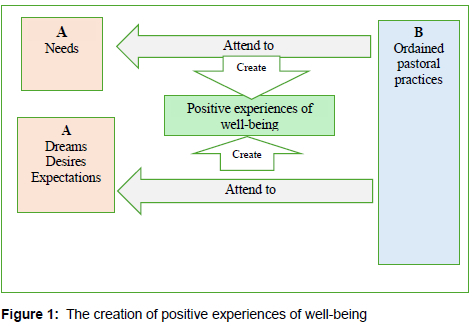
The mutual relationship (of needs and answers/support) create positive experiences of well-being in the lives of the members. Figure 1 illustrates the mutual relationship between the needs, dreams, desires, and expectations of the members (A blocks), and the attention of ordained pastoral leadership (B block) in answer to and support of the quest of members. This seems so easy. When pastors answer the call of members, positive experiences of well-being are created. The empirical data show that there is more to it. The characteristics and attitude of pastors towards their practices play an important role in how the members experience the attention and support regardind their needs, dreams, and expectations.
There are several examples of the involvement of pastors in the lives of people living within a context of poverty. These include material, physical, emotional, relational, and spiritual support to the congregation and the community. Members and leaders report about the support actions and the provision of resources from their pastors. They are full of praise for their pastors. They acknowledge their availability, good character, and involvement with children. They appreciate all the support that enriches their lives and well-being. Members value pastors for the resources they source and make available to them: from food to an opportunity to be heard.
Through their involvement in congregations, pastors play a pivotal role in the mentoring and practice of a missional ecclesiology. Regular times of reflection ensure that the congregation, within a context of poverty, remain relevant and attend to the needs of their members and the people in the community.
Pastors and their congregational leadership take time to reflect and evaluate the congregational practices. Without reflective practices, the pastor could lose credibility and trust. Consequently, when the pastor fails to maintain the trust and respect of the members, s/he will not be able to guide the congregation through troubled waters. When the pastor is unable to support the needs of members in challenging and changing circumstances, the members lose trust, faith, and hope. This could be the beginning of a downward circle to deprive them of well-being. The reflective practices of a congregational pastor within a context of poverty are a power to be reckoned with, a necessary practice to enrich people's lives of well-being.
When pastors lead by example, show respect, and ensure that they interact decently with their congregants, it enhances members' feelings of well-being. To lead by involvement and example is a sign of respect for themselves and others, and the pastor creates trust between him and the congregants. Other reasons given by the members for substantiating the trustworthiness of the pastor are the reliability of the pastor; the pastor is a man of his word; the pastor has good values, norms, and character; the pastor builds trust through engagement with the people; the pastor, as part of the team of leadership, creates trust, and the pastor overcomes the challenges of confidentiality.
Trust is an important characteristic in the professional practices of a pastor within a context of poverty. The reports of people stating that they love their pastor and that the pastor is a good man, are signs of trust. This trust is created and sustained by constant involvement in the lives of leadership and congregational members and other leaders. The pastors practise as good and trustworthy servants and the acceptance of their authority granted by God and the congregations. These trustworthy practices are building blocks towards positive experiences of the well-being of people within a context of poverty.
The literature revealed special elements of service, authority, character, and specific competencies that are essential for congregational leadership. However, congregational leadership also involves reflective practices that contain elements of interpretation, listening, cultivation of culture, constant evaluation and reflection, as well as planning. Pastors who constantly reflect on their personal relationship with God, their calling, their competencies, character, congregational practices, and ability to plan, will be relevant not only in the lives of their congregants, but also in guiding the congregations in practising the missio Dei. When the pastor's practice reveals relevancy, it spills over to the congregation and the practices.
3.3 Challenges
When comparing the empirical findings with the literature on leadership and poverty, the importance of the role of the pastor in the practices of congregations within a context of poverty becomes evident. The empirical data revealed the challenges that congregational pastors, within a context of high incidence of poverty, deal with every day. When they constantly evaluate and reflect on change and challenges, they can remain relevant in their practices. The pastors' actions are relevant when they teach, guide, and mentor congregations to act as God's pipeline to the world - not only as carriers of faith, but also as servants and carriers of material support. Through faith formation and authoritative servant leadership, pastors enhance well-being in their communities. The two elements (faith and service) of a missional ecclesia go together. Within a context of poverty, bringing hope through faith formation, support, personal development, and the creation of sustainable well-being should happen together. The relevant congregational leadership calls for an ordained pastoral leader who acts as the main initiator, teacher, motivator, and mentor in the practices of congregations.
Congregations should be places or opportunities where development in the context takes place. The potential of people should be developed and enhanced. They need to participate in the creation of their own self-esteem, in order to take part in the development of their community. This poses, among the challenges that the data revealed, yet another challenge to pastors. Do they have the knowledge, resources, and skills to aid in the development of people in the context?
The challenge for the pastor is to be innovative and to obtain knowledge that s/he may be lacking. Therefore, pastors need regular evaluation of the practices and resources of their congregations. Osmer's (2008:4-29) hermeneutical tasks come to mind. When pastors familiarise themselves with proper interpretation skills and regularly apply them, the reflection and evaluation elements of the professional practice become a habit. The reflection and evaluation should be on a personal level as well as on congregational practices. Pastors should take opportunities for retreats, reflection, and personal growth of character. The research data shows the importance of the role of the pastor in practising a missional ecclesia in congregations.
On a congregational level, pastors must stay abreast of knowledge about the context, changing times, and relevant developments in the environment. When they have the relevant knowledge, they will be able to guide the congregations in the reflection and evaluation processes. These processes will determine relevant (ideal) future planning and practice. Where the resources of other partners and authorities are needed, the pastors should call for their assistance. Pastors must always act in the best interests of the congregations who granted them the authority to lead and guide them. This implies that they should make use of all possible resources and knowledge available. Pastoral leadership, within a context of poverty, empowers people with resources, skills, and knowledge. By implementing regular reflection and evaluation, the pastors can guide the congregation in sustainability, not only for the longevity of the congregation, but also for the well-being of their members and the community. To guide their congregations in reflection, evaluation, and adaptation in changing and challenging times, pastors must use all the resources at their disposal. These resources, in turn, will assist the well-being of people living within a context of poverty.
Positive experiences of well-being reveal that practices of a missional ecclesiology contribute to positive experiences of well-being among people living within a context of poverty. According to the empirical data, themes on ordained pastoral practices, positive experiences of well-being, and reflective leadership, the research brought forward the importance of the role of the pastor as pivotal in the practice of congregations. The missional practice of congregations depends on the pastor. When a pastor does not know and understand the context of poverty, the congregation will find it difficult to be involved and practise a missional ecclesia.
4. PASTORS AS POWER SOURCES FOR A RELEVANT CONTEXTUAL MISSIONAL ECCLESIOLOGY
When pastors practise and encourage a missional approach in their congregations, they contribute to the healing of God's people - especially within a context of poverty. A context of poverty poses obstacles to the well-being of people and needs to be healed of brokenness. A context of poverty duly needs pastoral servants who practise a missional ecclesiology relevant to their communities.
Gehman (2008) opines that a servant leader (God's representative acting as a disciple) is under God's authority. However, to serve does not mean to have no authority. The pastors have authority and are in a position of power in their congregations. They are also servants called by God to minister to his people. God grants pastors the power to lead and gives them the authority over his people and his bride, the church, to guide and mentor them in similar lives of servanthood. God grants the pastors the authority to pass on his mission to the world, by making true followers and disciples in his kingdom. In this calling, pastors find personal authority to proclaim the gospel, to minister to congregations, and to be spiritually involved in the lives of people. In a survey among spiritual leaders in America on the importance of the congregants' acceptance of their leaders, Carroll (2006:154) realised that "[a]ll [clergy] emphasize the great importance of having a call from God, being competent in ministry, and gaining member trust". The researcher agrees with him when he states that,
[a]lthough God's call is an important part of both official and personal authority, competence and trust are especially important for personal authority.
A call from God is the foundation of personal authority.
Apart from the personal or informal authority granted to pastors, there is also the formal or official authority granted by their denomination and/or congregation. In the context of the research, pastors of the DRC, DRCA, and URCSA denominations are granted legitimacy by their denominational council of curators. Once pastors are legitimised, they may be called by congregations to serve as their congregational pastor. When pastors accept their first call to a congregation, they are ordained in the professional practice of that congregation. Their ordination grants them the authority to practise their calling in the specific religious community. Unfortunately, ordination does not mean that the congregants instantly trust the pastor with the ministry or their lives.
Trust takes time to develop. Although trust is the heart of personal authority, it only becomes embedded in formal authority when it is established between congregation and pastor. Carrol (2006:153) calls the establishment of trust a "second ordination". Through nurturing the practices of "consistency, dependability, openness, hard work, impartiality, and ever-deepening spirituality" (Carrol 2006:153), trust is earned and established between congregations and their pastor.
[W]e [the people] grant them authority or legitamacy because we have come to trust them as reliable representatives and interpreters of God's power and purposes (Carroll 2011:35).
Carroll (2011:51) maintains that
[p]astors must earn the respect of their parishioners by their personal attributes regardless of the standing that their office may give them.
A relationship of trust brings forth an openness in mutual care and responsibilities between pastors and congregants. Established trust eases out pastoral care. People become open to the teaching and mentorship of the pastors. The professional practice of the pastors becomes a sign of the authority granted to them.
Authority is not empowerment. Pastoral authority must always be used for the good of people. Authority is granted to pastors in order to guide, mentor, and minister their congregations to a life of well-being. The power associated with authority is the consent that pastors receive to do everything in their capability to minister the congregations in their ecclesiastic identity. Pastors are responsible to use their authority to the benefit of the kingdom. The well-being of God's people comes first.
[T]rue leaders never seek to promote themselves but only a mission connected to the people they lead. The mission - and not the position -is the platform from which to lead. In other words, the desire to improve the lives of others gives a person the mandate to lead (Mhlophe 2018:xii).
By executing authority with integrity, pastors answer the call of being servants to the people. The data emphasises the relevancy of authoritative servant leadership, characterised by a mutual relationship of people's needs and ordained pastoral support.
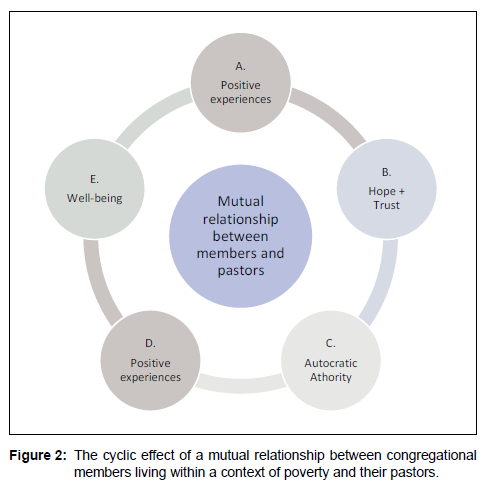
Although pastors are servants in the congregations, the congregations grant them the authority to guide, teach, and mentor them. The empirical research reveals that there is a fine line between the authority and autocracy that the people in poor communities grant their pastors. The people in poor communities grant their pastors the authority to be autocratic in their leadership if they can trust the pastors. Because of their positive experience regarding lives of well-being, their faith and hope lead them to depend on the pastors as resources and doors to other resources. They adhere to everything the pastors teach and command. They depend on the service and support of the pastors.
The honest practices of the pastors, together with practices of faith formation in the lives of congregational members, create hope and trust. Because of their trust in the authority of the pastors, they expect their pastors to lead them (and the congregation as a whole) to sustainable lives of well-being. Block C in Figure 2 reveals that members trust their pastors to such an extent that the pastors may act with granted autocratic authority. Through practices of faith formation, pastors create and enhance hope among congregational members. The trust in their pastor, together with the hope the pastors created in them, drive the members to rely on their pastors with any decisions, actions, and guidance for their lives. They willingly submit to the granted autocratic authority of the pastors if they provide, fulfil, and support them towards enhanced experiences of well-being. Because pastors lead with perceptible good character, good intentions, care, and involvement, members submit to their granted autocratic authority.
5. CONCLUSION
The professional practice of granted autocratic authority by ordained congregational pastors within a context of poverty is imperative to sustainable positive experiences of well-being of the congregational members.
By executing authority with integrity, pastors answer the call of being servants to the people. When people within a context of poverty trust their pastors to lead with authority, they (blindly) trust them with their lives. They grant their pastors autocratic authority to secure well-being in their lives. Research illustrates the importance of the authoritative role of pastors in practising a contextual missional ecclesia in a congregation. It is evident that autocratic authoritative pastoral leadership enhances the relevancy of a contextual missional ecclesiology in congregations within a context of poverty.
BIBLIOGRAPHY
- Ammerman, N.T., Carroll, J.W., Dudley, C.S. & McKinney, W. 1998. Studying congregations. Nashville, TN: Abington.
-
Bosch, D.J. 1991. Transforming mission. Paradigm shifts in theology of mission. New York: Orbis Books. https://doi.org/10.1177/009182969101900203
» https://doi.org/10.1177/009182969101900203 - Burger, C. 1999. Gemeentes in die kragveld van die Gees. Stellenbosch: CLF-Drukkers.
- Carrol, J. 2006. God's potters. Pastoral leadership and the shaping of congregations. Cambridge: Wm B. Eerdmans.
- Carrol, J. 2011. As one with authority. Reflective leadership in ministry. Second edition. Eugene, OR: Cascade Books.
- Cilliers, J. 2007. Creating space within the dynamics of interculturality: The impact of religious and cultural transformations in post-apartheid South Africa. Berlin, Germany: Transaction Publishers.
- Gehman, R.J. 2008. Learning to lead. The making of a Christian leader in Africa. Wheaton, Ill: Oasis International Ltd.
- Guder, D. 1998. Missional church: A vision for the sending of the church in North America. Grand Rapids, MI: Wm B Eerdmans. The Gospel and our culture Series.
- Guder, D. 2015. Called to witness: Doing missional theology. Grand Rapids, MI: Wm B. Eerdmans. The Gospel and our culture Series.
- Hendriks, H.J. 2004. Studying congregations in Africa. Wellington: Lux Verbi. BM.
-
Hermans, C. & Schoeman, W. 2015a. Practice-orientated research in service of designing interventions. Acta Theologia Supplementum 22:26-44. https://doi.org/10.4314/actat.v21i1.4S
» https://doi.org/10.4314/actat.v21i1.4S -
Hermans, C. & Schoeman, W. 2015b. Practice-orientated research in practical theology and congregational studies. Acta Theologica Supplementum 22:45-63. https://doi.org/10.4314/actat.v21i1.5S
» https://doi.org/10.4314/actat.v21i1.5S - Max-Neef, M. 1991. Human scale development. Conception, application and further reflections. New York: Apex.
- Mhlophe, A. 2018. A passion for position. A call to servant leadership. Tygervalley, Cape Town, South Africa: Struik Christian Media.
- Nel, M. 2015. Identity-driven churches. First edition. Wellington: Biblecor.
-
Niemandt, C.J.P. 2012. Trends in missional ecclesiology. HTS Teologiese Studies/Theological Studies 68(1):Art. #1198, 9 pages. https://doi.org/10.4102/hts.v68i1.1198
» https://doi.org/10.4102/hts.v68i1.1198 - Niemandt, N. 2019. Missional leadership. Cape Town: AOSIS. HTS Religion and Society Series.
- Osmer, R.R. 2008. Practical theology. An introduction. Grand Rapids, MI: Wm B. Eerdmans.
-
Schoeman, W. 2015. Exploring the practical theological study of congregations. Acta Theologica Supplementum 22:64-84. https://doi.org/10.4314/actat.v21i1.6S
» https://doi.org/10.4314/actat.v21i1.6S - Van Gelder, C. 2000. The essence of the church. A community created by the Spirit. Grand Rapids, MI: Baker Books.
- Van Gelder, C. 2007. The ministry of the missional church. A community lead by the Spirit. Grand Rapids, MI: Baker Books.
Date accepted: 11 November 2024
Date published: 17 December 2024
2 At the time of this research, the poverty line for household incomes in South Africa was approximately R6,500 per month.