Eternal bonds: Families as divine stewardship beyond the world
Abstract
The parent-child relationship is characterised by an enduring bond that transcends conventional familial dynamics, reflecting a deep sense of intimacy and permanence. While the dissolution of spousal relationships is societally normalised, the notion of "ex-parent" or "ex-child" remains anomalous, highlighting the unique nature of this connection. However, the rise in familial violence in Indonesia, often influenced by socio-economic disparities, exposes a critical breakdown in this sacred relationship. This article examines the theological construction of the parent-child relationship by way of the stewardship framework, drawing on the Christian tradition. Anchored in the Torajan cultural practice of Passiliran - a funerary ritual that symbolises the burial of infants in trees as an act of eternal care - the article reinterprets the theological significance of stewardship as extending beyond familial roles to encompass a reciprocal and interconnected relationship with God and creation. Engaging Michael W. Austin's conceptualisation of stewardship, this article offers a reimagined theological perspective on familial relationships as synergistic, sustainable, and reflective of divine interrelatedness, providing a pathway toward restoring harmony within family systems.
Divine stewardship; Parent-child relationship; Passiliran ritual; Cultural theology; Christian ethics
1. INTRODUCTION
The bond between children and parents is perpetual and cannot be readily severed. For instance, the terms "ex-wife" and "ex-husband" are readily understood, yet the expressions "ex-mother", "ex-father", or "ex-child" evoke a distinct connotation, since these relationships transcend mere familial ties, embodying a profound and enduring connection. In their research on family and poverty, Daly and Kelly (2015) discovered that the vast majority of respondents highlighted the significance of children within the family. Some regarded them as a source of pride, others as a means of imparting purpose to parental life, while some concentrated on the objective of distributing family resources (Daly & Kelly 2015:87). Daly and Kelly point out that parents had expectations for their offspring, while also exhibiting motivation in the act of parenting. In this role, it is evident that both parents and their offspring seek to be regarded and integrated as members of the family.
Tragically, several cases of violence, including the murder of parents by their children and vice versa, are prevalent in Indonesia. For instance, a woman severed the neck of her 7-year-old child (Llewellyn 2022); a father murdered four of his offspring (Dancel 2023); a police officer fatally assaulted his mother with a gas canister (Regar 2024), and a 14-year-old child fatally attacked his father and grandmother, subsequently injuring his mother (Guardiola 2024). Some news accounts illustrate the problem in the parent-child relationship in Indonesian society. The perpetrators of murder no longer consider the age or professional background of individuals within the community, regardless of whether they are teenagers or police officers. Research conducted by Sugiharti et al. (2023:1) across 34 provinces in Indonesia indicates that poverty and wealth disparity serve as markers of rising crime rates, particularly domestic crime. This indicates that economic and financial issues influence familial interactions, hence impacting the roles of parents and children within the family structure. The author explores the theological framework regarding the notion of parents and children within the context of the Christian religion.
The author recognises the significance of examining the concept of stewardship within the family context. This article analyses the dynamics between parents and children through the lens of a traditional aspect of Toraja culture in South Sulawesi, Indonesia (the author's native region), with the specific focus on the cultural practices of Passiliran. Passiliran (the funeral of a baby under a tree) symbolises the profound significance of eternal stewardship, including not only the bond between parents and children, but also a deeper connection with God and nature within an interrelated existence. This article starts with a description of the conventional Passiliran. This is followed by the interpretation of stewardship ideals from the perspectives of Michael W. Austin. The third theological framework of everlasting stewardship proposes an interpretation of the duties and interactions between parents and between parents and children that is synergistic and sustainable, reflecting a reciprocal dynamic dynamic akin to God's connection with creation. The article ends with the conclusion.
2. THE PASSILIRAN TRADITION - BABY FUNERAL
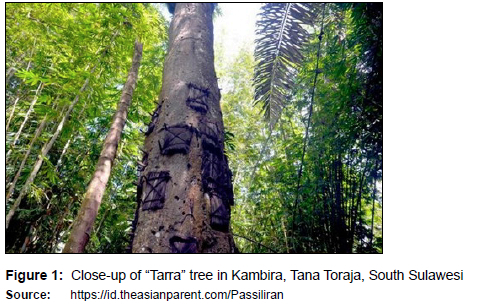
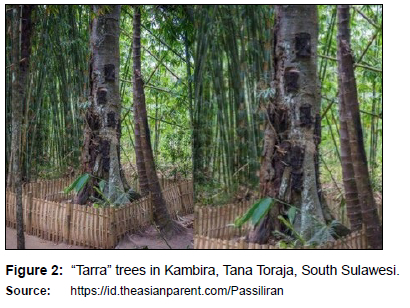
Passiliran is a form of burial procession conducted in the Kambira region of Lembang Buntu, Tana Toraja, South Sulawesi (Irsa 2011:86). In this custom, a deceased infant is interred differently from an adult or elderly individual, who is entombed in a cave, rock, or cliff by excavating a cavity for the coffin. The Passiliran tradition involves interring deceased infants within trees by perforating the trunk; however, the designated tree for this practice is exclusively the Tarra tree, characterised by a substantial diameter ranging from 80 cm to 300 cm. Scientifically, this tree possesses a taproot that develops systematically, resulting in the formation of cavities (Utomo 2014:243). The choice of the tree for the baby's burial considers both its shape and development, which are influenced by specific meanings. Notably, in addition to possessing chambers appropriate for housing infant remains, the Tarra tree is selected for its abundant sap.

The sap of the tree, which is milky white, is considered by the local people as a substitute for breast milk for buried babies. Meanwhile, babies who died and were buried in the hole of the Tarra' tree are considered to be returned to their mother's womb, so that it is hoped that they can save babies born later (Kusuma 2016:105).
The Passiliran funeral procession is characterised by its simplicity, since it involves merely filling the tree hole with palm oil and the deceased infant who is naked like a newborn in a mother's womb. Moreover, according to the Passiliran custom, the social status of the infant is discernible by the burial site's elevation; if the parents belong to a higher social class, the burial spot within the tree hole will be situated at a greater height (Kusuma 2016:105). Not all deceased infants are interred beneath the Tarra tree; certain restrictions apply to those infants under the age of six months, who have not developed milk teeth, cannot walk, and are still nursing (Ilma & Bakthawar 2020:17). The essential circumstances stipulate that infants interred beneath the Tarra' tree retain their sacred status, as the burial practice adheres to the Passiliran tradition and is not arbitrary. This tradition, akin to nature's sanctity, is philosophically viewed as the locus of human return following death, particularly with infants presumed to be sinless (Ilma & Bakthawar 2020:17). The Passiliran tradition emphasises not only the shape, location, and conditions of the infant, but also mandates that the orientation of the baby placed in the tree hole aligns with the direction of the bereaved family's residence. Decades later, the remains of the buried infant become integrated with the tree. This funeral practice displays a profound bond and stewardship that not only facilitates the connection with parents, but also links humanity with the environment and the divine.
3. STEWARDSHIP THEOLOGY
Stewardship involves mutual care within an equitable partnership. In the context of Christian ethics, Michael W. Austin (2007:7) defines a guardian as an individual entrusted with a significant asset that unambiguously does not belong to him/her. Austin uses the notion of stewardship in the context of parenthood to emphasise that parents serve merely as administrators, and that the ownership of children does not reside with them. This indicates that, while parents own complete biological rights to their offspring, it does not imply that they have the authority to treat their children as they like. For Austin, parental responsibility is analogous to environmental stewardship. Environmental managers engage in a reciprocal exchange of values with the environment; the inherent worth of environmental instruments shapes managerial actions that may affect the environment (Austin 2007:86). Austin indirectly points out that the essence of stewardship lies in the reciprocal connection, wherein the manager acknowledges the significance of the managed entity. The notion of stewardship defines the relationship between parent and child as a family unit of equal worth, where every action and choice influence and respect one another.
Consistent with Austin, Kreutter (2012) perceives stewardship as a trust that ought to be viewed as a harmonic relationship rather than a hierarchical one. Kreutter considers Psalm 8:4-8 to be a favourable aspect bestowed by God onto nature, rather than an impediment to God's redeeming work as the only creator; man's connection with nature is characterised as symbiotic rather than hierarchical (Kreutter 2012:27). Kreutter's interpretation of the link between human beings and the environment highlights an inclusive connection, rendering stewardship an interdependent and mutually supportive-symbiotic act. The wording of Psalm 8:4-8 is frequently used as a means to legitimise human authority, control, and dominion over nature. Kreutter (2012:27) posits that power should not be wielded destructively but rathe foster mutual support, as all earthly resources, both natural and artificial, are divine property, with human beings only acting as stewards. God is the ultimate source of all. Theological stewardship provides a viewpoint that considers others, nature, and God as interconnected relationships that nurture, develop, and equalise one another, rather than dominate the vulnerable or act contrary to their own volition. Kreutter's view can elucidate the responsibility of theology with the concept of family.
The bond between human beings and the environment exemplifies the unity of God, the ultimate owner. The family is thus also inherently God's. Rubio (2003:154) emphasises that the ultimate ownership of each family member is with God. If a family (parents and children) is aligned with God, then parental ownership of children and vice versa, constitutes a temporary stewardship, or, in Kreutter's terminology, a borrowing from God as the ultimate proprietor. Thus, the theological perspective fosters a relationship between parents and children grounded in love, kindness, and mutually reinforcing actions to refrain from dominating or oppressing one another.
Austin elucidates the notion of negative and positive duties in comprehending the dynamics between parents and their roles as managers of children. Negative responsibilities refer to the duty to refrain from certain activities, whereas positive obligations pertain to the actions that parents are required to perform for their children (Austin 2007:112). Austin asserts that stewardship activities entail rational deliberations and judgements on the treatment of others, particularly in the context of parenting. Austin's reasoning implicitly reveals that stewardship activities possess inherent constraints that consistently affect the dynamics between parents and children. Negative obligations encompass violence and neglect, whether emotional or physical, as well as indoctrination related to career, religious, and political choices. Positive obligations foster the development of children into independent individuals through both formal and informal education, ensuring an emotionally stable environment (Austin 2007:112-113). The negative and positive obligations establish a stewardship framework that promotes independence, while simultaneously imposing a duty to pursue the welfare of the relationship between parents and children.
According to Blomberg (2013:151), stewardship entails making prudent and effective choices such as allocating a portion of funds for the children's benefit. However, excessive generosity may foster laziness or lack of diligence. Blomberg employs the notion of prosperity to denote pragmatic acts derived from a stewardship paradigm within a Christian society. Austin and Blomberg implicitly indicate that theological stewardship constitutes a divine invitation for human beings to embrace their obligation and right to cultivate creative power, thereby influencing individuals' lives to develop holistic and autonomous persons, reflecting the work of God, the ultimate proprietor of all creation.
Austin and Blomberg's concept of theological stewardship transcends ethical obligation, encompassing theological responsibility through relational dynamics that characterise God's interaction with humanity. Austin and Blomberg perceive stewardship as a moral discipline grounded in wisdom and self-restraint, although its theological aspect emerges when regarded as a covenantal vocation rather than simply stewardship. Stewardship inherently implies relationships; it does not exist in isolation but within a framework of reciprocal commitments and trust. This relational viewpoint elucidates the divine connection between God and his people, characterised by caring, obedience, and loyalty as the basic elements of the covenant. Indisputably, stewardship derives its theological significance from this basic covenant, serving as a manifestation of loyal relationship between human beings and God.
The interpretation of the covenant within the Old Testament is clearly fundamental to religious life. Johnstone (1995) views the covenant as a social construct grounded in ancient human customs before gaining theological importance in the connection between God and Israel. Johnstone (1995:53) asserts that the covenant established at Sinai should not be perceived solely as a singular historical occurrence, but rather as a relational bond that has been recognised in Near Eastern culture, wherein two unrelated parties voluntarily commit to each other through mutual obligations. He avers that the covenant represents a change of social order into a theological symbol signifying God's commitment to his people. Conversely, Johnstone's study indicates that covenant theology fundamentally diverges from human relational logic, which subsequently forms a bond uniting the divine and human in loyalty and accountability. Comprehending the covenant theological perspective influences the notion of stewardship, perceived as an extension of covenant practice, wherein human beings act as partners with God in the stewardship of life - a relationship founded not on hierarchical authority, but on mutual loyalty that encourages creative responsibility towards creation.
Circumcision is a fundamental covenant practice that establishes the link between human beings and between human beings and God. Sorenson (2024:3) asserts that circumcision in the Old Testament is integral to God's economy of grace, functioning as a sacramental seal of righteousness attained through faith. This practice signifies the people's engagement in God's covenant with Abraham, not only as a physical rite or a marker of social identity, but also as an act that unites mankind with the divine promise. Sorenson's view on circumcision illustrates the profound and intergenerational basis of humanity's connection with God. Transcendent denotes that the human response is initiated by God, who first established the covenant, whereas intergenerational means that the significance of circumcision extends beyond the individual to serve as a covenantal sign for his descendants, thereby bequeathing not only physical lineage, but also God's promise, spiritual identity, and fidelity to the covenant.
Sorenson (2024:3) asserts that a flawed comprehension of the sacramental nature of circumcision may undermine the basis of New Testament sacramental doctrine, particularly baptism, which supplanted circumcision as the sign of admission into the family of God. Sorenson's view indicates that the practice of circumcision, which subsequently served as the foundation for the sacrament of baptism, represents an assertion of human duty, specifically that of parents, to uphold a relationship with God. Sorenson's examination of the sacramental
dimension has theological ramifications for comprehending the relationship between parents and children, indicating that parents who nourish and care for their offspring partake in upholding God's timeless promise that surpasses both time and the earthly realm. Austin and Blomberg's concept of stewardship emphasises that parents serve as "stewards of divine promise", responsible not only for the biological well-being of the child, but also for imparting God's faith, loyalty, and truth.
4. ETERNAL BONDS: FAMILIES AS DIVINE STEWARDSHIP BEYOND THE WORLD
The family is a unit or group that disseminates God's love both internally among its members and externally among the broader community and society. In defining family from a Christian perspective, two contrasting opinions emerge: conservative and liberal. Rubio (2003:17-18) asserts that liberal theologians are generally more inclusive and adaptable in recognising various family structures and the evolution of cultural contexts, whereas conservative theologians adhere to traditional family models, positing that the ideal family aligns with religious standards. The family is shaped by its cultural and social context, leading to inevitable changes in familial relations, due to this dynamic process. However, this does not suggest that the Christian family abandons the values of faith that have sustained its integrity; rather, a balance of openness and continuity remains essential to the concept of family. This prompted my concurrence with Cahill's (2000:xii) characterisation of the Christian family as a catalyst for social change, which prioritises personal welfare while also engaging in transformational societal acts. The family, as a fundamental aspect of human social needs, is intrinsically connected to society, warranting a broadened definition of family to acknowledge its role as a transformational force. No entity is flawless, including familial units.
Familial care beyond a mere moral or social obligation embodies a divine imperative to cultivate connections that mirror God's love. Authentic attention and concern are the mechanisms whereby family members cultivate the experience and expression of intimacy - the capacity to be entirely present for others, comprehend their needs, and share life genuinely within the love of Christ. Balswick et al. (2021:139) point out that, from a modern point of view, just as God designed human beings for communal existence, children require not only a family, but also families -a setting where family members flourish within a community of faith. Families not only consist of biological relations, but they also encompass a broader segment of communities. For example, instruction on equality should be imparted within the family unit to enable each child to apply it within society. The practice of cooking is not exclusive to women; males also participate, along with tasks such as laundering, cleaning floors, and helping mothers with shopping. Although seemingly straightforward, these activities provide youngsters with the resilience necessary for independence and the capacity to engage in responsible employment. Balswick et al. (2021) assert that life fundamentally revolves around providing and collaborating for the collective benefit, rather than seeking personal service. This serves as a crucial foundation for social well-being, as a thriving society consists of individuals who are considerate and accountable for both themselves and others. It results in individuals possessing better balanced life skills, enabling them to care for others and contribute to their families and communities.
Furthermore, the family constitutes a cohesive unit and is also under the divine authority of God. Stewardship theology provides a framework for comprehending that familial ownership, whether from parents to children or vice versa, constitutes a divine stewardship that is beyond earthly bounds, as it is founded on God's role as the ultimate owner. In Toraja culture, the philosophical significance of tradition posits that children, from birth to death and beyond, are the property of the creator; hence, upon his/her departure from this world, a child is expected to return to the creator. This practice not only communicates the significance of a child's role in communal life, but it also reflects an implicit recognition by parents that children are entrusted with property, necessitating a willingness to relinquish it, particularly in the face of death. Judd and Judd (2017:259) elucidate that, within the early setting of Christianity, marriage and family provide two forms of "social" virtues, integral to God's purpose and glory, and simultaneously represent the manifestation of everlasting life and eternity for humanity. Judd and Judd's viewpoint illustrates that eternal familial connections are not simply a divine gift to humanity but are integral to God's design for individuals to navigate existence on this transient planet. Judd and Judd (2017:259) assert that the family precedes the church as God's instrument for the salvation of his children. This indicates that the family's value, as a reflection of God's perpetual salvific work, aligns with the connections among family members, wherein each individual, whether parent or child, participates equally in God's salvific endeavour, which is not merely transient but eternal, encompassing life until death.
The perpetual connection established in the divine relationship between God and humanity ought to serve as the foundation for comprehending familial relationships that rejuvenate and strengthen one another. Austin (2007:61-63) elucidates the absolutist and quasi-absolutist interpretations of parental rights concerning children. The absolutist perspective regards parental authority over the life and death of children as an inherent right, whereas quasi-absolutism perceives parents as the ultimate decision-makers in issues impacting their offspring. These two concepts undeniably influence the interactions between parents and children. Austin (2007:63) indirectly conveys his moderate stance while emphasising his stewardship perspective by acknowledging the influence of parents on children, while also asserting that children possess moral status. The stewardship relationship establishes a balanced dynamic between parents and children, wherein children possess autonomy while parents retain the obligation to thoughtfully consider the relationships that mutually affect one another.
Traditional Passiliran conveys the concept of stewardship as a harmonious unity between humanity and nature, aligned with the divine purpose of God's ownership. Austin (2007:63) points out that parental stewardship of children parallels environmental stewardship. Nature can affect human existence, while the presence of children, in terms of stewardship, can influence the lives of parents, and conversely. The exchange of values between parents and children establishes a durable bond that offers connection and is both enduring and sustainable. Traditionally, Passiliran holds that the tree's sap, resembling milk in colour, is regarded by the local populace as a substitute for breast milk for interred infants. It demonstrates assurance in the harmony between humanity and nature, as well as the bond between mothers and their offspring. This indirectly indicates that the effect of stewardship is unity rather than division. Stewardship unites parents and children, enabling mutual support during familial separations, particularly between parents and offspring. Stewardship may be perceived as a failure to unite interdependent relationships.
Furthermore, the family constitutes an enduring connection that renders the act of stewardship a privilege rather than a harmful or detrimental endeavour. In traditional Passiliran, it is believed that a baby interred in a tree is akin to being in the mother's womb, which can also supply milk as a source of sustenance. Philosophically, this illustrates that the relationship between parents and children within the framework of stewardship is mutually invigorating. Judd and Judd (2017:260) observe that, despite its imperfections, the family possesses a significant capacity to confer blessings. Austin (2007:105) posits that the duty of parents to meet their children's responsibilities is a manifestation of affection, closeness, and love. Parents subsequently assume the role of managers for their children through acts of love and care, creating an environment where both parents and children experience the power of blessing. While it is indisputable that parents cannot fulfil all of their children's fundamental needs, they serve as stewardship agents who offer affection and intimacy.
In everyday life, this can be achieved by allowing time for prayer during separations, facilitating the sharing of experiences, and celebrating each significant life event, thereby fostering a positive stewardship relationship between parents and children. Judd and Judd (2017:260) cited Michael Novak, stating,
My dignity as a human being relies more on the quality of my role as a husband and parent; my connections with them (wife and children) do not resemble bonds, yet these connections constitute my liberation.
Novak's view in Judd and Judd's writings indicates that the foundation of humanity is intricately linked to parental identity; the familial bond serves as a framework for recognising an unrestrained yet liberating connection that celebrates love and a shared existence.
This is further underscored in God's covenant with his people, exemplified by circumcision. It represents human involvement in God's everlasting covenant, which necessitates accountability for preserving the sacred connection beyond generations. Sorenson (2024:26) posits that circumcision is not merely a legalistic ritual but a sacrament integral to the Gospel's proclamation in the Torah, wherein Abraham and his descendants, both physically and spiritually, obtain God's grace. In the context of stewardship, this signifies that parents and children are integral to God's grace, interconnected not only in the earthly realm but also profoundly, united in a relationship established within God. Parents have been provided with the duty to cultivate and transmit fidelity to God, ensuring that their position transcends simply biological or social functions to encompass spiritual and sacramental dimensions. Parents need not attain perfection to fulfil their roles as stewards, as the connection between children and parents represents an enduring relationship that signifies a unity of life, which remains inseparable even in death.
5. CONCLUSION
This article emphasised that the family belongs to God and must be understood through the lens of stewardship theology, where the relationship between parents and children is not characterised by absolute ownership but by sacred responsibility. Within the familial context, it underscores that the parent-child relationship should not be perceived as an absolute possession, but rather as a divine obligation. From the standpoint of stewardship theology, each child is a sacred gift entrusted to parents, rendering their tasks not solely administrative or social, but also spiritual and sacramental. This concept's theological implications contest hierarchical or possessive family structures that regard children as personal property or tools for parental advantage. The notion of sacred duty emphasises a relational dynamic founded on divine trust, wherein parents serve as stewards who nurture, guide, and transmit faith and spiritual qualities to their offspring. The ritual of Passiliran among the Toraja community exemplifies this principle that children are regarded not as human possessions but as divine blessings, and the practice of interring infants in trees signifies the child's return to the divine and nature. This practice asserts that parental obligation extends beyond earthly existence and that familial bonds are transcendent, enduring in a spiritual connection that surpasses death. The phrase "sacred duty" encapsulates the theological aspect of stewardship, wherein the family serves as a conduit for the manifestation of God's love, the transmission of faith, and the nurturing of human relationships with God and others through sacred and transcendent duties.
This understanding resonates with the insights of Judd and Judd, who view the family as part of God's redemptive design - a space where the dynamics of salvation are mirrored through relationships marked by grace, care, and fidelity. Similarly, Austin's ethical perspective on parenting highlights the importance of mutual influence and formation between parents and children. In his view, the family should cultivate relationships that are not based on coercive control, but on love, responsibility, and freedom. Such principles echo strongly in Passiliran, where the harmony between parent, child, and nature embodies a more holistic and life-giving model of stewardship. Scholars such as Judd and Judd view the family as part of God's plan of salvation, where relationships within the family reflect the eternal work of salvation. In the Passiliran tradition, the concept of stewardship also includes harmony between human beings and nature. The unity between mother and child in this tradition describes a relationship that enlivens, not separates, where families are supposed to support each other. The family, though imperfect, becomes the managing agent of affection, intimacy, and blessings that liberate and celebrate love. Ultimately, the family is considered to be an eternal bond that not only impacts temporary life but also the spiritual and divine dimensions, where the relationship of love and stewardship creates a mutually constructive living space until death.
BIBLIOGRAPHY
- Austin, M.W. 2007. Conceptions of parenthood: Ethics and the family. Ashgate Studies in Applied Ethics. Aldershot, England: Ashgate.
- Balswick, J.O., Balswick, J.K. & Frederick, T.V. 2021. The family: A Christian perspective on the contemporary home. Ada, MI: Baker Academic.
- Blomberg, C.L. 2013. Christians in an age of wealth: A biblical theology of stewardship. Grand Rapids, MI: Zondervan Academic.
- Cahill, L.S 2000. Family: A Christian social perspective. Minneapolis, MN: Fortress Press.
-
Daly, M. & Kelly, G. 2015. Families and poverty: Everyday life an a law income. Bristol: Policy Press. https://doi.org/10.46692/9781447318859
» https://doi.org/10.46692/9781447318859 -
Dancel, R. 2023. Indonesian dad arrested for allegedly killing his four children, aged 1 to 6. The Straits Times 8 December. [Online.] Retrieved from: https://www.straitstimes.com/asia/se-asia/indonesian-dad-arrested-for-allegedly-killing-his-four-children-aged-1-to-6 [15 December 2024].
» https://www.straitstimes.com/asia/se-asia/indonesian-dad-arrested-for-allegedly-killing-his-four-children-aged-1-to-6 -
Guardiola, J.A. 2024. South Jakarta teen arrested for killing father and grandmother, motive still unknown. Jakarta Globe 2 December. [Online.] Retrieved from: https://jakartaglobe.id/news/south-jakarta-teen-arrested-for-killing-father-and-grandmother-motive-still-unknown [16 December 2024].
» https://jakartaglobe.id/news/south-jakarta-teen-arrested-for-killing-father-and-grandmother-motive-still-unknown -
Ilma, A.A. & Bakthawar, P. 2020. Memaknai Upacara Kematian dalam Bingkai Lokalitas Budaya Indonesia: Studi Kasus Tiga Cerpen Pilihan Kompas. SULUK: Jurnal Bahasa, Sastra, dan Budaya 2(1) (July 2):14-22. https://doi.org/10.15642/suluk.2020.2.1.14-22.
» https://doi.org/10.15642/suluk.2020.2.1.14-22. - Irsa, M. 2011. 666 Misteri Paling Hebah Indonesia dan Dunia. Jakarta: Cmedia.
- Johnston, W. 1995. Exodus. Sheffield: Sheffield Academic Press.
- Judd, D.K. & Judd, J.D. 2017. The doctrines of eternal marriage and eternal families. In: C.J. Ostler & M.H. MacKay (eds), Foundations of the restoration: The 45th Annual Brigham Young University Sidney B. Sperry Symposium (Salt Lake City, UT: BYU Religious Studies Center), pp. 245-268.
-
Kreutter, K. 2012. Theology of stewardship. Verbum 10(1):25-31. https://doi.org/10.18804/jyt.2012.09.25.31
» https://doi.org/10.18804/jyt.2012.09.25.31 - Kusuma, B. 2016. Top 15 travel destinations in Indonesia. Jakarta: Gramedia.
-
Llewellyn, A. 2022. Why do mothers kill? In Indonesia, child's death prompts search for answers. South China Morning Post 27 March. [Online.] Retrieved from: https://www.scmp.com/week-asia/people/article/3171946/why-do-mothers-kill-death-child-7-forces-indonesia-ask [16 December 2024].
» https://www.scmp.com/week-asia/people/article/3171946/why-do-mothers-kill-death-child-7-forces-indonesia-ask -
Regar, R.F. 2024. Kasus Tragis Matrisida atau Anak Bunuh Ibu di Indonesia. 15 December 15 WIB. [Online.] Retrieved from: https://www.tempo.co/hukum/kasus-tragis-matrisida-atau-anak-bunuh-ibu-di-indonesia-1176837 [16 December 2024].
» https://www.tempo.co/hukum/kasus-tragis-matrisida-atau-anak-bunuh-ibu-di-indonesia-1176837 - Rubio, J.H. 2003. A Christian theology of marriage and family. New York: Paulist Press.
- Sorensen, L.S. 2024. Old Testament circumcision: Sacramental? Concordia Theological Quarterly 88(1):3-26.
-
Sugiharti, L., Purwono, R., Esquivias, M.A. & Rohmawati, H. 2023. The nexus between crime rates, poverty, and income inequality: A case study of Indonesia. Economies 11(2) (February 13):62. https://doi.org/10.3390/economies11020062
» https://doi.org/10.3390/economies11020062 - Utomo, W.P. 2014. Jeiajah Negeri Sendiri. Yogyakarta: Bentang Pustaka.
Date accepted: 9 October 2025
Date published: 12 December 2025
2 I would like to extend my profound gratitude to Prof. I. Sil Yoon, of the United Graduate School of Theology at Yonsei University, for her guidance during the Family Dynamics: Challenges and Opportunities course. She was instrumental in developing the ideas explored in this article.