The gender-responsive church: Models of religious community in realising alignment for women
Abstract
This research investigates the persistent disparity in evaluation, treatment, and access to opportunities across gender lines that pervades everyday life. Gender-based inequities, biases, and exploitation are entrenched within structural and cultural spheres. Within this framework, the church as a faith-based institution is called upon ecclesiologically to effectuate a ministry attuned to gender sensitivities. Employing qualitative methodologies, this study focuses on female congregants of the Nazarene Church in the Java-Bali district. Data collection was facilitated via Forum Group Discussions (FGDs) across five women's groups in the said district. The objective of this research is to elucidate a paradigm for church ministry that aligns more closely with gender-responsive principles. Through this examination, the study delineates four innovative ministry models in pursuit of gender egalitarianism: facilitative, participatory, assistive, and advocative.
Church; Gender-based; Religious community; Women
1. INTRODUCTION
The church is a religious institution that plays a pivotal role in the community's social life. Religion and all its "tools" spearhead the cultivation of understanding and implementing theological values in equitable practices (Jatmiko 2019). The intersection of religion and the state becomes a determiner of social control and establishes the integrity of national life (Abdillah 2013). Regarding gender issues, religious institutions, especially churches, need to not only voice, but also realise the implementation of equality, starting from within the community itself.
The church has a call to strive for a gender-responsive atmosphere in its programmes, policies, and interaction patterns. It should be conducted by the church in taking into account the church's call to serve the poor, support marginalised groups, voice equal rights, and contribute to addressing various issues around it (Ac 2:45; 4:32-35; 6:1-7). The great commission in Matthew 28:19-20 must be understood within the framework of the church's submission as the people of God by "[d]oing everything I have commanded you". It confirms that the ecclesiological praxis of the church is not only limited to the spiritual mandate of "preaching, converting, baptizing", but also loving your neighbours as yourself (Mt. 22:39); serving the poor (Pr. 22:9; Mt. 26:11; Mk. 14:7); defending the oppressed (Ex. 3:7-8; Ps. 12:5); siding with the poor, widows, and marginalised groups (Ex. 22:21-24; 23:9), and various other equitable praxis.
Gender responsiveness is one of the endeavours to pay consistent and systematic attention to the differences between women and men in society, supported by efforts to eliminate structural and cultural barriers, in order to achieve gender equality (Mastuti & Kemal 2010). In line with its call, the church should become a pioneer as well as a driving force, considering its strategic position as a life pillar in the religious Indonesian society. The church must also be present to learn the urgency of the gaps in assessment, treatment, and participation opportunities that occur between men and women. These gaps must be eliminated.
The COVID-19 outbreak is clear evidence that gender-based inequality and injustice still frequently occur in modern society. This pandemic caused not only epidemiological problems, but also a shadow pandemic in various fields of life, especially posing a threat to children and women as relatively more vulnerable social groups. Women are the group most frequently sacrificed in dilemma choices. For instance, in the case of economic turmoil, many job providers take efficiency measures, by terminating employment or adding working hours for the employees who are still employed. At the global level, the International Labor Organization (ILO) states that, during the 2019 and 2020 periods, 4.2 per cent of women's jobs were eliminated. This was equal to a decline of 54 million jobs. Across the world, the economic sectors mostly affected by the pandemic-like global crisis were micro-, small, and medium enterprises (MSMEs), the social sector, health, and education. Meanwhile, 70 per cent of the workers in these sectors were women (Victoria 2021).
Various factors triggered unfavourable situations, in which wives (women) are forced to take on multiple roles in the family. Gender issues, ideological and cultural influences, exploitation, and discrimination are also determinants that compelled a woman to engage in multiple roles during the pandemic. For instance, school closures due to the pandemic meant that children require special assistance when they learn from home (online). With or without a negotiation process, it is generally the wife who must take on multiple roles, in order to assist the children when studying (Kamila 2020; Rachman 2020).
Apart from the economic issues, greater demands imposed on women generally occur amid a dominant patriarchal culture. McLaren et al.'s (2020) study in Malaysia proves that several government regulations indicate a clear tendency that, during hard times such as a pandemic, only men are allowed to leave the house. By contrast, women are completely forbidden to go out and must stay at home. Within the same cultural context, this situation is exacerbated when women are particularly perceived as a weaker group and have a lower position. Ningrum & Mas'udah (2021) found motives of husbands coercing women to work or increase their workload, in order to meet family needs. Women's burdens are not only in the public sphere, but also within the family.
In addition to the points mentioned above, the social turmoil faced by women also targets their physical and psychological realms. Various problems generate the escalation of conflict, which leads to domestic violence and divorce (Bainus & Rachman 2021). Fazraningtyas et al. (2020) argue that the number of domestic violence has escalated during the COVID-19 pandemic. A number of studies have been conducted to find various factors that trigger violence against women. Peterman et al. (2020) mention that uncertainty and fear can result in a rise in the number of violence cases against family members, particularly women and children. Economic depression is also stated as the dominant factor that generates domestic violence (Van Gelder et al. 2020). These pressures then converge into stress triggers which ultimately become behavioural catalysts that result in violence in the family (Mazza et al. 2020; Usher et al. 2020).
Some of these studies indicate the need for assistance and the realisation of gender-responsive communities that support and assist women through these social dynamics. In the African context, the responsive role of the church has generally been apparent in assisting women against the HIV/AIDS outbreak (Moyo & Müller 2011; Marshall & Taylor 2006). Meanwhile, more studies on the role of the gender-responsive church still need to be conducted. Wowor (2021) mentions the urgency of this issue, by conducting a study in the context of Christianity, more specifically on the role of Christian education in addressing the rise in violence against women. This study is believed to be very crucial to giving awareness experiences for church leaders and educational actors to play a role in responding to physical violence that frequently occurs against women. Yet, the complexity of problems regarding gender equality issues also needs space for thought and real action, since the vulnerability of this social group is not only related to physical violence. This present research attempts to answer this gap.
The following research question needs to be answered in this study: "What kind of ministry models should the church as a faith community realise in playing a responsive role to women?" This research is aimed at finding gender-responsive faith community models. The findings are expected to be developed and modified in various contexts of ministry within the ecclesiological community. The research findings are expected to be reconstructed into gender-responsive ministry models for the church as a religious community.
2. RESEARCH METHODS
This article used a descriptive qualitative research method to explain the characteristics or nature of a predetermined phenomenon. By their nature, qualitative methods are applied to understand and interpret the meanings of a phenomenon or event of human behaviour interaction in a particular situation, according to the researcher's own perspective (Moleong & Surjaman 2011). Therefore, this method was employed to understand the meaning of the social dynamic in the group of participants.
The locus selected for this study was a group of women in the Nazarene Church in Java-Bali district. This district consists of 82 local churches with various numbers of congregations, geographical location, community context, pastor leadership style, financial capability, and various other unique factors. The research instrument used was a discussion scheme that included topics and questions which would be used in the Forum Group Discussions (FGDs).
Considering the distance, the geographical distribution of the respondents, and the pandemic situation, the data collection was carried out using two approaches: in person discussion and online through Zoom meeting. The selection of informants or research subjects was mainly based on the criteria determined by the researchers in advance, namely church members; age ranging from 25 to 60 years old, and being involved in church community activities.
The verbatim data collected was processed, organised, and analysed qualitatively using the atlas.ti app. The data coding conducted covered the process of open coding, axial coding, and selective coding. The data validity was conducted by triangulating data-collection techniques. The triangulation was done by applying data-collection techniques with FGDs, in-depth interviews, and direct observation to ensure information saturation and data validity.
In addition, the research was reviewed and approved by the appropriate ethical review committee, ensuring that it aligns with principles of respect, confidentiality, voluntary participation, and minimal risk to participants. Permission was hereby granted to the researcher to conduct this study among women affiliated with the Church of the Nazarene in Java-Bali district, under the following conditions:
1. Informed consent: All participants will be fully informed of the purpose, procedures, and their rights before consenting to participate.
2. Confidentiality: All personal information and responses will be kept strictly confidential and used solely for academic purposes.
3. Voluntary participation: Participation is entirely voluntary, and individuals may withdraw at any time without penalty.
4. Cultural sensitivity: The research will be conducted with utmost respect for the cultural and religious values of the community.
This approval is granted with the understanding that the researcher will adhere to the highest ethical standards in conducting the study.
3. RESULTS AND DISCUSSION
3.1 Field research results
The source of data for this research was obtained through an in-depth interview process at a Forum Group Discussion (FGD) among women in Nazarene Church in Java-Bali district in two local churches in Yogyakarta, representatives of the zones of Nazarene Churches in Central Java, Yogyakarta, East Java, and Jakarta. Two local churches in Yogyakarta were also used as research loci since Yogyakarta is one of the major cities in Indonesia.
In the next section, the discussion focuses on various findings in the research process conducted in the field. The discussion attempts to elaborate on the condition of each group collected in the FGD as a data-collection method. The discussion also presents specific conditions, problems faced, the role of the church, examples of appropriate responses for each context, as well as proposed programmes to meet the needs of gender-responsive churches.
3.1.1 Local Church 1 (Filadelfia Church)
Filadelfia Church of the Nazarene is a local church in Yogyakarta with 700-750 attendants in weekly services. The church has a Women Ministry Commission with a membership of 150 adult women aged 25-60 years. This commission is to meet the spiritual needs of women through regular and special programmes.
Through FGDs consisting of 15 members, the community admits that the church plays its role as an entity where Christian spiritual values are realised. God's love for all people, all genders, and all groups of people are successfully realised through various commissions, including the Women Ministry Commission. Through the involvement of the pastors' wives and the programmes in the Commission, women realise that the church is present and exists for their interest.
The ministry model used by the church is fairly varied for women. The church provides sufficient space for women to realise their existence and actualise themselves. Women are granted a considerable portion in church leadership to be part of the church assembly, chairperson of the Commission, and take on a role in teaching through sermons, commission ministry, congregational visits, and organising programmes. In addition, women are empowered as subjects, not solely objects of the ministry. Hence, women are involved in providing ideas and thoughts that are crucial for the development of the church ministry.
3.1.2 Local Church 2 (Agape Church)
Agape Church of the Nazarene is a local church in the suburbs of Yogyakarta, with a congregation of 150 people. This local church has 50 women involved in Women Ministry Commission. The FGD for this research conducted among eight people reveals the crucial role of the church as a community of faith that strengthens the fellowship bonds among them.
The COVID-19 pandemic has built an awareness and understanding of the role of the church in women's congregations. Amid health threats, social pressure, and limited interaction, the pastors and their wives, as representatives of the church, play a pivotal role in strengthening faith amid uncertain conditions. The pastors' greetings in the congregation's WhatsApp group every morning and prayers for the congregation are a means for the church to stay connected to the congregation and to pay attention and provide moral support. Group members admit that, during the pandemic, the bond of brotherhood was getting stronger because of the need to pray for each other, strengthen and comfort each other, and even the women's fellowship, which is carried out in a limited manner (time, distance, and number of attendees), became more meaningful concerning interpersonal relationships.
The church's ministry model to the congregation through online interaction in the WhatsApp group is a cure for longing and a medium for expressing love. Women who expect attention from others and pay attention to others have a medium to obtain and share love, even though it is only conducted online. In addition, they can also meet in the midweek ministry through Zoom.
3.1.3 Central Java Zone
The FGD for the zone was conducted among 28 participants who work as pastors and pastors' wives in Nazarene Churches in Central Java. The discussion shows that, through experience, women play a significant role in church ministry. Women get involved in all the elements of ministry in their respective local churches: teaching, preaching, counselling, visiting, prayer meeting, and worship service in various forms. The church admits the potential of women for ministry.
The group members acknowledge that individuals of all genders possess distinct strengths and capacities that contribute meaningfully to pastoral ministry. They emphasise the importance of inclusive ministry, recognising that the contributions of women - whether as independent leaders or in partnership with others in pastoral roles - enhance the effectiveness and reach of spiritual care. Women frequently participate in areas such as counselling and prayer ministry, offering particular value in contexts that may benefit from empathetic engagement and strong interpersonal communication. These capacities are not viewed as inherently gendered but as skills developed through individual experience and spiritual formation. In the realm of pastoral counselling, women, like their male counterparts, are capable of integrating psychological insight with emotional intelligence, thereby facilitating holistic and effective pastoral care. Such contributions are essential to the overall health and vitality of congregational life.
The group discussions show the expectations of women who are ministers in the local church. They expect that the church should further empower women ministers by running programmes to equip them to help other women to be more useful. The church needs to facilitate seminars and training and give opportunities for women ministers to advance their potential and talents. This will, in turn, return to the church as the beneficiary of the women's ministry.
3.1.4 East Java Zone
The FGD for this group, conducted among six people, focuses more on the role of women in the church's growth. The discussion reveals that the East Java Province Coordination is working on sending out women ministers, by issuing licenses by local churches to women ministers to be equipped in ministry with ministry courses. This phenomenon responds to the issue of how the church needs to be gender-responsive. Therefore, the church facilitates women to learn and be equipped for the task of ministry. It also encourages and motivates them.
The model and programme developed by women ministers in the East Java region is a model of mission ministry through a compassion programme. The East Java Nazarene Missions International (NMI) has become a model of soul outreach ministry for other Nazarene Churches in Indonesia. The predominantly female members of NMI mention that women engage very effectively, because taking action based on compassion is a woman's nature. Through compassion ministry to victims of natural disasters and marginalised communities, women get involved in soul outreach for church growth. Women involvement is not limited to ministry in the local church, but it can be extended to the external scope of the church.
3.1.5 Jakarta zone
The FGD consisting of five pastors and their wives represents the thoughts of women ministers in the church from Jakarta. Through the discussion, it is noted that the city of Jakarta, with all the characteristics of its people, finally leads the church to an understanding that, amid the harsh life of the metropolitan city, the church needs to be an oasis for the congregation. The characteristics of the congregation, in which nearly all people spend their time working in a harsh social environment, encourage the church to be able to help the congregation have a stronger Christ-like character. This is crucial so that the congregation is not immersed in the worldly values of the big city. Instead, the congregation can increasingly show its existence as Christians.
The model of gender-responsive church action from Jakarta zone is exemplary. Church leaders, both male and female ministers, are required to be able to have a way of life that is in line with Christ's call to be able to influence the congregation to live in Christ. The life of pastors and servants and the family life and relationships between members of the pastor's family should set an example for the congregation to imitate. The gender-responsive church needs to be realised in the family prototype of the pastor and the ministers. It surely encourages and challenges pastors, pastors' wives, and female ministers to be able to play a strategic role of women in the church. This model will be imitated by the congregation as a model.
3.2 Coding results and data processing
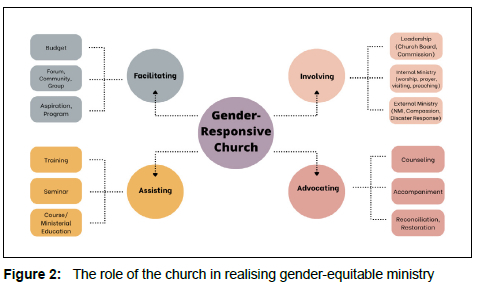
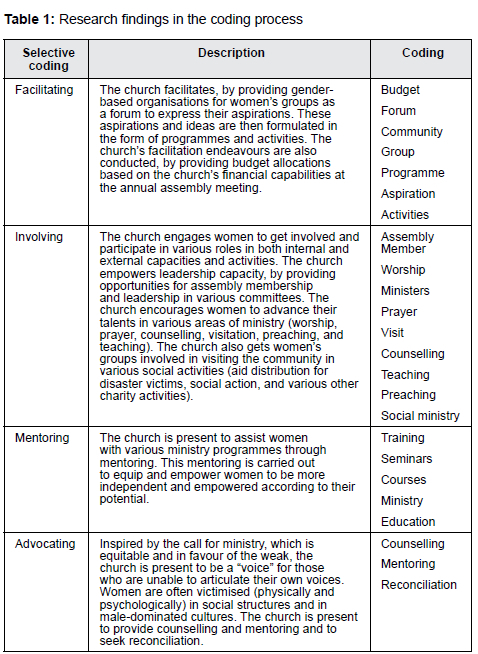
Based on the notes from the FGDs, the researchers conducted a process of coding and data processing. The open coding, axial coding, and selective coding processes are presented in Table 1 and Diagram 1. Table 1 displays various categories of variables (selective coding) after the axial coding process is conducted. The data processing shows various roles of the church in gender mainstreaming, namely facilitating, involving, mentoring, and advocating for women's groups.
3.3 Towards a gender-responsive church
The findings in this study depict a pattern that can be used as a model of the church as a gender-responsive religious community. identification of the roles taken by Nazarene Churches in the Java-Bali region shows characteristics of ministry that can be used as a community model that is more inclusive for women. Some of the religious community models proposed in this study to realise alignments with women are the facilitation, participatory, supportive, and collaborative models.
3.3.1 Facilitative model
Facilitation of women's empowerment in a religious community is aimed at increasing the contribution of women in self-actualisation and involving this group to play an active role in society. The church believes that every believer is called to grow and serve one another as members of the body of Christ (1 Cor. 12:27; Eph. 4:12). In general, the realisation of a gender-equitable religious community will contribute to the national sustainable development agenda (Prasetyawati 2018). Therefore, as a religious community, the church plays a crucial role as part of society to contribute to achieving national targets for the Gender Empowerment Index (IDG). The facilitation model places the church as a facilitator to create a space conducive to the growth of women's initiatives, participation, and aspirations (Pratama et al. 2023).
The facilitation model can be conducted by religious communities at the level of policies, programmes, and activities which eliminate gender inequality. At the policy level, the effort to realise a gender-responsive religious community is to establish a forum for women's organisations/groups that can accommodate the aspirations and interests of various women's groups (Lesyoningsih 2020; Wiyani 2017). The church facilitation model, which sides with women, is carried out by accommodating the interests and aspirations of this group in an officially recognised organisational structure. The following are actual examples from the findings. The policies mainstreaming gender at the policy level can be realised, by establishing gender-based ministry organisations in the church such as the Women's Commission, Mothers' Fellowship, Women's Fellowship, Indonesian Christian Women's Fellowship (ICWF), and Indonesian Nazarene Women's Fellowship (INWF). Such organisations contribute positively to the endeavours to empower women. With these organisations, as part of the church, women are not only accommodated for their aspirations, but they are also given ample opportunities to run various programmes and activities.
The facilitation step will boost community-psychological and community-structural empowerment (Hermawan & Sulastri 2023). This effort will foster a sense of belonging, mutual cooperation, mutual trust (cooperation, deliberation, a sense of security, and self-confidence), partnership, togetherness, social solidarity, and collective vision within the group (Lopulalan & Latuasan 2022). In addition, the facilitated group will be able to initiate collective actions and reinforce member participation in various innovations, ideas, and actions.
Gender-responsive church programmes and activities must also ensure that women's groups have access to facilities, resources, and programmes determined by the church. Gender responsiveness in public facilities within religious communities must accommodate the needs of user groups such as children, the elderly, the disabled, men, and women (Ummah 2019). Gender-responsive churches can provide facilities and infrastructure which are not only accessible to all user groups, but also comfortable and safe for users based on their needs (Esariti & Dewi 2016; Utami & Chairunnisa 2016). For instance, churches provide lactation rooms, separate toilets for men and women, proper height of stair steps, appropriate height of sockets or light switches, and so on.
The church's resources should be proportionally distributed to various segments of ministry, including gender-based ministry. It should be well understood that the process of gender mainstreaming deals not only with the allocation of power, but also with the equitable distribution of access to resources (Nurhaeni et al. 2011). The drive to design aspirational activities for women cannot, of course, be separated from material resources. Therefore, budget support is surely one of the indicators of a gender-equitable religious community (Aprianti 2022; Khaerah & Mutiarin 2016). The annual ecclesiastical budget should give budget allocations for group and gender-based organisations, and provide support for various programmes and activities, as well as supervision for the skill and capacity-building of women (Setianingsih 2018).
3.3.2 Participatory model
The participatory model has been developed in the context of community empowerment. It is a new scheme that replaces the development paradigm with empowerment, where human beings or social groups mainly participate in initiating, managing, and ultimately enjoying the results (Bihamding 2019; Bahua 2018). The peculiarity of this pattern rests on the fact that it is decentralised and democratic. In the context of gender-equitable religious communities, the church intentionally self-empowers, develops, and strengthens the position of women to play a role in various fields and sectors of life (Muchtar 2016). The Bible mentions that the call to contribute to building one another up is not limited by gender (Eph. 4:11), but all members of the body of Christ are called to play a role (Eph. 4:15-16).
A gender-responsive church with a participatory model will be committed to participating, or even entrusting women to work in building and responding to the needs around them. Participatory programmes contribute to gender mainstreaming endeavours in achieving effective programme results, since they are in line with aspirations from the bottom up and the abilities and needs of the groups involved (Agustana 2020; Nugroho 2017). In addition, this group will be more empowered with experience in designing, implementing, managing, and being accountable for the programme implementation efforts (Ras 2013).
The research conducted at the loci indicates appreciation from women as the space is available for them to participate. The women in Nazarene Churches in Java-Bali are not only given an organisational platform; they also feel very appreciated when they have an adequate chance to be involved in various charities and social community activities. For instance, women had the opportunity to raise funds, manage, and distribute aid during COVID-19, natural disasters, and various other social actions. Such things are needed to realise mainstreaming within a religious community.
The gender-participatory church strives to place women not as beneficiaries who always depend on outsiders. Yet, women are placed as subjects (agents or participants who do action) who are actively and independently involved. The gender-responsive church encourages women to be an independent group of participants by providing space and capacity to develop their potential, control their environment and resources, solve problems independently, and participate in determining policies and programmes by their aspirations (Agustana 2020).
3.3.3 Assistive model
The process of achieving a gender-equitable community requires strengthening the vision and initiation that grows from the bottom up and from the championed group itself. However, it is often found that structural and cultural situations shape the pattern of inequality in society so that the process towards empowerment requires "assistance" from outside parties (Zuhri & Amalia 2022; Sakina 2017; Susanto 2015; Aisyah 2013; Puspitawati 2013). This assistance or supervision is not to dictate, patronise, or determine every step to be taken, but it serves as a companion serving a sharing partner for empowered groups, making it easier to mobilise, organise, connect, give space, encourage, lift up, and so on (Saptatiningsih et al. 2015). In the mentoring process, the relationship between women's groups and the church as organisations and individual representatives is equal, respectful, and open. They also trust and learn from each other to grow together.
In the context of the church, the assistance model can be realised by paying particular attention to its existence as a religious organisation in society, as well as an organism/individual generally represented by clergy, assemblies, deacons, presbyteries, or devices within it. The community of believers has an ecclesiological call to embody love for the weak and marginalised groups through diaconal movements that empower and transform (Jatmiko et al. 2021; Pattiasina 2021; Siswanto 2016). The Apostle Paul provides a clear example of this pattern. In 1 Corinthians 9:22, he mentions that he sought to identify with the people he served, in order to empower them. To the Romans, Paul mentions that this is mandatory (Rm. 15:1).
The gender-responsive church that implements assistance patterns should strive to create a favourable atmosphere that enables the potential of women to develop (enabling). This idea believes that every individual member of the church has the potential or "talent" that needs to be developed (Mt. 25). In other words, no group or individual (including women) is completely powerless. Assistance or mentoring from the church is an effort to find and then develop that potential, encourage and build awareness of this potential, and strive to develop it (Setyobudiarso et al. 2016).
Inputs in the mentoring process can certainly be related to spiritual, moral, and character values such as honesty, hard work, frugality, openness, accountability, perseverance, and so on. Then, more tangibly, the church is required to create various opportunities for the development of women's potential (Saptatiningsih et al. 2015). For instance, the church provides opportunities for women to learn various skills, by conducting training in agriculture, skills, catering, financial management, and so on. The church can also collaborate and build partnerships with various parties such as the government, NGOs, civil society organisations, universities, MSMEs, and others to provide opportunities for women to develop themselves.
3.3.4 Advocative model
The role of advocacy is not unfamiliar in Christian theological discourse. The church as an assembly of believers believes that God calls every Christian to be an ambassador for him and an advocate for those in need (Ranubaya & Endi 2023; Pattiasina 2021; Gabriel 2019). The Bible abounds in verses in which God specifically asks his people to speak up on behalf of others who are oppressed, mistreated, and marginalised (Pr. 31:8-9; Dt. 16:20; Job 5:1516; Ps. 41:1; 50:6; Is. 56:1; Jr. 22:3; Am. 5:24; Zch. 7:9; Mt. 25:40; Lk. 11:41; 2 Cor. 8:13-15; Gl. 6:2; Ja. 1:27; 1 Jn. 3:17-18). The Bible conveys not only advocacy recommendations, concepts, and mandates, but also real narrative examples of people whom God calls to respond to injustice and how they serve as intermediaries for the oppressed.1
The advocacy role which needs to be conducted by religious communities also means protecting. Advocative empowerment schemes refrain the weak from becoming weaker, due to a lack of power before the strong (Sukma 2023). It is, therefore, crucial to side with women who are often the weak party. Normatively, the role of advocacy has also the meaning of protection, which prevents the domination over, and exploitation of the weaker by the strong (Lubis 2015).
As found in the research, women obtain meaningful support when the church carries out pastoral care ministry such as counselling, prayer, consultation, visits, and various other kinds of pastoral care. Furthermore, the church needs to consider its role to become an intermediary in various structural issues (exploitation, inequality, domination, hegemony, and so on). In cases of domestic violence, harassment, or exploitation, women are often restrained from speaking up, due to power imbalances and deeply rooted social structures that restrict their participation in decision-making processes and public discourse. These limitations are not a reflection of individual capability or courage, but rather the result of systemic barriers that marginalise female voices (Wulandari & Hana 2023; Haniffadhillah & Hidayati 2022; Sasmito et al. 2022). In such situations, the church must, of course, be present to listen to the voices of the victims and then speak up to represent them to the parties involved and to law enforcers as long as the process is needed. This call requires the church to be present not only to provide normative and ethical explanations from behind the pulpit, but also to do action outside the walls of the church to accompany and advocate for those who are unable to speak for their sufferings.
4. CONCLUSION
This research investigated the persistent disparity in evaluation, treatment, and access to opportunities across gender lines that pervades everyday life. Gender-based inequities, biases, and exploitation are entrenched within structural and cultural spheres. Within this framework, the church, as a faith-based institution, is called upon ecclesiologically to effectuate a ministry attuned to gender sensitivities. Employing qualitative methodologies, this study focused on female congregants of the Nazarene Church in the Java-Bali district. Data collection was facilitated via FGD across five women's groups in the said district. The objective of this research was to elucidate a paradigm for church ministry that aligns more closely with gender-responsive principles. Through this examination, the study delineates four innovative ministry models in pursuit of gender egalitarianism: facilitative, participatory, assistive, and advocative.
BIBLIOGRAPHY
-
Abdillah, M. 2013. Hubungan agama dan negara dalam konteks modernisasi politik di era reformasi. AHKAM: Jurnal Ilmu Syariah 13(2): 247-258. https://doi.org/10.15408/ajis.v13i2.937
» https://doi.org/10.15408/ajis.v13i2.937 -
Agustana, P. 2020. Pentingnya Pemberdayaan Masyarakat Sebagai Strategi Dalam Pembangunan Sosial. Locus 12(1):60-69. https://doi.org/10.37637/locus.v12i1.288
» https://doi.org/10.37637/locus.v12i1.288 -
Aisyah, N. 2013. Relasi gender dalam institusi keluarga (pandangan teori sosial dan feminis). Muwazah: Jurnal Kajian Gender 5(2): 32-54. https://doi.org/10.28918/muwazah.v5i2.346
» https://doi.org/10.28918/muwazah.v5i2.346 -
Aprianti, H. 2022. Anggaran Responsif Gender: Meminimalisir Disparitas Partisipasi dan Akses Perempuan dalam Pembangunan. Jurnal Hawa: Studi Pengarus Utamaan Gender dan Anak 4(2):150-162. https://doi.org/10.29300/hawapsga.v4i2.4726
» https://doi.org/10.29300/hawapsga.v4i2.4726 - Bahua, M.I. 2018. Perencanaan partisipatif pembangunan masyarakat. Gorontalo: Ideas Publishing.
-
Bainus, A. & Rachman, J.B. 2021. COVID-19 dan Kekerasan terhadap Perempuan sebagai Pandemi Bayangan (The shadow pandemic). Intermestic: Journal of International Studies 5(2):173-186. https://doi.org/10.24198/intermestic/v5n2.1
» https://doi.org/10.24198/intermestic/v5n2.1 - Bihamding, H. 2019. Perencanaan pembangunan partisipatif desa. Yogyakarta: Deepublish.
- Esariti, L. & Dewi, D.I.K. 2016. Pendekatan Responsif Gender Dalam Penyediaan Sarana Lingkungan Perkotaan. Ruang 2(4):324-330.
-
Fazraningtyas, W.A., Rahmayani, D. & Rahmah, I.F. 2020. Kejadian Kekerasan Pada Perempuan Selama Masa Pandemi COVID-19. Dinamika Kesehatan Jurnal Kebidanan dan Keperawatan 11(1):2549-4058. https://doi.org/10.33859/dksm.v11i1.550
» https://doi.org/10.33859/dksm.v11i1.550 -
Gabriel, R.F. 2019. Keadilan dan Advokasi sebagai Panggilan Gereja dalam Konteks Kehidupan Kaum Buruh. BIA': Jurnal TeologI dan Pendldlkan Kristen Kontekstual 2(2):248-263. https://doi.org/10.34307/b.v2i2.106
» https://doi.org/10.34307/b.v2i2.106 - Haniffadhillah, R.A. & Hidayati, D.A. 2022. Peran Institusi Pendidikan dalam Mencegah Terjadinya Tindak Kekerasan pada Anak (Studi Kasus di MAN 1 Bandar Lampung). Jurnal Sociologie 1(2):218-223.
- Hermawan, E. & Sülastri, R. 2023. Pemberdayaan Masyarakat: Pentingnya Pemenuhan Kebutuhan Dasar Masyarakat. Distingsi: Journal of Digital Society 1(3):1-6.
-
Jatmiko, B. 2019. Optimalisasi Fungsi-Fungsi Jabatan Kepemimpinan Gerejawi Sebagai Salah Satu Perwujudan Pelayanan Yang Holistik. Sanctum Domine: Jurnal Teologi 8(2):133-156. https://doi.org/10.46495/sdjt.v8i2.54
» https://doi.org/10.46495/sdjt.v8i2.54 -
Jatmiko, B., Sembodo, T.B., Langke, A.Y., Sukirdi, S. & Hulu, Y. 2021. Gereja sebagai Hamba yang Melayani: Sebuah Perspektif Eklesiologi Transformatif di Era Society 5.0. CARAKA: Jurnal Teologi Biblika dan Praktika 2(2):234-253. https://doi.org/10.46348/car.v2i2.75
» https://doi.org/10.46348/car.v2i2.75 -
Kamila, A. 2020. Peran Perempuan sebagai Garda Terdepan dalam Keluarga dalam Meningkatkan Motivasi Belajar Anak di tengah Pandemi COVID-19. Jurnal Konseling Pendidikan Islam 1(2):75-83. https://doi.org/10.32806/jkpi.v1i2.21
» https://doi.org/10.32806/jkpi.v1i2.21 -
Khaerah, N. & Mutiarin, D. 2016. integrasi anggaran responsif gender dalam anggaran pendapatan belanja daerah. Journal of Governance and Public Policy 3(3):413-445. https://doi.org/10.18196/jgpp.2016.0065
» https://doi.org/10.18196/jgpp.2016.0065 - Lestyoningsih, I.H. 2020. Literatur review: Implementasi responsif gender dimasa pandemi COVID-19. In: Prosiding Seminar Nasional Kesehatan Masyarakat 2022. V. 1. 68-83.
-
Lopulalan, J. & Latuasan, M. 2022. Peran Lembaga Pemberdayaan Masyarakat Kelurahan (LPMK) Dalam Pemberdayaan Masyarakat Kelurahan Klagete Distrik Malaimsimsa. J-MACE Jurnal Penelitian 2(1):30-45. https://doi.org/10.34124/jmace.v2i1.12
» https://doi.org/10.34124/jmace.v2i1.12 - Lubis, N. 2015. Advokasi Sosial Bagi Pekerja Migran Perempuan. Pekerjaan Soslal 11(1): 45-67.
-
» https://doi.org/10.33558/makna.v1i1.795 -
Marshall, M. & Taylor, N. 2006. Tackling HiV and AIDS with faith-based communities: Learning from attitudes on gender relations and sexual rights within local evangelical churches in Burkina Faso, Zimbabwe, and South Africa. Gender and Development 14(3):363-374. https://doi.org/10.1080/13552070600980344
» https://doi.org/10.1080/13552070600980344 - Mastuti, S. & Kemal, D. 2010. Panduan perencanaan dan penganggaran responsif gender bidang perdagangan. Jakarta: Kementerian Pemberdayaan Perempuan dan Perlindungan Anak Kementerian Perdagangan.
-
Mazza, M., Marano, G., Lai, C., Janiri, L. & Sani, G. 2020. Danger in danger: interpersonal violence during COViD-19 quarantine. Psychiatry Research 289:113046. https://doi.org/10.1016/j.psychres.2020.113046
» https://doi.org/10.1016/j.psychres.2020.113046 -
McLaren, H.J., Wgng, K.R., Nguyen, K.N. & Mahamadachchi, K.N.D. 2020. COVID-19 and women's triple burden: Vignettes from Sri Lanka, Malaysia, Vietnam and Australia. Social Sciences 9(5): 2-11. https://doi.org/10.3390/socsci9050087
» https://doi.org/10.3390/socsci9050087 - Moleong, L.J. & Surjaman, T. 2011. Metodologi penelitian kualitatif. Bandung: PT Remaja Rosdakarya. 6.
-
Moyo, N. & Muller, J.C. 2011. The influence of cultural practices on the HIV and AIDS pandemic in Zambia. HTS Teologiese Studies/Theological Studies 67(3):1-5. https://doi.org/10.4102/hts.v67i3.770
» https://doi.org/10.4102/hts.v67i3.770 -
Ningrum, W.T.P. & Mas' Udah, S. 2021. Family conflicts and the violence of unemployed husbands against their wives acting as the main breadwinner. Sosilogi Dialektika 16(1):76-85. https://doi.org/10.20473/jsd.v16i1.2021.76-85
» https://doi.org/10.20473/jsd.v16i1.2021.76-85 -
Nugroho, T. 2017. Reorientasi Peranan Pesantren Pada Era Pembangunan Menuju Partisipasi Pemberdayaan Masyarakat Bawah. Ulumuddin: Jurnal Ilmu-ilmu Keislaman 7(2):147-155. https://doi.org/10.47200/ulumuddin.v7i2.197
» https://doi.org/10.47200/ulumuddin.v7i2.197 - Nurhaeni, I.D.A., Habsari, S.K. & Listyasari, S.I. 2011. Efektivitas implementasi kebijakan anggaran responsif gender. JIANA (Jurnal Ilmu Administrasi Negara) 11(1):74-86.
-
Pattiasina, S.M.O. 2021. Pemberdayaan Kaum Miskin Sebagai Panggilan Gereja Terhadap Masalah Kemiskinan. BIA': Jurnal Teologi dan Pendidikan Kristen Kontekstual 4(1):125-140. https://doi.org/10.34307/b.v4i1.238
» https://doi.org/10.34307/b.v4i1.238 - Peterman, A., Potts, A., O'Donnell, M., Thompson, K., Shah, N., Oertelt-Prigione, S. & Van Gelder, N. 2020. Pandemics and violence against women and children. V. 528. Washington, DC: Center for Global Development.
-
Prasetyawati, N. 2018. Perspektif Gender Dalam Pembangunan Nasional Indonesia. IPTEK Journal of Proceedings Series (5):53-60. https://doi.org/10.12962/j23546026.y2018i5.4421
» https://doi.org/10.12962/j23546026.y2018i5.4421 - Pratama, L., Sari, N., Pranata, D., Shalihin, N., Azwar, W. & YusuF, M. 2023. Analisis Bibliometrik: Kajian" Fasilitasi" dalam Isu Pemberdayaan. Jurnal Pemberdayaan Masyarakat 11(1):30-39.
- Puspitawati, H. 2013. Konsep, teori dan analisis gender. Bogor: Departemen Ilmu Keluarga dan Konsumen Fakultas Ekologi Manusia Institut Pertanian.
-
Rachman, S.A. 2020. Penguatan Peran Orang Tua Dalam Mendapingi Pendidikan Anak Usia Dini Di Masa Pandemi COVID-19. Jurnal Golden Age 4(2):322-333. https://doi.org/10.29408/jga.v4i02.2520
» https://doi.org/10.29408/jga.v4i02.2520 -
Ranubaya, F.A. & Endi, Y. 2023. Kesetaraan Gender: Perempuan Dalam Perspektif Ajaran Gereja Katolik Menurut Gaudium Et Spes. Kamaya: Jurnal Ilmu Agama 6(2):224-234. https://doi.org/10.37329/kamaya.v6i2.2454
» https://doi.org/10.37329/kamaya.v6i2.2454 - Ras, A.A. 2013. Pemberdayaan masyarakat Sebagai Upaya pengentasan kemiskinan. SOCIUS: Jurnal Sosiologi 14(1): 56-63.
-
Sakina, A.I. 2017. Menyoroti budaya patriarki di Indonesia. Share: Social Work Journal 7(1):71-80. https://doi.org/10.24198/share.v7i1.13820
» https://doi.org/10.24198/share.v7i1.13820 - Saptatiningsih, R.I., Nugrahani, T.S., Rejeki, S. & Upy, F.K.D.I.P. 2015. Pemberdayaan Perempuan Desa Untuk Mengurangi Kemiskinan. Yogyakarta: Universitas PGRI.
- Sasmito, A., Prartono, S.P.S. & Sulandjari, R. 2022. Literasi Uu No. 23 Tahun 2004 untuk Meminimalisir Fenomena Kekerasan dalam Rumah Tangga (KDRT) di RW XIII Perumahan Pucang Gading Kecamatan Mranggen Kabupaten Demak. Jurnal Egaliter 6(11): 38-42.
- Setianingsih, N.A. 2018. Penganggaran Program Pemberdayaan Masyarakat (Prodamas) Kota Kediri. Jurnal RAK (Riset Akuntansi Keuangan) 3(1):25-33.
- Setyobudiarso, H., Sebayang, N. & Wedyantadji, B. 2016. Ibm Pemberdayaan Wanita GKJW Tulangbawang Malang. Prosiding SENIATI 2(2):68-A.
- Siswanto, K. 2016. Tinjauan teoritis dan teologis terhadap diakonia transformatif gereja. Jurnal Simpson: Jurnal Teologi dan Pendidikan Agama Kristen 1(1): 27-32.
-
Sukma, D.P. 2023. Upaya Advokasi Perempuan dan Anak Terhadap Perlindungan Korban Kekerasan. J-ABDI: Jurnal Pengabdian kepada Masyarakat 3(2):349-360. https://doi.org/10.53625/jabdi.v3i2.6006
» https://doi.org/10.53625/jabdi.v3i2.6006 -
Susanto, N.H. 2015. Tantangan mewujudkan kesetaraan gender dalam budaya patriarki. Muwazah 7(2):120-28. https://doi.org/10.28918/muwazah.v7i2.517
» https://doi.org/10.28918/muwazah.v7i2.517 -
Ummah, N.I. 2019. Pengelolaan sarana prasarana pendidikan responsif gender: Studi di iain jember. An-Nisa': Journal of Gender Studies 12(2):137-158. https://doi.org/10.35719/annisa.v12i2.14
» https://doi.org/10.35719/annisa.v12i2.14 -
Usher, K., Durkin, J. & Bhullar, N. 2020. The COVID-19 pandemic and mental health impacts. International Journal of Mental Health Nursing 29(3):315 - 316. https://doi.org/10.1111/inm.12726
» https://doi.org/10.1111/inm.12726 -
Utami, T.K. & Chairünnisa, C. 2016. Penelitian Kebutuhan Fasilitas Kapal Penumpang yang Responsif Gender di Pelabuhan Balikpapan. Warta Penelitian Perhubungan 28(6):393-411. https://doi.org/10.25104/warlit.v28i6.583
» https://doi.org/10.25104/warlit.v28i6.583 -
Van Gelder, N., Peterman, A., Potts, A., O'Donnell, M., Thompson, K., Shah, N. & Oertelt-Prigione, S. 2020. COVID-19: Reducing the risk of infection might increase the risk of intimate partner violence. EClinicalMedicine 21(1):1-2. https://doi.org/10.1016/j.eclinm.2020.100348
» https://doi.org/10.1016/j.eclinm.2020.100348 -
Victoria, A.O. 2021. Sri Mulyani: Pekerja Perempuan Lebih Rentan Kena PHK di Tengah Pandemi. [Online.] Retrieved from: https://katadata.co.id/agustiyanti/finansial/608014495455a/sri-mulyani-pekerja-perempuan-lebih-rentan-kena-phk-di-tengah-pandemi [30 March 2022].
» https://katadata.co.id/agustiyanti/finansial/608014495455a/sri-mulyani-pekerja-perempuan-lebih-rentan-kena-phk-di-tengah-pandemi -
Wiyani, N.A. 2017. Perencanaan Program Kegiatan Responsif Gender. Yinyang: Jurnal Studi Islam Gender Dan Anak 12(2):327-350. https://doi.org/10.24090/yinyang.v12i2.2017.pp327-350
» https://doi.org/10.24090/yinyang.v12i2.2017.pp327-350 -
Wowor, J.F.P. 2021. Practicing communicability, redeemability, and educability: The response of Christian education to violence against women during the COVID-19 pandemic. DUNAMIS: Jurnal Teologi dan Pendidikan Kristiani 6(2):406-425. https://doi.org/10.30648/dun.v6i2.488
» https://doi.org/10.30648/dun.v6i2.488 -
Wulandari, S. & Hana, N. 2023. Perlindungan Hak Asasi Manusia Bagi Perempuan pada Kasus Kekerasan dalam Rumah Tangga di Indonesia. AL-MIKRAJ Jurnal Studi Islam dan Humaniora 4(1):631-642. https://doi.org/10.37680/almikraj.v4i1.4062
» https://doi.org/10.37680/almikraj.v4i1.4062 - Zuhri, S. & Amalia, D. 2022. Ketidakadilan gender dan budaya patriarki di kehidupan masyarakat Indonesia. Murabbi 5(1):17-41.
Date accepted: 25 April 2025
Date published: 30 June 2025