Christians' social perception of climate change and poverty: A study of the Nkroanza south district assembly
Abstract
Climate change and its associated risks continue to dominate global discourse, considering the negative effect on human existence. Despite a plethora of scientific publications on climate change with its associated risks globally and locally, there is limited empirical evidence from the Ghanaian Christian context. Consequently, hardly any research has been done to examine the social perception of Christians on climate change. A quantitative study was conducted using self-prepared questionnaires to examine the knowledge and social perception of Christians on climate change in the Nkroanza South Municipal. It was established that respondents understand climate change from the context of their indigenous knowledge systems. The study chi-square test (25.167, df) = 10, p = 0.005, indicated a statistically significant association between the duration of residence in the community and climate change awareness. The study further found a divergence in the general perception of climate change among the Christian community.
Social perception; Christians; Poverty; Nkroanza South; District Assembly
1. INTRODUCTION
Religiosity is ingrained within the complex of Ghanaian social structures. Mbiti (1969) points out that religiosity permeates every fibre of society. With the high religiosity of Ghanaians, it is imperative to avoid undervaluing the significance of situational religious response to climate change in Ghana. Ghanaians view religion from a holistic perspective that encompasses all facets of life, including thought processes, social interactions, the state of the economy, and the environment (Addai et al. 2011). Okyere-Manu and Morgan (2022) remark that, while the church has a significant influence on adaptation and mitigation of climate change in other regions, the same cannot be said with certainty about the Christian community in Ghana. This is somehow problematic, considering the numerous criticisms levelled against the church as a major contributor to climate change (White 1967). It may be noted that a number of Ghanaian Christians and churches may affirm that God created human beings to be stewards of the planet and its natural resources. Nevertheless, it remains to be explored whether and to what extent Christians consider it their responsibility to protect the environment. Despite a plethora of scientific studies, hardly any research has been done to examine the social perception of Christians on climate change and its associated risks in the transitional forest zones in Ghana. This article seeks to answer the following question: What is the knowledge level and the social perception of Christians on climate change and its associated risks? In finding answers to this question, the study aims to examine the knowledge level and social perception of Christians on climate change and its associated risks in the transitional agro-ecological forest zone. Two main propositions were set for this study. First, Ghanaian Christians are more likely to attribute poverty to supernatural forces rather than to anthropogenic causes of climate change. Secondly, Ghanaian Christians resort to religious beliefs rather than to evident scientific knowledge.
According to Ye et al. (2013), conversations on climate change remain inevitable, considering the multifaceted evidence suggesting that it has detrimental effects on human existence. Several studies have pointed out that climate change impacts on every aspect of human existence, mainly on agricultural production, health, and the availability of water. Climate change generally signifies alterations in the average and/or variability of the climate's properties such as temperature, precipitation, humidity, incident radiation, isothermality, and wind patterns that last usually for decades or more (Ye et al. 2013). Researchers and scholars have offered some working definitions for climate change. The International Panel for Climate Change (IPCC 2022) defines climate change as a long-term change in climatic conditions measured or felt over several years, presented under "climate variation over a long period of time". For Apollo and Mbah (2021:23), a shift in weather conditions and/or the irregularity of climate parameters are discussed under "changes in weather patterns". Molthan-Hill et al. (2022) view it as a shift from the natural course of the environment to rapid changes and the occurrence of global warming, which have been termed "changes in the natural environment".
One cannot overemphasise the severity of the consequences of climate change, which researchers have identified as gradual, long-term processes. They include acute and catastrophic events such as floods and subacute events such as droughts or heatwaves. In addition, mention is made of longer term changes such as desertification, modification, and erosion of the physical environment that is essential for the population's food supply and economic well-being (Antronico et al. 2020). According to Janssens et al. (2020), Ghana and other developing nations in sub-Saharan Africa are expected to be disproportionately more affected by the negative effects of climate change, due to their reliance on climate-sensitive economic activities such as agriculture and hydroelectric power, as well as lack of resources to counteract these threats.
There is no doubt that anthropocentric factors have been identified as the main causes of climate change. Presently, anthropological climate change is reportedly affecting many weather and climate extremes globally in every region, with extensive loss and damage to human beings and nature alike (Cooper 2023). A study by Antronico et al. (2020) emphasises that the spatio-temporal dimension affects population perception, suggesting that issues such as correct behaviour towards the geosphere, the sustainability of anthropisation processes, community resilience, and disaster risk-reduction policies can be dominant and expedient to alleviate the effects of climate change in population and society.
In view of the anthropic contributions to climate change, a number of scholars have critiqued some of the church's belief, namely dominion theology, which essentially holds that humanity or "man", in the patriarchal language of early Christianity, is distinct from nature, over-ranking it; therefore, nature could be exploited for human benefit (Wilkins 2022). Wilkins (2022) further indicates that dominionism was broadly opposed to ecological concerns. In addition, attitudes resulting from such beliefs have been critiqued by Biri's examination of the theology of survival. It is argued that the Pentecostal theology of survival adopts a capitalist orientation that has covert structures of oppression and exploitation. Consequently, deployment of this theology revolving around food security is located within the matrix of the gospel of prosperity and dominion and culminates in excessive accumulation (Biri 2024). Accordingly, White (1967), an early eco-theologian, claims that the primary motivation for advances in modern science and technology was Christian ideology, with the ultimate objective being the conquest of the earth and the exploitation of its resources for human use.
In Keellings and Waylen's (2012) opinion, based on the complex nature of the discourse on climate change and its associated risks to human existence, climate change represents a necessarily interdisciplinary topic, in which the traditional approach of the physical sciences can be usefully integrated with the contribution of the social sciences. Therefore, appreciating climate change and its associated risks from a religio-social perspective is imperative. McDaniels et al. (1996) stress that the social perception of climate change is crucial for two main reasons. First, it is crucial because it plays a significant role in the socio-political framework that influences policymakers' decisions. They further remark that public sentiment has the ability to support or undermine political, economic, and social initiatives meant to address the issue of climate change.
Perception, however, is an entirely subjective evaluation of an idea or feeling that is shaped by one's interests, one's existence, the influences one encounters during one's personal development, the context within which one's perception is formed, and so on. Thus, individual perceptions of potential hazards differ. This also explains why victims of disasters frequently give disparate accounts of the same incident. Antronico et al. (2020) report that the perception of climate change varies in relation to contextual factors, including media communication, respondents' socio-demographic characteristics such as knowledge and education, economic and institutional factors, personal values, as well as psychological factors and experience. This is consistent with the viewpoint of those who contend that public opinion rather than scientific evidence ultimately motivates governments to act. Moreover, this assertion seems to resonate with the Ghanaian experience, as public outcry has strongly influenced most of the ecological and environmental sustainability policies introduced in Ghana over the past decade.
2. SOCIAL PERCEPTION OF CLIMATE CHANGE
A large number of people in sub-Saharan Africa, including Ghana, view climate change from cultural and spiritual perspectives (Kupika et al. 2019). The traditional viewpoint on causes of climate change is rooted in the indigenous knowledge systems of the cultural and spiritual aspects of society (Davies et al. 2019). Zoundji, Magnon and Adiaka (2024) remark that these perspectives include the belief that floods, droughts, extremely high temperatures, and other natural disasters such as low crop yields are the result of the supreme being punishing the living generation for disobedience. This viewpoint highlights an intriguing aspect that illustrates how local people, predominantly farmers, perceive and comprehend the causes of climate change. This is against the backdrop, offered by Dramani et al. (2020), that farmers in sub-Saharan Africa have, in recent times, acknowledged a notable shift in rainfall patterns, including changes in frequency, intensity, distribution, timing, and temperature. Thus, social views, values, and customs of smallholder farmers in local communities may be correlated with responses to climate change challenges in sub-Saharan Africa, given that these norms and beliefs dictate their actions such as agricultural techniques.
According to Ayanlade et al. (2017), examining local perceptions of the causes of climate variability might serve as a starting point for investigating the function and/or prospective involvement of local knowledge systems for tackling climate change issues through research and policy. Audefroy and Sanchez (2017) remark that a number of scholars have emphasised the importance of using local or indigenous knowledge as a foundation for understanding and adapting to climatic variability and change. According to Eguavoen (2012), local populations are capable of observing and describing changes in weather elements, particularly rainfall and temperature, even though they might struggle to understand the concept of "climate change" in their native tongues. Since the indigenous inhabitants of the African Sahel region have lived through, and adapted to changing weather conditions (droughts) for the previous century, they are thus familiar with climate change (Musarandega et al. 2018).
3. CLIMATE CHANGE AND POVERTY
According to the IPCC (2014),
poverty and climate change are now inextricably linked in ways that have never existed before. They further indicated that poverty would get worse due to climate change and its negative effects will be most noticeable in developing countries due to their unique geographic and climatic circumstances, heavy reliance on natural resources, and limited ability to adjust to a changing climate. The poorest citizens of these nations are the most at risk because they have the fewest resources and the least ability to adjust.
In the IPCC 2023 report, they indicate that
between 3.3 and 3.6 billion people reside in environments that are extremely vulnerable to climate change. Vulnerability in ecosystems and people are related. Climate hazards are more likely to affect areas and individuals with significant development constraints. Millions of people are now acutely food insecure due to changing weather patterns and climate extreme events.
In summary, climate change and the collective efforts to adapt to, and mitigate it will exacerbate inequity, should humanity fail to ensure a just transition towards a climate-resilient future (Boehm & Schumer 2023). Stated differently, damages and losses will disproportionately affect the poorest and most vulnerable populations, particularly those in Africa and least developed countries, creating more poverty (Cooper 2024). A very sad and disturbing statistic indicates that households with incomes in the top 10 per cent, including a relatively large share in developed countries, already emit upwards of 45 per cent of the world's greenhouse gases, while those families earning in the bottom 50 per cent account for 15 per cent at most. Yet the effects of climate change already hit and will continue to hit poorer, historically marginalised communities the hardest (Boehm & Schumer 2023). Accordingly, in areas such as the economy, society, and environment, the 2030 agenda on climate change enumerates 17 goals traversing 169 inclusive, indivisible targets with the primary goal to ensure decent livelihoods in safe, healthy environments free from hunger and poverty. It also seeks to successfully counteract the threats posed by climate change, by implementing efficient and productive economies along with sustainable patterns of production (ONU 2021).
4. METHODOLOGY
Informed by positivist research philosophy, the study adopted a quantitative research approach to conduct the study. This enabled the researchers to collect and analyse the quantitative data. The quantitative data originated from closed-ended questions with the help of self-administered questionnaires. The respondents were selected through both purposive and simple random sampling techniques. The purposive sampling technique was used to categorise Christian communities into identifiable groups, namely Mainline/Orthodox, Pentecostal,1 and Independent Pentecostal/charismatic/ prophetic churches.2
The study also used the multi-stage sampling technique to group the communities into urban, peri-urban, and rural. Ten communities were then selected from these clusters and respondents were selected from churches within these communities. Three hundred and forty-seven respondents took part in the quantitative study and ten people took part in the qualitative interviews. The questionnaires were coded and keyed into the KoboCollect application. Data was collected with the Kobo application, which indicates the geolocation of respondents, to ensure that data was collected from the right target groups in the identified communities.
5. ETHICAL CONSIDERATION
The study was conducted by first obtaining ethical clearance from the ethical review board of the Kwame Nkrumah University of Science and Technology (KNUST); Department of Religion and Human Development (DRHD). The researchers ensured that the study met all the ethical considerations for conducting research involving human subjects such as confidentiality and data protection, respect for persons and communities, informed consent and voluntary participation, minimisation of potential risks, as well as fair recruitment and selection of participants.
The participation in the study was entirely voluntary, with informed consent obtained from all respondents prior to participation. No physical, psychological, or emotional harm was caused to participants during or after the research. The researchers ensured that the study does not conflict with any local cultural, religious, or legal norms. Finally, all changes to the research protocol were submitted to the board for further review and approval.
6. RESULTS AND DISCUSSION
This section presents the study findings discussed thematically.
6.1 Demographic characteristics
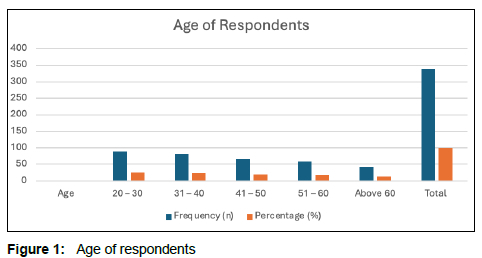
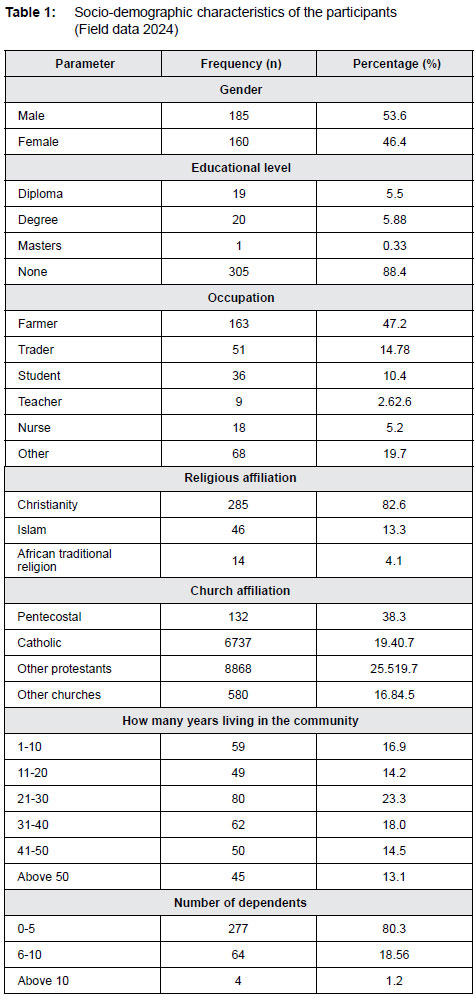
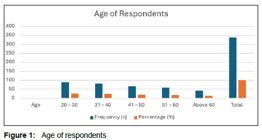
For the background demographics of the respondents, data was collected on their age, gender, educational level, occupation, religious affiliation, church affiliation, number of years they have been in the community, and the number of dependents. Data on the age of the respondents indicated that, of the majority of the respondents, 26.2 per cent were aged between 20-30 years and 24.2 per cent were aged between 31-40 years. The results further showed that 19.4 per cent are also aged between 41-50 years, with 17.5 per cent aged between 51-60 years, and the remaining 12.7 per cent aged above 60 years. The results from the study clearly indicate that the Nkroanza South district has a very youthful population. This is essential, considering the fact that available studies have highlighted that the poverty situation in sub-Saharan Africa will worsen by 2030 (IPCC 2023; Mthuli 2024). Consequently, we aptly argue that, all things being equal, the vast majority of these populations will be most affected. Sanson et al. (2019) indicate that climate change has unequal sources and effects. This implies that climate change, which is mostly the result of industrialisation, will disproportionately influence the poor world, with children and future generations bearing the brunt of its effects. Young people and children are especially susceptible to its effects. According to predictions from the World Health Organization (WHO), they will experience over 80 per cent of the diseases, injuries, and fatalities linked to climate change (McMichael et al. 2004). This ties in with the finding of the IPCC that damages and losses resulting from climate change will disproportionately affect the poorest and most vulnerable populations, particularly those in Africa, creating more poverty (Cooper 2023). Figure 1 presents the age of the respondents.
The results on the gender of the respondents also showed that 53.6 per cent of the respondents are females and 46.4 per cent are males. Several studies have highlighted the degree of effect climate change may have on males and females. According to USAID's (2017) fact sheet report, men and women are affected by climate change in various ways, due to the disparities in their traditional roles, societal expectations, and means of subsistence. The vast majority of the 1.4 billion people living in poverty in developing countries are women, and as such, they are more vulnerable to the effects of climate change since they typically earn less, have less access to credit and decision-making power, and have less control over resources.
The results on the educational level of the respondents indicated that 88.4 per cent of the respondents have no formal education; 5.8 per cent have a bachelor's degree; 5.5 per cent have a diploma, and 0.3 per cent have a master's degree.
The results on the occupation of the respondents also showed that 47.2 per cent of the respondents are farmers; 14.7 per cent are traders; 10.4 per cent are students; 2.6 per cent are teachers; 5.2 per cent are nurses, and 19.7 per cent are in different occupations. This finding is essential, considering the fact that studies have indicated that farmers are some of the most affected by climate change. For instance, the agricultural sector's contribution to Ghana's economy is disproportionately small, as it steadily shifts from being driven by agriculture to one being focused on services and industry (Almazán-Gómez, Duarte, Lanagirta & Julio 2021). For instance, the sector's contribution to the GDP fell from an average of 41.3 per cent between 1990 and 1999 to 35.4 per cent in 2006 and 34.0 per cent in 2009 (Awunyo-Vitor & Sackey 2018). It continued to decline from 22.13 per cent in 2012 to 19.57 per cent in 2022 (O'Neill 2024). According to Adzawla and Alhassan (2021:24), the unfavourable impact of climate change is a possible explanation for the agriculture sector's declining performance.
The finding that 47.2 per cent of the respondents are farmers is not surprising, considering the fact that Ghana, to some extent, operates an agrarian economy with a significant number of people being farmers. The finding resonates with the 2019 Ghana Living Standards Survey report, which indicates that the agriculture sector contributes to employment, and thus accordingly, agriculture employs the second highest number of people. The Ghanaian economy still depends heavily on the agriculture sector for job creation (Ofori-Appiah et al. 2021). For instance, 44.7 per cent of the labour force is employed in this area. It also contributes significantly to export revenue and supplies raw materials for industrial growth (Arndt et al. 2015).
The results on the religious demographics also showed that 82.6 per cent of the respondents are Christians; 13.3 per cent are Muslims, and 4.1 per cent are African Traditional Religion (ATR) adherents. This result also supports the 2022 religious demographic report by the Ghana Statistical Service, in which 71.3 per cent are Christians and 19.9 per cent are Muslims (GSS 2022). This finding justifies the necessity of this study to investigate the Christian response to climate change. It will then be notable to document the Christian contribution to discourse on climate change and poverty, given their vast population.
The study further sought to find out the demographics of the Christian community as the focus for this study. The results indicated that 38.3 per cent of the respondents are Pentecostals; 19.4 per cent are Catholics; 25.5 per cent belong to other protestant churches, and 16.8 per cent are affiliated with other independent churches.
On the number of years during which the respondents have lived within the study communities, the finding indicated that 16.9 per cent of the respondents lived in the community between 1 and 10 years; 14.2 per cent lived in the community between 11 and 20 years, and 23.3 per cent lived in the community between 21 and 30 years. The results further showed that 18.0 per cent lived in the community between 31 and 40 years; 14.5 per cent lived in the community between 41 and 50 years, and 13.1 per cent lived in the community for over 50 years. It could be inferred from these results that the vast majority of the respondents qualify to share their knowledge about climate change.
Finally, the results indicated that 80.3 per cent of the respondents have between 0 and 5 dependents; 18.5 per cent have between 6 and 10 dependents, and 1.2 per cent have more than 10 dependents. The findings are summarised in Table 1.
6.2 Christians' perceptions about climate change and poverty
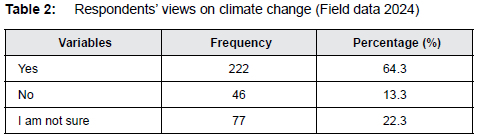
The main objective of this study was to examine the general social perception of Christians about climate change and poverty. Several variables were measured such as, among others, whether there was any significant climate change, the type or nature of the change that occurred, and whether the change led to poverty. Respondents were asked whether there has been any significant climate change. The results indicated that, of the majority of the respondents, 64.3 per cent of the respondents answered affirmatively; 13.3 per cent responded in the negative, and 22.3 per cent indicated that they are not sure. Considering that 82.6 per cent of the total population are Christians, it was further realised that 77.8 per cent of the Christian population was knowledgeable about significant climate change in the communities. However, their perceived understanding of the change in climatic conditions was based on their indigenous knowledge systems rather than on scientific knowledge. This result clearly indicates that the respondents have considerable knowledge about the change in climatic conditions based on their social knowledge and perceptions. Thus, it is apt to state that the respondents are not ignorant. Hence, this supports the assertion that most of the climate change knowledge exhibited by the people has its roots in the indigenous knowledge systems of the surrounding communities, which are connected to the cultural and spiritual aspects of society (Davies et al. 2018). According to Kupika et al. (2019), a large number of people in sub-Saharan Africa, including Ghana, view climate change from cultural and spiritual perspectives, making them assertive to climate change knowledge.
6.3 Types of climate change that have occurred
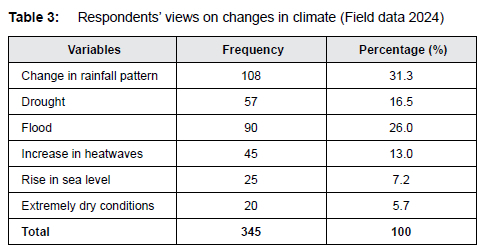
The results indicated that the majority of the respondents acknowledged that there are significant climate changes and they based their assertion on their social perception and knowledge gathered over the years from living in the communities. The results indicated that 31.3 per cent of them stated that there have been some changes in the general rainfall pattern, and 16.5 per cent of them remarked that there is periodic drought. The results furthermore showed that 13.0 per cent of them stated that there are excessive heatwaves, and 26.0 per cent of them stated that floods are, among others, some of the key climatic elements that were identified by the respondents. Thus, the findings resonate with the observations made by Eguavoen (2012) that, although local populations may find it difficult to comprehend the phrase "climate change" and associated poverty in their own tongues, they nevertheless notice and describe changes in weather aspects, especially temperature and rainfall. Considering that 47.2 per cent of the population are farmers, these changes in general rainfall pattern, periodic drought, and excessive heatwaves were identified to significantly impede their yields and therefore negatively affect their household incomes, leading them to poverty. Musarandega et al. (2018) opine that the native people of the African Sahel region are accustomed to climate change because they have spent the past century enduring and adapting to shifting weather patterns, particularly droughts.
The analysis revealed that Christians are more likely to attribute poverty to supernatural forces rather than to anthropogenic causes of climate change. For instance, although they are aware of climate change and their reduced yields, which negatively affect their household incomes, they fail to identify the direct link between anthropogenic climate change and their lived experience of poverty. They rather posited spiritual reasons such as witchcraft attacks, spells, sinful attitudes, and so on for their experience of poverty. Accordingly, they rely on spiritual resources such as prayers and other forms of spiritual guidance to alleviate their dilemma. This confirms the first proposition that Christians are more likely to attribute poverty to supernatural forces rather than to anthropogenic causes of climate change.
6.4 Perceived climate change risks
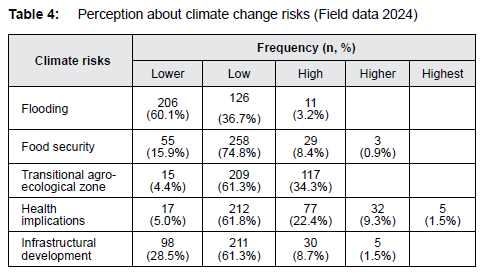
The study explored the perceived associated climate risks. This was important because these risks, if not mitigated or well adapted, can lead to poverty. The results on the perceived associated climate risks indicated that 60.1 per cent of the respondents perceive the risk of flooding as "lower", while 36.7 per cent perceive it as "low". High and higher categories have lower percentages. In addition, a substantial proportion of the respondents (74.8 per cent) perceive the risk to food security as "low", while 15.9 per cent perceive it as "lower". High and higher categories exhibit lower percentages. Predominantly, 61.3 per cent of the respondents perceive the risk as "low", whereas 34.3 per cent of them perceive it as "high". Similarly, 61.8 per cent of the respondents perceive health implications as "low", whereas 22.4 per cent of them perceive it as "high". The higher and highest categories account for 10.8 per cent. For infrastructural development, 61.3 per cent of the respondents perceive the risk as "low", with a minor percentage attributing a higher level of risk.
It can be asserted from the results that the respondents have different perceptions about the associated risks of climate change. Respondents' views on perceived risks associated with climate change contrast with what is generally established in literature. For instance, the literature reviewed in this study indicated that, even though climate change is clearly having an impact on the world at large, developing nations are likely to be more negatively impacted than developed ones, especially the communities that depend heavily on natural resources and are less equipped to handle climate variability and extremes. Due to its detrimental effects on livelihood and health, climate change makes the poor more vulnerable and reduces their prospects for progress (Davidson et al. 2003). In addition, the World Bank (2023) report observes that Ghana is facing variations in temperature, patterns of precipitation, and a rise in the occurrence and severity of extreme weather phenomena such as storms, floods, and droughts. A number of poverty-related climate change impacts were identified in the third IPCC (2001) assessment report, which also confirmed that the poorest people are most vulnerable to climate change shocks. IPCC (2014) further reports that these impacts include a reduction in crop yields, due to decreased water availability, significant effects on food security, employment, incomes, and economic growth, a significant number of people being displaced, and the exposure of millions of people to health risks.
However, it is maintained that all the issues identified tend to affect the livelihoods of the people, leading to poverty. Nonetheless, because they are still engaged in their routine lifestyle and socio-economic practices, they find it difficult to envisage the imminent risks of climate change and its potential harm to their lives. This could be attributed to their religious world view typified in maxims such as "зwiemu nnyз Nyame nsakyerana" which implies that times and seasons, or more literally, the weather is under God's control and he will at any point in time intervene to their benefit. Thus, even in the face of scientific knowledge, they will rather rely on their religious constructs. This confirms our second proposition that Ghanaian Christians will resort to religious beliefs rather than to clearly evident scientific knowledge.
The chi-square test (25.167, df) = 10, p = 0.005 indicated a statistically significant association between the duration of residence in the community and climate knowledge. Noteworthy findings included a higher percentage of participants residing for 31-40 years (5.5%), exhibiting low knowledge, and those residing for 41-50 years (5.8%), demonstrating high knowledge. This finding prompts a deeper exploration of the potential influences that the length of time spent in the community may exert on climate change awareness and understanding. Associations between other demographic factors and climate knowledge were observed to be non-statistically significant.
6.5 Summary and conclusion
The study primarily focused on examining Christians' social perception of poverty and climate change. The study clearly indicated that, even though the respondents may not have any scientific knowledge to determine climate change and poverty, they are able to leverage their social perceptions, in order to contribute to the discourse. This is more profound, considering that several studies such as the Population and Housing Census report and the Ghana Living Standards Survey have all indicated that the Nkroanza South district is one of the poorest districts in Ghana. They attributed this to the failing agricultural production, due to climate change.
Generally, the vast majority of Christians (77.8 per cent) asserted that there are considerable climate changes and the associated risks lead to poverty. However, they failed to identify the direct link between anthropogenic climate change and their lived experience of poverty rather than positing spiritual reasons for their experience of poverty and thus relying on spiritual resources to counteract the effects of climate change. In addition, views on perceived risks associated with climate change contradict what is generally established in literature. This implies that, even in the face of scientific knowledge, Ghanaian Christians will rather rely on their religious constructs.
BIBLIOGRAPHY
-
Addai, I., Opoku-Agyeman, C. & Ghartey, H.T. 2011. An exploratory study of religion and trust in Ghana. Social Indicators Research 110(3):993-1012. https://doi.org/10.1007/s11205-011-9969-4
» https://doi.org/10.1007/s11205-011-9969-4 -
Adzawla, W. & Alhassan, H. 2021. Effects of climate adaptation on technical efficiency of maize production in Northern Ghana. Agricultural and Food Economics 9(1):1-18. https://doi.org/10.1186/s40100-021-00183-7
» https://doi.org/10.1186/s40100-021-00183-7 -
Almazán-Gómez, M.A., Duarte, R. & Langarita, R. 2021 water and socioeconomic dependencies: a multiregional model. Clean Techn Environ Policy 23: 783-796. https://doi.org/10.1007/s10098-020-01915-x
» https://doi.org/10.1007/s10098-020-01915-x -
Antronico, L., Coscarelli, R., De Pascale. F. & Dante, D.M. 2020. Climate change and social perception: A case study in Southern Italy. Sustainability 12(17):6985 - 6987. https://doi.org/10.3390/su12176985
» https://doi.org/10.3390/su12176985 -
Apollo, A. & Mbah, M.F. 2021. Challenges and opportunities for climate change education (CCE) in East Africa: A critical review of climate. Climate 9(6):1-16. https://doi.org/10.3390/cli9060093
» https://doi.org/10.3390/cli9060093 -
Arndt, C., Asante F. & Thurlow, J. 2015. Implications of climate change for Ghana's economy. Sustainability 7(6):7214-7231. https://doi.org/10.3390/su7067214
» https://doi.org/10.3390/su7067214 -
Audefroy, J., Nelly B. & Sanchez C. 2017. Integrating local knowledge for climate change adaptation in Yucatán, Mexico. International Journal of Sustainable Built Environment 6(1):228-237. https://doi.org/10.1016/j.ijsbe.2017.03.007
» https://doi.org/10.1016/j.ijsbe.2017.03.007 -
Awunyo-Vitor, D. & Sackey, R.A. 2018. Agricultural sector foreign direct investment and economic growth in Ghana. Journal of Innovation and Entrepreneurship 7(1):15. https://doi.org/10.1186/s13731-018-0094-3
» https://doi.org/10.1186/s13731-018-0094-3 -
Ayansina A., Radeny, M. & Morton, J. 2017. Comparing smallholder farmers' perception of climate change with meteorological data: A case study from Southwestern Nigeria. Weather and Climate Extremes 15:24-33. https://doi.org/10.1016/j.wace.2016.12.001
» https://doi.org/10.1016/j.wace.2016.12.001 -
Biri, K. 2024. Pentecostalism, theology of survival and food security in Zimbabwe. In: L. Maseno, D.A. Omona, E. Chitando & S. Chirongoma (eds), Religion, climate change, and food security in Africa. Sustainable Development Goals Series (Cham: Palgrave Macmillan), pp.287-298. https://doi.org/10.1007/978-3-031-50392-4_17
» https://doi.org/10.1007/978-3-031-50392-4_17 -
Boehm, S. & Schumer, C. 2023. Ten big findings from the 2023 IPCC Report on Climate Change. World Resources Institute. [Online.] Retrieved from: https://www.wri.org/insights/2023-ipcc-ar6-synthesis-report-climate-change-findings [10 April 2024].
» https://www.wri.org/insights/2023-ipcc-ar6-synthesis-report-climate-change-findings -
Cooper, N. 2023. The IPCC just published its summary of 5 years of reports - Here's what you need to know. Climate Champions, 20 March 2023. [Online.] Retrieved from: https://climatechampions.unfccc.int/the-ipcc-just-published-its-summary-of-5-years-of-reports-heres-what-you-need-to-know/ [9 April 2024].
» https://climatechampions.unfccc.int/the-ipcc-just-published-its-summary-of-5-years-of-reports-heres-what-you-need-to-know/ -
Davidson, D.J., Williamson, T. & Parkins, R.J. 2003. Understanding climate change risk and vulnerability in northern forest-based communities. Canadian Journal of Forest Research 33(11):2252-2261. https://doi.org/10.1139/x03-138
» https://doi.org/10.1139/x03-138 -
Davies, J., Spear, D., Chappel, A., Joshi, N., Togarepi, C. & Kunamwene, I. 2019. Considering religion and tradition in climate smart agriculture: Insights from Namibia. In: T. Rosenstock, A. Nowak & E. Girvetz (eds), The climate-smart agriculture papers (Cham: Springer), pp. 187-197. https://doi.org/10.1007/978-3-319-92798-5_16
» https://doi.org/10.1007/978-3-319-92798-5_16 -
Dramani, J.M.-Buu File & Derbile, E.K. 2020. Sunshine, temperature and wind. International Journal of Climate Change Strategies and Management 12(1):22-38. https://doi.org/10.1108/ijccsm-04-2019-0023
» https://doi.org/10.1108/ijccsm-04-2019-0023 - Eguavoen, I. 2012. Blessing and destruction: Climate change and trajectories of blame in Northern Ghana. ZEF Working Paper Series No. 99. Bonn, Germany: Centre for Development Research (ZEF), University of Bonn.
-
Ghana Statistical Service 2022. Population and Housing Census, National Analytical Report. [Online.] Retrieved from: https://statsghana.gov.gh/gssmain/fileUpload/pressrelease/2010_PHC_National_Analytical_Report.pdf [10 April 2024].
» https://statsghana.gov.gh/gssmain/fileUpload/pressrelease/2010_PHC_National_Analytical_Report.pdf - Intergovernmental Panel on Climate Change (IPCC) 2014. Climate change: Impacts, adaptation, and vulnerability: Regional aspects. Cambridge, UK: Cambridge University Press.
- Intergovernmental Panel on Climate Change (IPCC) 2023. Summary for policymakers. In: H. Lee & J. Romero (eds), Climate change: Synthesis report. Contribution of working groups I, II and III to the sixth assessment report of the Intergovernmental Panel on climate change [Core Writing Team] (Geneva, Switzerland: IPCC), pp. 1-34. DOI: 10.59327/IPCC/ AR69789291691647.001
-
Intergovernmental Panel on Climate Change (IPCC) Climate Change 2022. Mitigation of climate change. In: P.R. Shukla et al. (eds), Contribution of working group III to the sixth assessment report of the Intergovernmental Panel on climate change (Cambridge, UK: Cambridge University Press), pp. 1909-1924. https://doi.org/10.1017/9781009157926
» https://doi.org/10.1017/9781009157926 -
Janssens, C., Havlik, P., Krisztin, T., Baker, J., Frank, S., Hasegawa, T., Leclère, D., Ohrel, S., Ragnauth, S., Schmid, E., Valin, H., Van Lipzig, N. & Maertens, M. 2020. Global hunger and climate change adaptation through international trade. National Climate Change 10:829-835. https://doi.org/10.1038/s41558-020-0847-4
» https://doi.org/10.1038/s41558-020-0847-4 -
Keellings, D.J. & Waylen, P.R. 2012. The stochastic properties of high daily maximum temperatures applying crossing theory to modeling high-temperature event variables. Theoretical and Applied Climatology 108:579-590. https://doi.org/10.1007/s00704-011-0553-2
» https://doi.org/10.1007/s00704-011-0553-2 -
Kupika, O.L., Gandiwa, E., Nhamo, G. & Kativu, S. 2019. Local ecological knowledge on climate change and ecosystem-based adaptation strategies promote resilience in the Middle Zambezi Biosphere Reserve, Zimbabwe. Scientifica 1-15. https://doi.org/10.1155/2019/3069254
» https://doi.org/10.1155/2019/3069254 -
Mbah, M.F. 2024. Discrepancies in academic perceptions of climate change and implications for climate change education. NPJ Climate Action 3: 1 - 24. https://doi.org/10.1038/s44168-024-00105-5
» https://doi.org/10.1038/s44168-024-00105-5 - Mbiti, J.S. 1969. African religions and philosophy. African Writers Series. Johannesburg: Heinemann Publications.
-
McDaniels, T., Axelrod, L.J. & Slovic, P. 1996. Perceived ecological risks of global change 1A Psychometric comparison of causes and consequences. Global Environmental Change 6(2):159-171. https://doi.org/10.1016/0959-3780(96)00006-4
» https://doi.org/10.1016/0959-3780(96)00006-4 - McMichael, A.J., Campbell-Lendrum, d., Kovats, S., Edwards, S., Wilkinson, P., Wilson, T. & Andronova, N. 2004. Global climate change. In: M. Ezzati, A. Lopez, A. Rodgers & C. Murray, Comparative quantification of health risks: Global and regional burden of disease due to selected major risk factors (Geneva, Switzerland: World Health Organization), pp. 1543-1649.
-
Molthan-Hill, P., Blaj-Ward, L., Mbah, M.F. & Ledley T.S. 2022. Climate change education at universities: Relevance and strategies for every discipline. In: W.-Y. Chen, T. Suzuki & M. Lackner (eds), Handbook of climate change mitigation and adaptation (USA: Springer International Publishing), pp. 3395-3457. https://doi.org/10.1007/978-3-030-72579-2_153
» https://doi.org/10.1007/978-3-030-72579-2_153 -
Mthuli, N. 2024. Can Africa's extreme poverty be eliminated by 2030? African Development Bank Group, 13 August 2014. [Online.] Retrieved from: https://bit.ly/437HMlI [9 April 2024].
» https://bit.ly/437HMlI -
Musarandega, H., Chingombe, W. & Pillay, R. 2018. Harnessing local traditional authorities as a potential strategy to combat the vagaries of climate change in Zimbabwe. Jàmbá: Journal of Disaster Risk Studies 10(1): 651-661 . https://doi.org/10.4102/jamba.v10i1.651
» https://doi.org/10.4102/jamba.v10i1.651 -
Ofori-Arriah, Y., Onumah, E.E. & Asem, F.E. 2021. Efficiency and productivity analysis of pineapple farmers in the Akwapim-South District of Ghana: A distance function approach. African Journal of Science, Technology, Innovation and Development 14(2):512-522. https://doi.org/10.1080/20421338.2020.1857544
» https://doi.org/10.1080/20421338.2020.1857544 -
Okyere-Manu, B. & Morgan, N. 2022. Putting words into action. Routledge eBooks:91-103. https://doi.org/10.4324/9781003147909-7
» https://doi.org/10.4324/9781003147909-7 -
O'Neill, A. 2024. Share of economic sectors in the GDP in Ghana 2022. Statista. [Online.] Retrieved from: https://www.statista.com/statistics/447524/share-of-economic-sectors-in-the-gdp-in-ghana/#:~:text=This%20statistic%20shows%20the%20share,sector%20contributed%20about%2042.03%20percent [10 Apil 2024].
» https://www.statista.com/statistics/447524/share-of-economic-sectors-in-the-gdp-in-ghana/#:~:text=This%20statistic%20shows%20the%20share,sector%20contributed%20about%2042.03%20percent -
ONU (Naciones Unidas) 2021. Informe sobre los objetivos de desarrollo del milenio. Naciones Unidas. [Online.] Retrieved from: http://www.un.org/millenniumgoals/2015_MDG_Report/pdf/MDG%202015%20rev%20(July%201).pdf [30 April 2021].
» http://www.un.org/millenniumgoals/2015_MDG_Report/pdf/MDG%202015%20rev%20(July%201).pdf -
Sanson, A., Van Hoorn, J. & Bürke, S. 2019. Responding to the impacts of the climate crisis on children and youth. Child Development Perspectives 13(4):201-207. https://doi.org/10.1111/cdep.12342
» https://doi.org/10.1111/cdep.12342 -
USAID Office of Women in Development 2017. Climate change and gender. [Online.] Retrieved from: www.usaid.gov/our_work/cross-cutting_programs/wid/index.html [30 April 2024]
» www.usaid.gov/our_work/cross-cutting_programs/wid/index.html -
White, L. Jr. 1967. The historical roots of our ecological crisis. Science 155:1203-1207. https://doi.org/10.1126/science.155.3767.1203
» https://doi.org/10.1126/science.155.3767.1203 -
Wilkins, J.S. 2022. Species, God, and dominion. In: B. Swartz & B.D. Mishler (eds), Speciesism in biology and culture (Cham: Springer), pp. 95-110. https://doi.org/10.1007/978-3-030-99031-2_5
» https://doi.org/10.1007/978-3-030-99031-2_5 -
World Bank Group 2023). Climate Change Knowledge Portal. [Online.] Retrieved from: https://climateknowledgeportal.worldbank.org/country/ghana/vulnerability [2 May 2025]
» https://climateknowledgeportal.worldbank.org/country/ghana/vulnerability -
Zoundji G.C., Magnon Y., Z., and Adjaka N., F. 2024. Agricultural insurance adoption in the context of climate change: Influencing factors in Benin (West Africa). Agricultural Science Digest. 44(5): 823-829. https://doi.org/10.18805/ag.DF-622
» https://doi.org/10.18805/ag.DF-622
Date accepted: 31 March 2025
Date published: 30 June 2025
2 This is a generic term used to describe all other churches who are not part of the Ghana Pentecostal Charismatic Council and neither are they Indigenous African Churches.