Towards an emergent theory of reimagining Church in a racially divided society: Building theory from different cases
Abstract
How to build an emergent theory on changing social imagination of church in the context of South Africa? Emergent theory involves building theory, not testing theory. The author uses the so-called Eisenhardt method of building an emergent theory. Rigour in the Eisenhardt method rests on five criteria: "how" and "why" research questions, using theoretical sampling, well-identified theoretical constructs, identifying mechanisms of transformation, and boundary logic. The author builds an emergent theory on how to change social imagination based on three cases, namely Dion Forster's study on the social imagination of forgiveness, Jaco Botha's study on reimagining outreach by White theology students, and Wynand Breytenbach on transformation of ecclesiological imagination of a congregation in liturgy.
Emergent theory; Eisenhardt method; Whiteness; Changing social imagination of church
1. INTRODUCTION
This article aims to build new theory from multiple cases. The ultimate argument for this journey in academy is rigour! "Rigorous theory building from multiple cases rests on whether the emergent theory is accurate, internally coherent, and parsimonious" (Eisenhardt & Ott 2017:82). I elaborate on what this means in the first section, where I introduce the so-called Eisenhart method for building theory from multiple cases.
In the field of theology and religious studies, the opportunity to embark on a journey like this is rarely given when using an empirical methodology. This opportunity arose when Forster wrote his thesis on forgiveness (Forster 2017), in which he introduced the concept of building a theological theory based on changing social imagination (see also Forster 2019). At the same time, two young researchers, Jaco Botha and Wynand Breytenbach, began researching the changing social imagination of young DRC members. Practical theology is a small academic field of empirical research with no strong theories of paradigmatic status. Using the same theoretical framework across three cases enabled me to engage in rigorous theory-building using multiple cases.
Why embark on a journey aimed at building theory about the power of imagination of religion? According to Ward (2019:94),
it is not at all clear what part religions might play in any future reconciliations, though they hold profound creative resources for peace, healing, and hospitality in their teachings, in their texts, and in their rituals.
Maybe this power is not necessarily and not primarily connected to faith-based institutions. Ward (2019:93) suggests seeking this power "at the level of the imagination, with the conviction and aspiration it can mobilize".
According to Ward (2018), there are different identifiable levels of the imaginative pursuit in which we are always embroiled, individually and collectively.
• The cultural imagination as a vast deposit of possibilities.
• Cultural values or ethos that emerge from engaging this imagination.
• Ways in which we institutionalise and organise these imaginative pursuits. This is characterised as the social imagination.
Institutionalisation of social systems motivates their members to engage in practices according to the imagination of the system and cultural values of whiteness. For example, young people, who engage in practices of outreach, act according to the role expectations of DRC congregations and the value system of whiteness. Can we use the power of imagination to change practices? Ward's theory suggests that imagination has this power to mobilise change, specifically religious imagination.
This article is structured according to the Eisenhardt method of building theory through rigorous criteria. It formulates the five Eisenhardt criteria for building emergent theory from multiple cases. It then develops these five criteria and elaborates on the types of questions used in emergent theory-building, focusing on "what" and "how" questions. "What is happening?" and "How is change emerging?" The research question relates to whiteness as a specific cultural identity of White people in the context of South Africa. Next, the article focuses on theoretical sampling and describes the defining constructs and how they were measured. This is followed by a definition of the theoretical logic of the relations between constructs (mechanisms). The article then presents the core propositions of the changing social imagination of the church, and formulates the emergent theory on the changing social imagination of the church and its boundary conditions.
2. THE "EISENHARDT METHOD": BUILDING THEORY FROM CASES
How to build theory on transformation of social imagination from different cases? In the methodological academic debate on this topic, Eisenhardt has been one of the dominant voices over the past decades since 1989. Her article on "Building theories from case study research" (Eisenhardt 1989) has been quoted 76.267 times (registered on 9 November 2023). Compared to her first publication in 1989, her method is more refined and balanced. For example, in the beginning, she focused a great deal on an iterative process linked to data, while in time she balanced this with theoretical logic (see Eisenhardt 2021). Because of this strong development of her methodology in time, I chose the so-called "Eisenhardt method" as methodological framework to build theory from cases. A case study simply means a stand-alone, substantial description of specific instantiations of a given phenomenon that is usually crafted from multiple data sources (Yin 1994).
What is needed to build an emergent strong theory from multiple cases? Rigour in the Eisenhardt method rests on five criteria, namely research questions without obvious answers; theoretical sampling of cases; defining constructs and how they were measured; theoretical logic of relations between constructs (mechanisms), and boundary conditions of the theory.
First, emergent theories arise from research questions for which there is hardly any or conflicting prior theory and/or empirical evidence (Eisenhardt 2021:148). When I read this, my first thought is: Welcome to our field of study! In practical theology, missiology, religious studies, and other theological fields, there is hardly any theory, and not a great deal of empirical evidence. Research questions without obvious answers are never "How much" questions, because this presupposes a strong theory with a predictive logic. "Theory building from multiple cases also has little to do in effect sizes or the size and directionality of interaction" (Eisenhardt & Ott 2017:87). The type of questions in building an emergent theory are typically "What" questions (What is happening here? What is changing?) and "How" questions (How did this change happen?)
The question of how to change the social imagination of the church is intriguing, as there is hardly any to no theory or empirical evidence on the subject. This does not mean that we cannot build on existing theory. In this instance, I use Ward's (2018) theory of imagination and resilience, as well as Hermans' (2022) theory of resilient religion. I also use the concept of "whiteness", as developed by Steyn (2018), and ideas on transforming prejudice from intergroup theory (Pettigrew & Tropp 2011), for which there is strong empirical evidence. However, we do not know whether these theoretical constructs will help us develop a theory on transforming the social imagination of the church and society.
Secondly, the Eisenhardt method emphasises theoretical sampling cases. This means
choosing cases where the focal phenomenon is likely to occur, and case designs where the similarities and differences across cases are likely to improve theory building (Eisenhardt 2021:149).
In our research, the focal point is the transformation of social imagination. We choose cases in which prejudice based on whiteness informs the social imagination of the White community. In our research, we use a common process design with the same focal phenomenon of transforming the social imagination of White respondents in purposefully different settings. The settings are different but we use a comparative set of change mechanisms (process design), making comparison possible.
Thirdly, a strong emergent theory demands defining constructs and how they were measured.
This means providing the relevant data to readers in a way that they can clearly see the tie between the emergent constructs and theory with the actual data that grounds them (Eisenhardt & Ott 2017:84).
The defining construct of social imagination was the same in all settings: an integral and inclusive concept of identity. Working on an emergent theory does not mean that we cannot build on existing theories. For an integral theory, we used a theory developed by Wilber (2012), and for the concept of levels of inclusivity, we used intergroup contact theory (Pettigrew & Tropp 2011). Rigorous research using theory-building from multiple cases requires the emergent theoretical constructs to be grounded in compelling and convincing data, which
helps to ensure that the emergent theory is accurate and true to the empirical context, and that its constructs are measurable, thus making the theory testable (Eisenhardt & Ott 2017:85).
I elaborate on this below.
Fourthly, the Eisenhardt method emphasises the importance of explicitly formulating the theoretical logic between the constructs of the theory (Eisenhardt 2021:151). In the emergent theory that we are developing, this points to the theoretical logic between the transformation mechanisms and the social imagination construct. More specifically, why would the construct of social imagination shift towards a more integral construct? And why would it shift towards a more inclusive construct?
Fifthly,
strong theory requires addressing alternative explanations and specifying boundary conditions. Alternative explanations increase confidence in the validity of the theory while boundary conditions specify the scope of the theory and determine its generalizability (Eisenhardt & Ott 2017:82).
Specifying boundary conditions is an indicator of rigour in theory development. This process involves theoretical logic based on the definition of the theory's constructs and the logic of the mechanisms that induce the transformation of social imagination. This logic is closely linked to the situation in South Africa, which is characterised by interracial conflict, socio-economic inequality, structural unemployment, and whiteness.
3. RESEARCH QUESTIONS ON CHANGING SOCIAL IMAGINATION OF CHURCH
The type of questions in building an emergent theory are typically "What" questions (What is happening here?) and "How" questions (How did this change happen?). This type of questions is different from "How many" questions that refer to quantifiable units of analysis. For example: How many people accept a voting rights for non-Dutch nationals in local elections? The answer to this question is precise and quantifiable. We know who we mean by voting rights and what non-Dutch nationals are. The focus of our research interest, social imagination, is not precise and quantifiable. Social imagination is embodied in social practices that are influenced by identity, colour, and power in the ways in which we organise our practices. For example, we do not know what understanding different race groups have about the social imagination of forgiveness. In the history of apartheid and post-apartheid in South Africa, members of different race groups have a different understanding of forgiveness and the social practices associated with it. This is linked to the difference in identity, colour and power between different race groups in South Africa, specifically the issue of whiteness, as I elaborate below.
In terms of our research problem, this leads to the following main research questions in the projects involved in this programme. To what extent did the social imagination of [X] change after participation in a specific set of practices [Y] towards a more integral and more inclusive imagination?
As formulated earlier, social imagination is informed by cultural identities of the persons and practices in which they are involved. The concept "cultural identities" plays an important role in the field of cultural analysis (Clarke 2010). I first define this concept and then relate it to whiteness, as a specific shape of cultural identity in the context of South Africa.
Cultural identities are marked by a number of factors - 'race', ethnicity, gender and class to name but a few; the very real locus of these factors, however, is the notion of difference (Clarke 2010:1).
Defining ourselves by difference can lead to a strong sense of who we are not and who we do not want to be. Power is involved in the question of who ascribes a cultural identity to whom, and for what reason. The question of difference is a powerful emotional force that makes us feel strongly connected to a certain group and way of life. It enables us to define "us" in relation to "others" and distinguish the in-group from the out-group. Emotion and imagination are both central to identity construction (Clarke 2010:27).
The way in which people imagine the world to be and imagine the way that others exit in the world is central to the construction of identity (Clarke 2010:27).
Whiteness is a lens on practices which unfairly privileges and places White people in positions of dominance (Green et al. 2007:298).
Whiteness, like all racial categories, is fluid and is dependent on the changing and emerging features of social life, but whiteness also reflects deeply embedded, structural, hard, enduring, solid-state features of race and racism (Green et al. 2007:297).
The content and transmission of whiteness changed in South Africa with the transition of apartheid to post-apartheid.
Under the hegemonic operations of 'white talk', non-racialism -which historically advocated a form of race-cognisant inclusivity, mutated into colour blindness - and neo-liberal economic policies have been advanced as the only viable road for the country (Steyn 2018:10).
According to Steyn, White South Africans have distanced themselves from accountability for the past in three ways, namely by claiming innocence and asserting that White people were unaware of what happened during apartheid; by withdrawing into private spaces such as elite neighbourhoods, private schools, the private sector, and segregated churches, and by constructing themselves as victims (Steyn 2018:12). Since 2015, Steyn notes a marked shift towards analyses that foreground how racial injustice has been the organising logic of our social formation over generations, rather than merely residing in the acts of a few nasty individuals (Steyn 2018:13).
This allows for a much more trenchant understanding of how the ideologies of coloniality have created a world that is systematically and consistently inclined in favour of those of European stock and is stacked against those who are black, especially through the operations of whiteness as the norm (Steyn 2018:12).
This normative order reproduces itself as soon as it is in place. The views of those who are privileged by being in this normative space are viewed as more authoritative, more competent, and what happens to them is regarded as more newsworthy (Steyn 2018:12).
4. THEORETICAL SAMPLING
Theoretical sampling means
choosing cases where the focal phenomenon is likely to occur, and case designs where the similarities and differences across cases are likely to improve theory building (Eisenhardt 2021:149).
Why? In our research, our theory-building focuses on the transformation of the church's social imagination. We selected cases based on four criteria.
• First, the focal phenomenon in each case is the social imagination relating to the patterns of habitual practices within the formal or informal institutional structures that govern, disseminate, and evaluate those practices, as well as the relations between persons.
• Secondly, each case demonstrates an absence of change in a specific area of social imagination. Change is unlikely to occur "of its own accord", due to the influence of whiteness on social imagination.
• Thirdly, in line with the normative order of whiteness, participants will not hold racist views, but they will rather adopt a position of colour blindness and ignorance of power. There needs to be an openness to talking to and learning from members of other racial groups.
• Fourthly, none of the respondents previously participated in any learning practices regarding prejudice, demonstrating their willingness to rebuild South African society on different principles.
Three cases were selected based on these criteria. The first case concerns two Methodist church communities in Somerset West (Forster 2017). One community (Church Street Methodist Church) was almost entirely made up of Brown (sometimes identified as Black) South Africans. The second community (Coronation Avenue Methodist Church) came from a privileged South African constituency and is made up of predominantly White South African Christians. The topic of this case is the social imagination of forgiveness, i.e. the restoration of relationships between individuals within a broken community (Forster 2019:74). This social imagination is highly contested in the South African post-apartheid context with regard to issues of social justice, the absence of social harmony, restitution, and economic recompense (Forster 2019:74).
The second case is a group of seven theology students (two males and five females) belonging to the DRC church who are in their second year of theology study at the Faculty of Stellenbosch (Botha 2025). Social imagination, in this case, refers to mission as institutional practice of church (local congregations, synods), more specifically outreach programmes in which groups of people are sent to a community for the goal of evangelisation or community upliftment. In the South African context, many outreach programmes are short-term trips defined between race and class lines where White privileged young people are sent to convert or uplift the poor Black. The criticism on this method is that it keeps colonial systems of power and privilege in place. The young students learn this form of habituated practices of outreach from the members of their congregation. In this setting, transformation of social imagination of outreach is not likely to occur.
The third case concerns the liturgical team of a DRC congregation in Durbanville, responsible for evening song (see Breytenbach & Hermans 2025). Social imagination refers to the liturgical team's ecclesiological vision of the community celebrating liturgy. The community is predominantly White, reflecting those present at the evening song services. In line with Steyn's (2018:12) analysis, the liturgical team's non-racialism takes the form of colour blindness. In this setting, transformation of the liturgical team's ecclesiological imagination is unlikely to occur "of its own accord".
5. DEFINING THEORETICAL CONSTRUCTS AND MEASUREMENT
This section defines two key concepts that underpin our emergent theory of social imagination and transformation. I first define an integral model of social imagination and indicate how it was measured in all cases. Secondly, I define levels of inclusivity of social imagination and how it was measured in all cases.
Social imagination differs according to the specific institutional structures of habituated actions involving social actors. The social actions of forgiveness, outgroup programmes aimed at evangelisation and/or community upliftment, and the ecclesiological imagination of the local congregation in liturgy regard different institutional settings. However, the integral mapping of social imagination underlying these actions can be defined in the same way, using Wilber's (2012) integral theory of knowing. Forster applied this concept to his study of forgiveness (Forster 2017; 2019). In its most basic form, Wilber's theory posits that every idea or action can be considered from four perspectives. In line with this logic, social imagination can be constructed on the basis of these four integral perspectives.
the subjective (I forgive), the intersubjective (we are in a state of forgiveness), the objective (it is done by one individual for the sake of being forgiven by another) and the inter-objective (it is done by a group to ensure forgiveness by another group) (Forster 2019:75).
Mapping social imagination in a specific context using four different perspectives makes it more integral and open to different perspectives. We define social imagination as the multi-perspective configuration in which we give meaning to our institutionalised social systems based on subjective thoughts, beliefs, emotions, and hopes directed towards certain objects, matters of fact, states of affairs, goals, or values (individual-subjective); objective states of individual characteristics, individual actions or individual observations of the world (individual-objective), shared thoughts, beliefs, emotions, hopes of a community directed at objects, matters of fact, states of affairs, goals, or values (inter-subjective), and objective states of shared characteristics, shared actions or shared observations of the world (inter-objective).
The transformation of social imagination is defined as a shift in the configuration and/or content of the four perspectives. A change in the content of one perspective can alter the configuration of the social imagination as a whole. Alternatively, the dominance of one or more perspectives can change, indicating a shift in importance or focus at a given time and in a given context. The contingency of circumstances and contexts can prevent meanings from emerging or stimulate new ideas and meanings. This is in line with Ward's idea of a change in social imagination. "Not every possibility for combination and change in the social imagination is activated at any given time" (Ward 2018:226).
How to measure social imagination based on this integral model of consciousness? All cases share the formal definition of social imagination and measure the four perspectives on social imagination in the same way. Yet the empirical observations are done in specific practices and institutional settings of being church, notably social imagination of forgiveness, social imagination of outreach/inreach and ecclesiological imagination of the community in celebrating liturgy.
First, the individual-subjective perspective refers to one's own thoughts, beliefs, emotions, hopes, and so on, directed towards certain objects, matters of fact, states of affairs, goals, or values. These can be identified using the pronouns "I" or "me". "I" refers to the person who feels, acts, values or aims at something. "Me" refers to the subject at the receiving end of an action, aim or feeling. In the field of religion, typical examples are "I believe in an afterlife"; "I experience a deep spiritual connection with Jesus"; "my sins and my forgiveness"; "my freedom", and "my purpose in life" (see also Forster 2017:168).
Secondly, the individual-objective perspective refers to the objective characteristics, actions or observations of individuals. "Objective" implies that something can be observed as distinct from an opinion or conjecture. This observation or action is performed by a specific subject. For example, I might confront someone with the negative environmental impact of his/her actions. Alternatively, someone might confront me about the negative environmental impact of my actions. This is not merely an opinion, but a claim based on the observable effects of an action. In institutions, individuals' actions are not necessarily the same as the institution's norms, due to the freedom of human agency (Hermans 2022). This freedom is important in transforming social imagination.
Thirdly, the intersubjective perspective refers to the shared thoughts, beliefs, emotions, and hopes of a community concerning objects, matters of fact, states of affairs, goals or values. These can be identified using the pronouns "we" or "us". "We-intentionality" refers to a community that feels, acts, values, and aims at something. "Us" refers to the community on the receiving end of an action, aim or feeling. In the field of religion, typical examples are "we believe in Jesus"; "our condition of sin"; "my freedom"; "our purpose as a congregation", and "our belief in the afterlife" (see also Forster 2017:169).
Fourthly, the inter-objective perspective refers to objective states involving shared characteristics, actions, or observations of the world. The social imagination of institutions refers to observable patterns of habitual action. Institutions encourage adherence to practices and impose sanctions for disobedience.
Forgiveness is more than just personal action; it requires institutional sanction and support to facilitate and sustain it (e.g., collective action, political action, consequences of a legal system, reparation) (Forster 2017:169).
Social imagination is affected not only by our consciousness of the world (i.e. different perspectives), but also by what happens within intergroup relations. We distinguish four levels of racial prejudice: essentialism at one end of the spectrum and "beyond essentialism" at the other.1 While essentialism predicts a higher level of racial prejudice and discrimination, "beyond essentialism" predicts an absence of racial prejudice and discrimination. Between these two extremes, the levels of racial ignorance and racial recognition can be distinguished. This article focuses on defining each level and how to measure them.
Essentialism is the first level and is defined as a social imagination based on labelling people according to race (colour branding), where the outgroup is considered inferior to the ingroup. There is evidence of a two-way influence between essentialism and prejudice. It is important to consider the indirect effect of essentialism on racial attitudes via interactions with other social information, group-based beliefs, and experiences.
The second level, racial ignorance, is defined as a social imagination based on explicit and tacit mechanisms of knowing and not knowing that evade and distort racial reality and the power differences related thereto. While not racist, White talk in race ignorance evades and distorts racial reality and the related power differences (see definition above). This perpetuates racial inequality and the associated power imbalances that are the root cause of social inequality and disparities in opportunity between different racial groups. Systemic discrimination against people of colour (Black, Brown, and so on) exists, but the knowing and not-knowing practices in which White people are involved do not create awareness of this or hold them accountable.
The third level, racial awareness, is defined as a social imagination based on the knowledge of the racialisation of society and related racial inequalities, and the ability to engage critically with ingroup and outgroup dynamics without retreating, disengaging or feeling threatened. An important aspect of observing race cognisance is being aware that everything in the public sphere is racialised, and that power and privilege dynamics are associated with this racialisation of society. It is also important to use the lens of decoloniality to observe racial injustice and White privilege.
The fourth level, which is defined as social imagination, is the ability to become capable human subjects who can create the good life for themselves and others within fair institutions and a sustainable society. While the given relates to the essentialisation of human life, the possible relates to an ontology of contingency that breaks with essentialism. The process of becoming a subject is considered open, based on the principles of non-identity and contingency. This is a characteristic of eschatological language in religion.
6. THEORETICAL LOGIC OF TRANSFORMATION (MECHANISMS)
How can social imagination transform in two directions, namely towards a more integral perspective on social imagination and towards higher levels of inclusivity?
The first issue we need to address is social labelling based on categorisation. Contact with the "other" (the outgroup) plays an important role in the transformation of social imagination. However, this contact will only have a positive impact if the other person is viewed as an individual rather than a category. We focus on two processes based on intergroup theory (Pettigrew & Tropp 2011), namely decreasing anxiety and increasing empathy.
Secondly, we select two types of hermeneutics (interpretation) for the transformation of social imagination. Social imagination is the result of the process of creating meaning and interpretation. There are differences in social imagination because the processes of meaning-making and interpretation differ. We believe that these two forms of hermeneutics can play a decisive role in transforming social imagination. First, African contextual hermeneutics with a focus on the role of context, resistance, and resilience. Secondly, event hermeneutics with a focus on imagining new possibilities that emerge in practices of knowing of the new inclusive community.
6.1 Mechanisms related to a decrease of prejudice (intergroup theory)
According to Stephan and Stephan (1985:158-165), anxiety in intergroup relationships arises because people fear a number of negative outcomes. The most important of these are negative psychological consequences such as discomfort, frustration, irritation, and loss of self-confidence, due to contact with the outgroup; negative behavioural consequences such as fear of being dominated or exploited by the outgroup, and negative evaluation by the outgroup. Positive contact can lead to a reduction in fear, and a reduction in fear during group interactions has a significant impact (31%) on reducing prejudice (Pettigrew & Tropp 2011:83). When a great deal of fear is experienced in an intergroup situation, cognitive processes simplify. People only register behaviour that confirms their own prejudices, while other behaviour goes unnoticed (Stephan & Stephan 1985:168).
Empathy is the second most important factor in reducing prejudice through intergroup contact. Empathy, particularly in friendships, enables us to view things from the other person's perspective. Like fear, it mediates roughly 30% of the prejudice reduction process through contact (Pettigrew 1998; Pettigrew & Tropp 2011:83).
Reducing anxiety plays a crucial role during the initial phase of contact. Through people begin to observe individual differences and character traits, and share personal information (Brown et al. 1999). During subsequent contact, once anxiety has been alleviated, empathy becomes more significant as participants engage more deeply with each other (Pettigrew & Tropp 2011:85).
6.2 African contextual hermeneutics
According to TRI, ignorance of race and power is (re)produced by explicit and tacit practices of knowing and not knowing that evades and distorts racial reality and differences of power related with it (see above). The effect of this ignorance is a distorted idea of reality, specifically to the objective perspective of social reality.
First, the individual-objective perspective refers to objective states of individual characteristics, actions or observations of the world. For example, I do not see my type of action towards others as expression of race and power.
Secondly, the inter-objective perspective refers to objective states of shared characteristics, actions or observations of the world. For example, we pay some workers a low salary because of the characteristics of a certain type of work, neglecting the influence of race and power in defining a specific type of work in the context of South Africa.
African Biblical Hermeneutics (ABH) is an interpretive approach that emerged in Africa in response to interpretations of African social reality that neglected the African context, as well as the pain, suffering, resistance, and resilience present among the people and traditions of Africa. ABH focuses solely on text hermeneutics, specifically the Bible. According to Paul Ricoeur's definition of texts, buildings, institutions, practices, paintings, and so on can also be considered texts because they express meaning and are the subject of our hermeneutic interpretations. In line with this, I propose extending ABH to include African Contextual Hermeneutics (ACH).
I define three markers or characteristics of an ACH based on an idea of Funlola Olajede on African Biblical Hermeneutics (2020). Each of the markers defines a specific characteristic of the process and content of the hermeneutical approach used in a set of practices to change social imagination. In practice, that can be intercultural Bible reading, but also liturgy, meals between different groups, staying as a guest of families who differ in terms of race and power, and so on.
First, ACH is a contextual hermeneutical approach.
It was also forged out of the crucible of pain and persistent suffering brought about by the oppressive powers of slavery, colonialism, apartheid, imperialism, exile, neo-colonialism, and so forth as well as by the forces of poverty, disease, illiteracy, corruption, and perennial internecine wars and violence that have characterised the African context (Olajede 2022:143).
Secondly, ACH is a resistant hermeneutical approach.
A radically resistant post-slavery, postcolonial and post-apartheid hermeneutics that takes a swipe at traditional or conventional Eurocentric interpretations of the biblical text and of Western indoctrination and their imperialising realities and tendencies and that resists their relics and memories (Olajede 2022:143).
In postcolonial contexts,
there is always - sooner or later, major or minor, explicit or implicit - resistance to the centre on the part of the politically, economically, culturally, and religiously subordinated margins (Segovia 2006:41).
Thirdly, ACH is a resilient hermeneutical approach.
On the one hand, it problematizes persistent challenges and heart-breaking diversities experienced daily in their communities by the resilient people of Africa, but on the other hand, it offers hermeneutical strategies and solidarity to the afflicted in ways that can cause the process of resilience to produce positive outcomes (Olajede 2022:144). And, it gives insight into the hermeneutical strategies and solidarity which the affected have in the process of resilience in their communities.
6.3 Event hermeneutics (including liturgy)
How do human subjects experience new beginnings that establish the good life with, and for others in fair institutions and a sustainable society as a permanent feature of the future? How can the possible be experienced as real? (Hermans 2020). I answer this question in two steps. First, I shift the hermeneutical approach from the author or text to the event of the text creating possible meanings. Secondly, I elaborate on the notion of contingency as a condition for transformation.
In a hermeneutics of events, the focus is not on the producer (author) or the resulting text (Bible, liturgy or act of forgiveness), but on the dynamic process of meaning-giving. This process is not primarily concerned with the active aspects of the dynamics, but with the passive-pathic aspects. In a hermeneutics of events,
[i]t is not the author, but the text that stands in the foreground, and indeed in such a way that neither the producer (sensus auctoris) nor the product (sensus operis) is the hermeneutical interpretandum, but rather the meaning-event of the production of the text (Dalferth 2016, Chapter 3, Section 4).
The essence of being in an ontology of contingency is that which emerges as an event.
The event concerns the singular occurrence by which our world changes, since it interrupts something in our world or interjects something new in it (Van der Heiden 2014:17).
Characteristic of an "event" is the emergence of an actuality that was not foreseen, nor can be reduced to the factual. The possible should not be thought of in the framework of an emergence-continuum of the real, but as a transformation of what is given through the divine power of the possible. What counts is the event to which the text owes its existence
and to which it bears witness through its reality as a text, as well as paying attention to the possibilities of understanding, self-understanding, and life that are set free and put into play by this event (Van der Heiden 2014a:17).
The meaning of the text reveals who I really am (that is, coram deo). The theological interpretandum is neither behind nor in front of the text, but the text as event in which our understanding of ourselves and the world is transformed.
"Contingent" implies that a transformation is unnecessary, yet possible and actually happening. Any reference to God retains this inexplicable contingency and deepens it further. According to Dalferth, theology observes the world from the perspective of prioritising the possible over reality, with its focus on God as the embodiment of the possible. How does the logic of possibility function in the human mind? According to the philosopher Peirce, logic must allow for a third value in addition to truth and falsehood, "that of potentiality defined not as ignorance but as a state of being" (Prawat 2001:pp?). Between a positive assertion ("if x ...") and an absolute negation ("if not x ..."), there is an intermediate field of "possibility". Possibility is neither an assertion nor a negation of a fact but a third something in between, "something-that-may-be". Within the category of possibility, Peirce distinguishes between a "logical" possibility and a "real" possibility. The first type of possibility is completely open. It has "no real ontological status, no real claim to reality or existence. It is a world by itself, separated from everything else." Only when possibility finds a place in the universe does it become "real". There is "a sense that things might be otherwise, the glimmering of an idea that might resolve the difficulty" (Prawat 2001:688).
For Abraham this 'sense' lay in the possibility that a woman might fall pregnant in her old age. The difference between a mere 'logical' possibility and a 'real' possibility is that a person is prepared to act on the latter, because it has grounds in reality. Abraham accepted the emerging possibility because he accepted the condition 'if x', that is, Sarah falling pregnant in her old age. It need not happen, but it could happen! He accepted it as a 'real possibility' and acted accordingly, "as if" the possible was real (see Hermans 2012:257)
Liturgical practices within the social system of the church have the capacity to make the possible seem real to participants. According to Smith, liturgical practices offer a pedagogy of the heart through the imagination. Smith (2016:137) defines practices as liturgy in the sense that they bring conceptions of the good life (or human flourishing) to life in a way that deeply resonates with hearts longing for unlimited happiness. The focus is on the formative role of practices with regard to a particular conception of the good life as a real possibility, rather than on a struggle between beliefs. Liturgical practices do more than disseminate information; they shape our heart's orientation, desires, and love (Smith 2013:12). In this instance, Smith refers to a central idea of Augustine's: a person is defined by desires. The desire describe by Augustine is not so much curiosity as hunger; it is not so much an intellectual puzzle to be solved, but rather a desire for sustenance for life (see Ps. 42:1-2) (Smith 2016:8). Consistent with this, Smith describes liturgy as a form of institutional pedagogy of the heart with the capacity to shape a person's desires and aspirations towards the ultimate possibility: God.
7. CORE PROPOSITIONS OF CHANGING SOCIAL IMAGINATION OF CHURCH
This section sets out the core propositions that underpin the preferred direction of change in the social imagination of the church in a racially divided context. "A proposition is a tentative and conjectural relationship between constructs that is stated in a declarative form" (Hars 2024:14). Propositions are associations between theoretical concepts that cannot be tested directly (Hars 2024:14). In order to test them, the constructs must be measured using the corresponding variables of those constructs. The articles of Forster and Hermans (2025), Botha (2025) and Breytenbach & Hermans (2025) in this issue report on how this is done empirically.
The focus of our project's emergent theory is to change the social imagination of the DRC, which is influenced by the cultural concept of whiteness. As influenced by whiteness, we expect the church's social imagination to be biased.
First, it will be biased towards dimensions of knowing and interpretation that are specific to whiteness in the context of South Africa. Our preferred outcome is for people to develop a more integral understanding of the church's social imagination in a racially divided context.
Secondly, we expect the social imagination to be exclusive, i.e. biased towards White people only. The preferred change is for people to develop a more inclusive social imagination of the church.
Using Ward's theory, we conceptualise social imagination as the institutionalisation of the church as a social system. When this social imagination is biased towards the cultural imagination of whiteness, we need to focus on a fuller, more integral understanding of the church. But what does it mean to be the church? Using Wilber's (2012) integral theory of knowledge, we can identify four approaches to knowledge relating to the four domains of truth claims, namely subjective, cultural (intersubjective), individual-objective, and interobjective. For example, a characteristic of whiteness is the neglect of power differences between groups in a racially divided society (see above). Power differences related to issues of justice are part of society's inter-objective reality. A change in the social imagination of the church can emerge when people are open to the inter-objective truth claims about the meaning of the church. In a more integral view, people open up for different domains of truth and the validity of a particular claim.
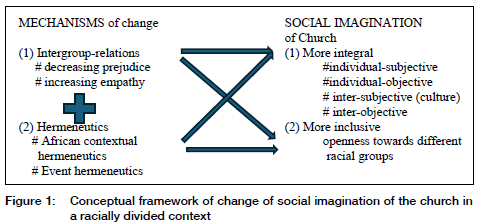
In our conceptual framework (see Figure 1), we identify two processes as mechanisms of change: specific intergroup relations and specific forms of hermeneutics. First, contact with the "other" (the outgroup) plays a significant role in transforming social imagination. However, contact will only have a positive impact if the other person is viewed as an individual rather than as part of a category. Our focus is on two processes based on intergroup theory (Pettigrew & Tropp 2011), namely decreasing anxiety and increasing sympathy.
Secondly, the hermeneutical method of knowledge and interpretation should be contextual, robust, and resilient. This kind of hermeneutics can be found in African biblical hermeneutics (see Olojede 2022). Event hermeneutics, which focuses on the text as an event that transforms our understanding of ourselves and the world, also helps us identify the hermeneutical process that can lead to a change in our social imagination of the church. We specifically mention the role of liturgy in the projects of Botha and Breytenbach in this instance.
Finally, we view the two mechanisms of change (intergroup relations and hermeneutics) as conceptually closely linked (see Figure 1 and the plus sign). During the hermeneutical process, members of different groups come into contact with each other in order to understand the social imagination of the church. The quality of intergroup relations (notably decreasing anxiety and increasing empathy) influences the content of the hermeneutical process.
Based on the argument above, we can formulate the first core proposition towards a more integrative social imagination:
A set of practices based on decreasing anxiety and increasing sympathy in intergroup relations and hermeneutical processes which are contextual, resistant, and resilient and experiencing the new social imagination as a real possibility, can induce change towards a more integral social imagination of church (i.e. individual-subjective, individual-objective, intersubjective, and inter-objective).
Where integral refers to a more complete imagination of church (i.e. in terms of what is essential to church), inclusive refers to an openness to different racial groups in the social imagination of church (community). Inclusiveness refers to the racial composition of the "we" dimensions of social imagination (i.e. the inter-subjective [culture] and inter-objective dimension).
Conceptually, there is a relationship between intergroup relations and the hermeneutical process of understanding the church and the content of social imagination in terms of inclusivity. The problem of racism is essentialism (see above). Reducing prejudice and increasing empathy can help us view others as individuals rather than as categories.
Contextual, resistant, and resilient hermeneutical processes help create an understanding of a community based on mutual interest and upliftment.
Event hermeneutics aims to create experiences that demonstrate the possibility of a new, inclusive community of Black and White people.
Based on the argument above, we can formulate the second core proposition towards a more inclusive social imagination:
A set of practices based on decreasing anxiety and increasing sympathy in intergroup relations and in contextual, resistant, and resilient hermeneutical processes and experiencing the new social imagination as a real possibility can induce change towards a more inclusive social imagination of church in terms of presence of other races in the community ("we" dimension).
8. EMERGENT THEORY ON CHANGING SOCIAL IMAGINATION OF CHURCH AND BOUNDARY CONDITIONS
The emergent theory answers the following main question: To what extent did the social imagination of church [X] change after participation in a specific set of practices [Y] towards a more integral and more inclusive imagination?
The predictions of our core propositions were confirmed in the three projects that form the basis of our emergent theory (see section 7). The argument in this section rests on the research results of the three projects, as reported in the conclusion of the articles of Forster and Hermans (2025), Botha (2025) as well as Breytenbach and Hermans (2025), where the answer on the research question is formulated.
8.1 More integral
Prior to the intervention, the White participants emphasised the interior and collective interior dimensions of the church's social imagination. When discussing their social imagination, they emphasise the spiritual truth claims of the individual and collective interior (culture), while paying less attention to the truth claims of the individual and collective exterior. The focus is on their thoughts, beliefs, feelings, and hopes relating to certain goals, values, and matters of fact. They understand forgiveness as unconditional and spiritual and focus on the forgiveness of sins (spiritual), not connecting it to engagement in broader social, economic, or political issues (Forster 2017; Forster & Hermans 2025). In the Outreach Project, we observe a focus on their internal calling to outreach, spiritual upliftment, and the community as a source of upliftment (Botha 2025). In the Ecclesiological Imagination Project of the church in liturgy, the focus is on experiencing an intimate connection with Jesus, oneself, and others (Breytenbach & Hermans 2025).
Fewer statements concerning individual or shared characteristics, actions or observations of the world (i.e. the individual or collective exterior) were recorded in all three projects prior to the interventions. We interpret this as indicating a lack of integration of social imagination in the sense described by Wilber, whereby not all dimensions play an essential role in constructing social imagination. For example, forgiveness is spiritual and unconditional, i.e. no social, economic or political transformation is necessary for it to occur. Congregations are viewed as passive spaces, thus reinforcing pre-existing perspectives on forgiveness. In the outreach project, we observed some reflection on individual acts such as spending time with others and preaching the Gospel. In the collective interior, social uplift is mentioned without any reflection on the systemic problem of poverty. The same absence of reflection on connectedness to social, economic, and political acts is also evident in the project on ecclesiological imagination.
Following the intervention, the collective interior (culture) and the collective exterior (societal actions) became more dominant. Respondents opened up to the truth presented in the dimensions of the collective interior and collective exterior, and to the validity of these truth claims. This has led to a more integral view.
In the Forgiveness Project, congregations are viewed as active spaces for reimagining social relations and restorative justice. Participants broaden their understanding of forgiveness to encompass the transformation of social, economic, and political systems (CE), thereby bringing about real change in the lives of others and ourselves. In the Outreach Project, participants emphasise the importance of a collective "we", where diversity provides an opportunity to learn from one another. They advocate joining together in activities that promote collective growth and the development of mutual and communal relationships. In the Ecclesiological Imagination Project, participants embrace discomfort and address barriers to belonging, in order to create a shared, inclusive church environment. Sharing Communion and engaging in inclusive activities are communal acts that promote empathy and dismantle systemic biases that perpetuate inequality (collective exterior).
8.2 More inclusive
Prior to the intervention, the collective "we" did not encompass a broader racial spectrum than members of the White community. After the intervention, there is a shift in imagination of the collective "we".
This shift is observed in the collective interior, incorporating a shared calling and belonging that includes Black and White South Africans. Church is experienced as a space of inclusivity, hospitality, and love. Congregations are recognised as active spaces for reimagining social relations and restorative justice (Forster). Participants identify the self as part of a "we" that includes White and Black South Africans (Botha). By embracing discomfort and self-awareness in the collective "we" of the community, participants begin to critically engage with the norms of whiteness (Breytenbach). This mirrors the transformative potential of liturgy, where spiritual introspection fosters inclusivity.
In the collective exterior, we observe a shift towards incorporating others in collective acts of the community (liturgy; Breytenbach). A new focus on concrete acts of communal engagement with restorative justice; forgiving and social, economic, political dimension change (Forster). And a shift in focus from benevolent upliftment to a more mutual and reciprocal process of growth leads to acts of mutual upliftment (Botha).
8.3 Boundary conditions
The boundary conditions of the formulated emergent theory reflect a specific community (White) and context (South Africa), as well as the cultural imagination of whiteness within which this theory was developed. While acknowledging these limitations, the theory simultaneously presents an opportunity for expansion. This expansion would primarily focus on members of Coloured and Black communities in South Africa, rather than in other countries and cultural groups. How did the social imagination of the church change for members of Coloured and Black communities? What was their agency in this process, particularly in the hermeneutic processes of resistance and resilience?
Secondly, we are aware that two projects (Botha and Breytenbach) involved young people who were born in post-apartheid South Africa. One project involved White participants who experienced themselves in the apartheid era. Do the intervention's practices work in the same way for older generations as for younger generations? And for church communities in rural areas in the same way as in urban areas. We do not know.
Finally, the focus of this project was on changing the social imagination of the church. We do not know how to progress from here to practical changes in the way in which the church operates in a racially divided context. Changing the imagination is the first step; changing church life in a more lasting manner is another issue.
BIBLIOGRAPHY
- Bennett, T. & Frow, J. 2010. Introduction: Vocabularies of culture. In: T. Bennett & J. Frow (eds), The SAGE handbook of cultural analysis (London: SAGE), pp. 1-16.
- Breytenbach, W.M. & C.A.M. Hermans 2025. Reimagining ecclesiological imagination within a Dutch Reformed Congregation in South Africa. Acta Theological Supplementum 39.
- Botha, J. 2025. Reimagining outreach as inreach: A study of White DRC students at Stellenbosch University. Acta Theological Supplementum 39.
-
Brown, R., Vivian, J., & Hewstone, M. 1999. Changing attitudes through intergroup contact: The effects of group membership salience. European Journal of Social Psychology 29: 741-764. https://doi.org/10.1002/(SICI)1099-0992(199908/09)29:5/6<741::AID-EJSP972>3.3.CO;2-#
» https://doi.org/10.1002/(SICI)1099-0992(199908/09)29:5/6<741::AID-EJSP972>3.3.CO;2-# -
Clarke, S. 2010. Culture and identity. In: T. Bennett & J. Frow (eds), The SAGE handbook of cultural analysis (London: SAGE), pp. 510-529. https://doi.org/10.4135/9781848608443.n25
» https://doi.org/10.4135/9781848608443.n25 -
Dalferth I.U. 2016. Radical theology. An essay on faith and theology in the twenty-first century. Minneapolis: Fortress Press. Kindle edition. https://doi.org/10.2307/j.ctt1b3t6tc
» https://doi.org/10.2307/j.ctt1b3t6tc -
Eisenhardt, K.M. 1989. Building theories from case study research. The Academy of Management Review 14(4):532-550. https://doi.org/10.2307/258557
» https://doi.org/10.2307/258557 -
Eisenhardt, K.M. 2021. What is the Eisenhardt method, really? Strategic Organization 19(1):147-160. https://doi.org/10.1177/1476127020982866
» https://doi.org/10.1177/1476127020982866 -
Eisenhardt, K.M. & ott, T.E. 2017 Rigor in theory building from multiple cases. In: R.A. Mir & S. Jain (eds) The Routledge companion to qualitative research in organization studies (London: Routledge), pp. 79-91. https://doi.org/10.4324/9781315686103-6
» https://doi.org/10.4324/9781315686103-6 -
Forster, D. 2017. The (im)possibility of forgiveness?: An empirical intercultural Bible reading of Matthew 18.15-35. Stellenbosch: African Sun Media. https://doi.org/10.2307/j.ctv1nzfwnk
» https://doi.org/10.2307/j.ctv1nzfwnk -
Forster, D. 2019. A social imagination of forgiveness. Journal of Empirical Theology 32(2):70-88. https://doi.org/10.1163/15709256-12341387
» https://doi.org/10.1163/15709256-12341387 - Forster, D.A. & Hermans, C.A.M. 2025. Reimagining forgiveness. A transformative engagement with social imagination of forgiveness through intercultural biblical reading in South Africa. Acta Theologica Supplementum 39.
-
Green, M.J., Son, C.C. & Matsebula, J. 2007. Reviewing whiteness: Theory, research, and possibilities. South African Journal ofPsychology 37(3):389-419. https://doi.org/10.1177/008124630703700301
» https://doi.org/10.1177/008124630703700301 -
Hars, R. 2024. Research skills reader. 2024-2025 edition. [Online.] Retrieved from: https://opentextbooks.rug.nl/rspremsc/ [7 May 2025]. https://doi.org/10.21827/67a4ceba2ceca
» https://opentextbooks.rug.nl/rspremsc/ -
Hermans, C.A.M. 2012. Towards a "U-turn" by the churches: how (not to) possibilise the future. Religion and Theology. A Journal of Contemporary Religious Discourse, 19: 237-264. https://doi.org/10.1163/15743012-12341241
» https://doi.org/10.1163/15743012-12341241 - Hermans, C.A.M. 2020. Human experiences of heartbreaking adversity. In: C.A.M. Hermans & K. Schoeman (eds), Resilient religion and heartbreaking adversity (Münster: LIT Verlag), pp. 13-30.
- Hermans, C.A.M. 2022. Processes of resilience. In: C.A.M. Hermans & K. Schoeman (eds), Resilient religion and heartbreaking adversity (Münster: LIT Verlag), pp. 31-46.
- Olajede F. 2022. Resilience and resistance in the Book of Job: An African socio-economic hermeneutical reading in a pandemic context. In: C.A.M. Hermans & K. Schoeman (eds), Resilient religion and heartbreaking adversity (Münster: LIT Verlag), pp. 141-151.
- Pettigrew, T.F. & Tropp, L.R. 2011. When groups meet: The dynamics of intergroup contact (Essays in Social Psychology). New York: Psychology Press. Kindle Edition.
-
Prawat, R. S. 2001. Dewey and Peirce, the Philosopher's Philosopher. Teachers College Record 105: 667-721. https://doi.org/10.1177/016146810110300407
» https://doi.org/10.1177/016146810110300407 -
Segovia F.F. 2006. Biblical criticism and postcolonial studies: Toward a postcolonial optic. In: R.S. Sugirtharajah (ed.), Postcolonial biblical reader (Oxford: Wiley-Blackwell), pp.33-44. https://doi.org/10.1002/9780470775080.ch2
» https://doi.org/10.1002/9780470775080.ch2 - Smith, J.K.A. 2013. Imagining the kingdom. How liturgy works. Grand Rapids, MI: Baker Academic.
- Smith, J.K.A. 2016. You are what you love. The spiritual power of habit. Grand Rapids, MI: Brazos Press.
-
Stephan, W.G. & Stephan, C.W. 1985. Intergroup anxiety. Journal of Social Issues. 41(3):157-175. https://doi.org/10.1111/j.1540-4560.1985.tb01134.x
» https://doi.org/10.1111/j.1540-4560.1985.tb01134.x -
Steyn, M. 2018. Whiteness: Post-apartheid, decolonial. In: J. Netshitenzhe (ed.), Whiteness Afrikaans Afrikaners: Addressing post-apartheid legacies, privileges and burdens (Johannesburg: Mapungubwe Institute for Strategic Reflection [MISTRA]), pp. 9-15. https://doi.org/10.2307/j.ctvh8qwz9.8
» https://doi.org/10.2307/j.ctvh8qwz9.8 - Van der Heiden, G.J. 2014. Ontology after ontotheology. Plurality, event and contingency in contemporary philosophy. Pittsburgh, PA: Duquesne University Press.
- Wilber, K 2012. The spectrum of consciousness. 2nd edition. Wheaton, IL: Quest Books.
- Ward, G. 2018. Unimaginable. What we imagine and what we can't. London: I.B. Tauris.
- Ward, G. 2019. Theology and religion. Why it matters. Cambridge: Polity Press. Kindle edition.
- Yin, K.K. 1994. Case study research: Design and methods. Second edition. Newbury Park, CA: SAGE.
Date accepted: 30 September 2025
Date published: 20 November 2025