Interview with Prof Malan Nel
M. Laubscher
Department Practical and Missional Theology, University of the Free State, Bloemfontein, South Africa. E-mail: https://orcid.org/0000-0002-4240-1991
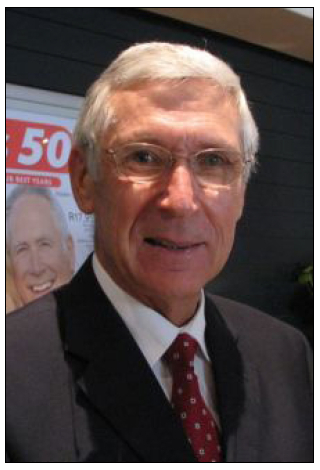
Malan Nel Is currently a senior research fellow In Practical Theology, University of Pretoria. In 2012, he retired as Director of the Centre for Contextual Ministry, Faculty of Theology, University of Pretoria. This ecumenical Centre, which he founded in 1992, still offers continuing theological training for pastors from a wide range of denominations and other Christian groups.
Malan Nel specialises in Congregational Studies; Evangelism; Youth Ministry; and Christian Education. He was and is involved with many congregations in South Africa and often preaches somewhere in the country. He often consults in processes of missional congregational development. He has led congregational analyses and consulted in strategic discerning processes and planning in over 150 congregations.
Prof. Malan Nel is synonymous with so many aspects regarding Practical Theology (and its history) in South Africa. Say, for instance, the influential 1974 Youth-to-Youth Campaign ("Jeug-tot-Jeug Aksie"), or The Society of Practical Theology in South Africa, or the Journal of Practical Theology in South Africa, or the state of Congregational Studies, Youth Ministry, or Homiletics in South Africa and abroad, then his name immediately comes to mind. It is about time to pick his brain and reflect upon how far we have come. His institutional memory of our discipline within academia and church within our context is something to treasure. Here are some of the most important thoughts I recall from our conversation.
If you ask him about books, persons, events, and societies that had a lasting impact on his life, then the names of lecturers such as H.D.A. du Toit and Ben Marais are highlighted. At the University of Pretoria where he studied, the biblical sciences were strong and thoroughly appreciated, but it was the grounded passion of Du Toit who sparked his everlasting love for practical theology. The crucial book during these early years which oriented his trajectory for good, was Jaap Firet's Het agogisch moment in het pastoraal optreden. There are various subdisciplines within the field of practical theology to study and specialise in, but only as long as we remember that they all form part of the interconnected ways in which God comes to us and the world through ministry. This chorus resonates in everything Nel has done throughout his life. It is no wonder that Kittel's Theological dictionaries of the New Testament was always in the back of his bakkie in the 1970s Youth-to-Youth Campaign, as he often had to preach three sermons a day. Not only do the rub on the covers of these books tell the story of the thousands of kilometres on the road bringing the Good News, but also the over 600 congregations in the Dutch Reformed Church (DRC) to which he was invited to preach over the years. In short, although he always keeps the interwovenness of various fields within theology together, he just had to focus and write (with Attie Barnard as his supervisor) his doctoral dissertation on Youth Evangelism within and through the DRC, within which he personally invested so much at this stage in his life. The foundations for the emergence of (Missional) Congregational Studies were indeed already laid in this instance.
No surprise then that Nel can also tell us a great deal about the early years of the Society of Practical Theology in South Africa (SPTSA). His former teacher, H.D.A. du Toit, was again instrumental as one of the founding fathers of the Society in the 1960s, and soon Nel joined the Society at their second annual meeting to become a member of SPTSA. The variations and tensions in how we define (name and practice) the study field of practical theology, during those early years, was very typical of the North-South divide of the time between the latter preferring a diaconal approach and the former preferring an inherent practical theological approach. Stated differently, truth as such should (not) be limited to the ancient sources alone as the empirical reality also voiced its presence in the quest for meaning. Those days are gone and, nowadays, we agree that there are first and second texts of significance, and although both are important and taken seriously, their authority differs in terms of the truth(s) they reveal. However, if we continue the discussion to where we are now and what characterises the current state and trends of our field, it soon becomes clear that the pendulum is not static and that the normative task of practical theology is still immanent in many of the current creative tensions we face nowadays.
Between the lines in the above is, of course, Nel's appreciative sense of Christian witness in all its layered forms. In his own words: "I have never thought other than missional in my whole life." When he wrote his award-winning book, Gemeentebou [Building up the local church], for which he was awarded the Andrew Murray prize in 1995, it was always at its core turned towards the world in which the local church has a calling to be a witness of the Word. The church is distinct in its knowledge from the world, but surely not separated or indifferent to the environment in which it is situated. The congregation belongs to the world, and not to itself, because it knows who its Lord is. Therefore, everything we do, even (or shall we rather say, most importantly) gathering for worship, is deeply in touch with the world in which it resides. The church, and especially the local congregation, is the last place where we come to flight or hide from the world. To enter the ordo of the liturgy, is nothing other than to rearrange the order of perspectives on life as such.
Back to the current growth trajectory of SPTSA, of which he was its secretary, for ten years, and editor of the journal for twenty years, it might be important for the society to reconsider whether the thematic approaches to our annual conferences allow enough space for us all to share the latest research in our respective fields of study within practical theology. The annual themed conferences are well planned and enriching experiences, but for the society the field of practical theology cannot be reduced or limited to a specific annual theme.
There is a need to also create enough space and time for both students and well-established researchers to stimulate each other with all the impulses they dare to explore. For instance, far too many excellent highly specialised dissertations are written every year without the possibility of being presented within an academic society such as ours. Both the researcher and society will suffer from this disconnect in the long run, and it might be time to reconsider the set agenda and mindset of an exclusively themed annual conference. Themes will continue to be up front and centre; yet it should also be possible for anyone to merely enter through this door into the web of practical theological knowledge.
The set-up and step-up between various levels within the flow of knowledge also pertain to connect and lead on the international scene. The International Association for the Study of Youth Ministry was his brainchild, and other South African colleagues continue to take this baton further in various international societies of note. He loves Afrikaans and often works within Afrikaans communities, but colleagues in other tongues and places also want to hear what he has to say. Nowadays, most of our work is not only written in English, but often also translated in foreign languages such as the 2015 Identity-driven churches which is now also available in Russian. The stronger the theological accountability resonates within our ranks, without discouraging the further flow and development, the better our voices sound in being heard by others abroad. Our emphatic experience with collective trauma within this land of ours has scarred us to know and own the various faces of pain we face in discerning our sense of kairos. Empirical work within South African practical theology surely deepens a sense of pathos when the depths of despair are embraced in our approaches to emphatically resonate with the hurt and pain in our long night's journey with each other into a new dawn. In short, the underlying thought in the above is that our responsibility pertains not only in developing a discipline and specific craft of practice, but most importantly, people who are there to come through the ranks, are often scarred by our past, and yet called and willing to take it further.
The discussion hereafter concludes towards what it means to also belong to the church. In our case, it is the Dutch Reformed Church (DRC), and again it is difficult to discern its future without a sense of also reckoning with its past. For instance, it is five decades after the evangelism campaigns of the 1970s, many of the ministers who received their callings during that time are now fast approaching retirement, and we wonder how this, and so many other challenges, will affect the well-being of our mother. It is not that easy to answer this, but he takes comfort in the fact that we are also known and raised within this family affair by Father and Son. The authority of Scripture in our lives is important, but it cannot replace or become something else than the all-encompassing living presence of the Triune God. What we worship, and to Whom we belong, is not words, a code, or a book per se, but the living God who revealed Himself through Christ in the Spirit to us. In seeking a way forward, we do need to know the difference between understanding Scripture and knowing the heart of the Gospel.
In sum, how we remember, whether it be conversations such as ours, or a rich and blessed "career" (read: life of witness) such as the one of Prof Malan Nel, its memory is crucial for what is to come.
Date received: 3 June 2025
Date published: 30 June 2025