Urban green infrastructure and social cohesion in Lagos Metropolis, Nigeria
Abstract
Urbanisation has increasingly resulted in social fragmentation, insecurity, and health challenges in cities worldwide. Urban green infrastructure (UGI) presents a viable solution, by promoting social interaction and enhancing safety and well-being. While an increasing body of scholarly literature has examined the interaction between UGI and its social impacts in the built environment, empirical studies specifically addressing the connection between UGI quality and social cohesion in densely populated urban areas of developing countries remain limited. This article investigates the relationship between UGI and social cohesion in Lagos Metropolis, Nigeria. It aims to explore how the presence, accessibility, and quality of green spaces affect social interactions, community trust, and residents' sense of belonging. Using a multi-stage sampling approach, the study surveyed 1,560 residents through questionnaires administered in their neighbourhoods. Findings from descriptive statistical analyses and categorical regression reveal that, despite residents perceiving the current green infrastructure as substandard, there is a strong belief that it positively influences social cohesion. The study identifies three critical dimensions of UGI, which include the deterioration of green spaces, accessibility for recreation, and proximity to residences, as factors that significantly impact on social cohesion. These insights can inform urban planning policies aimed at creating inclusive and sustainable green spaces, ultimately improving social cohesion and enhancing the overall well-being of urban communities in Lagos and similar contexts throughout the Global South. By prioritising these dimensions in urban planning, cities can support stronger community ties and improve residents' quality of life.
green infrastructure; multi-stage sampling technique; security; social cohesion; urban neighbourhoods
1. INTRODUCTION
The phenomena of rapid urbanisation and anthropogenic activities have precipitated increasingly severe challenges within urban environments, including urban environmental degradation, biodiversity depletion, unsustainable infrastructural development, and threats to neighbourhood security, all of which pose substantial impediments to social cohesion in urban neighbourhoods and the overarching goal of sustainable urban development (Pauleit, Liu & Hansen, 2022: 3; Oyeleye, 2021: 164; UN, 2015). Social cohesion, defined as the robustness of interpersonal relationships and the sense of solidarity among community members, is progressively diminishing in many of the densely populated urban centres of sub-Saharan Africa (Jennings & Bamkole, 2019: 461; Oyeleye, 2021: 164). A cohesive society is characterised by individuals who experience connection, provide mutual support, and collaborate towards the collective welfare. This concept encompasses elements such as trust, shared values, and active participation in community activities (Ganugi & Prandini, 2023: 3; Van der Meer & Tolsma, 2019: 444; Jennings & Bamkole, 2019: 461; Cabitza et al., 2016).
While social cohesion is intricately linked to the sense of community, it is crucial to recognise them as distinct constructs. The sense of community pertains to feelings of belonging, reciprocal support, and attachment to the neighbourhood (Arnberger & Eder, 2012), whereas social cohesion specifically addresses the connecting cord of relationships, and the stability perceived among members in a community (Cramm & Nieboer, 2015: 3). The interplay between these two phenomena within neighbourhoods represents a significant focus of inquiry within the fields of urban sociology and community psychology. These concepts are frequently interconnected and mutually reinforcing, thereby enhancing residents' sense of relationship and quality of life (Choi et al., 2015: 4). Within the realm of social studies literature, social cohesion is often viewed as a potential solution to a myriad of societal issues, including individualism, marginalisation, and threats to security (Ganugi & Prandini, 2023: 3). As a result, Jennings and Bamkole (2019: 463) contend that any interventions designed to cultivate social cohesion among individuals are likely to yield enduring impacts on their lives and may become intrinsic aspects of their overall well-being and community participation.
Green infrastructure (GI) has been acknowledged as a critical strategy in the attainment of sustainable and resilient urban environments. Empirical studies have substantiated that the incorporation of GI elements such as open spaces, sports fields, parks and gardens, community forests, and street trees within urban settings can positively influence the quality of life of urban inhabitants (Herath & Bai, 2024; Dipeolu & Ibem, 2022: 84; Marando et al., 2022; Akpinar, 2016: 79). In alignment with this perspective, some scholars such as Fonseca, Lukosch & Brazier (2019: 235) and Choi et al. (2015: 4) have emphasised that UGI is vital for the promotion of social interactions and the engagement of communities. These spaces provide venues for recreation, leisure, and communal activities, which are imperative for cultivating a strong relationship among residents and deep social cohesion. Within densely populated and frequently chaotic urban environments, accessible and well-maintained green spaces can function as communal gathering locations that reinforce social connections.
Urban areas worldwide are experiencing rapid population growth, leading to increased pressure on natural ecosystems and public spaces. In Lagos Metropolis, Nigeria, one of the fastest-growing cities in Africa, this trend has led to significant environmental degradation, reduced access to green spaces, and weakened social ties among residents (Koko & Bello, 2023; Kumuyi & Ojo, 2023: 169; Agunbiade, 2021: 525). The lack of sufficient and well-maintained UGI exacerbates these challenges, contributing to environmental degradation, urban heat island effects, and social isolation (Marando et al., 2022; Obaitor et al., 2021: 3881). Recognising the urgent need for a solution to restore the deteriorating environment, the Lagos State Government established the Lagos State Parks and Gardens Agency (LASPARK) in 2011. The agency was created to expand access to green spaces, which are essential for improving residents' social cohesion, enhancing community life, and supporting sustainable urban development (Dipeolu, 2017: 78). Despite UGI's recognised benefits such as improved environmental quality, enhanced mental well-being, and strengthened community bonds, there is limited research on how these spaces influence social cohesion in densely populated cities such as Lagos. Many neighbourhoods lack adequate access to green spaces, which might otherwise serve as hubs for community interaction and social integration (Kumuyi & Ojo, 2023: 169; Obaitor et al., 2021: 3881). In addition, existing green spaces are often underutilised or neglected, due to poor planning, maintenance, or insecurity, further limiting their potential to create social connections (Onyebueke & Onwuka, 2020: 101). This study seeks to address this gap, by exploring the relationship between UGI and neighbourhood social cohesion in Lagos. It aims to understand how access to, and GI features in green spaces affect residents' sense of community, trust, and participation in social activities. Therefore, it was important to investigate residents' perception of UGI features in Lagos Metropolis and investigate the role that UGI plays in social cohesion among residents in their neighbourhoods. By determining specific features of UGI that contribute most significantly to creating social cohesion among residents, the study helps inform urban planners and managers in providing policy recommendations regarding the elements of UGI that require enhancement to ensure the development of inclusive, sustainable green spaces that can enhance both environmental and social outcomes in urban areas.
2.1 Green infrastructure in the built environment
Green infrastructure (GI) is conceptualised as a strategically planned network of natural and semi-natural areas that are intended to provide a diverse array of ecosystem services within both rural and urban contexts (Herath & Bai, 2024; Marando et al., 2022; Akpinar, 2016: 79). GI in the built environment is generally referred to as urban green infrastructure (UGI) (Herath & Bai, 2024; Dipeolu & Ibem, 2022: 84). It encompasses green roofs, urban forests, parks, street trees, green walls, rain gardens, and permeable surfaces. These elements provide multiple functions such as improving air quality, managing stormwater and micro-climate, enhancing biodiversity, promoting human well-being, and improving human-environment relationship (Breed, Engemann & Pasgaard, 2024: 904; Marando et al., 2022; Dipeolu, Ibem & Fadamiro, 2021). UGI is becoming a key strategy for sustainable urban development, offering solutions that are integrated into city planning and design. It supports climate adaptation, improves resilience, and promotes social cohesion and ecological benefits (Xing et al., 2021; Wolch, Byrne & Newell, 2014: 236).
The concept of GI has received increasing recognition in recent years in addressing various challenges faced by urban areas, including climate change, biodiversity loss, and health-related issues. For instance, a study in the Washington metropolitan area by Li, Bou-Zeid and Oppenheimer (2014: 18) investigated the effectiveness of GI in reducing urban heat island effects. They found that green roofs significantly lowered temperatures compared to traditional roofs, contributing to more comfortable and energy-efficient urban environments. Furthermore, UGI plays a significant role in managing stormwater runoff. The research by Xing et al. (2021) also evaluated the performance of various UGI elements in reducing stormwater peak flow and total runoff volume in the Pearl River Delta of the south-east coastal area of China. They concluded that rain gardens, bioswales, and green roofs were highly effective in capturing and infiltrating stormwater, reducing the burden on conventional drainage systems.
In addition to its environmental benefits, UGI also contributes to social and economic well-being. The study by Borgström, Andersson and Björklund (2021) in Stockholm, Sweden, explored the multiple ecosystem services of GI in urban areas. It identified benefits such as reduced noise pollution, increased property values, and enhanced residents' well-being. However, while GI offers numerous advantages, its implementation can be challenging, due to factors such as limited space, government political will, high initial costs, and lack of awareness among stakeholders (Breed et al., 2024: 904; Dipeolu et al., 2021; Grigoletto et al., 2021: 6454). In Nigeria, urbanisation has been rapid and often unregulated, resulting in environmental degradation, loss of green spaces, social fragmentation, and challenges related to infrastructure, pollution, and climate change. UGI in Nigerian cities can offer a potential solution to these issues, by integrating nature-based solutions into urban planning and strategies.
2.2 Social cohesion in the community
Multiple definitions of social cohesion are prevalent. For instance, Van der Meer and Tolsma (2019: 471) characterised social cohesion as the robustness of interpersonal relationships and the collective sense of unity among members of a community. This concept embodies the readiness of individuals within a society to collaborate with one another, in order to ensure survival and prosperity. Social cohesion is inherently multifaceted, encompassing dimensions such as social inclusion, mobility, capital, and equity that are essential for the stability and prosperity of communities, as they create collaboration, mitigate conflicts, and enhance overall well-being. Societies characterised by cohesion are better prepared to confront challenges such as economic recessions, natural calamities, and social disturbances (Fonseca et al., 2019: 235). Moustakas (2023: 1030) articulated that social cohesion pertains to the degree of interconnectedness and unity among various societal groups. Rodríguez (2024: 8) elucidated that social cohesion is related to social bonds that exist within and between individuals and places, with all its symbolic identity in total ramifications of a community.
The development of social cohesion is facilitated when individuals are near to one another within a community that presents unique opportunities for social interaction, mutual trust, shared norms and values, and a sense of acceptance, which collectively engender a sense of security and protection. Williams and Collins (2021: 667) indicated that robust social networks and support systems can contribute to lower levels of stress, diminished anxiety, and enhanced overall health outcomes. Studies have further shown that individuals living in cohesive communities show more interest in civic assignments and participate well in community activities and engagements. This leads to more effective governance and the implementation of policies that reflect the needs and preferences of the community (Putnam, 2000: 35). Well-maintained green spaces can also contribute to reducing crime rates, by enhancing natural surveillance, increasing pedestrian traffic, and creating a sense of ownership among residents (Nassauer & Raskin, 2014: 248). Research by Donovan and Prestemon (2012: 7) demonstrated that trees and greenery plantations in urban neighbourhoods facilitate lower crime rates, particularly in economically disadvantaged areas. This reduction in crime can be attributed to the increased social interaction and community engagement fostered by green spaces, which deter criminal activities (Wolch et al., 2014: 236).
The issue of social inequalities and socio-economic disparities is central to creating social interaction and community engagement in residential areas. Effective management of these inequalities is crucial for promoting social cohesion in urban communities. One of the primary challenges in city development, particularly in developing nations, is rapid urbanisation and uncontrolled urban growth. Kumuyi and Ojo (2023: 169) highlight that such growth has led to environmental injustices and exacerbated social inequalities, particularly in sub-Saharan Africa, where disparities between affluent neighbourhoods and low-income areas are stark (Koko & Bello, 2023; Agunbiade, 2021: 525). The lack of basic infrastructure and essential services, especially in lower income areas, hinders neighbourhood integration and community activities. Poor roads, limited access to green spaces, and inadequate healthcare and education facilities are common in these neighbourhoods (Obaitor et al., 2021: 3881). The absence of sufficient public services can alienate residents, reducing their engagement with urban systems and community life.
The proliferation of informal settlements in many African megacities exacerbates these challenges. Uncontrolled urban growth often results in spatial segregation, weakening social cohesion, by creating disparities in access to infrastructure and services. Obaitor et al. (2021: 3892) note that informal settlements contribute to social fragmentation, by deepening socio-economic divisions, with residents experiencing unequal levels of inclusion. In cities such as Lagos, high poverty and unemployment rates further impede social cohesion, fuelling distrust and hindering the formation of a collective identity necessary for cohesive communities.
From the literature reviewed, it is clear that social cohesion benefits communities in several ways, including improved health outcomes across age groups, reduced crime rates, decreased social unrest, and increased civic participation. Enhancing infrastructure, particularly through the creation of accessible public spaces, can significantly improve social cohesion. Research indicates that investments in green spaces, recreational areas, and open spaces encourage social interaction and strengthen community bonds (Onyebueke & Onwuka, 2020: 100). Moreover, cohesive societies tend to experience stronger economic growth, due to greater cooperation and reduced identity-based conflicts (Oh & Thomas, 2024; Moustakas, 2023: 1030).
2.3 Green infrastructure and social cohesion
GI includes parks, gardens, green roofs, street trees, and hydrological systems, all meticulously crafted to yield environmental, economic, and social advantages (Herath & Bai, 2024; Dipeolu, Ibem & Oriola, 2022: 162). The literature has documented that GI within the built environment provides multifunctional benefits encompassing environmental, economic, and social dimensions (Marando et al., 2022; Choi et al., 2015: 4; Wolch et al., 2014: 236). Empirical studies have substantiated that UGI facilities frequently function as communal areas where individuals congregate, interact, and partake in recreational pursuits. Such interactions can cultivate social connections, bolster community spirit, and mitigate feelings of isolation (Marando et al., 2022; Rigolon, 2016: 163; Buchel & Frantzeskaki, 2015: 171).
Literature indicates that research and academic discourse regarding the correlation between UGI and social cohesion in residential neighbourhoods is evolving. Existing investigations, particularly from developed nations (Dulin et al., 2022; Arnberger & Eder, 2012: 44; Wood, Frank & Giles-Corti, 2010: 1384), have identified a robust and positive correlation between social cohesion and the advantageous utilisation of GI facilities in residential neighbourhoods. The cumulative results of these studies imply that the availability of UGI in a neighbourhood, coupled with its positive engagement by residents, engenders multiple social, economic, and environmental advantages.
From the view of community marginalisation, Kabisch and Haase (2014: 131) scrutinised the services of UGI in Berlin, Germany, and its role in bridging the disparity between affluent and impoverished populations. Their findings indicate that a strategically designed UGI facility encouraged social equity, by ensuring accessible green spaces for underserved and marginalised demographics. This initiative also contributed to alleviating socio-economic disparities and enhancing inclusivity. The research conducted by Buchel and Frantzeskaki (2015: 171) in communities around Rotterdam, The Netherlands, along with the study by Grigoletto et al. (2021: 6444) in Italy, further corroborated that UGI initiatives can advance social inclusivity, by providing accessible green spaces for all socio-economic strata. Although these investigations were conducted in two developed nations, the identified social inclusivity holds significant relevance in sub-Saharan Africa, where social and economic disparities are pronounced.
Many African cities are increasingly recognising the value of UGI such as parks, community gardens, and green corridors as essential spaces for social interaction. These areas serve as communal hubs where people from diverse backgrounds can meet, interact, and engage in recreational activities, creating social bonds and reducing isolation (Abbass & Aina, 2020: 24). UGI initiatives are also key to promoting social inclusivity, providing accessible spaces for all socio-economic groups. This inclusivity is particularly important in sub-Saharan Africa, where social and economic inequalities are widespread. Accessible green spaces can bridge these divides, fostering a sense of belonging, particularly among marginalised communities (Mukosha & Banda, 2021; Kimani & Macharia, 2018: 226).
Moreover, access to green spaces is associated with improved mental health and well-being, an important consideration in urban areas, where stressors such as overcrowding and pollution are prevalent (Tadesse & Moges, 2020: 21). UGI provides areas for physical activity, relaxation, and stress relief, which contribute to better mental health outcomes and, by extension, stronger social cohesion.
In addition to physical accessibility, the qualitative aspects of UGI significantly influence individual preferences and the benefits derived from these spaces. Buchel and Frantzeskaki (2015: 171) emphasise that access to high-quality greenery, especially within residential neighbourhoods, promotes recreation and facilitates social gatherings, both of which are crucial for well-being and creating a strong sense of belonging. Akipinar (2016: 79) further argues that well-designed UGI spaces, equipped with amenities catering to diverse age groups, tend to attract more users and encourage a wider range of activities, in contrast to poorly structured spaces. Overall, existing research suggests that UGI plays a key role in cultivating a sense of community, by providing venues for social interaction, recreation, and environmental engagement. However, much of this literature is based on studies conducted in developed countries, with limited focus on the sub-Saharan African context. Therefore, it is essential to expand the knowledge base on this topic, particularly in the context of sub-Saharan Africa. In urban centres such as Lagos, where rapid urbanisation often leads to the neglect of communal spaces, understanding the dynamics of UGI becomes vital for urban planners and policymakers. The present study seeks to address this gap in the literature.
3. STUDY AREA
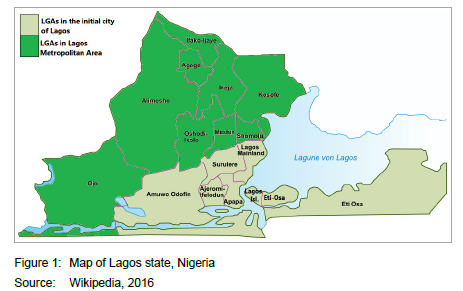
Located between approximately 6° 21' N and 6° 52' N latitude and 3° 20' E and 3° 42' E longitude (see Figure 1), Lagos is Nigeria's most populous and rapidly urbanising state. According to the 2006 Nigerian population census, Lagos had a population of 9,113,605 (NPC, 2006). By 2013, the urban population was projected to exceed 13 million, with a population density of approximately 6,870 individuals per square kilometre (LSBS, 2015). As of 2023, the population is estimated at roughly 21 million (NBS, 2023).
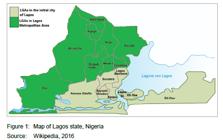
Lagos is administratively divided into 20 local government areas (LGAs), with 16 located within the Lagos Metropolitan Area and the remaining four in the suburban zones of Badagry, Epe, Ibeju/Lekki, and Ikorodu (LSBS, 2015). Over recent decades, the city has undergone rapid infrastructural development, which has markedly altered its once lush landscape. Extensive deforestation has occurred to accommodate the construction of residential and commercial buildings, and transportation infrastructure, significantly transforming the once green and forested landscape of the urban area.
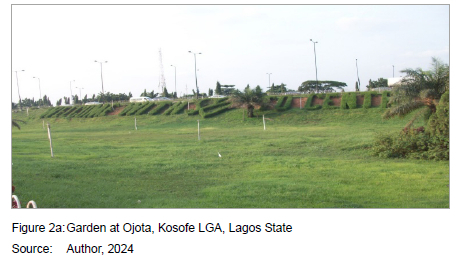
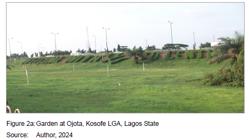
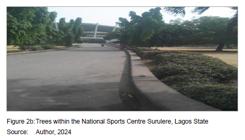
This transformation has resulted in a significant reduction of open and green spaces, which were once designated for communal gatherings, recreation, and relaxation, while also intensifying the negative environmental challenges faced by the region. In reaction to the diminishing quality and quantity of GI, Lagos State Government instituted the Lagos State Parks and Gardens Agency (LASPARK) in 2011, targeting the objective of multiplying environmental greening initiatives within the state (Dipeolu, 2017: 78) (see, for example, Figures 2a-b). Since its inception in 2011, the agency has persistently engaged in the design, aesthetic enhancement, afforestation, and maintenance of public open spaces. Furthermore, it has intensified the enforcement of adherence to existing legislative frameworks formulated to sustain the adequacy and safeguarding the current provisions of GI in Lagos. It is upon this premise that the present study aims to empirically assess the extent to which LASPARK's endeavours in the provision of GI facilities are impacting on residents' social cohesion within the Lagos Metropolis.
4. RESEARCH METHODS
4.1 Research design
This study used a quantitative research design to investigate the relationship between UGI and neighbourhood social cohesion in Lagos Metropolis, Nigeria. A structured questionnaire survey allowed the researchers to generalise their findings from a sample population (Creswell & Creswell, 2018). It also allows for descriptive and inferential statistical data analysis (Cooper, Fone & Chiaradia, 2014: 5). In this study, descriptive analysis was used to measure the perceptions of respondents on the UGI features as well as the role of GI in social cohesion. Inferential analysis was used to examine any potential relationships between the mean scores of UGI features and the mean score of social cohesion to understand the influence of UGI features on social cohesion in neighbourhoods in Lagos Metropolis, Nigeria.
4.2 Population, sample, and response rate
Four LGAs, namely Kosofe, Lagos Island, Ikeja, and Surulere, which are part of the Lagos Metropolis, were randomly selected for the study. Enumeration areas (EAs) records and maps acquired from the National Population Commission (NPC) office in Lagos indicated the existence of 17 EAs (Lagos Island = 4 EAs, Kosofe = 5 EAs, Ikeja = 3 EAs, and Surulere = 5 EAs) in the four selected LGAs. The communities (EA) where the survey took place were randomly chosen to ensure equal representation across all selected LGAs. Hence, participants were chosen from these identified EAs, using a systematic sampling technique. This involved selecting the first household at designated point in an EA, followed by other selections of households based on calculated sampling interval(s) until the requisite sample size allocated to the EAs was attained. The questionnaires were distributed manually, with each household head receiving one for completion in English. Voluntary participation was ensured in the study and devoid of any compulsion or coercion.
For the sample size (n), the formula suggested by Turner (2003) was applied

n de notes sample size, Za is the critical value of normal distribution at a confidence level of 95%, at 1.9(:5, r is the estimates of the percentage of reapondents (at !50ο/ο), f=4 (design effect), k stands for percentage of non-responses (at 20°%), p=().0ex18=0.54= and f is thf referenœ parameter. Acœrding toTurner (2003), 0.03 signifi0s each year of age represented within the fec0sed population, and d denotes the average household size, gen erallff acceffef to be 6 in most of t0e d eveloping nat i ons, and e is the level of precision at 5°% of r. Therefore,

The value of 380 obtained from the sample size calculation, indicates that, since 4 LGAs were involved in the survey, at least 1,520 participants were required for the study across all 4 LGAs. In all, a total of 1,640 questionnaires were distributed, and 1,560 (approximately 95.1%) of the total were completed accurately by the respondents.
4.3 Data collection
The survey was conducted during weekends between March and August 2021. This was due to the busy schedule of work activities in Lagos which make the weekends more feasible to meet most of the participants within their residential zones. It also ensures that only residents filled the questionnaires and not visitors. A questionnaire was administered to each consenting household head or adult representative encountered within the surveyed EA housing units. The semi-structured questionnaire was organised into three sections. Section A intended to gather socio-demographic data regarding the survey participants. Section B consisted of ten Likert-scale items on the UGI features present in the four Lagos communities. The items were extracted from a set of perceived residential quality indicators (PRQI) formulated by Bonaiuto et al. (2006). Section C included ten Likert-scale statements regarding the role of UGI in social cohesion within the community. In this scale, social cohesion was quantified, using measures adapted from prior research (Baur, 2011: 157; Pooley, Cohen & Pike, 2005: 73).
Participants were requested to rate their level of agreement on the items and the statements based on a 5-point Likert-type scale, ranging from 1 = Strongly Disagree to 5 = Strongly Agree. Ethical approval was secured from the ethics committee of the Lagos State Ministry of Environment for the study and the questionnaire. To ensure the validity of the research, a pilot study was conducted in a randomly selected LGA, and the insights gained were used to refine and adjust the questionnaire accordingly.
4.4 Data analysis
Descriptive statistics and categorical regression (CATREG) from the Statistical Package for the Social Sciences (SPSS) Version 25 were used to analyse the data. Frequency and percentage were used to show the profile of the respondents. Mean score and standard deviation were calculated and reported to show results on UGI features as well as UGI's role in social cohesion. For interpretation purposes, the analytical framework established by Akpa and Bamgboye (2015) were used to show the agreement level of respondents where M<3.0 = Disagree, MS=3.0 = Neutral, and MS>3.0 = Agree. For the regression analysis, the ordinal nature of the data set made CATREG suitable to examine the variance explained by R2, identify, and compare the relative influence of UGI on social cohesion in the sampled residents' neighbourhoods (Shrestha, 2009: 207). In executing the CATREG analysis, the mean score for social cohesion was identified as the criterion variable, while the mean scores for each of the ten items employed in evaluating the UGI features in the neighbourhoods were designated as independent variables. For this study, UGI features with p< 005 have significant influence on social cohesion in the neighbourhoods. The Cronbach's alpha coefficient test for reliability produced 0.79 and 0.83, respectively for the ten items used in assessing UGI features and social cohesion. These values are more than 0.6 proposed by previous studies (DeVellis, 2017: 56; George & Mallery, 2016: 122).
5. RESULTS
5.1 Residents' profile
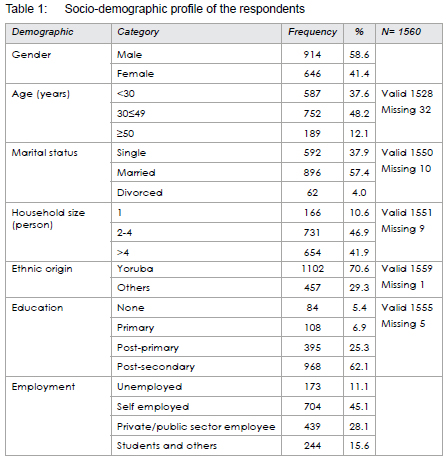
Table 1 shows the socio-demographic information of respondents. A higher proportion of the surveyed participants are male (58.6%), married (57.4%), aged 30 years and above (48.2%), and predominantly belong to the Yoruba ethnic group (70.6%). In additionally, the results indicate that approximately 89% of the respondents have household sizes exceeding two individuals and 94% possess at least a primary level of education, with about 73% being gainfully employed. The results further confirmed that the individuals participating in this survey are indeed literate adult inhabitants of the neighbourhoods under investigation and are suitably qualified to contribute pertinent data for the research.
5.2 Urban green infrastructure features
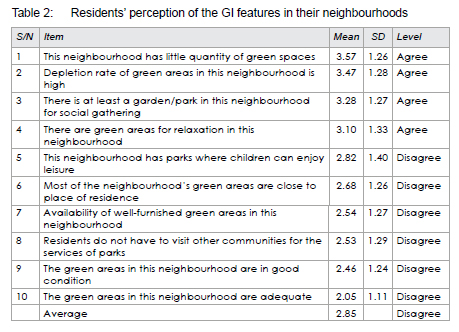
Table 2 illustrates the descriptive statistics pertaining to the ten items employed to evaluate the features of UGI within the study area. The computed mean score of 2.85 reflecting the participants' assessment of the overall UGI indicates that the residents disagree with the UGI features in their neighbourhoods. Respondents agreed that there is at least one garden or park for social interaction and relaxation, while simultaneously noting that green spaces in their respective neighbourhoods are limited in quantity and undergoing rapid depletion. The residents expressed disagreement regarding the following features: parks where children may partake in leisure activities; most of the green spaces are situated in close proximity to the residents; adequately equipped green spaces are accessible within the neighbourhood; it is not necessary for them to travel to other neighbourhoods within the city to utilise park facilities, and the green spaces in their neighbourhoods are maintained in good condition.
5.3 Role of UGI in social cohesion among residents
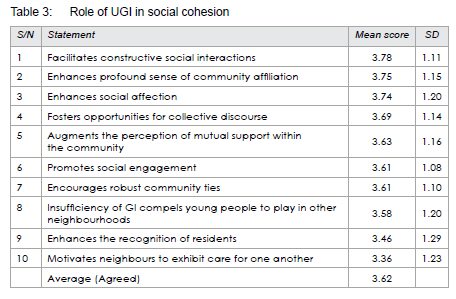
Table 3 presents the evaluation of the role of UGI in social cohesion among residents in their community. From this analysis, the computed mean score of 3.62 indicates that all mean scores are above 3.00 for each item in the scale. This confirms that the respondents agree that UGI plays a beneficial role in facilitating the development of the ten dimensions of social cohesion explored in this study. With mean scores above 3.70, residents agreed that the top three roles that UGI plays in creating social cohesion are constructive social interactions (MS=3.78), enhancing profound sense of community affiliation (MS=3.75), and enhancing social affection (MS=3.74).
5.4 Influence of UGI on neighbourhood's social cohesion
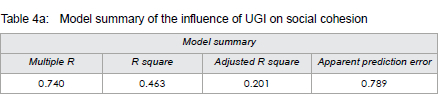
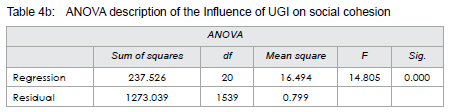
Tables 4a and 4b present coefficients derived from the regression analysis examining the impact of GI on social cohesion among residents in the selected neighbourhoods. The regression model yielded F (237.526, 1273.039) = 14.805, P<0.000, with an R2 value of 0.463. This indicates that the model employed in this study accounted for approximately 47% of the variance regarding the effect of GI on social cohesion within the examined area.
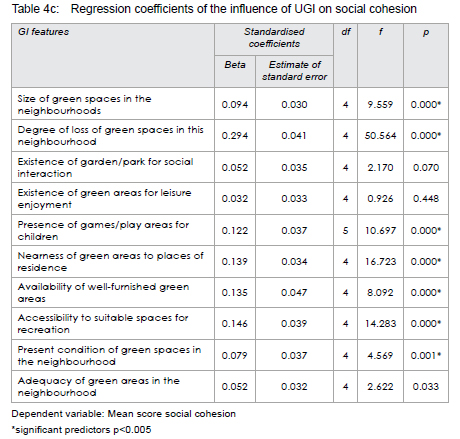
According to the p-values detailed in Table 4c, it appears that, out of the ten features of GI assessed in this study, only three, namely the presence of a garden/park designated for social interaction (p=0.070), the availability of green spaces for relaxation (p=0.448), and adequacy of green areas in the neighbourhoods (p=0.033), did not emerge as statistically significant predictors of social cohesion in the study. This suggests that the remaining seven features of GI exert a noticeable influence on social cohesion in the investigated area.
The β coefficients further illustrate that, in terms of influence, the degree of loss of green spaces in neighbourhoods, represented by the highest β coefficient of 0.294 (p=0.000), exerts the most pronounced influence on social cohesion within the study area, followed by accessibility to appropriate recreational spaces (β=0.146, p=0.000), nearness of green areas to residential locations (β=0.139, p=0.000), the availability of well-furnished green spaces within neighbourhoods (β=0.135, p=0.000), the existence of play areas for children (β=0.122, p=0.000), the size of green spaces within neighbourhoods (β=0.094, p=0.000), and the current condition of green areas within neighbourhoods (β=0.079, p=0.001), respectively. These findings imply that the rate at which green areas are diminished in neighbourhoods significantly contributes to elucidating social cohesion among the participants in the survey.
6. DISCUSSION
This study examined the relationship between UGI and social dynamics in Lagos, one of Africa's largest and most rapidly urbanising cities. As Lagos continues to expand, the role of UGI, comprising both natural and engineered elements such as parks, green roofs, urban forests, and recreational areas, became increasingly significant in shaping the city's physical landscape and fostering social cohesion within its communities. The research focused specifically on how these green spaces influence residents' perceptions of social cohesion, a vital element for community well-being and resilience in a rapidly urbanising context.
In response to the primary research question regarding residents' perceptions of UGI features within their neighbourhoods, survey data revealed that, while residents acknowledge the presence of UGI such as gardens, trees, and open spaces, they perceived the existing network to be inadequate in both quantity and quality. Specifically, respondents emphasised the insufficiency of green areas, which were reported to be diminishing, poorly equipped, and inadequately maintained. These findings suggest that current urban greening initiatives such as those implemented by LASPARK had not yet led to significant improvements in the quantity or quality of green amenities, as perceived by local residents. Drawing on existing literature (Herath & Bai, 2024; Marando et al., 2022; Grigoletto et al., 2021), which highlight the role of GI in facilitating recreational activities, the perceived deficiency of UGI in the surveyed neighbourhoods could limit access to essential spaces for recreation and social interaction. This limitation, in turn, may have negative implications for residents' health, social well-being, and overall social cohesion.
Regarding residents' perceptions of UGI's role in promoting social cohesion, the research indicated that, despite the generally poor quality of available green spaces, respondents believed that UGI plays a beneficial role in enhancing various dimensions of social cohesion. The results, summarised in Table 3, show that each of the ten social cohesion components surveyed had a mean score significantly exceeding 3.01, suggesting that residents recognised the positive contributions of UGI to these aspects of community life. Respondents concurred that UGI promotes beneficial social interactions, fosters community identity, creates social warmth, and provides opportunities for collective participation and reciprocal support. These findings align with previous studies (Grigoletto et al., 2021: 6451; Akipinar, 2016: 81; Rigolon, 2016: 166).
The results further indicated that GI enhances socialisation and strengthens communal bonds, improving neighbour recognition and mutual care. These findings support the arguments of scholars who have linked GI to social cohesion (Moustakas, 2023: 1034; Talen, 2000).
Of particular significance were the three UGI features that had the most substantial impact on social cohesion, namely the rate of degradation of green spaces; the accessibility of park services within neighbourhoods, and the proximity of green areas to residents. By contrast, the sufficiency of green spaces within neighbourhoods had the least impact on social cohesion. These results are consistent with prior research (Akipinar, 2016: 81; Arnberger & Eder, 2012: 46), which highlighted the positive correlation between GI and social benefits in urban neighbourhoods.
The finding that the degradation of green spaces had the greatest influence on social cohesion was particularly noteworthy. This aligns with Jennings and Bamkole's (2019: 462) assertion that the erosion of communal green spaces markedly reduces areas available for recreational and leisure activities, thereby diminishing opportunities for positive social interactions and gatherings, both of which are essential components of social cohesion (Cramm & Nieboer, 2015: 8).
Similarly, the emphasis on the accessibility of park services as a critical factor in creating social cohesion mirrors the conclusions of earlier studies (Dipeolu & Ibem, 2022: 89; Baur, 2011: 161), which suggested that urban parks, incorporating various elements of GI such as community forests, gardens, and open spaces, are vital in creating environments conducive to social interaction and engagement. Ganugi and Prandini (2023), as well as Cramm et al. (2013: 149), emphasise that frequent social interactions in such spaces foster relational bonds and strengthen community ties.
The finding that proximity to green spaces also plays a key role in social cohesion is consistent with previous studies (Jennings et al., 2016: 204), which show that access to green spaces, particularly those that are easily reachable, enhance social interactions. Moreover, Kabisch and Haase (2014: 136) and Rigolon (2016:167) highlight that attractive, accessible green spaces can, among other benefits, contribute to stronger social cohesion and enhance a sense of place.
Furthermore, Akipinar's (2016: 81) assertion that well-structured green spaces with adequate amenities tend to attract more users than poorly maintained ones offered insight into why well-maintained green spaces are viewed as significant for creating social cohesion in the study area. Access to such spaces likely reduces the need for residents to seek external locations for social activities, thereby promoting local community engagement and interaction.
7. CONCLUSION AND RECOMMENDATIONS
Social cohesion plays a crucial role in the development and stability of communities, with far-reaching implications for economic, social, and health outcomes. The literature highlights the multidimensional nature of social cohesion and its significant impact on community development. This study contributes to the growing body of research, by presenting three key findings.
First, residents of the Lagos Metropolis perceive the existing UGI facilities as substandard. Secondly, despite this, there is a general consensus among residents that UGI in their areas positively influence key aspects of social cohesion. Thirdly, the study identifies three critical factors affecting social cohesion through UGI, namely the deterioration of green spaces, limited accessibility to park services, and the proximity of green areas to residential neighbourhoods. These findings indicate that many neighbourhoods in the Lagos Metropolis are grappling with inadequate green spaces, and there is a clear demand for improvements in UGI facilities.
In light of these findings, there is an urgent need for policy intervention to enhance both the quantity and quality of green infrastructure across the Lagos Metropolis, particularly in underserved areas. To this end, several policy recommendations are proposed:
1. Increase the quantity and quality of UGI in underserved areas: The Lagos State Government should prioritise the expansion and improvement of UGI in communities with limited access to green spaces. This would not only enhance environmental quality but also create greater social cohesion, by providing spaces for interaction, recreation, and community engagement.
2. Promote equitable distribution of green spaces: It is essential to ensure that the distribution of GI is equitable, with particular attention to marginalised and underserved communities. Policy measures should be enacted to ensure that no neighbourhood is left behind in the provision of public green spaces.
3. Enforce and strengthen legislative protection for green spaces: To protect existing green spaces and prevent encroachment, the Lagos State Government should collaborate with agencies such as the National Environmental Standards and Regulations Enforcement Agency (NESREA) to update and enforce environmental regulations. Legislative frameworks should be designed to safeguard green spaces from unauthorised development, ensuring their long-term availability for community use. This will support the preservation of spaces that promote social cohesion and create social interaction.
4. Support community engagement through green spaces: Policies should also aim to facilitate community interactions, by making green spaces more accessible and conducive to social activities. This can be achieved through well-maintained public parks, recreational facilities, and spaces for communal events.
To address the limitations of this study, future research could expand the scope, by including a broader range of neighbourhoods and LGAs, which would allow for more generalisable conclusions across the Lagos Metropolis. Furthermore, while the regression model in this study accounted for approximately 47% of the variance in the relationship between GI and social cohesion, additional research is needed to identify other factors that contribute to the remaining 53%. Future studies should employ more sophisticated methods and data-collection tools such as qualitative interviews or longitudinal studies to gain deeper insights into the complexities of this relationship and minimise potential biases associated with self-reported survey data.
The promotion of social cohesion through GI in Nigerian urban centres is not only an environmentally sustainable strategy, but also a socially and economically beneficial one. By addressing critical urban challenges, enhancing neighbourhood security, and creating a sense of community, GI aligns with broader policy goals aimed at improving the quality of life for urban residents.
REFERENCES
2. LITERATURE REVIEW
- Abbass, K. & Aina, Y. 2020. Assessing the role of urban parks in promoting social cohesion in African cities: A case study of Lagos, Nigeria. Journal of Urban Planning and Development, 146(4), pp. 22-31.
- Agunbiade, M. 2021. Economic inequality and neighbourhood disunity in African cities. Journal of Development Studies, 47(6), pp. 523-540.
-
Akpa, O.M. & Bamgboye, E.A. 2015. Correlates of the quality of life of adolescents in families affected by HIV/AIDS in Benue State, Nigeria. Vulnerable Child Youth Studies, 10(3), pp. 225-242. https://doi.org/10.1080/17450128.2015.1066914
» https://doi.org/10.1080/17450128.2015.1066914 -
Akpinar, A. 2016. How is quality of urban green spaces associated with physical activity and health? Urban Forestry & Urban Greening, 16, pp. 76-83. https://doi.org/10.1016/j.ufug.2016.01.011
» https://doi.org/10.1016/j.ufug.2016.01.011 -
Arnberger, A. & Eder, R. 2012. The influence of green space on community attachment of urban and suburban residents. Urban Forestry & Urban Greening, 11(1), pp. 41-49. https://doi.org/10.1016/j.ufug.2011.11.003
» https://doi.org/10.1016/j.ufug.2011.11.003 - Baur, J.W.R. 2011. Urban natural parks in Portland: Nature, networks, and community health. Unpublished PhD dissertation, Oregon State University, USA.
-
Bonaiuto, M., Fornara, F. & Bonnes, M. 2006. Perceived residential environment quality in middle- and low-extension Italian cities. Revue Européenne de Psychologie Appliquée, 56, pp. 23-34. https://doi.org/10.1016/j.erap.2005.02.011
» https://doi.org/10.1016/j.erap.2005.02.011 -
Borgström, S., Andersson, E. & Björklund, T. 2021. Retaining multi-functionality in a rapidly changing urban landscape: Insights from a participatory, resilience thinking process in Stockholm, Sweden. Ecology and Society, 26(4), pp. 17-27. https://doi.org/10.5751/ES-12432-260417
» https://doi.org/10.5751/ES-12432-260417 -
Breed, C.A., Engemann, K. & Pasgaard, M. 2024. A transdisciplinary multiscale approach to engage with green infrastructure planning, restoration and use in sub-Saharan Africa. Urban Ecosystems, 27, pp. 895-907. https://doi.org/10.1007/s11252-023-01477-y
» https://doi.org/10.1007/s11252-023-01477-y -
Buchel, S. & Frantzeskaki, N. 2015. Citizens' voice: A case study about perceived ecosystem services by urban park users in Rotterdam, The Netherlands. Ecosystem Services, 12, pp. 169-177. https://doi.org/10.1016/j.ecoser.2014.11.014
» https://doi.org/10.1016/j.ecoser.2014.11.014 -
Cabitza, F., Scramaglia, R., Cornetta, D. & Simone, C. 2016. When the web supports communities of place: The "Social Street" case in Italy. International Journal of Web Based Communities, 12(3), pp. 216-237. https://doi.org/10.1504/IJWBC.2016.077758
» https://doi.org/10.1504/IJWBC.2016.077758 -
Cramm, J.M. & Nieboer, A.P. 2015. Social cohesion and belonging predict the well-being of community-dwelling older people. BMC Geriatrics, 15(30), pp. 1-10. https://doi.org/10.1186/s12877-015-0027-y
» https://doi.org/10.1186/s12877-015-0027-y -
Cramm, J.M., Van Dijk, H.M. & Nieboer, A.P. 2013. The importance of neighbourhood social cohesion and social capital for the well-being of older adults in the community. Gerontologist, 53(1), pp. 142-152. https://doi.org/10.1093/geront/gns052
» https://doi.org/10.1093/geront/gns052 -
Choi, N.G., Kim, J., DiNitto, D.M. & Marti, C.N. 2015. Perceived social cohesion, frequency of going out, and depressive symptoms in older adults: Examination of longitudinal relationships. Gerontology & Geriatric Medicine, pp. 1-11. https://doi.org/10.1177/2333721415615478
» https://doi.org/10.1177/2333721415615478 -
Cooper, C.H.V., Fone, D.L. & Chiaradia, A.J.F. 2014. Measuring the impact of spatial network layout on community social cohesion: A cross-sectional study. International Journal of Health Geographics, 13(11), pp. 1-14. https://doi.org/10.1186/1476-072X-13-11
» https://doi.org/10.1186/1476-072X-13-11 - Creswell, J.W. & Creswell, J.D. 2018. Research design: Qualitative, quantitative and mixed method approaches. 5th edition. London, UK: Sage.
- DeVellis, R.F. 2017. Scale development: Theory and applications. 4th edition. London, UK: Sage.
- Dipeolu, A.A. 2017. Impact of green infrastructure on environmental sustainability in selected neighbourhoods of Lagos Metropolis, Nigeria. Unpublished PhD dissertation, Federal University of Technology, Akure, Nigeria.
-
Dipeolu, A.A. & Ibem, E.O. 2022. Influence of green infrastructure on residents' connectedness with nature in Lagos metropolis, Nigeria. Urbani Izziv, 33(1), pp. 82-92. https://doi.org/10.5379/urbani-izziv-en-2022-33-01-03
» https://doi.org/10.5379/urbani-izziv-en-2022-33-01-03 -
Dipeolu, A.A., Ibem, E.O. & Fadamiro, J.A. 2021. Determinants of residents' preferences for urban green infrastructure in Nigeria: Evidence from Lagos Metropolis. Urban Forestry & Urban Greening, 57, article 126931. pp 1-9. https://doi.org/10.1016/j.ufug.2020.126931
» https://doi.org/10.1016/j.ufug.2020.126931 -
Dipeolu A.A., Ibem E.O. & Oriola, O.A. 2022. Influence of green infrastructure on residents' endorsement of the new ecological paradigm in Lagos, Nigeria. Journal of Contemporary Urban Affairs, 6(2), pp. 159-173. https://doi.org/10.25034/ijcua.2022.v6n2-4
» https://doi.org/10.25034/ijcua.2022.v6n2-4 -
Donovan, G.H. & Prestemon, J.P. 2012. The effect of trees on crime in Portland, Oregon. Environment and Behaviour, 44(1), pp. 3-30. https://doi.org/10.1177/0013916510383238
» https://doi.org/10.1177/0013916510383238 -
Dulin, A.J., Park, J.W., Scarpaci, M.M., Dionne, L.A., Mario Sims, M. et al. 2022. Examining relationships between perceived neighbourhood social cohesion and ideal cardiovascular health and whether psychosocial stressors modify observed relationships among JHS, MESA, and MASALA participants. BMC Public Health, 22, pp. 1890-1901. https://doi.org/10.1186/s12889-022-14270-x
» https://doi.org/10.1186/s12889-022-14270-x -
Fonseca, X., Lukosch, S. & Brazier, F. 2019. Social cohesion revisited: A new definition and how to characterize it. The European Journal of Social Science Research, 32(2), pp. 231-253. https://doi.org/10.1080/13511610.2018.1497480
» https://doi.org/10.1080/13511610.2018.1497480 -
Ganugi, G. & Prandini, R. 2023. Fostering social cohesion at the neighbourhood scale: The role of two social streets in Ferrara and Verona. SN Social Sciences, 3(105), pp. 1-25. https://doi.org/10.1007/s43545-023-00688-6
» https://doi.org/10.1007/s43545-023-00688-6 - George, D. & Mallery, P. 2016. IBM SPSS Statistics 23 step-by-step: A simple guide and reference. 14th edition. London, UK: Routledge.
-
Grigoletto. A., Mauro, M., Campa, F., Loi, A., Zambon, M.C., Bettocchi, M. et al. 2021. Attitudes towards green urban space: A case study of two Italian regions. International Journal of Environmental Research and Public Health, 18(12), pp. 6442-6453. https://doi.org/10.3390/ijerph18126442
» https://doi.org/10.3390/ijerph18126442 -
Herath, P. & Bai, X. 2024. Benefits and co-benefits of urban green infrastructure for sustainable cities: Six current and emerging themes. Sustainability Science, 19, pp. 1039-1063. https://doi.org/10.1007/s11625-024-01475-9
» https://doi.org/10.1007/s11625-024-01475-9 -
Jennings, V. & Bamkole, O. 2019. The relationship between social cohesion and urban green space: An avenue for health promotion. International Journal of Environmental Research and Public Health, 16, pp. 452-464. https://doi.org/10.3390/ijerph16030452
» https://doi.org/10.3390/ijerph16030452 -
Jennings, V., Larson, L. & Yun, J. 2016. Advancing sustainability through urban green space: Cultural ecosystem services, equity, and social determinants of health. International Journal of Environmental Research and Public Health, 13(2), pp. 196-207. https://doi.org/10.3390/ijerph13020196
» https://doi.org/10.3390/ijerph13020196 -
Kabisch, N. & Haase, D. 2014. Green justice or just green? Provision of urban green spaces in Berlin, Germany. Landscape and Urban Planning, 122, pp. 129-139. https://doi.org/10.1016/j.landurbplan.2013.11.016
» https://doi.org/10.1016/j.landurbplan.2013.11.016 - Kimani, M.W. & Macharia, D. 2018. Urban green spaces and social inclusion in Nairobi, Kenya. African Geographical Review, 37(3), pp. 210-224.
-
Koko, A.F. & Bello, M. 2023. Exploring the contemporary challenges of urbanization and the role of sustainable urban development: A study of Lagos City, Nigeria. Journal of Contemporary Urban Affairs, 7(1), pp. 175-188. https://doi.org/10.25034/ijcua.2023.v7n1-12
» https://doi.org/10.25034/ijcua.2023.v7n1-12 - Kumuyi, B. & Ojo, T. 2023. Managing diversity for social cohesion in African cities. Journal of African Social Policy, 14(2), pp. 167-181.
-
LSBS (Lagos State Bureau of Statistics). 2015. [Online]. Available at: https://mepb.lagosstate.gov.ng/lbs-publication/ (accessed on 15 February 2024).
» https://mepb.lagosstate.gov.ng/lbs-publication/ -
Li, D., Bou-Zeid, E & Oppenheimer, M. 2014. The effectiveness of cool and green roofs as urban heat island mitigation strategies. Environmental Research Letters, 9 pp. 7-23. https://doi.org/10.1088/1748-9326/9/5/055002
» https://doi.org/10.1088/1748-9326/9/5/055002 -
Marando, F., Heris, M.P., Zulian, G., Udías, A., Mentaschi, L., et al. 2022. Urban heat island mitigation by green infrastructure in European functional urban areas. Sustainable Cities and Society, 77, pp. 1-15. https://doi.org/10.1016/j.scs.2021.103564
» https://doi.org/10.1016/j.scs.2021.103564 -
Moustakas, L. 2023. Social cohesion: Definitions, causes and consequences. Encyclopedia, 3(3), pp. 1028-1037. https://doi.org/10.3390/encyclopedia3030075
» https://doi.org/10.3390/encyclopedia3030075 - Mukosha, L. & Banda, M. 2021. The impact of green spaces on social cohesion in Lusaka, Zambia. Urban Forum, 32(2), pp. 265-283.
-
Nassauer, J.I. & Raskin, J. 2014. Urban vacancy and land use legacies: A frontier for urban ecological research, design, and planning. Landscape and Urban Planning, 125, pp. 245-253. https://doi.org/10.1016/j.landurbplan.2013.10.008
» https://doi.org/10.1016/j.landurbplan.2013.10.008 -
NBS (National Bureau of Statistics). 2023. Nigeria Population and Housing Census 2023. Abuja, Nigeria: NBS. [Online]. Available at: <https://nigerianstat.gov.ng/download/474> (accessed on 4 October 2024).
» https://nigerianstat.gov.ng/download/474 -
NPC (National Population Commission). 2006. National Population Commission's population figures for Nigeria States for 2006 population and housing census. [Online]. Available at: <https://catalog.ihsn.org/index.php/catalog/3340> (accessed on 4 June 2024).
» https://catalog.ihsn.org/index.php/catalog/3340 -
Obaitor, O.S., Lawanson, T.O., Stellmes, M. & Lakes, T. 2021. Social capital: Higher resilience in slums in the Lagos Metropolis. Sustainability, 13, pp. 3879-3897. https://doi.org/10.3390/su13073879
» https://doi.org/10.3390/su13073879 -
Oh, J. & Thomas, M.C. 2024. The mediating role of neighbourhood social cohesion and trust in the relationship between childhood material hardship and adolescent depression Health & Place, 85, pp. 1-13. https://doi.org/10.1016/j.healthplace.2023.103162
» https://doi.org/10.1016/j.healthplace.2023.103162 - Onyebueke, L. & Onwuka, C. 2020. The role of public spaces in fostering social cohesion in African cities. African Journal of Urban Planning, 12(4), pp. 98-112.
-
Oyeleye, O.A. 2021. Urbanization and its environmental challenges in Nigeria: A case study of Lagos Metropolis. African Journal of Environmental Science and Technology, 15(5), pp. 160-168. https://doi.org/10.5897/AJEST2021.3057
» https://doi.org/10.5897/AJEST2021.3057 -
Pauleit, S., Liu, L. & Hansen, R. 2022. Integrating green infrastructure for urban biodiversity and social cohesion: Challenges in rapidly urbanizing regions. Journal of Urban Ecology, 8(1), pp. 1-10. https://doi.org/10.1093/jue/juac007
» https://doi.org/10.1093/jue/juac007 -
Pooley, J.A., Cohen, L. & Pike, L.T. 2005. Can sense of community inform social capital? The Social Science Journal, 42, pp. 71-79. https://doi.org/10.1016/j.soscij.2004.11.006
» https://doi.org/10.1016/j.soscij.2004.11.006 -
Putnam, R.D. 2000. Bowling alone: The collapse and revival of American community. New York: Simon & Schuster. https://doi.org/10.1145/358916.361990
» https://doi.org/10.1145/358916.361990 -
Rigolon, A. 2016. A complex landscape of inequity in access to urban parks: A literature review. Landscape and Urban Planning, 153, pp. 160-169. https://doi.org/10.1016/j.landurbplan.2016.05.017
» https://doi.org/10.1016/j.landurbplan.2016.05.017 -
Rodríguez, A.M. 2024. Social inequality and residential segregation trends in Spanish global cities. A comparative analysis of Madrid, Barcelona, and Valencia (2001-2021). Cities, 149, pp. 1-11. https://doi.org/10.1016/j.cities.2024.104935
» https://doi.org/10.1016/j.cities.2024.104935 -
Shrestha, S.L. 2009. Categorical regression models with optimal scaling for predicting indoor air pollution concentrations inside kitchens in Nepalese households. Nepal Journal of Science and Technology, 10, pp. 205-211. https://doi.org/10.3126/njst.v10i0.2962
» https://doi.org/10.3126/njst.v10i0.2962 - Tadesse, G.T. & Moges, M.A. 2020. The role of urban green infrastructure in promoting mental health and well-being: Evidence from Addis Ababa, Ethiopia. Journal of Environmental Psychology, 72, pp. 15-27.
-
Talen, E. 2000. The problem with community inp. Journal of Planning Literature, 15(2), pp. 171-183. https://doi.org/10.1177/08854120022092971
» https://doi.org/10.1177/08854120022092971 - Turner, A.G. 2003. Sampling strategies - Expert group meeting to review the draft handbook on designing of household sample surveys. Secretariat, Statistics Division. ESA/STAT/AC.93/2.
- UN (United Nations). 2015. Transforming our world: The 2030 Agenda for sustainable development. USA, New York: UN.
-
Van der Meer, T. & Tolsma, J. 2019. Ethnic diversity and its effects on social cohesion. Annual Review of Sociology, 45, pp. 459-478. https://doi.org/10.1146/annurev-soc-071913-043309
» https://doi.org/10.1146/annurev-soc-071913-043309 -
Wikipedia. 2016. Map of the local government areas of Lagos. [Online]. Available at: <https://en.m.wikipedia.org/wiki/File:Map_of_the_Local_Government_Areas_of_Lagos.png#metadata> (accessed on 18 November 2024).
» https://en.m.wikipedia.org/wiki/File:Map_of_the_Local_Government_Areas_of_Lagos.png#metadata -
Williams, D.R. & Collins, C. 2021. Racial residential segregation: A fundamental cause of racial disparities in health. Public Health Reports, 116(5), pp. 404-416. https://doi.org/10.1093/phr/116.5.404
» https://doi.org/10.1093/phr/116.5.404 -
Wolch, J.R., Byrne J. & Newell, J.P. 2014. Urban green space, public health, and environmental justice: The challenge of making cities 'just green enough. Journal Landscape and Urban Planning, 125, pp. 234-244. https://doi.org/10.1016/j.landurbplan.2014.01.017
» https://doi.org/10.1016/j.landurbplan.2014.01.017 -
Wood, L., Frank, L.D. & Giles-Corti, B. 2010. Sense of community and its relationship with walking and neighbourhood design. Social Science & Medicine, 70, pp. 1381-1390. https://doi.org/10.1016/j.socscimed.2010.01.021
» https://doi.org/10.1016/j.socscimed.2010.01.021 -
Xing, Y., Chen, T., Gao, M., Pei, S., Pan, W. & Chiang, P. 2021. Comprehensive performance evaluation of green infrastructure practices for urban watersheds using an engineering-environmental-Economic (3E) model. Sustainability, 13(9), pp. 4678-4695 https://doi.org/10.3390/su13094678
» https://doi.org/10.3390/su13094678
Peer reviewed and revised: November 2024
Published: December 2024