Guidelines for resolving safety constraints using the last planner system in Zimbabwean construction projects
Abstract
Construction projects in Zimbabwe continue to experience performance challenges arising from persistent safety constraints. This study examines how the Last Planner System (LPS), a key Lean Construction tool, can be applied to reduce these safety-related barriers. The aim is to provide construction stakeholders with practical, evidence-based guidelines for implementing LPS to improve safety performance on project sites. A quantitative survey was conducted among contractors registered with the Construction Industry Federation of Zimbabwe (CIFOZ), yielding 130 valid responses. Data analysis employed descriptive statistics, mean score analysis, exploratory factor analysis (EFA), and partial least squares structural equation modelling (PLS-SEM). Results show that LPS significantly alleviates two major categories of safety constraints, namely technical and managerial inadequacies, and employee-related and project delivery concerns, supported by p-values below 0.05 and path coefficients of 0.409 and 0.520, respectively. From these findings, practical LPS implementation guidelines are proposed. It emphasises multilevel planning (master, phase, look-ahead, and weekly), systematic identification and mitigation of safety risks, enhanced worker participation to strengthen ownership of safety practices, and improved workflow reliability to prevent last-minute changes that commonly lead to accidents. Although the study is limited to Zimbabwean projects and relies primarily on quantitative data, it demonstrates that LPS offers a viable and impactful strategy for improving construction site safety. Broader adoption of LPS can support performance enhancement across the sector and aligns with Sustainable Development Goals 9 and 11.
construction; last planner system; lean construction; project management; safety constraints
Abstract
Konstruksieprojekte in Zimbabwe ondervind steeds prestasie-uitdagings wat voortspruit uit volgehoue veiligheidsbeperkings. Hierdie studie ondersoek hoe die Last Planner System (LPS), 'n belangrike Lean Construction-instrument, toegepas kan word om hierdie veiligheidsverwante hindernisse te verminder. Die doel is om belanghebbendes in die konstruksiesektor te voorsien van praktiese, bewysgebaseerde riglyne vir die implementering van LPS om veiligheidsprestasie op projekterreine te verbeter. 'n Kwantitatiewe opname is uitgevoer onder kontrakteurs wat geregistreer is by die Construction Industry Federation of Zimbabwe (CIFOZ), wat 130 geldige antwoorde opgelewer het. Data-analise het beskrywende statistieke, gemiddelde tellinganalise, verkennende faktoranalise (EFA) en gedeeltelike kleinste kwadrate strukturele vergelykingsmodellering (PLS-SEM) gebruik. Resultate toon dat LPS twee hoofkategorieë van veiligheidsbeperkings aansienlik verbeter, naamlik tegniese en bestuurlike tekortkominge, en werknemerverwante en projekleweringskwessies, ondersteun deur p-waardes onder 0.05 en padkoëffisiënte van onderskeidelik 0.409 en 0.520. Uit hierdie bevindinge word praktiese LPS-implementeringsriglyne voorgestel. Dit beklemtoon multivlakbeplanning (meester-, fase-, vooruitkyk- en weekliks), sistematiese identifisering en versagting van veiligheidsrisiko's, verbeterde werkerdeelname om eienaarskap van veiligheidspraktyke te versterk, en verbeterde werkvloeibetroubaarheid om laaste-minuut veranderinge te voorkom wat algemeen tot ongelukke lei. Alhoewel die studie beperk is tot Zimbabwiese projekte en hoofsaaklik op kwantitatiewe data staatmaak, toon dit dat LPS 'n lewensvatbare en impakvolle strategie bied vir die verbetering van konstruksieterreinveiligheid. Breër aanvaarding van LPS kan prestasieverbetering regoor die sektor ondersteun en stem ooreen met Volhoubare Ontwikkelingsdoelwitte 9 en 11.
1. INTRODUCTION
The construction industry plays a critical role in the development of essential physical infrastructure such as roads and bridges (Ofori, 2015: 115). Despite this significance, the industry continues to experience suboptimal performance across multiple dimensions, including health, safety, and strategic management (Oyewobi et al., 2015: 1). Numerous key performance indicators have been identified to evaluate and improve construction outcomes, such as construction time, profitability, time predictability (project, design, and construction), quality assurance, risk management, safety, and productivity (Sibiya Aigbavboa & Thwala, 2015: 954). Safety management has, therefore, become increasingly important, with recent studies highlighting the necessity for continuous improvement across all areas of construction operations (Nasir et al., 2016; Habibi & Kermanshachi, 2018; Santoso & Gallage, 2020; Sweis & Jaradat, 2022). In Zimbabwe, concerns regarding safety performance have been particularly pronounced. The construction sector has recorded a high injury frequency rate of approximately 2.34%, significantly exceeding the International Labour Organisation's recommended threshold of less than 1% (Chigara & Moyo, 2014: 57). Persistent safety challenges remain evident, as noted by Chigara and Smallwood (2016), while Chazireni and Chigonda (2018) further emphasise the widespread safety-related issues on construction sites, reinforcing the need for sustained performance improvement efforts. Working conditions in the industry have repeatedly come under scrutiny, with the sector identified as one of the major contributors to indecent work practices. Many small and medium-sized enterprises (SMEs) continue to employ large numbers of workers without adequate protective equipment, while regulatory compliance remains weak, due to limited government oversight (Mhlanga, 2019). More recently, Dzimiri and Chigara (2025) also documented the growing safety concerns faced by construction workers.
Addressing these safety challenges requires the adoption of cost-effective performance enhancement strategies, including the application of lean construction tools (Enshassi, Saleh & Mohamed, 2019: 274). Lean construction aims to convert non-value-adding activities into value by minimising waste, improving communication, and enhancing teamwork through structured tools and techniques (Srinivas, 2020: 25). This approach has been shown to reduce problems related to waste generation and poor quality (Ahmed, Hossain & Haq, 2021: 368), while also improving the industry's capability to manage ambiguity and complexity (Ruin et al., 2016). Although lean construction concepts, particularly the LPS, have gained popularity, their application in many developing countries, including Zimbabwe, remains limited (Maske & Valunjkar, 2020: 143). While LPS is widely recognised as a significant lean tool (Sweis, Hiyassat & Al-Hroub, 2016: 446), its potential role in resolving safety constraints has not been clearly defined, resulting in a lack of practical implementation guidelines.
LPS promotes enhanced communication among trades and introduces improved methods for planning and executing activities that can positively influence overall project performance, including safety outcomes (Sundararajan & Madhavi, 2018). The system incorporates look-ahead scheduling and constraint analysis to identify and mitigate potential risks before they impact project progress (Heigermoser et al., 2019: 246). LPS does not require substantial financial investments but involves people planning and correct implementation. Given this potential, this study seeks to provide construction stakeholders in Zimbabwe with practical LPS implementation guidelines tailored to addressing safety constraints in construction projects.
2.1 Last Planner System (LPS)
The LPS, as introduced by Ballard and Howell (1998), represents a production management framework designed to enhance workflow reliability, an aspect often overlooked in conventional project management practices. The LPS aims to protect upcoming work from the disruptions and uncertainties that often occur in later stages of a project. This is achieved through collaborative planning among those responsible for executing the work, typically crews, which facilitate the development of detailed, reliable hand-off plans for upcoming tasks (Ballard & Howell, 1998: 15). The effect of LPS in handling construction processes has been further substantiated by theoretical contributions addressing decision-making uncertainty (Ballard, Hammond & Nickerson, 2009). Key conceptual foundations include the transformation-flow-value theory (Koskela & Ballard, 2006); the language/action perspective (Macombe & Howell, 2003), and Hayek's (1945) insight into the dispersed nature of planning-relevant knowledge among individuals.
Unlike the traditional project management paradigm, often described as a 'thermostat model', which focuses on adjusting resources in response to deviations, the LPS emphasises planning and production control as its core tenets (Ballard & Howell, 1998: 490). Planning, execution, and control are the foundational processes, and LPS introduces a more collaborative and adaptive approach to managing project workflows. Ballard et al. (2009: 490) outline five guiding principles of the LPS:
• Tasks should be planned with increasing specificity as their execution date approaches;
• Planning should actively involve those responsible for task execution;
• Constraints to task execution should be identified and resolved prior to commencement;
• Commitments made within the planning process should be reliable and secure, and
• Continuous learning should be derived from task failures to prevent them from recurring.
2.2 LPS and construction projects
Research has shown that using the LPS contributes to notable improvements in construction project outcomes. For example, LPS has been associated with better quality control in housing projects (Castillo, Alarcón & Salvatierra, 2018: 1). Howell et al. (2017) and Sundararajan and Madhavi (2018) report that LPS improves workforce efficiency, strengthens communication and coordination, and reduces rework and defects. Ogunbiyi, Oladapo and Goulding (2014: 1741) also note that lean tools such as LPS enhance the efficiency and quality of industrialised building operations.
In studies from Saudi Arabia, Al Sehaimi et al. (2009: 53) observe that LPS implementation resulted in improved communication among stakeholders, better coordination, higher quality outcomes, enhanced managerial practices, stronger teamwork, and increased productivity. Other lean tools such as first-run studies, 5S, fail-safe quality methods, and huddle meetings, have also been used successfully to reduce construction costs, accelerate project delivery, improve quality, enhance safety, and support better environmental performance (Bajjou, Chafi & En-nadi, 2017: 118).
Enshassi et al. (2019) identify LPS as one of the top three most effective tools for reducing accidents on construction projects in Gaza. Barth et al. (2020) And that LPS minimises uncertainty, improves planning, and increases stakeholder engagement - factors that collectively enhance safety. Xing et al. (2021) report that LPS implementation in Chinese projects led to overall improvements in project performance. According to Priyadarshana et al. (2023), global adoption of LPS has continued to grow, contributing to ongoing improvements in safety performance.
Given these documented benefits in other developing countries, LPS shows strong potential for addressing safety challenges within the Zimbabwean construction context. Its effectiveness can be assessed by examining how key LPS features help resolve specific safety constraints. Based on the literature, LPS features considered in this study include recording completed tasks per week, recording daily tasks per individual, discussing reasons for incomplete tasks, using look-ahead schedules, using a master schedule, using a phase schedule, using Percentage Plan Complete to track progress, weekly meetings, and weekly work plans. Although these features are largely geared toward time-related planning, their positive effects also extend to safety improvements.
2.3 Safety performance and constraints
Safety performance in the Zimbabwean construction sector remains a persistent challenge, influenced by systemic, organisational, and human factors. Despite global recognition of the construction industry as high-risk, Zimbabwe has struggled to achieve significant improvements in occupational safety, with accident rates and fatalities remaining alarmingly high (Chigara & Moyo, 2014; Smallwood & Haupt, 2005; Buniya et al., 2021). The industry's unique socio-economic and regulatory landscape exacerbates these issues, requiring contextualised interventions and tailored safety strategies.
A critical factor affecting safety performance is the regulatory environment and enforcement mechanisms. The Construction Industry Development Board (cidb) (2009) established guidelines for safety management; however, enforcement is weak, and compliance often focuses on documentation rather than genuine on-site practice (Smallwood & Haupt, 2005; Wong, Gray & Sadiqi, 2015; Chigara & Moyo, 2023). Many contractors perceive safety regulations as bureaucratic obligations rather than operational imperatives, leading to superficial compliance (Smallwood & Haupt, 2005). Without effective enforcement, safety policies fail to translate into meaningful improvements (Wong et al., 2015).
Human factors, particularly workforce behaviour, are central to safety outcomes. Kelloway and Cooper (2011) note that occupational safety is strongly influenced by employee attitudes and management commitment. In Zimbabwe, inadequate safety training, low awareness, and complacency among workers contribute to frequent incidents (Buniya et al., 2021; Chigara & Moyo, 2014). Workers often operate without proper personal protective equipment (PPE), due to cost constraints, supply shortages, or managerial negligence, directly increasing exposure to hazards (Smallwood & Haupt, 2005; Wong et al., 2015). High employee turnover and the prevalence of casual, unskilled labour further complicate safety management, undermining continuity in practices and limiting the effectiveness of training programmes (Chileshe & Dzisi, 2012; Buniya et al., 2021).
Organisational constraints also affect safety performance. Effective management systems require visible leadership commitment, integration of safety into daily operations, and structured policies (Abubakar et al., 2021; Amoah & Simpheh, 2021). However, the vast majority of small and medium contractors in Zimbabwe lack formalised systems, creating inconsistent safety standards across projects (Buniya et al., 2021). The lack of clearly articulated safety rules and policies reduces organisational capacity to enforce practices, while the scarcity of dedicated safety officers leaves hazard management ambiguously assigned (Smallwood & Haupt, 2005; Buniya et al., 2021).
Cultural and behavioural dimensions are also critical. Makhonge (2009) and Hon, Chan and Yam (2012) assert that a culture of risk acceptance persists in many African construction contexts, including Zimbabwe, where workers normalise unsafe practices and perceive accidents as inevitable. Berhan (2020) emphasises that instilling a safety-oriented culture requires ongoing training and behavioural interventions, yet most of the sites lack sustained programmes to reinforce safe practices (Chandi, Kajimo-Shakantu & Akintayo, 2018). Low employee involvement in safety management further weakens performance, as participatory approaches such as worker feedback in safety planning and risk assessment are rarely implemented (Wong et al., 2015; Carmichael, Fenton & Pinilla-Roncancio, 2016; AlKhaburi & Amoudi, 2018). Workers are often passive recipients of safety instructions rather than active contributors to safer work environments (Yiu et al., 2019; Williams, Hamid & Misnan, 2018).
Project characteristics and site conditions also constrain safety performance. Zimbabwean construction frequently occurs under resource scarcity, poor infrastructure, and climatic extremes, increasing risk exposure (Yiu, Sze & Chan, 2018). Tight project schedules and the prioritisation of cost and productivity over safety exacerbate unsafe behaviours, with contractors often adopting shortcuts and risk-taking practices to meet deadlines (Carmichael et al., 2016; Yiu et al., 2018; Buniya et al., 2021). Insufficient risk assessment and hazard identification further promote reactive rather than proactive safety management (Smallwood & Haupt, 2005).
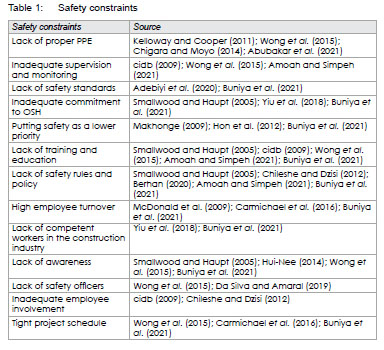
The Zimbabwean construction sector faces multifaceted constraints that limit safety performance. Table 1 provides a summary of safety constraints identified in previous research which form the variables used in this study to measure safety constraints. Addressing these challenges requires a holistic strategy integrating regulatory enforcement, management commitment, workforce training, participatory safety practices, and technological solutions to improve monitoring and hazard management, thereby transforming safety from a peripheral concern to a central operational priority.
3. METHODOLOGY
3.1 Research design
A quantitative research design was employed to examine how the LPS contributes to resolving safety constraints on construction projects in Zimbabwe. A quantitative approach is appropriate because it enables the systematic measurement of relationships between variables (Creswell, 2014), through descriptive and inferential statistical analysis. An extensive literature review informed the identification of 12 safety constraints and 9 core LPS concepts that were used to develop a structured questionnaire. The data-collection instrument assessed the prevalence of safety constraints, the perceived usefulness of LPS features, and the extent of LPS implementation among contractors registered with the Construction Industry Federation of Zimbabwe (CIFOZ). Descriptive analysis and ranking techniques were applied to determine the most significant variables according to respondent perceptions. EFA, a multivariate inferential technique, was used to group related variables and uncover underlying constructs by reducing observed measures into factors associated with safety constraints and LPS practices before structural modelling (Field, 2017). Partial Least Squares Structural Equation Modelling (PLS-SEM) was used to examine the relationships among the extracted factors and to test the influence of LPS application on the resolution of safety constraints (Hair et al., 2019). This research design and its analytical procedures ensured the validity of the findings and supported the development of practical guidelines for applying LPS to enhance safety performance on project sites in Zimbabwe.
3.2 Population, sampling and response rate
The target population is the group to which findings are generalised (Marshall & Rossman, 2016). This study focused on 173 contractors registered with CIFOZ (2025). Random sampling produced 130 valid responses from construction companies, a 75% rate exceeding the 40% minimum suggested by Schutt (2016). To reduce bias, only one response per Arm was collected, and random sampling strengthened credibility (Saunders, Lewis & Thornhill, 2016: 287). Although costly and time-consuming, this ensured data quality. For populations of 100-500, at least 50% is recommended (Leedy & Ormrod, 2016: 166). According to Krejcie and Morgan's (1970: 607) table, 118 responses are required for 173; thus, the 130 obtained were more than sufficient (Table 2).
3.3 Data collection
The questionnaire was developed using the QuestionPro online survey platform, allowing respondents to complete it at their convenience. A similar online survey method was used by Sarhan et al. (2017: 46) in their study on lean construction barriers. Prior to full distribution, a preliminary pilot study was conducted to assess the clarity, reliability, and completeness of the instrument, and to identify any weaknesses requiring adjustment. From June 2024, links to the revised questionnaire were emailed to potential respondents employed by contractors registered under the CIFOZ list (2025) in categories A-H. The final questionnaire consisted of three main sections. The first section gathered demographic information, including respondents' highest qualification, CIFOZ category, and years of experience. The second section measured the implementation of 9 key features of the LPS derived from the literature review. These features included recording daily and weekly completed tasks, discussing reasons for non-completion, use of look-ahead schedules, master schedules, phase schedules, percent plan complete (PPC) for tracking progress, weekly meetings, and weekly work plans. Respondents rated the extent of implementation for each feature using a 5-point Likert scale ranging from very low to very high. The third section presented 12 safety constraints identified in the literature. Respondents were required to rate the perceived importance of the LPS tool in resolving each of these constraints, also using a 5-point Likert scale of importance.
3.4 Method of analysis and interpretation of the data
Questionnaire data were first edited to ensure consistency and identify omissions (Creswell & Poth, 2018), then coded numerically for analysis (Kothari & Garg, 2020). Statistical analysis was conducted using SPSS version 23, with reliability confirmed through Cronbach's alpha values above 0.700 (Taherdoost, 2016).
Mean scores and standard deviations were applied to examine LPS tool features and safety-related constraints. These measures indicate central tendency and provide clear data representation (Leedy & Ormrod, 2016). Where means were equal, a lower standard deviation ranked higher (Bhandari, 2023). Standard deviations above 1.000 reflected greater variability, while means > 3.00 were considered important for further analysis (Schutt, 2016). Ranking was then used to provide a univariate overview of respondent insights.
EFA was conducted to group safety constraints addressed by the LPS tool. Suitability for factor analysis was confirmed by Bartlett's test (p<0.05) and the Kaiser-Meyer-Olkin measure (KMO>0.600) (Field, 2017). Factors were retained based on eigenvalues > 1, loadings >0.400, and cumulative variance >50% (Hair et al., 2019; Kum et al., 2024). Principal component analysis with varimax rotation clarified factor structure (Shrestha, 2021), and interpretation was guided by the variables associated with each factor (Moyo & Chigara, 2023).
Structural equation modelling (SEM) was then employed to examine relationships between LPS tool features and safety constraints. SEM tests links between observed and underlying (latent) variables (Byrne, 2010; Whittaker & Shumaker, 2022; Dimitrov, 2006). In this study, latent variables represented LPS tool features, while observed variables reflected safety constraints rated by respondents. A component-based SEM approach, Partial Least Squares (PLS-SEM), was chosen as it is suitable for complex models and relatively small samples (Haenlein & Kaplan, 2004: 283).
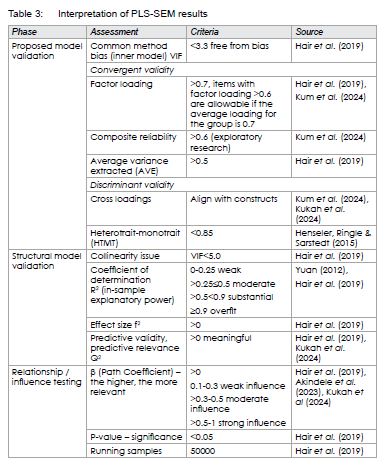
SmartPLS 4 was used to develop the model from the EFA using the PLS-SEM approach (Sarstedt, Ringle & Hair, 2022). PLS-SEM was appropriate for testing multiple relationships and maximising explanatory power (Hair et al., 2019). The criteria used to interpret PLS-SEM results are summarised in Table 3.
Variables not meeting the minimum criteria in Table 3 were removed. Where the average variance extracted (AVE) was below 0.5, items with factor loadings below 0.7 were sequentially removed until the threshold was achieved (Hair et al., 2019). Components losing more than half of their items were excluded. As global goodness-of-fit measures for PLS-SEM are limited (Henseler et al., 2015; Hair et al., 2019), predictive relevance was assessed using the cross-validated redundancy measure (Q2), where values above 0 indicate predictive relevance (Westland, 2015: 152).
The researcher obtained written consent, informed participants about the study, and ensured their privacy, anonymity, and confidentiality. Recruitment followed local privacy laws, and ethical clearance was granted (Ref. No. 0530).
4. FINDINGS
4.1 Demographic profile of the respondents
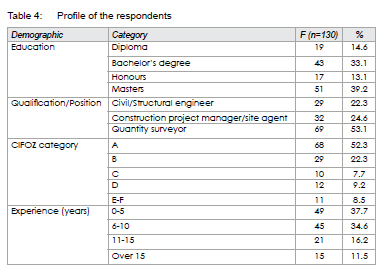
Table 4 shows that a total of 130 respondents participated in the study, most of whom were well-qualified built-environment professionals. Over 72% of the respondents held at least a Bachelor's degree, with 39.2% holding Master's degrees, confirming a highly educated sample. Professionally, participants were mainly quantity surveyors (53.1%), construction project managers/site agents (24.6%), and civil/structural engineers (22.3%), ensuring that responses came from individuals directly involved in construction project delivery. Over half (52.3%) belonged to CIFOZ Category A, representing the industry's most capable and experienced Arms. The distribution of work experience, with 34.6% having 6-10 years, and 27.7% having over 10 years' industry exposure, further strengthens the relevance and reliability of the insights gathered. This mix of emerging and seasoned professionals contributes both current perspectives and long-term industry knowledge to the findings. Overall, the respondents' qualifications, roles, and industry standing confirm that they were highly suitable to contribute valid and informed perspectives to the study.
4.2 Ranking results
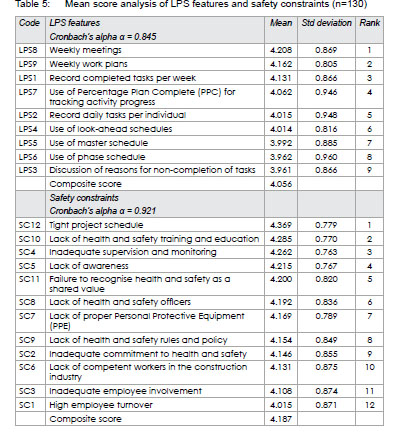
Table 5 summarises respondents' perceptions of the LPS features and safety constraints. The reliability of the LPS features scale was good (Cronbach's α = 0.845), exceeding the recommended threshold of 0.700 (Field, 2017). All LPS features recorded mean scores (MS) above 3.00 and were, therefore, retained for further analysis. LPS8 (weekly meetings) was ranked as the most important feature (MS = 4.208), while LPS3 (discussion of reasons for non-completion of tasks) was ranked as the least important (MS = 3.961). All standard deviations were below 1.000, indicating low response variability. The composite mean score (4.056) suggests that respondents generally agreed on the importance and application of LPS practices in construction projects.
The safety constraints scale demonstrated excellent reliability (Cronbach's α = 0.921). All safety constraints achieved mean scores above 3.00, confirming their importance in construction project environments. SC12 (tight project schedule) was perceived as the most critical constraint (MS = 4.369), while SC1 (high employee turnover) was ranked as the least critical (MS = 4.015). Standard deviations for all constraints were also below 1.000, suggesting a high level of agreement. The composite mean score for safety constraints (4.187) indicates that respondents strongly agreed that these factors significantly influence safety performance in construction projects.
4.3 EFA results for safety constraints
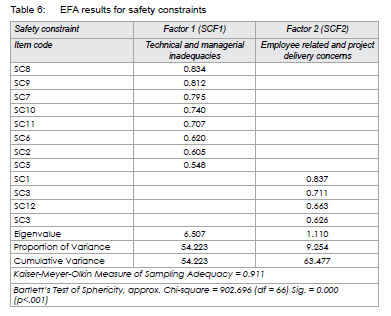
As shown in Table 6, the EFA results for safety constraints were valid, as they obtained a p-value of 0.000, which is <0.05 (Field, 2017). The KMO obtained a significant value for sampling adequacy of 0.911 (Field, 2017). Two factors were generated with eigenvalues of >1 and factor loadings of >0.400, which explained 63.477% of the total variance, confirming construct validity (Hair et al., 2019; Kum et al., 2024). All 12 safety constraints were significant, and the factor loadings ranged from 0.837 to 0.548. The factors were defined by their constituent safety constraints (Moyo & Chigara, 2023).
4.4 Model development
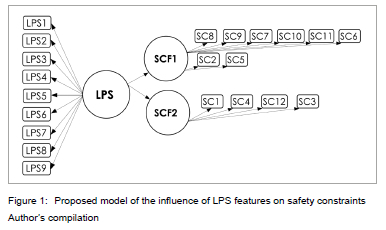
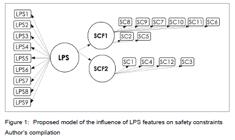
To examine statistically valid associations and confirm the practical relevance of LPS in addressing safety constraints, the proposed model shown in Figure 1 was developed. The proposed measurement model predicts that LPS features resolve safety technical and management inadequacies (SCF1) and LPS features resolve employee and project delivery concerns (SCF2)
4.5 PLS-SEM results
This section presents the evaluation of the PLS-SEM model, detailing both the measurement and structural components to assess the validity and reliability of the study's constructs.
4.5.1 Proposed model validity
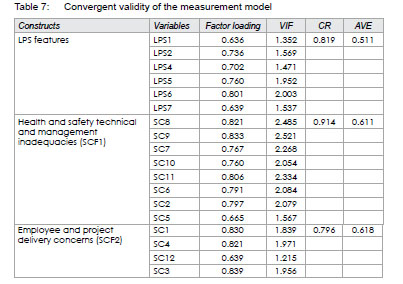
Table 7 shows the convergent validity which is the extent of correlation among various indicators intended to assess the same concept. To see if Common Method Bias (CMB) occurs (whether relationships between variables appear stronger than they actually are) the variance inflation factor (VIF) was examined within the PLS-SEM model, which is a commonly recommended approach for detecting potential bias (Rehman Khan & Yu, 2021). All VIF values were below the recommended threshold of 3.3. This indicates that the relationships among the predictor variables were not excessively correlated and that common method bias is unlikely to be a concern in this study.
Factor loadings of most features and constraints exceeded the suggested value of 0.60 (Hair et al., 2019: 2), showing that these indicators converge on the same underlying construct. The LPS features, namely discussion of reasons for non-completion of tasks (LPS3), weekly meetings (LPS8), and weekly work plans (LPS9) were omitted because of factor loadings of <0.60. The average variance extracted (AVE) values range from 0.511 to 0.686, which is greater than 0.5 and acceptable, thereby indicating that the construct explains over 50% of the variance of its items, according to Hair et al. (2019: 2). According to Kum et al. (2024: 2771), a composite reliability (CR) of greater than 0.6 is acceptable for exploratory research. Therefore, all CR values from Table 7 are acceptable and signify the reliability of the model.
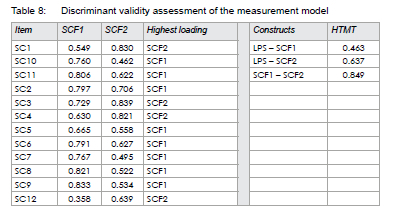
Table 8 shows the discriminant validity (DV) results, which assess whether constructs in a model measure distinct and non-overlapping concepts (Rehman Khan & Yu, 2021). In this study, discriminant validity was evaluated using cross-loadings and the heterotrait-monotrait ratio (HTMT) (Henseler et al., 2016: 115). Cross-loadings evaluate whether each measurement item loads more strongly on its intended construct than on other constructs. Table 8 shows that each indicator generally exhibited its highest loading on the construct (SCF1 or SCF2); it was intended to measure, supporting discriminant validity. The HTMT values range from 0.463 to 0.849, all <0.85 (Henseler et al., 2016). This indicates that the constructs in the model measure different concepts. The relatively low HTMT value between LPS and SCF1 (0.463) suggests a clear distinction between these constructs, while the value between SCF1 and SCF2 (0.849) indicates that although the two safety constraint factors are closely related, they remain empirically distinct.
4.5.2 Structural model validity
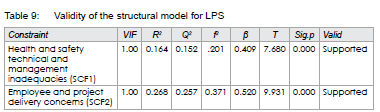
Table 9 shows the validity of the structural model. The structural model illustrates the relationships between the latent variables (Kum et al., 2024). Collinearity was assessed using the VIF guidelines, as high correlations between constructs are unsuitable in PLS-SEM (Hair et al., 2019). The VIF values for both LPS → SCF1 and LPS → SCF2 were 1.000, which is well below the threshold of 5.00, indicating that no collinearity issues were present.
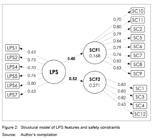
The model's goodness of fit was examined through the R-squared (R2) values. SCF1 had an R2 of 0.164, which lies between 0 and 0.25 and, therefore, reflects a weak coefficient of determination. SCF2 had an R2 of 0.268, which falls within the >0.25 to <0.50 range and indicates a moderate coefficient of determination. Among the two constraints, SCF2 showed the highest explanatory power, accounting for 26.8% of the variance. Predictive relevance was assessed using the cross-validated redundancy measure (Q2). Both values were greater than zero (SCF1 = 0.152, SCF2 = 0.257), confirming that the SEM model demonstrates valid predictive relevance. The ranking of Q2 values mirrors that of the R2 results, again showing that SCF2 has stronger predictive ability.
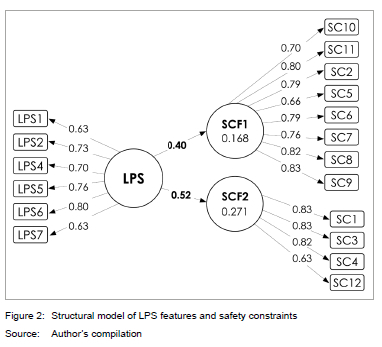
Effect size (f2) values were also all greater than zero, confirming that both constraints had meaningful influence on the model. SCF2 had the larger effect (f2 = 0.371), compared with SCF1 (f2 = 0.201). All relationships in the structural model were statistically supported with p values <0.05 (p = 0.000), based on bootstrapping with 50,000 resamplings. The path coefficients (β) indicate the strength and direction of these effects. The relationship between LPS features and SCF2 showed the strongest influence, with a β = 0.520 (strong influence) and a T-value of 9.931. In contrast, the relationship between LPS features and SCF1 produced a β = 0.409 (moderate influence) and a T-value of 7.680 (Kukah et al., 2024: 2327).
The findings show that, although both constraints significantly influence LPS features, employee and project delivery concerns (SCF2) exert a stronger effect than health and safety technical and management inadequacies (SCF1). Figure 2 presents the structural model showing the path coefficients (β) between LPS features and the safety constraints (SCF1 and SCF2), together with the factor loadings of the indicators associated with each constraint.
5. DISCUSSION
The results provide strong evidence that LPS features play a meaningful role in addressing both technical managerial safety deficiencies and employee-project delivery concerns.
The ranking results affirm that LPS features are widely recognised and valued within construction practice. All LPS features scored mean values above 3.00, with weekly meetings (LPS8) identified as the most important feature. The relatively low variability across responses indicates consistent agreement among practitioners regarding the usefulness of LPS as a project control mechanism. All safety constraints were rated above 4.00, indicating that respondents perceive them as persistent and influential issues in construction projects. The highest ranked constraint, tight project schedules (SC12), reflects widespread concerns about schedule pressure and its link to unsafe practices, worker fatigue, shortcut-taking, and reduced hazard awareness. The EFA results demonstrate that these constraints group naturally into two coherent dimensions, namely technical and management inadequacies (SCF1), and employee and project delivery concerns (SCF2).
This classification highlights that safety challenges arise from both organisational systems and workforce-related issues. The structural model results provide statistical confirmation that LPS features significantly influence safety constraints. Both relationships were significant (p<0.05), although the magnitude of influence differed between the two safety constraint categories. LPS features demonstrated a moderate effect on SCF1 (β = 0.409). This suggests that, while LPS improves planning reliability and facilitates problem-solving, certain technical and managerial safety issues may require interventions beyond planning processes. Challenges such as outdated equipment, inadequate training, or insufficient supervisory capacity may not be fully resolved through planning improvements alone. Nevertheless, the positive effect indicates that structured planning, clear task sequencing, and variability control inherent in LPS contribute to reducing systemic managerial shortcomings. Through detailed master planning, phase planning, look-ahead planning, and weekly planning, LPS ensures that critical project constraints, including safety, are addressed proactively (Sundrarajan & Madhavi, 2018).
The strongest relationship observed in the model was between LPS and SCF2 (β = 0.520), indicating that LPS is particularly effective in addressing workforce-related and project delivery challenges. Under SCF2, all factor loadings were above average, suggesting that these constraints can be effectively mitigated through LPS implementation. Inadequate employee involvement recorded the highest factor loading (0.839). LPS promotes extensive collaborative planning involving multiple stakeholders, ensuring that those responsible for executing tasks participate in planning processes (Sundrarajan & Madhavi, 2018). Such involvement gives workers a voice in project decisions, strengthening their commitment to safety practices and hazard reporting. High employee turnover also recorded a high factor loading (0.830), indicating that LPS can contribute to resolving this constraint. Safety performance improves when the same work team is retained throughout the project, as trained workers are more familiar with site conditions and safety procedures (Soomro et al., 2019). The collaborative nature of LPS strengthens teamwork and stakeholder engagement, resulting in greater cooperation and fewer conflicts (Ahmed et al., 2021). Similarly, inadequate supervision and monitoring (0.821) as well as tight project schedules (0.621) were strongly associated with this factor. LPS incorporates weekly commitment tracking, where planners monitor the completion of agreed tasks and evaluate whether commitments have been fulfilled (Sweis et al., 2016). In addition, the 'make-ready' process ensures that work activities are only released once all prerequisites are satisfied, reducing the likelihood of unsafe improvisations or rushed work processes.
Within the technical and management inadequacies category (SCF1), the lack of safety rules and policies recorded the highest factor loading (0.833). LPS promotes structured project planning that addresses major constraints such as cost, time, quality, and safety simultaneously (Sundrarajan & Madhavi, 2018). This structured planning environment improves accountability because team members commit to clearly defined tasks and timelines. The lack of safety officers also emerged as a significant constraint. Construction health and safety officers (CHSOs) play a critical role in project planning and site safety management (Smallwood & Deacon, 2021). The collaborative planning processes associated with LPS encourage the involvement of all stakeholders, including safety personnel, thereby strengthening safety governance. Other safety constraints, including inadequate PPE, insufficient safety training, and failure to recognise safety as a shared value, can also be mitigated through the collaborative planning environment created by LPS. When employees participate in planning processes, they develop a stronger sense of ownership and commitment to organisational goals (Al Sehaimi et al., 2009). Early identification of constraints allows teams to anticipate potential hazards and develop mitigation strategies before work begins. These findings are consistent with Bajjou et al. (2017), who identified LPS as a lean construction tool capable of improving safety performance on construction sites.
6. PROPOSED GUIDELINES FOR USING LPS TO RESOLVE SAFETY CONSTRAINTS
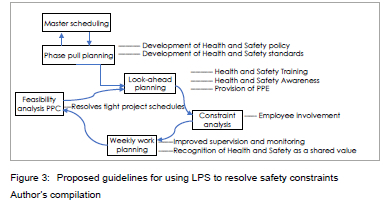
The findings indicate that LPS practices exert a strong influence on employee and project delivery concerns (SCF2) that include the following aspects: high employee turnover, inadequate employee involvement, inadequate supervision and monitoring and tight project schedules, as well as a moderate influence on technical and management inadequacies (SCF1) that include the following aspects: lack of health and safety training and education, failure to recognise health and safety as a shared value, inadequate commitment to health and safety, lack of awareness, lack of competent workers in the construction industry, lack of proper personal protective equipment, lack of health and safety officers, as well as lack of health and safety rules and policy. Guidelines were conceptualised from these significant features of LPS and constraints, as shown in Figure 3. The significant features of LPS identified in this study include master scheduling, phase pull planning, look-ahead planning, constraint analysis, weekly work planning, and feasibility analysis through Percent Plan Complete (PPC). These features collectively contribute to several safety improvement outcomes such as the development of safety policies and standards, improved safety training and awareness, enhanced supervision and monitoring, greater employee involvement, and the recognition of health and safety as a shared organisational value. Accordingly, the proposed guidelines focus on strengthening planning reliability, enhancing coordination and worker engagement, and embedding safety considerations within collaborative planning processes.
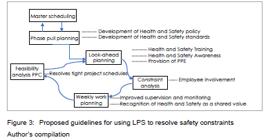
Master scheduling enhances overall project planning, by establishing clear timelines and coordination mechanisms (Bajjou et al., 2017). Improved planning reduces unexpected workflow disruptions and reactive decision-making, both of which are recognised contributors to accidents on construction sites. By promoting a more structured planning environment, master scheduling helps minimise schedule volatility that can compromise safe work practices.
Phase pull planning further contributes to safety improvement, by facilitating the collaborative development of health and safety policies as well as operational standards. Through the involvement of key project participants, this planning stage enables the integration of safety considerations into work sequencing and task preparation (Ballard & Howell, 2003). As a result, safety requirements are embedded within operational plans rather than treated as external compliance measures. Integrating safety discussions at this stage strengthens worker involvement and aligns safety planning with real-time operational knowledge.
Look-ahead planning plays a critical role in identifying upcoming constraints and preparing work packages in advance (Sundararajan & Madhavi, 2018). Within this process, project teams can identify training requirements, safety awareness needs, and potential hazards associated with upcoming tasks. This enables the organisation of safety briefings, educational workshops, and competency-based training activities that improve workers' knowledge of safe work practices and hazard recognition (Power et al., 2023).
Constraint analysis strengthens this process by systematically identifying and eliminating barriers that could affect task execution. In the context of safety management, constraint analysis allows project teams to identify potential safety risks, equipment deficiencies, or missing protective measures before work begins (Ballard & Howell, 2003). Because this process requires input from multiple project stakeholders, it encourages greater employee involvement in safety-related decision-making, thereby supporting a participatory safety culture.
Weekly work planning supports improved supervision and monitoring, by creating a structured forum where project teams review planned activities and confirm work readiness. Regular meetings enable supervisors, planners, and crew leaders to evaluate the safety implications of upcoming tasks, discuss site conditions, and ensure that appropriate safety measures are in place prior to task execution (Barth et al., 2020).
Feasibility analysis, conducted through PPC assessments, provides a mechanism for evaluating planning reliability and identifying causes of workflow disruptions. PPC reviews help project teams recognise scheduling delays and address tight project schedules, which are frequently associated with unsafe practices such as rushing work or bypassing safety procedures (Bajjou et al., 2017). By analysing reasons for incomplete tasks, project teams can identify recurring issues and integrate safety lessons into future planning cycles, thereby preventing the recurrence of incidents (Ballard & Howell, 2003).
Collectively, these LPS practices support a proactive approach to safety management, by embedding safety considerations within routine planning activities. Through collaborative planning, continuous monitoring, and systematic constraint removal, construction organisations can reduce safety risks while improving workflow reliability and project performance. Consequently, the adoption of these LPS-based implementation guidelines provides a practical framework for addressing safety constraints within construction projects.
7. CONCLUSIONS AND RECOMMENDATIONS
This study aimed to provide practical LPS implementation guidelines to address safety constraints within construction projects. The findings revealed that the most significant contributors to safety constraints are tight project schedules, followed by a lack of safety training, and inadequate supervision. Structural Equation Modelling (SEM) results indicate that the LPS significantly improves safety performance, by addressing both employee- and project-related concerns, as well as technical and managerial shortcomings.
LPS enhances safety through detailed multilevel planning (master, phase, look-ahead, and weekly), which ensures early identification and mitigation of safety risks. Increased worker involvement fosters ownership of tasks, improves adherence to safety protocols, and supports proactive hazard identification. The resulting reliable workflow also reduces chaos on site and improves coordination, cultivating safer working environments.
Implementing the LPS in Zimbabwe has the potential to substantially improve construction safety performance and embed a culture of safety within organisations. In addition, lean construction contributes positively to SDG9 and SDG11, by promoting efficiency, innovation, productivity, collaboration, knowledge-sharing, and resilience across the construction sector.
Based on the findings, the following recommendations are proposed:
1. Contractors should integrate lean principles, including the LPS, into all projects, regardless of project type or size, as these tools effectively address safety constraints;
2. Investment in worker training is essential to build competencies aligned with lean construction practices;
3. Contractors should adopt technologies and software that enhance project planning, coordination, and monitoring;
4. Awareness campaigns should be implemented to educate industry stakeholders on the benefits of LPS for project performance and safety improvement;
5. Regulatory bodies such as the NSSA should consider revising safety regulations to include LPS adoption as a recognised approach to safety enhancement;
6. Consultants should incorporate LPS implementation requirements into contract documents to ensure consistent use by contractors;
7. Consultants should advise clients on the benefits and value of LPS, including its potential to improve safety and justify investment.
This study was limited to the perceptions of respondents operating within a specific geographical context in Zimbabwe and relied solely on quantitative data. Further research is therefore recommended on developing a comprehensive framework for implementing LPS to improve construction safety performance in Zimbabwe, and exploring capacity-development strategies for construction companies to strengthen LPS adoption.
REFERENCES
2. LITERATURE REVIEW
-
Abubakar, M., Zailani, B.M., Abdullahi, M. & Auwal, A.M.A. 2021. The potential of adopting a resilient safety culture to improve the safety performance of construction organisations in Nigeria. Journal of Engineering, Design and Technology, 20(5), pp. 1236-1256. https://doi.org/10.1108/JEDT-09-2020-0354
» https://doi.org/10.1108/JEDT-09-2020-0354 -
Adebiyi, R.T., Babalola, O., Amuda-Yusuf, G., Rasheed, S.A. & Olowa, T.O. 2020. Effect of knowledge and compliance of health and safety information on construction sites workers' safety in Nigeria. International Journal of Safety and Security Engineering, 10(2), pp. 269-277. https://doi.org/10.18280/ijsse.100215
» https://doi.org/10.18280/ijsse.100215 -
Ahmed, S., Hossain, M. & Haq, I. 2021. Implementation of lean construction in the construction industry in Bangladesh: Awareness, benefits, and challenges. International Journal of Building Pathology and Adaptation, 39(2), pp. 368-406. https://doi.org/10.1108/IJBPA-04-2019-0037
» https://doi.org/10.1108/IJBPA-04-2019-0037 -
Akindele, O.E., Ajayi, S., Toriola-Coker, L., Oyegoke, A.S., Alaka, H. & Zulu, S.L. 2023. Sustainable construction practice in Nigeria: Barriers and strategies for improvement. Built Environment Project and Asset Management,13(4), pp. 590-609. https://doi.org/10.1108/BEPAM-06-2022-0085
» https://doi.org/10.1108/BEPAM-06-2022-0085 - Al-Khaburi, S. & Amoudi, O. 2018. Analysis of accident causes at construction sites in Oman. Jordan Journal of Civil Engineering, 12(2), article 279.
- Al Sehaimi, A., Tzortzopoulos, P. & Koskela, L. 2009. Last Planner System: Experiences from pilot implementation in the Middle East. In: 17th Annual Conference of the International Group for Lean Construction, pp. 53-66.
-
Amoah, C. & Simpeh, F. 2021. Implementation challenges of COVID-19 safety measures at construction sites in South Africa. Journal of Facilities Management, 19(1), pp. 111-128. https://doi.org/10.1108/JFM-08-2020-0061
» https://doi.org/10.1108/JFM-08-2020-0061 - Ballard, G. & Howell, G. 1998. What kind of production is construction? In: Proceedings of the 6th Annual Conference of the International Group for Lean Construction (IGLC-6), 13-15 August, Guaruja, Brazil.
-
Ballard, G. & Howell, G. 2003. Lean project management. Building Research & Information, 31(2), pp. 119-133. https://doi.org/10.1080/09613210301997
» https://doi.org/10.1080/09613210301997 - Ballard, G., Hammond, J. & Nickerson, R. 2009. Production control principles. In: Proceedings of the 17th Annual Conference of the International Group for Lean Construction (IGLC-17), Taipei, Taiwan, pp. 489-500.
-
Bajjou, M.S., Chafi, A. & En-nadi, A. 2017. A comparative study between lean construction and the traditional production system. International Journal of Engineering Research in Africa, 29, pp. 118-132. https://doi.org/10.4028/www.scientific.net/JERA.29.118
» https://doi.org/10.4028/www.scientific.net/JERA.29.118 -
Barth, K.B., Sterzi, M.P., Formoso, C.T., Alliende, J.I., Bertin, D. & Del Rio, J. 2020. Implementation of production system design in house building projects: A lean journey in Chile. In: Proceedings of the 28th Annual Conference of the International Group for Lean Construction (IGLC), pp. 397-408. https://doi.org/10.24928/2020/0124
» https://doi.org/10.24928/2020/0124 -
Berhan, E. 2020. Management commitment and its impact on occupational health and safety improvement: A case of iron, steel and metal manufacturing industries. International Journal of Workplace Health Management, 13(4), pp. 427-444. https://doi.org/10.1108/IJWHM-01-2019-0005
» https://doi.org/10.1108/IJWHM-01-2019-0005 -
Bhandari, P. 2023. How to calculate standard deviation (guide) calculator and examples. Scribbr. https://www.scribbr.com/statistics/standard-deviation/ [Accessed 20 May 2023].
» https://www.scribbr.com/statistics/standard-deviation/ -
Buniya, M.K., Othman, I., Sunindijo, R.Y., Kineber, A.F., Mussi, E. & Ahmad, H. 2021. Barriers to safety program implementation in the construction industry. Ain Shams Engineering Journal,12(1), pp. 65-72. https://doi.org/10.1016/j.asej.2020.08.002
» https://doi.org/10.1016/j.asej.2020.08.002 -
Byrne, B.M. 2010. Structural equation modeling with AMOS: Basic concepts, applications, and programming. New York: Routledge. https://doi.org/10.4324/9780203807644
» https://doi.org/10.4324/9780203807644 -
Carmichael, F., Fenton, S.J.H. & Pinilla-Roncancio, M.V. 2016. Workplace health and wellbeing in construction and retail: Sector-specific issues and barriers to resolving them. International Journal of Workplace Health Management, 9(2), pp. 251-268. https://doi.org/10.1108/IJWHM-08-2015-0053
» https://doi.org/10.1108/IJWHM-08-2015-0053 -
Castillo, T., Alarcón, L.F. & Salvatierra, J.L. 2018. Effects of the last planner system practices on social networks and the performance of construction projects. Journal of Construction Engineering and Management, 144(3), article 04017120. https://doi.org/10.1061/(ASCE)CO.1943-7862.0001443
» https://doi.org/10.1061/(ASCE)CO.1943-7862.0001443 - Chandi, I., Kajimo-Shakantu, K. & Akintayo, O. 2018. An investigation into health and safety factors in the South African construction industry. In: Proceedings of the 12th Built Environment Conference, 6-7 August, pp. 62-75.
-
Chazireni, E. & Chigonda, T. 2018. The socio-economic impacts of dam construction: Case of Tokwe Mukosi in Masvingo Province, Zimbabwe. European Journal of Social Sciences Studies, 3(2), pp. 209-218. https://doi.org/10.5281/zenodo.1410616
» https://doi.org/10.5281/zenodo.1410616 -
Chigara, B. & Moyo, T. 2014. Factors affecting labor productivity on building projects in Zimbabwe. International Journal of Architecture, Engineering and Construction, 3(1), pp. 57-65. https://doi.org/10.7492/IJAEC.2014.005
» https://doi.org/10.7492/IJAEC.2014.005 - Chigara, B. & Smallwood, J. 2016. Assessing the implications of public sector procurement on construction health and safety management in Zimbabwe. In: Proceedings of the 9th cidb Postgraduate Conference, 2-4 February, Cape Town, South Africa, pp. 152-161.
-
Chileshe, N. & Dzisi, E. 2012. Benefits and barriers of construction health and safety management (HSM): Perceptions of practitioners within design organisations. Journal of Engineering, Design and Technology, 10(2), pp. 276-298. https://doi.org/10.1108/17260531211241220
» https://doi.org/10.1108/17260531211241220 - Construction Industry Development Board (cidb). 2009. Construction health and safety in South Africa: Status and recommendations. Pretoria: cidb.
-
Construction Industry Federation of Zimbabwe (CIFOZ). n.d. Construction Industry Federation of Zimbabwe. Harare: CIFOZ. http://www.cifoz.co.zw [Accessed 15 June 2024].
» http://www.cifoz.co.zw - Creswell, J.W. 2014. Research design: Qualitative, quantitative, and mixed methods approaches. 4th edition. Thousand Oaks, CA: SAGE Publications.
- Creswell, J.W. & Poth, C.N. 2018. Qualitative inquiry and research design: Choosing among five approaches. 4th edition. Thousand Oaks, CA: SAGE Publications.
-
da Silva, S.L. & Amaral, F.G. 2019. Critical factors of success and barriers to the implementation of occupational health and safety management systems: A systematic review of literature. Safety Science, 117, pp. 123-132. https://doi.org/10.1016/j.ssci.2019.03.026
» https://doi.org/10.1016/j.ssci.2019.03.026 -
Dimitrov, D.M. 2006. Comparing groups on latent variables: A structural equation modeling approach. Work (Reading, MA), 26, pp. 429-436. https://doi.org/10.3233/WOR-2006-00576
» https://doi.org/10.3233/WOR-2006-00576 -
Dzimiri, T.K. & Chigara, B. 2025. The application of Industry 4.0 technologies in construction health and safety (H & S) management in Zimbabwe. In: Proceedings of the 10th International Conference on Development and Investment in Infrastructure (DII 2024), 24-26 July, Livingstone, Zambia. https://doi.org/10.1201/9781003483519-56
» https://doi.org/10.1201/9781003483519-56 -
Enshassi, A., Saleh, N. & Mohamed, S. 2019. Application level of lean construction techniques in reducing accidents in construction projects. Journal of Financial Management of Property and Construction, 24(3), pp. 274-293. https://doi.org/10.1108/JFMPC-08-2018-0047
» https://doi.org/10.1108/JFMPC-08-2018-0047 - Field, A. 2017. Discovering statistics using IBM SPSS Statistics. 5th edition. Los Angeles, CA: SAGE Publications.
-
Habibi, M. & Kermanshachi, S. 2018. Phase-based analysis of key cost and schedule performance causes and preventive strategies: Research trends and implications. Engineering, Construction and Architectural Management, 25(8), pp. 1009-1033. https://doi.org/10.1108/ECAM-10-2017-0219
» https://doi.org/10.1108/ECAM-10-2017-0219 -
Haenlein, M. & Kaplan, A.M. 2004. A beginner's guide to partial least squares (PLS) analysis. Understanding Statistics, 3(4), pp. 283-297. https://doi.org/10.1207/s15328031us0304_4
» https://doi.org/10.1207/s15328031us0304_4 -
Hair, J.F., Risher, J.J., Sarstedt, M. & Ringle, C.M. 2019. When to use and how to report the results of PLS-SEM. European Business Review, 31(1), pp. 2-24. https://doi.org/10.1108/EBR-11-2018-0203
» https://doi.org/10.1108/EBR-11-2018-0203 - Hayek, F.A. 1945. American economic association. The American Economic Review, 35(4), pp. 519-530.
-
Heigermoser, D., de Soto, B.G., Abbott, E.L. & Chua, D.K. 2019. BIM-based Last Planner System tool for improving construction project management. Automation in Construction, 104, pp. 246-254. https://doi.org/10.1016/j.autcon.2019.03.019
» https://doi.org/10.1016/j.autcon.2019.03.019 -
Henseler, J., Ringle, C.M. & Sarstedt, M. 2015. A new criterion for assessing discriminant validity in variance-based structural equation modeling. Journal of the Academy of Marketing Science, 43, pp. 115-135. https://doi.org/10.1007/s11747-014-0403-8.
» https://doi.org/10.1007/s11747-014-0403-8 -
Hon, C.K., Chan, A.P. & Yam, M.C. 2012. Empirical study to investigate the difficulties of implementing safety practices in the repair and maintenance sector in Hong Kong. Journal of Construction Engineering and Management, 138(7), pp. 877-884. https://doi.org/10.1061/(ASCE)CO.1943-7862.0000497
» https://doi.org/10.1061/(ASCE)CO.1943-7862.0000497 - Howell, G., Ballard, G., Tommelein, I., Koskela, L. & Liu, M. 2017. Construction safety and the Last Planner System. Proceedings of the 25th Annual Conference of the International Group for Lean Construction (IGLC-25), Heraklion, Greece, pp. 33-42.
- Hui-Nee, A. 2014. Safety culture in Malaysian workplace: An analysis of occupational accidents. Health and the Environment Journal, 5(3), pp. 32-43.
-
Kelloway, E.K. & Cooper, C.L. (Eds). 2011. Occupational health and safety for small and medium sized enterprises. Edward Elgar Publishing Online. https://doi.org/10.4337/9780857938701.00005
» https://doi.org/10.4337/9780857938701.00005 -
Koskela, L. & Ballard, G. 2006. Should project management be based on theories of economics or production? Building Research and Information, 34(2), pp. 154-163. https://doi.org/10.1080/09613210500491480
» https://doi.org/10.1080/09613210500491480 - Kothari, C.R. & Garg, G. 2020. Research methodology: Methods and techniques. 4th edition. New Delhi: New Age International Publishers.
-
Krejcie, R.V. & Morgan, D.W. 1970. Determining sample size for research activities. Educational and Psychological Measurement, 30(3), pp. 607-610. https://doi.org/10.1177/001316447003000308
» https://doi.org/10.1177/001316447003000308 -
Kukah, A.S., Owusu-Manu, D.G., Badu, E. & Asamoah, E. 2024. Structural equation model (SEM) for evaluating interrelationships among risks inherent in Ghanaian public-private partnership (PPP) power projects. Engineering, Construction and Architectural Management, 31(6), pp. 2327-2352. https://doi.org/10.1108/ECAM-10-2022-0943
» https://doi.org/10.1108/ECAM-10-2022-0943 -
Kum, Y.T., Yap, J.B., Lew, Y.L. & Lee, W.P. 2024. Transforming construction health and safety management during the COVID-19 pandemic using innovative technologies: PLS-SEM approach. Engineering, Construction and Architectural Management, 31(7), pp. 2770-2808. https://doi.org/10.1108/ECAM-08-2022-0780
» https://doi.org/10.1108/ECAM-08-2022-0780 - Leedy, P.D. & Ormrod, J.E. 2016. Practical research: Planning and design. 11th edition. Boston, NY: Pearson.
- Macombe, C. & Howell, G.A. 2003. The language/action perspective in project management. Proceedings of the 11th Annual Conference of the International Group for Lean Construction (IGLC-11), Blacksburg, Virginia, USA, pp. 1-13.
- Makhonge, P.W. 2009. Planning of occupational safety and health activities. African Newsletter on Occupational Health and Safety, 19(1).
- Marshall, C. & Rossman, G.B. 2016. Designing qualitative research. 6th edition. Thousand Oaks, CA: SAGE Publications.
- Maske, N.B. & Valunjkar, S. 2020. Lean construction tool - A literature review. International Research Journal of Engineering and Technology (IRJET), 7(10), pp. 143-145.
-
McDonald, M.A., Lipscomb, H.J., Bondy, J. & Glazner, J. 2009. Safety is everyone's job: The key to safety on a large university construction site. Journal of Safety Research, 40(1), pp. 53-61. https://doi.org/10.1016/j.jsr.2008.12.005
» https://doi.org/10.1016/j.jsr.2008.12.005 -
Mhlanga, P. 2019. Zimbabwe economy plunges into VUCA. Business Times, 14 February 14, p. 1. https://businesstimes.co.zw/zim-economy-plunges-into-vuca [Accessed 20 March 2025].
» https://businesstimes.co.zw/zim-economy-plunges-into-vuca -
Moyo, T. & Chigara, B. 2023. Barriers to lean construction implementation in Zimbabwe. Journal of Engineering, Design and Technology, 21(3), pp. 733-757. https://doi.org/10.1108/JEDT-01-2021-0044
» https://doi.org/10.1108/JEDT-01-2021-0044 - Nasir, N.B., Nawi, M.N., Zulhumad, F. & Anuar, H. 2016. Value management: A systematic approach for improving time performance of construction projects. International Journal of Supply Chain Management, 5(4), pp. 195-200.
- Ofori, G. 2015. Nature of the construction industry, its needs and its development: A review of four decades of research. Journal of Construction in Developing Countries, 20(2), article 115.
-
Ogunbiyi, O.E., Oladapo, A. & Goulding, J.S. 2014. An empirical study of the impact of lean construction techniques on sustainable construction in the UK. Construction Innovation, 14(1), pp. 1471-4175. https://doi.org/10.1108/CI-08-2012-0045
» https://doi.org/10.1108/CI-08-2012-0045 -
Oyewobi, L.O., Windapo, A.O. & James, R.O.B. 2015. An empirical analysis of construction organizations' competitive strategies and performance. Built Environment Project and Asset Management, 5(4), pp. 417-431. https://doi.org/10.1108/BEPAM-10-2013-0045
» https://doi.org/10.1108/BEPAM-10-2013-0045 -
Power, W., Sinnott, D., Lynch, P. & Solorz, C. 2023. An evaluation of the look-ahead planning function in Last Planner® System. In: Proceedings of the 31st Annual Conference of the International Group for Lean Construction (IGLC31), 26 June to 2 July, Lille, France, pp. 1337-1349. https://doi.org/10.24928/2023/0217
» https://doi.org/10.24928/2023/0217 -
Priyadarshana, M.D.L., Bandaranayake, I.W.N. & Kulathunga, A.K.K. 2023. Readiness of Sri Lankan construction industry towards implementing last planner system in lean construction. In: Proceedings of the 12th International Conference on Structural Engineering and Construction Management (ICSECM 2021), Singapore: Springer Nature Singapore, pp. 511-517. https://doi.org/10.1007/978-981-19-2886-4_36
» https://doi.org/10.1007/978-981-19-2886-4_36 -
Rehman Khan, S.A. & Yu, Z. 2021. Assessing the eco-environmental performance: A PLS-SEM approach with practice-based view. International Journal of Logistics Research and Applications, 24(3), pp. 303-321. https://doi.org/10.1080/13675567.2020.1754773
» https://doi.org/10.1080/13675567.2020.1754773 -
Ruin, X., Zuofa, T., Ochieng, E. & Yang, M. 2016. An appraisal of lean construction projects: Application of lean construction. In: 6th IEE International Conference on Logistics, Information and Service Sciences (LISS), 24-27 July, Sydney, Australia. https://doi.org/10.1109/LISS.2016.7854590.
» https://doi.org/10.1109/LISS.2016.7854590 -
Santoso, D.S. & Gallage, P.G. 2020. Critical factors affecting the performance of large construction projects in developing countries: A case study of Sri Lanka. Journal of Engineering, Design and Technology, 18(3), pp. 531-556. https://doi.org/10.1108/JEDT-05-2019-0130
» https://doi.org/10.1108/JEDT-05-2019-0130 -
Sarhan, J., Xia, B., Fawzia, S. & Karim, A. 2017. Lean construction implementation in the Saudi Arabian construction industry. Construction Economics and Building, 17(1), pp. 46-69. https://doi.org/10.5130/AJCEB.v17i1.5098
» https://doi.org/10.5130/AJCEB.v17i1.5098 -
Sarstedt, M., Ringle, C.M. & Hair, J.F. 2022. Partial least squares structural equation modeling. In: Homburg, C. et al. (Eds). Handbook of market research. Cham: Springer International Publishing, pp. 587-632. https://doi.org/10.1007/978-3-319-57413-4_15
» https://doi.org/10.1007/978-3-319-57413-4_15 - Saunders, M., Lewis, P. & Thornhill, A. 2016. Research methods for Business Students. 7th edition. Harlow: Pearson Education Limited.
- Schutt, R.K. 2016. Investigating the social world: The process and practice of research. 8th edition. Thousand Oaks, CA: SAGE Publications.
-
Shrestha, N. 2021. Factor analysis as a tool for survey analysis. American Journal of Applied Mathematics and Statistics, 9(1), pp. 4-11. https://doi.org/10.12691/ajams-9-1-2.
» https://doi.org/10.12691/ajams-9-1-2 -
Sibiya, M., Aigbavboa, C. & Thwala, W. 2015. Construction projects' key performance indicators: A case of the South African construction industry. In: Proceedings of the International Conference on Construction and Real Estate Management, 11-12 August, Lulea, Sweden, pp. 954-960. https://doi.org/10.1061/9780784479377.111
» https://doi.org/10.1061/9780784479377.111 - Smallwood, J. & Deacon, C. 2021. Construction health and safety (H&S) practitioners' developmental needs. In: Collaboration and Integration in Construction, Engineering, Management and Technology: Proceedings of the 11th International Conference on Construction in the 21st Century. London: Springer International Publishing, pp. 265-270.
-
Smallwood, J. & Haupt, T. 2005. The need for construction health and safety (H & S) and the construction regulations: Engineers' perceptions. Journal of the South African Institution of Civil Engineering, 47(2), pp. 2-8. https://doi.org/10.10520/EJC26975
» https://doi.org/10.10520/EJC26975 -
Soomro, F.A., Memon, M.J., Chandio, A.F., Sohu, S. & Soomro, R. 2019. Causes of time overrun in construction of building projects in Pakistan. Engineering, Technology and Applied Science Research, 9(1), pp. 3762-3764. https://doi.org/10.48084/etasr.2449
» https://doi.org/10.48084/etasr.2449 -
Sundararajan, S. & Madhavi, T. 2018. Last planner implementation in building projects. Chenai. In: Proceedings of the 26th Annual Conference of the International Group for Lean Construction (IGLC), 18-22 July, Chennai, India. https://doi.org/10.24928/2018/0528
» https://doi.org/10.24928/2018/0528 -
Srinivas, K. 2020. Lean construction in a real estate project - A case study. Journal of Construction Research, 1(2), pp. 25-29. https://doi.org/10.30564/jcr.v1i2.2577
» https://doi.org/10.30564/jcr.v1i2.2577 -
Sweis, G.J., Hiyassat, M. & Al-Hroub, F.F. 2016. Assessing lean conformance by first-grade contractors in the Jordanian construction industry. Construction Innovation, 16(4), pp. 446-459. https://doi.org/10.1108/CI-04-2015-0024
» https://doi.org/10.1108/CI-04-2015-0024 -
Sweis, R.J. & Jaradat, M. 2022. Project management performance of construction projects in Jordan: A comparative study of ISO 9001-certified and non-certified companies. The TQM Journal, 34(5), pp. 1341-1364. https://doi.org/10.1108/TQM-02-2021-0060
» https://doi.org/10.1108/TQM-02-2021-0060 -
Taherdoost, H. 2016. Validity and reliability of the research instrument: How to test the validation of a questionnaire/survey in a research. SSRN Electronic Journal, 5(3), pp. 28-36. https://doi.org/10.2139/ssrn.3205040
» https://doi.org/10.2139/ssrn.3205040 -
Westland, J.C. 2015. Structural equation models. Studies in Systems, Decision and Control, 22(5), article 152. https://doi.org/10.1007/978-3-319-16507-3
» https://doi.org/10.1007/978-3-319-16507-3 - Whittaker, T.A. & Schumaker, R.E. 2022. A beginner's guide to structural equation modeling. 5th edition. New York: Routledge.
-
Williams, O.S., Hamid, R.A. & Misnan, M.S. 2018. Accident causal factors on the building construction sites: A review. International Journal of Built Environment and Sustainability, 5(1). https://doi.org/10.11113/ijbes.v5.n1.248
» https://doi.org/10.11113/ijbes.v5.n1.248 -
Wong, J.Y.Y., Gray, J. & Sadiqi, Z. 2015. Barriers to good occupational health and safety (OHS) practices by small construction firms. Journal of Construction Management, 30(1), pp. 55-66. https://doi.org/10.1177/2977657020150105
» https://doi.org/10.1177/2977657020150105 -
Xing, W., Hao, J.L., Qian, L., Tam, V.W. & Sikora, K.S. 2021. Implementing lean construction techniques and management methods in Chinese projects: A case study in Suzhou, China. Journal of Cleaner Production, 286, article124944. https://doi.org/10.1016/j.jclepro.2020.124944
» https://doi.org/10.1016/j.jclepro.2020.124944 -
Yiu, N.S., Chan, D.W., Shan, M. & Sze, N. 2019. Implementation of safety management system in managing construction projects: Benefits and obstacles. Safety Science, 117, pp. 23-32. https://doi.org/10.1016/j.ssci.2019.03.027
» https://doi.org/10.1016/j.ssci.2019.03.027 -
Yiu, N.S., Sze, N.N. & Chan, D.W. 2018. Implementation of safety management systems in Hong Kong construction industry - A safety practitioner's perspective. Journal of Safety Research, 64, pp. 1-9. https://doi.org/10.1016/j.jsr.2017.12.011
» https://doi.org/10.1016/j.jsr.2017.12.011 -
Yuan, H. 2012. A model for evaluating the social performance of construction waste management. Waste Management, 32(6), pp.1218-1228. https://doi.org/10.1016/j.wasman.2012.01.028
» https://doi.org/10.1016/j.wasman.2012.01.028
Peer reviewed and revised: April 2026
Published: June 2026