'Deafspace' in the built school environment: a scoping review
Abstract
As a recognised disability, deafness affects speech, language, and cognitive development, influencing educational access and employability. While suitable physical environments for learners are well studied, limited research addresses architectural design for deaf learners. The concept of 'DeafSpace' extends universal design principles to reflect how deaf and hard-of-hearing individuals experience and communicate within space. When architectural designers overlook these spatial differences, it can hinder the developmental, social, and emotional needs of deaf children, leading to isolation and stigmatisation. In South Africa, deaf learners are accommodated in specialised schools; however, the effectiveness of these environments remains underexplored. This scoping review employs the Joanna Briggs Institute methodology to map existing literature addressing architectural provisions and spatial challenges within schools for the deaf. Eleven studies from six countries are identified, with 72.7% originating from North America, indicating a marked geographical and cultural bias. Three principal architectural paradigms are discerned, namely universal design, inclusive design, and DeafSpace, reflecting divergent epistemological positions on general accessibility versus specificity of deaf experience. Consensus emerges around key spatial parameters: visual connectivity (100%), lighting quality (81.8%), and acoustic management (72.7%). Nonetheless, significant implementation gaps persist, particularly concerning post-occupancy evaluation, economic analysis, and cultural contextualisation. The review further identifies an overreliance on technical rather than sociocultural approaches, with minimal participatory engagement of deaf users. This article highlights the absence of South African architectural research on deaf education and identifies urgent priorities for empirical validation, cross-cultural adaptation, and practical frameworks bridging theory and implementation.
architectural design; deafness; DeafSpace; school environment; scoping review; universal design; inclusive design
Abstract
Doofheid, 'n erkende gestremdheid, beïnvloed spraak-, taal- en kognitiewe ontwikkeling en beperk toegang tot onderwys en werk. Hoewel fisiese leeromgewings goed nagevors is, bestaan daar min studies oor argitektoniese ontwerp vir dowe leerders. Die konsep van 'dowe ruimte' brei universele ontwerpbeginsels uit om die unieke manier waarop dowe en hardhorende individue ruimte ervaar en kommunikeer, te weerspieël. Indien argitekte hierdie verskille ignoreer, kan dit die sosiale, emosionele en ontwikkelingsbehoeftes van dowe kinders benadeel en tot isolasie en stigmatisering lei. In Suid-Afrika word dowe leerders in gespesialiseerde skole geakkommodeer, maar die doeltreffendheid van hierdie omgewings is onderbestudeer. 'n Oorsig van elf internasionale studies toon 'n sterk Noord-Amerikaanse fokus (72,7%), wat 'n geografiese en kulturele vooroordeel aandui. Drie ontwerpbenaderings kom na vore: universele ontwerp, inklusiewe ontwerp en dowe ruimte. Kernaspekte sluit in visuele verbindings (100%), beligting (81,8%) en akoestiese bestuur (72,7%). Tog bestaan leemtes in implementering, veral ná okkupasie, ekonomiese analise en kulturele kontekstualisering. Die navorsing beklemtoon 'n oorbeklemtoning van tegniese benaderings en beperkte betrokkenheid van dowe gebruikers. Daar is 'n dringende behoefte aan Suid-Afrikaanse empiriese studies, praktiese raamwerke en kruis-kulturele aanpassing om teorie en toepassing te oorbrug.
1. INTRODUCTION
Deafness, particularly when occurring prelingually, significantly affects the development of speech, language, and cognitive skills, with long-term implications for access to education, social integration, and employability (Mackenzie & Smith, 2009). For deaf learners, the built environment can either support or hinder these developmental outcomes. Unlike their hearing peers, deaf individuals rely heavily on visual and tactile cues to navigate spaces, communicate, and learn, requiring architectural responses tailored to their unique spatial perception.
Within architectural discourse, these responses are framed under the broader principles of 'universal design' (Nygaard, 2018) and the more specialised concept of 'DeafSpace' (Edwards & Harold, 2014). While universal design seeks to ensure inclusivity for all, its broad focus may dilute specific cultural or sensory needs. DeafSpace, by contrast, draws directly from the lived experiences of the deaf community to create environments that enhance visual connectivity, spatial awareness, and communication, benefiting both deaf and hearing users.
A child's development in cognitive, emotional, and social terms is profoundly shaped by their experience of place. For deaf children, optimising spatial perception can improve educational quality, reduce distractions, and support identity affirmation (Day & Midbjer, 2007). When design neglects these perceptual differences, it risks reinforcing barriers to learning, increasing isolation and perpetuating stigma (Mackenzie & Smith, 2009). Despite growing recognition of deaf culture and identity, research on how architectural design addresses the needs of deaf learners, particularly in school environments, remains sparse.
In South Africa, deaf learners are recognised as a linguistic and cultural minority and are primarily accommodated within specialised schools, of which there are currently 43 (Oosthuizen, 2017). Educational reforms such as the inclusion of South African Sign Language (SASL) in the national curriculum (DBE, 2019) and its recognition in the National Senior Certificate examinations (Ramaphosa, 2018) have marked progress. However, debates persist between proponents of integrated schooling, who emphasise social inclusion and SASL awareness, and advocate for specialised schools, who caution against the risks of marginalisation, bullying, and loss of deaf cultural spaces (Bednarczyk, Alexander-Whiting & Solit, 1994; Malik et al., 2018; Kitzel, 2017). Practical challenges in both models, ranging from teacher shortages and inadequate funding to limited architectural responsiveness, are reflected in persistently low pass rates, reported at just 28% in 2016 (South African Market Insights, 2020).
Preliminary literature searches reveal a notable absence of South African studies examining the intersection between architecture and deaf education, highlighting a critical gap in both architectural and educational research. This scoping review, therefore, seeks to address the question: How can the nature of DeafSpace and deafness influence the architecture of a school for the deaf? Employing the Joanna Briggs Institute (JBI) scoping review methodology (Arksey & O'Malley, 2005; Levac, Colquhoun & O'Brien, 2010; JBI, 2015), the study systematically maps global scholarship to identify the architectural provisions made within school environments and to examine spatial challenges related to the educational and social needs of deaf learners.
This review constitutes a component of a Master of Architecture research project and precedes an empirical investigation into spatial perception and environmental challenges in a South African school for deaf and hard-of-hearing learners, explored through the lived experiences of teaching staff (Rout & Cloete, 2022). By synthesising global perspectives and situating them in the South African context, the review aims to inform design practices that bridge disciplinary gaps between architecture and education, while advocating for environments that affirm deaf identity and inclusivity.
2. METHODS AND REVIEW PROTOCOL
The JBI scoping review methodology was used to provide the framework for this review, as outlined in the 2024 Johanna Briggs Institute Reviewers' Manual, building on the works of Arksey and O'Malley as well as Levac et al. (Arksey & O'Malley, 2005; Levac et al., 2010; JBI, 2015; Tricco, et al., 2018). The methodology presented in the JBI manual was followed to ensure rigour and transparency of the study, adhering to current standards and best practices for evidence synthesis. A protocol was compiled by two reviewers in compliance with the JBI (JBI, 2015; 2019; 2024) key elements for a scoping review protocol, which states that at least two reviewers should be identified before the start of the review process, with the inclusion of multiple reviewers increasing reliability (JBI, 2015; 2024; Landa et al., 2011). The protocol considered six review stages, namely determining eligibility criteria; identifying relevant studies; study selection and review; charting the data (Munn et al., 2018); collating, summarising, and reporting results, and an optional stage of consultation with stakeholders (Tricco et al., 2018; Arksey & O'Malley, 2005; JBI, 2015; 2024; Pham et al., 2014). Ethical approval was not required for this study.
2.1 Eligibility criteria
This scoping review included studies employing quantitative, qualitative, and mixed-methods research designs. Systematic reviews, theoretical papers, opinion pieces, and grey literature will also be considered for inclusion (JBI, 2015; 2024). Only literature published in English will be included in this review. No restrictions will be applied based on the publication date, as earlier works may be seminal contributions to the field. Studies focusing exclusively on learners above 18 years of age (i.e., within tertiary or higher education settings) will be excluded. This age restriction aligns with the scope of this scoping review, which specifically focused on DeafSpace in school settings. Eligibility was further guided by the PCC (Population-Concept-Context) framework: Population: Deaf learners; Concept: Architectural provision; Context: School environment.
2.2 Types of sources
The following sources of literature were selected:
1. Websites of Deaf societies/institutes: Canadian Association of the Deaf; Gallaudet University.
2. Electronic databases: EBSCO Host (Academic Search Complete; APA PsycInfo; Atla Religion Database with AtlaSerials; Business Source Complete; CINAHL with Full Text; Education Source; ERIC; GreenFILE; Library, Information Science & Technology Abstracts; MasterFILE Premier; MEDLINE with Full Text; Newspaper Source); Proquest One Academic; Taylor & Francis Online.
3. Google Scholar search engine.
4. References obtained from the reference lists at the end of relevant journal articles.
2.3 Search strategy
The information search, search terms, and strategies were devised and executed by author2, as a component of a master's thesis from March 2020 to March 2021 under the supervision of authorl. A scoping review protocol was established in May 2020, and the scoping review process was conducted from June 2020 to November 2020. An initial limited search of EBSCO Host (Academic Search Complete) was undertaken to identify articles on the topic and develop appropriate search terms and Boolean phrases. The text words contained in the titles and abstracts of relevant articles and the index terms used to describe the articles were used to develop a full search strategy for the relevant electronic databases (JBI, 2019; 2024). Through the initial search query 1#, the following relevant search terms were identified: DeafSpace and Deaf Space. There was a marked scarcity of literature identified with the search terms (DeafSpace OR Deaf Space), and therefore there was no need to further limit through the use of the Boolean operator (AND); however, a wide portion of the literature that explores architecture for the deaf did not use these two terms in their title, abstract, or keywords; as such, another search query (#2) was attempted ("Accessible Design" OR "Architectural Accessibility" OR "Universal Design") AND (Deaf OR Deafness) AND (School OR Schooling OR Education OR Students OR Teaching) AND (Architecture OR "Built Environment" OR "Architecture Design" OR "Architectural Design").
Since both search queries were sufficiently limited, the Boolean operator (OR) was used to merge the two (#1 + #2) and the following search terms were identified to run on the other source types: Accessible Design; Architectural Accessibility; Universal Design; Deaf; Deafness; School; Schooling; Education; Students; Teaching; Architecture; Built Environment; Architecture Design.
2.4 Study selection
Following the final search, all identified records were collated and uploaded into the reference manager EndNote X9, and duplicate citations were removed. Articles identified in these searches based on the defined eligibility criteria were identified as those to keep, those to exclude, and those to discuss (JBI, 2019). A screening of the first 100 articles identified by the Google Scholar search engine for relevance was undertaken (Pham et al., 2014). A two-step selection process (as established in the protocol) was followed by two reviewers to screen articles initially on title and abstract, and then on full text (Munn et al., 2018), using PCC criteria:
(P)opulation - Deaf learners
(C)oncept - Architectural provision
(C)ontext - School environment
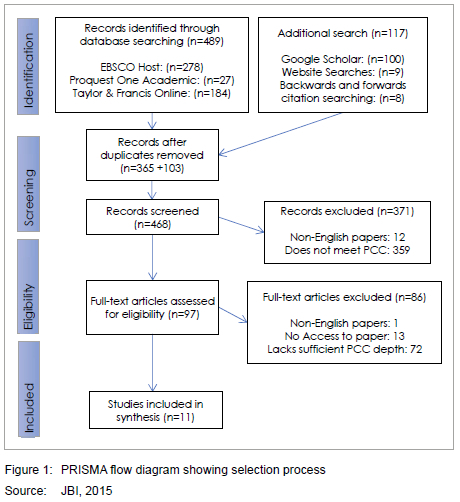
The software used for screening was Microsoft Word tabulated and recorded (as established in the protocol) in conjunction with EndNote to organise the literature (Munn et al., 2018). The results of the search are presented in a Preferred Reporting Items for Systematic Reviews and Meta-analyses (PRISMA) flow diagram (Pham et al., 2014; Tricco et al., 2018) (Figure 1). The reasons for excluding full-text papers were justified and recorded. Any disagreements were resolved by discussion between the master's student conducting the review and the supervisor (JBI, 2019).
2.5 Data extraction 'charting'
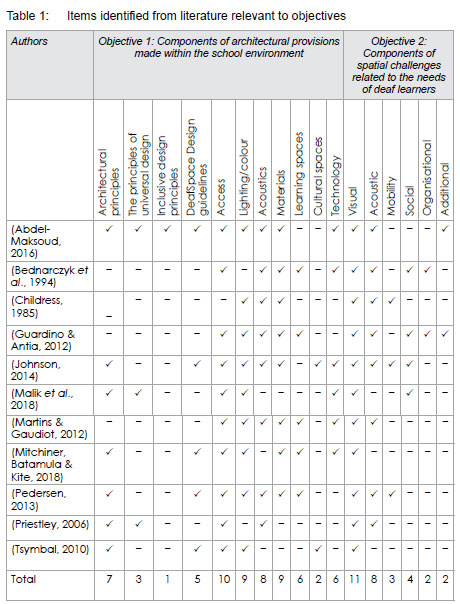
Data were extracted from papers included in the scoping review by one reviewer, the student, using a pre-developed JBI 'data extraction tool', verified by the second reviewer, the supervisor. This extraction was done in Microsoft Word, using a combination of the data extraction instrument (see Protocol) and separate comments in text to derive key themes from the literature relative to the question: "Are architectural provisions made to accommodate the needs of deaf learners within the school environment?" (see Table 1). The data extracted included specific details about deaf learners, deaf space (i.e., architectural provisions for the deaf), the built school environment, methods, and critical findings relevant to the review's questions.
2.6 Data presentation
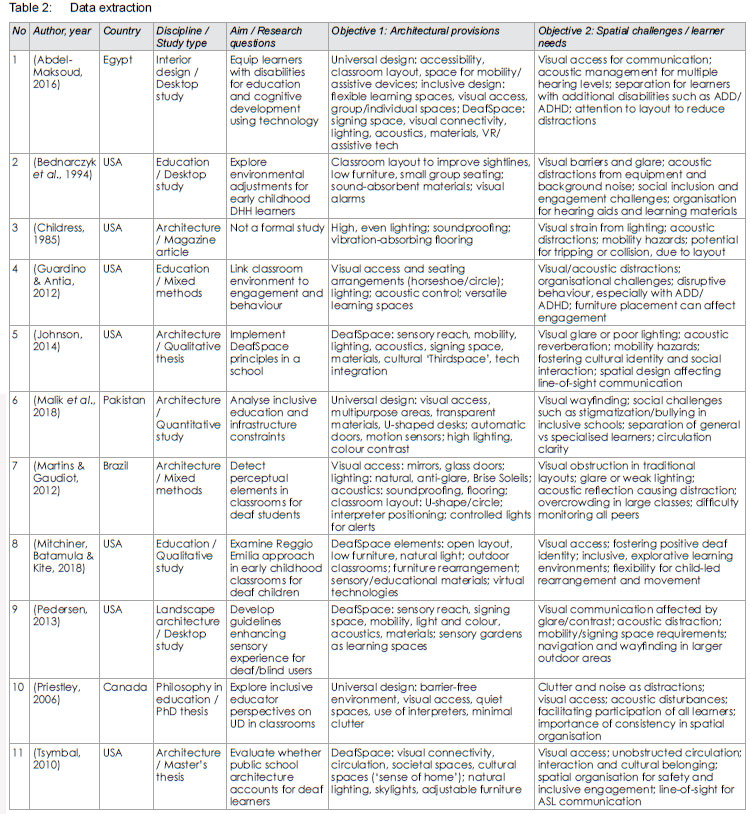
The extracted data are presented in tabular form (see Table 2) and were compiled collaboratively by both reviewers using Microsoft Word and EndNote. The table is structured to align with the objective of this scoping review and includes key information such as the author(s) or originating organisation/society, year of publication, country of origin, and aims or purpose of each document. Following data extraction, a narrative synthesis was conducted to describe how the findings relate to the review objective and research question, in accordance with JBI guidance (2015; 2019; 2024). The process also followed the three-stage framework recommended by Levac et al. (2010), which involves analysing the data, reporting the results, and interpreting their broader meaning. A PRISMA flow diagram was used to illustrate the flow of information throughout the review process (JBI, 2015). The findings will be disseminated through academic presentations at the university and published in a peer-reviewed journal.
3. RESULTS
3. 1 Screening results
The scoping review identified a total of 609 papers: 489 from the database search and a further from other sources. Following this, 138 duplicates were removed.First-level screening of title/abstracts excluded 371 papers, leaving 97 for full text screening of which 11 were assessed to be relevant to this review (Figure 1).
3.2 Description of reviewed studies
The literature selected 11 studies (see Table 1) that met the selection criteria for this review and, therefore, mention the provision for deaf learners, that is, school-going children (population under study) within their schooling environment (the environment in which a learner is educated in a formal capacity). Of the studies, eight (72.7%) were from North America, seven (63.6%) from the USA, one (9%) from Canada, with the remaining three from Egypt, Pakistan, and Brazil. Studies were from the fields of Architecture (n=5, 45.4%), Education (n=4, 36.3%), Interior Design (n=1, 9%), and Landscape Architecture (n=1, 9%). Ten (90.9%) were research studies; four (36.3%) of these studies were desktop studies, three (27.2%) of these studies were qualitative, one (9%) of these studies was quantitative and 2 (18%) of these studies were mixed methods (using both qualitative and quantitative methodology). Eight studies were published within the past ten years, with an early study from 1985 and two studies within 15 years.
Objective 1: Components of architectural provisions made within the school environment.
Categories identified within the reviewed studies (in order of greatest to least) were: Access (n=10, 90, 9%); Lighting and colour (n=9, 81.8%); Acoustics (n=8, 72.7%); Materials (n=8, 72.7%); Architectural principles (n=7, 63.6%); Technology (n=6, 54.5%); Deaf space principles (n=5, 45.4%); Learning spaces (n=5, 45.4%); Principles of universal design (n=3, 27.2%); Cultural spaces (n=2, 18.1%), and Inclusive design (n=1, 9%).
Objective 2: Components of spatial challenges related to the needs of deaf learners.
Categories identified within the reviewed studies (in order of greatest to least) were: Visual (n=11, 100%); Acoustic (n=8, 72.7%); Social (n=4, 36.3%); Mobility (n=3, 27.2%); Organisational (n=2, 18.1%), and other additional (n=2, 18.1%).
Analysis of these studies showed that significant attention was paid to architectural provisions, defined within this review as the act of providing for the learners through the use of the built environment or physical environment of the school, often referred to as architectural design, universal design, and, more recently, as DeafSpace. Eleven components were identified within discussion of architectural provisions in the reviewed studies, with 'access' most often referred to and hardly any mention of 'inclusive design principles'. Six components of spatial challenges relating to the needs of deaf learners were identified in the reviewed studies, with all eleven reviewed studies mentioning a visual component and fewer mentioning organisational aspects (see Table 2). An incremental increase in recognition of principles was noted, with early studies showing less mention of significant principles than more recent studies.
4. DISCUSSION
4.1 Architectural principles and provisions made within the school environment
This scoping review represents the first comprehensive mapping of literature examining 'deaf-space' for deaf learners within school-built environments. Through analysing architectural provisions - defined as purposeful design interventions using the built environment to support learners - the review reveals both emerging consensus and significant conceptual tensions within the field (see Table 1). Three distinct architectural approaches emerge from the literature, representing different philosophical positions on accommodation and inclusion. Universal Design (UD) provides the broadest framework, Inclusive Design (ID) offers education-specific guidance, and Deaf Space (DS) presents the most targeted approach for deaf users (see Supplementary Table 1). This hierarchy reflects a critical tension: while UD aims for universal accommodation, its breadth may dilute effectiveness for specific user groups, whereas DS's specificity may limit applicability in integrated settings.
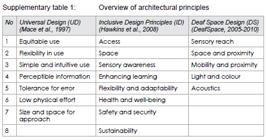
4.1.1 Universal Design: Breadth versus specificity
The literature reveals ambivalent treatment of Universal Design principles (see Table 1). While three studies reference UD (Abdel-Maksoud, 2016; Malik et al., 2018; Priestley, 2006), only Priestley (2006) critically evaluates its limitations, recognising UD as "a guide at the planning stage, not as a means of creating a 'utopian environment'". This critical perspective contrasts sharply with the uncritical adoption noted in other studies, suggesting insufficient theoretical engagement with UD's documented limitations (see Supplementary Table 2). The review identifies a concerning pattern: UD principles are frequently cited but rarely operationalised in deaf-specific contexts. This superficial engagement may reflect what Cauwer et al. (2009) identify as incomplete understanding of UD's epistemological foundations, potentially perpetuating ineffective design approaches in deaf education settings.
4.1.2 Inclusive Design: The missing middle ground
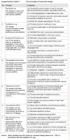
Inclusive Design appears as the most under-researched approach, mentioned in only one study (9%), as evidenced in Table 1, despite its educational focus. This absence is particularly striking, given ID's specific development for educational settings serving disabled learners (see Supplementary Table 3). The literature shows a conceptual leap from broad UD principles directly to specific DS guidelines, bypassing the potentially valuable middle ground of education-focused ID principles. This gap suggests missed opportunities for practical guidance that could bridge UD's generality with DS's specificity, particularly relevant for integrated educational settings serving multiple disability groups.
4.1.3 DeafSpace: Emerging but fragmented understanding
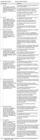
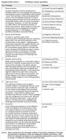
DeafSpace principles show strongest growth trajectory in recent literature, with five studies (45.4%) explicitly referencing DS guidelines (Abdel-Maksoud, 2016; Johnson, 2014; Mitchiner et al., 2018; Pedersen, 2013; Tsymbal, 2010) as shown in Table 1. However, implementation remains fragmented and theoretically inconsistent (see Table 2). While Johnson (2014) and Tsymbal (2010) provide comprehensive DS frameworks, other studies adopt principles selectively without acknowledging broader DS philosophy. A significant gap emerges between DS theory and educational application. The original 150 DS guidelines (Gallaudet University DeafSpace, 2005-2010) outlined in Supplementary Table 4 were developed for general built environments, yet their translation to educational settings remains largely unexplored. This represents a critical research gap where educational-specific adaptations are needed but absent.
4.2 Spatial challenges related to the needs of deaf learners
The analysis of spatial challenges reveals both universal concerns and significant blind spots in current research understanding (see Table 1). While certain challenges achieve consensus across studies, others remain consistently overlooked, suggesting systematic biases in research focus.
4.2.1 Visual dominance and its implications
Visual considerations achieve universal recognition (100% of studies), as shown in Table 1, establishing visual access as the foundational requirement for deaf-responsive design. However, this consensus masks important conceptual distinctions between visual access (basic sight lines) and visual connectivity (meaningful spatial relationships) evident in Table 2. Studies by Johnson (2014) and Martins and Gaudiot (2012) demonstrate more sophisticated understanding of visual spatial relationships, while others (Childress, 1985; Priestley, 2006) treat visual access more superficially. The overwhelming focus on visual considerations may inadvertently marginalize other important spatial factors. This visual dominance potentially reflects hearing researchers' assumptions about deaf experience rather than comprehensive understanding of deaf spatial needs.
4.2.2 Acoustic complexity: Beyond simple sound reduction
Acoustic considerations (72.7% of studies) reveal sophisticated understanding of deaf spatial needs, challenging assumptions about deaf spatial requirements (see Table 1). The literature shows that acoustic design for deaf users is more complex than simple sound elimination, requiring strategic balance between harmful noise reduction and beneficial vibration preservation, as detailed in Table 2. Studies by Martins and Gaudiot (2012) and Johnson (2014) show nuanced appreciation for how different degrees of hearing loss create distinct spatial challenges, while earlier work (Childress, 1985) shows more simplistic sound-reduction approaches. This evolution not only suggests growing field sophistication, but also highlights inconsistent understanding across the literature.
4.2.3 Consistently overlooked areas
Social and cultural considerations receive disproportionately limited attention (36.3% and 18.1%, respectively), as evidenced in Table 1, representing significant blind spots in current research. This oversight is particularly concerning, given deaf education's inherently social nature and the importance of deaf cultural identity in educational settings. Table 2 reveals that cultural spaces are mentioned in only two studies (Johnson, 2014; Tsymbal, 2010), indicating substantial under-research in this critical area. Mobility challenges (27.2% of studies) and organizational factors (18.1%) are consistently underexplored according to Table 1, despite their documented impact on deaf learners' educational experience. The limited attention to these factors suggests research bias toward technical solutions over holistic environmental understanding.
4.2.4 Learning spaces: Promising but underdeveloped
Learning space considerations (45.4% of studies) represent an emerging area of interest but remain conceptually underdeveloped, as shown in Table 1. While studies by Mitchiner et al. (2018) and Guardino and Antia (2012) demonstrate sophisticated understanding of spatial-pedagogical relationships, as detailed in Table 2, most of the treatments remain superficial. The Reggio Emilia concept of environment as "third teacher" appears in only one study (Mitchiner et al., 2018), despite its clear relevance to deaf spatial education. This represents a significant missed opportunity for theoretical framework development that could advance both deaf space understanding and educational practice.
4.2.5 Technology integration: Reactive rather than innovative
Technology considerations (54.5% of studies) show reactive rather than innovative approaches, as indicated in Table 1, focusing primarily on accommodation of existing technologies rather than spatial-technological integration. While studies mention assistive devices and visual alarm systems, as shown in Table 2, few explore how architectural design could enhance technological effectiveness or how emerging technologies might reshape deaf spatial requirements. The limited exploration of innovative technological integration suggests that research lags behind technological advancement, potentially limiting practical relevance of findings for contemporary educational environments.
4.3 Patterns, synthesis, and knowledge gaps across the literature
The synthesis of findings reveals both strong areas of consensus and critical under-researched domains in the literature. The vast majority of the studies originate from North America, particularly the United States, revealing a geographic and cultural concentration that limits global applicability. No African studies were identified, underscoring a significant gap in context-specific knowledge for low- and middle-income settings. This imbalance has shaped the theoretical evolution of the field, where early work focused on generic accessibility through universal design, while later research adopted DeafSpace principles to address visual, acoustic, and spatial communication needs more directly.
Across studies, there is a strong consensus on core design strategies. Visual connectivity, lighting quality, acoustic control, and spatial layout consistently emerge as key determinants of communication, engagement, and safety. These strategies underpin most of the architectural and educational recommendations. However, evidence of their effectiveness in applied settings remains limited, as few studies include empirical or post-occupancy evaluation data. This results in a growing theoretical knowledge base that has yet to be systematically tested in real-world contexts.
Despite these advances, several under-researched areas remain. First, there is minimal integration of DeafSpace principles with broader disability-inclusive frameworks, leaving unclear how architectural strategies could accommodate learners with multiple or overlapping needs. Secondly, the cultural and climatic adaptation of DeafSpace design is rarely examined, despite likely variation in light quality, material availability, and social interaction norms across regions. Thirdly, there is an absence of cost-benefit and implementation feasibility analyses, creating barriers to institutional adoption. Finally, the longitudinal impacts of spatial interventions on learning outcomes, identity development, and social inclusion have not been studied.
Methodologically, the field remains fragmented. Architectural studies tend to focus on technical or spatial elements, while educational research prioritises behavioural and pedagogical outcomes, with limited interdisciplinary integration. Only one study (Martins & Gaudiot, 2012) used a participatory design process involving deaf users, and more than a third of all studies rely on secondary or conceptual analysis. Consequently, the translation of design theory into practice is still weak, and implementation challenges in resource-constrained contexts remain unaddressed.
Overall, while the literature demonstrates consensus on core spatial needs, it is geographically narrow, empirically weak, and methodologically uneven. Addressing these gaps requires participatory, cross-cultural, and longitudinal approaches to validate and adapt DeafSpace and universal design strategies. Future research should aim to develop frameworks that not only theorise inclusive design principles, but also test their educational, social, and cultural effectiveness within diverse and resource-variable contexts.
5. CONCLUSION
This scoping review addressed the question: How can the nature of 'deaf-space' and 'deafness' influence the architecture of a school for the deaf? The review confirms that, while the concept of DeafSpace offers a rich, experience-based framework for inclusive design, its theoretical development has outpaced empirical validation and contextual adaptation.
Three architectural approaches, namely universal design, inclusive design, and DeafSpace dominate the literature, reflecting differing philosophies of accessibility. Universal design offers broad inclusivity but risks diluting deaf-specific needs; DeafSpace provides focused sensory and cultural responsiveness but remains under-tested outside Western contexts, and inclusive design, although promising for educational settings, is underrepresented in current research.
Across studies, there is strong agreement on essential design strategies: visual connectivity, lighting quality, acoustic balance, and spatial organisation. Yet, the implementation of these strategies remains inconsistent. None of the reviewed studies included post-occupancy evaluations or cost analyses, and few addressed cultural or climatic adaptation, limiting the applicability of current frameworks to diverse learning environments.
The review highlights several under-researched priorities. These include the integration of DeafSpace with multi-disability design needs, empirical assessment of design effectiveness on learning and social outcomes, and cross-cultural studies that examine how deaf architectural principles might be adapted to local materials, climates, and pedagogical traditions. Moreover, the near absence of African studies, including within South Africa, reveals a critical research gap, given the country's ongoing educational inequality for deaf learners.
Future research should, therefore, prioritise participatory and longitudinal approaches that involve deaf users directly in design processes, testing how architectural interventions affect educational performance, identity formation, and inclusion. Developing evidence-based implementation frameworks, linking theory, practice, and policy, will be essential for translating DeafSpace principles into practical, context-sensitive school environments.
By situating global insights within the South African context, this review establishes a foundation for empirical studies exploring lived experiences of deaf learners and educators. It underscores the urgent need for interdisciplinary collaboration between architecture, education, and studies on the deaf to create learning environments that move beyond accommodation toward empowerment, belonging, and cultural affirmation.
6. LIMITATIONS
This review faced several limitations. First, interpreting the multiple framings of similar concepts across disciplines posed a challenge, as education and architecture often use differing terminology and theoretical inflections to describe comparable ideas. Researcher subjectivity in interpreting the literature was mitigated through systematic data extraction and categorisation within summary tables. In one source (Tsymbal, 2010), key visual data were inaccessible, due to greyed-out images; attempts to contact the author were unsuccessful, and the review, therefore, relied solely on the available textual content. Similarly, while the DeafSpace Design Guidelines encompass over 150 specific recommendations, they remain unpublished. Efforts to contact the author, Hansel Bauman, on 11 December 2020 were unsuccessful, and these guidelines could not be directly accessed. Finally, the review was conducted during 2020, and it is possible that new research published since that time has not been captured. Future reviews should, therefore, consider updating the search to incorporate recent empirical and cross-cultural studies.
REFERENCES
-
Abdel-Maksoud, A. 2016. The role of universal design in virtual deaf schools. International Design Journal, 6(3), pp. 129-143. https://doi.org/10.12816/0036499
» https://doi.org/10.12816/0036499 -
Arksey, H. & O'Malley, L. 2005. Scoping studies: Towards a methodological framework. International Journal of Social Research Methodology, 8(1), pp. 19-32. https://doi.org/10.1080/1364557032000119616
» https://doi.org/10.1080/1364557032000119616 - Bauman, H. 2010. DeafSpace design guidelines. Unpublished working draft, compiled by Hansel Bauman and other contributors. Gallaudet University, Washington DC, USA.
-
Bednarczyk, A., Alexander-Whiting, H. & Solit, G. 1994. Guidelines for the adaptation of preschool environments to integrate deaf, hard-of-hearing, and hearing children. Children's Environments, 11(1), pp. 6-15. http://www.jstor.org/stable/41514902 [Accessed: 21 August 2024].
» http://www.jstor.org/stable/41514902 - Cauwer, P., Clement, M., Buelens, H. & Heylighen, A. 2009. Four reasons not to teach inclusive design. In: Proceedings of Include 2009 - International Conference on Inclusive Design, 5-8 April, Royal College of Art, London, UK, pp. 1-6.
- Childress, C. 1985. Schooling the young physique. Architectural Record, 173, pp. 96-99.
-
Day, C. & Midbjer, A. 2007. Environment and children: Passive lessons from the everyday environment. Oxford: Elsevier Architectural Press. https://doi.org/10.4324/9780080550978
» https://doi.org/10.4324/9780080550978 -
DBE (Department of Basic Education). 2019. Master list of schools. datafirst.uct [Accessed: 2 February 2024].
» datafirst.uct -
Edwards, C. & Harold, G. 2014. DeafSpace and the principles of universal design. Disability & Rehabilitation, 36(16), pp. 1350-1359. https://doi.org/10.3109/09638288.2014.913710
» https://doi.org/10.3109/09638288.2014.913710 -
Gallaudet University. 2010. DeafSpace, 2005-2010. Deaf space design guidelines. working draft, 31 August. https://infoguides.rit.edu/ld.php?content_id=59890829 [Accessed: 2 February 2024].
» https://infoguides.rit.edu/ld.php?content_id=59890829 -
Guardino, C. & Antia, S. 2012. Modifying the classroom environment to increase engagement and decrease disruption with students who are deaf or hard of hearing. The Journal of Deaf Studies and Deaf Education, 17(4), pp. 518-533. https://doi.org/10.1093/deafed/ens026
» https://doi.org/10.1093/deafed/ens026 -
Hawkins, G., Jenkins, J., Watson, L., Foster, V., Ward, M. & Keeler, D. 2008. Designing for disabled children and children with special educational needs: Guidance for mainstream and special schools. BB 102. Department for Children, Schools and Families UK. gov.uk [Accessed: 2 February 2024].
» gov.uk -
JBI (The Joanna Briggs Institute). 2015. The Joanna Briggs Institute reviewers' manual 2015: Methodology for JBI scoping reviews. The University of Adelaide: The Joanna Briggs Institute. https://api.semanticscholar.org/CorpusID:143303529 [Accessed: 2 March 2024].
» https://api.semanticscholar.org/CorpusID:143303529 -
JBI (The Joanna Briggs Institute). 2019. JBI scoping-PROTOCOL-template-201904. https://jbi.global/scoping-review-network/resources [Accessed: 2 March 2024].
» https://jbi.global/scoping-review-network/resources -
JBI (The Joanna Briggs Institute). 2024. Methodology for JBI scoping reviews. Joanna Briggs Institute reviewer's manual. The University of Adelaide: The Joanna Briggs Institute. https://doi.org/10.46658/jbimes-20-01
» https://doi.org/10.46658/jbimes-20-01 -
Johnson, C. 2014. Articulation of deaf and hearing spaces using deaf space design guidelines: A community based participatory research with the Albuquerque sign language academy. Published MSc, The University of New Mexico, Albuquerque, New Mexico. Scispace.com [Accessed: 2 March 2024].
» Scispace.com -
Kitzel, M. 2017. Creating a deaf place: The development of the Asylum for Deaf and Dumb Poor Children in the early nineteenth century. Journal of Cultural Geography, 34, pp. 149-169. https://doi.org/10.1080/08873631.2017.1305522
» https://doi.org/10.1080/08873631.2017.1305522 - Landa, A.H., Szabo, I., Le Brun, L., Owen, I., Gletcher, G. & Hill, M. 2011. Evidence-based scoping reviews. The Electronic Journal Information Systems Evaluation, 14(1): pp. 46-52.
-
Levac, D., Colquhoun, H. & O'Brien, K. 2010. Scoping studies: Advancing the methodology. Implementation Science, 5, pp. 69-77. https://doi.org/10.1186/1748-5908-5-69
» https://doi.org/10.1186/1748-5908-5-69 -
Mace, R., Connell, B., Jones, M., Mueller, J. & Mullick, A. et al. 1997. The principles of universal design, Version 2.0. Raleigh, NC: North Carolina State University: The Center for Universal Design. Projects.ncsu.edu [Accessed: 2 March 2024].
» Projects.ncsu.edu -
Mackenzie, I. & Smith, A. 2009. Deafness - The neglected and hidden disability. Annals of Tropical Medicine and Parasitology, 103(7), pp. 565-571. https://doi.org/10.1179/000349809X12459740922372
» https://doi.org/10.1179/000349809X12459740922372 -
Malik, A., Rashid, M., Awaan, M. & Alvi, I. 2018. The role of architecture in the identification of obstacles and spatial solutions to inclusive education. UMT Education Review, 1(2), pp. 39-58. https://doi.org/10.32350/uer.12.03
» https://doi.org/10.32350/uer.12.03 -
Martins, L. & Gaudiot, D. 2012. The deaf and the classroom design: A contribution of the built environmental ergonomics for the accessibility. Work, 41 (Suppl. 1), pp. 3663-3668. https://doi.org/10.3233/WOR-2012-0007-3663
» https://doi.org/10.3233/WOR-2012-0007-3663 -
Mitchiner, J., Batamula, C. & Kite, B. 2018. Hundred languages of deaf children: Exploring the Reggio Emilia approach in deaf education. American Annals of the Deaf, 163(3), pp. 294-327. https://doi.org/10.1353/aad.2018.0021
» https://doi.org/10.1353/aad.2018.0021 -
Munn, Z., Peters, M., Stern, C., Tufanaru, C., McArthur, A. & Aromataris, E. 2018. Systematic review or scoping review? Guidance for authors when choosing between a systematic or scoping review approach. BMC Medical Research Methodology, 18(1), article 143. https://doi.org/10.1186/s12874-018-0611-x
» https://doi.org/10.1186/s12874-018-0611-x -
Nygaard, K.M. 2018. What is universal design: Theories, terms and trends. Paper presented at the IFLA WLIC Transform Libraries, Transform Societies, 26 August, Kuala Lumpur, Malaysia. Library.ifla [Accessed: 24 June 2024].
» Library.ifla - Oosthuizen, A. 2017. SA is failing deaf and hard-of-hearing learners: Can a bilingual model of education be the solution to acquiring literacy? HSRC Seminar. Human Sciences Research Council.
- Pedersen, C. 2013. The sensory garden experience: A sensory enrichment design for the Arizona School for the Deaf and Blind. Unpublished MSc thesis. The University of Arizona, USA.
-
Pham, M., Rajic, A., Greig, J., Sargeant, J., Papadopoulos, A. & McEwen, S. 2014. A scoping review of scoping reviews: Advancing the approach and enhancing the consistency. Research Synthesis Methods, 5(4), pp. 371-385. https://doi.org/10.1002/jrsm.1123
» https://doi.org/10.1002/jrsm.1123 - Priestley, K. 2006. A qualitative study of educators' perceptions of universal design and teaching practices: Implications for inclusion. Unpublished PhD dissertation, University of Manitoba, Canada.
- Ramaphosa, C. 2018. President Cyril Ramaphosa: 2018 State of the Nation Address. South African Government.
-
Rout, M.J. & Cloete, M.C. 2022. Architectural considerations towards improving deaf education. International Journal of Technology and Inclusive Education, 11(1), pp. 1717-1726. https://doi.org/10.20533/ijtie.2047.0533.2022.0212
» https://doi.org/10.20533/ijtie.2047.0533.2022.0212 -
South African Market Insights. 2020. South Africa's education statistics. Southafricanmi.com [Accessed: 21 August 2019].
» Southafricanmi.com -
Tricco, A.C., Lillie, E., Zarin, W., O'Brien, K.K., Colquhoun, H., Levac, D. et al. 2018. PRISMA Extension for Scoping Reviews (PRISMA-ScR): Checklist and explanation. Annals of Internal Medicine, 169(7), pp. 467-473. https://doi.org/10.7326/M18-0850
» https://doi.org/10.7326/M18-0850 - Tsymbal, K. 2010. Deaf space and the visual world - Buildings that speak: An elementary school for the deaf. Unpublished M.Arch. thesis, University of Maryland, College Park, USA.
Peer reviewed and revised: October 2025
Published: December 2025