Future-ready buildings: Nigeria's transition to low-carbon, climate-responsive housing
Abstract
The global climate crisis is compelling nations to adopt building resilience practices to facilitate the transition to a low-carbon and sustainable future. In tropical regions, where the impact of climate change is predicted to be most adverse, elevated outdoor temperatures may render existing housing unliveable. In Nigeria, much attention is not paid to designing climate-responsive buildings, making new and existing buildings vulnerable to extreme future climates. This study evaluates Nigeria's readiness to transition to low-carbon and climate-responsive housing, using a mixed-methods approach, incorporating both qualitative and quantitative data. Weather data for 2020 and future projections for 2100 (based on RCP 8.5 scenarios) were generated using Meteonorm (v8) and analysed using Python in Jupyter Notebook. In addition, 68 peer-reviewed references were sourced from reputable online databases and informed a thematic analysis. The results show an average temperature increase of 5.2°C by 2100, with significant regional variability, highlighting the urgent need for climate-responsive building strategies. The thematic analysis identified financial constraints, weak policy frameworks, as well as technological and knowledge gaps as the primary barriers to sustainable building adoption in Nigeria. The study concludes that, for the habitability and sustainability of buildings, future-proofing strategies must prioritise solar shading, thermal mass insulation, passive cooling and ventilation, renewable energy integration, and low embodied energy materials. These measures must be supported by robust policies, incentives, and an effective building assessment framework to ensure the resilience and sustainability of Nigeria's housing supply.
Climate-responsive buildings; future buildings; future-proofing; low-carbon buildings; mitigation strategies
1. INTRODUCTION
The rising climate crisis, evidenced by rising temperatures and deteriorating climatic conditions, poses serious threats to global and local building resilience. Without immediate and pre-emptive interventions, future buildings and generations will endure the dire consequences of societal inaction (Emetere, Afolalu & Peters, 2021: 5). In Nigeria, limited attention is paid to the design of climate-resilient buildings with low global warming impact (Akinola et al., 2020: 9), significantly contributing to the country's rising carbon emissions. The vast majority of existing contemporary buildings rely heavily on non-renewable cooling systems, increasing energy consumption, and environmental strain (Lawal et al., 2024: 7, 8). However, climate-responsive building strategies are gradually gaining attention as a feasible approach to enhancing resilience and reducing carbon footprints (Umana et al., 2024). Yet, a clear strategic framework, supported by well-defined guidelines and policy reinforcements, remains lacking. Climate resilience strategies are recognised as essential for ensuring building sustainability in a changing climate (Unegbu et al., 2024a: 13). Green building strategies such as green roofs (Iwuanyanwu et al., 2024: 8; Ojelabi, Mohammed & Oladiran, 2024: 7), window glazing optimisation (Okpalike et al., 2022: 5-7; Alegbe & Mtaver, 2023: 7, 8), solar shading (Alegbe et al., 2023), and the use of low embodied carbon materials (Alegbe & Hammed, 2024; Basil et al., 2019: 5) can mitigate these challenges. These strategies not only enhance resilience, but also improve societal well-being, by supporting energy efficiency, indoor air quality, and long-term cost savings (Ekhaese, Adejuwon & Evbuoma, 2021; Abdulsalam et al., 2024). Incorporating green building systems and smart technologies enhance the overall sustainability value of buildings (Otegbulu, 2018: 19; Imafidon, Enwerem & Boye, 2024: 8, 14). Despite the growing global acceptance of green building practices and climate-responsive building strategies, their adoption and implementation in Nigeria remains significantly below expectations (Toriola-Coker et al., 2021; Iwuagwu & Onyegiri, 2019: 7).
The challenges in the industry are deeply rooted in technopolitical issues, awareness and perception barriers, as well as sociocultural influences (Akindele et al., 2023: 10-16). Sustainable construction encompasses a wide range of disciplines, including site planning, architectural design, and waste management (Osuizugbo et al., 2020: 8), which, when compared to conventional construction methods, offer significant socio-economic and environmental benefits (Windapo et al., 2021). Emerging trends in the Nigerian construction industry include the use of local materials and sustainable construction techniques, but alignment with global advancements is restrained (Evelyn, 2023: 6-8). For instance, while the relationship between building design and its environmental performance is recognised, their implementation for building energy efficiency is not applied (Omoragbon, Al-Maiyah & Coates, 2023). Inadequate use of localised building materials and the lack of building evaluation, which are critical for energy efficiency, remain underexplored in the industry (Ukpong & Ackley, 2019: 10).
In sub-Saharan Africa, economic concerns often impede the development of the green building market, taking precedence over environmental considerations (Addy et al., 2021). This stems from the urgent need to address pressing challenges such as poverty and housing shortages. With over 60 million Nigerians relying on non-renewable alternative power sources, environmental concerns and the transition to a sustainable future is further aggravated (Geissler, Österreicher & Macharm, 2018; Nwozor et al., 2021). Other barriers such as users' behavioural negligence (Omuh et al., 2018), clients' low awareness and resistance to sustainable building designs (Babalola & Harinarain, 2024: 5; Opoko et al., 2022: 10), as well as weak policy frameworks from regulatory bodies (Imafidon et al., 2024: 11, 12; Tunji-Olayeni & David, 2024) hinder the transition towards a more resilient and sustainable built environment. While the challenges impeding the sustainable transformation of Nigeria's built environment are multifaceted, they can be resolved by using the right approaches.
This study critically investigates the state of Nigeria's built environment industry regarding its readiness to transition towards a climate-resilient, low-carbon housing, identifying existing gaps, challenges and approaches for a sustainable future. It examines emission representative concentration pathways (RCPs) and temperature anomalies for projected climate scenarios for each region in the country. It further conducts a thematic review of relevant literature on the Nigerian built-environment industry and, Anally, proposes a set of climate-responsive design strategies to recommend actionable measures for future-proofing buildings in the country.
2.1 Building design and sustainability challenges in Nigeria
By 2050, urban households are projected to consume more energy than their rural counterparts, due to mass migration to cities (Dioha & Kumar, 2020: 10-13). This urbanisation necessitates innovative approaches to offset escalating energy demands through sustainable building design. Following the COVID-19 pandemic, there has been a notable shift towards integrating climate considerations into building design, highlighting the importance of indoor well-being and sustainability (Evelyn, 2023: 4). This heightened focus shows the need for human-centric, green buildings achieved through an integrated design process that prioritises key metrics. As noted by Ikudayisi et al. (2022: 13), these metrics such as project, process, team, and client attributes are crucial for ensuring successful sustainability outcomes in building projects.
The Nigerian building industry has set ambitious targets to reduce energy consumption and global warming potential in buildings. Intelligent building design, particularly through the optimisation of building envelopes, has shown significant potential for enhancing energy efficiency (Ochedi & Taki, 2022: 13). However, while developed nations are advancing rapidly in adopting modern building technologies, developing countries such as Nigeria face substantial barriers, including financial constraints, a shortage of technical expertise, and weak policy frameworks (Imafidon et al., 2024: 15). Moreover, Nigeria's growing housing deficit, persistent energy challenges, and environmental issues further complicate efforts to align with global climate goals (Onososen, Osanyin & Adeyemo, 2019: 2,10).
Nigeria's climate, characterised by extreme temperatures and high humidity, leads to a heavy reliance on non-renewable energy-powered mechanical cooling systems for indoor comfort - an unsustainable practice. In contrast, traditional buildings employed passive cooling techniques, such as extended roof eaves, cooling balconies, and high headrooms, reducing energy demand (Nwalusi et al., 2022: 8). The adoption of modern architectural designs has displaced these passive cooling strategies, emphasising the need for integrating traditional practices with contemporary building techniques.
Nigeria faces a divide between policies aimed at phasing out fossil fuel-based energy generation and those promoting renewable energy technologies, which has stagnated efforts to decouple the country's energy systems (Okoh & Okpanachi, 2023). Despite widespread recognition of these deficiencies, the adoption of sustainable construction methods remains limited. This issue extends beyond private residential buildings, with public structures such as museums lacking essential low-carbon strategies (Adewale & Ene, 2024). High-end shopping malls and hospitals also continue to rely heavily on non-renewable energy sources (Izobo-Martins et al., 2022: 10-18; Adeniran, Netswera & Marcus, 2024: 3). The tourism sector, a major energy-consuming industry, offers significant opportunities for improving energy efficiency; yet the high initial costs of building decarbonisation and regulatory challenges hinder progress (James et al., 2022: 13; Amasuomo, 2021: 64). Furthermore, technological limitations, socio-economic factors, public resistance, and low awareness exacerbate the slow adoption of low-carbon measures in the building sector (Rimamtanung & Charles, 2023; Muhammad et al., 2020).
While much attention has been paid to reducing operational energy in buildings, the growing importance of embodied carbon reduction must also be considered to meet long-term climate goals (Röck et al., 2020: 10; Khan et al., 2022: 16; Hu, 2023; Fang et al., 2023). Alarmingly, many modern buildings in Nigeria fail to meet basic sustainability standards (Ekhaese et al., 2021: 5,8), highlighting the need for a standardised policy framework with stricter regulations. In addition, tensions between preserving architectural heritage and embracing contemporary designs complicate efforts to achieve sustainability. In some instances, renovation offers a more sustainable alternative to new construction, providing both cultural preservation and material waste reduction benefits (Savoie, Sapinski & Laroche, 2025).
The challenges regarding building sustainability in Nigeria demand innovative policies, practices, and technologies to guide the sector toward a more sustainable future.
2.2 Global practices in transitioning to resilient futures
The transition to a low-carbon and resilient future demands holistic strategies that encompass urban design, landscape, building design, energy systems, and consumer behaviour, with countries making significant progresses to mitigate climate change. Several nations have promoted zero-energy buildings and continually refine methods to reduce their global warming impact. For instance, the adoption of frameworks with time-varying building characteristics in Canberra demonstrated a 23% reduction in building energy demand (Rostam & Abbasi, 2023: 8). The integration of passive measures such as super-insulation and energy-efficient HVAC systems in Algiers led to a remarkable 59% reduction in energy use and 44% decrease in emissions, by leveraging renewable energy sources such as solar photovoltaics (Makhloufi & Louafi, 2024: 11). However, as climate patterns evolve, the challenge of adapting building designs to future climate scenarios remains critical. A study in the UK indicates that net-zero energy buildings (NZEBs) can reduce GHG emissions by an impressive 89%, even as cooling demands increases, due to changing climate (Viganò et al., 2024: 20). Achieving outstanding energy reduction in buildings requires innovative optimisation techniques such as the Energy Demand and Supply Simultaneous Optimisation (EdeSSOpt) method applied in Italy, which proved to be effective in designing cost-efficient buildings that remain resilient across diverse future climate scenarios (Bilardo, Ferrara & Fabrizio, 2019: 3). These examples connote that resilience is not only about immediate outcomes, but also about planning for long-term sustainability.
Advancements in digital technologies are revolutionising the construction industry and accelerating the shift towards a low-carbon future. Building Information Modelling (BIM), for instance, has emerged as a transformative tool that enhances life cycle management, waste reduction, clash detection, and energy performance in buildings (Alsehaimi et al., 2024). Beyond this, technologies such as digital twin (DT) and the Internet of Things (IoT) are facilitating smarter and more integrated systems for energy management and building operations. These innovations streamline construction processes, improve decision-making, and ensure that projects meet and even exceed sustainability targets (Ghalandar & Lindkvist, 2023). However, transitioning to a resilient future is not only a technological endeavour; it also requires societal collaboration. Energy communities, for instance, play a pivotal role in promoting collective energy resilience (Moroni et al., 2019). The Supporting Consumer Co-Ownership in Renewable Energies (SCORE) project, piloted in the Czech Republic and Poland, exemplifies this approach. By encouraging renewable energy systems co-ownership, the project supports consumer engagement and reduces reliance on fossil fuels, which are integral in addressing energy inequities, especially in marginalised communities grappling with social disinvestment and deindustrialisation (Torabi Moghadam et al., 2020: 10-14; Bates et al., 2024: 8).
As global emphasis on sustainability intensifies, accountability has become a cornerstone of progress evaluation. Sustainability reporting frameworks such as those provided by the Sustainability Accounting Standards Board have empowered businesses to transparently disclose their sustainability practices (Job & Khanna, 2024: 9). This ensures that efforts towards low-carbon futures are effective, measurable, and align with global goals. Equally important is the consideration of geographical and micro-climatic contexts in building design, as exemplified in a study in the UK, where a two-tiered ensemble clustering method was employed to identify granular climate zones based on future projections. According to Xie et al. (2024: 2, 8), this approach offers scalable solutions to enhance climate-responsive building designs globally. In addition, universal design principles, which cater to the changing needs of occupants over their lifespans, are being integrated into building practices, in order to address challenges such as aging populations and evolving lifestyles (Romagnoli & Villani, 2024). These schemes ensure that buildings withstand both extreme climate adversities and changing individual needs.
2.3 Climate projections and building decarbonisation
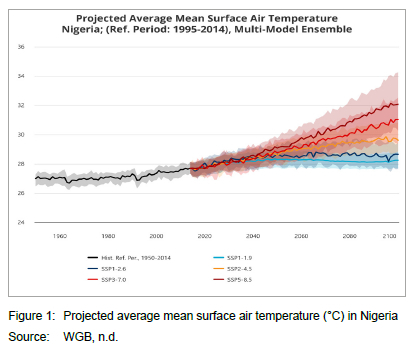
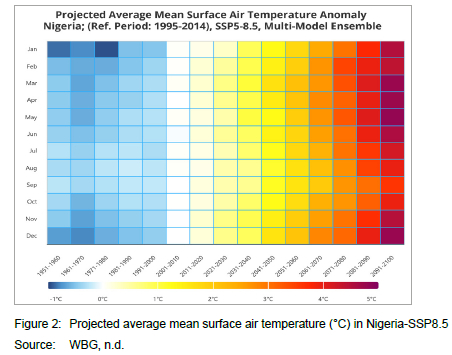
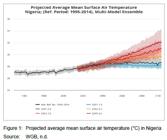
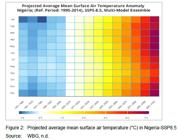
Climate change is the greatest threat to human survival, with two-thirds of the 1°C temperature rise since the industrial revolution occurring post-1986, making the last few decades the warmest in recorded history (PWC Nigeria, n.d.). According to climate projections, Nigeria is expected to face significant temperature increases, with annual temperature anomalies projected to rise by 0.35°C by 2035, 1.09°C by 2045, and 5.8°C by 2100, compared to 2025 levels by the World Bank Group (WBG, n.d.). As illustrated in Figure 1, a time series graph traces these temperature anomalies from 1951 to 2100, using shared socio-economic pathways (SSPs) in a multi-model ensemble. These SSPs offer valuable insights into potential future climates, shaped by carbon emissions, mitigation efforts, and development trajectories. In addition, Figure 2 presents a boxplot of average monthly surface temperatures across Nigeria spanning 150 years, from the mid-20th century to the 22nd century. Together, these projections show the urgent need to future-proof housing developments through the adoption of climate-responsive design strategies.
One of the urgent priorities for the Nigerian construction industry is decarbonising the building sector, driven by the growing demand for cement-based materials. The Green Building Council of Nigeria (GBCN) identified cement production as contributing 43% of the country's greenhouse gas emissions, owing to its highly carbon-intensive manufacturing process (Ekugbe, 2024). Alarmingly, this figure surpasses the global average of 32%. Urbanisation and population growth are the principal carbon emissions drivers that continue to significantly shape Nigeria's emission trends, determining its trajectory (Abam et al., 2023: 10; Abubakar & Aina, 2019: 7). Despite these challenges, the adoption of renewable energy technologies, which are essential for building decarbonisation, remains minimal (Ekung, Ohama & Tiokpat, 2020: 8). Aggravating the decarbonisation challenges further, many of the existing housing supply, influenced by modern architectural styles, were neither designed to be future-proof nor adapted to the local climate conditions (Soliman, Ibrahim & Ibrahim, 2022: 3).
2.4 Nigeria's pathway: Policies and practices
As remarked by Alhassan et al. (2022: 5, 10), Nigeria lags in the shift to a resilient future, primarily because traditional building designs and practices continue to dominate. In response, the Federal Executive Council, in 2022, approved the Energy Transition Plan (ETP), the first in Africa, which outlines a pathway to achieve net-zero emissions by 2060 (PWC Nigeria, n.d.). This plan prioritises decarbonising high-emission sectors through the adoption of renewable energy and biogas-based technologies. During COP26, the Nigerian government further pledged to commit to afforestation and reduce methane emissions by 30% by 2030, aligning national efforts with global climate action goals. To achieve meaningful and effective results, these promising developments will, nonetheless, require robust frameworks that extend beyond documentation.
When evaluated against low-carbon design alternatives, the vast majority of the current housing supply is found to be largely unsustainable (Ogunde et al., 2018). Property management practices do not adequately address the negative environmental impacts of buildings during their operational phases (Ogunba, Dabara & Gbadegesin, 2023: 7). Retrofitting buildings can help make them more energy-efficient, offering a cost-effective and environmentally friendly alternative to rebuilding (Omoragbon et al., 2023: 11, 12). Addressing energy inefficiency in Nigeria is a significant challenge, due to the reliance on the already strained national grid (Mato et al., 2023: 4). To curb this, Iwuagwu and Onyegiri (2019: 7) proposed using passive energy use strategies to reduce the pressure on the grid. In addition, sustainable practices such as the use of energy-saving bulbs and digital metering can support energy efficiency in buildings (Ogunba et al., 2023: 7). However, normalised unsustainable building practices and limited access to technologies truncate emission reduction objectives (Omopariola et al., 2024; Umana et al., 2024: 7). Regardless, Otegbulu (2018) purported that building occupants are willing to embrace low-carbon building features, provided they enhance indoor living standards.
Policies, practices, and educational interventions also play a critical role in Nigeria's transition to a low-carbon future. Government incentives are effective in promoting sustainable building practices and, if appropriately scaled, could support green building attainment and drive better adoption rates (Saka, Olanipekun & Omotayo, 2021). In addition, the awareness of sustainable construction among academics and industry professionals is growing, but at a slow pace (Oluwunmi et al., 2019: 7; Unegbu et al., 2024b: 6). To resolve this, targeted educational programmes for professionals could bridge this gap and accelerate the shift to carbon-neutral construction processes (Akinshipe, Oluleye & Aigbavboa, 2019: 6). Nevertheless, limited knowledge of sustainable construction technologies and the failure to translate research outcomes into innovations continue to discourage low-carbon building practices (Osuizugbo et al. , 2024). On a positive note, integrating climate-resilient strategies in buildings offers substantial prospects for reducing greenhouse gas emissions in buildings, with stringent policies and robust models playing significant roles (Muhammad et al., 2020: 9).
3. METHODOLOGY
3.1 Research design
This study employed a mixed-methods approach, combining quantitative and qualitative analyses to evaluate Nigeria's transition to low-carbon and climate-resilient buildings. A mixed-methods approach integrates multiple data sources (Zou et al., 2018: 7; Kinnebrew et al., 2020: 13) and may involve a combination of literature review and building simulation (Chohan et al. , 2024: 6), interviews and questionnaires (Adegoke et al. , 2023: 5; Ahmad et al., 2019: 5), or climate data analysis and building performance evaluation (Lops et al., 2024: 4).
In this study, quantitative analysis involved weather data collection, using Meteonorm - a climate data generator - with a focus on temperature extremes for 2020 and 2100. This involved analysing historical and projected weather patterns to ascertain their potential impact on buildings (Tootkaboni et al., 2021: 6). Qualitative data was gathered from a thematic analysis of reviewed literature, including journal articles, theses, and reports sourced from reputable databases. Thematic analysis has been widely applied in built-environment research such as in Azli et al. (2024: 6), Opoku, Agyekum and Ayarkwa (2019: 6), and Zailani, Mogbo and Kolo (2024: 3) to extract insights. In this study, it ensures that the research is contextually grounded, aligning with current discourse in Nigeria's built-environment industry. A structured approach to data analysis was followed, with statistical validation ensuring the reliability of weather data, while thematic analysis was used to categorise qualitative findings. The validated results were synthesised to formulate building strategies and recommendations aimed at advancing low-carbon and climate-resilient building practices, contributing to sustainable development within Nigeria's built environment. This use of mixed-methods approach thus facilitates a bidirectional integration, such that climate data identifies where the challenges are most critical, while thematic analysis explains why those challenges persist and how they might be addressed. The approach offers a replicable model for other regions facing similar sustainability transitions. By grounding technical projections in place-based socio-institutional realities, the framework ensures that adaptation strategies are not only evidence driven but also contextually practicable. Researchers in other tropical or rapidly urbanising regions can adapt this model to prioritise interventions, enhance planning, and design equitable, future-ready buildings.
3.2 Data collection
Weather data for 37 locations across Nigeria were generated, using Meteonorm (v8) based on geographical coordinates established in a previous study by Alegbe and Mtaver (2023: 6). These coordinates were obtained in batch, using a Python script with the Geopy library, specifying each state capital in Nigeria in the format geolocator.geocode("State_ Capital, Country"). The extracted coordinates were then verified using the Google Maps API to ensure accuracy. Each verified location was entered into the weather generator tool to produce weather data for the reference years. Meteonorm integrates data from over 8,000 weather stations, Ave geostationary satellites, and a globally calibrated aerosol climatology to offer reliable climate data (Remund et al., 2020). It has been applied in several building climate resilience studies, including Escandón et al. (2023: 3) and Tsoka (2023: 5), to generate time-series hourly weather data for assessing future building performance. Meteonorm provides a range of weather metrics, including temperature, solar radiation, humidity, precipitation, wind speed, atmospheric pressure, and cloud cover, as well as climate change projection. However, this study focused solely on temperature data for 2020 and 2100, given its critical role in influencing building energy performance, particularly under future climates conditions. This focus aligns with methods from previous building energy studies, including Pandit and Bhattarai (2018: 2), Dodoo (2020: 2), Wang et al. (2022: 3), and Fu and Liu (2023: 3-5). The data set reflects Nigeria's diverse climatic zones and their implications for building resilience.
Qualitative data were collected from reputable online sources, prioritising literature on low-carbon buildings, sustainable construction, and climate goals. Initially, 68 peer-reviewed articles were collected from Scopus, Google Scholar, and the Directory of Open Access Journals (DOAJ) databases. The search focused on articles specific to Nigeria, published between 2018 and 2024, using "low-carbon buildings", "climate resilience", "green buildings", and "sustainable construction" as keywords. Boolean operations were used to retrieve articles with similar terminologies. Fifteen additional articles were sourced from Scopus to gain a broader perspective on sustainability practices and recent technologies supporting global resilient building initiatives. The overall data collection included peer-reviewed journal papers, conference proceedings, published PhD theses, electronic articles, book sections, and government reports from the fields of energy, engineering, and environmental studies.
3.3 Data analysis
Weather data were first organised in Excel and pre-processed using Python in Jupyter Notebook, focusing on data cleaning and organisation. Python-based preprocessing techniques improve efficiency in handling large and complex, multi-source data, reducing the possibilities of errors (Liu et al., 2024; Grotov et al., 2022; Negrini, Shabadi & Urban, 2023). The primary weather parameters organised were daily maximum and minimum temperatures, along with seasonal averages and annual extremes. Statistical methods were then used to calculate the mean, standard deviation, class width, and range of temperature anomalies across the country. Trend analysis, using a linear regression model, was employed to determine the rate of temperature increase over time. In addition, correlation analysis was performed to assess the relationship between temperature changes across different regions. Correlation analysis measures the strength and direction of relationships between variables, typically using Pearson's correlation coefficient (r), which ranges from -1 to +1 (Sampaio et al., 2024). A coefficient of +1 indicates a perfect positive correlation, -1 a perfect negative correlation, and 0 no linear relationship, with values between these extremes representing varying strengths of correlation.
Data were clustered using K-means algorithms in Python to categorise the 37 locations based on similarities in temperature data and the magnitude of temperature anomalies observed over the 80-year interval. This approach facilitates a clear understanding of regional variations and helps identify areas requiring more stringent adaptation measures (Patil & Karthikeyan, 2020). The number of clusters was determined, using the Elbow Method, and the algorithm was implemented in Python, using the "KMeans" function from the sklearn.cluster module in scikit-learn machine learning library. Each location was assigned to one of three clusters (0, 1, or 2), representing distinct temperature patterns. These labels are arbitrary but correspond to classifications such as high, moderate, and low temperature zones, aiding in climate-responsive building strategies.
For the qualitative data, thematic analysis was performed to identify trends, challenges, and pathways critical to supporting the transition to a low-carbon and resilient future (Zailani et al., 2024: 3). A coding technique was used to identify recurring labels from the literature findings to extract insights that align with the current state of climate-responsive buildings in Nigeria and the barriers to their adoption. These labels were further grouped into six broad themes to inform recommendations for advancing low-carbon building practices in Nigeria. Critically, the cross-analysis of both projected temperature and literature data sets enabled a data-informed clustering of risk zones to thematic constraints, reinforcing the need for differentiated strategies that align climate risk with geo-political realities.
3.4 Validation process
3.4.1 Weather data validation
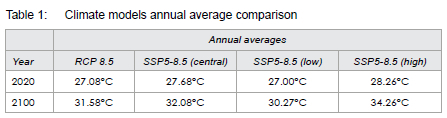
A validation process was conducted to ensure the reliability of the weather data study, by comparing temperature projections collected using Meteonorm for RCP 8.5 (CMIP5) with that of CMIP6 SSP5-8.5 projections, as sourced from World Bank Group. The validation process compares temperature values for the years 2020 and 2100 from both climate models, as shown in Table 1. The central estimate represents the most likely projection, while the lower bound (10th percentile) and the upper bound (90th percentile) represent lower and extreme waiming scenarios, respectively.
The following statistical measures were applied to quantitatively assess the agreement between the data sets.
Mean Bias Error (MBE) measures the average difference between RCP 8.5 and SSP5-8.5 (central) (rejections. A positive MBE indicates that the Meteonoim data overestimates the valuer while a negative MBE signifies an underestimation.

Root Me an Square Error (RMSE) evaluates the magnitude of discrepancies between trie data sets, where a lower RMSE indicates better accuracy and close r agreement between the values.

Mean Absolute Error (MAE) measures the abs o lute deviation between the data sets. A lower MAE value indicates minimal deviation, signifying a strong alignment between the data sets.

Coefficient of Determination (R2) quantifies how well RCP 8.5 aligns with SSP5-8.5 projections, where a value close to 1 signifies a stronger alignment and higher predictive accuracy.

Where:
y = RCP 8.5 (Meteonorm) values
ŷ = SSP5-8.5 central values
 = Mean of RCP 8.5 values
The validation results indicate a stsong agreement between the RCP 8.5 and SSP-8.5 data sets. The Mean Bias Error (MBE) of 0.55°C indicates a slight underestimation by RCP 8.5 compared to SSP5-8.5 percentiles. This could be due to differences in climate modelling frameworks (CMIP5 vs CMIP6), updated emission scenario assumptions, variations in model ensembles with higher climate sensitivities and regional or temporal variability in projections. The Root Mean Square Error (RMSE) and Mean Absolute Error (MAE), both at 0.55°C, confirm minimal deviations,indicating agood alignment between the data sets. In addition, the Coefficient of Determination (R2) of 0.94 (94%) su ggests that 94% of the variation in RCP 8.5 data is explained by SSP5-8.5 projections, demonstrating a strong correlation and reliability of the projected weather values.
3.4.2 Validation of thematic review
The following validation techniques were employed to ensure the validity and reliability of the review.
• Consensus coding: The authors independently reviewed the literature and identified codes and broader themes, which were then compared with the thematic review. A consensus was reached on which codes and themes were valid and should be retained or renamed.
• Saturation check: After agreeing on the identified themes, the authors rechecked the entire data set to conform that no new themes emerged from the additional literature, ensuring that data saturation was achieved.
4. RESULTS
4.1 Temperature variations and correlations
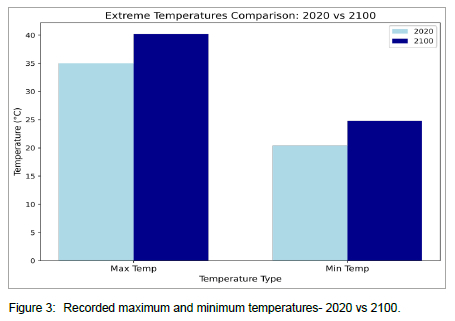
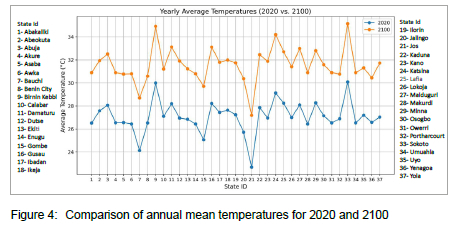
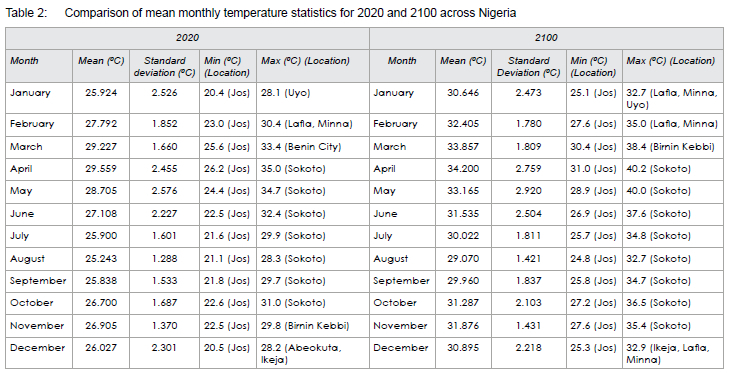
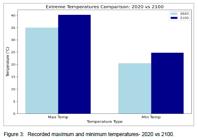
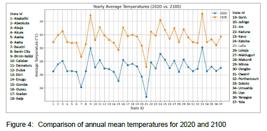
Table 2 compares average monthly temperature statistics for 2020 and 2100. Key metrics include the mean temperature, standard deviation, minimum and maximum recorded temperatures (with their corresponding locations). In 2020, mean temperature ranged from 25.24°C in August to 29.56°C in April, with variations in standard deviations, indicating the extent of monthly temperature fluctuations. Compared to the baseline year, extreme temperatures in 2100 differed by 5.2 °C, while the minimum temperatures showed a variation of 4.4°C (Figure 3). In addition, regional variability is observed, with locations such as Jos experiencing cooler temperatures compared to hotter regions such as Sokoto (Figure 4). By 2100, monthly temperature averages are projected to increase significantly ranging from 30.65°C in January to 34.20°C in April. These projected increases show the potential impact on building resilience and highlight the need for climate-responsive measures.
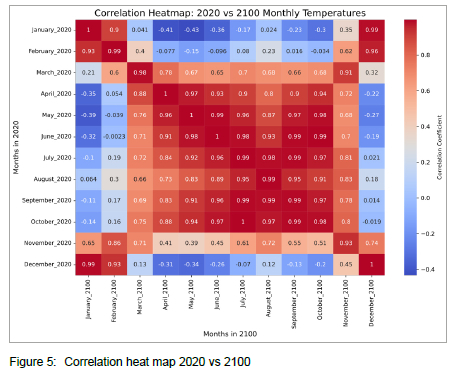
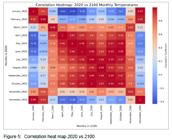
A correlation heatmap (Figure 5) illustrates the relationship between mean monthly temperatures in 2020 and 2100 across locations, showing strong positive correlations between corresponding months and weaker correlations elsewhere. Correlation coefficients range from -0.41 (moderate negative) to 1 (perfect positive), with the strongest correlations along the primary diagonal, such as January 2020 and January 2100 (r = 1), indicating proportional temperature in creases. Negative correlations suggest seasonal shifts and increased climate variability, emphasising the need for adaptive, climate-responsive building designs.
4.2 Cluster groups and patterns
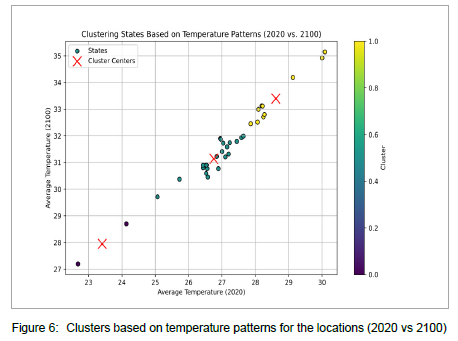
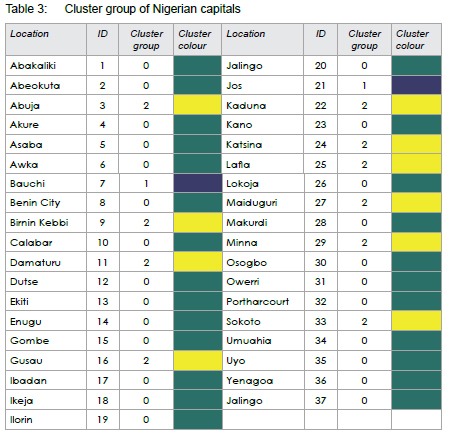
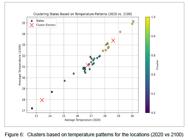
K-means algorithms in Python was used to cluster Nigerian state capitals based on their temperature patterns in 2020 and 2100. This approach provides insights into regional temperature variances, which can have significant localised implications for building resilience. Table 3 presents the locations, their assigned cluster IDs, corresponding colour codes, and cluster groupings. The cluster plot in Figure 6 further depicts the state clusters based on observed temperature patterns.
5. DISCUSSION
5.1 Thematic analysis
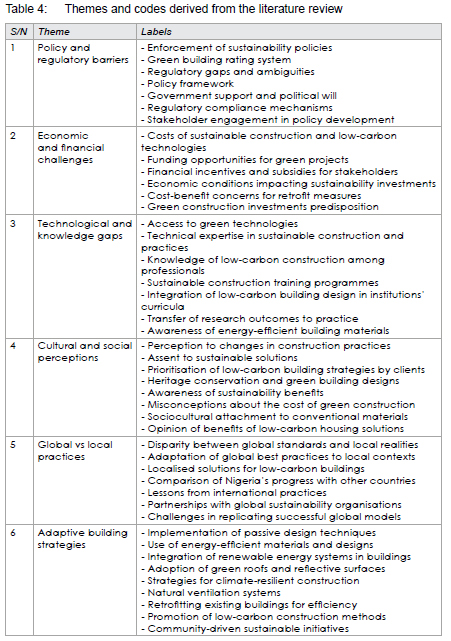
This analysis identified key factors influencing the adoption of low-carbon buildings in Nigeria, with a particular focus on future-proofing the built environment. Recurring labels using findings from 68 scholarly articles were manually identified and grouped into six major themes presented in Table 4. "Financial constraints" and "Lack of awareness" emerged as the most cyclical labels, appearing across economic, financial, and sociocultural discussions, highlighting their overarching significance. The theme "Policy and regulatory barriers" emerges as the most prominent in the literature, buttressing the critical role of governance and institutional frameworks in shaping Nigeria's transition to a low-carbon future. Conversely, "Adaptive building strategies", while crucial for addressing resilience and sustainability, was the least discussed theme, suggesting a gap in practical, solution-oriented research. Less frequent labels such as "Security concerns" and "Socio-economic instability" reflect situational barriers with localised implications.
Policy and regulatory barriers: One of the most significant barriers identified in the literature is the challenge of navigating Nigeria's regulatory environment for low-carbon buildings. This theme finds immediate relevance when cross-examined with temperature projections. For instance, regions projected to experience the greatest warming are often undeserved in terms of policy enforcement and building regulation, showing how weak governance exacerbates climate vulnerability. According to Adeniran et al. (2024: 3-5), the issue lies in the weak enforcement of regulations, which hampers green building (GB) adoption and practices. Similarly, Babalola and Harinarain (2024: 11-13) argue that lack of alignment between various industry stakeholders, including government, architects, and clients, further complicates building sustainability efforts. Despite the presence of GB policies in Nigeria, there is lack of political will and poor awareness to drive these policies forward (Unegbu et al., 2024b: 9). The absence of strong policy frameworks and regulatory enforcement delays the country's progress towards GB adoption and climate goals realisation. Mostly, the regulatory gap is often accompanied by clients' limited awareness of the benefits of green buildings. As noted by Olowosile, Oke and Aigbavboa (2019: 5-7), clients do not prioritise sustainability in their building projects, due to poor understanding of the rudiments of sustainable buildings and the long-term benefits. Therefore, the challenge extends beyond policy formulation to its enactment and enforcement.
Economic and financial challenges: Economic factors, especially financial constraints, is a key player in Nigeria's transition to a low-carbon future. The vast majority of construction professionals are sensitive to sustainable building practices, but the initial cost that prohibits implementation is remarked to be excessive (Omopariola et al., 2024; Muhammad et al., 2020: 10). With the predicted rise in temperature, the escalating need for mechanical cooling in high-risk regions intensifies operational costs, a burden many cannot bear without support. Further deepening the challenge is the widespread lack of financial incentives from both the government at all levels and the private sector supporting sustainable construction initiatives. In fact, Aghimien et al. (2018: 8) observed that the financial constraints faced by builders are decisive, considering the unwillingness of clients to bear the high costs accompanying energy-efficient buildings. Despite the evidence of rising temperature anomalies, especially in the north-western and north-central states, households and developers in these zones are likely to postpone or reject energy-efficient upgrades, due to affordability issues, revealing a disconnect between climatic urgency and socio-economic capacity. The financial strain also impacts on the long-term operational costs associated with low-carbon technologies, contributing to the reluctance in sustainable building adoption. Lekan et al. (2024: 8, 12) also pointed out that green building projects, which are integral to low-carbon transition, face financial barriers, impeding their implementation in the existing housing supply. This critical challenge can be resolved through policy reforms and financial incentives, in order to reduce the initial investment required to adopt green buildings (Saka et al., 2021).
Technological and knowledge gaps: Knowledge gaps and technological challenges, including a lack of technical expertise, significantly hinder the adoption of low-carbon buildings in Nigeria. Several studies such as Osuizugbo et al. (2024: 9), Tunji-Olayeni and David (2024: 8-10) as well as Osuizugbo, et al. (2024: 10-16) indicated that there is a widespread limited knowledge of energy-efficient technologies and systems in the construction industry. The absence of predictive tools and limited knowledge of building performance by professionals in regions with substantial increase in temperature diminishes the capacity to act on climate data. Thus, the statistical correlation between climate change and building performance cannot drive change, unless it is translated into practice through training and education. Nonetheless, some architects are aware of sustainable building design but require advanced knowledge of integrated low-carbon construction processes, in order to align them with design and practical applications (Opoko et al., 2022; Akinshipe et al., 2019: 4). These knowledge and skill gaps, as further emphasised by Hamza et al. (2019: 7-10), result from lack of relevant sustainability-focused curricula in the Nigerian education system.
Cultural and social perceptions: Cultural and social perceptions play a decisive role in influencing the acceptance of green building practices in Nigeria (Alhassan et al., 2022: 6; Omuh et al., 2018). A study by Unegbu et al. (2024b: 8, 11) noted that many industry stakeholders are hesitant in implementing sustainable housing solutions because they are accustomed to traditional construction methods. As Akindele et al. (2023: 9-12) further emphasised, there is often a resistance to change when it concerns unfamiliar construction systems and technologies, thus, requiring a relearning process. This inertia along with clients' reluctance to invest in green technologies are obstacles mitigating low-carbon buildings transition in Nigeria. There is also a growing recognition of the environmental and economic benefits of green buildings in Nigeria. For instance, studies show that some residents are inclined towards upgrading their buildings for improved living conditions, enhanced energy efficiency, and better market value. This indicates that, while cultural and social discernments may differ, a segment of the population is more receptive to sustainable building practices, provided there are clear benefits and incentives. This insight must guide how temperature projections are communicated to communities moving beyond raw statistics to narratives of improved quality of life.
Global vs local practices: While Nigeria is making efforts to align with climate goals involving environmental sustainability, there is a significant gap between local praxes and global best practices (Iwuagwu & Onyegiri, 2019: 6, 7; Abubakar & Aina, 2019: 5). The built environment industry struggles with technological constraints, limited expertise, and a lack of consistent regulatory frameworks, placing it far behind international standards for building sustainability (Osuizugbo et al., 2024; Tunji-Olayeni & David, 2024: 11). Despite evidence from the temperature model that cold regions will experience a drastic shift in their thermal profiles, these locations lack the needed mechanisms to emulate best global practices. Notwithstanding, the growing global emphasis on climate change mitigation provides an opportunity for developing countries such as Nigeria to adopt best practices from other parts of the world, through innovations and international collaborations, in order to bridge the existing gap. As noted by Unegbu et al. (2024a: 13), Nigeria can benefit from the lessons learned in developed regions, where net-zero and future-proof buildings are becoming a norm. In particular, the integration of smart technologies such as photovoltaic panels, building monitoring systems, and energy-saving cooling systems can help modernise the existing housing supply for energy efficiency.
Adaptive building strategies: Although the least discussed in literature, this theme finds new significance in light of the temperature data. It signifies that, while quantitative models offer precise projections, they remain underutilised in guiding design practices. Building adaptation for climate resilience benefits from integrated sustainable materials, passive design principles, and innovative technologies. Strategies such as solar shading, passive ventilation, and building envelope optimisation can improve energy efficiency and occupant comfort in tropical climates (Gamero-Salinas et al., 2021; Chiradeja & Ngaopitakkul, 2019: 21; Arman, 2019). Locally sourced materials also reduce building emission and enhance thermal comfort, although their application has been ineffective, due to social and economic perceptions (Onwuzuruike & Onwuzuruike, 2023: 1-3). In addition, technological innovations such as smart building systems could enhance building adaptability, but challenges such as high initial and maintenance costs and the complexities of integrating these technologies with building design pose significant obstacles (Osuizugbo et al., 2024; Iwuanyanwu et al., 2024: 10). The clustering exercise should serve as a blueprint of targeted implementation of adaptive design elements in regions that need them the most. These strategies, though well understood in theory, require mainstreaming through policy, subsidies, and public-private partnerships, in order to become widespread.
5.2 Temperature anomalies across locations
The analysis of temperature data for 2020 and 2100 reveals critical insights into the climatic challenges Nigeria may face in the coming decades. In the baseline year 2020, average monthly temperatures ranged moderately, with April and August identified as the warmest and coolest months, respectively. By 2100, projections indicate an elevated rise in average temperatures across all months. Variability in average monthly temperatures, evidenced by standard deviation, were low in 2020, indicating a degree of uniformity in climatic conditions nationwide. In contrast, projections for 2100 were inconsistent, especially in May and October, suggesting amplified localised climate disparities that could pose unique challenges for building resilience in different regions of the country. Extreme temperature in 2100 differs by 5.2°C compared to the baseline year. This result aligns closely with the 5.8°C temperature anomaly recorded between 2025 and 2100 by the World Bank Group in section 2.2. The result of the observed temperature anomalies in this study is consistent with findings from related studies such as Shiru et al. (2020: 8), King et al. (2024: 23), and Ilori and Ajayi (2020: 17), with recorded anomalies of up to 5.5°C in future climates. The sharp increase in projected temperatures accentuates the urgency for transitioning to low-carbon and climate-responsive housing solutions.
To assess spatial vulnerability, K-Means clustering was used to group the 37 state capitals based on projected temperature differences (Table 3, Section 4.2). The resulting clusters become particularly meaningful when viewed through the lens of the thematic analysis, as discussed below.
Cluster 0:
Regions in this group exhibit moderate temperature increases of approximately 4.25°C from 2020 to 2100. This cluster encompasses 25 capitals (68% of the country) and represents regions, mostly from the southern part of the country that are likely to experience moderate warming. These regions mostly suffer from barriers such as low green building awareness, inertia in policy implementation, and mild disconnection from global innovation cycles. Without proactive intervention, these moderately affected areas may be caught off guard as climate trends continue to intensify. Adaptive building strategies for these areas should focus on mitigating heat stress through reflective surfaces, solar control, ventilation, and passive cooling.
Cluster 1:
With an average temperature of 23.41°C and 27.93°C in 2020 and 2100, respectively, these regions are the coldest in the country but with a temperature increase of about 4.5°C. This cluster includes only two state capitals, Jos and Bauchi (Table 2 and Figure 6), representing only 5% of the total locations. The technological and knowledge limitations identified in the literature suggest that these regions are similarly ill-prepared to respond to changes to future energy demands. Although these locations will remain relatively colder, adaptive measures will still be required to manage the unexpected temperature increase effectively. This result corroborates with findings by Alegbe and Mtaver (2023: 12) who pointed out that both Jos and Bauchi, although the coldest, would experience the most temperature increase and cooling energy demand in the future.
Cluster 2:
This group represents regions with the most significant temperature increases, averaging about 5°C. These areas, comprising 27% of the locations, are particularly vulnerable to overheating risks and increased energy demands for cooling. States in this cluster often overlap with areas cited in the literature as suffering from regulatory failure, limited awareness, and poor financial capacity - themes that severely undermine their ability to adapt. Despite their exposure to exacerbating thermal stress, these areas lack effective enforcement of building codes with the majority of them lacking access to technologies that integrate passive cooling systems in buildings. Strategies for these regions should prioritise climate-responsive measures such as energy-efficient cooling systems, green building materials, and renewable energy integration, in order to achieve thermal comfort. The dual burden of environmental vulnerability and institutional capacity represents the most urgent risk nexus in the Nigerian built environment.
Correlation analysis between monthly temperatures in 2020 and 2100 revealed strong positive relationships (0.93-1.0) between corresponding months such as January 2020 and January 2100 (correlation coefficient: 1.0), March 2020 and March 2100 (0.98), as well as November 2020 and November 2100 (0.93). These linear relationships suggest consistent seasonal patterns across the period, indicating that climate-responsive buildings could remain adaptive under future conditions. However, weaker or negative correlations in some months suggest potential shifts in temperature trends and anomalies. This insight has important design implications such that buildings that can accommodate unpredictable climate changes can be designed and optimised, using predictable seasonal cues, provided practitioners are trained in interpreting and applying such data, bridging the knowledge and educational gaps as identified in the thematic review. The temperature analysis not only informs future climate risks, but it also gives a precise, geographically grounded context in which thematic challenges become more urgent and actionable. This reinforces the argument that adaptive design and policy must be both data driven and context sensitive, acknowledging the interconnectedness between environmental impact and systemic readiness. Without this integration, even the best scientific projections risk becoming academically interesting without practical relevance.
6. APPROACHES TO ADVANCING FUTURE BUILDINGS FOR CLIMATE RESILIENCE AND SUSTAINABILITY
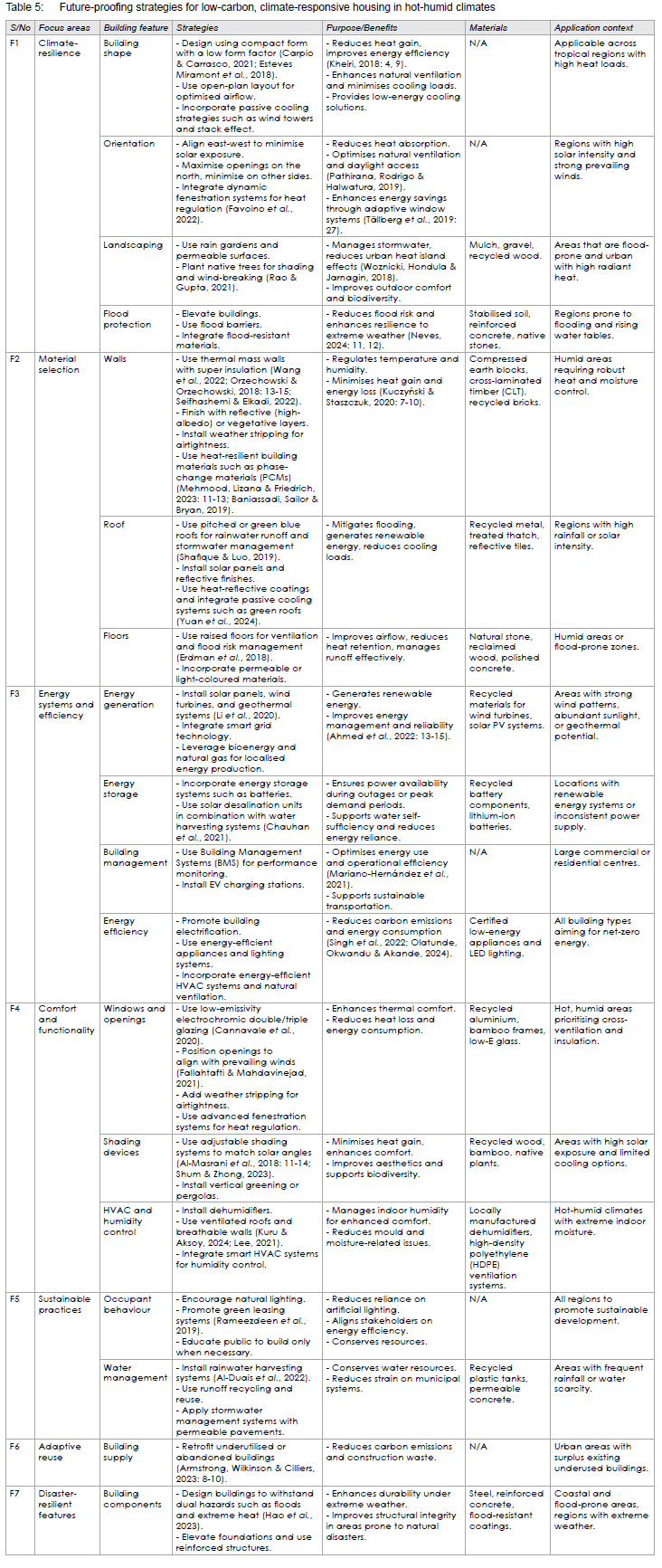
The transition to a low-carbon resilient future in Nigeria's building industry requires a multifaceted approach. Building on the findings of the mixed-methods study approach and data analysis, Table 5 summarises key design approaches and strategies for resilient buildings within the Nigerian context. These strategies are broadly classified into seven different focus areas, namely (F1) climate resilience; (F2) material selection; (F3) energy systems and efficiency; (F4) comfort and functionality; (F5) sustainable practices; (F6) adaptive reuse, and (F7) disaster-resilient features. Based on Nigeria's unique challenges and opportunities, the research suggests and outlines four pathways to achieving climate-responsive and resilient future buildings, aligning them with the identified focus areas.
These approaches are derived from a combination of literature findings and temperature anomaly analysis that predicts extreme regional warming of up to 5.2°C by 2100. This alarming trend requires tailored building strategies across the climatic zones in Nigeria. For instance, states in Cluster 2 face the greatest overheating risks and must urgently adopt energy-efficient cooling systems, reflective cooling systems, reflective materials, and advanced insulation technologies. In contrast, Cluster 0, which includes most of the southern capitals, will experience moderate temperature increases but still require cooling, ventilation, and landscaping strategies, in order to mitigate the heat effect. These differentiated needs expose the implementation gap identified in the thematic analysis. Although adaptive building strategies are crucial, they remain the least discussed and practised. Thus, the recommendations in Table 5 integrate both climate insights and practice-based thematic findings to propose responsive, region-specific solutions.
6.1 Optimising building design and retrofits for climate resilience
The growing demand for renovations in cities presents a viable opportunity to modernise the existing housing supply for enhanced energy performance. Retrofitting buildings is a significant step towards achieving carbon emissions goals (Table 5 - F1-F7), given the enormous number of energy-intensive buildings in Nigeria. Retrofitting measures enhance building energy performance and thermal comfort, while aligning with global sustainability objectives (Idowu et al., 2024: 2; Alegbe & Mtaver, 2023: 12; Lekan et al., 2024: 10-12). As highlighted by Ogunjuyigbe, Ayodele and Ogunmuyiwa (2020: 19), building retrofitting can vary in scale, from energy-efficient lighting fixture installation to whole building appliances replacement. Besides, insulating buildings and optimising building parameters such as walls, windows, and roofs enhances natural ventilation, indoor comfort, and energy efficiency (Ali-Tagba, Baneto & Lucache, 2024: 8; Kabanshi et al., 2023; Marincu, Dan & Moga, 2024; Okonta, 2023: 12). Measures such as replacing energy-intensive appliances with high-efficiency alternatives (Table 5 - F3) can reduce the building's energy use intensity by as much as 46.3% (Onyenokporo & Ochedi, 2019: 20). Moreover, adaptive design strategies that incorporate low embodied energy materials are essential for emission reduction and buildings' thermal comfort enhancement (Okonta, 2023: 3-5), and should be a major focus in low-income housing, where poor insulation and construction techniques remain prevalent. According to Sholanke et al. (2022: 15), early-stage design that prioritises the lifecycle of buildings can help identify building aspects that require optimisation, contributing to their long-term resilience.
6.2 Innovative technology and construction practices for a low-carbon future
The use of innovative technologies plays a pivotal role in positioning Nigeria's built environment industry towards sustainability. Some widely used technologies include photovoltaic panels, cool roofs, integrated EV charging spots, and energy-efficient windows, lighting, and HVAC systems (Table 5 - F2). These technologies demonstrate significant potential for reducing the environmental impact of buildings. Despite their long-term benefits of reduced operational costs, their adoption faces regulatory and financial hurdles (Unegbu et al., 2024c: 9-11). Similarly, smart technologies can enhance building energy efficiency, but concerns such as cybersecurity risks must be sufficiently addressed (Umana et al., 2024: 9). However, Oke et al. (2024: 10) noted that integrating energy economics into sustainable construction offers a pragmatic approach towards building resilience. In addition, leveraging bioenergy and natural gas provides a transitional pathway for Nigeria to embrace a low-carbon economy (Okoh & Okpanachi, 2023: 6, 8). These advancements, however, must be supported by capacity-building initiatives to address knowledge gaps among stakeholders and industry professionals. Doing so, the technologies integration is guaranteed to align with both local contexts and global sustainability.
6.3 Green building assessment, rating and policy interventions
Policy intervention and assessment frameworks are vital for steering sustainable construction practices in Nigeria. To meet its 20% carbon emissions reduction target by 2030, GB policies in Nigeria must prioritise energy efficiency and renewable energy integration in building projects (Nwagwu, Akin & Hertwich, 2024: 15), but the absence of a comprehensive GB assessment tool creates a significant gap (Atanda & Olukoya, 2019). Prioritising energy efficiency in buildings using building energy management systems can help increase operational efficiency (Table 5 -F3). Without sustainable architectural practices, supported by actionable assessment system, achieving GB development will remain unrealistic (Emmanuel, Chukwuemeka & Kalu, 2020: 2, 9). While policies such as the Nigerian Building Code and the Nigerian Building Energy Efficiency Code exist, enforcement to achieve their intended sustainability impact is weak (Isang, 2023: 9; Abisuga & Okuntade, 2020). These policies often fail to incorporate climate-responsive measures tailored to addressing Nigeria's unique environmental challenges (Geissler, Österreicher & Macharm, 2018: 17). Institutional limitations further exacerbate these challenges, as they can be more detrimental, compared to other factors influencing GB adoption. The lack of dedicated bodies to formulate and control the use of GB technologies continues to impede their espousal (Ganiyu et al., 2020: 6). Consequently, strengthening institutional capacity and implementing clear policy guidelines are imperative. Certification for GBs in Nigeria also remains low, owing to the lack of structured frameworks and institutional support (Ebekozien et al., 2022). In addition, environment-oriented research must shift its focus towards understanding the social and economic factors influencing the adoption of GB practices in the country (Mushi, Nguluma & Kihila, 2022: 7-9). By addressing these deficiencies and aligning efforts with global best practices, Nigeria can encourage greater uptake of GB and construction.
6.4 Stakeholder and public inclusion
Several studies on the assessment of green buildings (GBs) in Nigeria conclude that stakeholder and public inclusion, particularly building users, is a critical pathway for fostering the adoption of low-carbon, climate-resilient building practices. Lack of awareness about the benefits of sustainable practices and climate-responsive buildings is cited as a significant barrier to GB adoption in Nigeria (Unegbu et al., 2024a: 13; Omopariola et al., 2024; Alhassan et al., 2022: 6). It is, therefore, essential to enlighten the public and engage industry stakeholders in the decision-making processes to address resistance to change and improve acceptance of GB technologies and construction methods. Public sensitisation campaigns and participatory approaches involving industry professionals, government bodies, and the end-users can help increase responsiveness (Table 5 - F5).
Oluwunmi et al. (2019: 10) also observed that ignorance of the economic and environmental benefits of climate-responsive buildings impedes the attainment of climate goals. Consequently, strengthening communication between policymakers and industry stakeholders can help align their distinct priorities to build a shared commitment towards achieving low emission targets. Proactive efforts should, therefore, focus on empowering local communities through education and advocacy to drive awareness of the environmental benefits of sustainable building practices. By involving diverse stakeholders, it is possible to co-create solutions tailored to specific socio-economic and cultural contexts, fostering greater buy-in and ensuring that low-carbon, climate-sensitive strategies are not only accepted, but also widely implemented.
7. CONCLUSIONS AND RECOMMENDATIONS
7.1 Conclusions
Globally, various attempts are made to future-proof buildings against the impact of climate change. The built-environment industry offers significant opportunities for carbon emissions reduction and climate change mitigation. However, developing regions are struggling to align with global sustainability objectives. This study examines Nigeria's readiness to transition to a low-carbon and sustainable built environment, by analysing carbon emissions pathways, green building practices, and climate resilience strategies. Using quantitative weather data (2020 and 2100, RCP 8.5) for 37 geographical locations and a thematic review of 68 scholarly articles, the findings are:
A.
Temperature anomalies• By 2100, the mean maximum and minimum temperature anomalies are projected to increase by 5.2°C and 4.4°C, respectively, highlighting future heat stress and the need for passive cooling techniques in buildings.
• Despite stable seasonal patterns amidst rising temperatures, the most significant temperature fluctuations occurred in May, while August is the lowest.
• The K-Means clustering algorithms clustered the locations into three distinct groups based on the average temperatures and variations. Twenty-five locations were grouped into the first cluster (Cluster 0), two regions were grouped into the second cluster (Cluster 1), and ten regions were grouped into the third cluster (Cluster 2). Cluster 2 represents locations needing urgent strategies for heat stress while Cluster 0, though with more temperature anomalies than Cluster 1, represents the coldest regions in the country.
B.
Thematic review• Six key themes from the thematic review were identified: Policy and regulatory barriers, economic and financial challenges, technological and knowledge gaps, cultural and social perceptions, global vs local perspectives, and adaptive building strategies.
• Financial constraints and lack of awareness are the most recurring labels across the literature, while policy and regulatory barriers is the most discussed theme, emphasising the roles they play in promoting green building practices. Conversely, despite their significance in the transition to a low-carbon future, adaptive building strategies are the least emphasised.
C.
Future-proofing strategies for buildings in Nigeria• A multifaceted approach is needed to future-proof buildings, focusing on climate resilience, material selection, energy systems and efficiency, comfort and functionality, sustainable practices, adaptive reuse, and disaster resilience.
• Key strategies include building form and envelope parameters optimisation, proper orientation, blue-green landscape integration, low-carbon materials selection, super insulating the building envelope, deploying building management and energy-efficient systems, and incorporating green leasing techniques.
• Retrofitting existing buildings and emphasising occupant awareness are critical for improving sustainability.
The findings highlight a critical discrepancy between projected climate realities and current building practices. While the projected temperature analysis signals widespread warming, the thematic review reveals that key barriers such as financial constraints, lack of awareness, and policy inertia persist. This dual lens reinforces the urgency for transitioning to low-carbon, climate-resilience housing, using an integrated approach.
7.2 Recommendations
By synthesising temperature projection data with thematic insights from related literature, this study offers an integrated, region-specific set of recommendations that align future climate stress with on-ground barriers, thus fulfilling the core objective of the study approach. The following recommendations suggest key areas that offer actionable strategies to advance Nigeria's transition to a low-carbon and climate-resilient built environment.
Regionally targeted building codes and policy enforcement. Temperature projections show that states in Cluster 2 are most vulnerable to heat stress, yet they often coincide with areas where regulatory enforcement is weakest. To address this, sub-national building codes should include mandatory design standards with clear accountability mechanisms. Enforcing existing GB codes and establishing dedicated regulatory bodies are essential steps to promote compliance.
Integrated financial incentives based on climate risk. Findings from literature reveal that affordability remains a major concern. By linking retrofit grants and energy-efficient appliance subsidies to the severity of projected warming (e.g., prioritising Cluster 2), policies can ensure both climate justice and measurable mitigation outcomes. In addition, providing low-interest loans and fostering public-private partnerships to fund sustainable building projects through financing models such as the green bonds and collaborations with international bodies such as the UNDP and World Bank can alleviate financial barriers.
Public awareness and behavioural alignment with climate trends. Cultural resistance remains a recuring theme across the reviewed literature. For clusters with low thermal stress, the urgency may seem distant, but the risks are real. Therefore, public campaigns should localise temperature anomalies to reframe climate resilience as a community need, addressing the "cultural and social perceptions" barrier. Support partnerships among government agencies, private developers, and communities are essential to co-create climate-responsive solutions, while community-driven initiatives such as urban greening projects and cooperative energy systems should be prioritised to ensure inclusivity and equitable access to sustainable housing.
Mainstreaming climate data in built environment education. One of the major barriers to adaptive practice in the country is the knowledge and technology gaps. Embedding climate modelling, building simulation, and regional vulnerability mapping into built environment curricula would produce professionals capable of designing for projected realities.
Translating global best practice into local action. Findings under the "global vs local practices" theme (Section 5.1) show Nigeria's adaptation strategies lag behind. However, with clear temperature-based vulnerability data, tested global solutions such as net-zero retrofits, and modular shading systems can be tailored to suit existing buildings and economic realities.
Expanding future research. Future studies should broaden their scope to include underrepresented regions and address diverse environmental contexts. Research focused on state-specific challenges will inform regionally tailored policies and practices, ensuring an equitable and effective transition to a sustainable built environment.
This study is limited by the geographical concentration of the literature on sustainable and GB practices in Nigeria. Most of the studies focused on states in the southern part of the country and the Federal Capital Territory, with fewer studies from the northern region. This narrow scope may affect the generalisability and comprehensiveness of the findings from the thematic analysis as follows.
Regional variability in low-carbon transition. Nigeria's diverse climate and socio-economic landscape entail that the feasibility and impact of GB practices may vary across regions, possibly underrepresenting the distinctive challenges and prospects for implementing low-carbon construction systems in underrepresented states.
Bias in policy and technological insights. The regions represented in the literature may benefit from government support, technological access or public awareness, skewing findings towards an overly optimistic view of the country's readiness for a resilient and sustainable future.
Limited representation of local perspectives. The limited studies from other states may overlook region-specific barriers, opportunities and local contexts, especially in rural or underrepresented areas, restraining actionable insights for stakeholders in those regions.
FUNDINGThis research did not receive any grant from funding organisations in the public, for-profit or not-for-profit sectors.
REFERENCES
ACKNOWLEDGMENTS
The authors wish to express their gratitude to the GreenTech Research Lab for providing access to essential equipment and facilities that significantly contributed to the successful completion of this study. The support and resources made available were instrumental in achieving the research objectives.
2. LITERATURE REVIEW
-
Abam, F.I., Nwachukwu, C.O., Emodi, N.V., Okereke, C. & Diemuodeke, O.E. et al. 2023. A systematic literature review on the decarbonisation of the building sector -A case for Nigeria. Frontiers in Energy Research, 11, article 1253825. https://doi.org/10.3389/fenrg.2023.1253825
» https://doi.org/10.3389/fenrg.2023.1253825 -
Abdulsalam, R.S., Chan, M., Masrom, M.A.N. & Nawawi, A.H. 2024. Benefits and challenges of implementing green building development in Nigeria. Built Environment Project and Asset Management, 14(3), pp. 399-413. https://doi.org/10.1108/BEPAM-09-2022-0143
» https://doi.org/10.1108/BEPAM-09-2022-0143 -
Abisuga, A.O. & Okuntade, T.F. 2020. The current state of green building development in Nigerian construction industry: Policy and implications. In: Gou, Z. (Ed.), Green building in developing countries: Policy, strategy and technology. Springer International Publishing, pp. 129-146. https://doi.org/10.1007/978-3-030-24650-1_7
» https://doi.org/10.1007/978-3-030-24650-1_7 -
Abubakar, I.R. & Aina, Y.A. 2019. The prospects and challenges of developing more inclusive, safe, resilient and sustainable cities in Nigeria. Land Use Policy, 87, article 104105. https://doi.org/10.1016/j.landusepol.2019.104105
» https://doi.org/10.1016/j.landusepol.2019.104105 -
Addy, M., Adinyira, E., Danku, J.C. & Dadzoe, F. 2021. Impediments to the development of the green building market in sub-Saharan Africa: The case of Ghana. Smart and Sustainable Built Environment, 10(2), pp. 193-207. https://doi.org/10.1108/SASBE-12-2019-0170
» https://doi.org/10.1108/SASBE-12-2019-0170 -
Adegoke, A., Gbadegesin, J., Ayodele, T. & Agbato, S. 2023. Resilience of buildings at the operational stage: Understanding property managers' perceptions of barriers to the installation of vertical greenery systems. African Journal of Housing and Sustainable Development, 4(1), pp. 29-41. https://doi.org/10.52968/28464090
» https://doi.org/10.52968/28464090 -
Adeniran, A., Netswera, F. & Marcus, A. 2024. Green transition and carbon footprint reduction in the hospitality industry in Nigeria: A systematic review. International Conference on Science, Engineering and Business for Driving Sustainable Development Goals, SEB4SDG 2024, Omu-Aran, Nigeria, pp. 1-5, paper 10630220. https://doi.org/10.1109/SEB4SDG60871.2024.10630220
» https://doi.org/10.1109/SEB4SDG60871.2024.10630220 -
Adewale, B.A. & Ene, V.O. 2024. An assessment of the implementation of green design strategies in selected museums in Abuja, Nigeria. Civil Engineering and Architecture, 12(3), pp. 2461-2481. https://doi.org/10.13189/cea.2024.121337
» https://doi.org/10.13189/cea.2024.121337 -
Aghimien, D.O., Adegbembo, T.F., Aghimien, E.I. & Awodele, O.A. 2018. Challenges of sustainable construction: A study of educational buildings in Nigeria. International Journal of Built Environment and Sustainability, 5(1), pp. 33-46. https://doi.org/10.11113/ijbes.v5.n1.244
» https://doi.org/10.11113/ijbes.v5.n1.244 -
Ahmad, T., Aibinu, A., Stephan, A. & Chan, A. 2019. Investigating associations among performance criteria in green building projects. Journal of Cleaner Production, 232, pp. 1348-1370. https://doi.org/10.1016/JJCLEPRO.2019.06.013
» https://doi.org/10.1016/JJCLEPRO.2019.06.013 -
Ahmed, A., Ge, T., Peng, J., Yan, W.-C., Tee, B.T. & You, S. 2022. Assessment of the renewable energy generation towards net-zero energy buildings: A review. Energy and Buildings, 256, article 111755. https://doi.org/10.1016/j.enbuild.2021.111755
» https://doi.org/10.1016/j.enbuild.2021.111755 -
Akindele, O.E., Ajayi, S., Toriola-Coker, L., Oyegoke, A.S., Alaka, H. & Zulu, S.L. 2023. Sustainable construction practice in Nigeria: Barriers and strategies for improvement. Built Environment Project and Asset Management, 13(4), pp. 590-609. https://doi.org/10.1108/BEPAM-06-2022-0085
» https://doi.org/10.1108/BEPAM-06-2022-0085 -
Akinola, A.O., Opoko, A.P., Ibem, E.O., Okagbue, H.I. & Afolabi, A.O. 2020. Climate change adaptation and mitigation strategies in Lagos, Nigeria: Built environment professionals' perspective. International Journal of Engineering and Advanced Technology (IJEAT), 9(3), pp. 1273-1282. https://doi.org/10.35940/ijeat.B2630.029320
» https://doi.org/10.35940/ijeat.B2630.029320 -
Akinshipe, O., Oluleye, I.B. & Aigbavboa, C. 2019. Capacity of professionals in delivering sustainable construction in Nigeria. IOP Conference Series: Materials Science and Engineering, 640, paper 012006. https://doi.org/10.1088/1757-899X/640/1/012006
» https://doi.org/10.1088/1757-899X/640/1/012006 -
Al-Duais, H.S., Ismail, M.A., Awad, Z.A.M. & Al-Obaidi, K. 2022. Methods of harvesting water from air for sustainable buildings in hot and tropical climates. Malaysian Construction Research Journal, 12(1), pp. 150-168. https://shura.shu.ac.uk/id/eprint/29737
» https://shura.shu.ac.uk/id/eprint/29737 -
Al-Masrani, S.M., Al-Obaidi, K.M., Zalin, N.A. & Aida Isma, M.I. 2018. Design optimisation of solar shading systems for tropical office buildings: Challenges and future trends. Solar Energy, 170, pp. 849-872. https://doi.org/10.1016/j.solener.2018.04.047
» https://doi.org/10.1016/j.solener.2018.04.047 -
Alegbe, M., Chukwuemeka, L., Lekwauwa Kalu, J. & Eke-Nwachukwu, A. 2023. Building optimisation vis-à-vis solar shading for improved comfort and energy efficiency in classrooms. DIMENSI (Journal of Architecture and Built Environment), 50(2), pp. 53-68. https://doi.org/10.9744/dimensi.50.2.53-68
» https://doi.org/10.9744/dimensi.50.2.53-68 -
Alegbe, M. & Hammed, N. 2024. Sustainability beyond the surface: Evaluating the long-term environmental and energy performance of selected cladding materials for housing retrofits. Journal of Sustainable Construction Materials and Technologies, 9(3), pp. 221-238. https://doi.org/10.47481/jscmt.1536060
» https://doi.org/10.47481/jscmt.1536060 -
Alegbe, M. & Mtaver, G. 2023. Climate resilience and energy performance of future buildings in Nigeria based on RCP 4.5 and 8.5 scenarios. Journal of Design for Resilience in Architecture and Planning, 4(3), pp. 354-371. https://doi.org/10.47818/DRArch.2023.v4i3102
» https://doi.org/10.47818/DRArch.2023.v4i3102 -
Alhassan, A.A., Awoamim, Y.J., Yusuf, U.D. & Dogara, M.U. 2022. The challenges of sustainable buildings in Nigeria. International Journal of Sustainable Building Technology and Urban Development, 13(4), pp. 488-499. https://doi.org/10.22712/susb.20220035
» https://doi.org/10.22712/susb.20220035 -
Ali-Tagba, A.-R., Baneto, M. & Lucache, D.D. 2024. Factors influencing the energy consumption in a building: Comparative study between two different climates. Energies, 17(16), article 4041. https://doi.org/10.3390/en17164041
» https://doi.org/10.3390/en17164041 -
Alsehaimi, A., Waqar, A., Alrasheed, K.A., Bageis, A.S. & Almujibah, H. et al. 2024. Building a sustainable future: BIM's role in construction, logistics, and supply chain management. Ain Shams Engineering Journal, 15(12), article 103103. https://doi.org/10.1016/j.asej.2024.103103
» https://doi.org/10.1016/j.asej.2024.103103 -
Amasuomo, T. 2021. Barriers to the adoption of environmentally sustainable design methods in residential buildings. The architects' and building owners' perspectives in four Nigerian states. Unpublished PhD dissertation, Te Herenga Waka-Victoria University of Wellington. https://doi.org/10.26686/wgtn.14869932.v1
» https://doi.org/10.26686/wgtn.14869932.v1 -
Arman, H. 2019. Assessment of solar shading strategies in low-income tropical housing: The case of Uganda. Proceedings of the Institution of Civil Engineers - Engineering Sustainability, 172(6), pp. 293-301. https://doi.org/10.1680/jensu.17.00072
» https://doi.org/10.1680/jensu.17.00072 -
Armstrong, G., Wilkinson, S. & Cilliers, E.J. 2023. A framework for sustainable adaptive reuse: understanding vacancy and underuse in existing urban buildings. Frontiers in Sustainable Cities, 5, article 985656. https://doi.org/10.3389/frsc.2023.985656
» https://doi.org/10.3389/frsc.2023.985656 -
Atanda, J.O. & Olukoya, O.A.P. 2019. Green building standards: Opportunities for Nigeria. Journal of Cleaner Production, 227, pp. 366-377. https://doi.org/10.1016/j.jclepro.2019.04.189
» https://doi.org/10.1016/j.jclepro.2019.04.189 -
Azli, M., Abdullah, J., Abdullah, Y., Sahabuddin, M. & Taib, I. et al. 2024. A thematic review of neighbourhood built environment factors that affect the sense of community. Citi Science, 4(1), pp. 58-84. https://doi.org/10.60167/csj/v4i1.2024.06
» https://doi.org/10.60167/csj/v4i1.2024.06 -
Babalola, A. & Harinarain, N. 2024. Policy barriers to sustainable construction practice in the Nigerian construction industry: An exploratory factor analysis. Journal of Engineering, Design and Technology, 22(1), pp. 214-234. https://doi.org/10.1108/JEDT-07-2021-0375
» https://doi.org/10.1108/JEDT-07-2021-0375 -
Baniassadi, A., Sailor, D.J. & Bryan, H.J. 2019. Effectiveness of phase change materials for improving the resiliency of residential buildings to extreme thermal conditions. Solar Energy, 188, pp. 190-199. https://doi.org/10.1016/j.solener.2019.06.011
» https://doi.org/10.1016/j.solener.2019.06.011 -
Basil, A.M., Sam-Amobi, C., Ugwu, C.C. & Odoh, P.E. 2019. Combating global warming/climate change via reduction of CO2 emission of buildings. IOP Conference Series: Materials Science and Engineering, 640, paper 012016. https://doi.org/10.1088/1757-899X/640/1/012016
» https://doi.org/10.1088/1757-899X/640/1/012016 -
Bates, A., Nwadiaru, O.V., Goldstein, A., Cantor, J. & Cowan, M. et al. 2024. Whose low-carbon future? Community perceptions and expectations on the renewable energy transition in a post-industrial city. Energy Research and Social Science, 118, article 103781. https://doi.org/10.1016/j.erss.2024.103781
» https://doi.org/10.1016/j.erss.2024.103781 -
Bilardo, M., Ferrara, M. & Fabrizio, E. 2019. Resilient optimal design of multi-family buildings in future climate scenarios. E3S Web of Conferences, 111, paper 06006. https://doi.org/10.1051/e3sconf/201911106006
» https://doi.org/10.1051/e3sconf/201911106006 -
Cannavale, A., Ayr, U., Fiorito, F. & Martellotta, F. 2020. Smart electrochromic windows to enhance building energy efficiency and visual comfort. Energies, 13(6), article 1449. https://doi.org/10.3390/en13061449
» https://doi.org/10.3390/en13061449 -
Carpio, M. & Carrasco, D. 2021. Impact of shape factor on energy demand, CO2 emissions and energy cost of residential buildings in cold oceanic climates: Case study of South Chile. Sustainability, 13(17), pp. 9491. https://doi.org/10.3390/su13179491
» https://doi.org/10.3390/su13179491 -
Chauhan, V.K., Shukla, S.K., Tirkey, J.V. & Singh Rathore, P.K. 2021. A comprehensive review of direct solar desalination techniques and its advancements. Journal of Cleaner Production, 284, article 124719. https://doi.org/10.1016/j.jclepro.2020.124719
» https://doi.org/10.1016/j.jclepro.2020.124719 -
Chiradeja, P. & Ngaopitakkul, A. 2019. Energy and economic analysis of tropical building envelope material in compliance with Thailand's building energy code. Sustainability, 11(23), article 6872. https://10.3390/su11236872
» https://10.3390/su11236872 -
Chohan, A., Awad, J., Ismail, M. & Arar, M. 2024. Integrating technology and heritage design for climate resilient courtyard house in Arid Region. Civil Engineering Journal, 10(3), pp. 928-952. https://doi.org/10.28991/cej-2024-010-03-018
» https://doi.org/10.28991/cej-2024-010-03-018 -
Dioha, M.O. & Kumar, A. 2020. Exploring sustainable energy transitions in sub-Saharan Africa residential sector: The case of Nigeria. Renewable and Sustainable Energy Reviews, 117, article 109510. https://doi.org/10.1016/j.rser.2019.109510
» https://doi.org/10.1016/j.rser.2019.109510 -
Dodoo, A. 2020. Energy and indoor thermal comfort performance of a Swedish residential building under future climate change conditions. E3S Web of Conferences, 172, article 02001. https://doi.org/10.1051/e3sconf/202017202001
» https://doi.org/10.1051/e3sconf/202017202001 -
Ebekozien, A., Ikuabe, M., Awo-Osagie, A.I., Aigbavboa, C. & Ayo-Odifiri, S.O. 2022. Model for promoting green certification of buildings in developing nations: A case study of Nigeria. Property Management, 40(1), pp. 118-136. https://doi.org/10.1108/PM-05-2021-0033
» https://doi.org/10.1108/PM-05-2021-0033 -
Ekhaese, E.N., Adejuwon, G.A. & Evbuoma, I.K. 2021. Promoting green urbanism in Nigerian purlieus as therapy for psychological wellbeing/health. IOP Conference Series: Earth and Environmental Science, 665, paper 012015. https://doi.org/10.1088/1755-1315/665/1/012015
» https://doi.org/10.1088/1755-1315/665/1/012015 -
Ekugbe, G. 2024. Council calls for decarbonisation of Nigeria's building sector. Punch. [Online]. Available at: <https://punchng.com/council-calls-for-decarbonisation-of-nigerias-building-sector/> [Accessed: 11 January 2025].
» https://punchng.com/council-calls-for-decarbonisation-of-nigerias-building-sector/ -
Ekung, S., Ohama, V. & Tiokpat, M. 2020. Cost factors in zero-carbon technologies applied in buildings: Nigeria's perspective. Journal of Sustainable Construction Materials and Technologies, 5(2), pp. 484-493. https://doi.org/10.29187/jscmt.2020.52
» https://doi.org/10.29187/jscmt.2020.52 -
Emetere, M.E., Afolalu, S.A. & Peters, U.J. 2021. Evidence of climate change using seasonal temperatures over Agege-Lagos. Nigeria. E3S Web of Conferences, 259, paper 01005. https://doi.org/10.1051/e3sconf/202125901005
» https://doi.org/10.1051/e3sconf/202125901005 -
Emmanuel, U., Chukwuemeka, C.B. & Kalu, K.C. 2020. Life cycle energy assessment (Lcea) approach: A prospect for sustainable architecture in developing countries. Civil Engineering and Architecture, 8(5), pp. 777-791. https://doi.org/10.13189/cea.2020.080505
» https://doi.org/10.13189/cea.2020.080505 -
Erdman, J.A., Williams, E.A., James, C.W. & Coakley, G.P. 2018. Raising buildings: The resilience of elevated structures. In: Day, J. & Erdman, J. (Eds). Mississippi Delta restoration: Pathways to a sustainable future. Springer International Publishing, pp. 143-170. https://doi.org/10.1007/978-3-319-65663-2_10
» https://doi.org/10.1007/978-3-319-65663-2_10 -
Escandón, R., Calama-González, C., Alonso, A., Suárez, R. & León-Rodríguez, Á. 2023. How do different methods for generating future weather data affect building performance simulations? A comparative analysis of Southern Europe. Buildings, 13, article 2385. https://doi.org/10.3390/buildings13092385
» https://doi.org/10.3390/buildings13092385 -
Esteves Miramont, A., Esteves, M.J., Mercado, M.V., Barea Paci, G.J. & Gelardi, D. 2018. Building shape that promotes sustainable architecture. Evaluation of the indicative factors and its relation with the construction costs. Architecture Research 8(4), pp. 111-122. https://doi.org/10.5923/j.arch.20180804.01
» https://doi.org/10.5923/j.arch.20180804.01 -
Evelyn, A.-K. 2023. Global sustainable architectural trends: Top three trends in Nigeria and their implications. Journal of Engineering, Computational and Applied Sciences (JECAS), 1(1), pp. 25-34. https://doi.org/10.56892/jecas.v6i01.258
» https://doi.org/10.56892/jecas.v6i01.258 -
Fallahtafti, R. & Mahdavinejad, M. 2021. Window geometry impact on a room's wind comfort. Engineering, Construction and Architectural Management, 28(9), pp. 2381-2410. https://doi.org/10.1108/ECAM-01-2020-0075
» https://doi.org/10.1108/ECAM-01-2020-0075 -
Fang, D., Brown, N., De Wolf, C. & Mueller, C. 2023. Reducing embodied carbon in structural systems: A review of early-stage design strategies. Journal of Building Engineering, 76, article 107054. https://doi.org/10.1016/j.jobe.2023.107054
» https://doi.org/10.1016/j.jobe.2023.107054 -
Favoino, F., Loonen, R.C.G.M., Michael, M., De Michele, G. & Avesani, S. 2022. 5 - Advanced fenestration - Technologies, performance and building integration. In: Gasparri, E. (Ed.). Rethinking building skins. Woodhead Publishing, pp. 117-154. https://doi.org/10.1016/B978-0-12-822477-9.00038-3
» https://doi.org/10.1016/B978-0-12-822477-9.00038-3 -
Fu, Z. & Liu, C. 2023. Investigation into the use of statistically and dynamically downscaled future climate datasets in assessing building performance. Proceedings of the 18th IBPSA Conference, Shanghai, China. International Building Performance Simulation Association, pp. 2153-2160. https://doi.org/10.26868/25222708.2023.1596
» https://doi.org/10.26868/25222708.2023.1596 -
Gamero-Salinas, J., Monge-Barrio, A., Kishnani, N., López-Fidalgo, J. & Sánchez-Ostiz, A. 2021. Passive cooling design strategies as adaptation measures for lowering the indoor overheating risk in tropical climates. Energy and Buildings, 252, article 111417. https://10.1016/j.enbuild.2021.111417
» https://10.1016/j.enbuild.2021.111417 -
Ganiyu, A.-Y., Adebiyi, R.W.M., Abdulraheem, R.T., Orire, M., Eluwa, I.S. & Stephen, E. 2020. Barrier factors affecting adoption of green building technologies in Nigeria. Built Environment Journal, 17(2), pp. 37-48. https://ir.uitm.edu.my/id/eprint/41972/1/41972.pdf. https://doi.org/10.24191/bej.v17i2.8860
» https://ir.uitm.edu.my/id/eprint/41972/1/41972.pdf. https://doi.org/10.24191/bej.v17i2.8860 -
Geissler, S., Österreicher, D. & Macharm, E. 2018. Transition towards energy efficiency: Developing the Nigerian building energy efficiency code. Sustainability, 10(8), article 2620. https://doi.org/10.3390/su10082620
» https://doi.org/10.3390/su10082620 -
Ghalandar, T. & Lindkvist, C. 2023. Digital transitions for future building scenarios. IOP Conference Series: Earth and Environmental Science, 1176, paper 012007. https://doi.org/10.1088/1755-1315/1176/1/012007
» https://doi.org/10.1088/1755-1315/1176/1/012007 -
Grotov, K., Titov, S., Sotnikov, V., Golubev, Y. & Bryksin, T. 2022. A large-scale comparison of Python code in Jupyter Notebooks and scripts. IEEE/ACM 19th International Conference on Mining Software Repositories (MSR), 23-24 May, Pittsburgh Pennsylvania, pp. 353-364. https://doi.org/10.1145/3524842.3528447
» https://doi.org/10.1145/3524842.3528447 -
Hamza, S., Jamal, A., Kamin, Y.B., Al-Rahmi, W.M. & Kosnin, A. et al. 2019. Assimilating green skills in building construction programme: Crucial to realizing environmental sustainability. IEEE Access, 7, pp. 125214-125224, article 8790707. https://doi.org/10.1109/ACCESS.2019.2933658
» https://doi.org/10.1109/ACCESS.2019.2933658 -
Hao, H., Bi, K., Chen, W., Pham, T.M. & Li, J. 2023. Towards next generation design of sustainable, durable, multi-hazard resistant, resilient, and smart civil engineering structures. Engineering Structures, 277, article 115477. https://doi.org/10.1016/j.engstruct.2022.115477
» https://doi.org/10.1016/j.engstruct.2022.115477 -
Hu, M. 2023. Strategies and techniques of life cycle - Embodied carbon reduction from the building and construction sector: A review. Journal of Architectural Engineering, 29(3), article 04023017. https://doi.org/10.1061/JAEIED.AEENG-1591
» https://doi.org/10.1061/JAEIED.AEENG-1591 -
Idowu, A.O., Aigbavboa, C., Oke, A.E. & Aghimien, D. 2024. Barriers to low carbon retrofitting of higher educational building projects. International Conference on Science, Engineering and Business for Driving Sustainable Development Goals, 2-4 April, Omu-Aran, Nigeria, paper 10630026. https://doi.org/10.1109/SEB4SDG60871.2024.10630026
» https://doi.org/10.1109/SEB4SDG60871.2024.10630026 -
Ikudayisi, A.E., Chan, A.P.C., Darko, A. & Adegun, O.B. 2022. Integrated design process of green building projects: A review towards assessment metrics and conceptual framework. Journal of Building Engineering, 50, article 104180. https://doi.org/10.1016/j.jobe.2022.104180
» https://doi.org/10.1016/j.jobe.2022.104180 -
Ilori, O. & Ajayi, V. 2020. Change detection and trend analysis of future temperature and rainfall over West Africa. Earth Systems and Environment, 4, pp. 493-512. https://doi.org/10.1007/s41748-020-00174-6
» https://doi.org/10.1007/s41748-020-00174-6 -
Imafidon, H., Enwerem, M. & Boye, A. 2024. Adapting green building practices and smart technology in developing countries: A review. African Journal of Environmental Sciences and Renewable Energy, 16(1), pp. 183-202. https://doi.org/10.62154/ajesre.2024.016.010407
» https://doi.org/10.62154/ajesre.2024.016.010407 -
Isang, I.W. 2023. A historical review of sustainable construction in Nigeria: A decade of development and progression. Frontiers in Engineering and Built Environment, 3(3), pp. 206-218. https://doi.org/10.1108/FEBE-02-2023-0010
» https://doi.org/10.1108/FEBE-02-2023-0010 -
Iwuagwu, B.U. & Onyegiri, I. 2019. Analysing the challenges of designing nearly zero energy buildings and retrofitting of the existing housing stuck in Nigeria: A study of South-Eastern Nigeria. IOP Conference Series: Materials Science and Engineering, 609, paper 072072. https://doi.org/10.1088/1757-899X/609/7/072072
» https://doi.org/10.1088/1757-899X/609/7/072072 -
Iwuanyanwu, O., Gil-Ozoudeh, I., Okwandu, A.C. & Ike, C.S. 2024. Retrofitting existing buildings for sustainability: Challenges and innovations. Engineering Science & Technology Journal, 5(8), pp. 2616-2631. https://doi.org/10.51594/estj.v5i8.1515
» https://doi.org/10.51594/estj.v5i8.1515 -
Izobo-Martins, O.O., Oyelami, B.J., Agboola, O.O. & Ejale, E.A. 2022. Investigation of passive cooling strategies in selected shopping malls, south-western Nigeria. IOP Conference Series: Earth and Environmental Science, 1054, paper 012024. https://doi.org/10.1088/1755-1315/1054/1/012024
» https://doi.org/10.1088/1755-1315/1054/1/012024 -
James, M.E., Fulani, O.A. & Azoji, C.F. 2022. Application of passive cooling principles in selected hotel buildings in south-west Nigeria. IOP Conference Series: Earth and Environmental Science, 1054, paper 012032. https://doi.org/10.1088/1755-1315/1054/1/012032
» https://doi.org/10.1088/1755-1315/1054/1/012032 -
Job, J.S. & Khanna, S. 2024. Building a resilient future: Collaborative sustainability regulation. Clean Energy, 8(3), pp. 223-237. https://doi.org/10.1093/ce/zkae026
» https://doi.org/10.1093/ce/zkae026 -
Kabanshi, A., Choonya, G., Ameen, A., Liu, W. & Mulenga, E. 2023. Windows of opportunities: Orientation, sizing and PV-shading of the glazed area to reduce cooling energy demand in sub-Sahara Africa. Energies, 16(9), article 3834. https://doi.org/10.3390/en16093834
» https://doi.org/10.3390/en16093834 -
Khan, S.A., Alam, T., Khan, M.S., Blecich, P. & Kamal, M.A. et al. 2022. Life cycle assessment of embodied carbon in buildings: Background, approaches and advancements. Buildings, 12(11), article 1944. https://doi.org/10.3390/buildings12111944
» https://doi.org/10.3390/buildings12111944 -
Kheiri, F. 2018. A review on optimization methods applied in energy-efficient building geometry and envelope design. Renewable and Sustainable Energy Reviews, 92, pp. 897-920. https://10.1016/j.rser.2018.04.080
» https://10.1016/j.rser.2018.04.080 -
King, L., Udo, S.O., Ewona, I., Amadi, S., Ebong, E.B. & Umoh, M.D. 2024. Assessment of temporal trend in surface air temperatures across some selected eco-climatic zones in Nigeria. Trends in Renewable Energy, 10(1), pp. 132-158. https://doi.org/10.17737/tre.2024.10.1.00169
» https://doi.org/10.17737/tre.2024.10.1.00169 -
Kinnebrew, E., Shoffner, E., Farah-Pérez, A., Mills-Novoa, M. & Siegel, K. 2020. Approaches to interdisciplinary mixed methods research in land-change science and environmental management. Conservation Biology, 35(1), pp. 130-141. https://doi.org/10.1111/cobi.13642
» https://doi.org/10.1111/cobi.13642 -
Kuczynski, T. & Staszczuk, A. 2020. Experimental study of the influence of thermal mass on thermal comfort and cooling energy demand in residential buildings. Energy, 195, article 116984. https://doi.org/10.1016/j.energy.2020.116984
» https://doi.org/10.1016/j.energy.2020.116984 -
Kuru, Z. & Aksoy, K. 2024. A review of breathable walls and breathable paints: Innovations and sustainability in building materials. The European Journal of Research and Development, 4(4), pp. 58-100. https://doi.org/10.56038/ejrnd.v4i4.515
» https://doi.org/10.56038/ejrnd.v4i4.515 -
Lawal, O.A., Jimoh, A.A., Abdullah, K.A., Bello, B.A. & Awoyemi, E.D. 2024. Economic and environmental impact of energy audit and efficiency: A report from a Nigeria household. Energy for Sustainable Development, 79, article 101387. https://doi.org/10.1016/j.esd.2024.101387
» https://doi.org/10.1016/j.esd.2024.101387 -
Lee, Y. 2021. A breathing wall study for homeostatic buildings implementing natural ventilation effective design. Unpublished MSc thesis, The University of Texas, USA. https://doi.org/10.26153/tsw/42171
» https://doi.org/10.26153/tsw/42171 -
Lekan, A., Aigbavboa, C., Chalya, D. & Fortune, A. 2024. A framework for industry 4.0 related green concept integration of services component in commercial buildings. Sustainability, 16(21), article 9141. https://doi.org/10.3390/su16219141
» https://doi.org/10.3390/su16219141 -
Li, K., Liu, C., Jiang, S. & Chen, Y. 2020. Review on hybrid geothermal and solar power systems. Journal of Cleaner Production, 250, article 119481. https://doi.org/10.1016/j.jclepro.2019.119481
» https://doi.org/10.1016/j.jclepro.2019.119481 -
Liu, M., Hongli, Zhang, Y. & Yue, F. 2024. Multi-source data preprocessing method research based on Python. 5th International Conference on Geology, Mapping and Remote Sensing, 12-14 April, Wuhan, Hubei, pp. 221-224. https://doi.org/10.1109/ICGMRS62107.2024.10581052
» https://doi.org/10.1109/ICGMRS62107.2024.10581052 -
Lops, C., Serpilli, F., D'Alessandro, V. & Montelpare, S. 2024. Climate change and building renovation: The impact of historical, current, and future climatic files on a school in Central Italy. Applied Sciences, 14, article 9067. https://doi.org/10.3390/app14199067
» https://doi.org/10.3390/app14199067 -
Makhloufi, A.W. & Louafi, S. 2024. Optimising building performance for a resilient future: A multi-objective approach to net zero energy strategies. Energy and Buildings, 324, article 114869. https://doi.org/10.1016/j.enbuild.2024.114869
» https://doi.org/10.1016/j.enbuild.2024.114869 -
Mariano-Hernández, D., Hernández-Callejo, L., Zorita-Lamadrid, A., Duque-Pérez, O. & Santos García, F. 2021. A review of strategies for building energy management system: Model predictive control, demand side management, optimization, and fault detect & diagnosis. Journal of Building Engineering, 33, article 101692. https://doi.org/10.1016/j.jobe.2020.101692
» https://doi.org/10.1016/j.jobe.2020.101692 -
Marincu, C., Dan, D. & Moga, L. 2024. Investigating the influence of building shape and insulation thickness on energy efficiency of buildings. Energy for Sustainable Development, 79, pp. 101384. https://10.1016/j.esd.2024.101384
» https://10.1016/j.esd.2024.101384 -
Mato, H., Labaran, Y.H., Mukherjee, D., Saini, G. & Farouq, M.M. 2023. Achieving sustainability in Nigerian households: Investigating factors impacting energy efficiency practices. Journal of Sustainable Construction Materials and Technologies, 8(3), pp. 180-191. https://doi.org/10.47481/JSCMT.1261384
» https://doi.org/10.47481/JSCMT.1261384 -
Mehmood, S., Lizana, J. & Friedrich, D. 2023. Low-energy resilient cooling through geothermal heat dissipation and latent heat storage. Journal of Energy Storage, 72, article 108377. https://doi.org/10.1016/j.est.2023.108377
» https://doi.org/10.1016/j.est.2023.108377 -
Moroni, S., Alberti, V., Antoniucci, V. & Bisello, A. 2019. Energy communities in the transition to a low-carbon future: A taxonomical approach and some policy dilemmas. Journal of Environmental Management, 236, pp. 45-53. https://doi.org/10.1016/j.jenvman.2019.01.095
» https://doi.org/10.1016/j.jenvman.2019.01.095 -
Muhammad, A.Y., Ibrahim, S.K. & Dalibi, S.G. 2020. Barriers and drivers facing architects in adopting energy efficiency and the use of zero-carbon technologies in Nigerian built environment. IOP Conference Series: Earth and Environmental Science, 588(2), paper 022046. https://doi.org/10.1088/1755-1315/588/2/022046
» https://doi.org/10.1088/1755-1315/588/2/022046 -
Mushi, F.V., Nguluma, H. & Kihila, J. 2022. A critical review of African green building research. Building Research & Information, 50(6), pp. 610-627. https://doi.org/10.1080/09613218.2021.2015276
» https://doi.org/10.1080/09613218.2021.2015276 -
Negrini, L., Shabadi, G. & Urban, C. 2023. Static analysis of data transformations in Jupyter Notebooks. Proceedings of the 12th ACM SIGPLAN International Workshop on the State Of the Art in Program Analysis, 17 June, Orlando, Florida, USA, pp. 8-13. https://doi.org/10.1145/3589250.3596145
» https://doi.org/10.1145/3589250.3596145 -
Neves, J. 2024. Urban planning for flood resilience under technical and financial constraints: The role of planners and competence development in building a flood-resilient city in Matola, Mozambique. City and Environment Interactions, 22, article 100147. https://doi.org/10.1016/j.cacint.2024.100147
» https://doi.org/10.1016/j.cacint.2024.100147 -
Nwagwu, C.C., Akin, S. & Hertwich, E.G. 2024. Modelling Nigerian residential dwellings: Bottom-up approach and scenario analysis. Buildings and Cities, 5(1), pp. 521-539. https://doi.org/10.5334/bc.452
» https://doi.org/10.5334/bc.452 -
Nwalusi, D.M., Obi, N.I., Chendo, I.G. & Okeke, F.O. 2022. Climate responsive design strategies for contemporary low-rise residential buildings in tropical environment of Enugu, Nigeria. IOP Conference Series: Earth and Environmental Science, 1054(1), paper 012052. https://10.1088/1755-1315/1054/1/012052
» https://10.1088/1755-1315/1054/1/012052 -
Nwozor, A., Olanrewaju, J.S., Oshewolo, S., Iseolorunkanmi, J. & Fayomi, O. et al. 2021. Transition to green energy and sustainable development in Nigeria: A prospective and evaluative analysis. IOP Conference Series: Earth and Environmental Science, 665, paper 012029. https://doi.org/10.1088/1755-1315/665/1/012029
» https://doi.org/10.1088/1755-1315/665/1/012029 -
Ochedi, E.T. & Taki, A. 2022. A framework approach to the design of energy efficient residential buildings in Nigeria. Energy and Built Environment, 3(3), pp. 384-397. https://doi.org/10.1016/j.enbenv.2021.07.001
» https://doi.org/10.1016/j.enbenv.2021.07.001 -
Ogunba, O.A., Dabara, D.I. & Gbadegesin, J.T. 2023. Sustainable real estate management practice: Exploring the priority of operational stage for actualizing sustainable built environment goal in sub-Saharan Africa. International Journal of Construction Management, 23(10), pp. 1746-1755. https://doi.org/10.1080/15623599.2021.2006570
» https://doi.org/10.1080/15623599.2021.2006570 -
Ogunde, A.O., Amos, V., Tunji-Olayeni, P., Akinbile, B. & Ogunde, A. 2018. Evaluation of application of eco friendly systems in buildings in Nigeria. International Journal of Civil Engineering and Technology, 9(6), pp. 568-576. https://eprints.covenantuniversity.edu.ng/11100/
» https://eprints.covenantuniversity.edu.ng/11100/ -
Ogunjuyigbe, A.S., Ayodele, T.R. & Ogunmuyiwa, S.M. 2020. Retrofitting existing buildings to reduce electrical energy consumption and greenhouse gas emission in Nigerian food and beverage industries. Journal of Electrical Systems and Information Technology, 7(1), pp. 9. https://doi.org/10.1186/s43067-020-00018-3
» https://doi.org/10.1186/s43067-020-00018-3 -
Ojelabi, R.A., Mohammed, T.A. & Oladiran, O.J. 2024. Awareness and implementation challenges of the green retrofitting in building enclosure in the Nigerian construction industry. IOP Conference Series: Earth and Environmental Science, 1342, paper 01203. https://doi.org/10.1088/1755-1315/1342/1/012023
» https://doi.org/10.1088/1755-1315/1342/1/012023 -
Oke, A.E., Aliu, J., Akinpelu, T.M., Ilesanmi, O.O. & Alade, K.T. 2024. Breaking barriers: Unearthing the hindrances to embracing energy economics principles in Nigerian building projects. Energy and Built Environment, 6(3), pp. 533-544. https://doi.org/10.1016/j.enbenv.2024.01.011
» https://doi.org/10.1016/j.enbenv.2024.01.011 -
Okoh, A.S. & Okpanachi, E. 2023. Transcending energy transition complexities in building a carbon-neutral economy: The case of Nigeria. Cleaner Energy Systems, 6, article 100069. https://doi.org/10.1016/j.cles.2023.100069
» https://doi.org/10.1016/j.cles.2023.100069 -
Okonta, D.E. 2023. Investigating the impact of building materials on energy efficiency and indoor cooling in Nigerian homes. Heliyon, 9(9), article 20316. https://doi.org/10.1016/j.heliyon.2023.e20316
» https://doi.org/10.1016/j.heliyon.2023.e20316 -
Okpalike, C., Okeke, F.O., Ezema, E.C., Oforji, P.I. & Igwe, A.E. 2022. Effects of renovation on ventilation and energy saving in residential building. Civil Engineering Journal, 7, pp. 124-134. https://doi.org/10.28991/CEJ-SP2021-07-09
» https://doi.org/10.28991/CEJ-SP2021-07-09 -
Olatunde, T.M., Okwandu, A.C. & Akande, D.O. 2024. Reviewing the impact of energy-efficient appliances on household consumption. International Journal of Science and Technology, 6(2), pp. 1-11. https://doi.org/10.53771/ijstra.2024.6.2.0038
» https://doi.org/10.53771/ijstra.2024.6.2.0038 -
Olowosile, S., Oke, A. & Aigbavboa, C. 2019. Barriers to the achievement of sustainable construction project in Nigeria. Proceedings of the International Conference on Industrial Engineering and Operations Management, Toronto, Canada. IEOM Society, pp. 1002-1010. https://doi.org/10.46254/NA04.20190299.
» https://doi.org/10.46254/NA04.20190299 -
Oluwunmi, A.O., Oladayo, O.P., Role, B.A. & Afolabi, T.O. 2019. Benefits and barriers to the implementation of green building standards in universities: What are students' views? IOP Conference Series: Materials Science and Engineering, 640, paper 012031. https://doi.org/10.1088/1757-899X/640/1/012031
» https://doi.org/10.1088/1757-899X/640/1/012031 -
Omopariola, E.D., Olanrewaju, O.I., Albert, I., Oke, A.E. & Ibiyemi, S.B. 2024. Sustainable construction in the Nigerian construction industry: Unsustainable practices, barriers and strategies. Journal of Engineering, Design and Technology, 22(4), pp. 1158-1184. https://doi.org/10.1108/JEDT-11-2021-0639
» https://doi.org/10.1108/JEDT-11-2021-0639 -
Omoragbon, O.M., Al-Maiyah, S. & Coates, P. 2023. A survey of environmental performance enhancement strategies and building data capturing techniques in the Nigerian context. Buildings, 13(2), article 452. https://doi.org/10.3390/buildings13020452
» https://doi.org/10.3390/buildings13020452 -
Omuh, I., Ojelabi, R., Tunji-Olayeni, P., Afolabi, A., Amusan, L. & Okanlawon, B. 2018. Green building technology design and adoption: Occupants' perspective. International Journal of Mechanical Engineering and Technology, 9(8), pp. 1345-1352. https://eprints.covenantuniversity.edu.ng/11588/
» https://eprints.covenantuniversity.edu.ng/11588/ -
Onososen, A.O., Osanyin, O. & Adeyemo, M. 2019. Drivers and barriers to the implementation of green building development. PM World Journal, 8(9), pp. 1-15. https://pmworldjournal.com/article/drivers-and-barriers-to-the-implementation
» https://pmworldjournal.com/article/drivers-and-barriers-to-the-implementation -
Onwuzuruike, E.J. & Onwuzuruike, J.A. 2023. Green and sustainable architectural review for low-income households. 2nd International Conference on Multidisciplinary Engineering and Applied Science, 1-3 November, Abuja, Nigeria, pp. 1-5, paper 10429888. https://doi.org/10.1109/ICMEAS58693.2023.10429888
» https://doi.org/10.1109/ICMEAS58693.2023.10429888 -
Onyenokporo, N.C. & Ochedi, E.T. 2019. Low-cost retrofit packages for residential buildings in hot-humid Lagos, Nigeria. International Journal of Building Pathology and Adaptation, 37(3), pp. 250-272. https://doi.org/10.1108/IJBPA-01-2018-0010
» https://doi.org/10.1108/IJBPA-01-2018-0010 -
Opoko, A.P., Obiakor, C.J., Odutayo, A.A. & James, O.A. 2022. Investigation of architects' awareness of green building technologies in Lagos metropolis. IOP Conference Series: Earth and Environmental Science, 1054, paper 012021. https://doi.org/10.1088/1755-1315/1054/1/012021
» https://doi.org/10.1088/1755-1315/1054/1/012021 -
Opoku, D., Agyekum, K. & Ayarkwa, J. 2019. Drivers of environmental sustainability of construction projects: A thematic analysis of verbatim comments from built environment consultants. International Journal of Construction Management, 22(6), pp. 1033-1041. https://doi.org/10.1080/15623599.2019.1678865
» https://doi.org/10.1080/15623599.2019.1678865 -
Orzechowski, T. & Orzechowski, M. 2018. Optimal thickness of various insulation materials for different temperature conditions and heat sources in terms of economic aspect. Journal of Building Physics, 41(4), pp. 377-393. https://10.1177/1744259117708733
» https://10.1177/1744259117708733 -
Osuizugbo, I.C., Orekan, A.A., Omer, M.M. & Simon, R.F. 2024. An exploratory factor analysis on technological-related barriers to the construction of zero-energy buildings in Nigeria. International Journal of Building Pathology and Adaptation(ahead-of-print). https://doi.org/10.1108/IJBPA-05-2024-0091
» https://doi.org/10.1108/IJBPA-05-2024-0091 -
Osuizugbo, I.C., Oshodi, O.S., Ibrahim, K. & Njogo, B.O. 2024. Influence of technology-related factors on zero-carbon building development in Lagos Nigeria. Smart and Sustainable Built Environment (ahead-of-print). https://doi.org/10.1108/SASBE-02-2024-0069
» https://doi.org/10.1108/SASBE-02-2024-0069 -
Osuizugbo, I.C., Oyeyipo, O., Lahanmi, A., Morakinyo, A. & Olaniyi, O. 2020. Barriers to the adoption of sustainable construction. European Journal of Sustainable Development, 9(2), pp. 150-162. https://doi.org/10.14207/ejsd.2020.v9n2p150
» https://doi.org/10.14207/ejsd.2020.v9n2p150 -
Otegbulu, A.C. 2018. Willingness to pay for sustainable features in prime residential submarkets of Lagos. Journal of Sustainable Real Estate, 10(1), pp. 183-189. https://doi.org/10.1080/10835547.2018.12091908
» https://doi.org/10.1080/10835547.2018.12091908 -
Pandit, S. & Bhattarai, N. 2018. Impact of rise in atmosphere temperature on an official building's energy consumption in Kathmandu. Journal of the Institute of Engineering, 13(1), pp. 102-107. https://doi.org/10.3126/JIE.V13I1.20354
» https://doi.org/10.3126/JIE.V13I1.20354 -
Pathirana, S., Rodrigo, A. & Halwatura, R. 2019. Effect of building shape, orientation, window to wall ratios and zones on energy efficiency and thermal comfort of naturally ventilated houses in tropical climate. International Journal of Energy and Environmental Engineering, 10(1), pp. 107-120. https://10.1007/s40095-018-0295-3
» https://10.1007/s40095-018-0295-3 -
Patil, P. & Karthikeyan, A. 2020. A survey on K-Means clustering for analyzing variation in data. https://doi.org/10.1007/978-981-15-0146-3_29
» https://doi.org/10.1007/978-981-15-0146-3_29 -
PWC Nigeria. n.d. Decarbonising Nigeria's economy. [Online]. Available at: <https://pwc.com/ng/en/publications/decarbonising-nigerias-economy.html> [Accessed: 11 January 2025].
» https://pwc.com/ng/en/publications/decarbonising-nigerias-economy.html -
Rameezdeen, R., Zuo, J., Ochoa Paniagua, J., Wood, A. & Do, P. 2019. Ensuring environmental performance in green leases: The role of facilities managers. Facilities, 37(9), pp. 527-549. https://doi.org/10.1108/F-01-2018-0017
» https://doi.org/10.1108/F-01-2018-0017 -
Rao, P. & Gupta, J. 2021. Energy-efficient landscape design. In Samad, S., Sara, S., Sharifeh, S. & Jose, D. (Eds.), Design of cities and buildings - Sustainability and Resilience in the Built Environment. IntechOpen. https://doi.org/10.5772/intechopen.94904
» https://doi.org/10.5772/intechopen.94904 -
Remund, J., Muller, S., Schmutz, M. & Graf, P. 2020. Meteonorm Version 8. [Online]. Available at: <https://https://meteonorm.com/assets/publications/5BV.3.8_pvsec_2020_mn8.pdf> [Accessed: 6 January 2025].
» https://https://meteonorm.com/assets/publications/5BV.3.8_pvsec_2020_mn8.pdf -
Rimamtanung, W. & Charles, M. 2023. Bariers to implementating sustainable design strategies for energy efficiency in buildings in Nigeria. Journal of Biodiversity and Environmental Research, 2(2), pp. 70-84. https://ssaapublications.com/sjber/article/view/98
» https://ssaapublications.com/sjber/article/view/98 -
Röck, M., Saade, M., Balouktsi, M., Rasmussen, F.N. & Birgisdottir, H. et al. 2020. Embodied GHG emissions of buildings - The hidden challenge for effective climate change mitigation. Applied Energy, 258, article 114107. https://doi.org/10.1016/j.apenergy.2019.114107
» https://doi.org/10.1016/j.apenergy.2019.114107 -
Romagnoli, F. & Villani, T. 2024. Future-proof homes. Design support system for selecting age-adaptive building elements and finishes. Studies in Health Technology and Informatics, 320, pp. 191-198. https://doi.org/10.3233/SHTI241003
» https://doi.org/10.3233/SHTI241003 -
Rostam, G. & Abbasi, A. 2023. Dynamic climate-adaptive design: A key to realizing future-proof energy efficiency in building sector. Applied Energy, 341, article 121146. https://doi.org/10.1016/j.apenergy.2023.121146
» https://doi.org/10.1016/j.apenergy.2023.121146 -
Saka, N., Olanipekun, A.O. & Omotayo, T. 2021. Reward and compensation incentives for enhancing green building construction. Environmental and Sustainability Indicators, 11, article 100138. https://doi.org/10.1016/j.indic.2021.100138
» https://doi.org/10.1016/j.indic.2021.100138 -
Sampaio, N., Mazza, F., de Siqueira, S. & Miranda, J. 2024. Applications of Correlation analysis in environmental problems. Revista de Gestão Social e Ambiental, 18(3), article 04925. DOI:10.24857/rgsa.v18n3-085
» https://doi.org/10.24857/rgsa.v18n3-085 -
Savoie, É., Sapinski, J.P. & Laroche, A. 2025. Key factors for revitalising heritage buildings through adaptive reuse. Buildings and Cities, 6(1), pp. 103-120. https://doi.org/10.5334/bc.495.
» https://doi.org/10.5334/bc.495 -
Seifhashemi, M. & Elkadi, H. 2022. Aesthetic appealing wall insulation: A novel approach for uptake of solid wall insulation in the UK. Building and Environment, 224, article 109550. https://doi.org/10.1016/j.buildenv.2022.109550
» https://doi.org/10.1016/j.buildenv.2022.109550 -
Shafique, M. & Luo, X. 2019. Comparison study of green roof, blue roof, green blue roof for stormwater management: A review. International Conference on Construction and Real Estate Management, Banff, Alberta, Canada, 21-24 May, pp. 475-482. https://doi.org/10.1061/9780784482308.054
» https://doi.org/10.1061/9780784482308.054 -
Shiru, M., Chung, E., Shahid, S. & Alias, N. 2020. GCM selection and temperature projection of Nigeria under different RCPs of the CMIP5 GCMS. Theoretical and Applied Climatology, 141, pp. 1611-1627. https://doi.org/10.1007/s00704-020-03274-5
» https://doi.org/10.1007/s00704-020-03274-5 -
Sholanke, A.B., Alugah, K.D.T., Ademo, J.A. & Adisa, O.S. 2022. Impact of energy efficient design strategies on users' comfort in selected mixed-use buildings in Lagos state, Nigeria. IOP Conference Series: Earth and Environmental Science, 1054, paper 012025. https://doi.org/10.1088/1755-1315/1054/1/012025
» https://doi.org/10.1088/1755-1315/1054/1/012025 -
Shum, C. & Zhong, L. 2023. Optimizing automated shading systems for enhanced energy performance in cold climate zones: Strategies, savings, and comfort. Energy and Buildings, 300, article 113638. https://doi.org/10.1016/j.enbuild.2023.113638
» https://doi.org/10.1016/j.enbuild.2023.113638 -
Singh, A.G., Urs, R.R., Chauhan, R.K. & Tiwari, P. 2022. Green energy technology-based energy-efficient appliances for buildings. In Power Electronics for Green Energy Conversion, pp. 1-28. https://doi.org/10.1002/9781119786511.ch1
» https://doi.org/10.1002/9781119786511.ch1 -
Soliman, S.A.A., Ibrahim, I.E.M. & Ibrahim, M.M.A. 2022. Smart materials and adaptive building envelopes as an approach for reducing energy consumption in Egypt: A literature review. WIT Transactions on Ecology and the Environment, 260, pp. 13-25. https://doi.org/10.2495/SC220021
» https://doi.org/10.2495/SC220021 -
Tällberg, R., Jelle, B.P., Loonen, R., Gao, T. & Hamdy, M. 2019. Comparison of the energy saving potential of adaptive and controllable smart windows. Solar Energy Materials and Solar Cells, 200, article 109828. https://doi.org/10.1016/j.solmat.2019.02.041
» https://doi.org/10.1016/j.solmat.2019.02.041 -
Tootkaboni, P., Ballarini, I., Zinzi, M. & Corrado, V. 2021. A comparative analysis of different future weather data for building energy performance simulation. Climate, 9, article 37. https://doi.org/10.3390/CLI9020037
» https://doi.org/10.3390/CLI9020037 -
Torabi Moghadam, S., Di Nicoli, M.V., Manzo, S. & Lombardi, P. 2020. Mainstreaming energy communities in the transition to a low-carbon future: A methodological approach. Energies, 13(7), article 1597. https://doi.org/10.3390/en13071597
» https://doi.org/10.3390/en13071597 -
Toriola-Coker, L.O., Alaka, H., Bello, W.A., Ajayi, S., Adeniyi, A. & Olopade, S.O. 2021. Sustainability barriers in Nigeria construction practice. IOP Conference Series: Materials Science and Engineering, 1036(1), article 012023. https://doi.org/10.1088/1757-899X/1036/1/012023
» https://doi.org/10.1088/1757-899X/1036/1/012023 -
Tsoka, S. 2023. Evaluating the impact of urban microclimate on buildings' heating and cooling energy demand using a co-simulation approach. Atmosphere, 14(4), article 652. https://doi.org/10.3390/atmos14040652
» https://doi.org/10.3390/atmos14040652 -
Tunji-Olayeni, P. & David, S. 2024. Barriers hindering green building materials adoption in the Nigerian construction industry. The Journal of Solid Waste Technology and Management, 50(3), pp. 577-591. https://doi.org/10.5276/jswtm/iswmaw/503/2024.577
» https://doi.org/10.5276/jswtm/iswmaw/503/2024.577 -
Ukpong, E. & Ackley, A. 2019. Exploring post occupancy evaluation as a sustainable tool for assessing building performance in developing countries. Journal of Sustainable Architecture and Civil Engineering, 25(2), pp. 71-84. https://doi.org/10.5755/j01.sace.25.2.21176
» https://doi.org/10.5755/j01.sace.25.2.21176 -
Umana, A.U., Garba, B.M.P., Ologun, A., Olu, J.S. & Umar, M.O. 2024. Architectural design for climate resilience: Adapting buildings to Nigeria's diverse climatic zones. World Journal of Advanced Research and Reviews, 23(3), pp. 397-408. https://doi.org/10.30574/wjarr.2024.23.3.2701
» https://doi.org/10.30574/wjarr.2024.23.3.2701 -
Unegbu, H.C., Yawas, D.S., Dan-asabe, B. & Alabi, A.A. 2024a. Climate resilience in Nigerian construction: A systematic review of strategies and outcomes. Journal of Sustainable Construction, 4(1), pp. 60-76. https://doi.org/10.26593/josc.v4i1.8114
» https://doi.org/10.26593/josc.v4i1.8114 -
Unegbu, H.C., Yawas, D.S., Dan-asabe, B. & Alabi, A.A. 2024b. Evaluating the implementation of green building practices in Nigeria. Journal of Management, 1(3), pp. 85-97. https://doi.org/10.61552/JMES.2024.03.002
» https://doi.org/10.61552/JMES.2024.03.002 -
Unegbu, H.C., Yawas, D.S., Dan-asabe, B. & Alabi, A.A. 2024c. Innovative energy-efficient solutions for sustainable development in Nigeria's construction industry. Mechanical, 15(2), article 199. https://doi.org/10.23960/mech.v15i2.5268
» https://doi.org/10.23960/mech.v15i2.5268 -
Viganò, G.S.M., Rugani, R., Marengo, M. & Picco, M. 2024. Assessing the impact of climate change on building energy performance: A future-oriented analysis on the UK. Architecture, 4(4), pp. 1201-1224. https://10.3390/architecture4040062
» https://10.3390/architecture4040062 -
Wang, R., Lu, S., Zhai, X. & Feng, W. 2022. The energy performance and passive survivability of high thermal insulation buildings in future climate scenarios. Building Simulation, 15(7), pp. 1209-1225. https://doi.org/10.1007/s12273-021-0818-3
» https://doi.org/10.1007/s12273-021-0818-3 -
WBG (World Bank Group). n.d. Nigeria: Climate data projections. Climate Change Knowledge Portal. [Online]. Available at: <https://climateknowledgeportal.worldbank.org/country/nigeria/climate-data-projections> [Accessed: 10 January 2025].
» https://climateknowledgeportal.worldbank.org/country/nigeria/climate-data-projections -
Windapo, A., Omopariola, E.D., Olugboyega, O. & Moghayedi, A. 2021. Use and performance of conventional and sustainable building technologies in low-income housing. Sustainable Cities and Society, 65, article 102606. https://doi.org/10.1016/j.scs.2020.102606
» https://doi.org/10.1016/j.scs.2020.102606 -
Woznicki, S.A., Hondula, K.L. & Jarnagin, S.T. 2018. Effectiveness of landscape-based green infrastructure for stormwater management in suburban catchments. Hydrological Processes, 32(15), pp. 2346-2361. https://doi.org/10.1002/hyp.13144
» https://doi.org/10.1002/hyp.13144 -
Xie, H., Eames, M., Mylona, A., Davies, H. & Challenor, P. 2024. Creating granular climate zones for future-proof building design in the UK. Applied Energy, 357, article 122549. https://doi.org/10.1016/j.apenergy.2023.122549
» https://doi.org/10.1016/j.apenergy.2023.122549 -
Yuan, J., Jiao, Z., Chai, J., Farnham, C. & Emura, K. 2024. Reflective coatings: Enhancing building performance and sustainability. Nano-Structures & Nano-Objects, 39, article 101296. https://doi.org/10.1016/j.nanoso.2024.101296
» https://doi.org/10.1016/j.nanoso.2024.101296 -
Zailani, M., Mogbo, O. & Kolo, M. 2024. Enhancing construction claims and dispute resolution in the Nigerian building sector: Insights from thematic analysis. Nile Journal of Engineering and Applied Science, 2(1), pp. 134-140. https://doi.org/10.5455/njeas.188525
» https://doi.org/10.5455/njeas.188525 -
Zou, P., Xu, X., Sanjayan, J. & Wang, J. 2018. A mixed methods design for building occupants' energy behavior research. Energy and Buildings, 166, pp. 239-249. https://doi.org/10.1016/J.ENBUILD.2018.01.068
» https://doi.org/10.1016/J.ENBUILD.2018.01.068
Peer reviewed and revised: April 2025
Published: June 2025
DECLARATION: The author(s) declared no potential conflicts of interest with respect to the research, authorship, and/or publication of this article.